Is water hammer damaging and/or dangerous?

Hello, brand new here, amazed at what a wonderful resource and vibrant community this is!
I'm hoping for help resolving a fun little domestic dispute :)
We have a one-pipe steam system that needs some TLC. I've done a lot of research now, facilitated in large part by this site, and I feel like I know where to head for solutions.
I've been setting the thermostat to somewhere between 63 and 65 overnight and then raising it to 68 in the morning. I understand now that allowing the pipes to cool down in this manner causes condensate and water hammer, and I know of some options for correcting it (being hot and miserable all night, insulating the pipes, lowering the pressure, raising the header, etc).
What I'm wondering is whether this was causing significant stress to the system, damaging it and potentially creating a fire hazard? Did it cause too much pressure to build up, or is the system capable of handling a five degree increase without any concern for pipes blowing, etc?
And, relatedly, if I close the supply valve on the radiators in my bedroom, will this be damaging/hazardous? Or just inefficient? It's pretty inefficient sleeping with both my windows open, anyway, so I've got some flex there.
Comments
-
setback won't cause water hammer in a properly functioning system.
water hammer can damage vents and things like that, piping and other things in extreme cases.
on high pressure steam it can cause craters in the middle of the street.
1 -
is this 1 pipe or 2 pipe steam? on 2 pipe steam you can use the radiator valve to throttle the output of the radiator. on 1 pipe steam the valve must be all the way open or closed.
if it is 1 pipe you can get a trv that is designed for 1 pipe steam that goes between the vent and the radiator that will close off the vent to keep the radiator from heating if the room is above the setpoint. you can also put a slower vent on the radiator so it gets less heat. the trv will keep the radiator from heating at the beginning of a cycle but it won't stop it from heating if the room becomes too warm while it is already heating during a cycle. it works by keeping the air from getting out of the radiator so the steam can't get in.
1 -
On the water hammer… in a residential system you will never get anywhere near the point where it is worse than a nuisance. Not to worry. In some cases yes, it can damage poorly placed vents — but that's not a problem either.
That said, it shouldn't happen. And THAT said, it can be remarkably difficult to find out just what the problem is! But it's a rather fun way to get to know your system better.
Br. Jamie, osb
Building superintendent/caretaker, 7200 sq. ft. historic house museum with dependencies in New England1 -
Thanks everyone!
It's 1 pipe - thanks for the info on the trv, that looks like a good option. We'll be replacing air vents soon so I'll also look into slower ones.
0 -
A 5 degree set back shouldn't be a big issue. The first thing to check is the pitch on all radiators. They should be down on the supply end for 1 pipe.
The pitch on the steam pipes also needs to be checked. Houses settle and pipes can sag.
A water hammer issue is water standing somewhere in the system where it should not be……its not draining.
 2
2 -
I think we've got a complex problem, working through it gradually. I've pitched the radiators properly at this point and heard improvement. Pitch of pipes something of course I'd need a pro for and that won't happen til after holidays. The header is too low as well, maybe other problems with near boiler piping but frankly I stopped investigating once I found header was 8 inches too low. Have cleaned the air vents and teflon taped them, with mixed results. Pretty sure we need to drain the boiler. I haven't figured out where the main vent is to see if it's plugged. And I'm pretty sure the pressure is too high. So… we'll chip away at it!
But yeah I suppose I came here seeking reassurance that, as we work toward a properly functioning system, managing heat and noise in the meantime by setting low overnight or by closing off the supply valve (all the way!) wouldn't cause actual damage. Seems like that is indeed the case from your responses.
0 -
What is your pressuretrol set at? Attach a picture.
If you have been able to pitch your radiators then you are handy enough to try raising them if you suspect the hammer is coming from somewhere very near or under a radiator. Often the horizontal takeoffs going to the radiators that are suppose to pitch back toward the boiler lose their pitch and collect water that leads to hammer. Sometimes raising the entire radiator 3/4" or so (while maintaining its proper pitch) can make a difference.
1 -
A rad on my third floor started banging at the start of the heating cycle this past October. I used a car Jack to raise the supply side of the one pipe system by 1/4” and kept it elevated for a day. The problem disappeared. Slipped a 1/16” thick washer underneath one leg of the rad on the supply side and no more banging-yet.
I have a 5’ Sunrad on the first floor that bangs just once at the end of the heating cycle, though not very loudly. I am not quite sure if it is water hammer or just the radiator expansion/contraction noise. Is it common for water hammer to occur at the end of a heating cycle, approx. 5 mins after the boiler has shut off?
1 -
Interesting! I don't think I can figure out the pitch of the takeoffs necessarily, right? So maybe I would just try the lift anyway and see if it works?
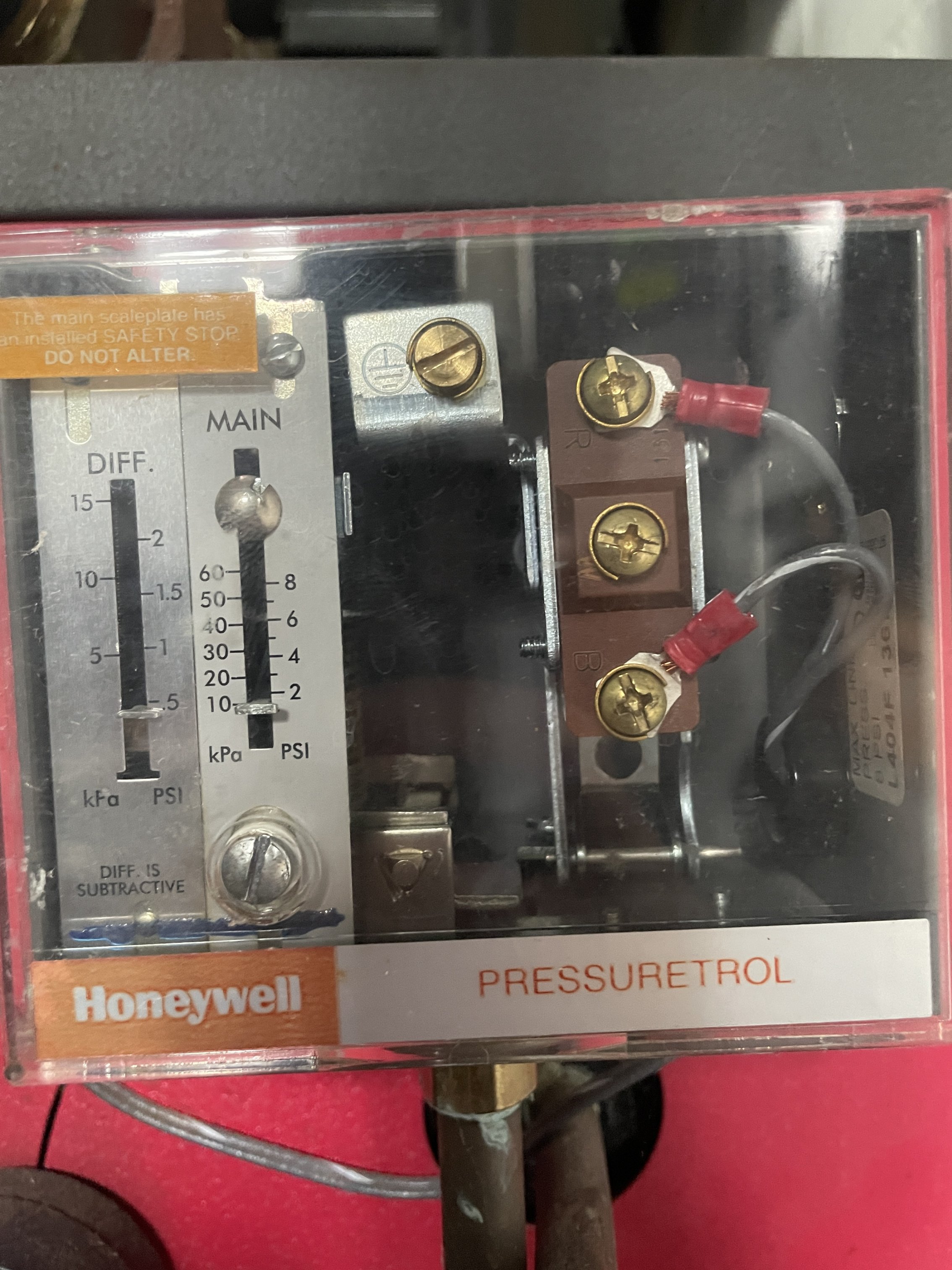
I suspect the pressuretrol is set too high - what do you think? Thank you!
0 -
Pressure control looks ok. I would investigate the pipe pitch. It doesn't necessarly mean re-piping. Just trying to find the issue will help even if you have to call someone in to fix it..
Sometimes just a little tweak will fix things.
1 -
A bang after the end of a cycle is almost always contraction.
Br. Jamie, osb
Building superintendent/caretaker, 7200 sq. ft. historic house museum with dependencies in New England 1
1 -
pipes that can't move freely through the building materials as they expand and contract will make a kind of pop/knock sort of sound when they break free and move suddenly.
0 -
Thanks. This rad is on the first floor and the riser feeding it traverses 2’ of open area of the unheated crawl space that is under the floor. It has 4” horizontal nipple that connects with the feed valve. I have caulked around the circumference of this riser to keep out cold air.
.
0 -
the caulk could be your noise. it needs to be something soft like foam insulation that the pipe can slide through as it changes length and the radiator changes size.
0 -
Thanks. Out with the caulk then, and observe if the hammer reduces. The gap around the riser is too narrow to insert any other flexible material but I will think about what might work some more. Luckily, the hammer occurs just once while the rad is cooling and is generally audible at night.
0 -
I've heard that a section of plastic milk jug makes a good bearing surface around a pipe. Cut it long enough to wrap all the way around the pipe with some overlap, & maybe a few inches wide.
 1
1


Categories
- All Categories
- 87.6K THE MAIN WALL
- 3.3K A-C, Heat Pumps & Refrigeration
- 59 Biomass
- 430 Carbon Monoxide Awareness
- 124 Chimneys & Flues
- 2.2K Domestic Hot Water
- 5.9K Gas Heating
- 120 Geothermal
- 168 Indoor-Air Quality
- 3.8K Oil Heating
- 78 Pipe Deterioration
- 1K Plumbing
- 6.6K Radiant Heating
- 394 Solar
- 16K Strictly Steam
- 3.5K Thermostats and Controls
- 56 Water Quality
- 51 Industry Classes
- 50 Job Opportunities
- 18 Recall Announcements