Hot water line in steam boiler flashing fix

Hello heating experts,
I read this before posting this:
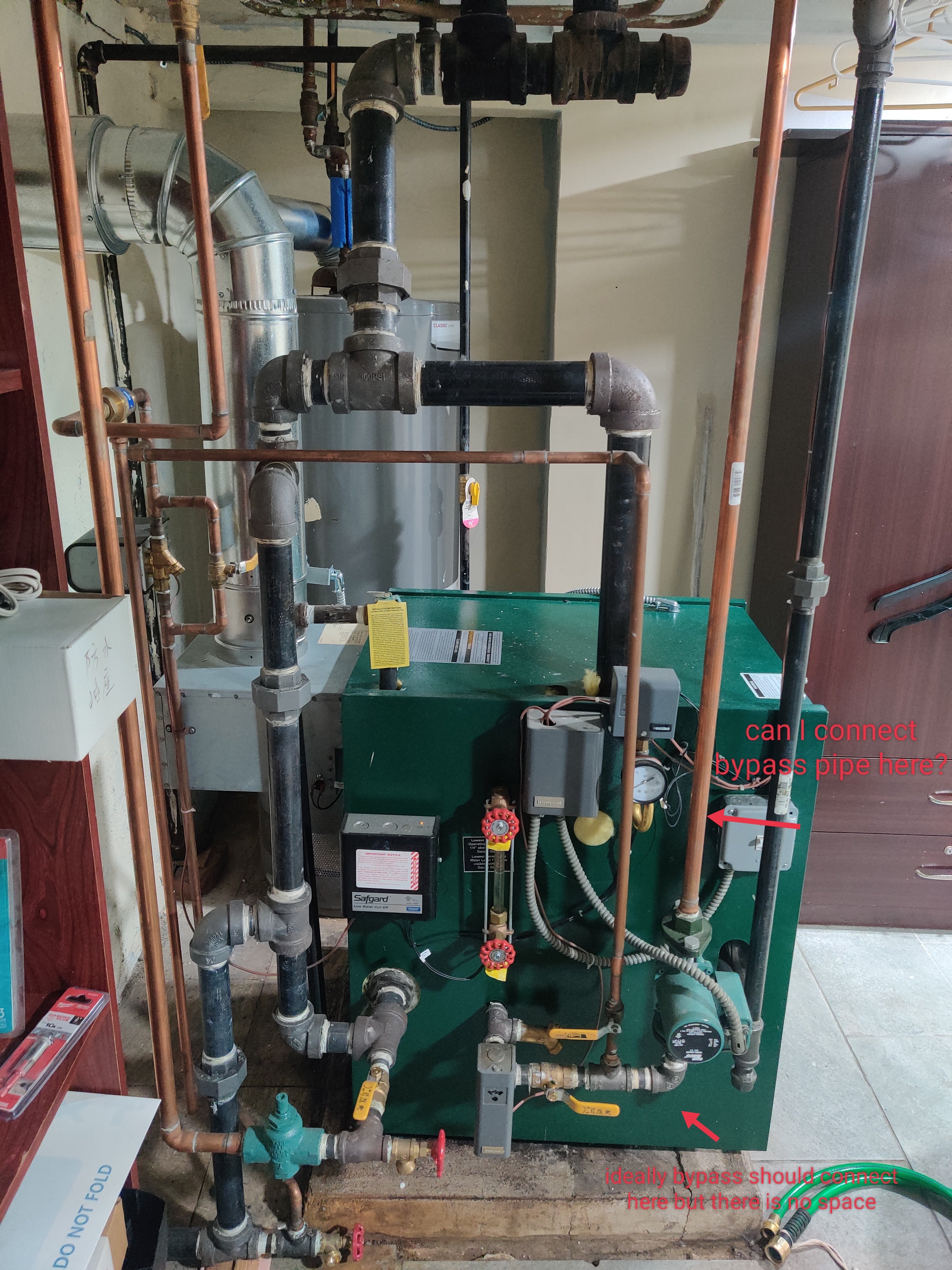
I have a hydronic system added to a steam boiler and whenever both steam (first floor)and water zone (2nd floor) are on I hear "kettling/gurgling" noise from my hydronic pipes on the second floor as well as from the circulator next to the boiler. I believe this is due to flashing, which for whatever reason still happens when circulator is on, because when steam is off, the issue stops.
Question to you all, I don't have space to add bypass line without major change, can I connect the bypass after the circulator?
Comments
-
You would like to pump after the bypass "recycle" joint because then the water you are pumping is cooler and less prone to flashing to steam due to the low pressure generated by the pump.
You would also like to run that outlet down to the floor where the pump should be sitting so it has a little more "head" (pressure) going into it I think. You are really close to the water level there.
I think you know this since you mentioned Dan's article which goes into all this, so all you have to do now is to move the stuff around to where it should be. Once begun, it's half-done.
NJ Steam Homeowner.
Free NJ and remote steam advice: https://heatinghelp.com/find-a-contractor/detail/new-jersey-steam-help/
See my sight glass boiler videos: https://bit.ly/3sZW1el 1
1 -
Steam on the 1st floor and hot water on the second?
That’s going to be tough
 0
0 -
I assume that the circulator direction is pumping out of the boiler. The bypass has to connect to the suction side of the circulator because you are cooling the water entering the circulator so it doesn't cavitate with the pressure drop in the circulator. You could remove that boiler drain and add a tee and connect the bypass and drain to the tee or to the fill connection or to the aquastat connection.
you could also close the valve out of the circulator or at the return a little to throttle the pump a bit to keep a little more pressure at the pump but ultimately if the boiler is steaming you will need a bypass to keep the water cool enough to not cavitate.
0 -
@pegmsg, the house was built with steam and for second floor addition, the previous owner added hydronic...
Thanks ethicalpaul for confirming.
Thank you mattmia2 for your ideas, will try to close the valve a bit and see how it goes before I move the pipes around.
I should be good, thank you!
0 -
You could easily take the elbow off under the pump and put a tee in its place.
0 -
it’s actually so easy that even I did it
NJ Steam Homeowner.
Free NJ and remote steam advice: https://heatinghelp.com/find-a-contractor/detail/new-jersey-steam-help/
See my sight glass boiler videos: https://bit.ly/3sZW1el
 2
2 -
@EBEBRATT-Ed thank you, that is a great idea!
Also I forgot to add that the boiler's water level in glass gauge fluctuates when both systems run, I believe that is called surging. Is that also a sign of steam flashing?
0 -
If that is a direct connection with no heat exchanger and independent circuit for the second floor you are going to have flashing problems when the boiler is steaming.
Br. Jamie, osb
Building superintendent/caretaker, 7200 sq. ft. historic house museum with dependencies in New England0 -
Not with a bypass loop as Dan advises in his article
Also I forgot to add that the boiler's water level in glass gauge fluctuates when both systems run, I believe that is called surging. Is that also a sign of steam flashing?
How much (in inches) does it fluctuate in the glass? Surging is not related to steam flashing in my mind—it might lower your water level that your pump pulls in air I suppose.
NJ Steam Homeowner.
Free NJ and remote steam advice: https://heatinghelp.com/find-a-contractor/detail/new-jersey-steam-help/
See my sight glass boiler videos: https://bit.ly/3sZW1el0 -
The problem with flashing in an arrangement of this type is really rather simple: the absolute pressure in the second floor is going to be around 10 psia and water over about 190 F will boil leaving only steam in those — which the pump may not be able to pump through (just as bad as an air pocket, hydraulically).
Br. Jamie, osb
Building superintendent/caretaker, 7200 sq. ft. historic house museum with dependencies in New England0 -
that is why there needs to be a bypass from the return that brings some of the return water in to the inlet of the circulator to bring the water temp in to the circulator down.
if the water in the hot water loop is flashing to steam then collapsing back to liquid water that certainly will pull some water in and out of the boiler. if it is enough to move the water line much, i'm not sure.
1 -
Thats why you need a bypass to keep the temp low enough so the water will not flash
2 -
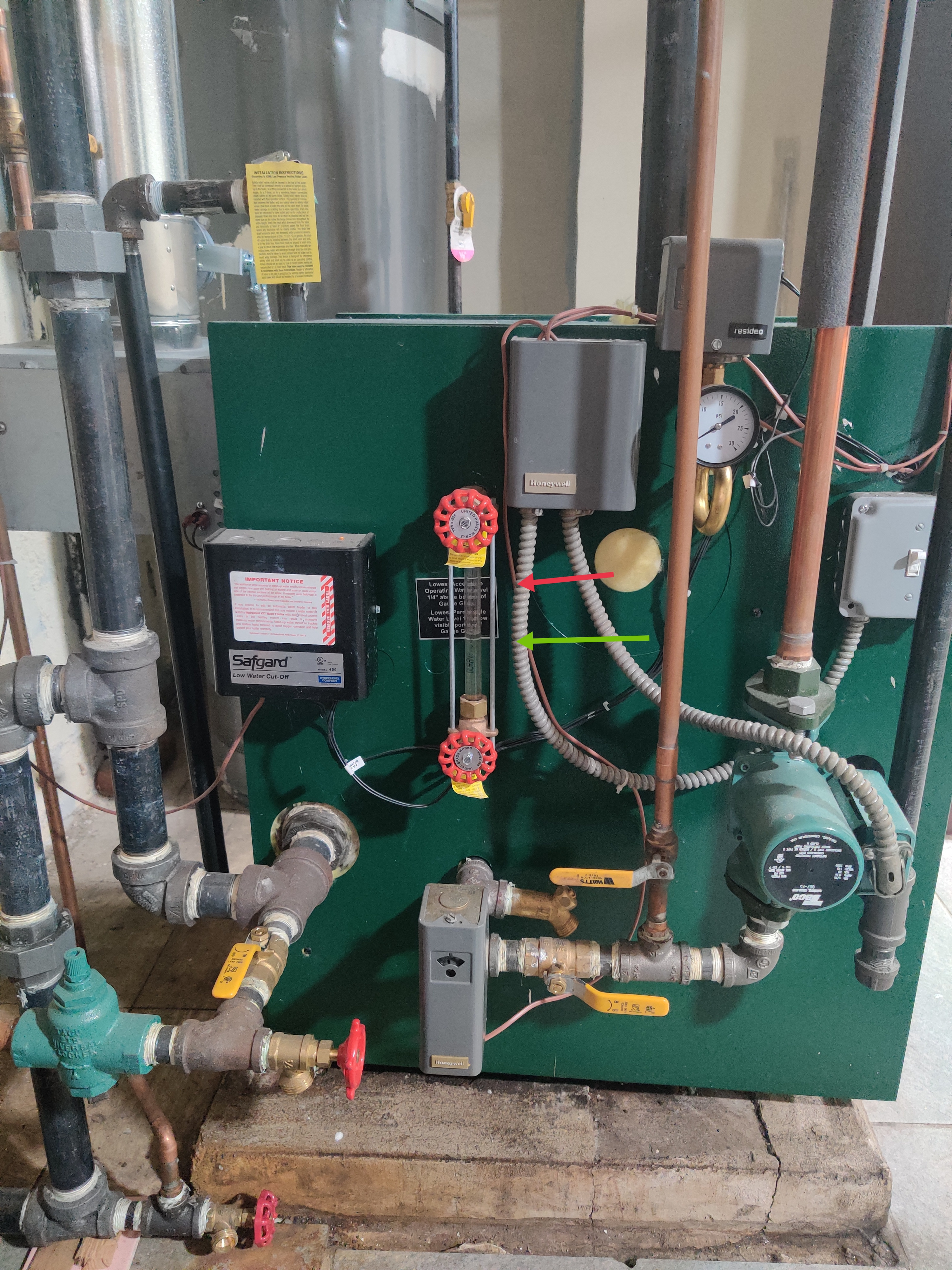
The green arrow is where the water level is when only hot water loop is on, when both are on, water goes up to red arrow. And one strange thing I notice is that even when my hot water loop thermostat is not calling for heat, the second floor pipes are hot when steam is on (hours after the pump stopped running), the pump is not running (I don't feel any vibration), as if the steam is so hot that it somehow causes hot water to flow through the second floor pipes.
0 -
the water will flow by gravity. that is what the flow check valves are there for, to stop that. they can be manually held open with th knob on the top. check to make sure that is closed.
1


Categories
- All Categories
- 87.5K THE MAIN WALL
- 3.3K A-C, Heat Pumps & Refrigeration
- 59 Biomass
- 429 Carbon Monoxide Awareness
- 124 Chimneys & Flues
- 2.2K Domestic Hot Water
- 5.9K Gas Heating
- 118 Geothermal
- 168 Indoor-Air Quality
- 3.8K Oil Heating
- 78 Pipe Deterioration
- 1K Plumbing
- 6.6K Radiant Heating
- 394 Solar
- 15.9K Strictly Steam
- 3.5K Thermostats and Controls
- 56 Water Quality
- 50 Industry Classes
- 50 Job Opportunities
- 18 Recall Announcements