Help/Advice requested, undoing some iffy "modernizations" of a 1920s water radiator system.
Comments
-
Yeah, those suggestions sound good to me. Regarding the Reverse Return vs. Direct Return, I really only have a rudimentary understanding of the various applications where you'd want to do one or the other. In the 3rd or 4th post down I was talking with Jamie Hall and he seemed to think it was still worth doing Reverse Return and I figured it couldn't really hurt (other than more labor and pipe required) but also don't see much benefit, based on this excerpt I found in a guide on heating design "The designer should attempt to select all terminal units with nearly-equal pressure drops if a reverse-return arrangement is to be used. If the above considerations cannot be met, the primary advantage of a reverse-return piping arrangement will be lost, and the use of a lower-cost direct-return system would be more practical."
"If terminal units have widely varying pressure drops or if throttling-type valves are used to control flow rates, it is generally advisable to use a direct return piping arrangement."
As Jamie pointed out, these radiators themselves will have very little pressure drop, however, on further consideration, I realized that there are 2 radiators that have either exceptionally short or long runs of 1/2" piping going to them, relative to the rest, plus the tenants may be using the radiator valves to tune flow to their liking, so that seems like there may end up being widely varying pressure drops, and hence Direct Return may be all that is needed.
 1
1 -
WHOLE OTHER QUESTION for you guys regarding this same heating system, and I am hoping this is an easy one to diagnose. These boilers are about 15yrs old, and for the first time this year, I noticed water frequently leaking out the pressure release/blowoff valves that comes out the downspout onto the floor. I'd initially thought the valves were crudded up or failing, but on closer inspection it seems that the pressure in the hydronic system is varying wildly as the boiler cycles on and off. Basically, what will happen is when the boiler is in it's off cycle, the pressure drops in the system, to as little as 0-5psi, based on the gauges on the boilers. Then when the boiler cycles on, the pressure increases up to 25-30psi, and this cycle seems to repeat every time the boiler goes on and off. If I have the line feed ball valves open, so the pressure regulator auto-fill can operate, when the pressure drops in the boiler the auto-fill valve will release more water from the city water line, bringing the boiler system up to about 12psi. Then, when the boiler cycles on again, as I am sure you can guess, I get the pressure increase, but now it is starting from 12psi rather than 0-5psi, so the pressure increase exceeds the 30psi mark, and the pressure release starts dumping water onto my floor.
I've only recently discovered the cause of this, and have been keeping the ball valves on the feed lines closed, which keeps things in check, but I am still a little puzzled as to the underlying mechanism. Do you have any idea of what causes this sort of phenomenon? At first I thought it was due to the temperature increase in the boiler, but the weird thing is that one of them (the one that leaks less) and which only has about a 20psi increase is exhibiting a 45 degree swing from 140f in the off cycle to 175f in the on cycle, whereas the one that has a the 30psi increase and leaks more is exhibiting a 10 degree swing from 165f to 175f, so that seems odd that the one with a smaller temp swing is experiencing a greater pressure increase. The other thing that occurred to me is that if there is a lot of air in one of the radiators, maybe when the hot water gets to it there is a greater expansion of it, so in other words, its not so much related to the boiler temps as it is to what temp water happens to be pumped down the line (which will have a delay that offsets it somewhat from the boiler cycle). One of the systems might have more air than the other, leading to the differing temp/psi ratio. Or could this be caused by the expansion tank bladders failing? They are the same age, but simultaneous failures on both systems would be pretty far out.
Anyway, thanks in advance for lobbing any ideas you have my way.
0 -
Classic water logged expansion tank. Couldn't be more classic! Time for a new tank. Or tanks
Br. Jamie, osb
Building superintendent/caretaker, 7200 sq. ft. historic house museum with dependencies in New England 1
1 -
A homerun system is not as difficult as you’re imagining it to be. The pipes can be grouped and hung together using 3” or 4” PVC sleeves like we did on this job.


You can also remotely mount one or more of the manifolds and use two 1” pipes to feed them.
Bob Boan
You can choose to do what you want, but you cannot choose the consequences.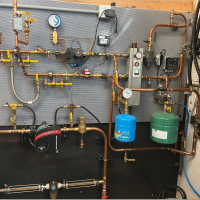 3
3 -
What is the threader for?
also, what kind of expansion tank is it? could just need to be drained if it is a compression tank or the precharge to be replaced if it is a bladder type tank. might just need maintenance rather than replacement.
0 -
The threader was for gas piping.
I’m not sure what you’re referring to with the expansion tank. Everything was replaced on this job except the standing cast iron radiators.
The original system had no expansion tank: they left an air cushion in the very top portion of the rads. That resulted in almost all of the old black iron piping being plugged with sludge after 80 years. That’s why all the piping was replaced.
Bob Boan
You can choose to do what you want, but you cannot choose the consequences.1 -
two different posts. the expansion tank is about the OP's relief valve
0 -
The tank is an Amtrol Extrol EX-30. Thanks to all of your input, I did check the pressure and try adding air, but after adding air, and then putting the pressure gauge back on it, I had water leaking out of the Schrader valve, so I'm pretty sure the bladder/diaphragm is ruptured. I recently had a Granite Group location open a few hundred yards down the street from this house, so they hooked me up with a new house brand equivalent expansion tank and Taco Hy-Vent (the old one's rubber seal crumbled in my fingers when I was inspecting it). We're luckily experiencing an unseasonable, but welcome, warm spell in Southern New England, so I have the new setup 3/4 of the way configured, and will be re-pressurizing/bleeding it tomorrow, fingers crossed.
1 -
I had water leaking out of the Schrader valve
Time for a new Extrol #30
Edward Young Retired
After you make that expensive repair and you still have the same problem, What will you check next?
1 -
Wow Ironman, that is a super tidy home run installation! Thank you for the pics, as that does re-perspective the concept in terms of how neat and compact it can be! Out of curiosity, do you do any sort of labeling of the pipes so you can identify them at midpoints, or is PEX so reliable that it's unnecessary, and you only need to worry about it at junctions? I am already a bit down the road of doing the conversion to a 2-pipe system for this urgent 1st floor setup, but I would still be open to doing a home run, as the 2nd floor has the same fundamental shortcomings. I'm thinking I'll see how this 1st floor setup works, and depending on how well it balances, I'll decide which way to go for the 2nd floor.
0 -
Hi Jamie, thanks for the diagnosis!👍️ That seems to be right on. I tried adding pressure to the tank and then checked the pressure with a gauge, at which point water came dripping out the Schrader valve. Upon unscrewing the tank from the system, I found it was heavy as heck, and clearly full of water, so you were right-on regarding it being waterlogged (which means an irreparably ruptured membrane/diaphragm/bladder based on my understanding).
0 -
Label as much as you want. We kept each pair zip tied together at various points.
FYI: that’s PAP (pex-Al-pex). It’s more rigid than pex, requires less support, and has far less thermal expansion than pex. It’s similar to soft copper, but slightly less rigid.
Bob Boan
You can choose to do what you want, but you cannot choose the consequences.0 -
Hi guys, I hope you've been having a good Summer (for us Northern Hemisphere folks), and are well prepared for this upcoming Winter.😊
I'm hoping for a 2nd round of advice and tweaks / modifications I can do, 1yr out from our previous round, to my oil boiler with hot water radiator system in a unit I rent to tenants in my duplex.
If you need Background: Just to try to refresh everyone's memories and save you digging back into last year's posts earlier in the thread, when I bought the place, it had previously had all the (copper) pipes stolen, and had a single ancient boiler for the duplex. In retrospect, looking at the remnants of various pipes that were left by the thieves, I think it had a Fluidflow system, with a single large diameter (3/4 or 1") copper circuit, and each individual radiator had 1/2" copper running to it, which was controlled by regulator/shutoff valves, which are still located on the outflow of each radiator. Interestingly (to me at least) these valves are opened by turning them COUNTER clockwise! I am sure there is a reason for this, due to the threading and valve type, but I just thought it was funny given how standardized things are now.
I wanted separate utilities for each unit, so I had a very strongly recommended local plumber install 2 new boilers, and re-pipe it. I clearly failed in my responsibility to educate myself, and talk tech and monitor him, and instead trusted his expertise. He plumbed the 2 new boilers into the old radiators in SERIES, using 5/8" PEX A, with 9 radiators per unit, and said he thought they should "balance out" fine.
As I'm sure you can imagine, right off the bat, I had issues with heat imbalances along the chain, with some rooms (early in the series) too hot, and some rooms (later in the series) too cold. After struggling with it for years, and with a new round of tenant complaints, this past winter I had separated the heating circuit for that unit into 3 separate circuits for the front/back/side of the house, using readily available fittings and ball valves from Home Depot, and and 3/4" PEX, to improve flow rate.
Some of you guys said I should really use a manifold system with 1/2" PEX going to each radiator, but I didn't listen, as I couldn't source one locally and I had my handyman booked and available, plus I was concerned about how messy that many home run 1/2" circuits would add up to, if I ended up doing one for the other unit in the duplex too, so I went with what was on hand and seemed like it might work.
The swap to 3 circuits was certainly an improvement, but was not great, and I was constantly adjusting the ball valves to try to please the student tenant's (in a 4br apartment) requirements.
Back to the Current problem: Over the Summer, I had shut the boiler off, as they have an electric water heater for domestic hot water, and in the Spring "shoulder season" as some call it, it seemed like the boiler was thermal siphoning, as they were telling me they had the thermostat all the way down, but the radiators were still hot. Now, as we enter a new heating season, I am getting a whole new round of "too hot / too cold" complaints from the girls, on all 3 heating circuits. They're telling me "thermostat is at 55f, but my radiator is burning hot". My suspicion is that that with the current plumbing arrangement, and 3 relatively free flowing circuits, the boiler, which stays hot and ready, is constantly flowing hot water to the earlier radiators in each circuit due to thermal siphoning, regardless of if the thermostat is calling for it and circulator is running, and since the boiler is configured to maintain a given temp, the return flow from the thermal siphoning creates a vicious cycle, even if it is 70f in the house and outside, and the thermostat is at 55f. My constant adjusting of the ball valves on the 3 circuits can help get the 3 circuits balanced if the temp is consistently 25f outside, and genuine BTUs are needed 24/7, but in Spring/Fall where heating needs are intermittent, it seems like there isn't a fix without stopping the (presumed) siphoning, and making the BTU input to the system tied to what the thermostat is actually calling for.
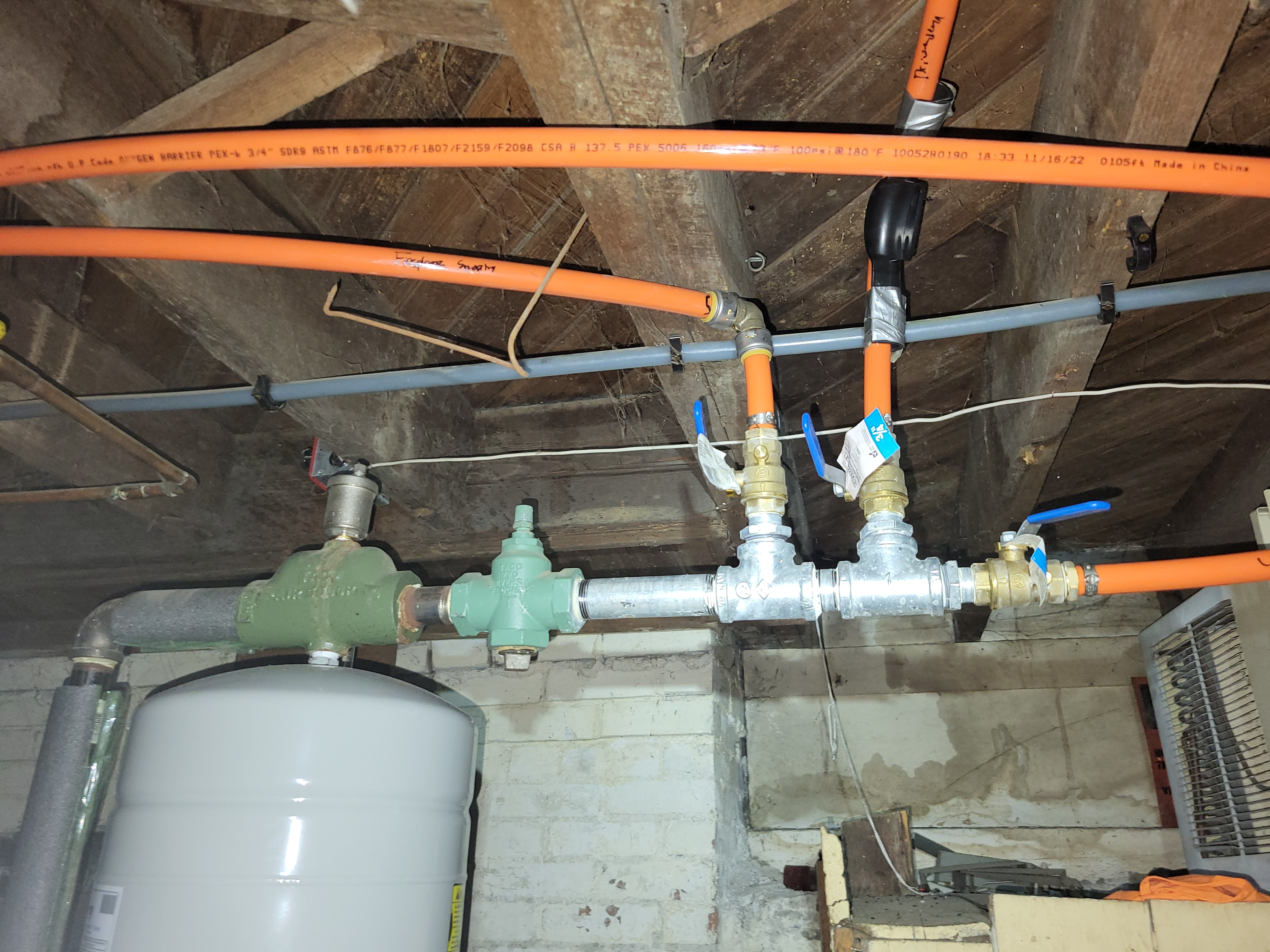
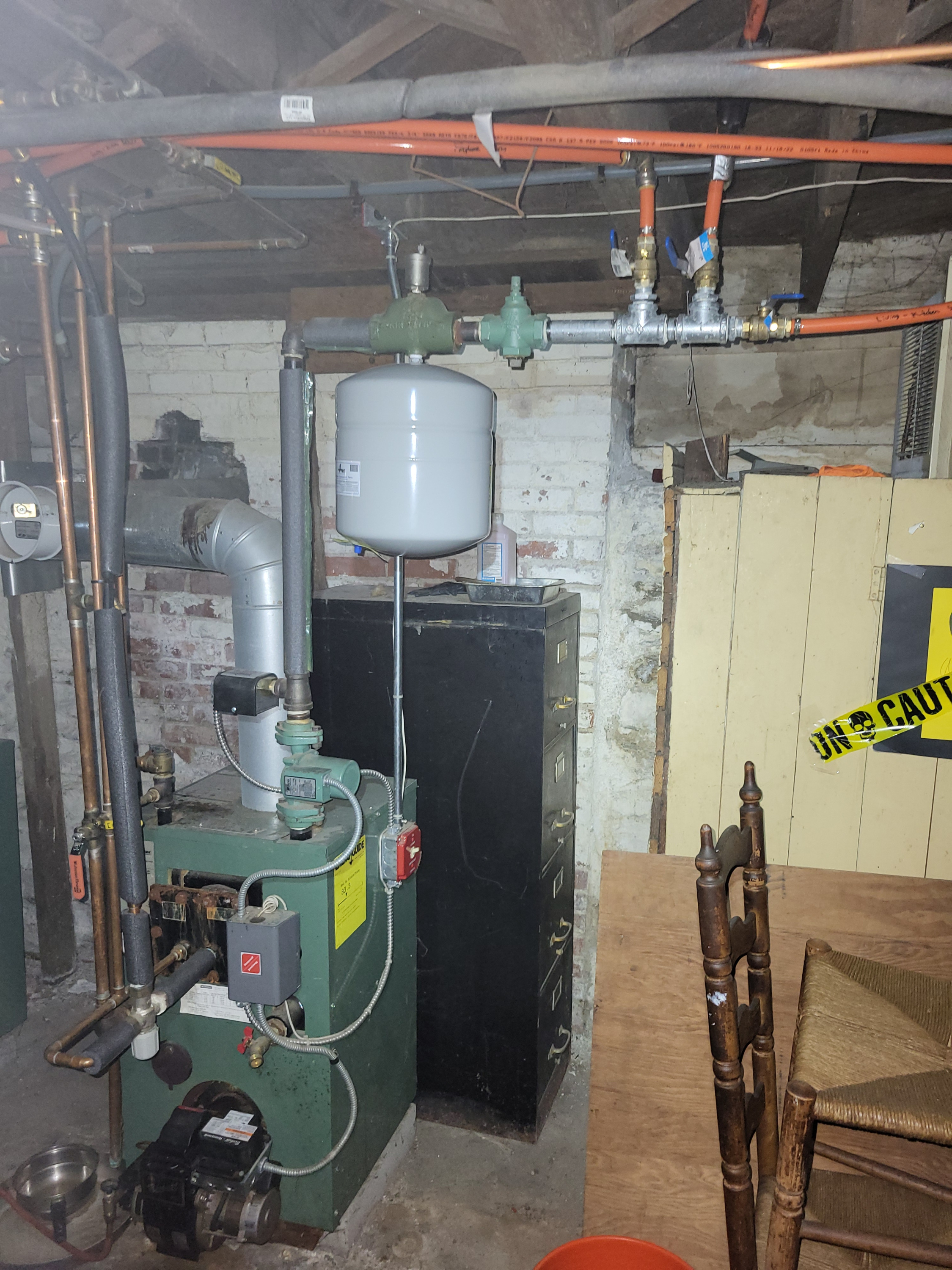
My question for you learned experts is, can I easily stop this thermal siphoning, while maintaining the current configuration more or less? I know I probably should have gone manifold last year, but I am struggling to understand how that would fix the problem, as it still seems like I'd get thermal siphoning in the manifold too. Will something as simple as a dip or a loop in the pipes to create some sort of thermal lock? If not, how is thermal siphoning not plaguing every system?I'm attaching pics of the DIY "manifold" we rigged up, as well as an overall pic of the boiler setup. I realized I probably should have taken a detailed pic of the return lines, but you can kind of make them out in the upper left of the 2nd pic with the "big picture" showing the whole boiler.
0 -
why is the boiler set up as warm start?
i see a tankless coil in the boiler, is that being used?
is it one zone divided in to 3 loops? if so, is that flow check closed? there is a knob o manually open it when servicing the system, did you close it after you were done?
0 -
@mattmia2: I've pasted your very excellent questions below in italics, and my answers follow each one.
why is the boiler set up as warm start?
i see a tankless coil in the boiler, is that being used?
These questions seem related, so I'll answer them as 1. It was set up this way from the original installation, due to it being configured for a tankless water heater. We have city water that comes from a surface source, and in the Winter the tankless system has proven to be insufficient when the supply temps drop by about 30f+, so the domestic hot water temp fluctuates in the shower as the boiler cycles on/off, dropping to a very unpleasant lukewarm before heating up again. As a result of tenant complaints, I installed a standalone electric water heater for that unit last year, but the system is still has the plumbing to run the tankless coil. Since installing the electric water heater, I have shut the boiler off in the summers, and generally kept the shutoff valve for the tankless coil in the closed position, but if I were to have it open, it seems that the domestic hot water will be drawn via a combo of the water heater and the coil on the boiler.
is it one zone divided in to 3 loops? Yes, it is 1 zone, and since installing the additional piping to separate the single loop into 3 zones, I've been hoping that I can use the individual valves for each loop to achieve a sort of balance that will keep the 1600sqft 7 room apartment more or less evenly heated. I think last Winter, when it was consistently cold and heat needs were more or less constant, and after many repeated adjustments to the valves, we got to a decent balance, but in the Spring/Fall conditions it seems to frequently be delivering heat at inappropriate times, even with the thermostat turned all the way down, which is what prompted my questions about thermal siphoning/gravity feeding, even if the circulator is off.
if so, is that flow check closed?
there is a knob o manually open it when servicing the system, did you close it after you were done?
This seems like a pair of facepalms😯. First of all, thank you for pointing this potential Flo-Check issue out! I think I've fundamentally misunderstood the purpose of the Flo-Check. I'd thought it was intended to prevent backflow, in a similar manner to the very loosely sprung/free moving check valves with rubber flappers that I've used to prevent backflow from sprinklers into domestic potable water, or in aquarium settings. I didn't realize, or had forgotten, that its primary purpose was to prevent thermosiphoning/gravity driven flow in the forward direction. So, just to make sure I understand the structure of the Flo-Check, it seems like the valve must have some sort of spring in it, that is calibrated such that when preloaded by the knurled knob, the force to open it exceeds the expected pressure differentials that could be achieved by thermosiphoning, but is well under the pressure differentials generated by the circulator pump. Is that correct?
Based on the PDF in the final post from the TACO rep in this thread (https://forum.heatinghelp.com/discussion/155723/taco-flow-check), you are100% correct that the knurled Flo-Check valve was in the fixed "open" position, as I just checked and the knob and stem were in the fully counterclockwise/many stem threads showing position. In my defense, the Flo-Check operation instructions are surprisingly hard to come by and even in the previously linked thread there are posters with diametrically opposed suggestions as to what position is fully open, and what position is "normal/active". I just turned that Flo-Check fully clockwise/fully threaded in/no threads showing, and will be thrilled if that fixes the delivering heat on warm days (with thermostat all the way down) problem. 🙏
It is a bit of a sidebar, but not only are official TACO instructions tough to come by, but the PDF in the thread I posted above references loosening the "packing nut" before adjusting the knob, and then re-tightening the (unspecified) "nut". I think I know what a packing nut is from other plumbing situations, and think I understand what they're getting at with these instructions, but my Flo-Check also has what I'd term a "locknut" on the threaded stem. Having no mention of the locknut at all in the instructions and the ambiguous reference to re-tightening a "nut" after adjusting the knob is enough to make a fella doubt the little bit of common sense he was graced with. I can't help but doubt if they're calling the locknut a "packing nut" etc…when a simple valve with 2 user selectable positions should be pretty clear and easy. I found this other official TACO PDF (https://fwwebbimage.fwwebb.com/ProductInfo/100-7.5.pdf), and it doesn't seem to show any mechanical springs, so now I'm thinking it's some sort of calibrated weight valve design, but it's still not clear to me how threading the stem in or out affects the valve closing pressures.
0 -
supplyhouse.com has the instructions for the flo check on the page for that product
https://www.supplyhouse.com/Taco-220-6-1-Universal-CI-Taco-Flo-Chek
looks like there is a small packing nut and a bigger cap that was used to assemble the valve. some designs use a spring and others just use a weighted gate. the stem lifts the gate when it is in the manual open position.
if you are not using the tankless you can turn the low limit all the way down on the aquastat and it will be cold start, it will only fire when the thermostat calls for heat. it only needs to be kept warm if you are using the tankless coil. it will save a fair bit of fuel running it cold start.
0 -

The Thumb knob (yellow arrow) should be in the Automatic position to prevent thermosyphoning (gravity flow) I believe that is turning it clockwise until you can no longer see the threads.
The Taco Submittal is vague on the subject but the B&G flow check operates the same way with a weighted stopper. Here is the information on the way a Flow Check operates

I may have enhanced the illustration a bit
Edward Young Retired
After you make that expensive repair and you still have the same problem, What will you check next?
0 -
In reference to your tankless water heater not being enough to make sufficient hot water, this is a function of the L7224 Aquastat Relay and the mixing valve. You need to determine the minimum boiler temperature necessary to make the cold inlet water from the utility’s water meter, to the desired shower temperature. That may be 160°F or 170°F or even as low as 150°F. You set your Low Limit on the Aquastat to that temperature. Then set the high limit at least 20° higher .I have had many customers with tankless heaters that never run out of hot water. You just need to stay within the limits of the tankless heater.
I happen to notice that there are no service valves on your tankless heater. After several years of operation there may be some build up of calcium or other minerals inside the domestic water side of the coil. That mineral build up acts like insulation keeping the boiler temperature from transferring to the potable water as it is moving through the dirty coil. Tankless water heaters need regular maintenance and you have no way to do it on that tankless heater.

Edward Young Retired
After you make that expensive repair and you still have the same problem, What will you check next?
0



Categories
- All Categories
- 87.6K THE MAIN WALL
- 3.3K A-C, Heat Pumps & Refrigeration
- 59 Biomass
- 429 Carbon Monoxide Awareness
- 124 Chimneys & Flues
- 2.2K Domestic Hot Water
- 5.9K Gas Heating
- 119 Geothermal
- 168 Indoor-Air Quality
- 3.8K Oil Heating
- 78 Pipe Deterioration
- 1K Plumbing
- 6.6K Radiant Heating
- 394 Solar
- 15.9K Strictly Steam
- 3.5K Thermostats and Controls
- 56 Water Quality
- 50 Industry Classes
- 50 Job Opportunities
- 18 Recall Announcements