Welcome! Here are the website rules, as well as some tips for using this forum.
Click here to Find a Contractor in your area.
If our community has helped you, please consider making a contribution to support this website. Thanks!
What Are Some Simple Ways to Improve Home Heating Efficiency?

Hi everyone,
I’m curious to hear what steps people have taken to make their home heating more efficient, especially during colder months.
Things like regular furnace maintenance, improving insulation, checking air leaks, adjusting the thermostat, or upgrading older heating equipment can all make a difference. But I’d be interested to know what has actually worked well for others.
What heating-efficiency improvements have you tried, and did you notice a significant difference in comfort or energy use?
Looking forward to hearing everyone’s experiences and tips.

Comments
-
A Blower door test is relatively cheap. Many utilities will pay or supplement the cost. Find out how the heat is getting out and how to keep it in!
 1
-
Reducing the building loss is by far the most effective thing anyone can do.
I haven't done much i that department, but that's the way it is. Everything else isn't going to make much of a difference as long as the heating system is functioning properly. Oil fired systems should be cleaned and tuned at least once per year.
Adjusting the thermostat has never made sense to me. We heat and cool for comfort, if you want the cheapest solution turn the thermostat off. Otherwise, adjust it so you and your family are the most comfortable. You can tend to keep it on the lower or higher side where everyone is still comfortable, but trying to shave off little bits to save a tiny percentage while people are wearing coats inside doesn't make sense.
Doing a setback while everyone is away as long as it's a decent length of time will always save fuel because it reduces losses. Anyone who says "the system works harder to catch up and is less efficient" is just wrong because long run times isn't working harder and is certainly without any doubt more efficient and easier on equipment. This includes both heating systems and air conditioning. Many steam systems will not like setbacks due to oversized boilers and improper venting but a well tuned one will handle them fine, even large setbacks without building excessive pressure or causing balancing issues.
Single pipe 392sqft system with an EG-40 rated for 325sqft and it's silent and balanced at all times.
0 -
Reduce your heat loss! Every single BTU that doesn't leave your building is one you don't have to bring in from some other source.
And it's amazing what a few simple simple tweaks and maintenance can do. Take windows, for example. If you are so fortunate as to have older double hung windows, make sure they fit well and then provide good storm windows. A good deal less expensive than replacement with fancy modern ones, and as effective — if not more so. Likewise doors.
Attic insulation — but be careful to make sure that you don't create a moisture problem (if there is a trap door to your attic, they leak like sieves — create some kind of cover for it!
General insulation may or many not be feasible. It's effective, if it is — but it isn't always possible to do effectively or at a reasonable price.
Draughts. A blower door test may — or may not — be possible. But you can do a lot if you have a nice windy cold day and just walk around. If you find draughts — one of the more likely places is the joint from the sill to the foundation — there are many ways to seal them up. This will also find poorly fitting windows and doors — or vent fans with dampers which don't close!
Br. Jamie, osb
Building superintendent/caretaker, 7200 sq. ft. historic house museum with dependencies in New England0 -
reducing air leaks was #1 at my house, followed by increasing the amount of insulation in the attic. Insulating the boiler piping and reducing the operating temperature of the boiler helped also.
1 -
Does AI really need higher efficiency heating in cyberspace?
Edward Young Retired
After you make that expensive repair and you still have the same problem, What will you check next?

 6
-
Our place had approx R16 in the attic. Had R50 blown in on top (with moore vents), insulated the hatch and fabbed a gasket with locking clips.
We both noticed the rooms upstairs became more comfortable. Fuel use came down maybe 8% ? (hard to compare apples).
30+ yrs in telecom outside plant.
Currently in building maintenance.0 -
Use foam in a can to seal any penetrations through the ceiling. Smoke detectors, light fixtures, wire penetrations all leak air up and out of the house.
1 -
Air sealing, air sealing, air sealing! Adding insulation without air sealing is creating an expensive air filter
 1
-
Hi @EdTheHeaterMan , We gotta air seal. Even AI needs clean air 😜
Yours, Larry
0 -
With a caution on adding spray foam to pot light cans or anywhere that temperatures vs clearances might be important. I did use caulking in electrical boxes as the original build in the old part of house was pre-vapour barrier boxes.
Also, since we're on the subject of sealing air … perhaps a caution for those who have older combustion heaters (or hot water) that take their combustion air from the "leaks" into the house. Super-seal a house and then turn on a bathroom fan or two , could result in the boiler/furnace sucking for makeup air when it fires up. At a worst case, CO could spill ?
30+ yrs in telecom outside plant.
Currently in building maintenance. 2
-
Speaking of insulating around wires.
I've always heard you can't insulate around knob and tube. But why? Its copper wiring that uses the same exact NEC rules as romex for sizing. I.E. 14 awg fused at 15a and 12awg fused at 20a.
So somehow knob and tube copper can't be insulated around but romex can?
Single pipe 392sqft system with an EG-40 rated for 325sqft and it's silent and balanced at all times.
0 -
Knob and tube insulation needs to breath. Romax doesn’t.
0 -
Exactly. Remember that the current rating of the wire alone is based on allowable maximum temperature for the type of insulation. Required wire size for a given circuit may be also limited by allowable voltage drop, but you can't exceed the current limitation based on temperature rise and insulation type.
Br. Jamie, osb
Building superintendent/caretaker, 7200 sq. ft. historic house museum with dependencies in New England0 -
Things I did in my 1909 Colonial Revival house (2200 sq ft) in central Michigan to specifically target heating was a layered approach and did not all occur in one winter. Here they are in no particular order.
*Beefed up attic insulation to well above a R60. (Pink fiberglass)
*Walls are already insulated with blown cellulose (previous owner)
* Insulated all my basement rim and floor joist.
* Finished replacing all the old windows (previous owner replaced second floor)*Cleaned my 1937 boiler and fine tuned the burners.
*Use a thick thermal curtain to block my trouble kitchen door (terrible draft, no budget to replace door just yet).
*Air sealed the other exterior doors
*Bought a programmable thermostat.Even with my older boiler, my gas bill has never exceeded $265. And that’s with 5 NG burning pieces of equipment in use all winter.
Lifelong Michigander
-Willie
0 -
Is that an actual fact or an old wives tale?
Single pipe 392sqft system with an EG-40 rated for 325sqft and it's silent and balanced at all times.
1 -
per Gemini…
Under NEC Article 394.12(5), concealed knob-and-tube wiring is strictly prohibited in hollow wall, ceiling, or attic spaces that are filled or enveloped with loose, rolled, or spray-foam insulation.
although there was plenty of it buried in rockwool in my house before I rewired it.0 -
I don't have a copy of the current code, but in the older code I worked with many years ago, that was in the code.
Br. Jamie, osb
Building superintendent/caretaker, 7200 sq. ft. historic house museum with dependencies in New England0 -
Interesting
Does that mean k&t had to be derated when used in attics also due to the higher temperature?
Single pipe 392sqft system with an EG-40 rated for 325sqft and it's silent and balanced at all times.
0 -
buy a smoke puffer and get to work. Gotta wait for cold weather though for the natural convection affect.
or bust out the blower door. I just bought a little 4 family and one of the tenants said she was getting wicked drafts last winter. She expressed further dismay when I told her she would be getting her own heating and hot water bill in the near future.
I blew the dust off my 20 year old blower door set up and found some gushing wall cavity leaks.
I’ll see if the local energy program can tighten things up. I won’t tell them I did my own blower door. Seems to be the classic balloon frame building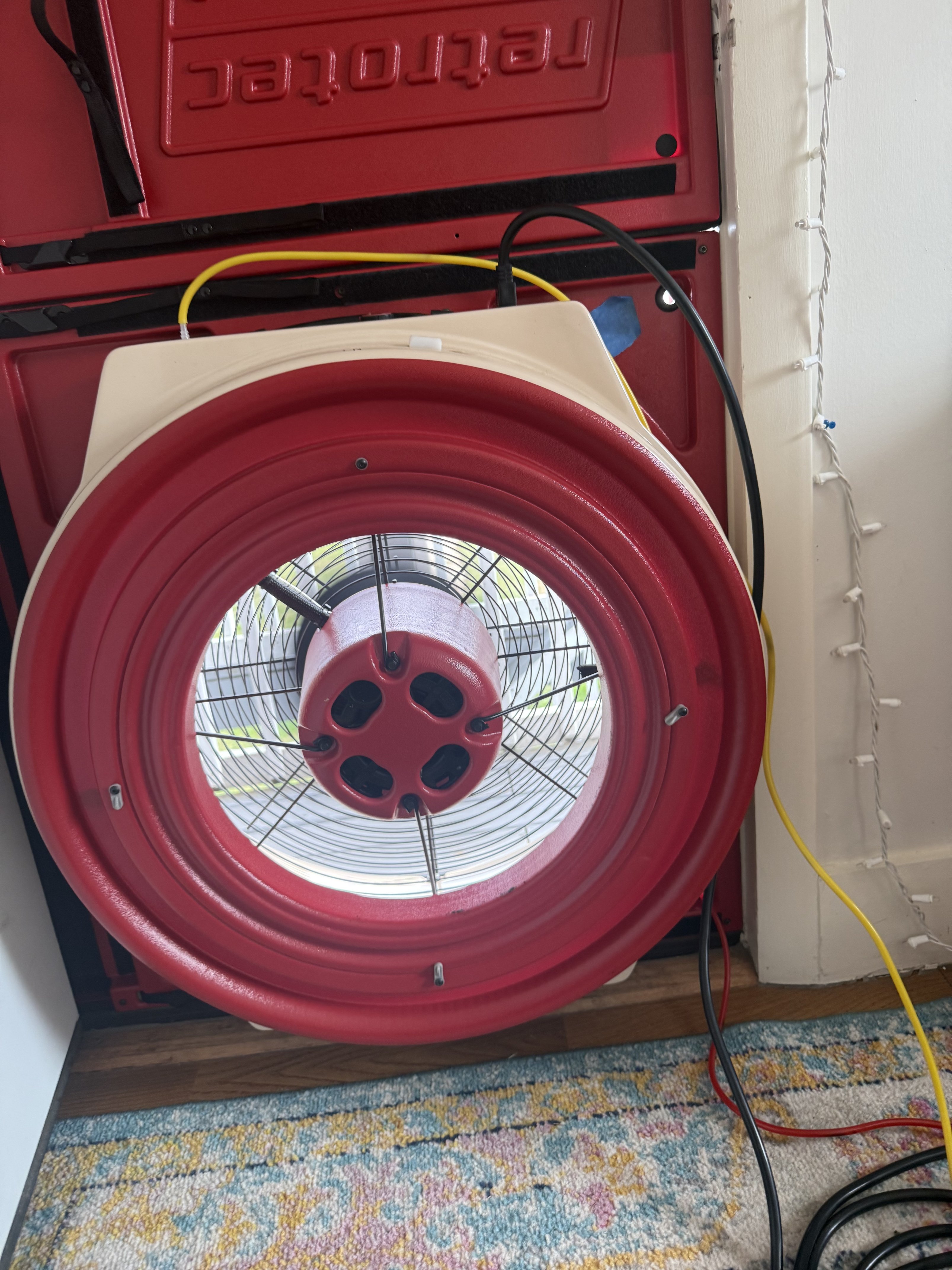
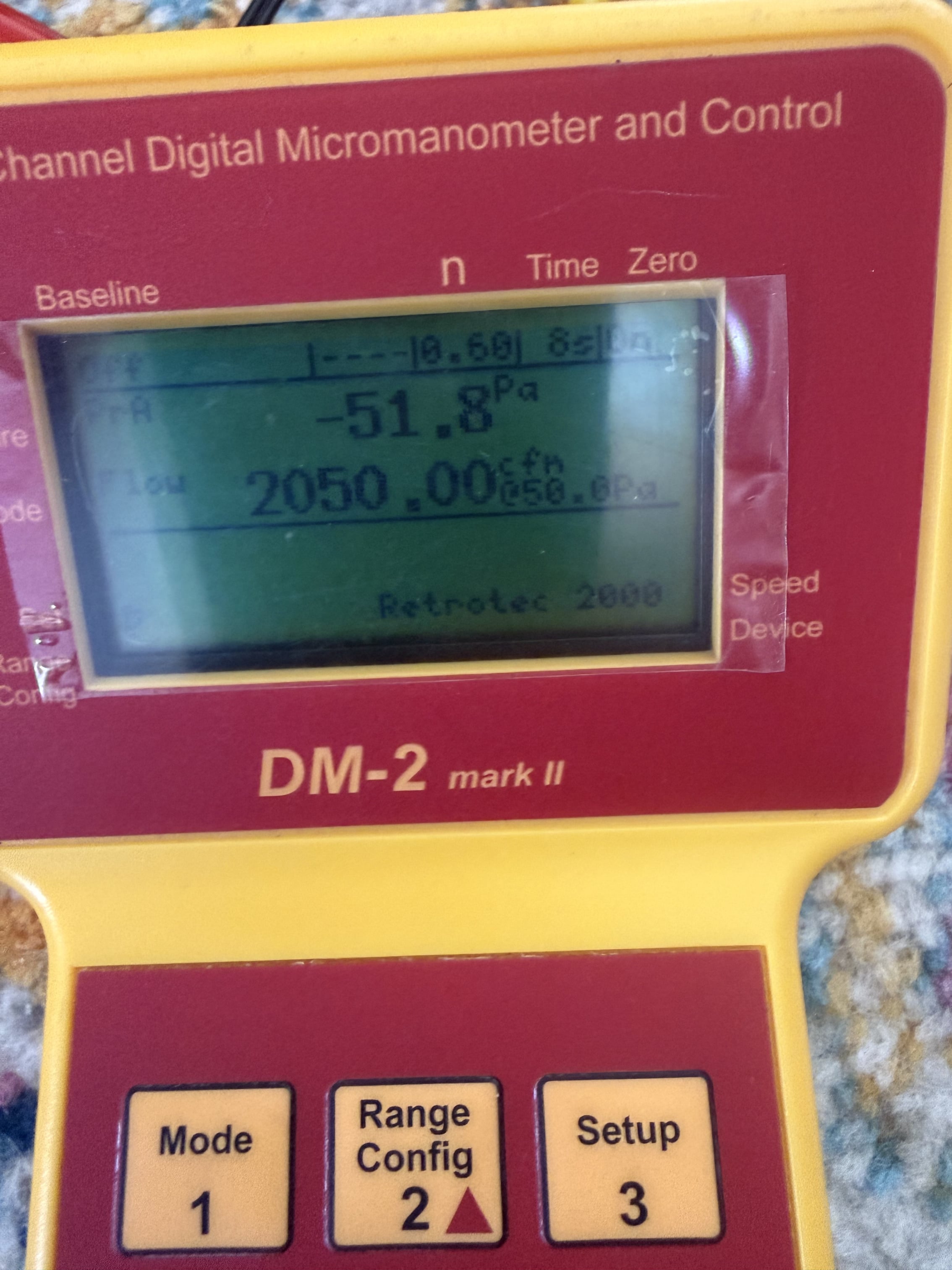
yes I see the tiny hole in the panel. I’ll simply re test in the same manner
0 -
Knob and tube has rubber insulation that can't take a lot of heat so it is not supposed to be buried in insulation. But I am sure there are 1000s of homes with K & T with blown in insulation.
NM (Romex) wires are rated 90c (at least the modern stuff) and have THHN insulation (although the individual wires are not marked as such) T=thermoplastic, H=Heat HH=more heat, N=Nylon outer covering.
I don't know what K & T was maybe just R=rubber covered although RH=rubber/heat resistant and RHHW Rubber heat and water resistant were also made.
Even though the newer romex has 90C wire the code only allows it to be rated and protected at an amperage that does not exceed 60c. Which drives electricians insane. Many proposals to change this are and have been in the works.
0 -
NM-B is rated higher but kept at 60C so there's no derating needed in hot attics etc as far as I remember.
It looks like the NEC rule about insulation and K&T didn't come out until 1987.
Single pipe 392sqft system with an EG-40 rated for 325sqft and it's silent and balanced at all times.
0 -
It probably wasen't an issue until the oil embargo of the early 70's, oil was cheap! I was paying what .25 or .30C a gallon for gasoline, diesel and home heating oil was cheaper.
0 -
I thought you were a lot younger than that.
Single pipe 392sqft system with an EG-40 rated for 325sqft and it's silent and balanced at all times.
0 -
No
I still remember seeing my 1st Sabor Jet flying and Sputnik!
1 -
Children, children! Let's see… when I got out of college I had a side gig pumping gas at a station on US route 66. We usually were at 15.9 to 19.9 cents per gallon, but occasionally down to 9.9. That's cents, not dollars. Learned to drive on a 1929 Model A Ford pickup — which wasn't an antique or a classic at the time. I still have — and was running just yesterday, for mowing a couple of paddocks — the first tractor we bought after the War; a 1950 Ferguson TO20. Before that we had a team of beautiful big Percherons to run the farm. My uncle's place down the road didn't get electric lights until… I think it was about 1955. Which was bout when we got a dial telephones and private line at out place — before that we had a hand crank affair on the wall, which I remember well.
A long time ago now…
Br. Jamie, osb
Building superintendent/caretaker, 7200 sq. ft. historic house museum with dependencies in New England 2
-
-
You left out the part about being able to call anyone in town with a 2 or 3 digit phone number.
0 -
An ounce of insulation is worth a pound of hydronics.
2 -
My lowest gas cost was somewhere around $1 since I started driving.
My question for @Jamie Hall is, you said it was a long time ago. Does it seem like that, or does it seem like it wasn't very long?
It kind of feels like the way my memory works is there's only so long and then we stop there, and everything just compresses. Meaning at one point, a few years ago was as long as we remembered. Then it's 20 years ago but it still feels the same as "a few years ago" Then 40, but still, feels the same as "a few years ago" did.
Single pipe 392sqft system with an EG-40 rated for 325sqft and it's silent and balanced at all times.
0 -
An infrared scan along with blower door will show you where to start
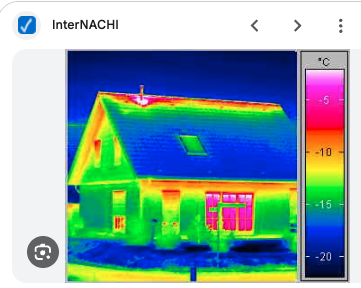 Bob "hot rod" Rohr
trainer for Caleffi NA
Living the hydronic dream1 -
I just go around my house when it's cold out see what it feels like.
I can generally feel where walls are cold, where drafts are etc. Perhaps that's just because mine is just "that bad" .
Single pipe 392sqft system with an EG-40 rated for 325sqft and it's silent and balanced at all times.
1 -
I think you mean having to click the switch-hook in order to get the operator's attention to ask her to connect you!
NJ Steam Homeowner.
See my sight glass boiler videos: https://bit.ly/3sZW1el 1
-
That's even older, before phones had dials.
0 -
Gas prices tripled in 1970's (mids .3x to over $1). Stayed in $1.50 range until '86 when the prices drop back down to around $1 until the Iraq Kuwait invasion in 1990.
0 -
I'm thinking late 1990s, like 98-2000.
It could've been $1.05 or $1.10 but it was very close to $1.
Single pipe 392sqft system with an EG-40 rated for 325sqft and it's silent and balanced at all times.
0 -
Or just turn the crank… our old number was 444, ring 3.
Br. Jamie, osb
Building superintendent/caretaker, 7200 sq. ft. historic house museum with dependencies in New England1 -
indeed, I’m very aware and I’m wondering if Jamie misses those days 😉
I am a huge fan of old phones and magnetos
NJ Steam Homeowner.
See my sight glass boiler videos: https://bit.ly/3sZW1el0 -
The crank was the oldest version- that type of phone had batteries that provided the DC talking current, and the crank operated a small magneto that made AC to ring the bells and signal the operator. This was the local-battery system, and it was necessary for a tech to change the batteries from time to time.
Later the batteries were moved to the central office, and this was called "common-battery". With this system all you had to do was pick the phone up, and that signaled the operator. Talking current remained DC and ringing current AC.Dial switching using the Step-by-step system came next, but it couldn't handle large cities. The Panel system solved that problem and that's how they automated NYC (and Baltimore too). Both were built around common-battery operation. Those 2, 3 or 4-digit numbers were found in Step areas, or areas served by one of the later all-relay systems.
There are museums in Seattle and in Ellsworth, ME where you can watch this equipment working.
0 -
yes, I remember it dropping to close to $1 in late 90s.
I’m glad we finally got this thread into interesting areas. I was getting of bored with insulations and air sealing!🤣
0 -
We still have one of the dial phones which were first installed in this area — and it still works. But our area is going to be "improved" to fiber next month, so that will be the end of that.
The thing which people miss about the older (not oldest) systems — the common battery — is the absolute reliability. So long as that battery had power (and they were built like tanks) and the wire to your house was intact (didn't have to be in the air, but it helped) the 'phone worked. Period. It was almost impossible to physically break the telephone itself, and there were no electronics to fail, either. The local battery system used basically the same equipment, but you did have the local battery — but it didn't need a "tech" to come and replace or recharge the battery — most vaguely competent handymen could do it.
Br. Jamie, osb
Building superintendent/caretaker, 7200 sq. ft. historic house museum with dependencies in New England0









Categories
- All Categories
- 87.9K THE MAIN WALL
- 3.3K A-C, Heat Pumps & Refrigeration
- 60 Biomass
- 430 Carbon Monoxide Awareness
- 133 Chimneys & Flues
- 2.2K Domestic Hot Water
- 6K Gas Heating
- 124 Geothermal
- 170 Indoor-Air Quality
- 3.9K Oil Heating
- 80 Pipe Deterioration
- 1.1K Plumbing
- 6.7K Radiant Heating
- 397 Solar
- 16.1K Strictly Steam
- 3.5K Thermostats and Controls
- 56 Water Quality
- 51 Industry Classes
- 51 Job Opportunities
- 18 Recall Announcements