Welcome! Here are the website rules, as well as some tips for using this forum.
Click here to Find a Contractor in your area.
If our community has helped you, please consider making a contribution to support this website. Thanks!
Are Air-to-Water Heat Pumps Finally Ready for Extreme Cold Climates?

I've been working with hydronic heating systems for a while and have noticed a growing interest in air-to-water heat pumps, especially in regions that experience harsh winters.
Traditionally, many homeowners and contractors have been skeptical about heat pumps because performance tends to drop significantly as outdoor temperatures fall. However, newer cold-climate systems claim to operate efficiently even in temperatures as low as -31°F (-35°C).
What interests me most is the ability of these systems to integrate with:
- Radiant floor heating
- Fan coil systems
- Domestic hot water production
- Existing hydronic heating setups
Some manufacturers are also offering monoblock designs, which simplify installation and reduce refrigerant work on-site.
For those who have installed or serviced cold-climate air-to-water heat pumps:
- How have they performed during extended cold snaps?
- Are homeowners seeing meaningful energy savings compared to propane, oil, or electric resistance heating?
- What challenges have you encountered with retrofits?
- Do you still recommend backup heat sources in very cold regions?
I'd be interested to hear real-world experiences from contractors, designers, and homeowners.
Comments
-
Any facts to back this up?
 1
1 -
You need to do the homework when considering on a A2whp
The required operating temperature at design condition is one critical number.
Staying below 120 is a good goal. So large surface area emitters like radiant panels work best.
Data is available from manufacturers and independent testing on efficiency drop as outdoor temperatures drop. No guessing required. Same with performance at higher operating temperatures
This info, in graph form was in my installation manual. Realistic numbers not sales hype.
Operating cost comparison is directly related to the various fuel cost at the insty locat. That data is also available going back 30 years or more. The question is fuel costs going forward?
I would also pull the data to see how many days a location is at or below design when considering a backup system.
Some do, some don’t consider the installed cost of a HP. ROI is another hard to pin down number. System longevity is a question Refrigerators have a 15-20 year lifespan, as far as the compressor snd components
Lots if electronics under the hood A piwer conditioner is a goid option.
Qualified installer and service people needs to be considered. It takes multiple skills to troubleshoot a HP
I’m going on 3 years with a Viessmann system running 120 SWT to radiant slabs. Just started running chilled water to the slab for cooling. So far I am pleased with the operation and operation cost
Electric rates vary between 11– 13 cents, and I have enough PV to run the system on sunny days
So for me, all the boxes checked.
Replacing or a new installation on a system needing 140 or more, especially in cold climates. This may end up with some heart break.
Bob "hot rod" Rohr
trainer for Caleffi NA
Living the hydronic dream
 2
2 -
"Traditionally, many homeowners and contractors have been skeptical about heat pumps because performance tends to drop significantly as outdoor temperatures fall. However, newer cold-climate systems claim to operate efficiently even in temperatures as low as -31°F (-35°C)."
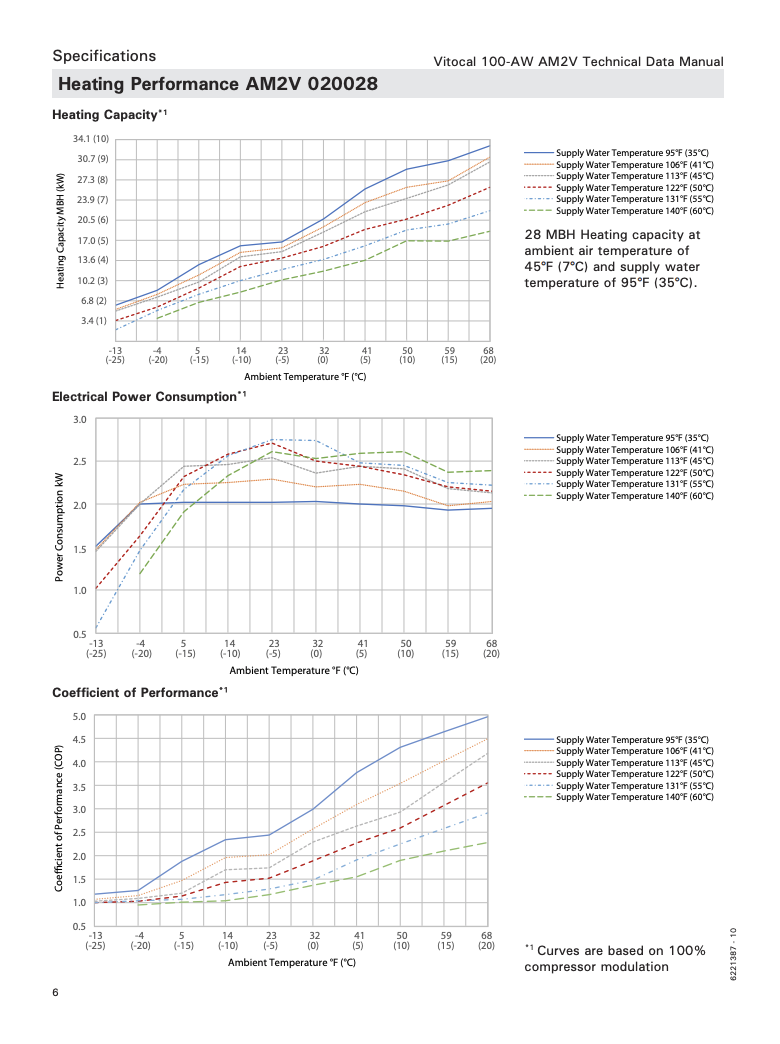
It's not just that efficiency drops, it's that output drops. Unlike combustion appliances where a BTU is a BTU, heat pumps produce far less than their nameplate capacity in cold weather.
A big advantage of air-to-water is that buffer tanks make oversizing less of an issue. So you can size for actual loads on heating design days without being oversized in moderate weather.
0 -
An example for the Viessmann
 Bob "hot rod" Rohr
trainer for Caleffi NA
Living the hydronic dream0 -
One major issue with all these Low Temp Heat Pumps Weather Air to Air, Air to Water, or Water to Water is finding someone that knows how to work on them and getting ahold of tech support after hours, holidays and weekends! A lot of computers are in there. I'd still want a backup plan.
2 -
It really depends on the brand.
Viessmann tech support answers the phone. If they are busy they call or txt back within an hour. I've spoken to several different tech support, mostly in Waterloo, Canada a 1/2 dozen times as I programed the unit.
In some cases the local rep for the area is helpful.
Maybe not so for some of the imports from China purchased online.
Bob "hot rod" Rohr
trainer for Caleffi NA
Living the hydronic dream0 -
I agree Viessmann may be an exception to that rule.
Mitsubishi, Daykin, Fujitsu all normal business hours, and were not even going to discuss parts availability.
0 -
Longevity is a really important factor in the math here too. There is no reason they shouldn't last 40 years with proper engineering but I doubt that most actually will, maybe the Viessman if they are actually building them in Germany or at least Africa.
0 -
I can't speak for Viessman, but "Most" heat pumps are 7 1/2 -10 years before parts are obsolete.
1 -
Technically, anything above −459.67°F (absolute zero) is said to contain some measure of heat. Therefore, in theory, an air-to-water heat pump should be able to extract at least some measurable heat from the outdoor air at temperatures above −128.6°F, the coldest temperature ever recorded on Earth.
If you have a large enough heat exchanger, you can recover some of that heat, compress it, and transfer the resulting higher-temperature heat into cold water, making the water hotter. You can then use that heated water for something useful.
So, perhaps you could take a shower at Vostok Station in Antarctica! That is where they recorded the -128.6° temperature
Of course, the practical problem is that as the outdoor temperature approaches absolute zero, the amount of available heat becomes vanishingly small, and the efficiency and capacity of a heat pump decline dramatically. Long before reaching −128.6°F, the size of the heat exchanger and the amount of energy required to operate the compressor would make such a system impractical. But from a purely thermodynamic standpoint, there is still heat to be extracted from anything above absolute zero.
Edward Young Retired
After you make that expensive repair and you still have the same problem, What will you check next?
0 -
an equal practical problem is that the refrigerant becomes a liquid and then a solid even at 0 psia at some point.

 2
2 -
I’ve worked of -120*F Freezers. Cascade system. A reverse cascade can be done. Is it cost effective I don’t think so, at least not yet.
0 -
what sort of efficiency will you get out of it, will you get a cop better than 1?
0 -
I've not had trouble getting Weil, Burnham, Lochinvar, IBC, NTI, ECR on the phone. They all offer A2WHP now.
The key is to get the direct tech support number, or a number place to txt. A contracted "phone answerer" in India may not be of much help.
Odd that the boiler companies are embracing, supporting and training A2WHP. They certainly have more hydronic experience that Mitsubishi, Dakin and Fujutisu. Several offer the intergration control if you want to pair a boiler.
Although many of the products and brands are merely rebadged equipment. I don't know of any boiler manufacturer that manufacturers HP?
Bob "hot rod" Rohr
trainer for Caleffi NA
Living the hydronic dream0 -
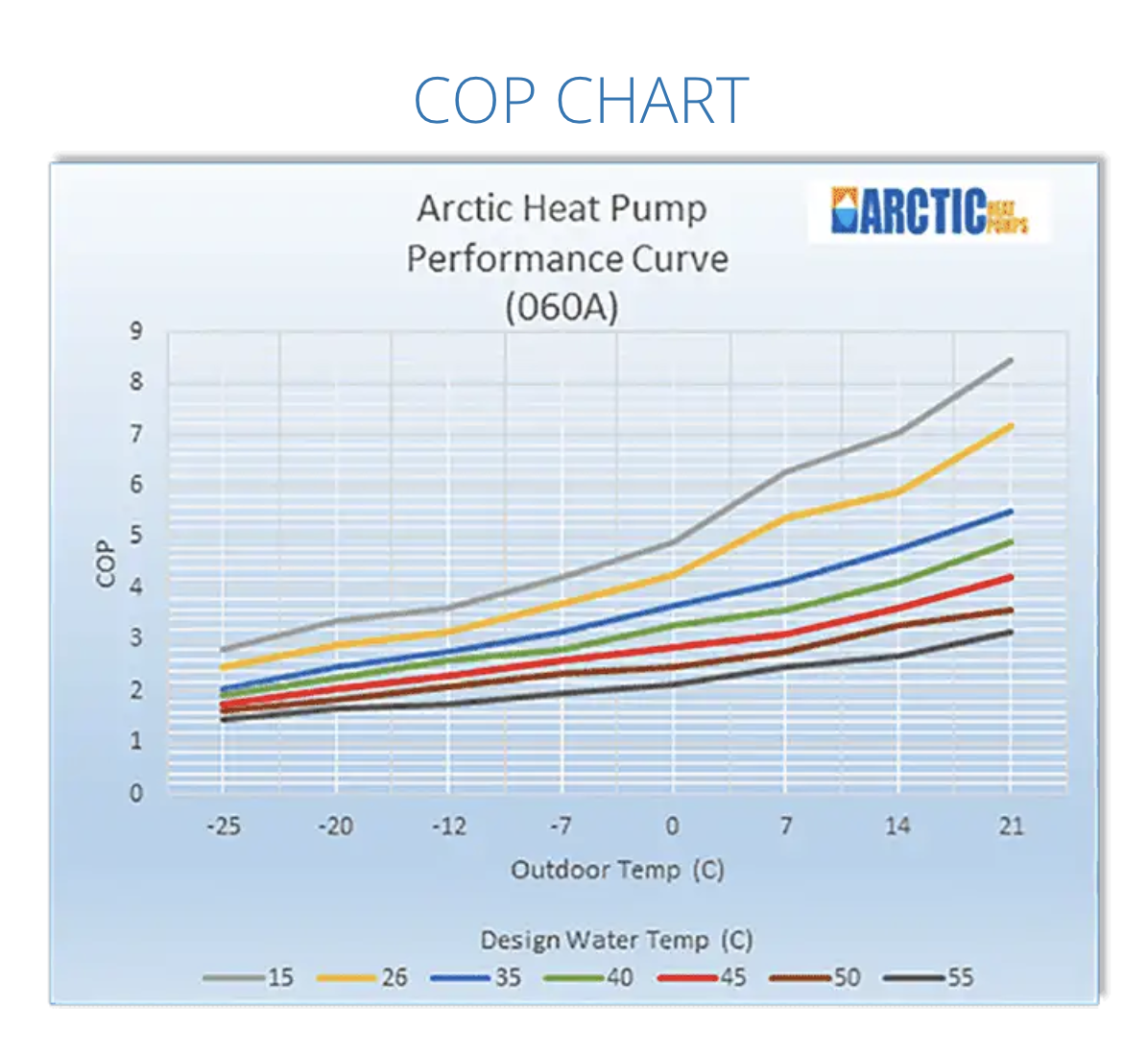
@hot_rod : "Data is available from manufacturers and independent testing on efficiency drop as outdoor temperatures drop. No guessing required. Same with performance at higher operating temperatures."
Ironically, Arctic, who started this thread, does not make that information freely available on their website.
0 -
They tell part of the story
 Bob "hot rod" Rohr
trainer for Caleffi NA
Living the hydronic dream0 -
do you use that 15 c water to feed another heat pump?
0 -
The really important part is output vs. temperature. The only thing that matters when sizing is output at your design temperature. Output at warmer temperatures is irrelevant.
0 -
Since this is obviously not somebody looking for actual help, still want to get some info out there.
DHW off an AWHP is a bad idea in pretty much any climate.
In cold climate, the COP of the unit tanks when making 140F water when it is bellow 0F out, output also significantly drops. This means recovery takes a LONG time during which you loose house heat when you need it the most. The AWHP then needs to run at max capacity (again lower COP) for hours after a DHW call to catch up. Overall, it works out to close to resistance heat operating cost.
In warmer climate DHW off an AWHP can work, but in those climates you generally need a lot of cooling. You are better off running a HPWH which can save you significant summer time cooling costs and is cheaper to install.
As for operation, my AWHP about the same cost as natural gas heat but because I no longer have to pay meter fees, the overall operating cost is lower.
0 -
When Carrier bought Viessmann they had mentioned that over 70% of Viessmann's overall business was in manufacturing and selling heat pumps. Pretty sure their US outdoor unit is rebadged though as Viessmann's European models are R-290
0 -
The best air-to-air heat pumps are certainly "ready" for extreme cold. It doesn't seem that air-to-water heat pumps have caught up quite yet to them. There's a certain logic to that, air-to-air is a much bigger market and air-to-water is still niche, it makes sense that innovation would happen first in the broader market.
Air-to-water has a fundamental advantage in that designs can incorporate a buffer tank, so the actual output can be arbitrarily low. This results in much better low-load performance and multi-zone comfort than air-to-air.
The big downside is cost. It's still a niche technology and commands a premium.
0 -
a2w is likely to have more of a market in units and systems that are commercial sized. I can see them as a better option for a smaller school and similar buildings than a bunch of mini splits.
0 -
Guess I am behind the times. I never knew Carrier bought Viessmann…………………… out of the loop. Does this include the boiler line as well?
They will ruin it for sure.
2 -
They scale better than air-to-air.
0 -
I've been looking into switching to an air-to-water heat pump, but I'm concerned about how well it would handle temperatures below 0°F. My existing radiators need fairly hot water to keep the house warm. Would a heat pump still be efficient, or would I need to upgrade the radiators too?
0 -
You would definitely need to upgrade your radiators, AFTER upgrading your dwelling's heat-loss i.e. 1.) air seal and 2.) insulate more.
0 -
There is no one, or simple answer to that question. But there are steps you can take to get the answer.
Homes with low temperature radiant are usually the best fit. Medium temperature systems with panel radiators are sometimes workable.
So adding or upgrading emitters becomes an option. Some ideas here
Another is to help the current boiler for backup or extreme conditions, a hybrid approach.
A heat load calc first, room by room
Radiator assessment next.
Energy audit to identify upgrade options.
Then look into equipment options.
Bob "hot rod" Rohr
trainer for Caleffi NA
Living the hydronic dream0 -
The short answer is no. An air to water HP will only put out 110 deg water approx. You would have a major repiping job and adding radiation to heat the house.
0 -
you can get higher then 110*F but with today’s technology it’s expensive and impractical.
Like air to air heat pumps, the technology isnot quite there……….. Yet0 -
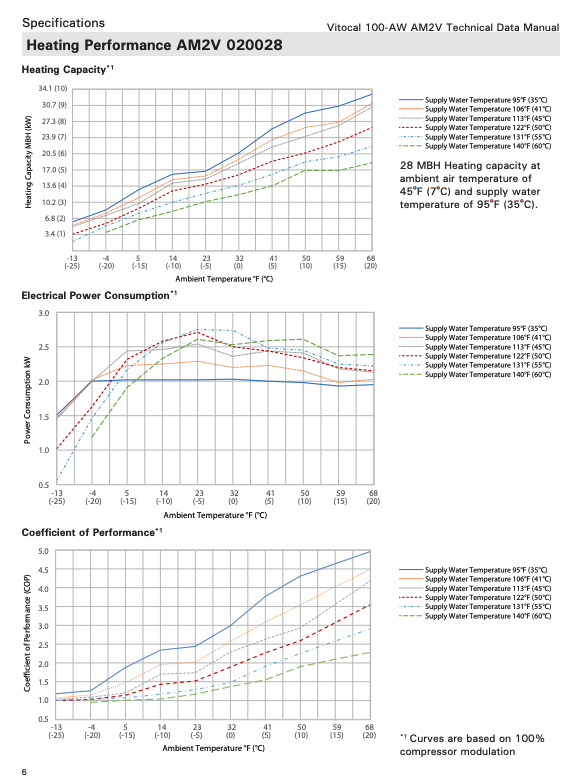
The performance graphs are available for most brands. 120 and below is a good range to operate. Better yet a radiant floor with 100° SWT
You take a capacity and efficiency hit as it gets colder outside. ODR helps keep the temperatures as low as possible. A small % of the year you will be at design condition.
This is the Viessmann unit I have, 115 is the high SWT. ODR ramps it down from there.
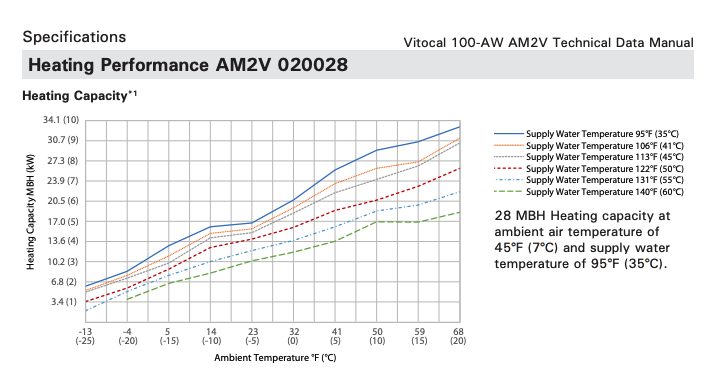
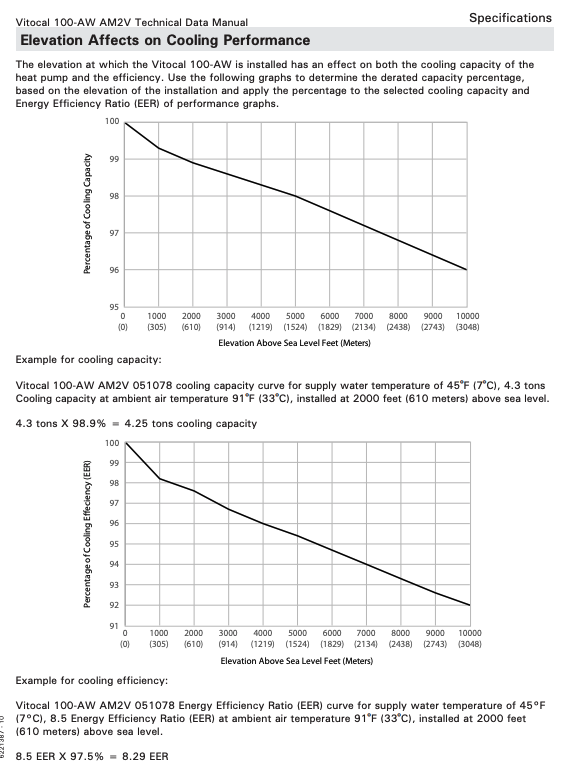
Altitude takes a bite on the cooling side also.
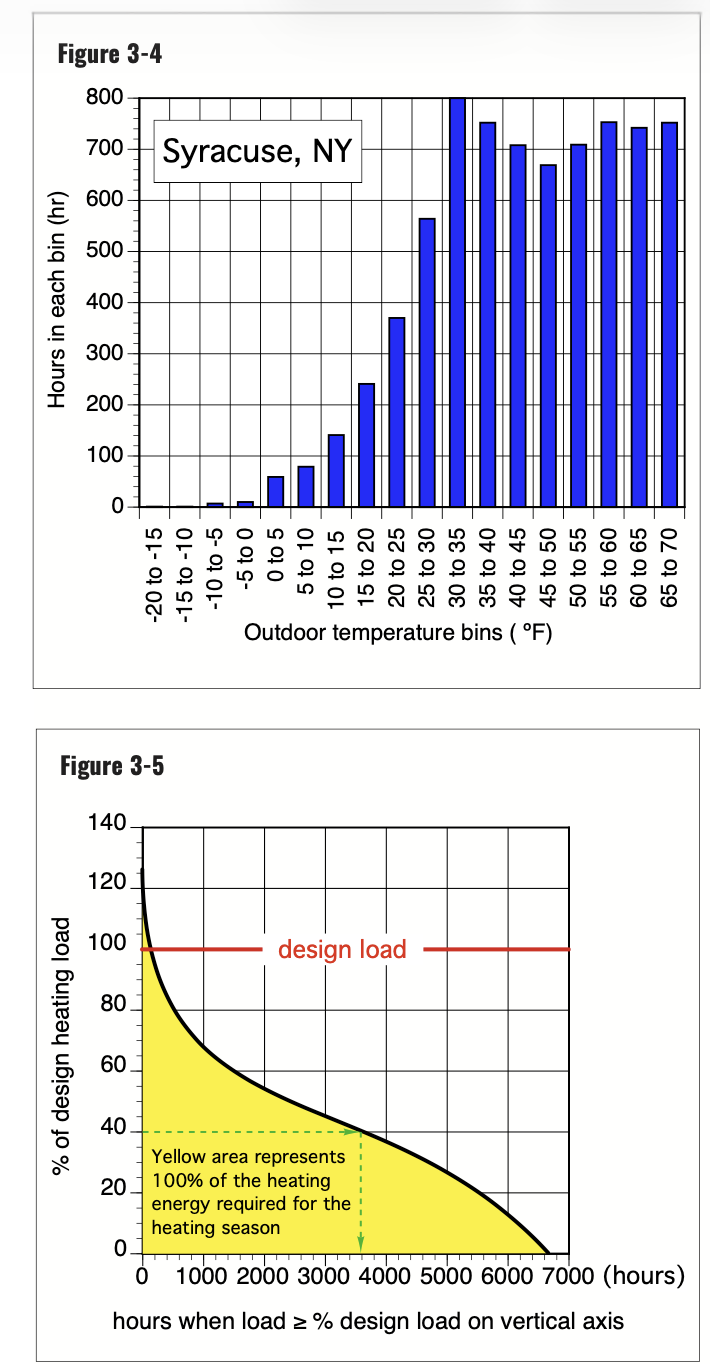
You can find or compile data like this to see % of the year at various tempersture. Syracuse, NY spends less that 100 hours at 5°
I think the Mitsubschi Ecoden has a bit better numbers compared to this Viessmann.
Bob "hot rod" Rohr
trainer for Caleffi NA
Living the hydronic dream0 -
You should probably start a new thread rather than bringing this bot's (AI?) initial post back from the dead. In the new thread post all your details, current heating system size, climate zone, heat loss calc, current supply temp of your system, etc. Although if you're bot friends, I can understand posting here.
1





Categories
- All Categories
- 87.8K THE MAIN WALL
- 3.3K A-C, Heat Pumps & Refrigeration
- 60 Biomass
- 430 Carbon Monoxide Awareness
- 133 Chimneys & Flues
- 2.2K Domestic Hot Water
- 6K Gas Heating
- 124 Geothermal
- 170 Indoor-Air Quality
- 3.9K Oil Heating
- 79 Pipe Deterioration
- 1.1K Plumbing
- 6.7K Radiant Heating
- 397 Solar
- 16.1K Strictly Steam
- 3.5K Thermostats and Controls
- 56 Water Quality
- 51 Industry Classes
- 51 Job Opportunities
- 18 Recall Announcements