Condensation Tank Nightmares'
Comments
-
I would think a cost effective way to convert the existing condensate pump to a boiler feed pump set, the following would be needed:
- Add a side tank to increase the storage volume to give the desired amount of boiler steaming time. The connections between the 2 tanks should be at the bottom, sized to equal pump flow. This tank should be vented to atmosphere, same as existing. Height should be same, allowing gravity flow of condensate from existing return line.
- Use the existing float switch to control a solenoid make up water valve.
- Adjust switch setting to maintain suitable water levels.
- This connection should have a vacuum breaker in the supply line.
- Wire the pump's motor to operate stop / start on demand of the boiler's low water sensor.
The only shortcoming I see with all this is the material of the existing receiving tank. This is welded steel, typically 3/16" wall. These are not known for long life. A much better choice would have been / is cast iron which typically come with a 20 year warranty against corrosion failure.
These condensate / boiler feed pumps themselves are pretty much all the same. Most have cast iron housings with cast bronze impellers and carbon/ ceramic mechanical seals. Some have sheet brass impellers, while others can be had with stainless steel housings.
Weak points for all of these are the mechanical seals and motor bearings. Single phase motors have centrifugal starting switches which can fail too.
Dennis Pataki. Former Service Manager and Heating Pump Product Manager for Nash Engineering Company. Phone: 1-888 853 9963
Website: www.nashjenningspumps.com
The first step in solving any problem is TO IDENTIFY THE PROBLEM.0 -
I'm skeptical about the need for more storage volume, its such a small boiler and I'm assuming it is not severely undersized for the connected radiation.
What I would do especially since it is warm out is;
- Shut the boiler down and let things settle for a while.
- Manually fill the boiler to about 3/4 on the sight glass and mark that level. Or as full as you can run it where where the system behaves normally.
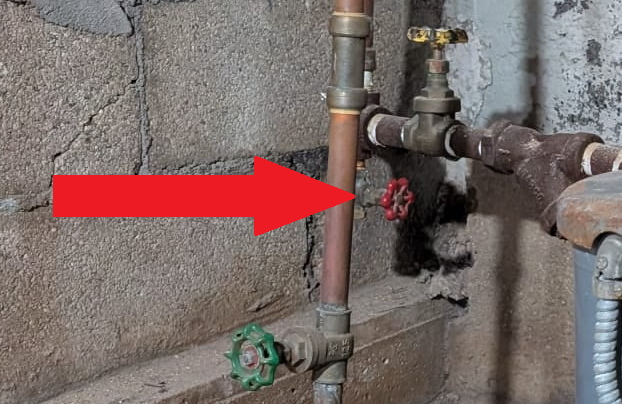
- Open the valve (shown below) and drain anything that is there into a bucket. I would expect not much.
- Fire up the boiler and time how long it takes after the boiler starts steaming for condensate to start draining out of the open valve.
- Shut the boiler down mark the present water level after the boiler cools a bit.
- Fill the boiler to the beginning mark on the sight glass. Then drain the boiler down to the ending level mark measuring what comes out, example 4 gallons.
- Close the valve and normalize anything else that was touched.
Say it is 4 gallons, I would think your present tank is plenty big enough. If the LWCO stops the process I'd seriously wonder why, where is all the steam (or water) going ?
BTW how many radiators do you have ?
 National - U.S. Gas Boiler 45+ Years Old
Steam 300 SQ. FT. - EDR 347
One Pipe System0 -
Please keep in mind what I posted earlier. The purpose of a condensate pump is TO MOVE CONDENSATE, NOT TO STORE CONDENSATE.
The existing condensate pump's tank may be large enough to function as a boiler feed tank, but this would need to be determined.
First would be determining the boiler's steaming capacity, and next the volume of the condensate tank. These 2 numbers would tell us how much steaming time this tank would provide. If it's at least 10 minutes, great. Make the pump control and make up water changes and see how it all works out.
If the boiler is still shutting off on low water, or the make up valve is opening to take on more water, or the tank is flooding when the boiler completely shuts down, the tank is too small. Then consider adding the side tank I suggested earlier, or a completely new, properly sized boiler feed pump and tank unit.
Dennis Pataki. Former Service Manager and Heating Pump Product Manager for Nash Engineering Company. Phone: 1-888 853 9963
Website: www.nashjenningspumps.com
The first step in solving any problem is TO IDENTIFY THE PROBLEM.0 -
Unless that pump is a real monster, I think the concern about water volume operating as a boiler feed tank is a bit over done. Consider the operating sequence here.(worst possiblecase) Boiler is steaming. Boiler level control demands more water. Feed pump kicks on. Water level starts to drop. Eventually float and relay command the feed valve to open. Unless that feed pipe is small, you're up at 2 gallons per minute, minimum. That's enough for a 900,000 BTUh boiler.
How does the water volume figure into this? Well, ideally that volume between auto feed on and auto feed off is enough to give time for the condensate to start returning at the same rate as it is being created, and after a couple of trips around the block there will be just enough water left below the auto feed on level to cope — and enough headroom above that to handle the slow returning condensate after things shut down.
Now I will freely and happily grant that the tank and pump and control levels should all be designed and installed after a thorough review of the performance and requirements of that particular system. i got that. I'm just trying to come up with a three figure, one day solution to @adnrahin 's situation.
Br. Jamie, osb
Building superintendent/caretaker, 7200 sq. ft. historic house museum with dependencies in New England0 -
@Jamie Hall " How does the water volume figure into this? "
To me the water volume the boiler uses before the condensation starts to return just helps prove the radiation and piping is somewhat normal. That there is not a leak, restriction, pooling, or something otherwise undesired happening to the steam or condensate and the piping is not hundreds of yards long.
In this case it would not surprise me if the condensate tank has more water volume than the boiler.
I still believe the tank and pump is just for lift not an actual need for additional water. That by design of the structure and the boiler's location the condensate from the radiation will not gravity return to the boiler in the garage.
National - U.S. Gas Boiler 45+ Years Old
Steam 300 SQ. FT. - EDR 347
One Pipe System0 -
Oh I think you are quite right on the tank/pup being for lift, not volume. All the more reason for rewiring to be a boiler feed setup!
Br. Jamie, osb
Building superintendent/caretaker, 7200 sq. ft. historic house museum with dependencies in New England 1
1 -
I think you need a step x step approach to figure this out.
First thing I would do is get the boiler to a normal water level and mark the gauge glass. Then turn the boiler on and let is run without any MU water.
Then after it has run a few cycles shut it down and leave it off. See how long it take from when you shut it down to when the pump stops cycling and see if all the water comes back to the gauge glass mark.
The purpose of this is to see how long it takes for all the condensate to return.
Changing to a boiler feed tank and other changes won't help if the condensate return is really sluggish or if you are losing water.
0


Categories
- All Categories
- 87.6K THE MAIN WALL
- 3.3K A-C, Heat Pumps & Refrigeration
- 59 Biomass
- 429 Carbon Monoxide Awareness
- 124 Chimneys & Flues
- 2.2K Domestic Hot Water
- 5.9K Gas Heating
- 119 Geothermal
- 168 Indoor-Air Quality
- 3.8K Oil Heating
- 78 Pipe Deterioration
- 1K Plumbing
- 6.6K Radiant Heating
- 394 Solar
- 16K Strictly Steam
- 3.5K Thermostats and Controls
- 56 Water Quality
- 51 Industry Classes
- 50 Job Opportunities
- 18 Recall Announcements