Condensation Tank Nightmares'
Comments
-
water leaking from the site glass. So when the auto feeder push water and some time later condestation pump pushes water it overflow the, and water started to dripping from the top of site glass
0 -
I really don't have any idea why it's there. It makes no sense, this pipe is connected to radiator and strange thing is radiator has two pipe solutions. Not sure why it's there.
0 -
Little over 1 feet. Condestation tank is lowered then the boiler position. So all the exits (return) pipe are lower then the boiler level. I think that's Why they put this tank below the boiler. I am trying to get solution but before I made any decisions I want to find the root cause and correct it.
0 -
There are things to research to find the best resolution for you. System size, EDR, how long it takes for the condensation to start returning, water contamination and if the boiler needs skimming, reworking the pump control, if the pump is even needed, moving pipes to eliminate hammer, repairing leaks.
Personally I don't like the piping clutter on the right side of the boiler, makes maintenance more awkward and difficult, maybe it just looks worse in the picture.
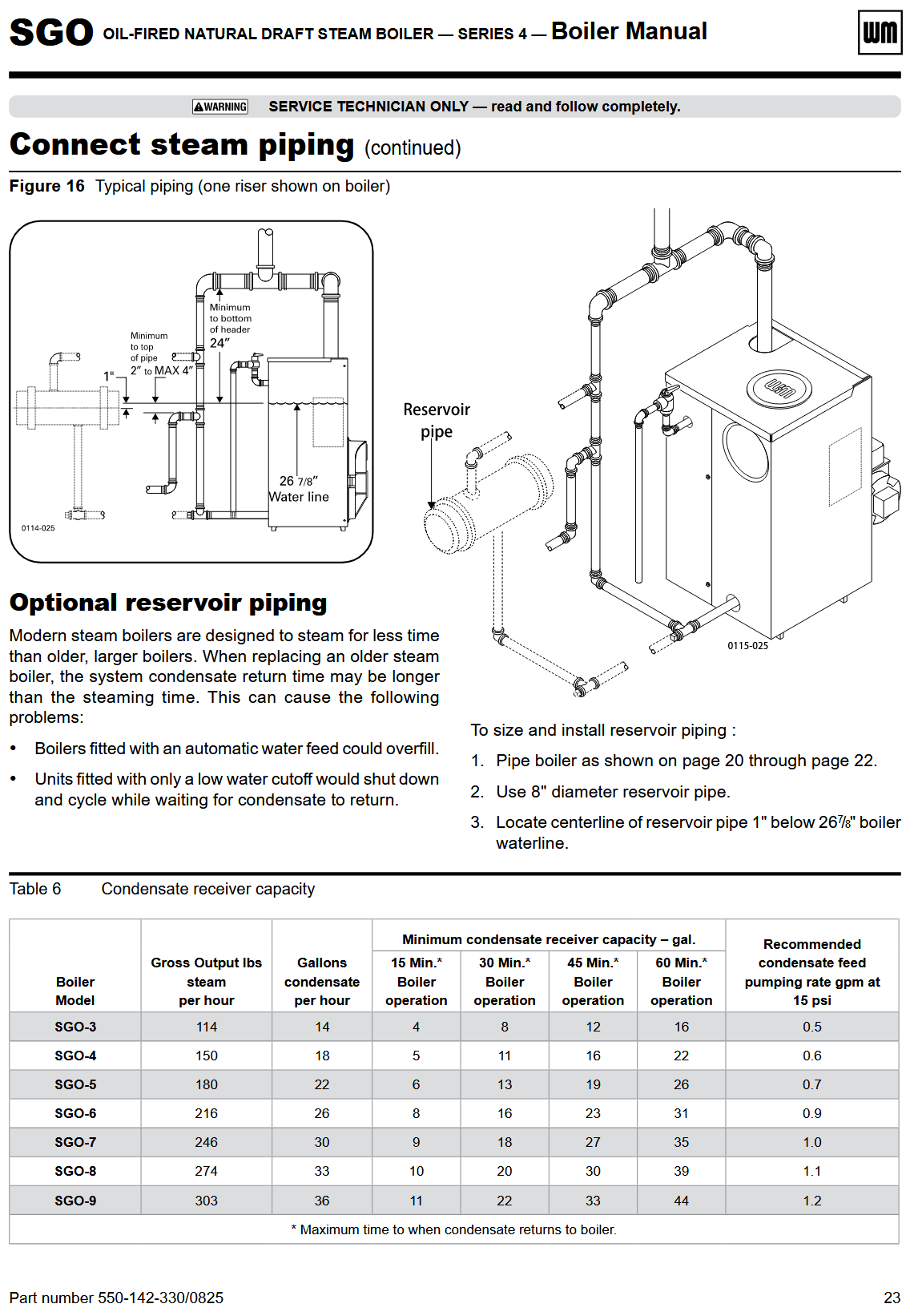
More reservoir use information as an example.
 National - U.S. Gas Boiler 45+ Years Old
Steam 300 SQ. FT. - EDR 347
One Pipe System0 -
I think the condensate return time is important to know before any decisions are made concerning the tank. I would lean towards not using a pump and elevating the tank (if needed), making it a reservoir if the extra water volume is needed due to slow condensate return time due to system size.
Are there any radiators that are lower than the boiler's water line ?
National - U.S. Gas Boiler 45+ Years Old
Steam 300 SQ. FT. - EDR 347
One Pipe System 1
1 -
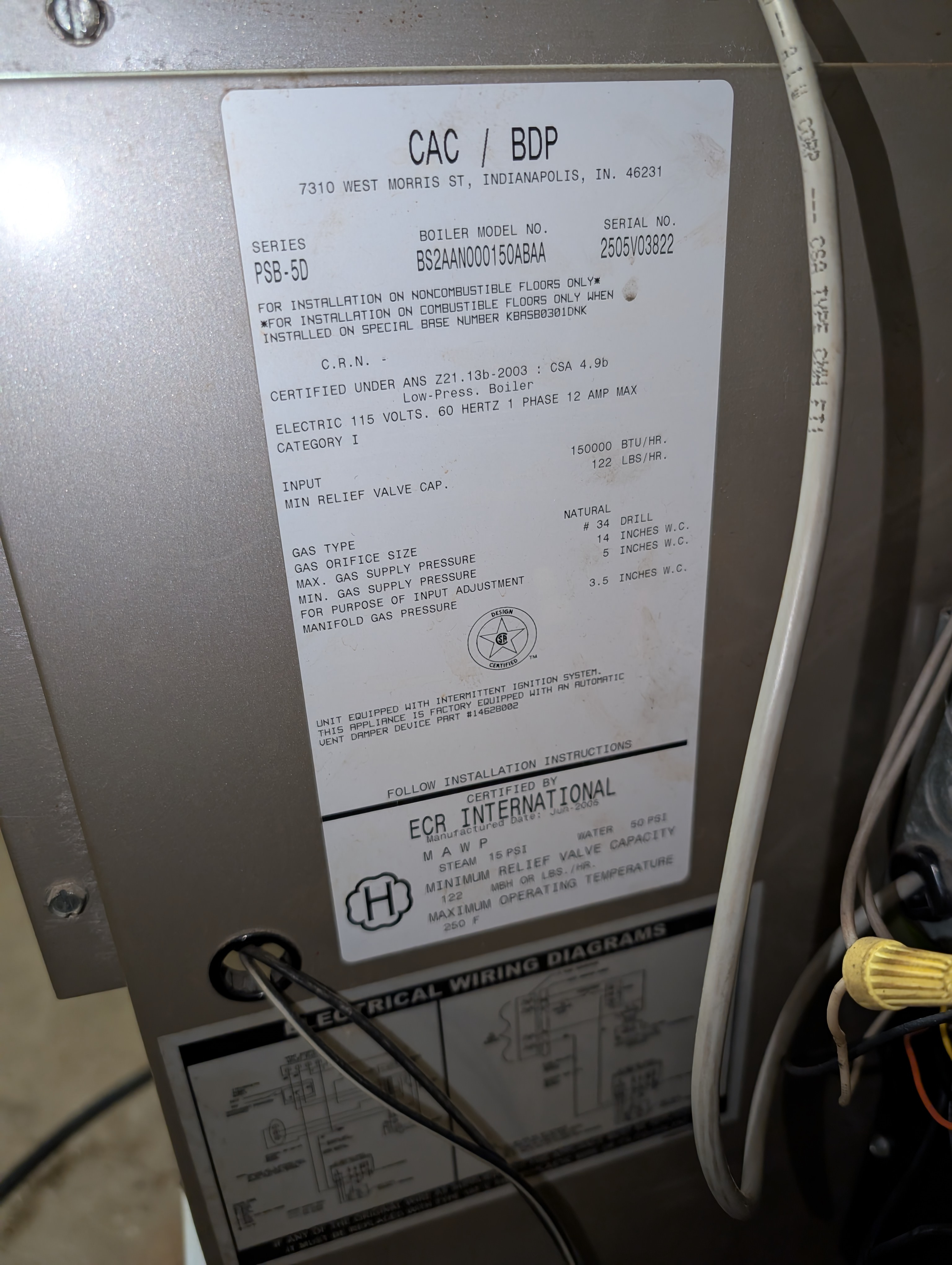
Here is what I found in boiler. It's 150000BTU.
0 -
So the condestation tank is 6 feet below from the boiler. And the return seems to he sits on the middle of boiler and tank.
0 -
Wow it moved 5 feet in about an hour ???
National - U.S. Gas Boiler 45+ Years Old
Steam 300 SQ. FT. - EDR 347
One Pipe System 1
1 -
Well with a boiler that size (I did not think it was very big), you must have a lot of pipe that needs to be filled with steam before the steam gets to the radiators, to need a condensate tank, something seems odd.
How big is the area the boiler serves ?
Is the boiler a ways away from the area it serves ?
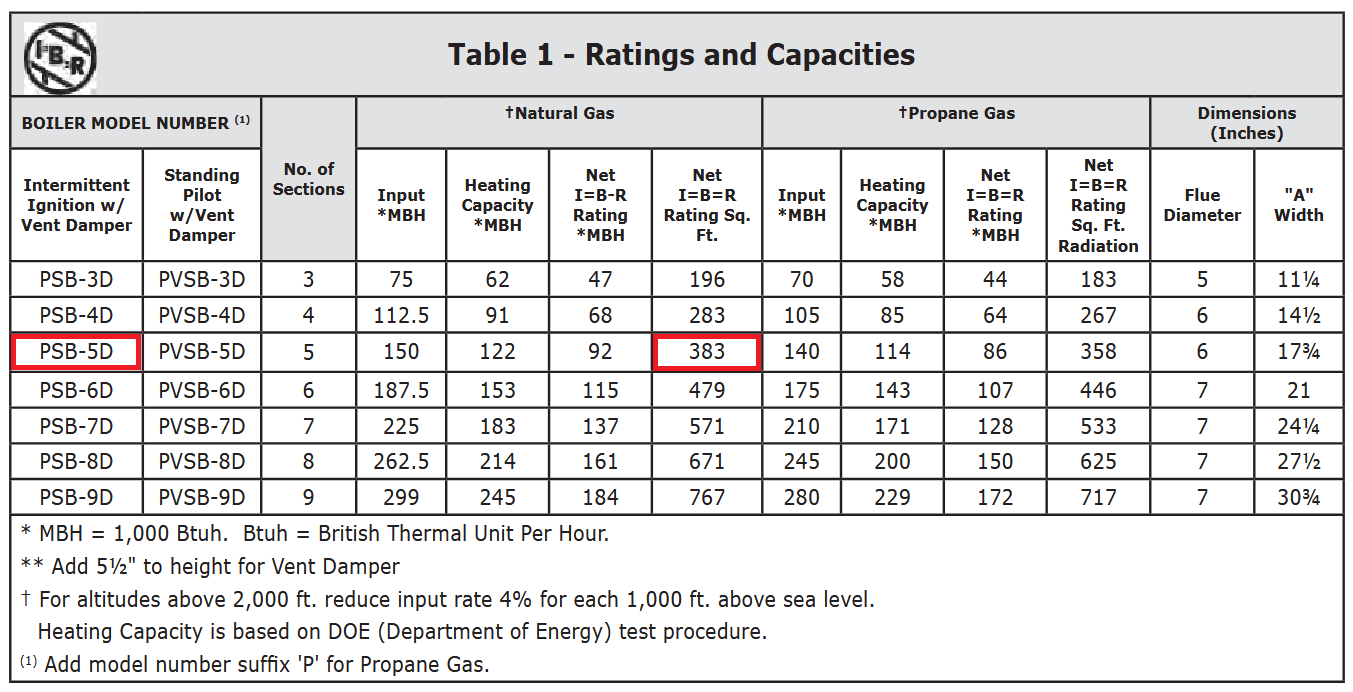
https://dunkirk-legacy.ecrserver.com/sites/default/files/2435_0.pdf
National - U.S. Gas Boiler 45+ Years Old
Steam 300 SQ. FT. - EDR 347
One Pipe System0 -
Sorry 😭, I missed calculated the height. Boiler is in garage and tank is in basement I just calculated the boiler return pipe and condesation pipe.
0 -
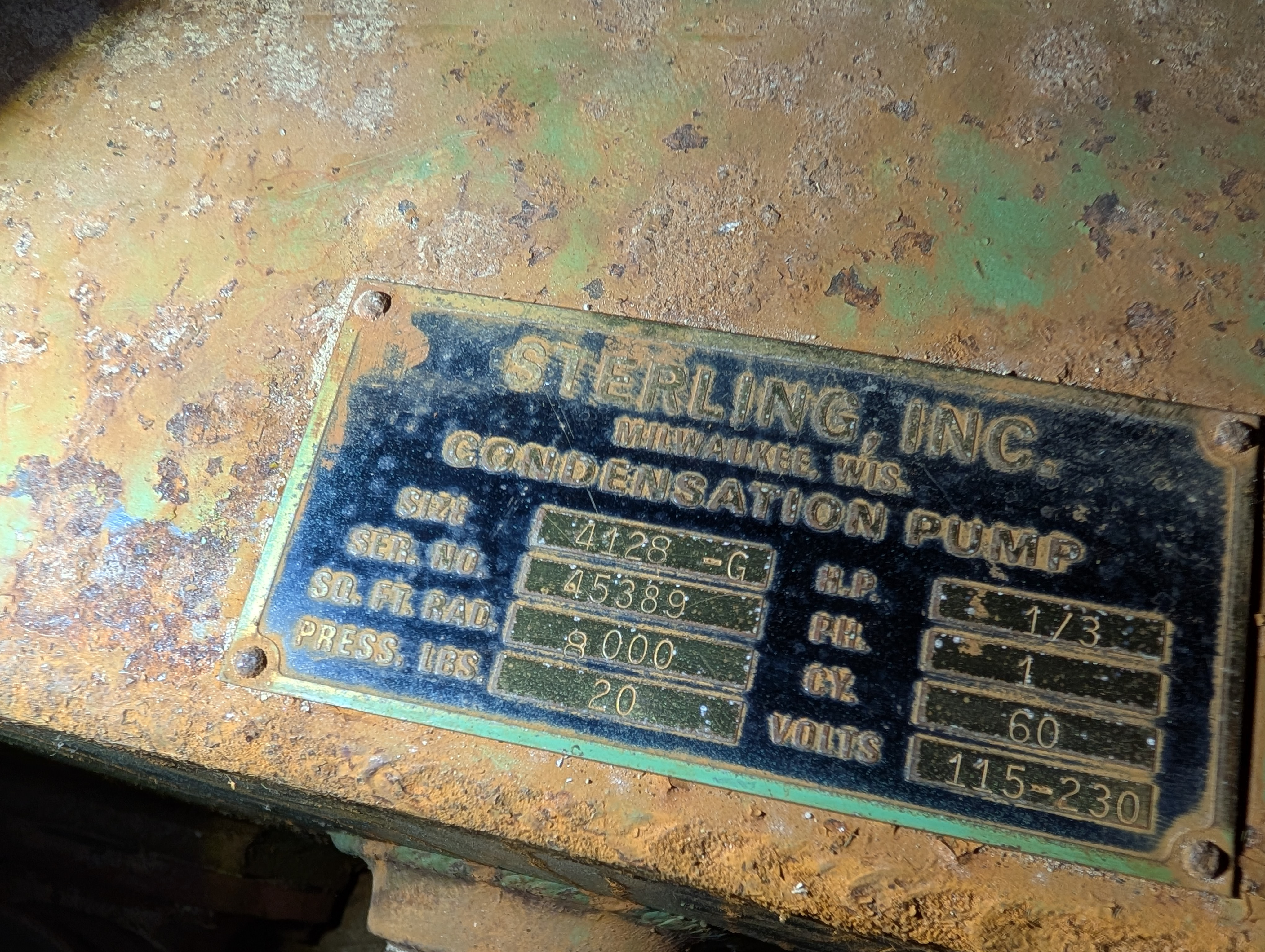
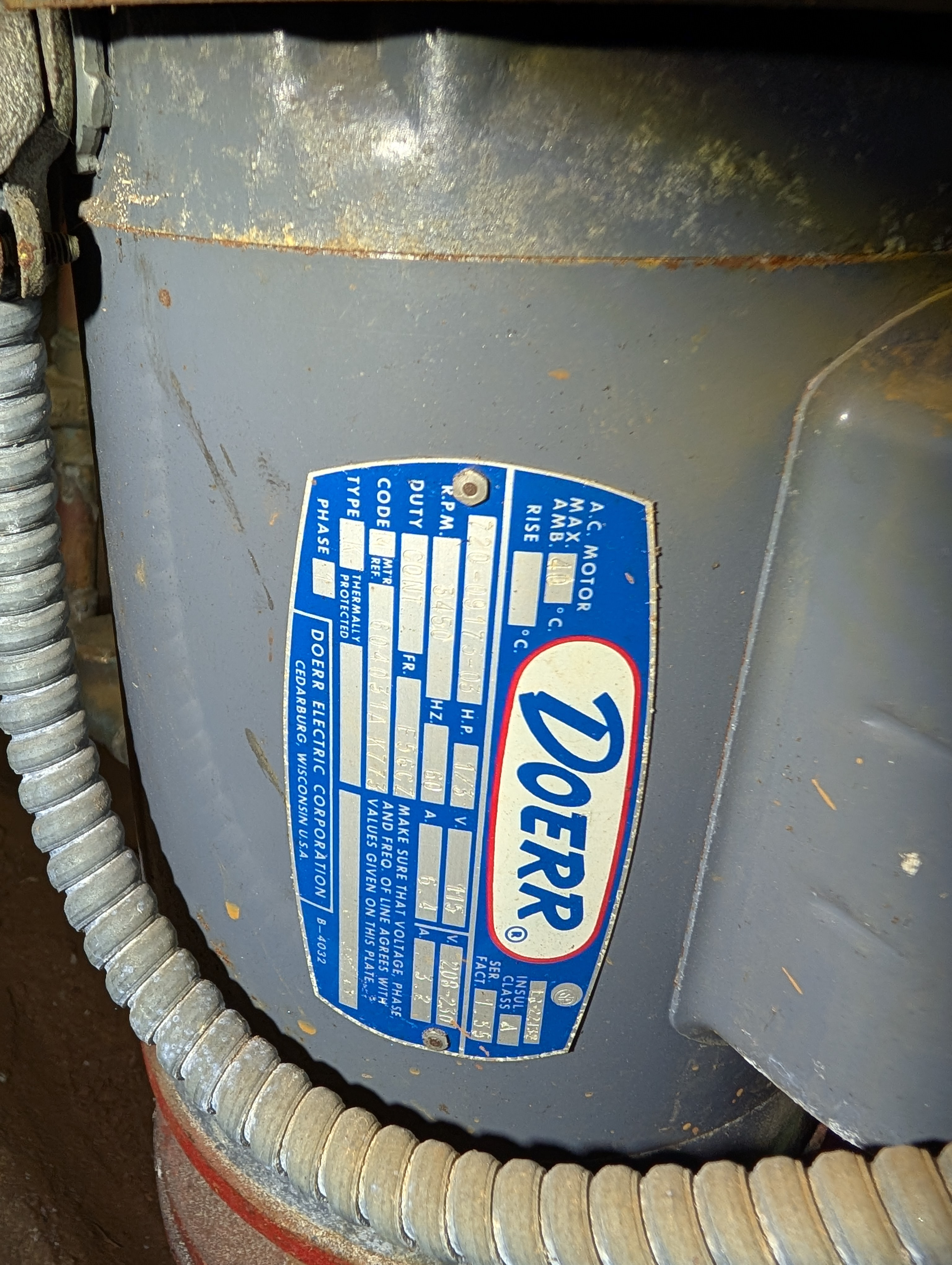
Around 2000 sqft. Here is the picture of condesation pump tag.
 0
0 -
I'm certainly not a condensate tank/pump expert. However, what I get from that tag on the tank is it is for a system that is 8000 Square feet system, your boiler is 383 Square feet. Kind of a huge mismatch.
By the equipment locations it almost seems like they are using it as a lift pump system.
Are there radiators in the basement ?
Is the main floor of the house above the garage floor ? If so by how much ?
National - U.S. Gas Boiler 45+ Years Old
Steam 300 SQ. FT. - EDR 347
One Pipe System0 -
A newer version,
Sterling 4128G - 1/3HP 15 GAL 1PH Steel Simplex Condensate Pump
The tank may hold more water than the boiler.
National - U.S. Gas Boiler 45+ Years Old
Steam 300 SQ. FT. - EDR 347
One Pipe System0 -
I think I have something similar, I don't see any difference between this and one that I have. I was thinking of something more smaller like Sterling 4028G which has capacity of 8Gal, but my biggest concern is will it solve the problem.
0 -
Yes, There are radiators on the basement, it's same level as the boiler. Underneath this radiator where the Condensation Pump is.
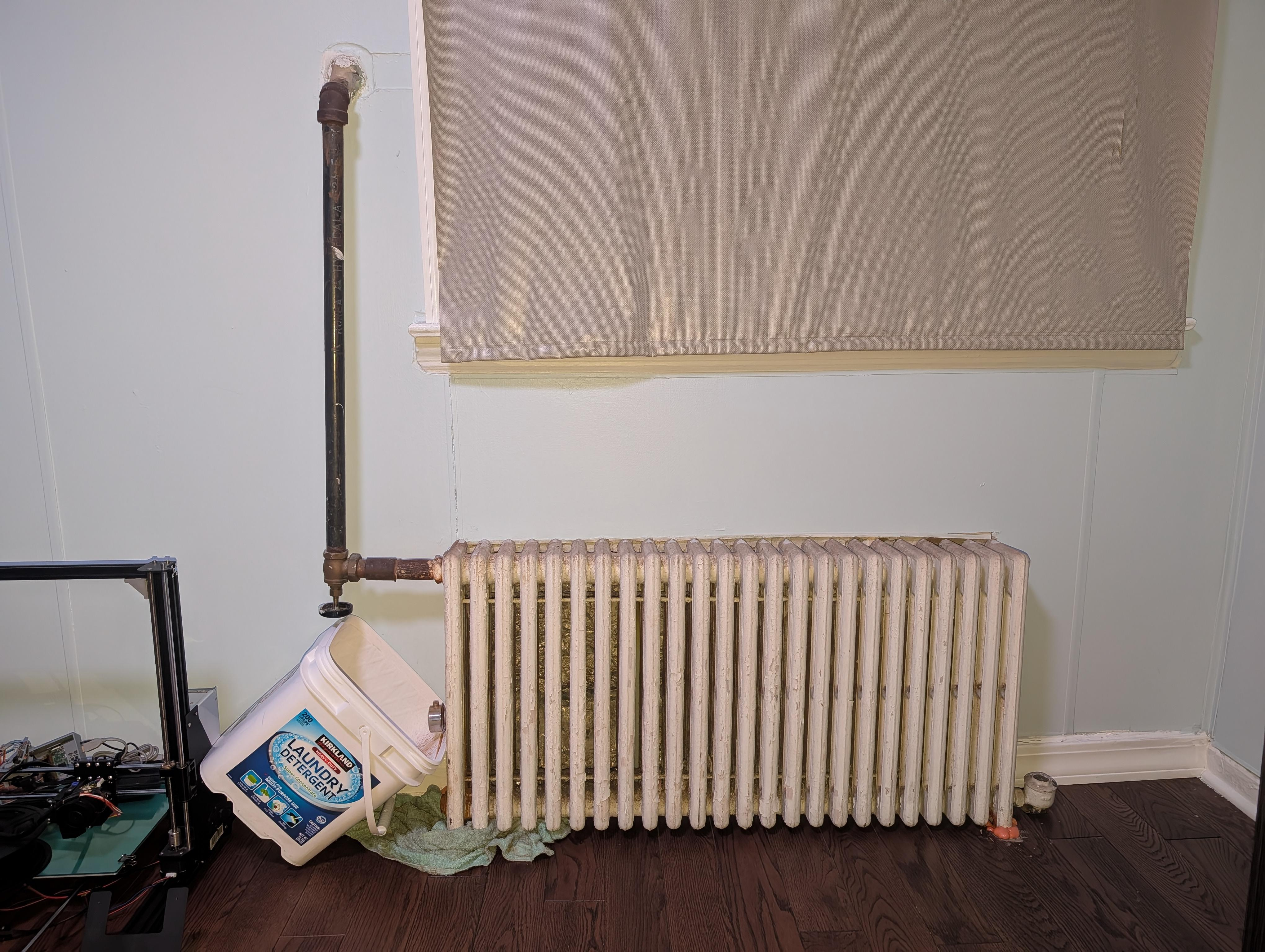
Other side of the pipe is is looks like below picture.
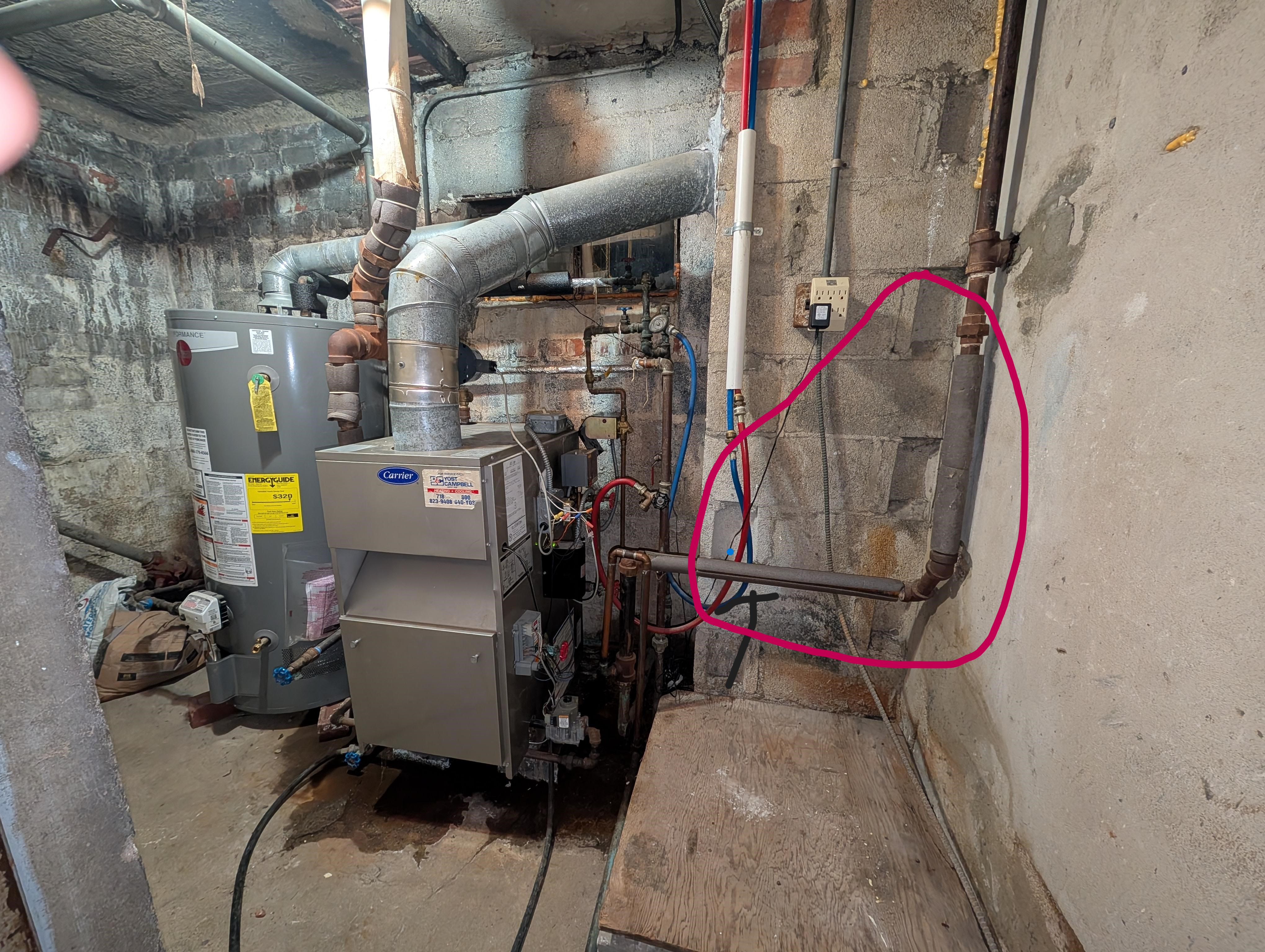
I don't understand the piping here. As you can see in first picture it has exit in the left side, where compensated water go back to the return main. And return to tank. Not sure why it' needs to this pipe (red mark)
0 -
I am losing my mind over this beast. During the storm I had to go outside to manually drop some waters from the system, and I have Split System install but this is not very efficient when temperature drops below -5F.
0 -
" I don't understand the piping here. " I agree…
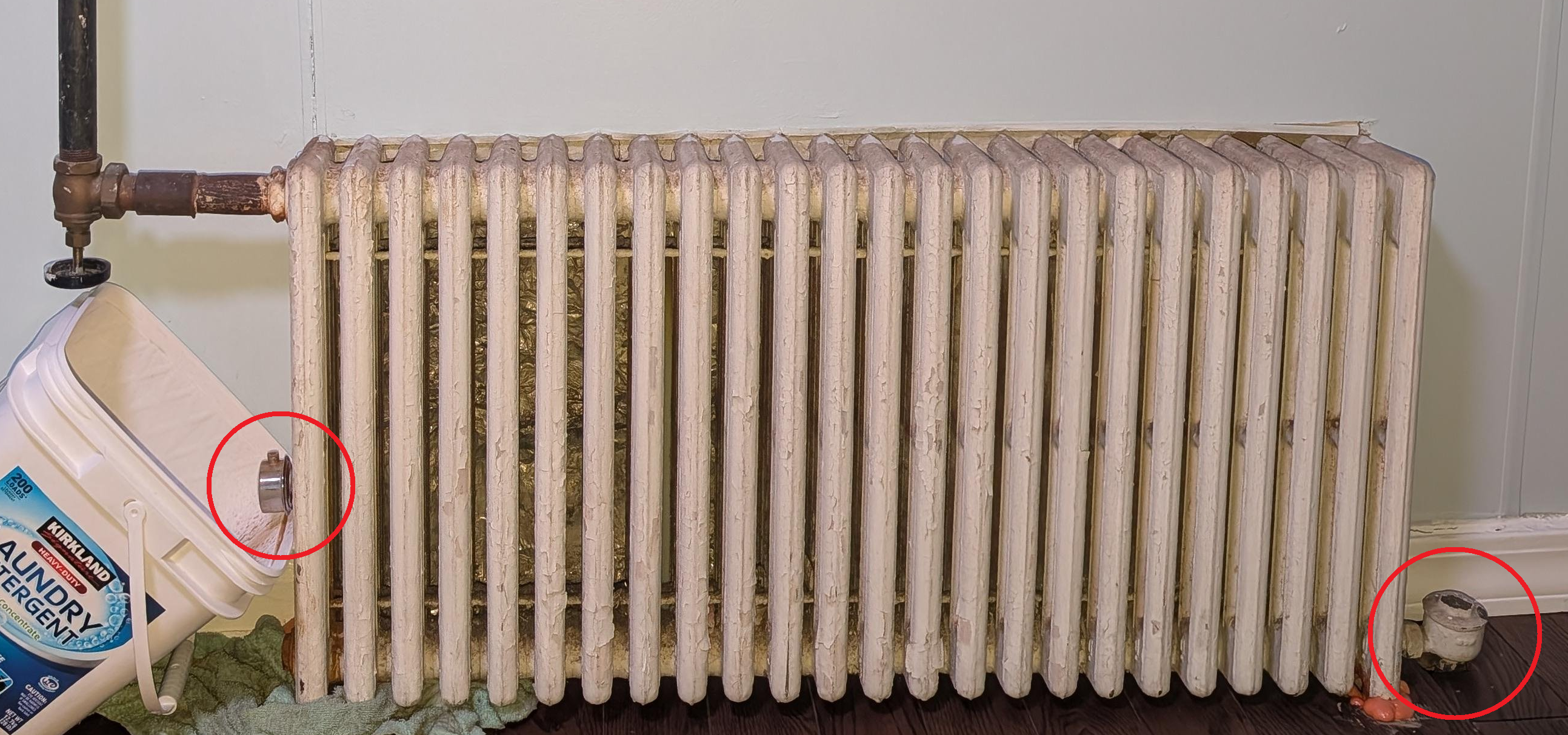
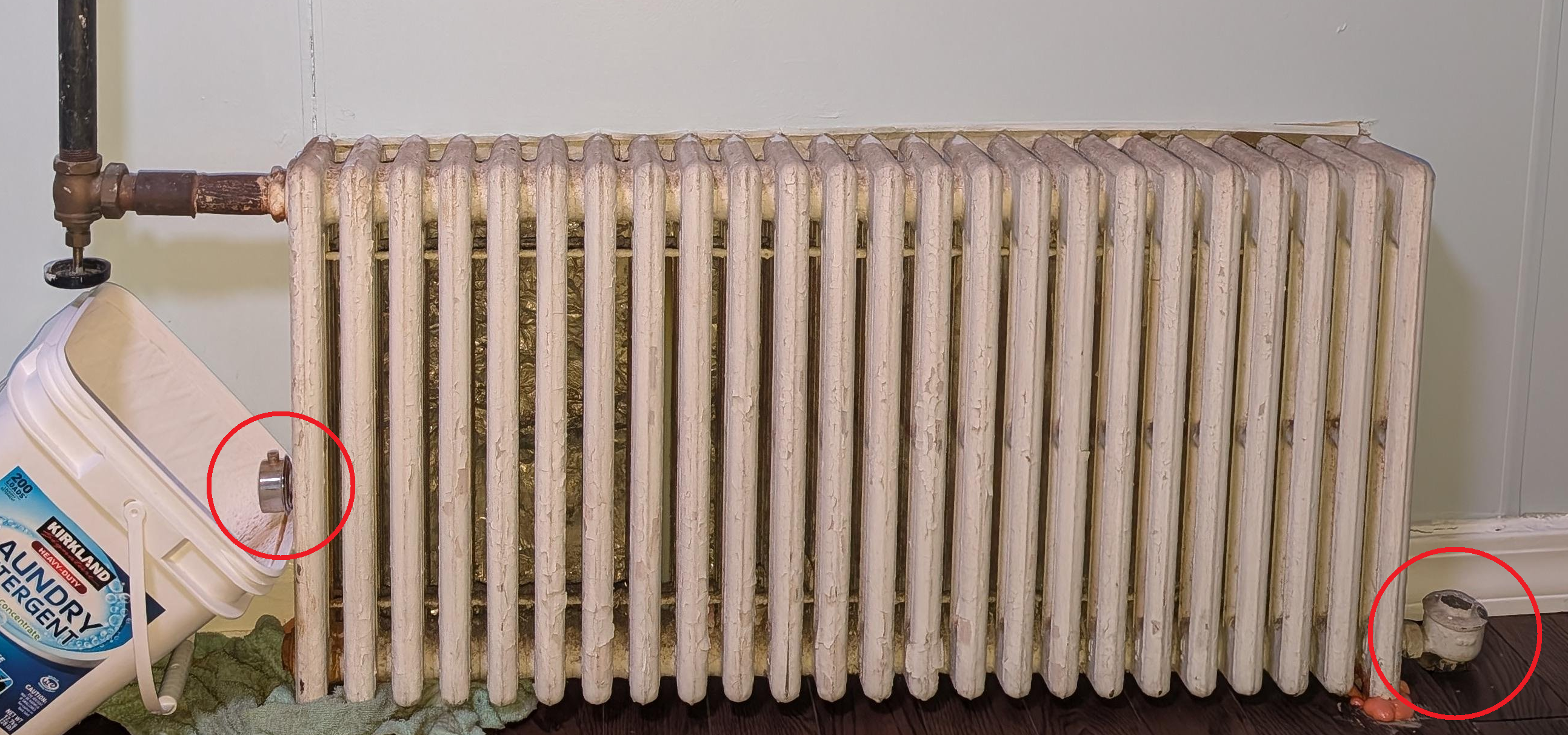
And it gets more complicated, usually 2 pipe systems don't have vents on the radiators , especially at the wrong end of the radiator.
 National - U.S. Gas Boiler 45+ Years Old
Steam 300 SQ. FT. - EDR 347
One Pipe System0 -
If it were me I would not buy a smaller tank until the old one failed. I don't think it would solve the issue. I would use @Jamie Hall's idea for better automatic boiler fill control.
To put it another way;
When the Boiler's LWCO calls for water it turns the pump on via an appropriate relay.
When the Boiler's LWCO is satisfied it shuts the pump off. No more overfilling the boiler.
The float switch on the condensate tank and the boiler's water feeder (cold water) are repurposed to control the addition of cold water to the condensate tank. This maintains a reasonable water level in the condensate tank. To compensate for normal steam system water loss.
I would still have a manual valve to directly fill the boiler for maintenance purposes.
A bit of wiring, maybe a junction box or two, an appropriate relay, some cold water pipe plumbing, that is it for that issue. It should be rather inexpensive to change, apparently you need to find the right person or do it yourself.
Hopefully the LWCO and boiler water feeder is all 24 VAC for mostly easy low voltage wiring. In that case the relay coil would be 24 VAC and the contacts are rated for the load of the pump.
National - U.S. Gas Boiler 45+ Years Old
Steam 300 SQ. FT. - EDR 347
One Pipe System0 -
Maybe those horizontal pipes in the return that are above the waterline of the new boiler are a clue that the old boiler was up on a pedestal and/or was a huge behemoth boiler whose water capacity was much greater?
Can you get a plumber to get rid of that issue and also install an experimental bypass of the condensate tank/pump so you can get a handle on whether or not this boiler even needs one? I mean if the LWCO shuts the boiler burn off, fine, use that opportunity to time how long it takes the condensate to return to the boiler to the level which it was at before the burn. Then assess whether or not you even need the condensate tank/pump. Maybe you can get by with the passive gravity feed reservoir.
And I would also get those previous persons of interest under a hot lamp and go at them hard 😆
2 -
aargh. It's so simple…
Br. Jamie, osb
Building superintendent/caretaker, 7200 sq. ft. historic house museum with dependencies in New England1 -
@Captain Who, from what @adnrahin stated I believe @adnrahin needs the condensate tank / pump for a lift station since the boiler is in the garage and the condensate tank / pump is in the basement. With the size of the boiler I believe gravity return is best but the overall layout of the system may make it hard and/or expensive to accomplish. Looking at the picture of the radiator I wonder what other interesting irregularities the system has.
National - U.S. Gas Boiler 45+ Years Old
Steam 300 SQ. FT. - EDR 347
One Pipe System0 -
Yeah maybe so. Probably shoulda lead off with the info. that the boiler and condensate tank/pump were in entirely different rooms and different levels. It's been a tad hard to follow this one……
0 -
Looking at this picture I wonder if the trap has failed closed trapping a lot of water in the radiator. However maybe it is just a carryover issue due to an overfilled boiler.
 National - U.S. Gas Boiler 45+ Years Old
Steam 300 SQ. FT. - EDR 347
One Pipe System0 -
Have you throttled down the valve on the discharge side of the pump? Im getting lost in all these possible solutions, but if the valve used to be throttled down and someone opened it complete, it would overfill when pumping and have a shorter run time, giving return water less time to get back. The last one I put in, which I dont remember brand or size, it was designed to be throttled on the discharge side to slow the boiler fill speed.
0 -
having an oversized tank is not an issue. I would control the pump for the boiler with an additional control mounted higher than the LWCO.
0 -
aargh. It's so simple…
Br. Jamie, osb
Building superintendent/caretaker, 7200 sq. ft. historic house museum with dependencies in New England1 -
Since presently the pump operation is NOT based on the boiler's actual water needs (LWCO). Presently the pump operation is based on the water level of the condensate tank. In this case throttling the pumps output flow will just change the water's transfer time. Slowing down the condensate transfer time may make the problem worse, since it may allow the LWCO and the auto feeder more time to add water to the system that it does not need.
Additionally since there is no real synchronization between the boiler's needs and the pump operation other than possibly slow returns the present system is doomed to have too much water in it.
Kind of makes me wonder if with the present equipment configuration ever worked correctly. If it did work reasonably well at some point, what changed ?
The one possibility I can think of is a stuck closed radiator trap. The radiator fills with condensate, and the stuck closed trap lets the radiator fill, starving the boiler of water, the LWCO / auto fill replenishes the missing water. As the stuck closed trap very slowly lets the condensate return to the tank it overfills the condensate tank which then overfills the boiler. The overfilled boiler behaves badly making the overall system's performance degrade. Just one theory.
A thermal camera may be interesting, looking at a radiator with a lot of water in the bottom of it.
National - U.S. Gas Boiler 45+ Years Old
Steam 300 SQ. FT. - EDR 347
One Pipe System 2
2 -
-
I've scrolled through this thread several times, but my eyes are just glazing over.
So let's start from the beginning and discuss the condensate pump set as pictured, and understand its purpose.
THE PURPOSE OF A CONDENSATE PUMP, like the one pictured, IS TO MOVE CONDENSATE, NOT TO STORE CONDENSATE.
The shown settings of the float switch stop segments cause a very short start - stop interval.
This means the pump is doing what it's supposed to do, MOVE CONDENSATE.
If the problem is a starve-then-flood situation at the boiler, a condensate pump like the one shown will not solve the problem.
What's needed is a means to STORE condensate.
The reservoir pipe arrangement shown by @109A_5 is an elegant design. It's a matter of determining the needed reservoir storage volume, and installing it so gravity will supply the needed extra feed water.
If this is not practical, then the condensate pump set needs to be replaced with a BOILER FEED PUMP set. A boiler feed pump is not controlled with a float switch. It is controlled for start - stop operation by water level sensors in the boiler.
The sizing of the boiler feed pump's tank is very important. It has to be large enough to meet the steaming capacity of the boiler and the condensing capacity of the system's radiation WITHOUT NEEDING TO TAKE ON MAKE-UP WATER. I.E. the condensate flow needs to be in equilibrium.
As a general rule, I recommend sizing the boiler feed pump's tank for a 20 minute storage capacity. This means we would have 20 minutes of boiler steaming time before outside make-up water is needed.
Now, there may be system issues that are causing or contributing to the problems. I'm a pump guy, and while I know a lot about systems, I'm the first to admit there's a lot I don't know, so I will leave to others to deal with what those might be.
Dennis Pataki. Former Service Manager and Heating Pump Product Manager for Nash Engineering Company. Phone: 1-888 853 9963
Website: www.nashjenningspumps.com
The first step in solving any problem is TO IDENTIFY THE PROBLEM.1 -
Very well said, @Pumpguy . Much better than I could!
But the question is… what do we do about the situation immediately to hand without spending a king's ransom to do it? Let's see here. We have a low water control in the boiler. We don't know what type it is, but so send a signal to an automatic water feeder before they shut off the boiler. Be nice if it were that type. If not, maybe there is a time delay on shutoff but not on feed. Anyway, there is one. We have a nice pump. Probably too big, progably needs a check valve, but the pump is there. We have a nice tank We have a float in the tank. We havea power source.
What else do we need? Well, I mentioned a check valve. Probably need a vent pipe. Might need an additional low water cutoff, but might not. We need a slenoid controlled water valve. We need two relays with suitable coil voltages, one of which with heavy enough contacts to handle the pump. We need some wire. Not that big a shopping list.
Now we take the old wire. Wire the LWCO and the relay with heavy contacts to start and stop the pump. Wire the other relay to reverse the action of the float in the tank so it turns on when the level is low and use that output to open our new solenoid valve.
A few hundred dollars in parts. A few hours of labour. Voila— one boiler feed tank and pump.
Br. Jamie, osb
Building superintendent/caretaker, 7200 sq. ft. historic house museum with dependencies in New England 2
2 -
One important thing when sizing a boiler feed tank in addition to what @Pumpguy said is lets say your boiler evaporites 250 lb of steam/hour,
You want the boiler to steam for 20 min in hopes condensate comes back before you need feed water. The shape of the building matters. An 8 story apartment building should return condensate faster than a one story building with a basement.
250 lb of steam/hour, 20 min is 1/3 of an hour so the condensate will be 250x .33=82.5 pounds of water.
a gallon is 8.33lbs so 82,5/8.33=10gpm
so you need a feed tank that between the normal tank operating level and the level where it starts to add MU water is at least 10 gallons. That doesn't mean you buy a 10 gallon tank
1 -
@Pumpguy To be fair the original idea of re-working the condensate / make up water management was @Jamie Hall's. I liked the idea so I though it was worth repeating in my words hoping it would gain traction.
EDIT: Yes I did add the reservoir method before I understood the condensate tank is in the basement and the boiler is in the garage with 5 feet difference.
looking at the float switch mechanical linkage, I'm thinking its switching logic could be reversed. So when the water level drops to certain point make up water is added.
I think if the boiler was in the basement the tank and pump would not be needed. To me it is just a lift station, just controlled incorrectly for this application.
@Pumpguy on the rating plate of the tank it states 8000 Sq. Ft., does that correlate to the size of the system's radiation ?
National - U.S. Gas Boiler 45+ Years Old
Steam 300 SQ. FT. - EDR 347
One Pipe System1 -
I have checked the steam trap, don't see any water there. But water comes out of the vent only when there is too much water in the system. Also I am also surprised prev owner ( technician) put vent in the wrong side. I probably have to put it in right side of the radiator.
0 -
Not sure if you are referring to valve between condensate pump and boiler connection pipe. I didn't adjusted anything. So right now I feel like the main issue is condensate pump not returning the water until condensate pump is full. The water level of pump get managed by the pumptrol basically mechanical float switch.
0 -
What specific type or model of control would you recommend for the additional pump control mounted above the LWCO? Are you referring to something like a McDonnell & Miller pump controller or just a separate float switch?
0 -
@4GenPlumber I am based on New York.
0 -
I am not sure, if the system have worked properly, I asked the same questions to prev owner technician and he said owner never mentioned anything like what I have been going thru. Also, after I purchase the house I called a boiler technician because of the thermostat wasn't working, when he looked at system, he mentioned that some reason the LWCO wasn't working, it wasn't disconnected from the Control Board. Also in the pressuretrol pressure was set 5+. He adjusted all this things.
0 -
I had already suspected that simply replacing the condensate pump or switching to a boiler feed pump might not automatically solve the problem, which is why I was trying to understand the system behavior first.
As you mentioned, the main issue seems to be the timing between when the condensate pump returns water to the boiler and when the boiler’s automatic feeder decides to add make-up water. In my case, the feeder was adding water before the returning condensate had time to get back to the boiler, which led to overfilling, water hammer, and vents spitting water.
After I disabled the auto feeder, the overfilling stopped, but now the boiler sometimes shuts down on LWCO and stays off for a long time while waiting for condensate to return.
So at this point I'm trying to determine whether the real solution is adding storage (as you described) or converting to a properly sized boiler feed unit that can provide enough buffer to prevent the starve-then-flood situation.
0 -
One thing I’m still trying to understand is how adding a larger tank would change the behavior if the condensate pump is still controlled by the same float switch.
Even if the tank were large, for example something that could hold 20 gallons of water, the condensate pump would still turn on and off based on the float switch level. That means the pump would continue sending water back to the boiler in the same small cycles as it does now.
So it seems like the pump would still only move water once the float switch is triggered, and then wait again until enough condensate returns to the tank to trigger it again.
Because of that, I’m not fully seeing how simply increasing the tank size would solve the timing issue between the boiler losing water during steaming and the condensate returning from the system.
Am I misunderstanding how the larger storage volume would change the behavior of the system?
0 -
I could not find in the manual for your boiler the boiler's water capacity. Since your boiler's Square Feet capacity (383) is only slightly bigger than mine (300) I kind of wonder in your case where the water is going and staying that the boiler water is depleted enough to trip the LWCO. My boiler's water line often seems to raise a bit, I presume due to the water expanding when heated to a boil, and the condensate is readily returning. So is all your water simply ending up in the condensate tank, or is it trapped somewhere else in the system for a while, or is your piping so huge that it needs all that steam to fill the pipes to get to the radiators and make the return trip as condensate.
For example; I'd like to believe if your boiler was moved into the basement and the condensate tank and pump was removed from the system, the system would behave like most other small systems.
Another thing that has me a bit puzzled is the vent on the pictured radiator. It looks like your system is a 2 pipe system. Usually 2 pipe systems don't have vents on the radiators. The venting is done by one vent back near the boiler or from the condensate tank. Do all your radiators have vents ?
National - U.S. Gas Boiler 45+ Years Old
Steam 300 SQ. FT. - EDR 347
One Pipe System0


Categories
- All Categories
- 87.6K THE MAIN WALL
- 3.3K A-C, Heat Pumps & Refrigeration
- 59 Biomass
- 429 Carbon Monoxide Awareness
- 124 Chimneys & Flues
- 2.2K Domestic Hot Water
- 5.9K Gas Heating
- 119 Geothermal
- 168 Indoor-Air Quality
- 3.8K Oil Heating
- 78 Pipe Deterioration
- 1K Plumbing
- 6.6K Radiant Heating
- 394 Solar
- 16K Strictly Steam
- 3.5K Thermostats and Controls
- 56 Water Quality
- 51 Industry Classes
- 50 Job Opportunities
- 18 Recall Announcements