One pipe steam system main vent

hey everyone so I have a one pipe steam system. The boiler is in the middle of the house. The steam main comes up and splits two directions to feed radiators on both sides of the house. One side is 2 inch the other side is inch and a half. My main vents are in the middle right above the boiler slightly to the right on the dry returns. I have had hissing throughout the house and am filling up the boiler a couple times a week. So im assuming the main vents are clogged since they make no noise and are probably too low. Im going to replace them and raise them up to hopefully solve the problem but my question is, is it okay for them to be on the dry returns? Or should they be at the end if the steam mains?
Comments
-
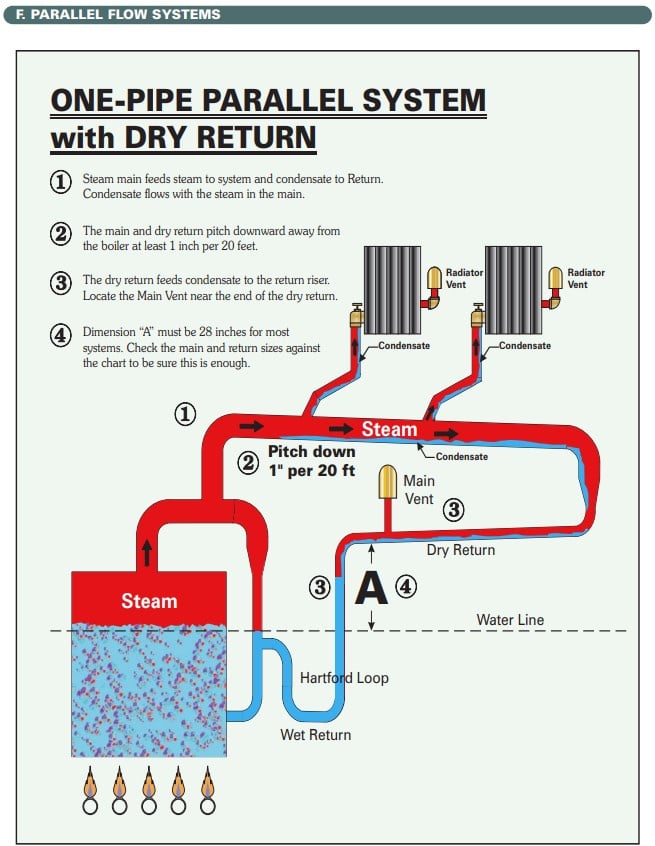
I used to wonder about this too but I'm glad I never moved my vents from the end of the dry returns to the end of the main. You don't want an air bound dry return. Vents are supposed to remove as much air from horizontal piping that can carry steam as possible. If you didn't it would cause more back pressure and hinder flow of condensate to the returns and it might even interfere with the A Dimension and possibly result in more noise and gurgling. From one pipe steam pdf by peerlessboilers:
 0
0 -
Check your pigtail too.
2 -
Took longer to get steam to my radiators when I had main vents back at the boiler vs at the end of my mains. Had data supporting such, not just one time time measurements but year long cuft gas used vs heating degree days. Perfectly acceptable to put them in either location but my experience has been better with them at the end of the mains.
 0
0 -
Makes sense but why not do both, so as to prevent the air being more or less trapped in the dry return which could increase the A Dimension requirement due to more pressure drop? I mean it isn't just about getting the steam to the radiators the fastest. That's great but steady state operation needs to be optimized as well?
Would you have gotten the same effect by increasing the venting at the dry return? Maybe even adding another or larger nipple for more venting?
Also, were your dry returns well insulated?
0 -
Main extensions were insulated. Two Gorton #2's and a Ventrite on the long main and one Gorton #2 and a Ventrite on the short main. Same antler setups were moved from the ends of the main extensions back at the boiler to the actual ends of the mains for year two vs year one.
0 -
I would be interested to know if it would be beneficial to add an additional vent somewhere along the line of the dry return. I have plans to increase my main venting (that is currently at the end of the horizontal run on the main lines) once this heating seasons ends. Fortunately I have full unrestricted access to the entire length of the return line, so adding additional venting (if it's beneficial) should be easily accomplished.
Perhaps this is a situation where I should concentrate on the existing main vent first, and then consider addition return line ventilation. Seems the common thought is to do one thing at a time and monitor the (hopefully) improvements……..
0 -
Personally I don't see the benefit. If you want to vent the entire main extension then just add more venting back there. If you don't, add more at the end of the main.
1 -
All of my main vents are at the ends of my mains. One main has a 10' length of "dry return" while the other has a 16' or so length. None of these returns have any kind of vent, and I decided to keep them that way because I have no reason to try and heat them. I added insulation to minimize their losses as well.
Air will not have any effect on a stream of condensate running along the bottom of a pipe returning via gravity.
Single pipe 392sqft system with an EG-40 rated for 325sqft and it's silent and balanced at all times.
1 -
Air being "trapped" in a "dry return" (Jamie would have issue with that term), is meaningless. There is no issue with pressure drop, and there is no issue with the "A Dimension" which itself is not even a thing.
You can put the main vent where you like as long as it's after the last radiator runout. The part of the main after the main vent doesn't care if there is air or steam in there, no more than the vertical drop cares.
If you want to see why there is no measurable pressure drop in a main, and no resulting effect on the water line at the end of the main, you can watch my video. Or you can continue to believe in provably false ideas, it's everyone's free choice!
NJ Steam Homeowner.
See my sight glass boiler videos: https://bit.ly/3sZW1el0 -
@EBEBRATT-Ed @DanHolohan @Steamhead @EdTheHeaterMan @pecmsg So, is the A Dimension and pressure drop due to friction effects and condensation effects and static head to overcome wet return resistance a total myth that has now been totally busted?
0 -
-
I've almost given up on the "dry return" thing… what's described here isn't a dry return (it's a steam main extension) but…
And can be vented anywhere after the last radiator runout.
There is, however an absolutely critical point here.
If these are steam main extensions — whatever you want to call them — they must NOT be connected together at the boiler. Rather, the MUST be individually vented — somewhere, as has been said, after the last radiator runout and MUST be individually dripped to the wet return.
If they were real dry returns, it's exactly the opposite. Real dry returns MUST be connected together at the boiler and MUST be vented together at that location. These are main vents, and sized as such! Then they are dripped together to the wet return.
Br. Jamie, osb
Building superintendent/caretaker, 7200 sq. ft. historic house museum with dependencies in New England0 -
@Jamie Hall Both of mine are 1" pipe. Have you ever seen a 1" steam main?
Hmmmm? 😁
Actually, the longer one may be 1 1/4, I can't remember anymore. But the short one is 100% 1", I know because I bang my head on it about once a month.
Single pipe 392sqft system with an EG-40 rated for 325sqft and it's silent and balanced at all times.

 2
2 -
No, I haven't seen a 1 inch steam main. What I HAVE seen — more times than I care to count — is venting and connection errors causing greater or lesser havoc because of a failure to distinguish a pipe carrying steam — and I don't care what you call it — and a pipe carrying only air and condensate and separated completely from steam — and I don't care what you call that one, either.
The confusion leads to bad advice and worse results — and is completely unnecessary.
Br. Jamie, osb
Building superintendent/caretaker, 7200 sq. ft. historic house museum with dependencies in New England0


Categories
- All Categories
- 87.8K THE MAIN WALL
- 3.3K A-C, Heat Pumps & Refrigeration
- 59 Biomass
- 430 Carbon Monoxide Awareness
- 132 Chimneys & Flues
- 2.2K Domestic Hot Water
- 6K Gas Heating
- 124 Geothermal
- 170 Indoor-Air Quality
- 3.8K Oil Heating
- 79 Pipe Deterioration
- 1.1K Plumbing
- 6.7K Radiant Heating
- 396 Solar
- 16.1K Strictly Steam
- 3.5K Thermostats and Controls
- 56 Water Quality
- 51 Industry Classes
- 51 Job Opportunities
- 18 Recall Announcements