Pressuretrol to Vaporstat with timer
Comments
-
Not my data. As I stated I have only just started thinking about this, let alone begin experimenting with it. The difficulty and work with a one pipe steam system would be greater than with two pipe, and I may never get past the leak testing phase if I even get to that (would be in the off season for sure).
You should read the Hoffman pdf. I'll ask you a question though. Do you think that latent heat of vaporization of steam is lost/wasted/used inefficiently in the process of pushing air out of the pipes and radiators every cycle?
0 -
I believe that's just advertising, a sales gimmick and it was aimed at coal / wood burning boilers which didn't turn off immediately. If you could keep heating a building with a dying fire, that was a benefit don't doubt that. However, there's not much heat left in a modern oil / gas fired boiler after the burner shuts off, and anything you do pull out you just have to put right back again anyway the next time the burner lights.
As far as energy lost pushing air out, I don't think it's much. Anything going out the main vents, at least in my system is out within 90 seconds on cooler days and the rest gets blown into the living space. But, it would be interesting to see if there's an actual way to measure the loss. Not sure it's latent heat doing the work though?
The disagreement I have with PMJ is the ability to keep a single pipe system balanced while using vacuum. My system depends on cycles and the system filling with air in order to control the radiators. My vents are somewhat tweaked to cheat and keep rooms more comfortable by speeding up delivery to some areas, and slowing it down to some. But, on top of that, because that only works on mild days I have TRVs on 5 out of 10 radiators and those 100% rely on venting air to work. By using air, I essentially have a 6 zone system for all intents and purposes.
Would it be better to keep the air out? Absolutely. But it doesn't seem like it would function the way I want.
Single pipe 392sqft system with an EG-40 rated for 325sqft and it's silent and balanced at all times.
 2
2 -
Check the date of the pamphlet and the systems it was meant to be used on…
Br. Jamie, osb
Building superintendent/caretaker, 7200 sq. ft. historic house museum with dependencies in New England0 -
Just for reference, here is a page from a Hoffman catalog directly referencing use of the #2 vacuum vent with oil and gas fired systems and affecting the number of burn operations. Yes, there were intermittently fired oil burning boilers for residential use in the 1920's. Hmmm.
Regardless, the only approved narrative here is that vacuum was for the coal days only as @Jamie Hall reminds us yet again. Been that way for many years. No deviation from that is ever allowed. Venturing into that zone wear your hard hat.
I won't speculate how things got to this place here nor why it is stuck there. I do know from years of first hand experience that most of what Hoffman has written is true.
1926 1000EDR Mouat 2 pipe vapor system,1957 Bryant Boiler 463,000 BTU input, Natural vacuum operation with single solenoid vent, Custom PLC control 1
1 -
I give up. But I don't care for it when people say I say things which I didn't, and don't…
Br. Jamie, osb
Building superintendent/caretaker, 7200 sq. ft. historic house museum with dependencies in New England0 -
There is a lot more air that has to get pushed out of the system by the steam after the vents on the mains are closed (90 secs is quite fast though) in the average one pipe steam system out there. The radiators often hold 60-80% or more of the system's air volume (depending on the building size and radiator count), and venting them takes longer—typically 5-15 minutes or more overall for the full system to heat evenly.
Even if the average gas fired system may achieve more on the order of 15% fuel savings (maybe 25% for oil burners and 33-13% for coal), comfort factor may be more important.
Steam at partial vacuum condenses at 180-200°F instead of 212°F+, so radiators in a vacuum system run cooler but more steadily. This reduces overheating and provides gentler, more consistent radiant heat—often described as "softer" and more comfortable. This would be a huge improvement in my system where my boiler is overpowered even though I have a lot of EDR in my rads and when it isn't all that cold outside, my radiators simply have to spend a large percentage of the time not in the hot condition. It would be a huge improvement to have the radiators be hot longer, even if it is at a reduced temperature, especially on those days.
0 -
Exactly right.
Though I know vacuum operation is significantly more efficient, the comfort improvement it provides is so great I would gladly pay more for it.
1926 1000EDR Mouat 2 pipe vapor system,1957 Bryant Boiler 463,000 BTU input, Natural vacuum operation with single solenoid vent, Custom PLC control0 -
They gave up on vacuum when coal was converted to oil and gas burners
0 -
I am tempted to buy a digital low pressure sensor like this:
and wire it to an Arduino. Then write some code to do datalogging.
once I capture data points, creat code that keeps the pressure at a certain max (maybe below 8in Water Column), and then cuts out just when it starts to rise. and then either delay for a set time, or cut back in when the pressure drops, dependent on factors like outside temp, radiator temp (measured with another sensor), etc. It wouldnt be that hard to code up, and I have found Arduinos to be pretty stable/reliable. You could better control the firing that way to maximize low pressure steam.
I would still keep the Vaporstat wired up as an emergency cuttoff should the Arduino fail.
Yeah, probably overkill and wishful thinking, but sounds like a fun project to experiment with.
I doubt it would perform any better than my existing setup just using a Vaporstat at <1psi however.
0 -
@JaymeHart , it is definitely fun once you have a programmable platform in place and it sounds like you can get one or do already.
What I ended up doing is managing a level of a partial fill in the radiators which if maintained will meet the demand, mimicking what the original coal fired system did, but with digital modulation. With these systems the needed partial fill level will only require low single digit ounces of pressure at the boiler header. I have found temperature at a remote radiator location to be a much better way to judge the steam fill level. So an adjustable burn delay off time after steam has first arrived there and the next burn starting when the temp at that same point has dropped indicating significant consumption of steam. From there you just oscillate between those two points until the tstat is satisfied, the goal being for that to take a while. This evens things out a lot. It is the burn stop delay time that can be adjusted automatically by the outdoor temperature to lengthen or shorten the burns in relation to the demand. It seems these systems just naturally settle in to 2 burns or so per hour run this way, at least mine does.
I am happy to discuss if you want. There is surely more than one way to approach this. The more people working on it the better. Best to do PM though.
1926 1000EDR Mouat 2 pipe vapor system,1957 Bryant Boiler 463,000 BTU input, Natural vacuum operation with single solenoid vent, Custom PLC control0 -
@JaymeHart I wouldn't use that one:
Long Term Working Temperature:
-40 to +85ºC (-40 to +185ºF)
0 -
Well you put it on a pigtail just like all the other pressure controls/gauges
NJ Steam Homeowner.
See my sight glass boiler videos: https://bit.ly/3sZW1el0 -
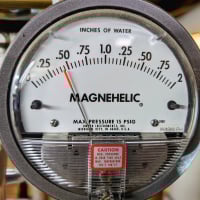
If they plumb it similar to how my Magnehelic and Dwyer pressure switch are, that would be far within spec.
Mine do not even get warm to the touch most of the time and during long runs barely warm. It's just a 18" long length of 1/2" black iron pipe vertical. The air blocks the steam and I guess the pipe conducts heat very poorly.
Single pipe 392sqft system with an EG-40 rated for 325sqft and it's silent and balanced at all times.
0 -
True, but if it was me I'd like to be able to put it in different places like end of steam main, final radiator of a main, etc.. I don't know how practical it would be to put a pigtail in those places or if it would even work as well as on a boiler. No problem obviously putting it on the pressuretrol tree that has a pigtail however.
0 -
All those places in a residential steam system have the same pressure as the boiler.
NJ Steam Homeowner.
See my sight glass boiler videos: https://bit.ly/3sZW1el0 -
Not true because of fluid dynamics and 2 phase fluid dynamics and pressure drop through a pipe due to friction effects where flow is occurring.
0 -
Yes true because of I hooked magnahelics in all those locations and observed it with my eyes. Pressure changes propagate at approximately the speed of sound. The pipes in a residential steam system are all too large to experience measurable pressure changes/differential due to flow or friction.
NJ Steam Homeowner.
See my sight glass boiler videos: https://bit.ly/3sZW1el0 -
Oh so first you said there was no pressure difference ("same pressure as the boiler") to now it is no "measureable pressure changes/differential". Don't believe me, just look it up. You are rewriting my whole Fluid Dynamics textbook we studied from in college, and are defying what Dan Halohan has written in his books and articles. Disclaimer to the mods: I mean no disrespect.
0 -
I think you'd find those books agree with me with the flow rates and pipe sizes that we see in our systems. Dan wrote very many things. Some of these things he saw with his own eyes, and some of these things he just took the word of things he read or heard.
It's very easy to prove me wrong, just hook up a couple gauges and put a couple cameras on them. But you know what? No one ever seems to want to try to prove me wrong, I can't figure that out.
NJ Steam Homeowner.
See my sight glass boiler videos: https://bit.ly/3sZW1el0 -
You can prove yourself wrong but do not want to research the science. If there was no pressure differential there would be no flow. The issue you seem to have trouble with is the degree. It turns out that minute pressure differences can cause steam to flow at high velocities/mass flow rates in a large pipe with very low friction. At some point, if the boiler were suddenly more powerful that pressure drop would get even higher due to the larger mass flow of steam and greater friction effects in that pipe at a higher mass flow rate.
Disclaimer to the mods: I mean no disrespect. Just a discussion of basic science as it relates to steam heating.
0 -
Just an offhand comment. Will there be a pressure difference in a pipe with flow between one end and the other? Yes. Will it be measurable? Depends on the resolution of the measuring device. Will it be significant? Maybe. In residential steam work
There are times when I'm very glad I got my engineering licenses and my degrees back in the dark ages, when one had to prove one's self in the field, with dirty boots and dirty hands and sweat. Rather than looking at books and listening to professors drone on and on…
Br. Jamie, osb
Building superintendent/caretaker, 7200 sq. ft. historic house museum with dependencies in New England0 -
Even within the steam chest of a boiler where there is only one supply pipe being used, the pressure will be lower at the inlet of that supply pipe and steam flows from the farther reaches of the steam chest where pressure is slightly higher to that supply pipe. I guess I don't understand asking if it is significant. It is the physics of the situation.
Disclaimer to the mods; I mean no disrespect
0 -
In terms of measuring the pressure at any given point in a heating cycle, I'm saying it doesn't matter where you put the device because the pressure will read the same at all points. There are all kinds of tiny differences in this world that do not matter so I ignore those. If they matter they matter. These don't matter and can't be measured with anything that we are talking about in this thread.
I have observed this, and no one has observed anything different so I don't know what else to say and probably won't.
if the boiler were suddenly more powerful
I've never known this to occur
NJ Steam Homeowner.
See my sight glass boiler videos: https://bit.ly/3sZW1el0 -
Have you read where Dan Halohan has written that the best place in a long steam main to place the vaporstat is at the end of the main? I have. Why do you think he says this?
Boiler suddenly being more powerful was a thought experiment which I thought you were in favor of.
Disclaimer to mods: I am not being disrespectful.
0 -
I’m not sure why he wrote that and I was surprised to see no difference between the pressure at the boiler and at the end of the main when I hooked up my gauges.
But then it made sense after I thought about it more.
I know Peerless thinks there is a pressure differential there as well, that’s why the myth of “dimension A” exists, because people used bad calculations to determine such things without ever measuring or looking.
That’s my best guess anyway.
But please hook up a couple gauges and prove me wrong, I’d like to learn if I’m mistaken.
But in the meantime I’ll trust my eyes thanks.
Have you considered that it’s possible for even Dan to have passed along incorrect information?
NJ Steam Homeowner.
See my sight glass boiler videos: https://bit.ly/3sZW1el0 -
That's like saying you looked at an atom with a microscope and didn't see any electrons and concluding that Niels Bohr was incorrect. You were surprised because you made an assumption that was incorrect about the magnitude of it in your nice dry steam conditions in your system, with the length and diameter of your steam main. It's a testament to the quality of your installation rather than any proof that a pressure drop does not exist. In someone's 2 pipe system I am conversing with, he sees max. 0.2 in Hg drop from the header to the end of the dry return. You could theoretically at least, hook up a clear vinyl tubing manometer with water in it between those two points and you would see a 2.7 in. difference in the water heights from when the boiler is off and cooled.
I don't have the measuring instruments that are sensitive enough to do it with the short steam main I have, but I could calculate what the theoretical pressure drop would be, based upon fluid dynamics equations. Saying the pressure drop isn't significant doesn't make sense to me (especially saying there is no difference) when it's very significance (and reality of existence) is absolutely proven by the desired result we need, namely steam flow. I don't remember if Dan said how long the steam main would have to be for it to be advantageous to locate the vaporstat there, but under non ideal conditions such as wet steam and/or heavy condensate flow (especially in a counterflow main) the friction becomes larger and the pressure drop becomes larger as the boiler pressure rises accordingly.
I always think about what I read when I read Dan's books and articles. So far it has always been backed up by the science as I know it, and stands the proof of fact checking if I do it.
Disclaimer to mods: I mean no disrespect.
0 -
this isn’t atomic physics, your switch that you linked is more than accurate enough to do the job you are discussing here, and where you place it doesn’t matter. So put it where you like and report back.
NJ Steam Homeowner.
See my sight glass boiler videos: https://bit.ly/3sZW1el0 -
I calculated the pressure drop to all of my radiators many years ago.
I have no idea how correct it is, but I do know it's far less than a Vaporstat would ever care about. Obviously my system is tiny compared to a huge apartment building etc but it's all I've got to work with.
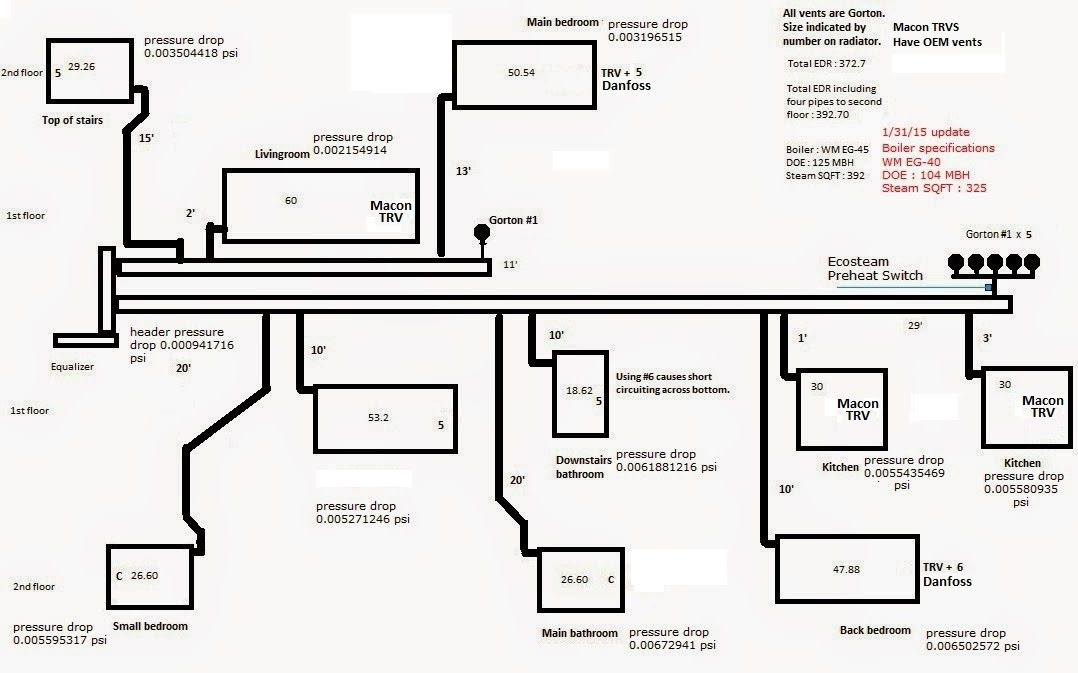
Single pipe 392sqft system with an EG-40 rated for 325sqft and it's silent and balanced at all times.
1 -
@JaymeHart Connecting that sensor to an Arduino may be disappointing. Think about the output voltage range of the sensor will generate with your system's pressure change, probably very small. Now think of the Analog to Digital (A to D) conversion of the Arduino 0-5 VDC at 10 Bit resolution (I believe), so about 5mV steps. And you already lost 20% of the Arduino's A to D range since the sensor only has a 4 volt range (0.5 to 4.5).
I would pick a different sensor that is much closer (but still roubust) to the expected pressures of your system or you will need to build an Op-Amp circuit to expand the sensor's narrow output range (in your system) into the whole A to D range of the Arduino.
National - U.S. Gas Boiler 45+ Years Old
Steam 300 SQ. FT. - EDR 347
One Pipe System0 -
@JaymeHart, you can definitely do that. i wouldn't recommend that particular pressure transducer though. Use one with a 0-5 psi range (vacuum won't hurt it). Don't bother with a pigtail (it affects the readings); just place it on a tube well above the boiler water line. You can find these transducers on eBay if you don't mind waiting for shipment. Or use a Magnahelic with switch on it.
I've use these transducers for years on my boilers—hooked up to ESP8266 board (NodeMCU 1.0) to get the wifi connectivity. I cycle the boilers on a timer once the pressure reaches about 8 inches of water or if they've been on long enough—the time limit for a cold start being much longer than a warm one.
If you bring the outdoor weather conditions into the equation you can probably eliminate the pressure transducer entirely based on your operating experience. I've thought about trying that but never have.
0 -
@Captain Who Please stop with your "Disclaimer to mods" at the ends of your posts. -Andrew
Forum Moderator
0 -
I mean no disrespect or such to anyone, but…
Remember two things.
First, KISS
Second, the objective of the exercise is a system which will work, every time, when needed…
Br. Jamie, osb
Building superintendent/caretaker, 7200 sq. ft. historic house museum with dependencies in New England0 -
Jaime Hall: "First, KISS"
Yep. Thats why I said after all that, it probably wouldnt be any better than just running my Vaporstat as it is currently set up just below 1psi.
But it would be fun to try....
And then my wife would ask me to take that digital stuff off so nothing goes wrong when I am away traveling for work.
1 -
Regarding simplicity - while surely desirable, improvement here does require some additional complexity which need not scare anyone away.
1.The good news is that PLC's are both incredibly reliable and inexpensive enough to always keep a spare on hand. I run many - some going on 30 years in continuous operation without ever letting me down.
2. Just leave the original controls in place. Be sure to wire a switch that bypasses all the new "experimental" stuff that with one flick and returns the system right back to the simple vaporstat/tstat control.
1926 1000EDR Mouat 2 pipe vapor system,1957 Bryant Boiler 463,000 BTU input, Natural vacuum operation with single solenoid vent, Custom PLC control0 -
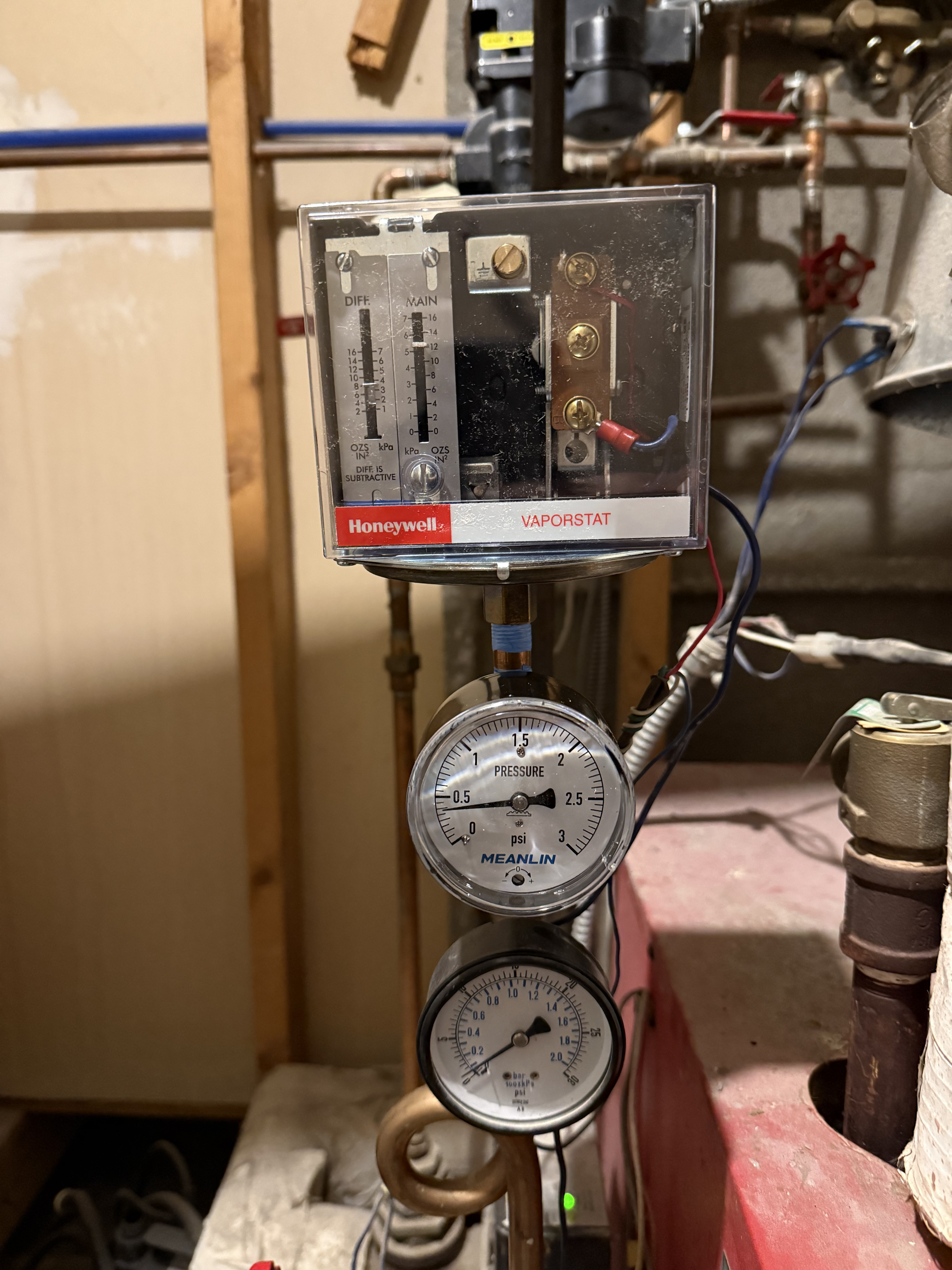
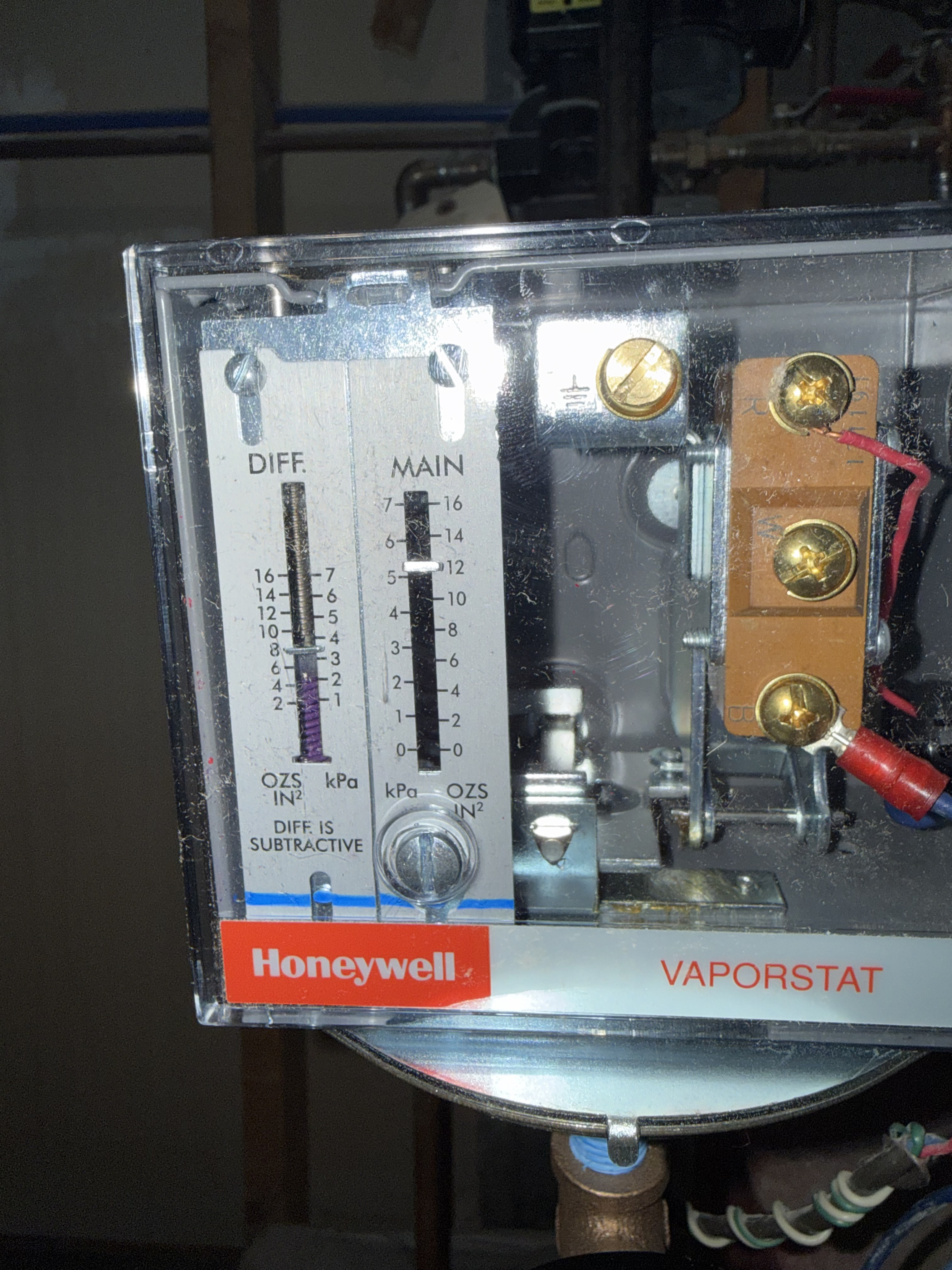
New vaporstat and 0-3 gauge installed. System is now reliably cutting out at just above 1 psi and back in at .5 psi.
Piping for return has been ordered and is scheduled for swap in two weeks.
0 -
With those settings I'd think it would be cutting out at 12 oz/in^2 (0.75 psi) and cutting in at 4 oz/in^2 (. 25 psi). Seems like the calibration of the vaporstat is off by 4 oz/in^2. How long is it taking your system to go from 1 psi to .5 psi and back to 1 psi again? At some point if that time is too small it is a lot of wear and tear on the gas valve and is called short cycling. I'd adjust the cut in to be more like 3 oz/in^2 by increasing the differential until that is what you see on your pressure gauge.
PS - after coffee I remembered you are the OP and when you do your delay circuit, the cut-in won't matter lol. Still wondering how a new vaporstat from Honeywell/Residio? can be so far off.
0 -
I agree, this vaporstat is still off, however it is closer than the pressuretrol I swapped it for so I’m going to run it for a bit.
0 -
As long as it is consistent, ie. precise, if not accurate, you can work with it for sure.
0 -
The scales look like they have slotted holes, can they be adjusted?
And if so, are you sure your gauge is correct?
Single pipe 392sqft system with an EG-40 rated for 325sqft and it's silent and balanced at all times.
0 -
I saw that too, including the blue line that maybe they drew at the factory?, but it looks like he needs to move the scale for the main maybe 1/4 in. down and the screw is already at the end of the slot.
0


Categories
- All Categories
- 87.8K THE MAIN WALL
- 3.3K A-C, Heat Pumps & Refrigeration
- 59 Biomass
- 430 Carbon Monoxide Awareness
- 133 Chimneys & Flues
- 2.2K Domestic Hot Water
- 6K Gas Heating
- 124 Geothermal
- 170 Indoor-Air Quality
- 3.8K Oil Heating
- 79 Pipe Deterioration
- 1.1K Plumbing
- 6.7K Radiant Heating
- 396 Solar
- 16.1K Strictly Steam
- 3.5K Thermostats and Controls
- 56 Water Quality
- 51 Industry Classes
- 51 Job Opportunities
- 18 Recall Announcements