Weil-McLain P-368 Sight-glass level drop as steam pressure falls?

I have a 1994 Weil-McLain P-368-S oil-fired steam boiler serving a one-pipe steam system. The boiler is rated for 355 sq ft EDR, with approximately 237 sq ft of connected radiation.
I've observed an interesting water-level phenomenon for many years and would appreciate an explanation of the underlying physics.
During extended firing, the water in the sight glass oscillates approximately one inch. When the Pressuretrol cuts out at 1.7 psi, the burner stops and the water level gradually falls as pressure decays.
By the time pressure reaches 0.5 psi, the water level has fallen close to the low-water cutoff operating point.
When the burner refires and pressure begins increasing, the sight-glass water level rises promptly toward its normal operating position.
When the thermostat is satisfied and the burner shuts down for an extended period, the water level returns to its normal resting position, slightly above the midpoint of the sight glass, in approximately one minute.
This behavior is longstanding. During a comprehensive boiler overhaul this summer, I disassembled and cleaned the LWCO, gauge column, Pressuretrol pigtail, and connecting fittings. All were remarkably clean, with no apparent restrictions.
I've considered whether this is caused by delayed condensate return, but the rapid water-level recovery when firing resumes makes me question that explanation.
I've also wondered whether vigorous steam generation changes the apparent water level through internal circulation and steam-bubble formation, followed by shrinkage when firing stops.
My question: What physical mechanism would explain the water level falling as boiler pressure decays and then rising again as steam generation resumes?
Comments
-
When water boils at 0psi the water temp is 212 deg.
At 1.7psi the water temp has risen to 217 degrees or 5 degrees warmer.
the only thing I can think of it when you are boiling at 1.7psi the pressure control stops the burner. As the pressure drops some of the water in the boiler is still at 217 degrees. If the pressure drops fast enough the boiler will produce more steam than normal for a minute or so because the 217 deg water has less pressure on top of it. This will cause rapid boiling, so the water level drops a bit.
Your boiler operation sounds normal to me, as long a s the water comes back to normal quickly when the stat is satisfied and your not tripping on lwco your fine.
You could try lowering the pressure a smidge which may give you short cycling. Since your building pressure you could look into reducing the firing rate (smaller nozzle) if your tech want's to try that. may not be worth fiddling with
 1
-
I'd also see if the boiler water is dirty. Not sure if you flushed it out this past summer. Dirty water, especially with a layer of oil on the top, won't boil right and can cause a lot of interesting behavior.
Also check the burner's firing rate- nozzle size and pump pressure. Make sure it's not overfired.
And does the piping around the boiler meet W-M's specs?
 1
-
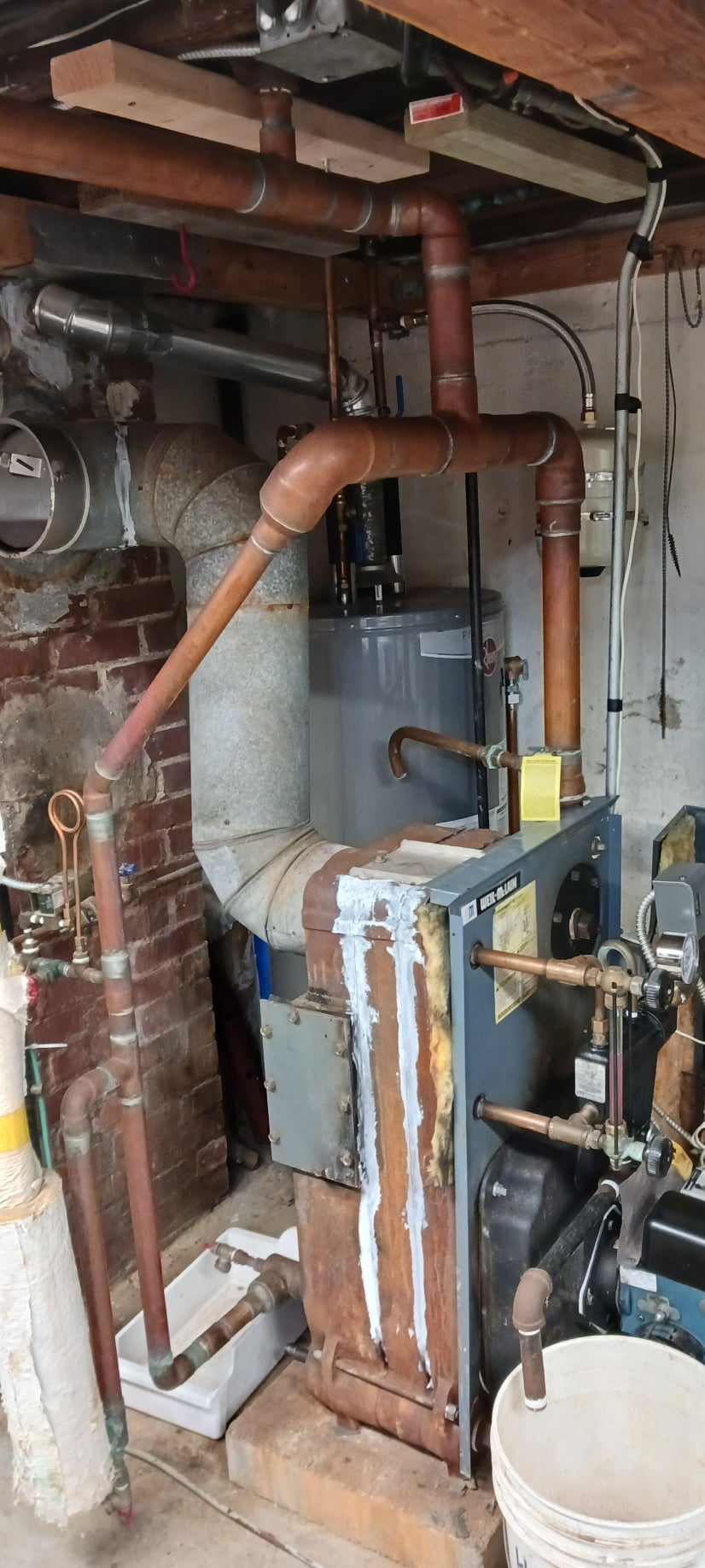
And what if the near boiler piping does not have the equalizer and Hartford loop. If that WM replaced the old original coal boiler with a check valve in the return line and the installer didn't read the piping instructions thoroughly then the installer may have connected it like the original large water volume boiler and therefore may be getting some strange pressures as the burner ignites and extinguishes.
Can we see a picture of the near boiler piping? Now since it has been working for all these years I do not suggest changing anything. I would like to see what is there and maybe have a explanation that @ethicalpaul might shed some light on.
Edward Young Retired
After you make that expensive repair and you still have the same problem, What will you check next?
0 -
thanks Ed. I have never seen this myself (and I currently don’t have a header or equalizer!)
But the OP described what he is seeing seemingly very accurately so this post is definitely interesting.
If the issue occurred during firing I would 100% suspect carryover due to water quality but this one has me stumped
NJ Steam Homeowner.
See my sight glass boiler videos: https://bit.ly/3sZW1el0 -
I have seen this happen before when a boiler shuts down. It rarely causes a LWCO trip from what I have seen.
If you have hotter water in the boiler that is above the steam pressure at that moment (Burner off, pressure drops water above the saturation temp of the lower pressure) is some of the boiler water not going to flash into steam? I say yes it will.
Time for an @ethicalpaul video😎😎😎😎


 4
-
I agree it would generate steam as the pressure dropped but I don’t know about “flash”.
How would that make so much water evaporate? We’re talking gallons.
Or are you saying something is pushing the water out of the boiler?
NJ Steam Homeowner.
See my sight glass boiler videos: https://bit.ly/3sZW1el0 -
No. not pushing. and not much water. He only has a 3-section boiler, so the amount is very small. We are only talking about the water from a normal level 1/2-gauge glass to the bottom of the GG. he doesn't even trip LWCO.
I have seen this happen. Maybe vacuum out in the system from steam collapsing or the steam pressure dropping with 217 deg water creates rapid boiling or a combination of both.
0 -
I definitely believe you Ed! I will say that a three section boiler is about 1 gallon per inch of gauge glass so he's losing maybe 3-4 gallons out of his boiler during this time. Mysterious!
NJ Steam Homeowner.
See my sight glass boiler videos: https://bit.ly/3sZW1el0 -
maybe it is causing a vacuum in part of the system that briefly and quickly pulls a slug of water up in to the mains through the return and that water takes some time to drain back to the boiler? maybe it has something to do with the steam slightly preferring one main over another?
0 -
Had somehow similar thing happen with my brand new boiler BEFORE proper skimming.
As water heats up it expands. So on mine it would raise around 0.5-1in above regular water line. As it starts steaming it would then slowly start collapsing close to LWCO. After i skimmed the boiler it started behaving more normally: raises about 0.5 above regular water as it heats up then gently dances +/- 1in around the regular water line.
»»» See my steam heat YouTube videos:
https://www.youtube.com/@HeatingBlog0 -
it was surging. because of the oil on the surface the water was boiling intermittently and violently throwing liquid water in to the mains
0 -
To clarify one point raised in the discussion, the LWCO does occasionally activate during this condition, typically under a heavy heat demand. I have an automatic makeup-water solenoid connected to the LWCO's auxiliary contact, with the incoming water flow restricted (very restricted) by a manual valve.
Regarding water cleanliness, this past summer, I completely disassembled and cleaned the LWCO, gauge column, Pressuretrol pigtail, and their connecting fittings. I used brushes and flushed the passages thoroughly. Everything was remarkably clean, probably because I've regularly treated the boiler water with 8-Way. I don't believe restricted gauge-column or LWCO passages are responsible, although I recognize that clean passages don't necessarily rule out water-chemistry effects.
Regarding flash boiling, Ed's @EBEBRATT-Ed explanation about hot boiler water continuing to generate steam as pressure falls makes sense to me. However, as @ethicalpaul pointed out, the actual quantity of water evaporated by a few degrees of temperature reduction would be relatively small. It seems unlikely that flash evaporation alone could account for the several inches of water-level change.
I've been considering whether another phenomenon is related to changes in the volume of the steam-water mixture inside the boiler. During firing, steam bubbles form throughout the heated water. Those bubbles occupy considerable volume, effectively expanding the mixture and raising the apparent water level. When the Pressuretrol shuts off the burner, steam generation gradually diminishes. As the bubbles escape or collapse, the mixture contracts, thereby reducing the volume in the boiler. When firing resumes, renewed steam-bubble formation increases the volume, raising the apparent water level again.
It also raises an interesting possibility: perhaps several gallons of water aren't actually leaving the boiler. Instead, the apparent water volume is changing because of another force in keeping with @mattmia2 idea about vacuum. Of course, the sight glass measures the level at its connections, not necessarily the average height of the boiling mixture, so I'm not certain this fully explains the observation.
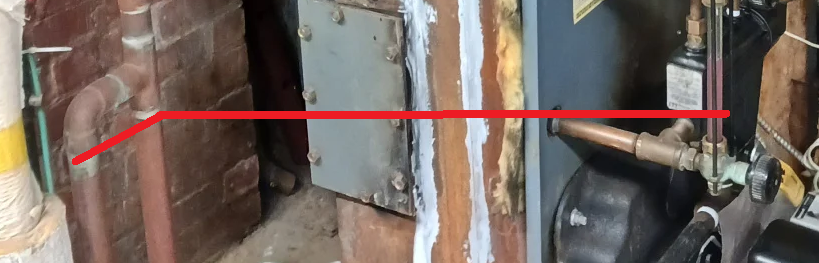
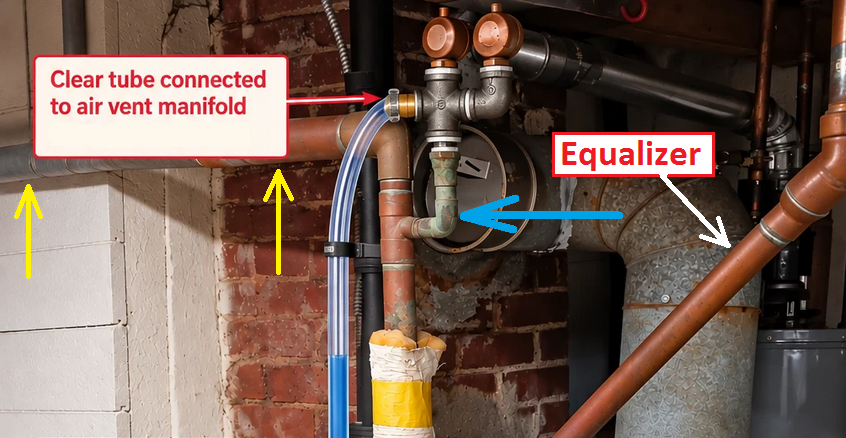
Regarding the near-boiler piping, Several of you asked about the header, equalizer, and Hartford Loop. I attached a photograph of the near-boiler piping.
Thanks again for helping me explore this.
PS> I left off the jacket to inspect for any seal leaks after this summer's overhaul.
 0
-
too much treatment can cause the water to prime(foam) under some circumstances.
there are some theories about steaming tilting the water line in the boiler.
0 -
oh, and the lwco and feeder can usually be set with a time delay to keep it from overfeeding the boiler as a result of a transient condition.
1 -
I'm leaning toward a vacuum issue. Especially if the system was at 1.7 PSI when the burner shuts off.
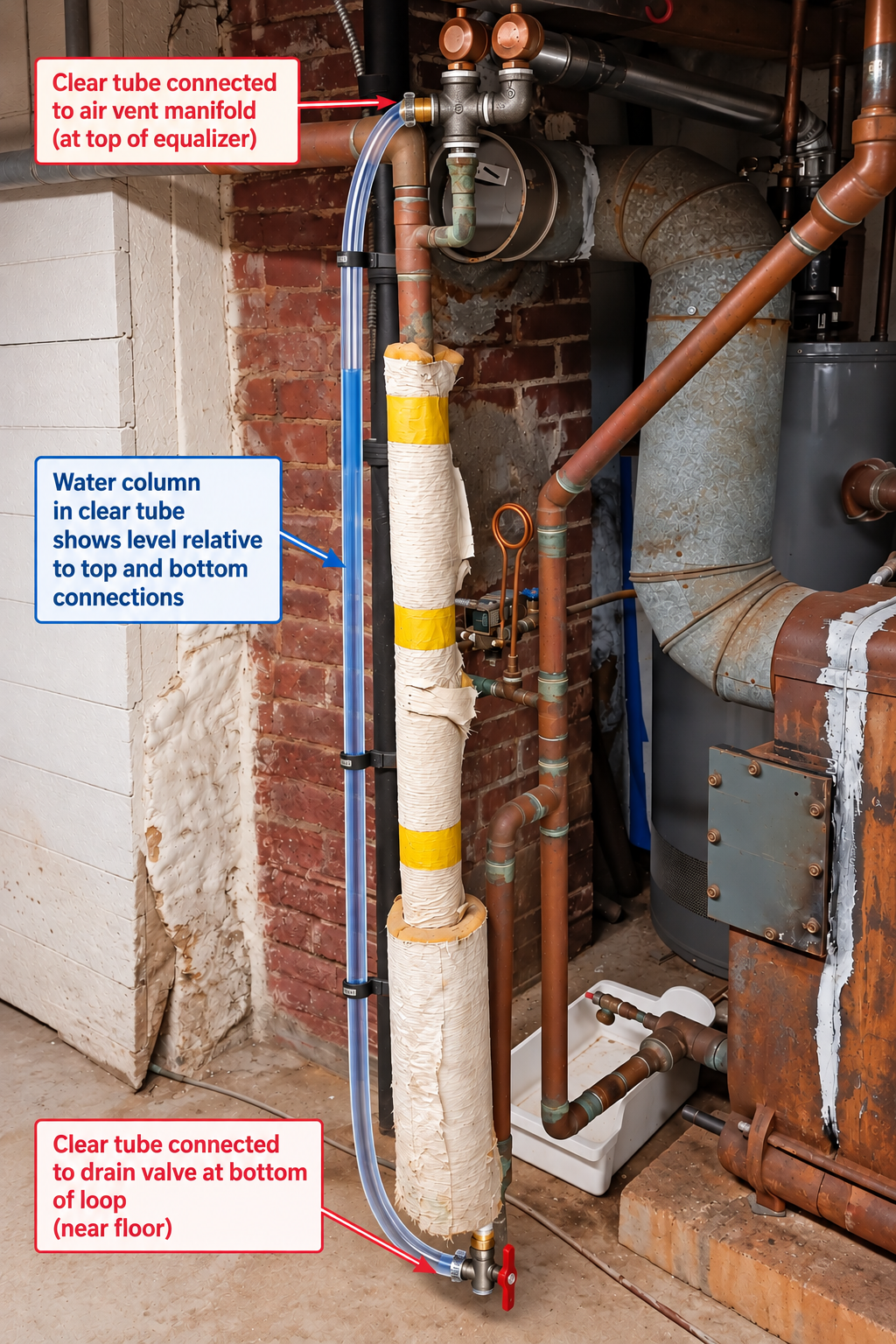
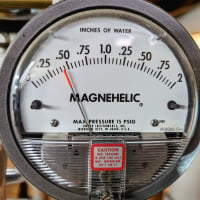
If you are into doing some experimenting. Maybe temporary lower the water level below the Hartford loop level so any negative pressure at the far end of the wet return can't pull water out of the boiler. See if the odd behavior persists. Another way is use a Dwyer Magnehelic Differential pressure Gage and compare the pressure between the top of the boiler and the far end of the Steam Main where the drip to the wet return is. Or add a sight glass (clear tubing) for the height of the drip of the Steam Main end down to the wet return.
 National - U.S. Gas Boiler 45+ Years Old
Steam 300 SQ. FT. - EDR 347
One Pipe System2 -
-
Boy it sounds to me like a vacuum issue. Can't wait for the video :)
Miss Hall's School service mechanic, greenhouse teacher, dog walker and designated driver
0 -
Whereabouts do you live, @JMC3 ?
NJ Steam Homeowner.
See my sight glass boiler videos: https://bit.ly/3sZW1el2 -
If the burner shuts off at 1.7 psi and turns back on at 0.5 psi how could there possibly be vacuum in the system?
Single pipe 392sqft system with an EG-40 rated for 325sqft and it's silent and balanced at all times.
1 -
Good point assuming the gauge is correct.
Miss Hall's School service mechanic, greenhouse teacher, dog walker and designated driver
0 -
Sounds like a road trip with a video camera is in the works? What do you think?
Edward Young Retired
After you make that expensive repair and you still have the same problem, What will you check next?
0 -
@109A_5@109A_5 At this time, I'm not comfortable lowering the boiler water level, so I'll consider your second experiment. I've attached an illustration showing a clear sight tube connected between the upper air-vent manifold and the drain valve at the bottom of the return loop. Is this the arrangement you had in mind?
As I understand your theory, a pressure differential between the boiler steam chamber and the far end of the steam main could displace water from the boiler into the return piping, possibly raising the water column in the return drip. If that's what's happening, the experimental sight tube might reveal a corresponding change in water level as the boiler cycles between 1.7 and 0.5 psi.
Am I interpreting your experiment correctly?
 0
-
The pressuretrol is also tripping and resetting reliably.
I'd say the chances of a vacuum are basically zero.
Single pipe 392sqft system with an EG-40 rated for 325sqft and it's silent and balanced at all times.
1 -
Question: Wouldn't the two Gorton #1 air vents break a vacuum that develops at the end of the main lines?
0 -
In my experience Gorton vents will hold a slight vacuum, but not much before it pulls them open as it's just a bi metal coil spring.
Nothing compared to the Hoffman vents I was using before them. Those seemed to be capable of holding a fairly deep vacuum until they clicked open.
Single pipe 392sqft system with an EG-40 rated for 325sqft and it's silent and balanced at all times.
0 -
Let me step in to say it is misleading to say "vacuum that develops at the end of the main lines".
In our residential steam systems, the pressure is the same all throughout the system. There is no measurable difference between the pressure in the boiler, and the pressure at the end of the main, for instance.
The simple reason for this is that pressure changes travel at the speed of sound through steam or air, so any pressure change is transmitted nearly instantly for purposes of our basements.
NJ Steam Homeowner.
See my sight glass boiler videos: https://bit.ly/3sZW1el0 -
The vacuum I refer to is in relation to the boiler's pressure, not to atmospheric pressure, not to outer-space. Call it negative pressure if you like. All that 1.7 PSI steam compressed into all the radiators then collapsing in the radiators, since they will dissipate the heat faster than the boiler will.
Yes @JMC3 your illustration is correct, it may help to see where the water is temporarily going.
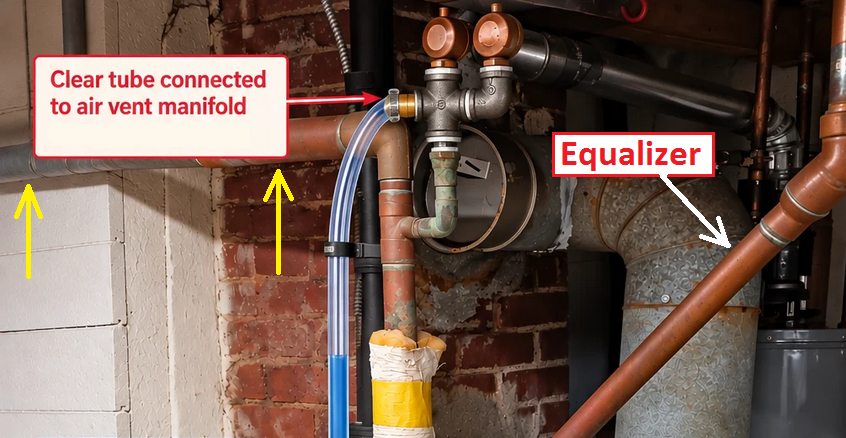
BTW that is not the equalizer.
National - U.S. Gas Boiler 45+ Years Old
Steam 300 SQ. FT. - EDR 347
One Pipe System1 -
The pipe the Yellow arrows are pointing to (looks like a Steam Main extension), depending on its length and it being mostly horizontal could hold a lot of water if the water can be lifted that far up due to a pressure differential.
 National - U.S. Gas Boiler 45+ Years Old
Steam 300 SQ. FT. - EDR 347
One Pipe System0 -
@109A_5 You're right, I mislabeled the vent riser. I'll source a high temp clear PTFE tubing to set up this experiment. I'll take notes and report back at a later date. @ethicalpaul I live in Wharton, New Jersey.
Thanks everyone for your inputs to this investigation.
0 -
You're an easy drive from me but honestly I'm not sure what I could find out—I do have some very good low pressure gauges
NJ Steam Homeowner.
See my sight glass boiler videos: https://bit.ly/3sZW1el1 -
-
It's not my house, I would need to be invited! But again, I'm not sure what I'd be able to find…I can't think of a cause of this…as was I think correctly stated earlier, how can their be a vacuum issue when the water level changes while the system is still pressurized?
NJ Steam Homeowner.
See my sight glass boiler videos: https://bit.ly/3sZW1el0 -
Forget the word vacuum that was used previously, think pressure differential. Like the earth, how can there be a pressure differential with the earth's atmosphere it is so vast, but there is.
National - U.S. Gas Boiler 45+ Years Old
Steam 300 SQ. FT. - EDR 347
One Pipe System0 -
ok where would the pressure differential be? I can’t picture it.
The only thing I can imagine that would drain that much water is carryover
NJ Steam Homeowner.
See my sight glass boiler videos: https://bit.ly/3sZW1el0 -
There's different pressures primarily due to temperature and gravity.
None of this applies to a microscopic (in comparison) steam heating system I'm afraid.
Single pipe 392sqft system with an EG-40 rated for 325sqft and it's silent and balanced at all times.
0 -
@JMC3 wrote:
"I have a 1994 Weil-McLain P-368-S oil-fired steam boiler serving a
one-pipe steam system. The boiler is rated for 355 sq ft EDR, with
approximately 237 sq ft of connected radiation. ""During extended firing, the water in the sight glass oscillates
approximately one inch. When the Pressuretrol cuts out at 1.7 psi, the
burner stops and the water level gradually falls as pressure decays. ""By the time pressure reaches 0.5 psi, the water level has fallen close to the low-water cutoff operating point."
Other than the pressure 1.7 PSI (hopefully due to the boiler being oversized) all sounds basically normal until after the Pressuretrol shuts the burner down due to excessive pressure. So I'm not seeing carryover, surging or priming as being the issue.
So I believe the pressure difference I refer to is in relation to the boiler's pressure compared to the rest of the system. I would call it differential pressure. Since the boiler water is still over 212 degrees Fahrenheit due to the pressure when the Pressuretrol shuts the burner down.
Then with all that 1.7 PSI steam compressed into all the radiators starting to collapse since they (the radiators) will dissipate the heat faster than the boiler will, creating the differential pressure (boiler versus the rest of the system).
With the differential pressure, the byproduct is the boiler's water is lifted out of the boiler via the wet return to fill the horizontal Steam main extension. I'd be curious about the vertical distance (in inches) from the Hartford loop to the Steam main extension.
When things cool down (thermostat satisfied) or when the burner refires the pressure throughout the system equalizes and the water returns to the boiler.
If the LWCO / autofeeder never adds fresh water due to this situation it may not hurt anything.
The sight glass added in parallel with the Steam main extension's drip pipe may provide proof of concept. However in this case with the Main Vents tapped in below the Steam main extension, this may make the filling of the added sight glass up near the very top up to the Steam main extension's level slow or initially impossible depending on the seal of the vents.
Even if the situation is eventually understood, I would not run my system up to 1.7 PSI, I don't see any good reason why.
National - U.S. Gas Boiler 45+ Years Old
Steam 300 SQ. FT. - EDR 347
One Pipe System0 -
Additionally since this phenomenon happens after Pressuretrol shuts the burner down I doubt a significant amount of water is leaving the boiler as steam. If that amount of water was leaving the boiler as steam I would expect the pressure to significantly go up even more. Also by the shear volume of water leaving the boiler, I believe the water is leaving the boiler as water.
National - U.S. Gas Boiler 45+ Years Old
Steam 300 SQ. FT. - EDR 347
One Pipe System0 -
What if the water isn't leaving the boiler?
Maybe it's all foamed up or full of steam bubbles which is expanding it and raising the water level.
Maybe the single riser on the small boiler is pulling the water towards the gauge glass side and making it look higher.
Perhaps both?
I think an easy way to prove either of those is fire the boiler whatever amount is needed to cause this to happen, turn the burner off, watch the level drop a large amount and turn the burner back on. Does the water magically come back as it starts producing steam?
Single pipe 392sqft system with an EG-40 rated for 325sqft and it's silent and balanced at all times.
0 -
@ChrisJ Your theory that the apparent water volume expands because the boiler water is "full of steam bubbles" is one of four candidates advanced in this discussion. However, it remains unverified.
My observations are described in my initial post. Yes, the water in the sight glass rises immediately when the Pressuretrol cuts in. Simply put, the apparent water level rises and falls with boiler pressure. The LWCO also shuts down the burner under a high heating load, usually during the first pressure cycle on a cold morning. If I manually shut off the burner after pressure cut-out, the water returns to its normal level as boiler pressure falls to zero, generally within about a minute, or two.
@EBEBRATT-Ed suggests that copious steam is generated as pressure falls while the boiler water remains near 217°F. @ethicalpaul , however, questions whether enough water could flash into steam in such a short interval to account for the observed change in water level. The magnitude of this effect remains unresolved.
@mattmia2 proposes that steam flow shifts the boiler waterline toward the riser and away from the sight glass and control connections. This theory has merit but has not yet been experimentally verified. You have also suggested waterline displacement, although in the opposite direction.
Finally, @109A_5 proposes that a pressure differential within the steam system displaces boiler water into the return piping, potentially raising it toward the steam main. Of the four explanations, this is the one we have a practical means of investigating through the experiment he proposed (earlier.)
@ethicalpaul If I find a pressure differential and water column rise during the experiment, then you can visit my boiler room to repeat and validate my findings with your better gauges. @EBEBRATT-Ed would be glad about that!
There are some very talented and knowledgeable people contributing to this discussion, and I appreciate everyone's input. It's been interesting to see the different theories and reasoning brought to bear on this rather curious phenomenon. Thanks!
 1




Categories
- All Categories
- 87.9K THE MAIN WALL
- 3.3K A-C, Heat Pumps & Refrigeration
- 60 Biomass
- 430 Carbon Monoxide Awareness
- 134 Chimneys & Flues
- 2.2K Domestic Hot Water
- 6K Gas Heating
- 124 Geothermal
- 170 Indoor-Air Quality
- 3.9K Oil Heating
- 80 Pipe Deterioration
- 1.1K Plumbing
- 6.7K Radiant Heating
- 397 Solar
- 16.1K Strictly Steam
- 3.5K Thermostats and Controls
- 56 Water Quality
- 51 Industry Classes
- 51 Job Opportunities
- 18 Recall Announcements