Welcome! Here are the website rules, as well as some tips for using this forum.
Click here to Find a Contractor in your area.
If our community has helped you, please consider making a contribution to support this website. Thanks!
Weil-McLain P-368 Sight-glass level drop as steam pressure falls?
Comments
-
I understand, under my own current conditions (I've put installing mine off for 2 years now?) it's not the best thing for me to say, but he has a lot of copper piping. Maybe it would be easy for him to install 1 or 2 of those sight glasses and actually watch what happens?
Single pipe 392sqft system with an EG-40 rated for 325sqft and it's silent and balanced at all times.
0 -
@ChrisJ said: What if the water isn't leaving the boiler?
How would you explain the sight glass lever dropping? The pressure at the top of the glass is greater than the pressure at the bottom, while the water in the boiler Does not leave?
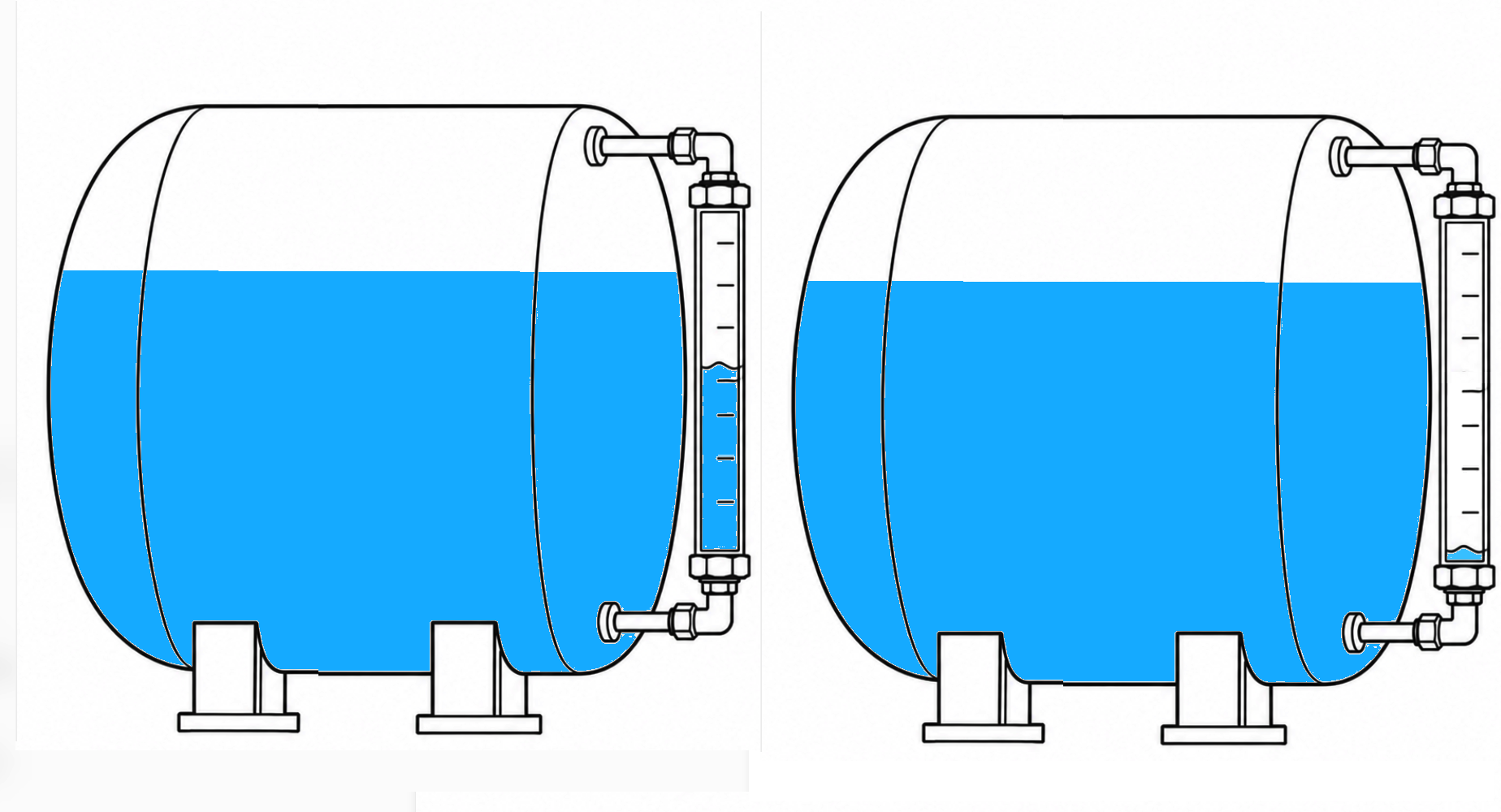
I don't think that is how gauge glasses work!
Edward Young Retired
After you make that expensive repair and you still have the same problem, What will you check next?
0 -
I was reaching…………I know.Single pipe 392sqft system with an EG-40 rated for 325sqft and it's silent and balanced at all times.
 1
-
I'm not against doing the easy things first to eliminate possible causes. Carryover, surging, priming or foaming water is usually a water quality or level issue issue. So flush out the boiler a few times and skim it too.
I suspect nothing will change, but you never know until you try.
If I understood @JMC3 correctly the phenomenon only occurs with the high pressure and when the burner shuts down. Is this a characteristic of carryover, surging, priming or foaming water ? Otherwise the boiler seems normal.
National - U.S. Gas Boiler 45+ Years Old
Steam 300 SQ. FT. - EDR 347
One Pipe System0 -
Its my understanding higher pressure should result in less foaming and carry over.
As pressure builds the steam bubbles get smaller. Also the velocity flowing out of the boiler should drop.
Single pipe 392sqft system with an EG-40 rated for 325sqft and it's silent and balanced at all times.
0 -
Here's what happens:
The LWCO didn't trip the fire circuit on this try, but it has in the past. Next video I'll show the water level return upon pressure rise.
0 -
@JMC3 You have to make sure the LWCO is reliable it's an important safety devise. You don't want to have to replace the boiler.
0 -
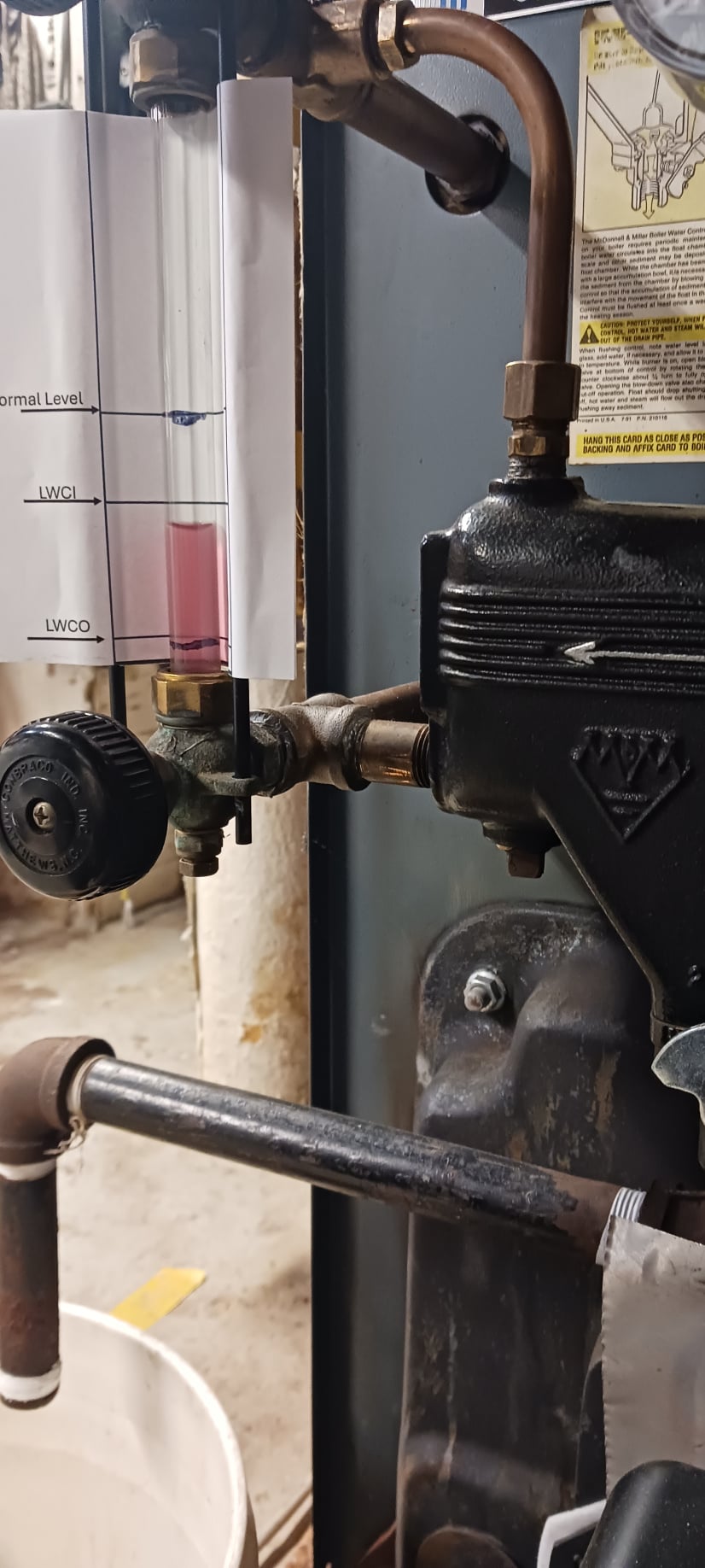
I made a paper reference scale and placed it behind the sight glass. The lowest mark indicates the LWCO cut-out level, which lines up perfectly with the painted line on the float body (thanks, @109A_5 ). After a blowdown of the float chamber and refill through the automatic make-up valve, the float was satisfied at the LWCI mark, shown slightly above the water level, probably due to cooling. Lastly, the highest mark indicates the normal operating water level.
My experience is that the apparent water level is repeatedly drawn below the LWCO mark until the water level in the boiler eventually reaches the normal operating level. I've deliberately throttled the make-up water supply to a very low flow rate to prevent overfilling during these unusual drawdowns.
0 -
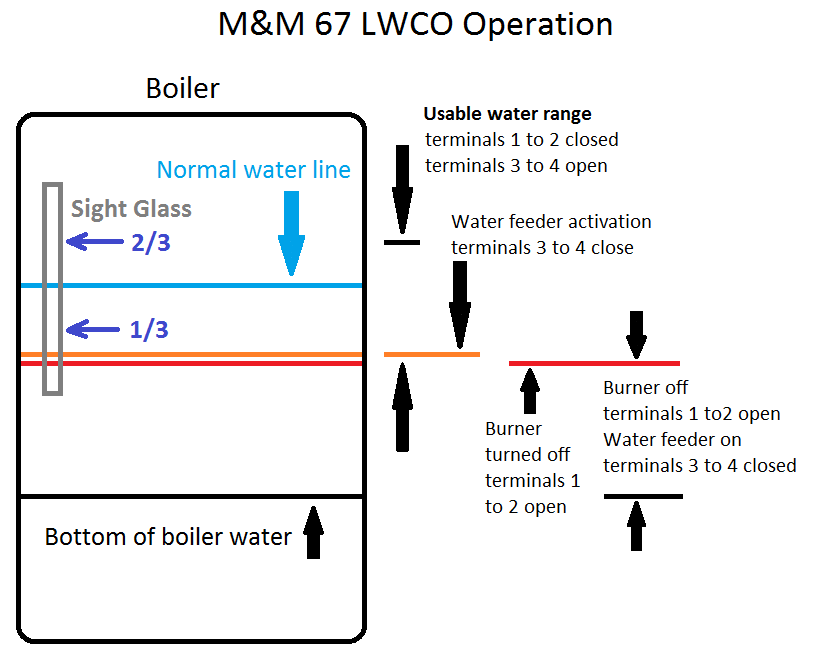
Over the years the switch in the M&M 67 has changed a bit. Some has some calibration adjustments of various types. The switch assembly usually has some hysteresis. So depending on the switch assembly as the system water slowly (normally) is lost the water will be replenished before the burner is shut off.
 National - U.S. Gas Boiler 45+ Years Old
Steam 300 SQ. FT. - EDR 347
One Pipe System 1
-
it’s taking a looong time to drop pressure after cut-out occurs!! Something is up
That’s a lot of level “bobbing” too, there might be some carryover
still can’t think of why the level drops
NJ Steam Homeowner.
See my sight glass boiler videos: https://bit.ly/3sZW1el1 -
@ethicalpaul "still can't think of why the level drops"
LOL, you should be asleep. I can't think straight most of the time and especially at 1:00am. LOL😎😎😎😎
 1
-
Boiler Water Level Experiment – Observations and Results
Following the recommendation of @109A_5, I conducted an experiment to investigate the unusual water-level behavior in my boiler, particularly the drop in the boiler sight glass during pressure decay that occasionally triggers the LWCO.
Experimental Setup
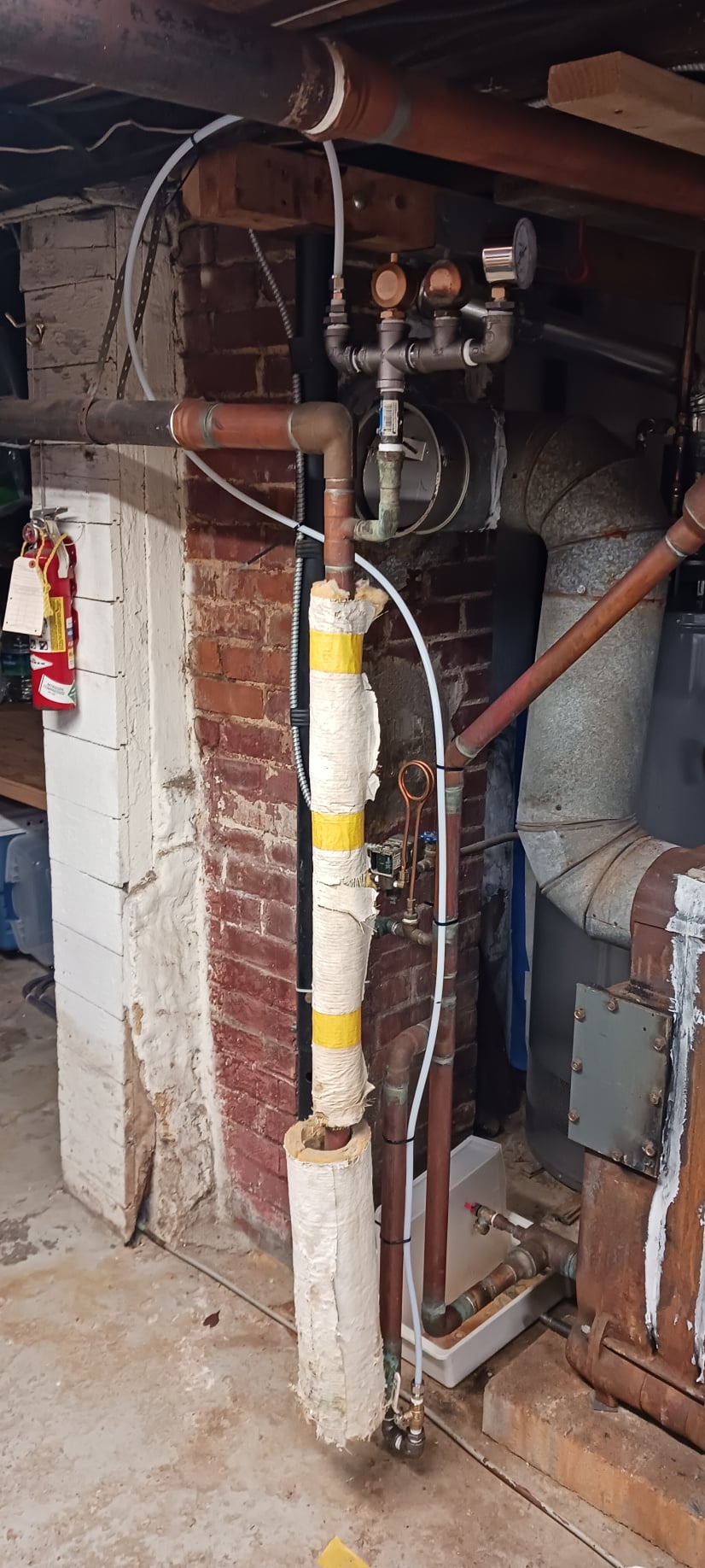
I installed a 0–3 psi pressure gauge on a riser manifold containing two Gorton No. 1 main vents and a fitting connected to the top of a temporary PTFE tubing sight glass. See picture below.
At the bottom of the Hartford Loop, I installed a 3/8" ball valve and compression fitting connected to the bottom of the temporary sight glass. This arrangement allowed me to observe the water level in the external column simultaneously with the boiler sight glass.
I also closed the automatic makeup-water supply valve to ensure that no additional water could enter the boiler during the experiment.
Additional Notes:
I flushed the boiler @patrykrebisz but did not a charge of 8-way treatment @mattmia2 in keeping with good recommendations from the forum.
Observations
- At rest: The water level in the experimental column was identical to that in the boiler sight glass.
- During initial steaming: Once air had been vented from the steam main, but with both pressure gauges still reading 0 psi, the boiler sight-glass water level began oscillating around its initial level. Meanwhile, the water in the experimental column dropped approximately 2.5", settling near the midpoint of the top of the Hartford Loop.
- As boiler pressure increased: The water level in the experimental column dropped an additional 1", for a total displacement of approximately 3.5", while the boiler sight glass continued to oscillate around its operating level.
- During pressure decay: As boiler pressure decreased from approximately 1.5 psi, the water level in the boiler sight glass dropped to the bottom of the glass, activating the LWCO. This reproduced the original phenomenon I was attempting to investigate. Interestingly, the water level in the experimental column remained relatively steady at approximately 3.5" below its original level. This effectively broke the connection between the boiler water and the wet side of the Hartford loop.
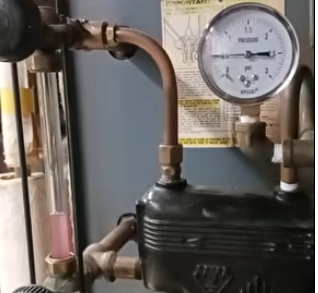
- Pressure readings: At no time during the experiment was there an observable pressure differential between the two 0–3 psi pressure gauges (predicted by @ethicalpaul.)
- Recovery: After boiler pressure reached zero, the water levels in both the boiler sight glass and the experimental column gradually returned to their original levels over approximately one minute. Since the makeup-water supply was closed, no additional water entered the system. Once the boiler water level recovered, the LWCO reset and permitted the burner to fire again.
Observations and Possible Conclusions
The experiment demonstrated that the boiler sight glass and the external water column behave quite differently during steaming and pressure decay, even though both return to their original levels once pressure dissipates.
The fact that both water levels recover without the addition of makeup water suggests that the phenomenon involves temporary water displacement or redistribution (suggested by @mattmia2.)
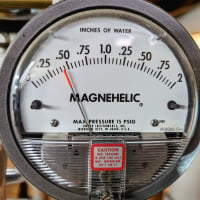
Although both pressure gauges indicated identical pressures throughout the experiment, I recognize that relatively small pressure differences might not be detectable on these gauges. For reference, a 3.5" water-column displacement represents approximately 0.13 psi; these gauges are not that precise.)
I know it's not very scientific to say that I feel like the volume of water is drawing closer to the riser and away from the sight glass. I've long felt this was the behavior but could never test it. @mattmia2 also suggested, "there are some theories about steaming tilting the water line in the boiler" so for now he has the leading theory.
If anyone can draw a more definitive conclusion from these results or recommend additional diagnostic testing, I would appreciate your thoughts.
Thanks!
0 -
to me it sounds like the steam pressure is forcing the water out of the boiler into the return. Measure from the floor to the normal water level. Then measure from the floor to the bottom of the Hartford Loop nipple. Most boiler MFGs recommend the HL be 2-4" below the normal water line. I suspect you HL may be too low
0 -
I don’t know anything about the internals of this old boiler but if it’s taking 1 minute for those water levels to equalize after the pressure is zero then I suspect some internal blockage or other weirdness.
NJ Steam Homeowner.
See my sight glass boiler videos: https://bit.ly/3sZW1el0 -
Well if this were true wouldn't the water level rise in the new sight glass installed parallel the steam main extension drip? The thing is where is the water going. Too bad a transparent cover can be made where the tankless coil would go.
It is a small boiler and oil maybe the shape of the boiler and internal sections and/or baffles is causing the odd behavior.
Personally I would never run my pressure that high, so I never would have noticed that behavior. My house heats just fine at less than 0.072 PSIG (2 inches of water column).
National - U.S. Gas Boiler 45+ Years Old
Steam 300 SQ. FT. - EDR 347
One Pipe System0 -
He started the boiler and had no visible pressure on either gauge as it was apparently just starting to steam. The water went somewhere and there are only two choices.
Into the return
out with the steam.
Since the boiler was just getting started I don't think the water jumped up in the supply pipe
Next thing to try would be to let the boiler go completely cold. Then start it up and when it starts to steam see if the cold return near the boiler gets hot when the water level drops.
0 -
@EBEBRATT-Ed I believe there is a missing step.
3.5 that the boiler shut down on pressure.
So where is the water going ? It appears to NOT go up the return drip, you would see it in the added sight glass.
From the point when the burner shuts down due to pressure I doubt all the remaining water that seems to vanish is turned into steam, if it did I would expect the pressure to shoot up violently with the expansion of that much water to steam.
So the water is either moving away from the sight glass tapping part of the boiler or up the supply or the equalizer pipe.
National - U.S. Gas Boiler 45+ Years Old
Steam 300 SQ. FT. - EDR 347
One Pipe System0


Categories
- All Categories
- 87.9K THE MAIN WALL
- 3.3K A-C, Heat Pumps & Refrigeration
- 60 Biomass
- 430 Carbon Monoxide Awareness
- 134 Chimneys & Flues
- 2.2K Domestic Hot Water
- 6K Gas Heating
- 124 Geothermal
- 170 Indoor-Air Quality
- 3.9K Oil Heating
- 80 Pipe Deterioration
- 1.1K Plumbing
- 6.7K Radiant Heating
- 397 Solar
- 16.1K Strictly Steam
- 3.5K Thermostats and Controls
- 56 Water Quality
- 51 Industry Classes
- 51 Job Opportunities
- 18 Recall Announcements