High-temp red RTV smells when heated?

Hello,
I have a hydronic heating system with a 100k BTU natural gas boiler (Utica model MGB100HID). This boiler is approximately 25 years old, and the silicone which seals the draft hood to the heat exchanger had begun to crack / peel. Before the start of this heating season I decided to replace the worn out silicone with high-temp red RTV (Red Devil P/N 08090I; rated to 600F)
I've run the boiler a total of ~5 hours since installing the high-temp RTV, and each time I run the system it emits a smell which smells like burning plastic. (Note - this is just a smell that fills my basement; there is no smoke). At first I thought this might be a normal "burn-in" period for the new RTV, however, after multiple hours of running the system with no signs of improvement i've grown worried that this smell is never going to go away…
I don't believe that i'm overheating the RTV in this application - I attached a thermocouple to the external side of the vent hood and am measuring a max of ~325F when the burner is firing. Additionally, the Utica installation manual appears to spec a silicone sealant (GE IS808) for this location which is only rated to 400F.
For now, i've been cracking my basement windows and using an outward facing fan in one of the windows to keep the smell from building up. This seems to prevent the smell from making its way upstairs.
I guess what I'm trying to figure out is whether new high-temp RTV is expected to smell like burning plastic when heated? And if so, how long should I expect this burn-in period to last?
Any input is appreciated.
Thank you!!
Comments
-
Should go away sooner or later.
 1
1 -
alternately you could try resealing it such that the silicone is kept a little bit away from the combustion side such that it doesn't squeeze out in to the combustion chamber. i suspect the part sticking out in to the flue gases is getting hotter than the part between the parts. or maybe you dropped some down inside somewhere.
0 -
Wouldn't that primarily be venting outside along with the combustion gasses?
Single pipe 392sqft system with an EG-40 rated for 325sqft and it's silent and balanced at all times.
0 -
Well, you are well below the temperature limits of red RTV (650 F). But that cuts both ways. You'll not damage the seal, no worry there, BUT… it will take longer to fully cure. I can only quote experience on engines — exhaust manifolds — but it can take quite some time — several hours of running — even at those temperatures, so I would expect maybe 12 to 24 hours of running before it settles down.
Br. Jamie, osb
Building superintendent/caretaker, 7200 sq. ft. historic house museum with dependencies in New England 1
1 -
most of it should but it takes very little to smell something. you can smell a gas leak that is slowly filling a soap bubble and the gas is only a fraction of a percent oderant.
you could also try placing the rtv so that it doesn't squeeze in to the combustion side and wiping it off the outside so it is only between the sealing surfaces,
0 -
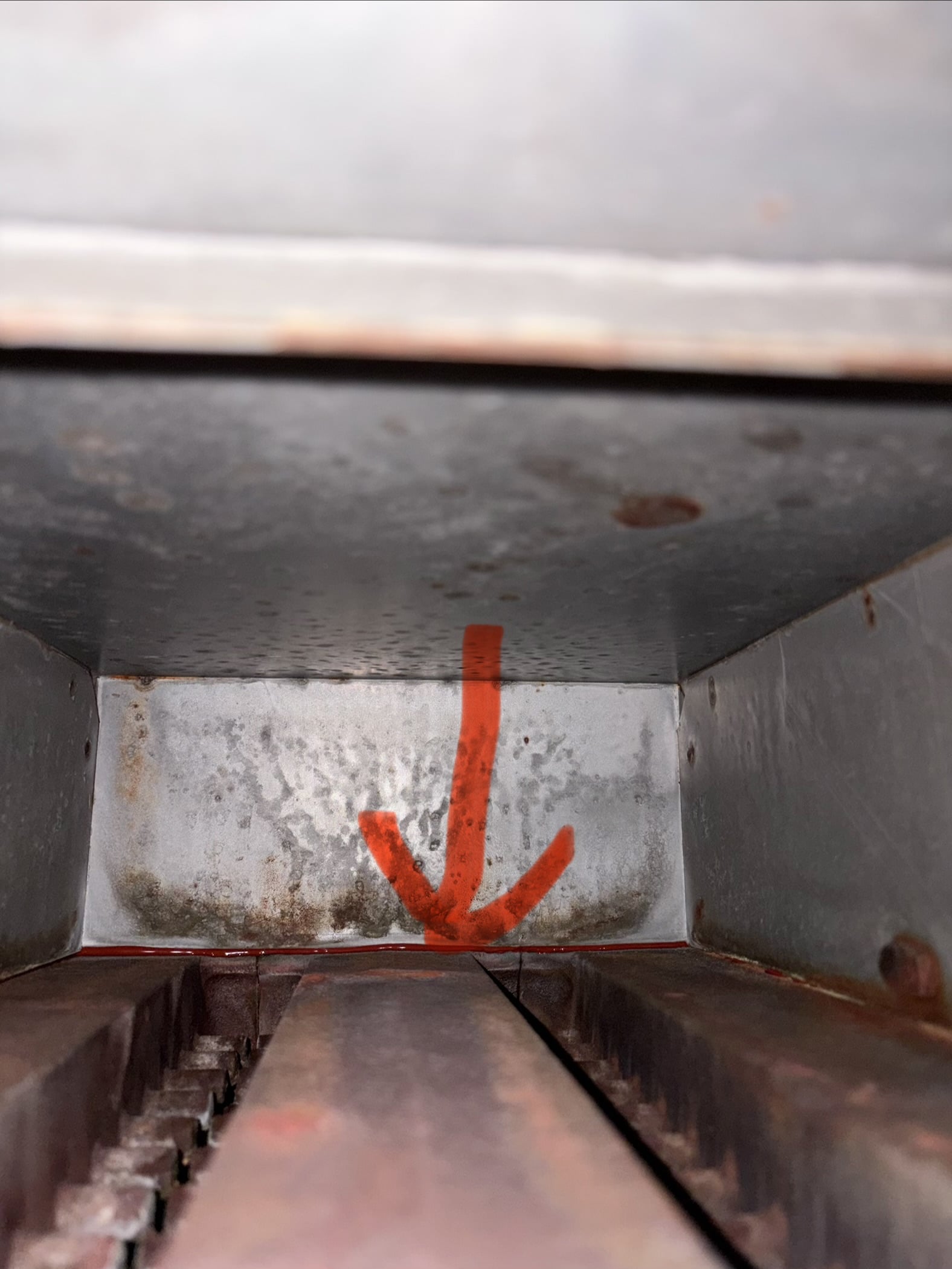
Thank you all for the suggestions. I was able to get a picture showing the combustion side of the draft hood (attached image) which shows there is quite a bit of RTV that has squeezed into the chamber. I believe this is due to my install method of running a bead around the perimeter of the heat exchanger and then pressing the hood into the bead
I'm tempted to remove all existing RTV and re-apply, this time trying to minimize the amount that makes it into the combustion chamber
 0
0 -
Smells are always tricky thing. Loks like you did a good job of sealing the hood and as other have said the smell will likely disapate with time. How much time is had to say. If you can tolerate it you can seal the hood with a fiber glass tape and furnace cement.
Miss Hall's School service mechanic, greenhouse teacher, dog walker and designated driver
0 -
I'm asking because I'm curious and don't know the answer.
The burner firing is producing very hot, but also very humid gasses. Wouldn't that humidity help cure the rtv?
Or is the whole "room temperature" part very important for the curing?
Single pipe 392sqft system with an EG-40 rated for 325sqft and it's silent and balanced at all times.
0 -
It's a humidity cure. And the dang stuff can take time — particularly on thicker beads…
Br. Jamie, osb
Building superintendent/caretaker, 7200 sq. ft. historic house museum with dependencies in New England0 -
@CG2026 looks like you did a nice job. i would give it a little more time. Check at the draft hod when the boiler lights and fires to make sure the chimney is pulling draft.
You can use a match, or lighter or a candle or a cigarette to give you a clue unless you have a manometer.
You may get a slight puff at the draft hood when it lights but only for a second.
0 -
open The windows
Raise the thermometer
Let it run an hour
0




Categories
- All Categories
- 87.8K THE MAIN WALL
- 3.3K A-C, Heat Pumps & Refrigeration
- 59 Biomass
- 430 Carbon Monoxide Awareness
- 133 Chimneys & Flues
- 2.2K Domestic Hot Water
- 6K Gas Heating
- 124 Geothermal
- 170 Indoor-Air Quality
- 3.8K Oil Heating
- 79 Pipe Deterioration
- 1.1K Plumbing
- 6.7K Radiant Heating
- 396 Solar
- 16.1K Strictly Steam
- 3.5K Thermostats and Controls
- 56 Water Quality
- 51 Industry Classes
- 51 Job Opportunities
- 18 Recall Announcements