DHW - 75' by the pipe from indirect to manifold

I'm looking for creative, energy efficient ideas for getting DHW to a pex manifold at an attached garage, about 75' away from my indirect, heated by a CI boiler.
Would serve an above garage appt, a laundry tub, and a lav. Sometimes the space will be used regularly (renter); other times it will see light use (plan to feed one main-house bath lav off of it).
After lengthy consideration, I've ruled out all styles of recirculating pumps, and CW fed tankless HW heaters would require 50A or more of service.
The volume of the 1" PEX that will feeding DHW to the space is about 2.1 Gal. Will also have low pressure at the garage.
I'm exploring the idea of a 6-8 gallon electric tank HW heater (3/4" fittings) at the site of the garage dist manifold, fed by the indirect. Anyone seen or tried this before?
Comments
-
Well, you said no circ pumps but you're going to need one at the indirect to feed the hw tank.
I would think you would be better off running the hot out there and using a small recirc pump to keep the loop hot.
You could have a switch out there to kill the circ pump when not needed (low use) and turn it on when you need it. You will still get HW without the pump, but it will take a while.
 2
2 -
I'm not sure what Ed is envisioning, but yes you can certainly utilize a small electric tank for the initial usage and feed the cold side from the hot side of the indirect. 1" PEX was a bit excessive but if it's already done and you don't want a recirc, that's about your only viable option.
1 -
@GroundUp I was thinking a HW line from the indirect with a small recirc line and skip the water tank. To me an apartment with a laundry tub and 2 lavs means a kitchen sink (dishwasher??) and a shower. Its a bit of a load
2 -
@EBEBRATT-Ed In the past, I've looked at the losses on those 2 gallons of water at 120F, and they are substantial energy waste. I bought for the project an on-demand circ pump, and am not satisfied with what the experience will be. I would just use standard water pressure to push the water to the tank when a valve/faucet is opened.
You are right that there is a washer, bath group, kitchen sink, dishwasher + lav + a utility sink in the garage.
@GroundUp - It's not done, but I did run IRC sizing calcs, and on the Hot Water side, I'm showing 5 fixture units, which equates to 9.4 GPM, and 3/4 is good for 8.8 GPM at 8fps. In real world terms, I could see a washer, shower, and kitchen sink running concurrently - that could be around 7-8 GPM. Pressure drop is a real concern here, with an undersized line to the house and static pressure about 51 at the entrance to the house. Losses, neglecting elevation effects but considering 2 elbows:
3/4" Pex - 8GPM/-15psi; 5 GPM/-7.5psi
1" Pex - 8GPM/-3.8psi; 5GPM/-1.7psi
I think even with a well flowing system (I ran the IRC pressure drop calcs on the CW, which is properly sized) had me at 32psi at just ahead of the showerhead. And that doesn't account for the water heaters/mixing valve or the 1" 275' main line, which should should be spec'd almost at 1-1/2".
While IRC is likely conservative, do you still think I'm overdoing it with 1" Pex? I'd love to go smaller, but don't want pressure issues or getting flagged on inspection.
0 -
Try your load calc with the newest WDC
I think your 7-8 gpm is high
The sink is probably under 1 gpm, shower 1.5. With low water pressure those are high numbers. Faucets and fixture gpm is rated at 80 psi
If you are running 30-50 gpm will be less
Bob "hot rod" Rohr
trainer for Caleffi NA
Living the hydronic dream 2
2 -
a gas tankless or electric tankless with a big enough feeder are probably your only options without standby losses.
everything else will have standby losses if you want it ready to go 24/7. a recirculating pump on a timer or motion sensor is probably the option that has the shortest time to be ready.
your indirect isn't going to supply 10 gpm for more than a couple minutes, that is like a small hotel or moderate sized apartment building sized system. if you have pretty warm incoming water, that is 300,000 btu/hr for the system to keep up.
1 -
@hot_rod - I do hope so. I'll definitely take a look and see what it says. Any idea if that tool lends itself to any particular credibility, that the inspector would allow it to override IRC on sizing?
@mattmia2 - I'm certainly not seeing that as any continuous rate (if ever) and don't see any practical use at that rate, but do know if I go to fill a bucket in a garage sink, it's likely to pull 7gpm. I just don't want to get flagged at inspection on under-sizing relative to IRC or cause pressure issues in the shower.
So, you don't think feeding a 6-10 gallon hot water heater from the indirect's output would work reasonably well? It would take 2 gallons at 70F before the supply reaches 120F. I'm not saying no losses, rather controlled losses.
0 -
There are a fair bit of ADUs around me and they are mostly either tankless/combi or resistance tank.
The problem is for your 75 run out and back, you would have to get the fancy insulated pipe that is pretty spendy if you want to put hot water through it. The cheap stuff will saturate with water over time and all you'll be doing is heating dirt with your indirect+recirc.
Single family ADU, 3/4 pipe is more than enough. You can run 3/8 pex connections to the washer, dishwasher and toilet to reduce the max flow there.
I would get a 40gallon tank and put it on a smart switch. When not in use, turn it off. You can put a lowboy in a corner cabinet in the kitchen if tight on space.
Since you mention well water, make sure to crank up the temperature on the tank and put a mixing valve. Rarely used tanks running at low temp off well water are asking for bacterial growth. The higher temp and mix valve also increases the effective volume of the water tank so you get more hot water out of the small tank.
1 -
I'd go with the 1 inch pipe, to minimize head loss — you don't have enough pressure to waste it. I'd think a bit about recirculating. The argument for it (you could use a half inch return line, by the way — it doesn't have to match the feed line) is that you'd have reasonably hot water right away (how hot would depend on when you last used the hot water, unless you had a fairly big recirculator). The argument against is that while you would have to wait for hot water, you'd not have the standby loss in the recirculation system, which could be quite large.
Which brings me to the next point: insulate that feed line (and the recirculation line if you use it). That won't eliminate the wait, but it sure will help, and help a lot — even cheap big box insulation will.
The idea of a small heater at the point of use is attractive — but you'd have a dickens of a cold water sandwich effect. You'd get a minute or two of nice hot water — and then a pause while the cool line water got out of the way and filled the now cool point of use tank. I wouldn't bother.
Br. Jamie, osb
Building superintendent/caretaker, 7200 sq. ft. historic house museum with dependencies in New England1 -
I believe the latest UPC and IPC have adopted the WDC. Since it was developed by IAMPO which controls the UPC codebook and updates.
 Bob "hot rod" Rohr
trainer for Caleffi NA
Living the hydronic dream0 -
I appreciate all the great info here!
@Kaos - thanks! Out of curiosity, what's that fancy insulated pipe, and what do you mean the 'cheap stuff' saturating with water? I have a combination of copper press and uponor propex here.
This is pretty much an ADU setup, with the following additions: between garage and indirect is one main house bathroom… shower closest to indirect at 41' (pipe) was going to run 1/2" pex; it's lav is closest to the garage manifold at 22' of 3/8" pex. So, being able to heat year round is important. I was also going to install a hot+cold drive hose bib off the same run. Not super critical, but would see some use. The garage utility sink is immediately at the location of the manifold, as well.
The radiant manifolds are already supplied by the boiler, else I'd look at the combi.
Had thought about a flow restrictor on the washer, but had not thought about 3/8" pex as the tool for those appliances or the toilet. That is a good one.
I must have misstated something… no well water in use within the house here. On the indirect, I do have a mixing valve and running higher temp in the indirect to manage legionella.
@hot_rod - that's excellent. I'll be getting to know it. I've got a MIXCAL 521616A on the indirect… am I reading the flow chart correctly that at, for example, @7GPM, I'm looking at 5psi loss?
@Jamie Hall - I'm running the full numbers on pressure drop for different pipe, which should be enlightening. I just have to figure out pressure drop for the indirect. This one has been in the works for several years, and it's regularly been on my mind. You're right that the losses are significant over that run. I thought the solution was the on-demand pump, but have high velocity concerns with longevity and ultimately decided hot water needed to be available at the distribution manifold at the garage to keep use realistic.
You're right that there will be a cold water sandwich, but I'm not envisioning it as noticeable. I was thinking that on a 8 gallon tank at 120F fed by the indirect at 120F with 2 gallons of water initially at 70F, that the output of the tank shouldn't drop below 108F. IMO, where this matters most is for the shower. I'll be using a hansgrohe thermostatic trim, so I'm thinking it wouldn't actually be felt in a shower at 105F or below. Thoughts?
Yes, any heated line will be continuously insulated. I have yet to see flexible pipe insulation that is a lot better than the poly… I've found a lot of the rubbery stuff dried out here in our arid climate.
Edit: I'm now thinking that the indirect would feed the tank at 140F (though more heat losses in the pipe cooling down), tank at 135F, and then mixing valve.
0 -
Heat trace is another option. Use 3/4 copper tube heat trace and fiberglass insulation. This is used in large commercial buildings instead of pumped recirc.
Regardless of how you do it the operating cost is based on the delta t and insulation quality
https://content.thermon.com/pdf/ca_pdf_files/CPD1013-WarmTrace-Design.pdf
Bob "hot rod" Rohr
trainer for Caleffi NA
Living the hydronic dream1 -
the problem with the small tank is if you are putting about 1/3 of its capacity of cold water in it before you get hot water from the small tank you will drop the temp significantly and the tank won't add any significant heat to the water at the drawdown rate for a shower or washing machine. you probably need more like a 20 gallon tank. the tank would be a lower initial cost but a controlled recirculation system might be less expensive than having to keep replacing a second tank in the long run. maybe you could even control the recirculation off a flow switch and thermostat.
7/8 pex is about equivalent to 3/4 copper. the id of 3/4 pex is significantly smaller than copper pipe. 7/8" pex is unruly enough to make you wonder if you should have used soft copper. it wants to stay in the shape of the coil.
0 -
yhere is likely a clause in the code that sayse something like "or using other engineering methods" that would let you use more precise load calculations.
0 -
you could also put an indirect in the garage. if you choose a well insulated one it probably will run twice a day to cover standby losses and you only lose heat in the dh piping on a call to reheat the indirect.
cheap vs expensive insulation is mainly if it is buried. cheap insulation absorbs groundwater and becomes ineffective. i think we were assuming this was buried but rereading it i'm not sure that is the case.
0 -
Thanks, Matt!
I'm not sold on the approach, but by my numbers a 8 gallon tank at 135F drawn down and receiving 2 gallons at 70F doesn't average below 118F before the 140F water would start to enter. This makes 2 key assumptions: (1) mixing is uniform (2) it's a continuous pull, such as a shower. If the supply lines weren't well insulated and cooled faster than the recovery time of the heater (case for smaller tank, even 6 gal is stronger in that case), then that could be an issue. Am I missing something here?
On your point, I could put the demand circ pump (higher velocity than standard recirc) on a flow switch. However, long waits would still apply (still have 24' to get to the lav or shower), unless it was feeding a tank - in which case even if you pull 1qt of hot water, you're still charging 2 gallons of water in the pipe.
The plumbing is run through 40' of midfloor joists, so that space should be around 70F, with warmboard above for 25' of that 40' section. The rest runs through a chase or vertically.
Truth be told, there's 2 sets of 3/4" sticks of copper already traversing 40' of bored joists. No longer can they be removed without cutting between joists - so that is heartache. When I was looking at velocities of the demand recirc pump (chosen for quick delivery), it looked like I'd exceed the max 5fps and leave me at risk for issues… and per IRC, it was slightly undersized, but based on info here, it's likely fine. When I finish pressure drop calcs to compare, I'll know. The pressure situation here is real.
For an indirect, how small do you think I could go on the tank and on the heating supply/return lines for that distance?
0 -
You need to narrow down the actual gpm to calculate velocity and pressure drop
If you limit flow to the washer, I don’t see you needing 7 gpm for 3 fixtures? Call it 5 for the calculation
1” pex has a .942 ID
3/4 copper M .875
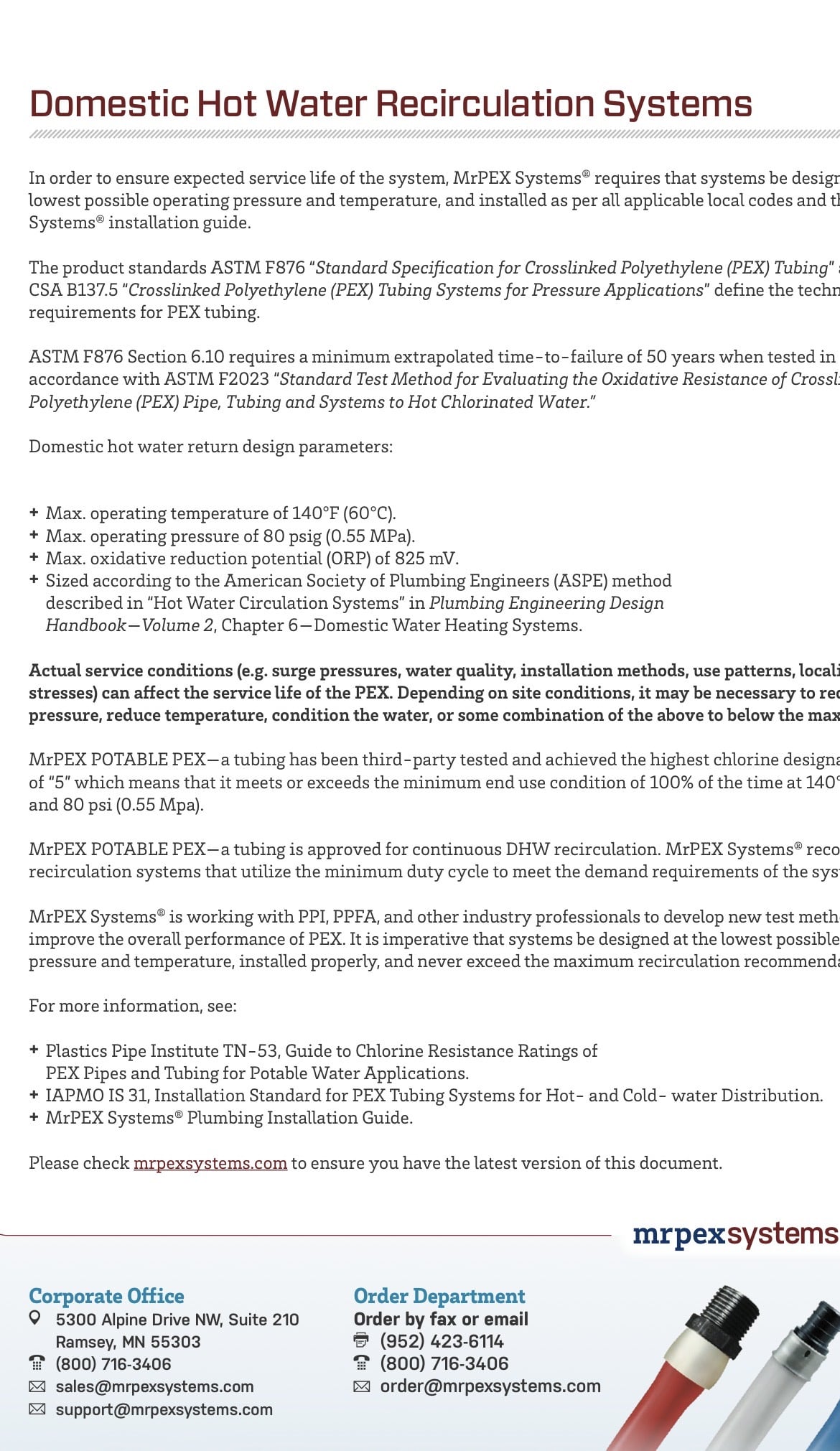
There is a time, temperature, pressure, and chlorine limitation on pex when used for DHW recirculation
The listing number on the pex tells you which classification it falls under. #5 on the tube us the highest number for chlorine.
Although pex manufacturers still want you to limit recirc time Hmmm?
I’d use the copper if you recirc
 Bob "hot rod" Rohr
trainer for Caleffi NA
Living the hydronic dream0 -
I was thinking do recirculation instead of having a tank in the garage. If you put an aquastat at the garage end that turns off the recirculation pump when it gets hot and you do a flow switch or motion sensor or even manual timer then you can push the velocity up a bit on the 3/4 copper and move the 2 gallons in your supply pipe in maybe 20 seconds or so without velocity corrosion being an issue because the recirculation pump runs so little of the time.
0 -
I was thinking detached garage, since attached, you can run regular insulated pipe.
Demand based recirc (motion sensor in bath) is probably the simplest, but with the volume of water there, when the place is not in use, I would set the recirc to run at least once a day to flush out all the pipes to avoid stagnant water.
High velocty recirc feels like it should work but it doesn't. I've tried with high volume piping and the wait time was way too long. The problem is you are not moving a slug a water but mixing the cold water in the pipe with the hot water, takes a long time for the water to come up to temp. Regular low velocity recirc works just fine with proper controls.0 -
You said that he would need a circ from the indirect to the storage tank, despite him saying he doesn't want a recirc. There is no need for a circulator from the indirect, so that is what I was confused about
0




Categories
- All Categories
- 87.8K THE MAIN WALL
- 3.3K A-C, Heat Pumps & Refrigeration
- 59 Biomass
- 430 Carbon Monoxide Awareness
- 133 Chimneys & Flues
- 2.2K Domestic Hot Water
- 6K Gas Heating
- 124 Geothermal
- 170 Indoor-Air Quality
- 3.8K Oil Heating
- 79 Pipe Deterioration
- 1.1K Plumbing
- 6.7K Radiant Heating
- 396 Solar
- 16.1K Strictly Steam
- 3.5K Thermostats and Controls
- 56 Water Quality
- 51 Industry Classes
- 51 Job Opportunities
- 18 Recall Announcements