lennox coil freeze up

I am having an issue with a lennox evaporator coil m#cx34-36c-6f-2, it is attached to a lennox furnace model# EL296uh090xv36c-05. Both were installed in 2014. The issue is that every couple of weeks the coil freezes up, unit stops cooling.
Once defrosted the suction pressure never goes above 100 psi, and with 410a that is low enough for it to freeze. The txv was replaced, and the results were the same. The issue appears to be air flow, as the super heat and subcooling at the outdoor unit are good.
The air filter is clean and there are no obstructions in the duct work. I increased the airflow setting in the lennox wall thermostat/ controller to 1400 cfm from 1050, in an attempt to move more air. The LCD readout on the furnace says that it is moving 1400 cfm of air, but listening to the noise level of the furnace it sounds like the blower is moving at half speed. I put an ecm motor tester on the motor and with the tester the ESP reading was the same. .44
I have yet to find any documentation from Lennox where with an actual live esp reading can be compared to a chart, so the readout can be confirmed that is the actual amount of air the furnace is moving. Could it be possible that the fan motor is not turning fast enough even though the board appears to be sending the proper signal for the motor to ramp up to it's highest speed? Like I previously mentioned the external static is the same where the motor is hooked to the furnace's circuit board, or an ECM tester. Thanks to all
Comments
-
what is the subcooling? what are the supply and return temps? is the whole coil cold?
there's always this :
1 -
What changed in 12 years ???
The CX35 page had the test setup illustration. CX34-36C-6F spec. is below.
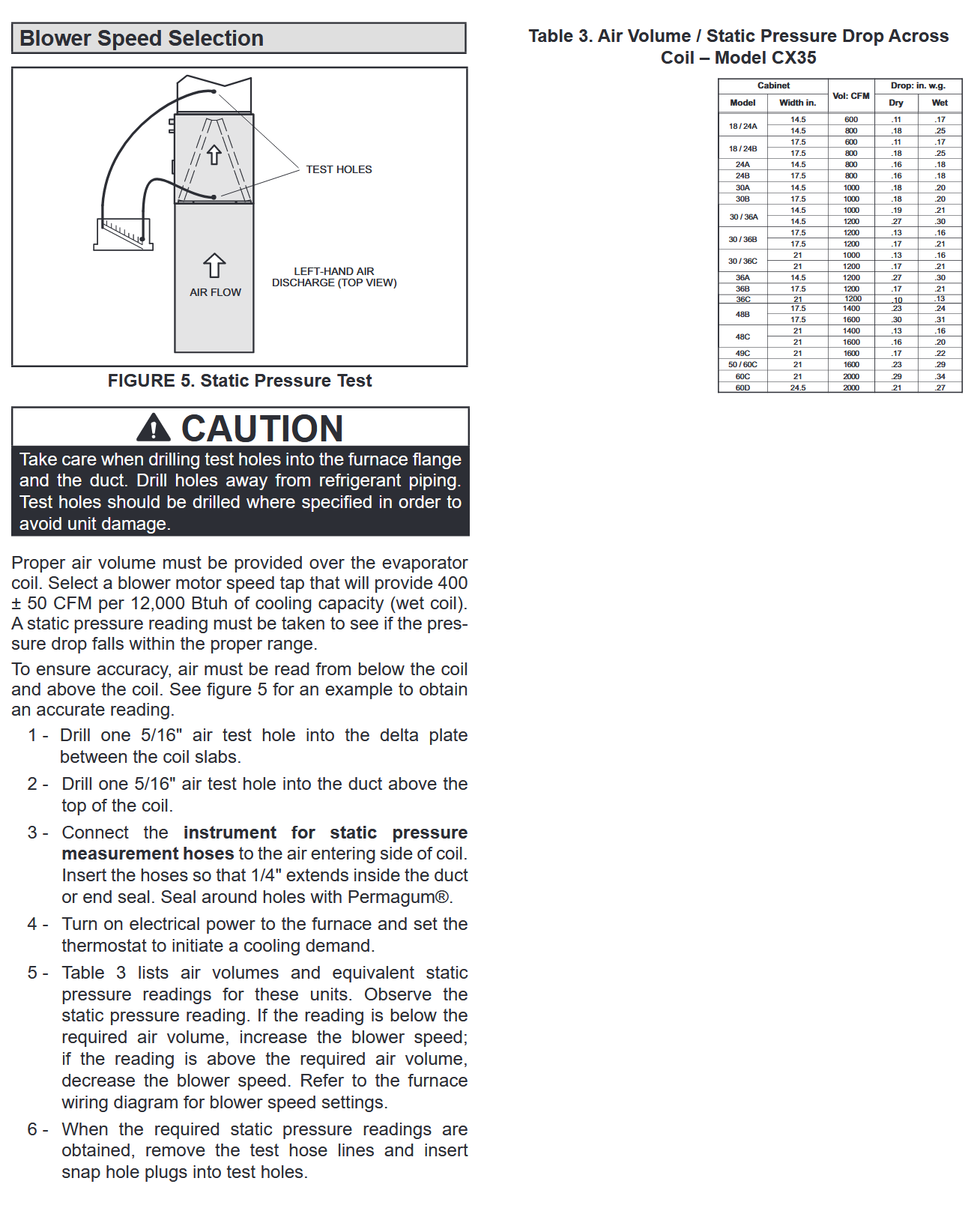
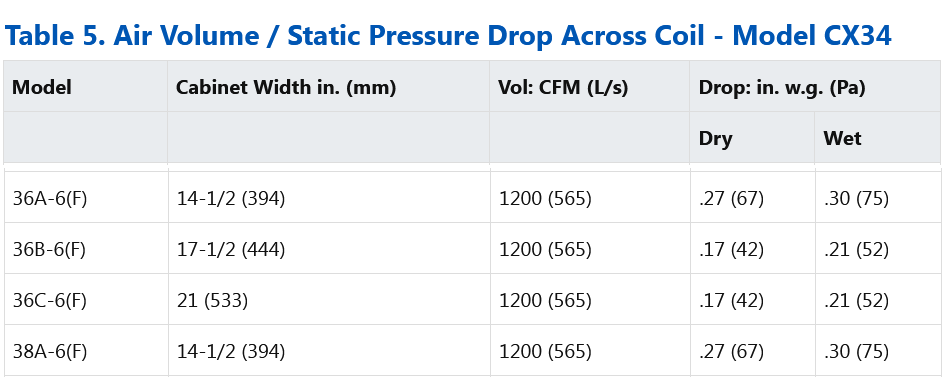
https://manuals.plus/m/94af1d579fdf7ff3cf00755778189d98d355dcd2e8581387b978a9fc0dc88a64
National - U.S. Gas Boiler 45+ Years Old
Steam 300 SQ. FT. - EDR 347
One Pipe System1 -
Total
External
Static
Pressure
TESP
Total External Static Pressure Testing - T.E.S.P. – Johnstone Supply Support
Without it your only guessing.
 1
1 -
thanks for the responses. The unit is running at 100 low / 275 high 12 degree SC / 19 degree superheat at the compressor. The Coil delta t is 28 degrees, and the delta p across the coil is .12
The esp for the system is .43 all the airflow settings are done through the Lennox wall thermostat. The display on the furnace says it’s moving 1400 cfm, but I have not found a way to verify that through documentation by Lennox. The customer has the same model furnace that serves another part of their home. That display in cooling says it moving 1050, and by sound the fan just sounds like it is moving more air
0 -
That's a calculated # not an actual reading. A little dust on the coil, a little dust on the blower wheel and the CFM's drop dramatically.
You need to measure the actual TESP to know what the actual CFM's are.
0 -
100 psi is 31 degrees so borderline freezing. That's why it takes a long time to freeze. if the coil is dirty that could be an issue. Maybe some insulation broke loose and is blocking the coil? Sounds like low cFM or a dirty coil as you have already figured out. Now its a matter of finding the problem.
0 -
shouldn't the txv set the superheat at like 5 f degrees if it has enough refrigerant supply, is good, and has the sensing blub properly installed?
0 -
Yes it does but if the airflow is low it’ll still be 5° super heat and low suction pressure
0 -
they say it is 19.
0 -
five 15, 20 it doesn’t matter it won’t prevent freeze ups
0 -
superheat measures the Saturation Temperature of the suction outlet at that pressure and how much extra heat has been absorbed? Say X degrees above that point.
0 -
but the superheat falls with more mass of refrigerant on the suction side, right? low charge or restriction will cause high superheat.
0 -
assuming a full column of liquid on the inlet of the expansion valve the super heat stays the same within the range of the valve. If you cut the airflow the suction line gets colder but the super heat will still be in that range it was adjusted for
1 -
thanks for the responses. ESP is TESP, and the TXV is from Lennox that is non adjustable
I spoke with Lennox today and there is no chart available for the furnace to compare the ESP reading on a chart to determine that actual cfm the furnace fan is moving. This to me seemed strange.
the good part is there is long section of straight duct with no registers that can be traversed to determine the actual cfm. For some reason the motor is just not ramping up, even though it is getting the proper signal. Lennox also recommended that if the motor is changed, the furnace circuit board also be changed. This to me also seemed strange and expensive.Remembering now I had an air temp packaged unit that the ecm motor even though it as getting the proper signal, would no ramp up above 50%. Luckily for the customer the motor was still under warranty
Thanks to all
1 -
can't you calculate flow from delta p and area?
0 -
ESP is how fast the fan spins to deliver "X" CFM's. That is tested on the factory floor under ideal conditions. We never see those conditions in the real world. A small amount of dust on the squirrel cage fan blade and you can lose 10 or 20% of air flow. That why I say it needs to be Actually tested not calculated.
Flex ducts not installed correctly
Flex collapsing
Crushed ducts
There are several things that effect air flow and the equipment doesn't read it.
1 -
yes that is how the cfm is going to have to be determined on this one, by the area of the duct and FPM. I guess the only other way would be with an anometer. That may be quicker, but I think a duct traverse would be more accurate.
0 -
I forgot to add, thanks for correcting me. Yes there is a difference in ESP, and TESP
1 -
thanks to all that posted about this. as it turned out both the motor, and control board had to be replaced to correct the issue. The original motor with an ecm tester, preformed the same way it did with the furnace control. Barely drew any amps, high delta d, etc. I changed the fan motor. The furnace immediately went into a code of "no communication with indoor motor" code. Put the fan in the on mode at the thermostat the new motor preformed fine, obviously at a reduced speed. Put the thermostat in either heat, or cool and it went into the same communication code. I changed the circuit board, and all was good.
0 -
Electronics is great until it fails.
National - U.S. Gas Boiler 45+ Years Old
Steam 300 SQ. FT. - EDR 347
One Pipe System2 -
Ain't that the truth
0


Categories
- All Categories
- 87.8K THE MAIN WALL
- 3.3K A-C, Heat Pumps & Refrigeration
- 59 Biomass
- 430 Carbon Monoxide Awareness
- 133 Chimneys & Flues
- 2.2K Domestic Hot Water
- 6K Gas Heating
- 124 Geothermal
- 170 Indoor-Air Quality
- 3.8K Oil Heating
- 79 Pipe Deterioration
- 1.1K Plumbing
- 6.7K Radiant Heating
- 396 Solar
- 16.1K Strictly Steam
- 3.5K Thermostats and Controls
- 56 Water Quality
- 51 Industry Classes
- 51 Job Opportunities
- 18 Recall Announcements