Retrofit single-zone hydronic baseboard to 3 bedroom zones with 3 way diverter valves.

Hi everyone,
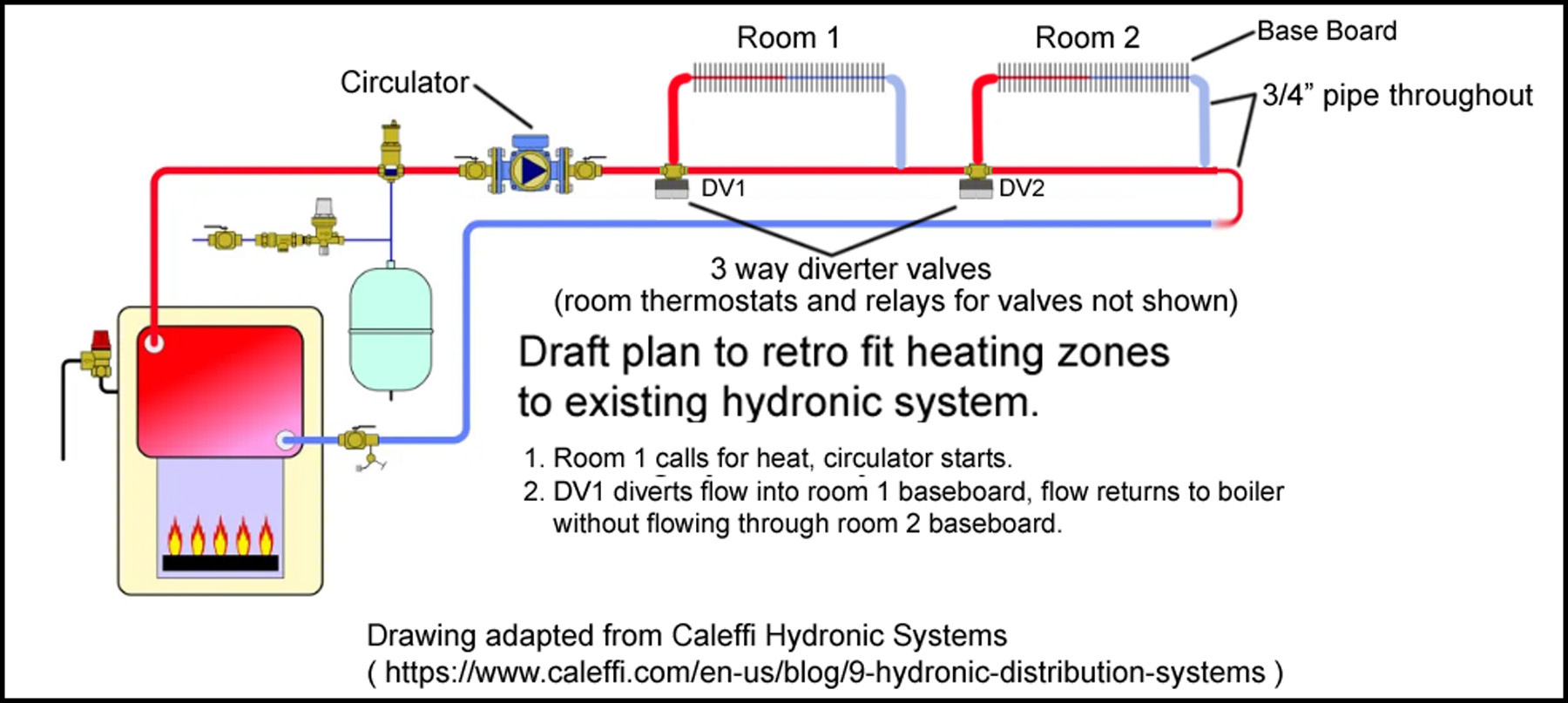
I am looking for some advice on zoning the upper floor of my 1980 raised ranch. Currently, the entire upper level (containing three bedrooms) is on a single, oil-fired hydronic baseboard loop. My goal is to give each bedroom its own independent heating zone. I am considering installing 3-way diverter valves on the baseboard for each bedroom along with additional piping.; This would be paired with dedicated thermostats, relays, and the necessary controls. I have attached a diagram of my proposed layout
My questions for the community:
- Is this a viable approach? Better way?
- Are there better or more efficient alternatives for zoning a setup like this?
I appreciate any and all constructive feedback. Thanks in advance! You guys re great!
Comments
-
Yes, It is a viable approach . I would try to fit the Diverter Valve and the new bypass pipe (to the next baseboard unit in the next bedroom) within the existing baseboard end caps. The bypass pipe can run below the finned element in each baseboard unit. Providing power to the diverter valves is another issue I'm not sure how to address but it's low voltage so it's easier than 120 VAC and its code requirements. The only other approach I can think of now would be to have each baseboard supplied directly by a home run from the boiler with a 2 way zone valve and a common return pipe. Don't know if you have easy access to run PEX tubing in place of copper ( a cost savings). You would need to build a small manifold at the boiler with 3 zone valves and 3 returns. All wiring would be located at the boiler and you could use smart thermostats like Ecobbe with a wireless remote temp sensor in each bedroom. This eliminates the need to run thermostat wires in each bedroom. Can you do this type of work yourself or do you need a heating guy? There are two costs: 1) for the piping and valves and 2) the electrical for the valves. Doing either one yourself is a big cost savings. My experience is that it's cheaper to just get a good plumber to do the work as you designed it rather than a Heating Contractor with his overhead costs. PEX is easy to work with and much cheaper than copper. I assume you need to have big differences in bedroom temperatures to justify the cost of this work. Do you have un-occupied bedrooms that can have a low temperature? A rough ball park cost would be about $1000 in material ( valves, transformers, thermostats, pipe and fittings) and maybe $2000 in labor( based on your location). There is one negative factor in that you may have a lot of boiler short cycling because of the small size of each zone. In the ideal world, you would install buffer tank to reduce the short cycling. Also, how is your insulation in your 1980's home. If you are looking to save on heating costs with this zone design, would the money be better spent on improved insulation and windows. Just a thought. Good Luck.
0 -
Sure it'll work. How many other zones are there? The issue is going to be micro zoning and short cycling of the burner. If the aquastat is below limit, that burner will fire every time any thermostat calls. I know. I did the same in a way, and it drove me bonkers for 23 years. When I bought my house it was one zone with a split loop. I immediately did an extension. Made the split loop into 2 seperate zones (living room and bedrooms). I added a zone for the new MBR, and a radiant zone for the new kitchen. The boiler had a tankless coil so I did P/S piping and wired it so the boiler circulator would shut off at low limit.
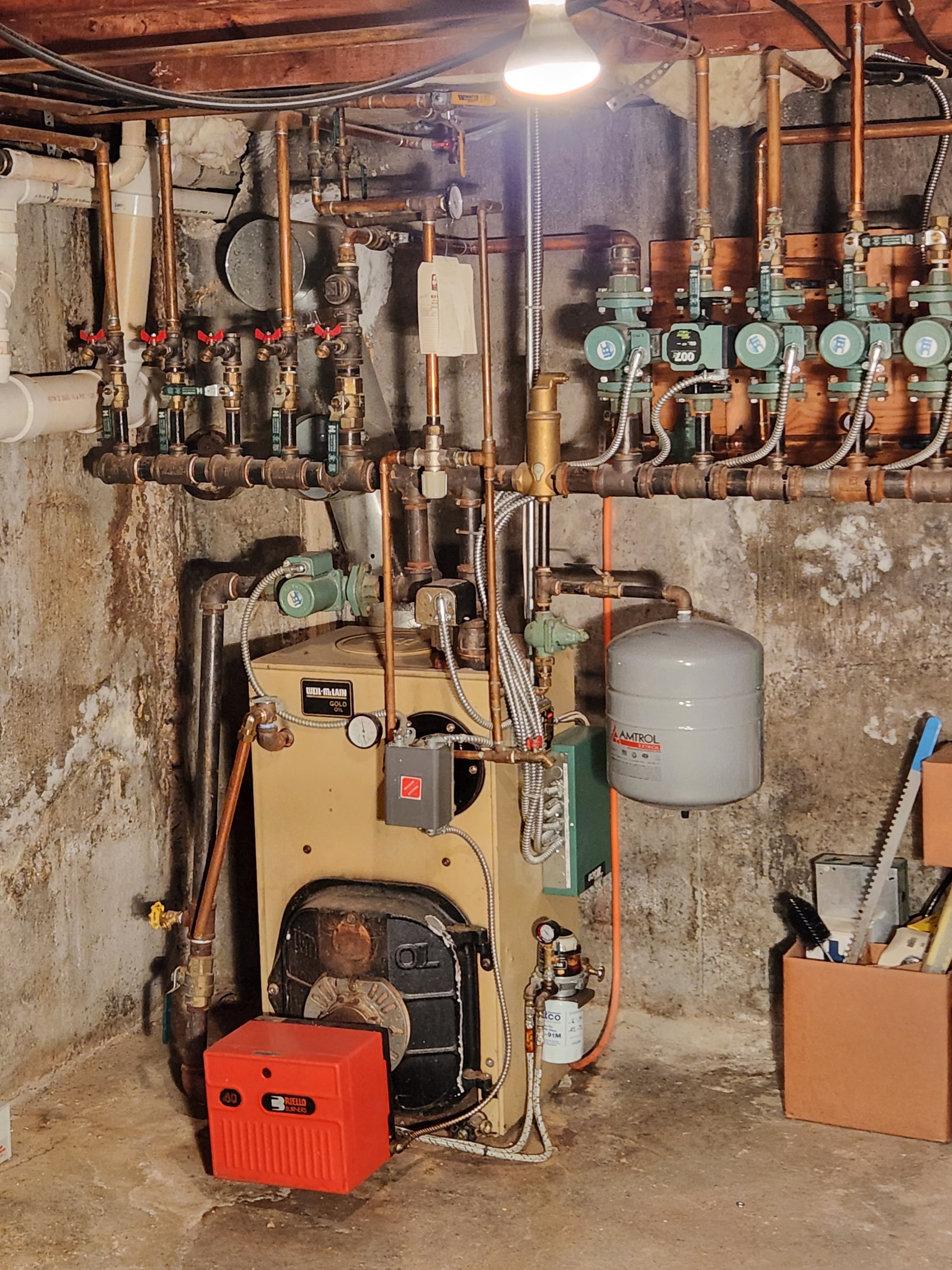
Its funny how I thought I knew what I was doing in 2003.
I still have 4 zones, but I don't worry about micro zoning anymore because I just installed this.
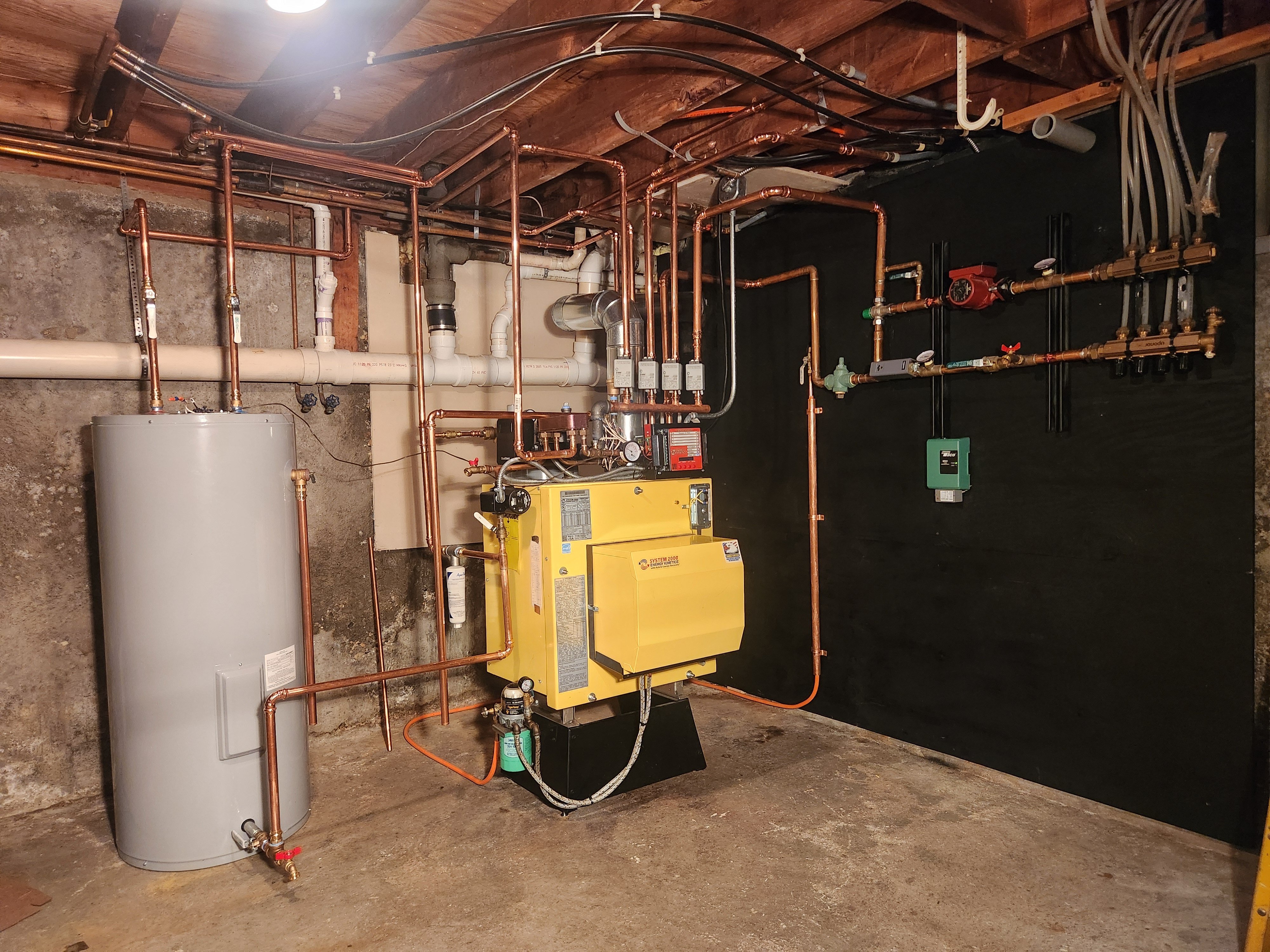
Almost done. I just have control wiring and some touch up left.
 1
1 -
You either need a buffer tank or a modulating boiler because of the microzoning.
TRVs might make a whole lot more sense than zone valves and thermostats.
Doing a heat loss calculation and sizing the radiation to be balanced might be a much simpler solution. I bet you have a series loop and they just put the baseboard wherever they could instead of sizing for the decreasing water temp in each room further in to the loop.
0 -
Do some additional number crunching first.
It would be nice to know the load of each room, and how many feet of fin tube are installed. This helps determine how low SWT you could run, also.
How does the boiler size match the fin tube installed?
I don't see an advantage to the 3 way valves? A 2 way at each baseboard does the same?
Any way you could balance the system instead of micro zoning? Those single room zones will not be friendly to the boiler cycles. You may trade one issue for a worse issue if the boiler short cycles and runs cold returns?
Bob "hot rod" Rohr
trainer for Caleffi NA
Living the hydronic dream1 -
I would think all the 3 way valves would add up to a large Cv and be restrictive. I agree with 2 way valves but with 3 bedrooms on 1 floor do you really need this?
Are the temps that uneven?
0 -
John 2129, It would be helpful to the discussion to know what your goal in wanting to zone the three bedrooms independently. Is it to lower heating costs by not heating unused bedrooms? Is it to customize temperature for different individuals. Do you want/need a bedroom temperature that can vary over a 24 hour day/7 day a week period?
0 -
EBEBRATT-Ed,
Can you explain how a two way valve would work in this setup. I think you would need to convert this setup to a single pipe system with mono flow tee's and have the 2 way valves on the side of the tee feeding the baseboard but then would you have the same concern about a large Cv through the mono flow tees when 2 of the 3 valves are closed? Would this setup work with regular tee's ? Thanks
0 -
First of all, many thanks for your analysis and suggestions. I really appreciate the feedback. To help narrow things down, here is a breakdown of my current setup and my micro-zoning goals.
Questions:
How would 2 way valves work?
Re is the system sized correctly? Probably not based on the different lengths of fin tube and the generic burner/boiler set up. BUT, I am stuck with it so I have to live with it, though I can easily replace some of the fin tube with plain copper or Pex O2 block.
To HVACNUT - somehow I like your old shinny copper steam-punk set-up, but progress is progress. Best of luck.
The TRV suggestion sounds interesting but I'm not sure how it would work with baseboard.
The House & System:
- Location: Douglas, MA (Zone 5)
- Structure: 1980 build, well-insulated (R-38 attic, 2x4 walls, full 3-mil vapor barrier). High passive solar gain from a south-facing cathedral kitchen end.
- Boiler: 1992 Burnham oil-fired boiler with a Beckett burner. Two zones with individual circulators (upper/lower floors). Hot water is supplied by an Amtrol Boilermate.
- Current Fuel Use: ~500 gallons of heating oil per year.
Upper Floor Loop Layout (Single Monotube Loop):
Loop starts: Boiler→ Bedroom A (10' baseboard) → Bedroom B (20' baseboard) →Bedroom C (20' baseboard) → Bathroom (7' baseboard) →Kitchen/Dining (Four 14" Beacon Morris kickspace heaters + 12'
baseboard) → Back to Boiler. Note: The thermostat is in an unheated central hallway. We keep a bedroom door open to keep the hall warm.- My Goal: want to micro-zone the upper floor to control individual room temperatures (e.g., dropping empty bedrooms to 65°F, the kitchen at 70°F when we are there, and boosting the bathroom to 75°F+ during bath times).
I am retired, home 90% of the time, and handy with copper, PEX-A/B, and electrical wiring. I have all the tools including my favorite Milwaukee expander. I also have licensed plumbers living next door if I get in over my head but this is one of my simpler projects.
I want to avoid short-cycling so I’ll run the system through a winter and try to balance everything by careful temp regulation. Although, adding a buffer tank sounds like a great summer project.
I am not wedded to this project, I am just considering it. The cost and the work of it are non-issues, but in the end, after considering the possibilities, I’ll try and do the sensible thing.
All the old phrases come to mind, like “mission creep”, “theory of diminishing returns”, “spend a dollar to save a dime", etc. Then, “there’s no fool like an old fool.”
Do you have hardware recommendations on the following:
- 3-Way Diverter Valve: 24V 3-way motorized diverter valve for a residential loop?
- Buffer Tank: a small buffer tank with a 10+ year or lifetime warranty.
- Controls: wireless thermostat and multi-relay.
Thanks again for your patience and insights!
0 -
PS:
The house was built in 1980 and originally heated by electric, resistance baseboard back when nuclear
generated electricity was “too cheap to meter”. In 1992 the house was converted to hydronic by oil The house is very well insulated, I am halfway through a program to replace the windows, re-roof and reside.0 -
Convert it or install it to make it a two pipe reverse return or direct return.
Come out of the boiler with the supply pipe. Tee off to each radiator with a standard tee. Put the two way valves on the branch to each radiator.
Do the same thing with the returns, standard tees to each radiator.
After the last radiator ty the supply and returns together with pressure balancing valve to maintain pressure and flow as the baseboard control valves open and close.
1 -
It depends on how it is pipes, as far as zoning options.
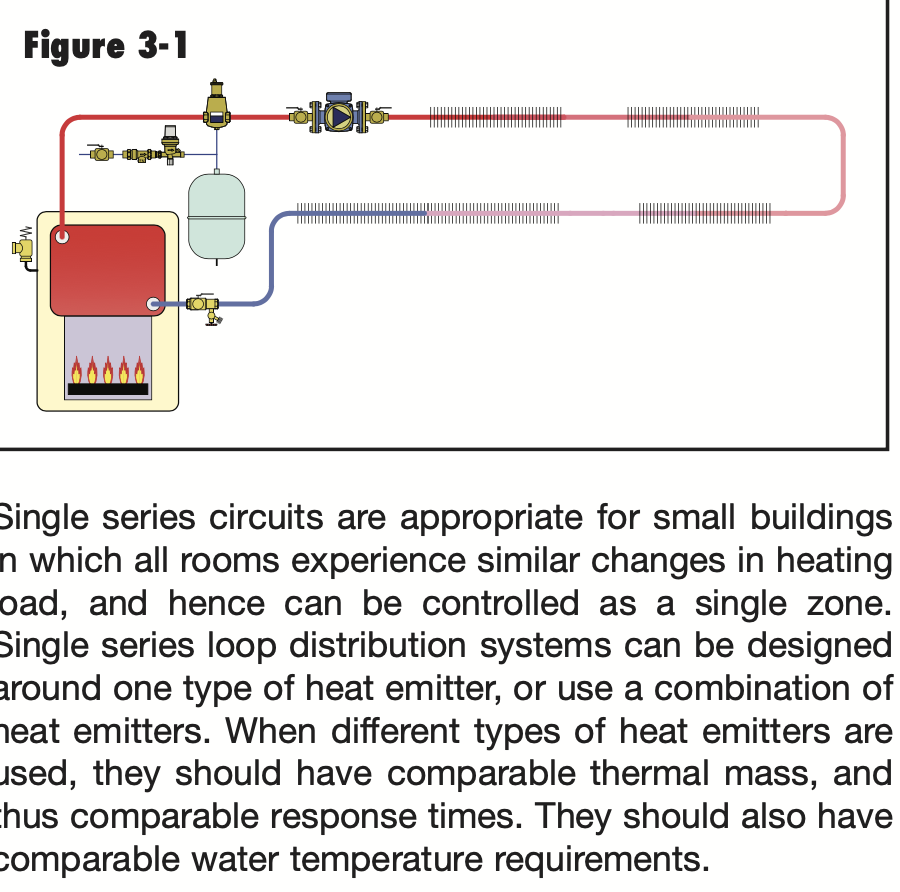
Most common in small homes is a series loop. Figure 3-1
With fin tube, you can regulate heat output in various rooms by adjusting the damper opening. Or put aluminum foil over some of the fins to limit output. A cheap way to djust room by room without zoning.
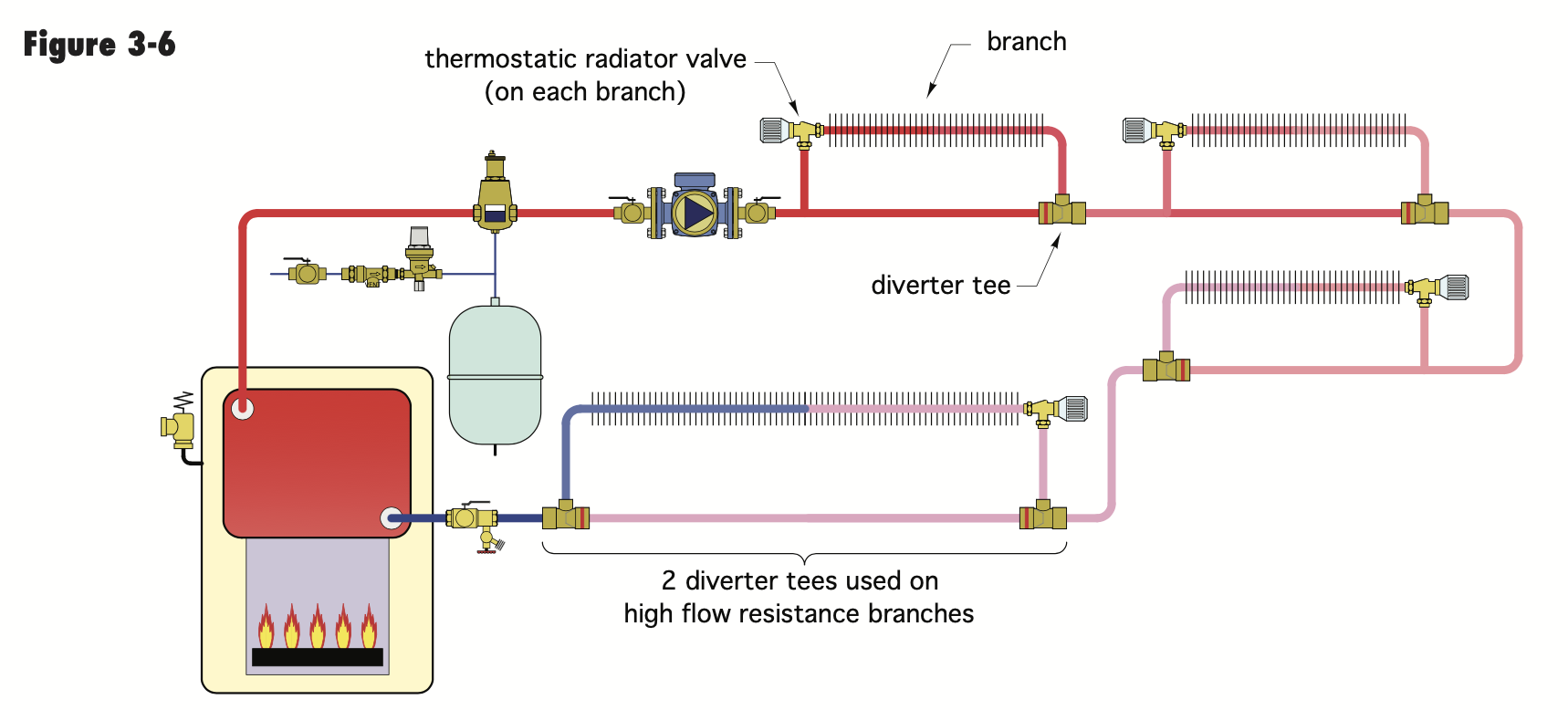
A monoFlo or diverter system is another method found in older homes Figure 3-6. If you have this system TRV thermostatic radiator valves can be added for individual room zoning.
With a series you cansplit off a zone by addingdiverter tees. Then a thermostatic valve.
Nice about TRVs is they do not require wiring.
Most zone valves are the dimension to fit inside standard fin tube enclosures if you want to zone with a 2 way.
A buffer tank is a band aid for a oversized boiler system. Ideally the boiler gets replaced with a correct size unit, it may pencil out the same $$ as adding a buffer. If you are paying someone to do the work.
But with a fixed output boiler, even correctly size, when you zone the system you are building in short cycling issues. Mild days, one zone calling will cause those short cycles.
Older cast iron boilers could hold 10, 15 or more gallons, so they were a bit of a buffer by design. Modern cast boilers are down to 3-5 gallons ijn some cases.
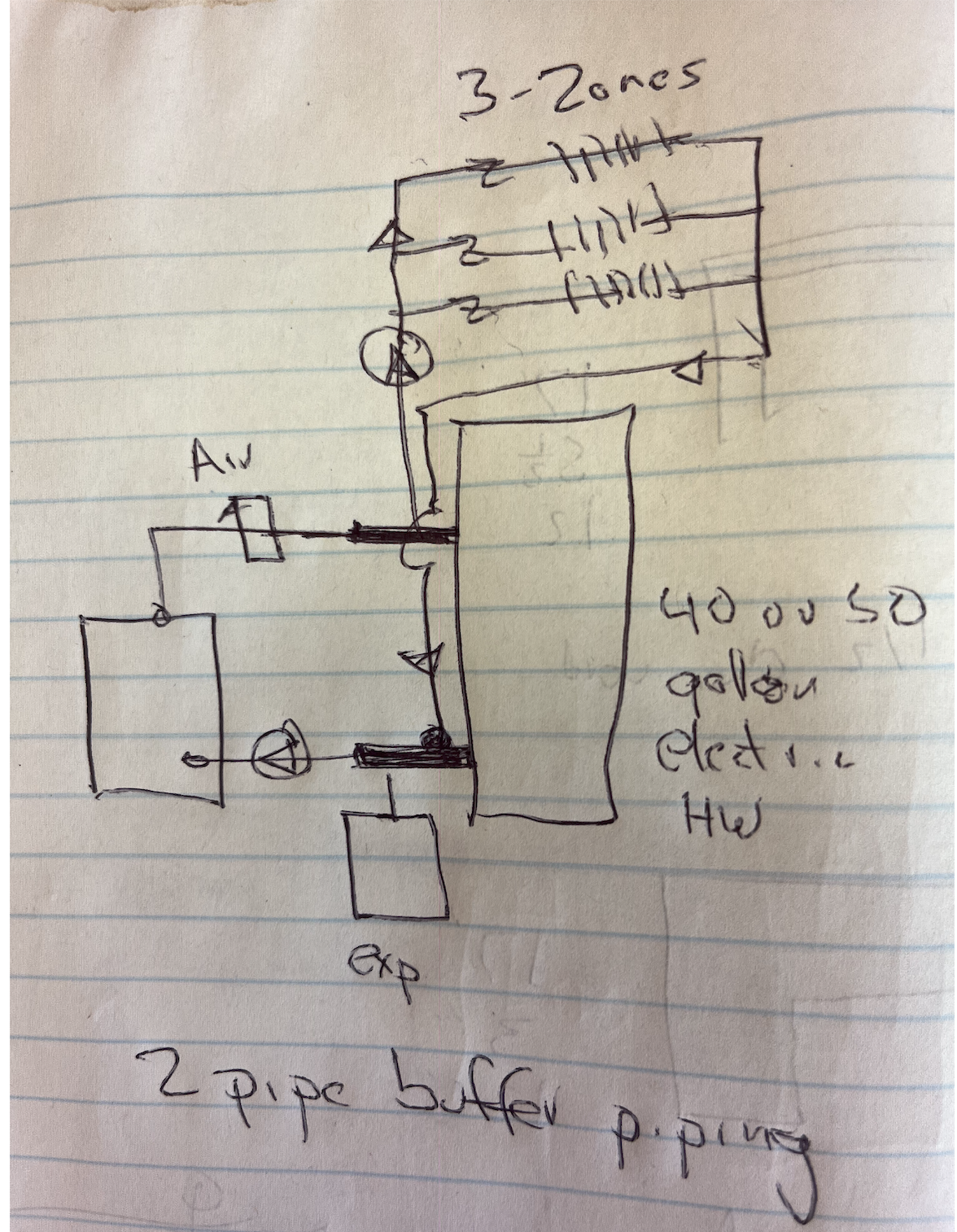
Here is one method I have used to add a common 40or 50 gallon electric HW tank as a buffer.
Replace the two elements with 1" pipe nipples connect boiler and zones in at the tank nipples. A setpoint control monitors the tank temperature and calls on the boiler. About as simple as it gets.
Util we know exactly what piping you have for the fin tube, tough to answer your question about options. Rarely do you need a 3 way ZV.
 Bob "hot rod" Rohr
trainer for Caleffi NA
Living the hydronic dream0 -
An electric water heater that isn't connected to power probably is the most cost effective way to get a buffer tank unless you need more tapings. A plain steel or glass lined steel tank will last a very long time in the closed side of the system because there is no fresh water with fresh oxygen entering the system to corrode the tank.
0 -
EBEBRATT-ed, Thanks. Yes, I see how that would work with a pressure balancing valve at the end of the circuit.
0 -
John 2129,
As to hardware recommendations, I have had good success with Ecobee 3 lite and their wireless temp/occupancy sensor. Thermostat can stay where the existing wiring is located and the sensor can go where you want the temperature sensed. Another nice feature is that the thermostat automatically reduces temperature when the room is sensed to be unoccupied for a period of time . The setback temperature is determined by analysis of the time it takes for the house temperature to recover from the setback. This allows the house to warm up quickly when occupied again. An energy saving feature.
0 -
You guys are really going to laugh at this question….On the system with TVR's on the baseboards, what turns the circulator on and off - where is the call for heat?
Also, do you have a recommendations for 3 way diverter valve and wireless wall thermostats and relay.
I like the idea for a water heater as a buffer tank. Can it take the higher temp water? Where do I get an appropriate tank thermostat?
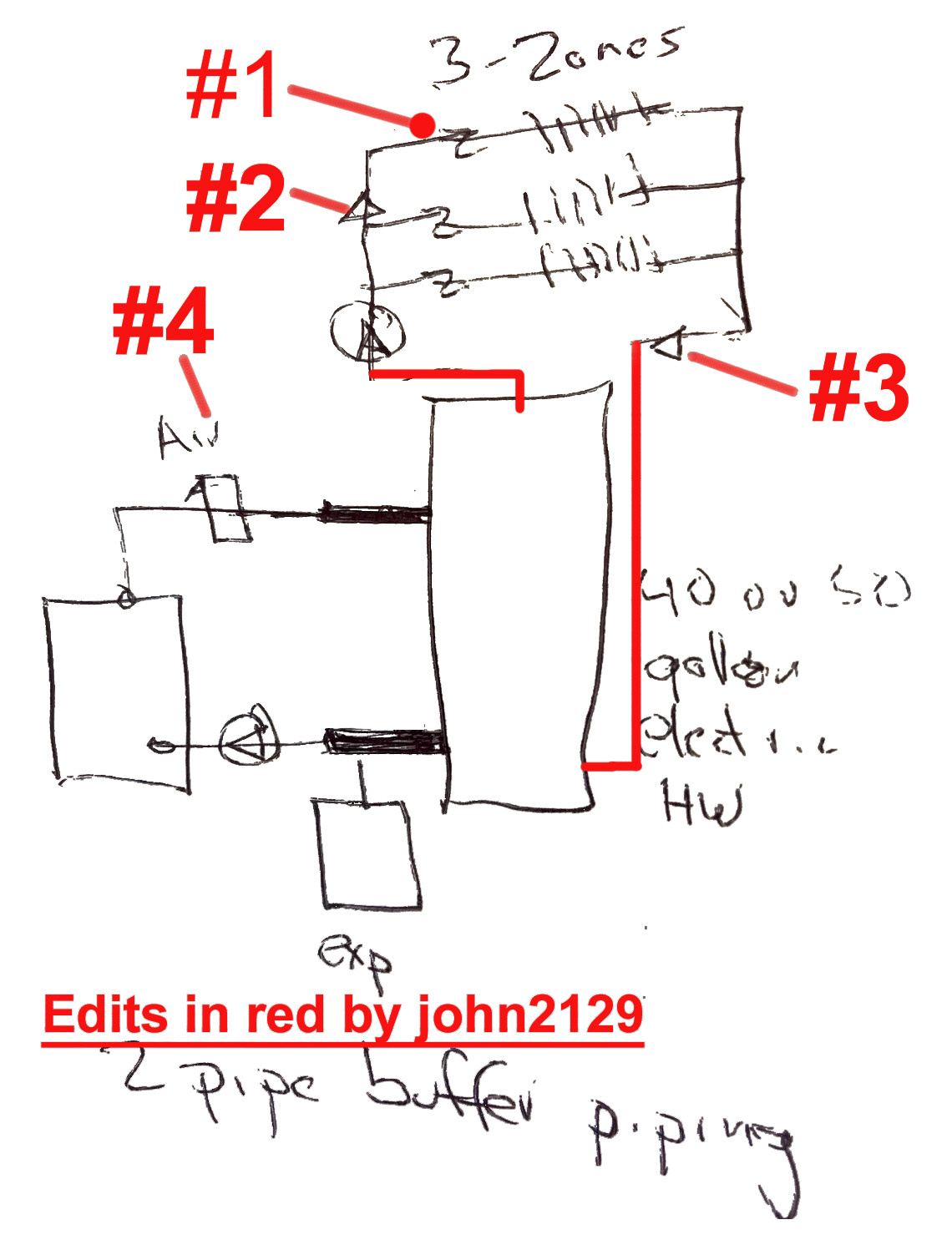
Hot Rod – thanks for taking the time to do the sketch. See my edited version – have I got it right?
#1 – is this a standard zone valve?
#2 - what is this?
#3 - what is this?
#4- Is this an Auto Vent?
Thanks
0 -
Thanks Brooklyn Mike.
0 -
pretty much all the new systems use ECM circulators with any type of zone valve or trv
The pump senses that a valve has opened and starts flowing automatically
So if you use zone valves, the thermostat turns open the valve the pump revs up
Same with trv.
Since the buffer is hot, there is no need to call the boiler on from a thermostat
Any 24v zone valve
1 is a zone valve
2&3 are arrows showing flow direction
4 is an air purger
Bob "hot rod" Rohr
trainer for Caleffi NA
Living the hydronic dream0 -
thanks Hot Rod
0




Categories
- All Categories
- 87.8K THE MAIN WALL
- 3.3K A-C, Heat Pumps & Refrigeration
- 60 Biomass
- 430 Carbon Monoxide Awareness
- 133 Chimneys & Flues
- 2.2K Domestic Hot Water
- 6K Gas Heating
- 124 Geothermal
- 170 Indoor-Air Quality
- 3.9K Oil Heating
- 79 Pipe Deterioration
- 1.1K Plumbing
- 6.7K Radiant Heating
- 397 Solar
- 16.1K Strictly Steam
- 3.5K Thermostats and Controls
- 56 Water Quality
- 51 Industry Classes
- 51 Job Opportunities
- 18 Recall Announcements