Advice on buffer tank sizing

An interesting new engineering problem: my sister bought a house last summer about 1/2 hr away from me, in Newton MA. It's a 1910 Spanish colonial with thick masonry walls, very solidly built, but probably little or no insulation. But good windows, so it's relatively airtight with the masonry walls. 3300 sq ft heated space.
Boiler is a Burnham Series 2 cast iron gas, 6-section, rated at 164,000 BTU/hr input, 118,000 BTU/hr net IBR. There are 6 zones, some newer baseboard, some original cast iron radiators. So it's an odd mix.
I visited occasionally during the winter and noticed the boiler room was quite warm all the time, and the boiler water temp was always around 170. It seemed obvious that the boiler was short-cycling because of so many zones with so little water volume in the baseboards. So I expected her to start complaining about the gas bills. But when I asked her, she said no, the gas bills hadn't been bad. Which probably no other MA homeowner said last winter. So I was surprised.
Then tonight she told me the gas company had sent her a letter saying they had billed her for the wrong gas meter for the entire last season. Turns out her meter actually clocked more than twice the number of therms that the other meter did. So her adjusted gas bill turned out to be more than twice what she had been billed for. Mystery solved…
I made copies of her adjusted gas bill, which showed actualy monthly usage. I converted it to BTU's and subtracted a reasonable amount for DHW production to get BTU's used for space heating. Comparing to my similar-vintage condo building with similar construction, I calculated that her house consumed 2x the number of BTU's per sq ft for heating during the same time, with an 84% AFUE non-condensing gas boiler as compared to our 82% AFUE non-condensing oil boilers.
That means either her house has a design heat loss of 2x ours (meaning 30-40 BTU/hr/sq ft), or her system efficiency is half of ours (or some combination of both). Her house is quite airtight because of the masonry construction and new windows, so I don't believe she has a heat loss of 30-40 BTU/hr/sq ft. In fact, I think her heat loss is quite close to ours at 15-20 BTU/hr/sq ft. So I suspect the real culprit is a 2x oversized boiler coupled with too many baseboard zones, causing severe short cycling.
I suggested a number of possible efficiency improvements, but probably the most effective (short of replacing the boiler with a mod-con) would be adding a buffer tank. @hot_rod just suggested that, along with sizing advice, in another thread, so I'm hoping he might weigh in here.
For spitballing, an 80-gallon tank with a delta T of 50 (say from 130 F to 180 F) would absorb 33,000 BTU. So her boiler with 164,000 BTU/hr input running at 84% efficiency would output 137,000 BTU/hr into the buffer tank, and would output those 33,000 BTU in about 15 minutes of run time. Is that a reasonable cycle time? I'd guess the current short-cycle times are like 3-5 minutes at best.
And if 15 minutes is a reasonable cycle time, what kind of improvement could we expect in efficiency? Because I think her house heat loss is roughly the same as ours per sq ft, I think if her boiler was running as efficiently as our cold-start boilers that run long cycles and then purge for hours of idle time until cold, she would be using maybe half the amount of gas that she used last season. So in theory a 50% improvement might be possible, but because she has so much baseboard, the radiation will likely need hotter water than we do, so I don't think 50% reduction is achievable for her. I'm guessing a 20% reduction is more achievable, and would still make for a reasonable payback period of maybe 4-6 years.
Thoughts?
Comments
-
For a 1910 house with no insulation in MA I'd believe 35 BTU/hr/sf.
0 -
The best first step is to lower the load as much as possible.
Then collect more data. Weather BIN data tells when and how often you could run reduced SWT. Add an ODR to control this.
I imagine that 3 minute run has pretty cool return water at the boiler?
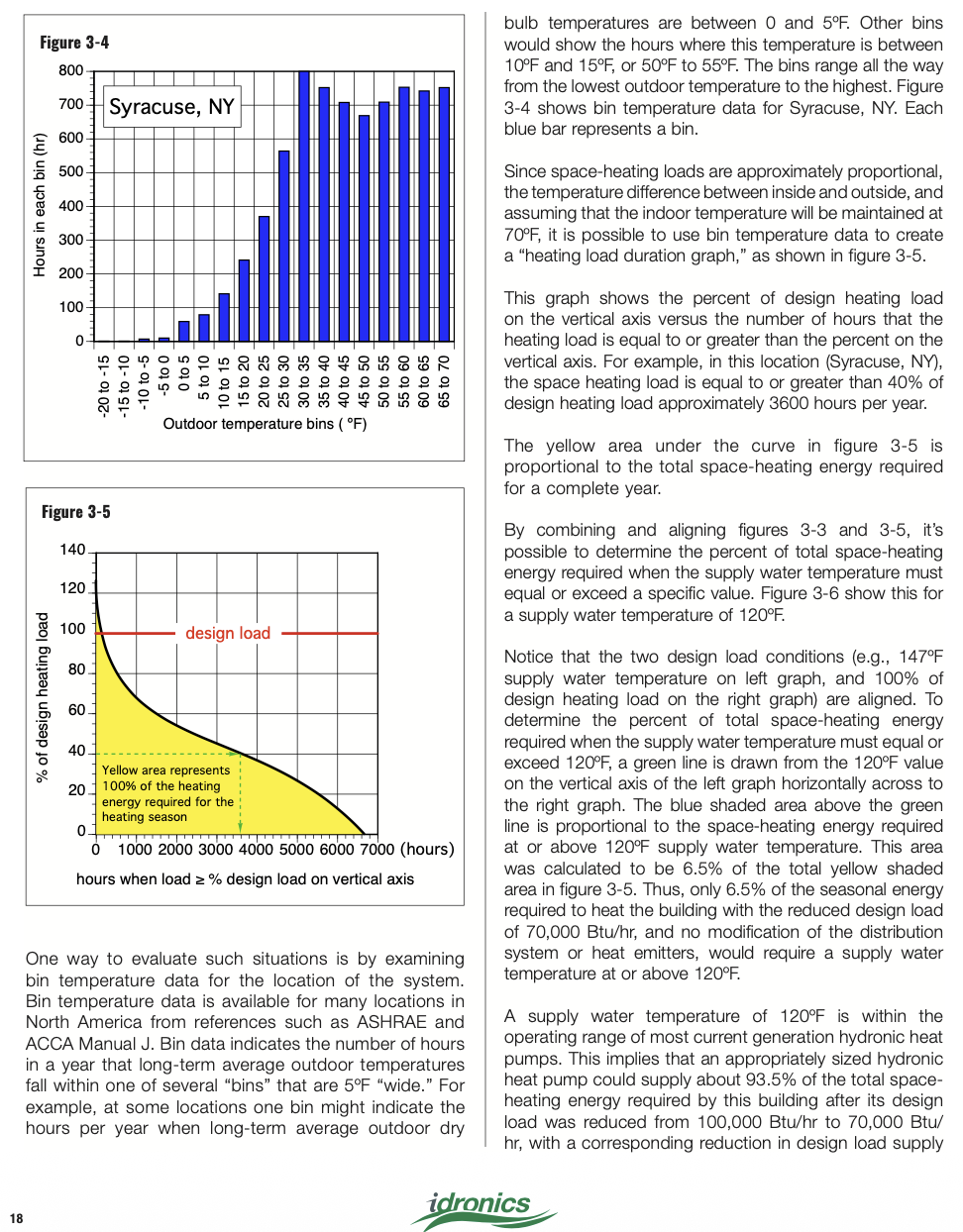
Watch the boiler operate for a few hours. Record burner off and burner on time to get a run fraction. See example for an oil boiler.
To get cycle efficiency, clock the meter with only the boiler firing. Your utility may have the fuel content info? to get Cycle Efficiency
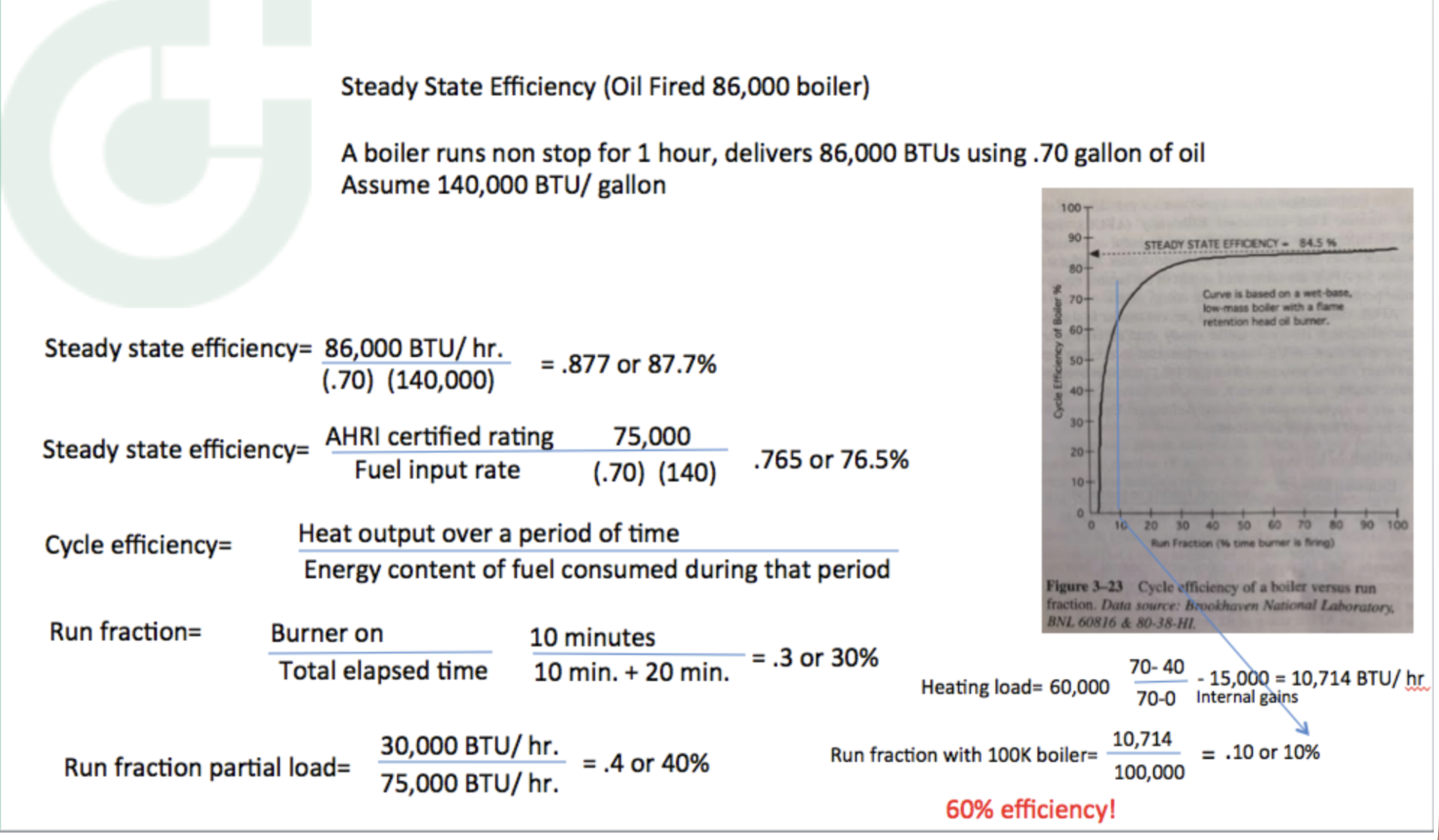
Below a 30% RF, efficiency drops like a rock.
So assume you have a 3 minute run, maybe 20 minute off??
3 ÷ (3 + 20) = .13 or a 13% RF.
The buzz kill is the partial load operating condition
Partial load RF 10,000 load, 116,000 boiler 10,000 ÷ 116,000= .08 or 8%!!
With a 116,000 boiler output and a 10,000 load, with an 80 gallon buffer you get this:
Takes the 3 minute burner on to 9 minutes or so. 9 minute run, 97 off
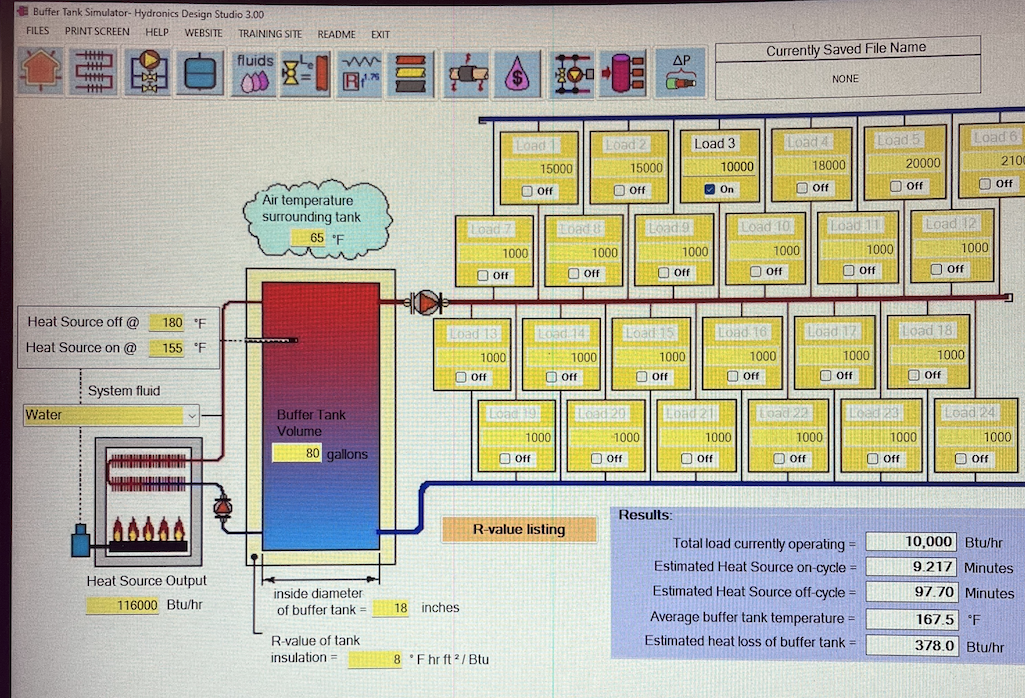
connect two zones 25,000 total the get
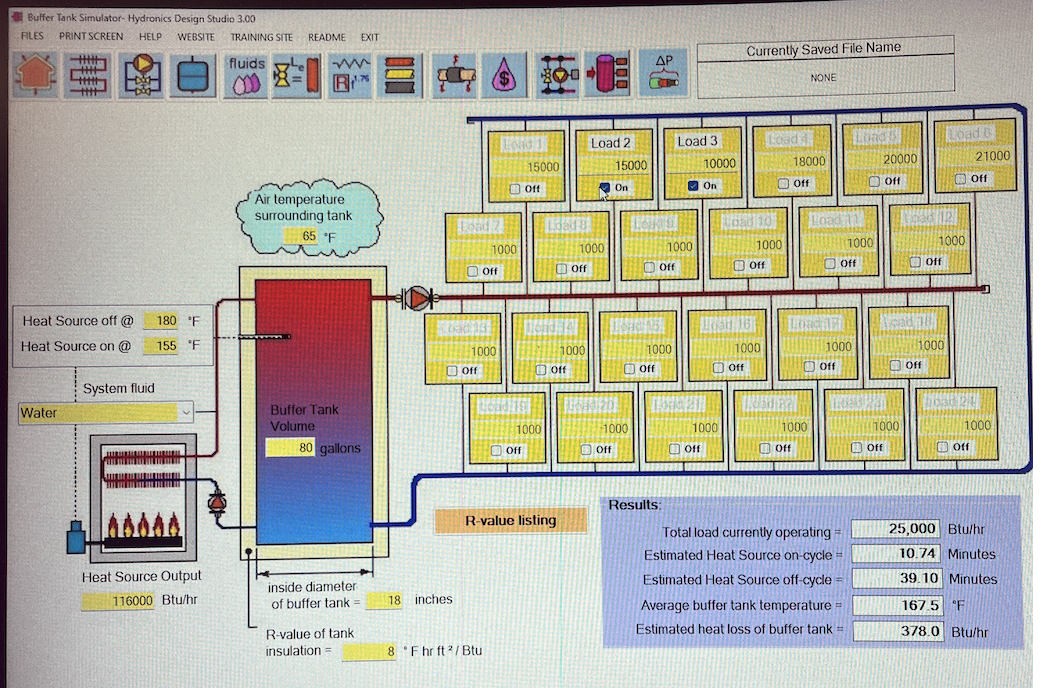
SO..
Lower the load
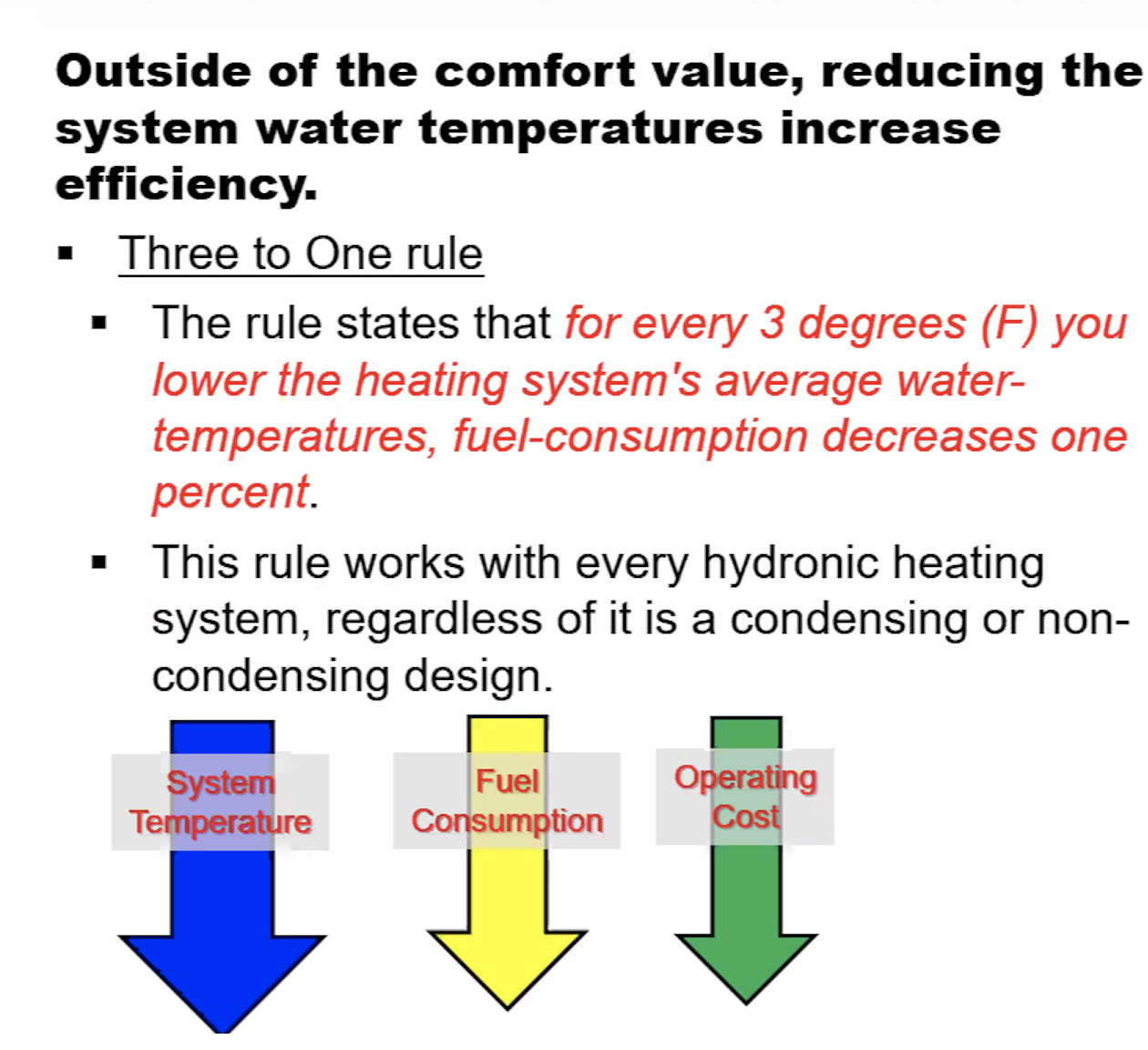
Run boiler SWT as low as possible, stretch ∆ to 25 if possible
Add ODR
Add 80 gallons of buffer
Shoot for a minimum 10 minuter run time, the longer the better.
How old is the boiler? What condition?
A mod con solves a lot of the efficiency questions, modulation,( a right sized boiler even with one zone calling) and low, possibly condensing, 90% efficiency, operating SWT on mild days is a huge win.
Takes your 60- 65% boiler to a 85- 90% boiler! A mod con that ramps down to 8,000 BTU/hr may never shut off during the heating season. That would be a near ideal operating condition for fuel economy and equipment life.
What a nice Christmas gift for your sister :)
Bob "hot rod" Rohr
trainer for Caleffi NA
Living the hydronic dream 2
2 -
Boston Bin data, is this close to her location?
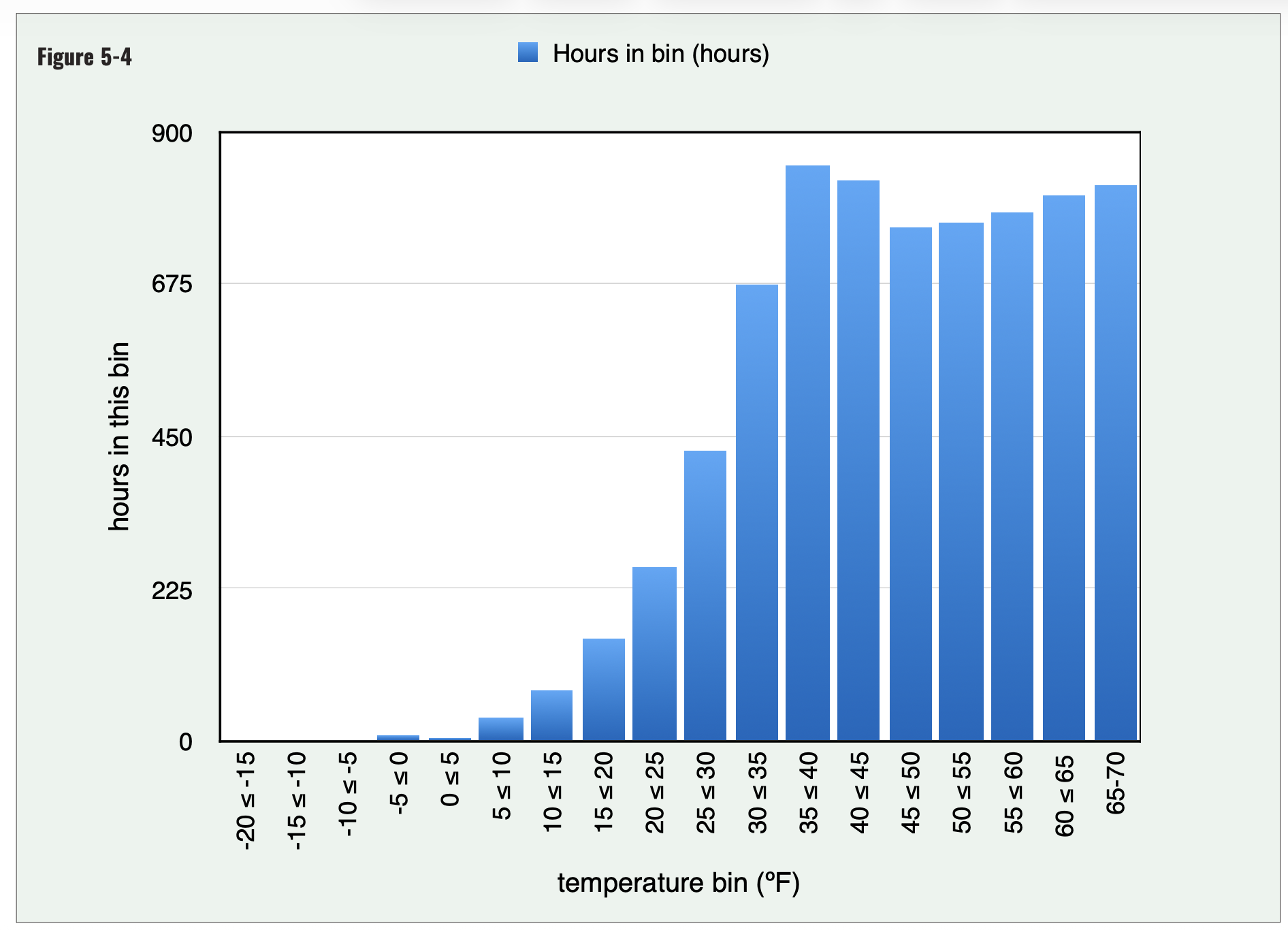
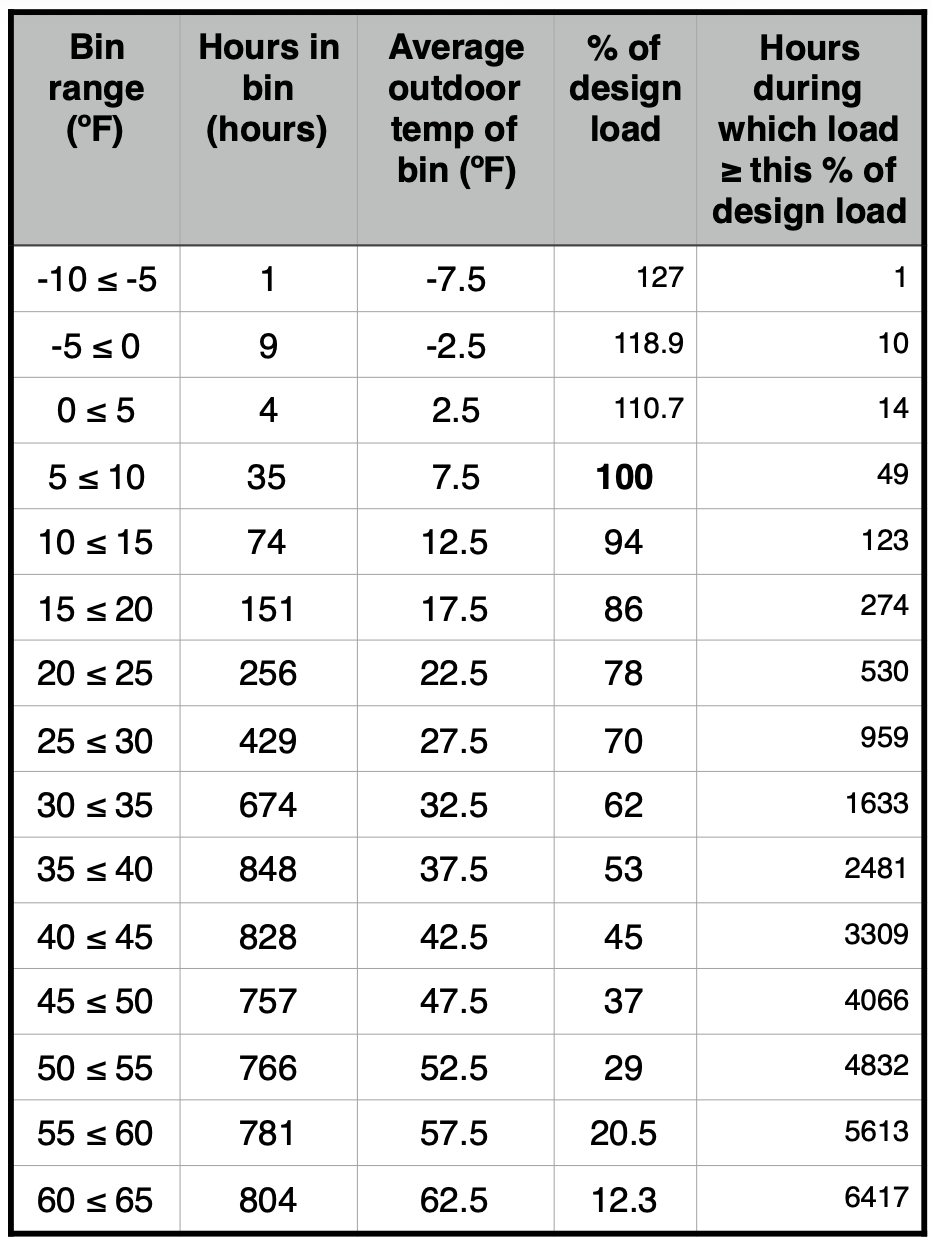
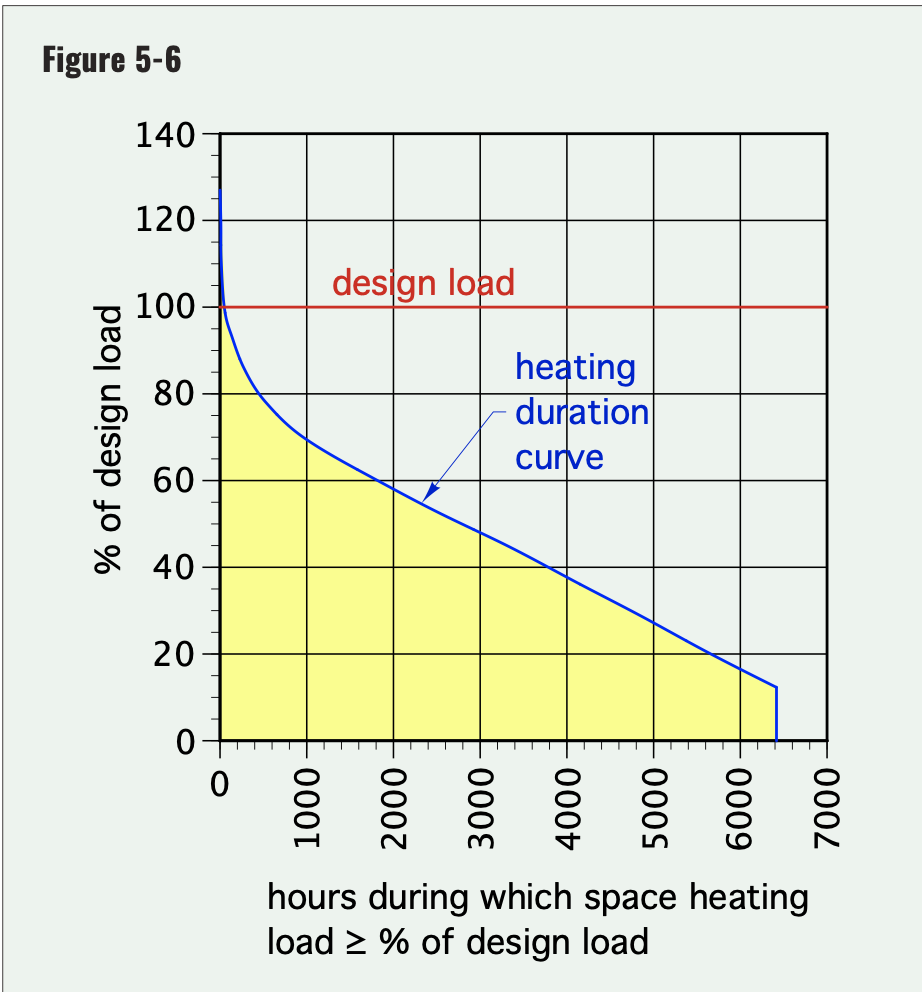 Bob "hot rod" Rohr
trainer for Caleffi NA
Living the hydronic dream0 -
Yes, for a generic unknown leaky wood-frame house, but that's not the case here. I didn't go into envelope details, but I live in and maintain a similarly-built 1924 masonry and frame, mostly uninsulated house nearbyt that has a well-documented (based on many heating seasons) heat loss of 15-20 BTU/hr/sq ft. So based on similar construction and location, I have a hard time believing her house has 2x the heat loss of ours (and she has better/newer double-pane windows throughout).
0 -
I would say start with the basics.
- A heat loss
- Radiation survey
Then I would start the boiler from a cold start with all zones calling and see how fast it heats and if the piping gest hot in all the zones at about the same time.
Is it possible part of the system is air bound or lack of pumping capacity? Is it zone valves or circulators? I would guess valves.
Any attic insulation?
I know you have looked it over pretty good but maybe something would become obvious.
Nice to have a challenge, isn't it?
I also believe 35btu/square foot is possible
 2
2 -
@hot_rod Thank you for all the good insight. To answer your questions:
- Boiler is 2003 Burnham 206, 6-section. Appears to be in good condition. Not serviced last year so combustion efficiency unknown, but I think it's probably close to spec. No sign of condensation because it's been running so hot (short cycling off high limit) all these years. Probably could get another 10+ years out of it. Also, sister doesn't know how long she'll stay in the house, so a less expensive solution like buffer tank plus ODR might be preferable to major investment of a new mod con.
2. If the bin data is from Boston area, it's good enough. We average around 5500 HDD's per season, if that helps.
My questions:
- Why not shoot for higher delta T in buffer for longer cycles, say from 130 to 180? Doesn't that help efficiency? (If needed, we could add bypass to boiler to protect from lower return temps).
- If we added ODR with the buffer, doesn't that reduce the delta T in the primary loop in milder weather, thereby reducing boiler cycle time and therefore efficiency? So isn't that also an argument for making the low limit temp on the buffer tank as low as possible?
0 -
Yeah, an ounce of insulation is worth a pound of hydronics.
You're not going to cut the fuel use in half by tinkering with the boiler. You might by insulating the attic.
0 -
@EBEBRATT-Ed Thanks for those thoughts.
Heat loss: I will do a manual heat loss and see how far off from (or close to) my guesstimate of 20 BTU/hr/sf.
Radiation survey: Definitely needed. Will do.
Cold start test: Good idea, and I will try that.
Zoning: It's zoned with circs, and Taco swing checks. Some may be stuck. Some zones probably are air bound. Will check that too.
Attic insulation: No attic. Vaulted ceilings under terra cotta roof. So probably no insulation in ceilings, and it's probably too difficult to retrofit.
0 -
Unfortunately there's no attic, just vaulted ceilings under original terra cotta tile roof. So probably little or no insulation in ceilings.
For comparison, in our 1924 condo building, there was about 3 inches vermiculite, so maybe R-6? We then blew in 10 inches of cellulose over the top (yes, I know about asbestos in vermiculite) for R-30+. Sadly, that made little difference (less than 10%) in our annual oil consumption. Since getting burned by that experience, I'm wary of claims made for adding attic insulation.
She just had most of the windows replaced with Pella double-insulated argon-filled, and with the entire house either solid masonry or clad in masonry there should be little air leakage. Plus the masonry construction makes adding insulation impractical. So the envelope is as good as it's going to get. I'll do a manual J assuming worst-case no insulation in the vaulted ceilings, but I still think the heat loss will end up closer to 20 BTU/hr/sf than to 35 BTU/hr/sf.
0 -
Some updated data.
Boiler output at 118,000?
Spread delta to 130- 180
So the pros and cons
The wide delta helps the on time quite a bit. With one 10,000 load you get a nice 18 minute boiler on, 195 minutes off.
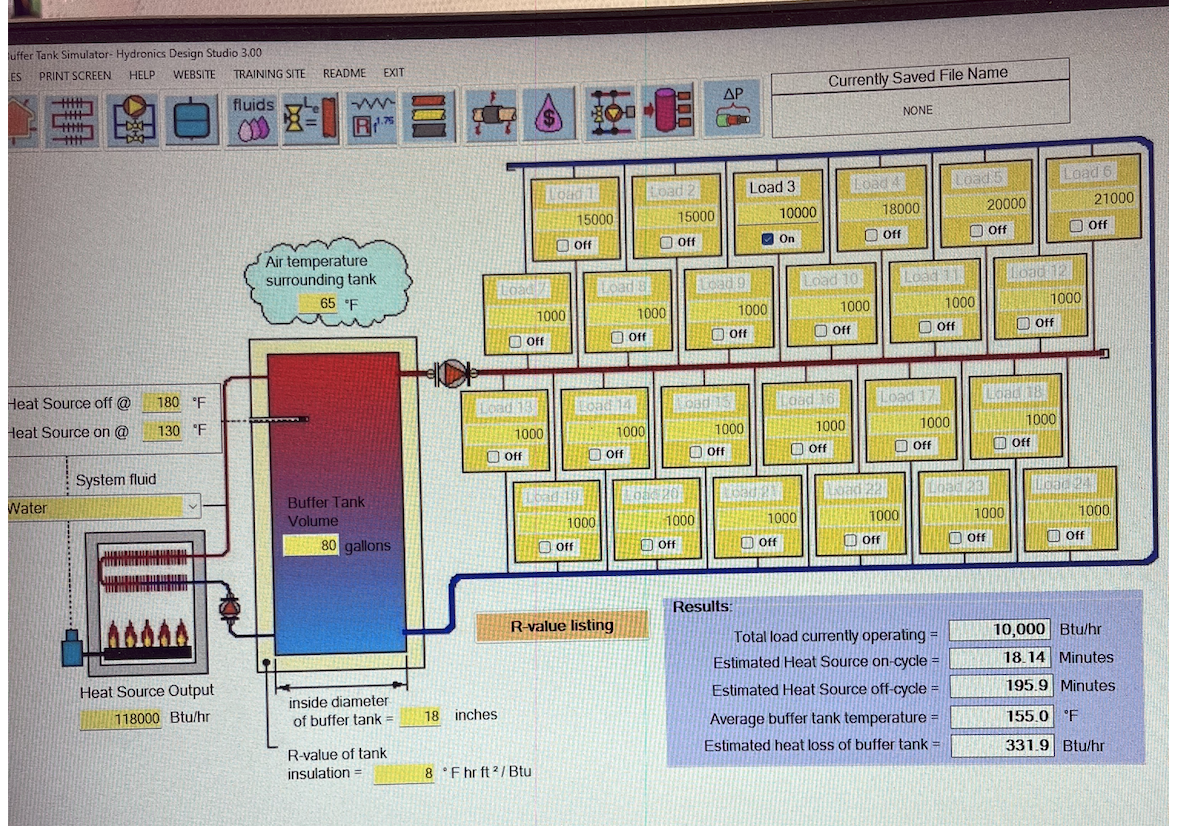
However running the boiler to 180 you lose efficiency, compared to a 150° boiler.
With a CI boiler of course the low temperature is what you need to work around.
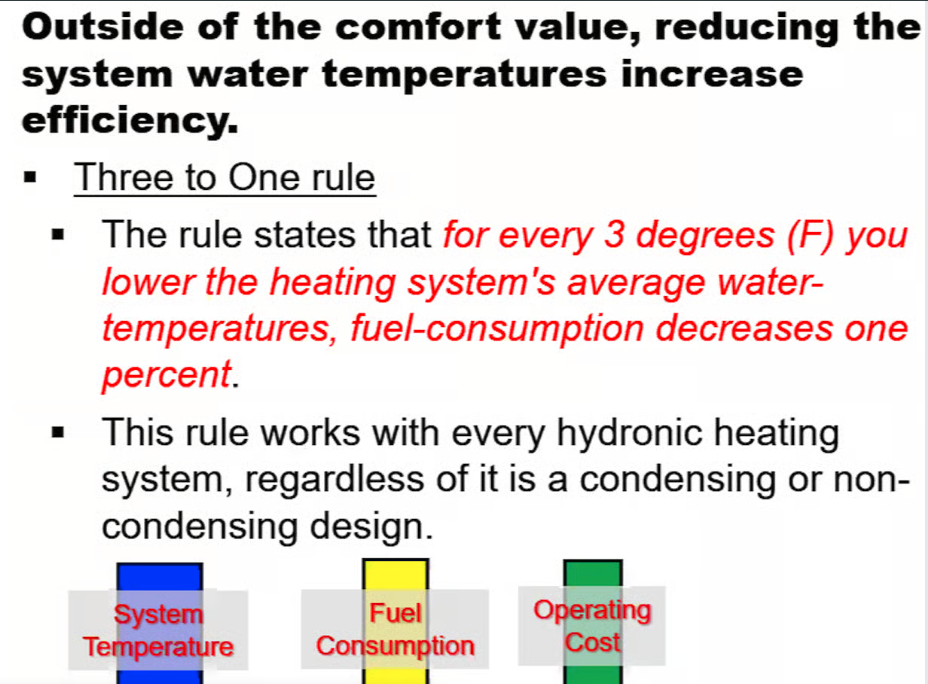
Now with an ODR you lose the leverage of that wide ∆ giving you the nice run times. But maybe most of the year it runs 160 or 150. So the efficiency is up. Runing 162 instead of 180 is an 18° reduction.
According to Viessmann training.
The unanswered questions.
A more accurate total heat load.
What is the smallest zone BTU/ hr load.
What is the radiator or fin tube output at lower SWT. How low can you go and still maintain comfort.
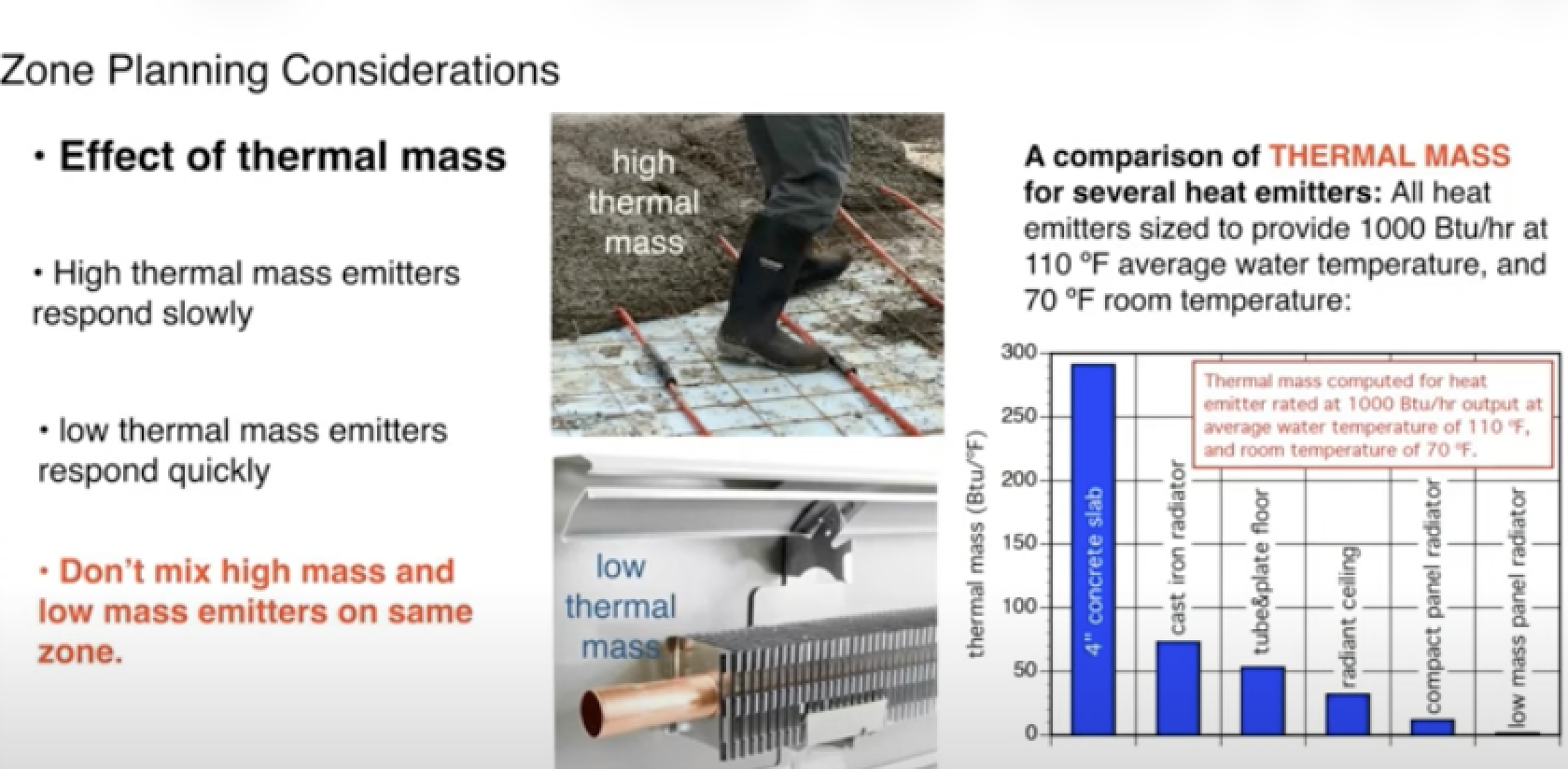
Unfortunately the CI radiators and fin tube are not a good blend. Very different heating characteristics. So there needs to be some compromise.
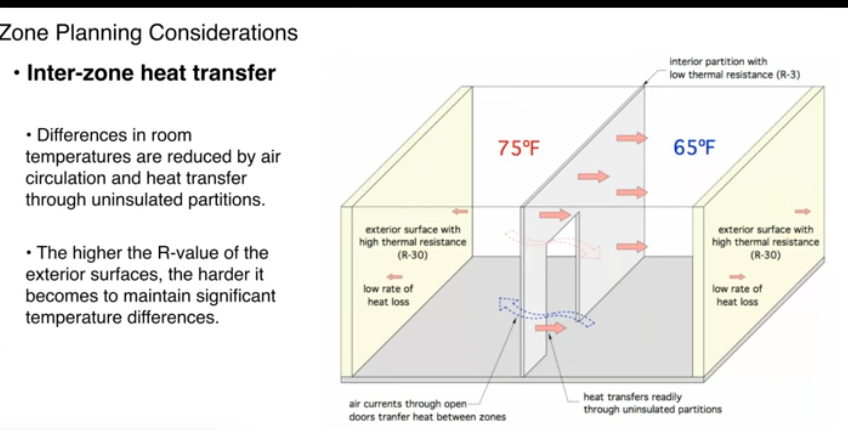
I think sometimes people have an unrealistic expectation of setting unused room temperature back a lot to save energy. Again the building enevelop comes into that equation along with insulation between rooms, if any. If your exterior wall is poorly insulated that can help. But of course the poorly insulated exterior wall is costing more energy regardless. 3-5° room to room difference may be reasonable
 Bob "hot rod" Rohr
trainer for Caleffi NA
Living the hydronic dream0 -
@hot_rod Thanks, as usual, more homework for me. 😀 I will do the Manual J and the radiation survey. Will be interesting to see what the building heat loss probably was vs. actual BTU input.
Meanwhile, it sounds like a buffer tank with ODR could work. So if we reduce average water temp by 20 F, in theory that's around 7% savings. That's like $400/yr, so it could take 10+ years to recoup a buffer tank with ODR. We'll have to see if juice is worth the squeeze.
0 -
"Vaulted ceilings under terra cotta roof" Well there is your problem. The old guys could usually build a resonably air tight flat ceiling but anything like that would leak like a seive. If that ceiling is wood, I would not be surprized if the place is above 20ACH@50pa.
Before doing any work, I would get a blower door test done. Some utilities subidize the cost of the test. For a couple of extra bucks the person running the blower door can also help you narrow down where the issues are. Once you have an actual ACH in hand, you can figure out a plan to get the heating cost down.
Fixing the short cycling and some better controls will not get you 50% fuel savings. Air sealing a 20ACH place down to 4-8ACH would.
2 -
@Kaos OK thanks, good idea on the blower door. The vaulted ceilings are mostly drywall/plaster, but there is one small walk-in attic storage area where the ceiling is some kind of tongue and groove board or beadboard paneling, I forget which. So that part of the ceiling could be very leaky. All the exterior walls are either solid masonry or stucco over wood framing, and so I had been thinking air leakage would be negligible, but I forgot about that one small attic storage area where the ceiling could be a sieve.
I've also been wondering whether the atmospheric draft bonnet on the gas boiler (with no automatic vent damper) could be causing too many ACH's, but Google AI says that type of flue bonnet typically makes a negligible contribution (0.02 to 0.05 ACH) of a typical house's total ACH of 0.3 to 0.5. But as AI is known to be error-prone, I mention that in case anyone knows better.
0 -
Infrared scans can tell a story also
Moreso than assuming a certain R value in that ceiling/ roof detail.
Bob "hot rod" Rohr
trainer for Caleffi NA
Living the hydronic dream1 -
If she can afford a much larger buffer tank you will be able to store more water on the return side, wherein the there will be a very large thermal mass of water that will require less heat energy to reheat.
Large volume galvanized pressure tested tanks are available that can be used to store the cooler return water that can still radiate heat into the basement space.
Cooler return water can still be thought of as a large thermal mass that will require less heat energy to reheat.
0 -
The issue with a tank over 119 gallons is the become very expensive. If you want pressurized and well insulated.
The best bang for the buck, if you are so inclined, is a used LP tank. They come in many sizes, can handle the pressure. But getting a R-10 or more around them is a hassle. I've built a 2" foam box around the entire tank.
And of course vertical is best.
The larger the tank, the more skin heat loss, so I would get as close to what is required as possible.
Now if I was buffering a solid fueled wood or coal, more is better. IF you think you are getting free heat with your own wood supply :)
Bob "hot rod" Rohr
trainer for Caleffi NA
Living the hydronic dream0 -
Good morning to you Bob,
My thought was that using a hydrotested galvanized tank that are available as new tanks as they weigh much less than a bulk propane tank and they could be more easily be lowered down a staircase or a Bilco door.
Leon
0 -
OK, back of the envelope heat loss calculation.
The building is 3300 square feet.
Let's say it's two stories, 32x52 rectangle. Eave walls are 20' high, so 20x52*2=2048 square feet of wall area. Gable ends are another 9' high in the middle, average height of 24.5, 24.5x32x2= 1568 square feet of wall area, so 3616 total. Let's assume 15% of the walls are windows and doors, so 542 square feet of doors and windows and 3073 square feet of regular walls.
With a typical 7/12 pitch the roof has a surface area 17% greater than the footprint, with a footprint of 1650 square feet that gives a roof area of 1925 sf.
Logan airport has a design temperature of 13F. At an interior temperature of 70F that's a difference of 57F. The conduction flow through an assembly is given by the temperature difference times the area divided by the R-value. Let's say the roof and walls are R4 and the windows and doors are R1, that may even be high for 1920s construction.
We get:
Walls: 3073*57/4= 43,790 BTU/hr
Roof= 1925*57/4= 27,431 BTU/hr
Window and doors= 542*57/1=30,894 BTU/hr
So 102,000 Btu/hr for conductive losses.
Now onto air infiltration. @Kaos suggested that a building like this could have a ACH50 of 20, I generally agree, but let's be conservative and say 10, which would mean a natural infiltration of about one half air change per hour. This building has an volume of 40,425 cubic feet, so 20,212 cubic feet per hour or 336 CFM. With a 57F differential that's 20,500 BTU/hr.
Adding it all up, we get 122,000 BTU/hr, or 37 BTU/hr/sq foot.
1 -
@DCContrarian I appreciate the brainpower. You could well be correct. I'm just having a hard time wrapping my mind around the 2x difference in heat loss per SF compared to our similar age and construction condo building.
Main difference is her vaulted ceiling and tile roof, so that could well be the governing heat loss. Also, some exterior masonry walls have no interior furring-out with plaster and lath overlay, just bare (painted masonry). Whereas our exterior masonry walls are furred-out inside, with plaster and lath interior finish. So it's possible that our walls are R-10 (which I've used for our calcs and gotten good agreement) and her walls are only R-4, despite appearing similar.
0 -
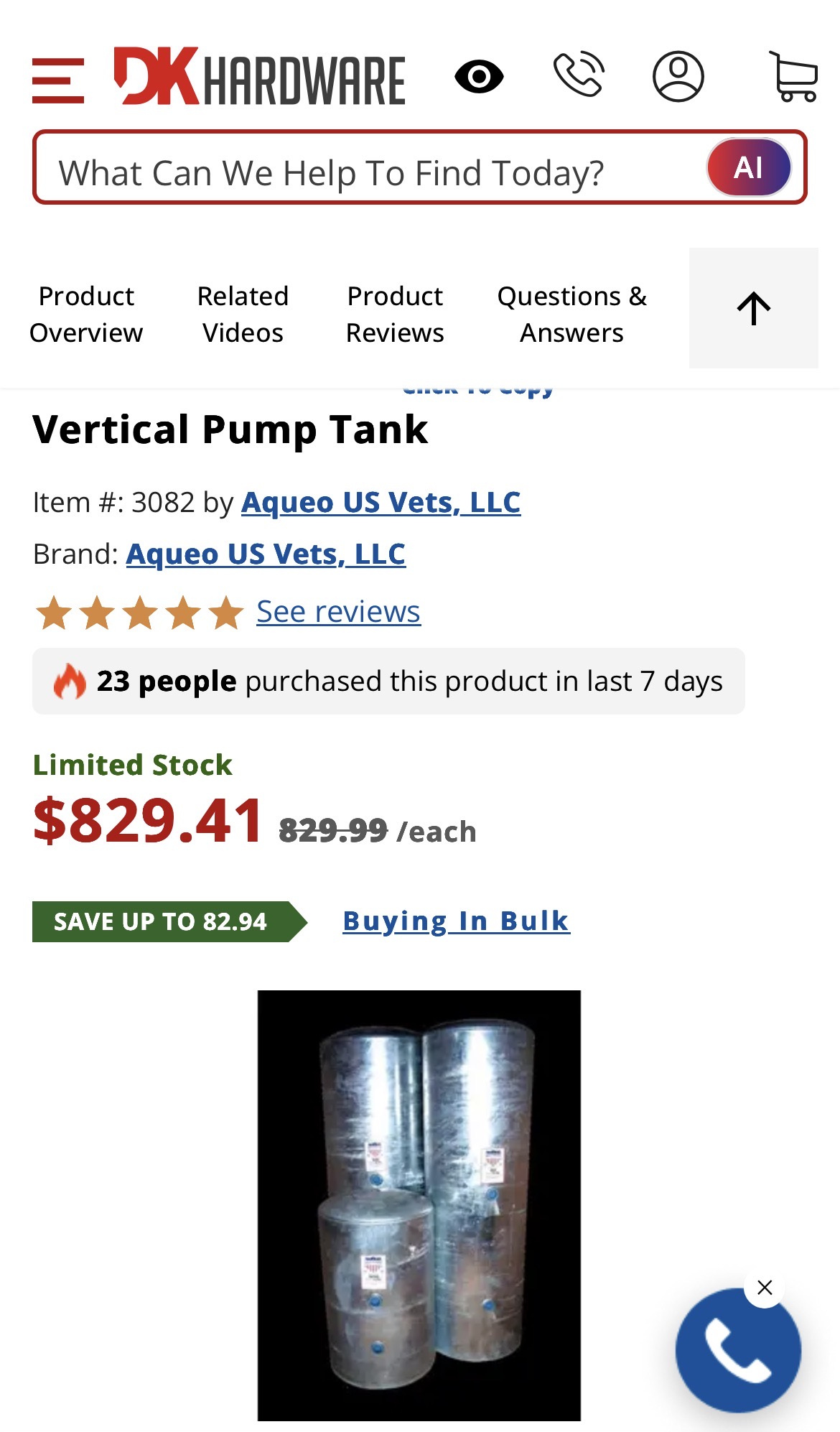
an 80 gallon electric runs around $1000,00
Could you foam insulate and jacket a galvanized for the price difference?
 Bob "hot rod" Rohr
trainer for Caleffi NA
Living the hydronic dream0 -
Fiberglass batt insulation, chicken wire and tie wire would run much less, that is what we did for my fathers WEBEN 500 gallon hot water tank in his laundromat.
0 -
@jesmed1 "stucco over wood framing" if that is original that also tends to be balloon framed. That generally means no blocking and floor joists and wall cavity open to roof space. This makes a really nice chimney to carry hot air from the house up to the roof and vent it through the roof tiles. Great for fresh air, not great for efficiency.
The lack of airgap for the plaster also makes quite a significant difference when there is no insulation. The air gaped plaster adds about R2, so that bumps up your effective wall R value by almost 50%.
I'm with @DCContrarian , the place could really be 35btu/sqft. At that point, boiler runtime is the least of your worries for heating cost.
@leonz "wherein the there will be a very large thermal mass of water that will require less heat energy to reheat" Buffer tanks are passive devices and can't create energy, except for reducing cycling thus slightly higher boiler efficiency, they won't reduce your fuel use no matter how big or where it is placed.
1 -
I had a 5 room ranch in Western, MA (near Springfield) all masonry. 1170 square feet. Walls were block on 3 sides and block with stone on the front. Inside was 3/4 furring strips with gypsum lath and plaster no insulation/
The attic had 4" insulation and I bumped it up to 8". Never changed the windows but they needed changing.
Original boiler was 122,000 input. Fin tube was 90' (as best I can remember) I changed the boiler to a Peerless PS-3 II 65,000 input, 48000 net heating capacity.
Tough place to heat the new boiler did not run away with the place. I put the boiler in when I sold the place
1 -
Good morning Kaos,
I do not want to get tangled up in the weeds and rollover in the drainage ditch about this.
I guess this is where we have a huge difference of opinion, yes buffer tanks are passive devices and do not create energy but if properly insulated the heat in the cooler water returning to the tank and then the boiler.
The insulated buffer tank that was used in my fathers laundromat saved money on his natural gas bill as it fed hot water to 48 washing machines first using two flat 1972 Weben coil boilers and then a single flash boiler.
I did the math with the hot water formulas in DESK REFERENCE 4th Edition in 3 examples of hot water storage involving a 5,000 gallon, 8,000 gallon and 33,000 gallon surplus insulated railroad tanks cars used for hot water storage starting with 52 degree well water and ending with 140, 160 and 180 degree hot water and using 120, 140 and 160 degree return water to the tank car using my coal stoker boiler to make hot water and reheat it and the fuel savings were massive.
 1
1 -
I remember a laundromat project my dad and I did back in the late '60. The drain water from the washers dumped into a steel tank with a mass of large copper coils, that my dad built. The laundromat was in Hamburg, N.Y so cold incoming water year around.
Basically a large drain recovery/ reverse indirect pre-heat tank.
Energy cannot be created or destroyed, we just change the form. Coal to HW for example.
With every conversion there are some losses. And all insulated tanks loss some heat regardless of the R-value around them.
Bob "hot rod" Rohr
trainer for Caleffi NA
Living the hydronic dream0 -
Thanks everyone for the good ideas. I'm going over there this morning to do a heat loss calculation. That could well be the problem based on my possibly-mistaken belief that it couldn't be much worse than our 1924 condo building.
0 -
Another double check, how much radiation is currently installed? Does it maintain temperature in the coldest condition? That give you an approximation of boiler size.
No need to have more boiler that what the attached emitters can move to the space.
If cold return is chronic, that is one indication of more emitter than boiler power.
The heat emitters ALWAYS drive the boilers operating condition. Good or bad.
Bob "hot rod" Rohr
trainer for Caleffi NA
Living the hydronic dream1 -
@jesmed1 also mentioned having both CI radiators and copper fin tube.
I am hoping they are not mixed on the same zone that could be an issue.
 2
2 -
@DCContrarian @Kaos Thank you for your input on heat loss. I spent today measuring and checking wall thickness, construction, insulation, etc, then running heat loss calcs. I found that most of the solid masonry walls on the first floor had been furred out inside with either 2x4 or 2x6 stud walls with batt insulation. So those walls weren't the problem. And because the roof is steeply pitched and begins at the first floor ceiling, the second floor consists mostly of wood-framed dormers with 2x6 stud walls and batt insulation. So those walls aren't the problem either. And because the first floor living room ceiling is vaulted, the second floor is a lot smaller than the first floor. So less square footage, and much of what would normally be second-floor ceiling area is counted with the first floor living room, because of its vaulted ceiling.
The problem was in the basement. Most of it is uninsulated solid concrete walls, 12-16 inches thick. I assumed R-1 for those. And because those are semi-submerged, I used a lower delta T (40 instead of 60). But the real problem was the concrete slab floor. Don't know its thickness or insulation. I assumed the worst, 4 inch slab, no insulation, R=0.3. I used a delta T of 20 for the floor slabs, assuming earth temp of 50.
Because there's 1000 sq ft of basement floor slab (half of it in heated family room, half in unheated boiler room), the heat loss through that slab is 70,000 BTU/hr, under those assumptions. That's enough for an entire house. If I incude the basement walls, the entire basement is 107,000 BTU/sq ft. That's enough for a bigger house.
I didn't bother with air infiltration, because the numbers are so bad anyway.
The breakdown:
First floor, with vaulted LR ceiling: 47,000 BTU/hr
Second floor: 9,000 BTU/hr
Finished basement (heated): 49,000 BTU/hr
Unfinished basement (unheated boiler room): 58,000 BTU/hr
Total: 163,000 BTU/hr
What's interesting is that the first and second floors come in right around 20 BTU/hr/sq ft, as I had guessed, and I didn't fudge the numbers to make that happen. But the basement comes in at 90+ BTU/hr/sq ft, because of the assumed 4-inch uninsulated floor slab at R=0.3, and the uninsulated 12-inch uninsulated perimeter walls at R=1. If I take the average, it comes out to 43 BTU/hr/sq ft.
So the killer is the uninsulated bare concrete basement. But here's where the limitations of reality set in. The boiler itself is rated at 164,000 BTU/hr input, 84% efficiency. So at best it's putting out 137,000 BTU/hr. And because the boiler pipes aren't insulated, and there's a long metal flue pipe running from the boiler over to the chimney, the boiler room is the warmest room in the house. (That's why I counted it in the heat loss, even though it has no rads). So if the house stayed at setpoint on the coldest days last winter, it did so at no more than 137,000 BTU/hr. I'll have to ask my sister tomorrow about that. She may say some days the boiler couldn't keep up. But I also think the boiler wasn't running as efficiently as 84%, so I think the practical max output was less than 137,000 BTU/hr.
So what do you all think about the basement slab loss? 70,000 BTU/hr for around 1,000 sq ft of slab 4+ feet below ground level? Sounds crazy high, but I guess numbers don't lie.
@hot_rod had a good point about radiation being the limiting factor, and I'm sure that's true. I'll do a radiation survey tomorrow, and I'll bet there's not enough radiation capacity for the boiler at max water temp.
0 -
Maybe insulate the basement ceiling? Might make the cellar cold.
But all the 1970s electric heated houses with electric baseboard heat and aluminum wire (😢🙄) around here had the basement ceilings insulated with 3 1/2" fiberglass and they don't seem to freeze up.
Might ask if the floors feel cold.
1 -
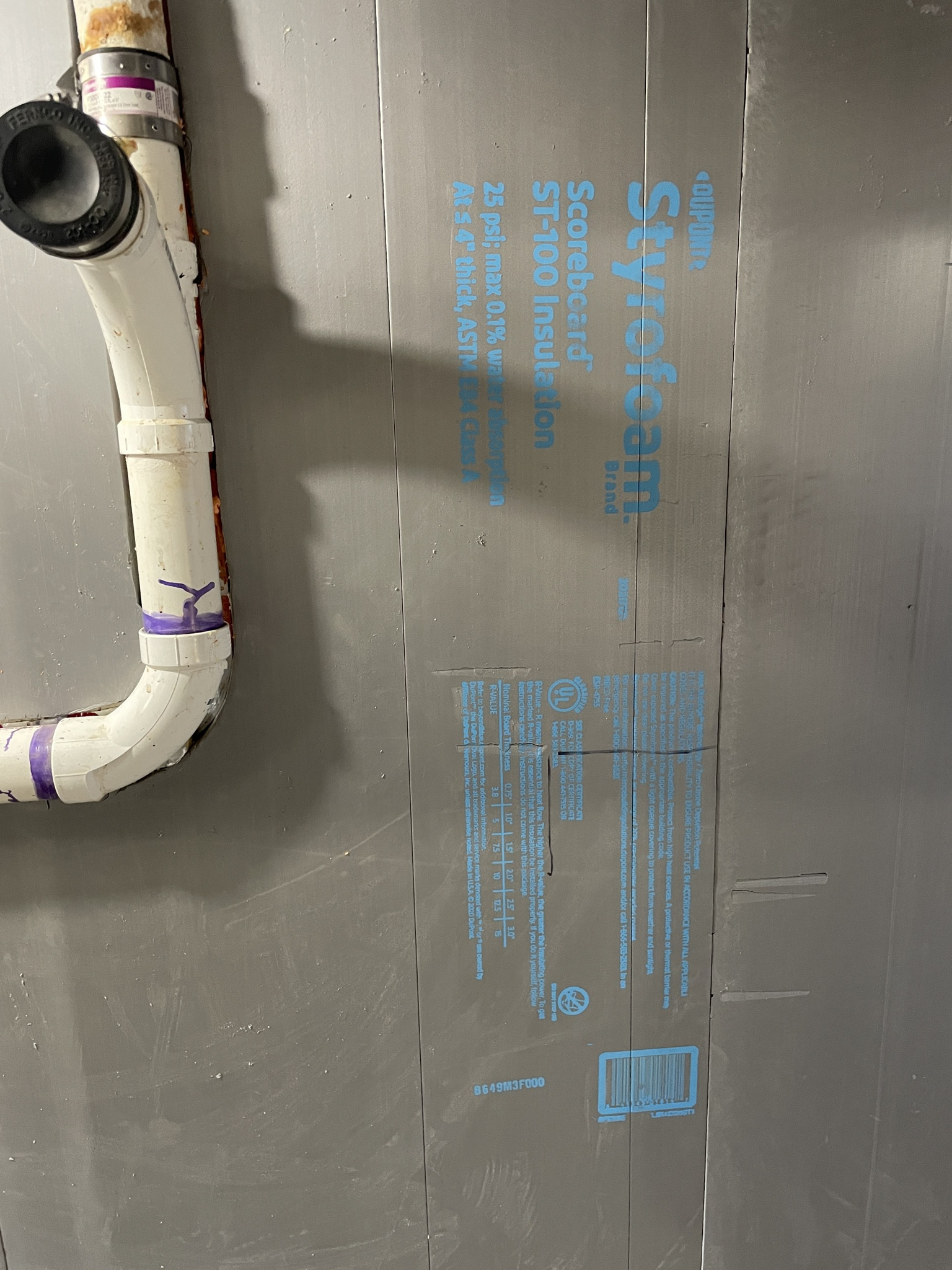
Recommend applying 2” exposure rated Dupont XPS to basement walls. Goes up fast and immediate payback.
 1
1 -
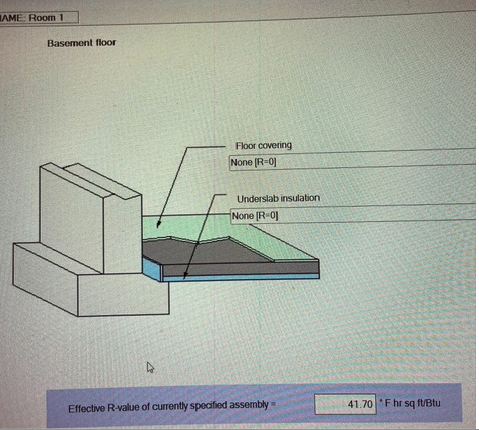
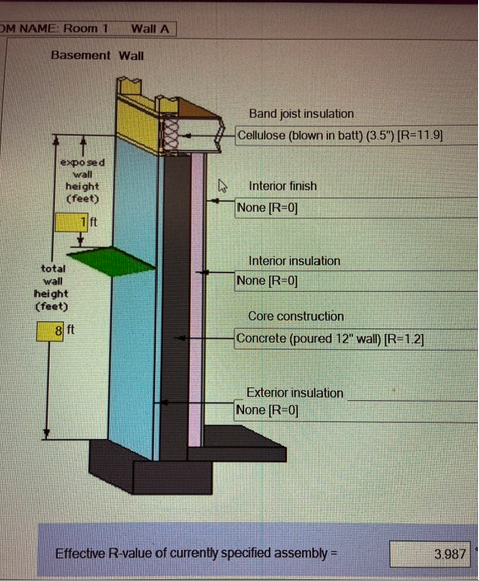
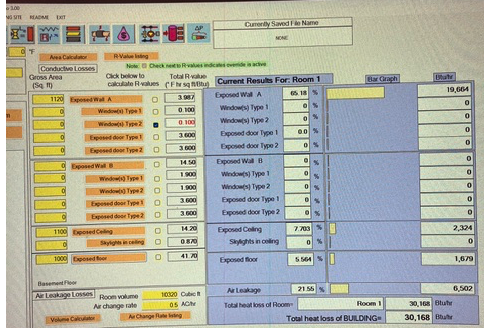
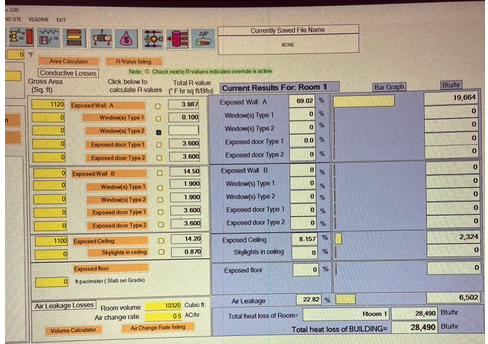
I figured 1120 sq ft of basement wall. No doors or windows? Insulated rim joist? Uninsulated slab
0° outdoor, 70° indoor. Heated space above?
Load around 30,000 is more realistic.
65
Bob "hot rod" Rohr
trainer for Caleffi NA
Living the hydronic dream0 -
65?
0 -
Did you include windows and doors? In my back-of-the-envelope calculation they were lost more heat than the roof.
70K for the basement slab seems high to me, but I don't doubt that the basement is a heat sink. My mental image of a basement in a 1920's house in Massachusetts is something that is basically open to the elements. And it wouldn't surprise me at all if when they finished part of it they did only minimal insulation and no air sealing.
My guess is that infiltration is a significant contributor to heat loss. I would expect a basement like that to have a bulkhead that barely closes, a bunch of windows that whistle when the wind blows, and maybe an abandoned coal chute that was indifferently sealed. Even if it doesn't have any of that stuff I'd expect the rim joists to be super leaky, even in the finished part of the basement.
"the boiler room is the warmest room in the house. (That's why I counted it in the heat loss, even though it has no rads)." Heat doesn't only go where you send it, you have to include everything inside the building envelope in the heat loss calculation.
1 -
temperature above basement floor
Bob "hot rod" Rohr
trainer for Caleffi NA
Living the hydronic dream1 -
OK, an update. I used some online calculators inputting the actual # therms used for heating, and the location, for which the online calculators select the appropriate number of HDD's to calculate the approximate heat load for the house. I've done this before with our condo building, and the results are pretty accurate, so I have confidence in the method.
Doing this for my sister's house gives a predicted heat loss of about 110,000 BTU/hr, vs the more extreme 163,000 BTU/hr I got from my guesstimating on floor slab R value, etc. Assuming the 110,000 BTU/hr is correct based on actual fuel usage, that gives an average heat loss of 33 BTU/hr/sq ft, quite close to @DCContrarian and @Kaos predictions.
So I think I probably was too conservative with the slab loss of 70,000, as several of you have observed above. Cutting the slab loss estimate roughly in half (by raising R value from 0.3 to 0.7) and raising the 12" thick concrete R value from 1 to 1.5 brings my calculations down pretty close to the 110,000 BTU/hr from the actual fuel consumption. So that seems reasonable.
0 -
Yes, I got about 12,000 BTU/hr from windows and doors.
Re leaks, this is not your typical basement. It's 12-16" thick solid concrete walls all the way up to a plaster ceiling with no rim joist visible, and no bulkhead doors, so it's quite airtight relatively speaking. The basement is built like a bomb shelter.
Notice that I already over-predicted the heat loss at 163,000 BTU/hr (mainly by being too conservative on the basement floor and wall R-values) vs. the calculated 110,000 BTU/hr based on actual fuel consumption, without even adding a factor for air leakage, Yes, I understand air leaks are definitely happening, but that means even less conductive/radiative heat loss is happening than I calculated using conservative R-values. In other words, my assumed R values were too low. So either the actual air leakage is lower, or the actual R values are higher. Either way, the 110,000 BTU/hr calculated based on actual fuel consumption should be the "real" number, and it's quite close to your BOTE of 122,000 BTU/hr, so thank you for setting me straight.
Now that you've convinced me the heat loss really is close to 35 BTU/hr/sq ft, I guess the boiler isn't the culprit here, but we can still check to make sure all the zones are circulating, do the radiation survey, etc. I'm sure the boiler is still short-cycling on some of those small zones, so there may be some minor improvements we can make to zoning.
0 -
"1920s Massachusetts house is basically open to the elements"
This is true. Go in the basement and you see outside light through all the cracks.
Insulation and air sealing were unknown around here until the 80s……maybe. Probably only decently tight construction from 1950s and after. Before the 50s we lived in barns
1 -
Sounds like we're back to "an ounce of insulation is worth a pound of hydronics."
I've heard good things about the Mass Save program, although it's been a while since I lived in Massachusetts. In particular I've heard that their assessors are good, their participating contractors are hit and miss. It might be worth getting them to do an assessment of the house to find out where the most productive places to do weather-sealing are.
1 -
If I modeled it right, the bare boiler room walls are losing about 16,000 BTU/hr, so that's almost 15% of the total. The XPS that @PC7060 suggested would take R=1.5 concrete to R=11.5 and reduce that 16,000 BTU/hr to 2,000 BTU/hr, so a roughly 12% savings. That's pretty decent return.
0


Categories
- All Categories
- 87.8K THE MAIN WALL
- 3.3K A-C, Heat Pumps & Refrigeration
- 60 Biomass
- 430 Carbon Monoxide Awareness
- 133 Chimneys & Flues
- 2.2K Domestic Hot Water
- 6K Gas Heating
- 124 Geothermal
- 170 Indoor-Air Quality
- 3.9K Oil Heating
- 79 Pipe Deterioration
- 1.1K Plumbing
- 6.7K Radiant Heating
- 397 Solar
- 16.1K Strictly Steam
- 3.5K Thermostats and Controls
- 56 Water Quality
- 51 Industry Classes
- 51 Job Opportunities
- 18 Recall Announcements