Weil-McLain SGO Series

Hello - I currently have a Weil-McLain SGO Series 7 and Weil-McLain SGO Series 5 that are both 30 years old and run on oil. If I replace with the same make and model, should the heating capacity of the new boilers be the same? Are the newer models very different as far as their heat output?
Comments
-
Hello - I currently have a Weil-McLain SGO Series 7 and Weil-McLain SGO Series 5 that are both 30 years old and run on oil. If I replace with the same make and model, should the heating capacity of the new boilers be the same? Are the newer models very different as far as their heat output?
Short answer NO
Why replace a 30 year old cast iron boiler if it is not leaking? That Cast Iron can last 50 years or more. If you want to make things better, just replace the burner and controls with the latest and greatest burner and controls. But That won't change much in the way of fuel usage.
The SGO oil-fired boilers have retained the same firing rates since the SGO line was introduced many years ago.
To be clear, the SGO replaced the Weil-McLain Model 68 steam boiler. The SGO debuted in April 1995, and Weil-McLain is currently selling the Series 4 version. There is no Series 7 SGO boiler as of 2026. “Series 4” refers to the current design generation of the boiler, not the number of cast-iron sections.
A comparison of the SGO Series 1, Series 2, Series 3, and Series 4 rating information shows that the firing rates have remained the same throughout the production run. For example, the SGO-5 has retained its 1.45 GPH firing rate through all four series. The available historical rating information indicates that this consistency applies throughout the SGO product line.
The SGO is available in several sizes, based primarily on the number of cast-iron sections and the amount of fuel that can be burned in the combustion chamber. The smallest current model is the three-section SGO-3, with a firing rate of 0.95 GPH and an input of 133,000 BTU/hr. The largest model is the nine-section SGO-9, with a firing rate of 2.55 GPH and an input of 357,000 BTU/hr.Here is the corrected version:
Your SGO-7 has a rated firing rate of 2.00 GPH, while your SGO-5 has a rated firing rate of 1.45 GPH. Those firing rates have remained unchanged throughout the different SGO series.
You may also derate a boiler by using a lower firing rate, as long as the combustion adjustments remain within the manufacturer’s permitted parameters. For example, I have a boiler rated at 1.50 GPH, but I am getting better performance from it at a firing rate of 1.24 GPH.
A qualified oil-burner technician may have already reduced the firing rates on your two SGO boilers. Therefore, checking the nozzle sizes and pump pressures may show that you can, in fact, use the smaller boiler.
When selecting a replacement boiler, you should not automatically assume that the existing boiler is the correct size. The person who selected it originally may not have chosen the best size for the system. In addition, radiators may have been added or removed over the years, changing the amount of connected radiation.
The proper way to size a steam boiler is to measure and total all the connected radiation in the building. The replacement boiler should then be selected according to its Net AHRI rating in square feet of steam, choosing the model that most closely matches the connected radiation.
There is normally no reason to add another pickup factor to the manufacturer’s square-foot steam rating. Weil-McLain’s published steam ratings already include a piping and pickup allowance of 1.33, or approximately 33%, for normal piping and pickup loads.
For example, suppose the connected radiation totals 680 square feet of Equivalent Direct Radiation, or EDR. The SGO-6 is rated for 658 square feet of steam, while the SGO-7 is rated for 758 square feet.
The previous installer may have selected the SGO-7 because the SGO-6 was technically 22 square feet below the connected load. That would have been an understandable and appropriate decision when following the rating chart strictly.
However, the 22-square-foot difference is very small—only about 3.2% of the connected radiation. Considering the substantial piping and pickup allowance already included in the manufacturer’s rating, the SGO-6 would probably be the better match for this particular system.
Selecting the SGO-7 provides approximately 78 square feet more steam capacity than the calculated 680-square-foot load. In comparison, the SGO-6 is only 22 square feet below the calculated load. Therefore, the SGO-7 could be considered overkill on top of the oversizing allowance already built into the manufacturer’s rating.
Edward Young Retired
After you make that expensive repair and you still have the same problem, What will you check next?
0 -
I have looked at your current oil fired boilers and it appears that you have the Series 1 SGO-5 and SGO-7. From that photo, it appears that there are no leaks on the cast iron sections. with that information I see no reason to replace the boilers that you have. There is no efficiency or fuel saving benefit to the new boilers since the burners are almost identical and the fuel usage will stay the same.
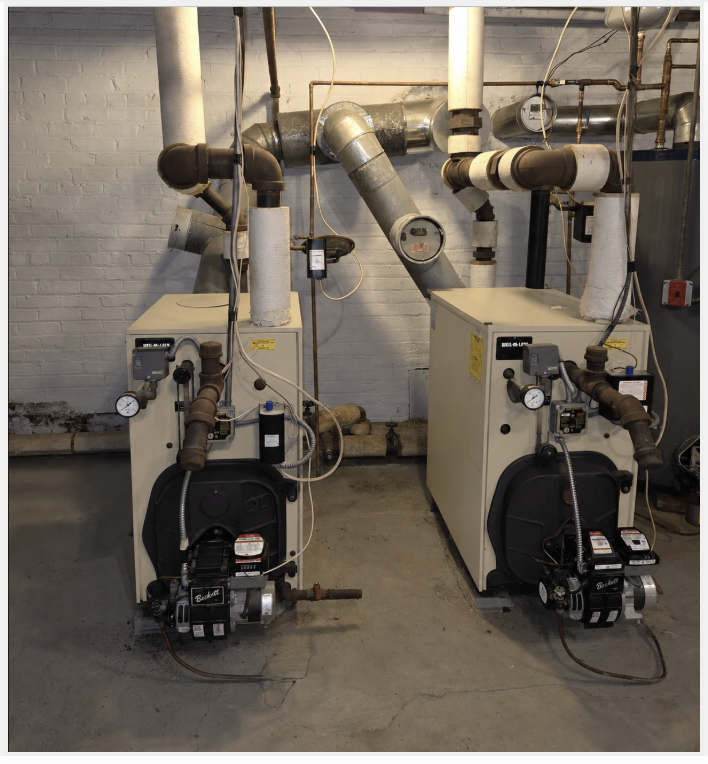
If you were able to use some cleaning agent and perhaps a coat of paint to make the boiler room look like this, would you still think the boilers needed to be replaced. the important part is under the covers and 30 years is nothing for cast iron. There are some 100+ year old cast iron boilers still working perfectly. Just ask @Jamie Hall
I might add a flexible fuel line to facilitate opening the burner door for maintenance. but properly tuned up that only needs to happen about every 5 years or so. The Barometric on the left boiler should be installed on the plumb and level in. order for it to be accurate. And I might finish the insulation on all the steam piping. They do make insulation for elbows and tee fittings.
Edward Young Retired
After you make that expensive repair and you still have the same problem, What will you check next?
0 -
Hi - thanks for all your advice. Who would I looked for to do the work you mentioned above? We have a furnace company that cleans the boiler once a year but that is it. They were the ones to suggest we replace them but I am not sure if it is just because they wanted the job. They are also not steam heat specialists.
0 -
@lovebug11768 , where are you located?
0 -
Long Island, NY
0 -
Plenty of good steam guys there. Go here to find one:
0 -
Thats a "Long" island. Care to narrow it down a bit?
0 -
Long Island, NY Northport, NY
0



Categories
- All Categories
- 87.8K THE MAIN WALL
- 3.3K A-C, Heat Pumps & Refrigeration
- 60 Biomass
- 430 Carbon Monoxide Awareness
- 133 Chimneys & Flues
- 2.2K Domestic Hot Water
- 6K Gas Heating
- 124 Geothermal
- 170 Indoor-Air Quality
- 3.9K Oil Heating
- 79 Pipe Deterioration
- 1.1K Plumbing
- 6.7K Radiant Heating
- 397 Solar
- 16.1K Strictly Steam
- 3.5K Thermostats and Controls
- 56 Water Quality
- 51 Industry Classes
- 51 Job Opportunities
- 18 Recall Announcements