R-32 V R454B video

"AC service tech" on U tube has a lot of good videos.
The latest is "R-32 V R454B" and why he thinks R-32 is better simpler etc.
80% of the MFGs went R-454-B. Daiken, Amana, Goodman Friedrich use R-32 which had been used in Europe for 15 years with no issues.
R-32 much less expensive
Easier to work with (single component refrigerant) does no fractionate or separate.
He also cautions that with R-454B you charge a system and start it up you can't check superheat or subcooling until you let it run for at least 1/2-1 hour. Something strange about the way it mixes.
This is something they are just finding out about now. He says a lot of R-454-B systems have been overcharged due to this.
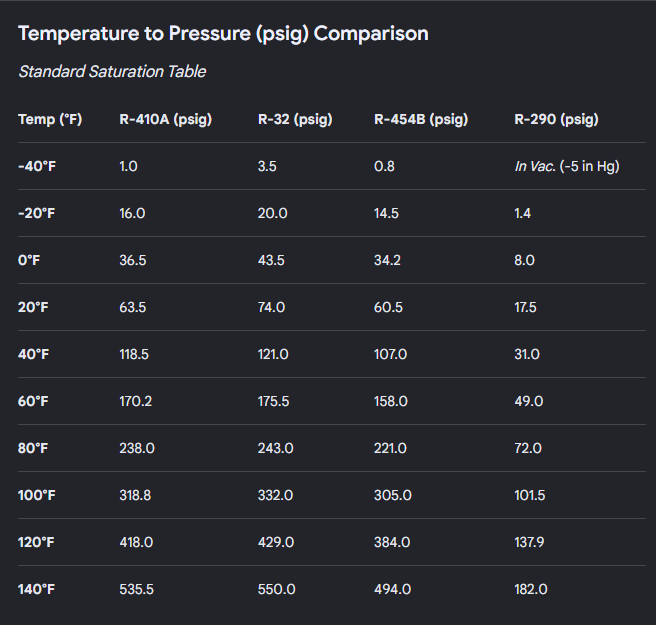
The eventual push towards the flammable refrigerants like R-290.. and the eventual phase out of R-32 & R454B.
R-32 and R454B production levels allowed by the EPA are already down to 60% they were at 90% a few years back.
maybe🤣🤣🤣🤣 that is to keep the price up LOL
But he explains it better than I can if your interested.

Comments
-
Why would there be any mixing if you charge as a liquid?
Either way I've been team R32 the entire time
Single pipe 392sqft system with an EG-40 rated for 325sqft and it's silent and balanced at all times.
0 -
Why does it matter, We don't have a choice anyway!
0 -
That's mostly the truth
Id like to think we do though.
Single pipe 392sqft system with an EG-40 rated for 325sqft and it's silent and balanced at all times.
0 -
No choice if doing service. If you buy equipment, you have some choice.
Have to see the video. R-32 single component charges just like 22, 12 etc.
gas or liquid charge
454B is more like 410A separates, fractionates whatever its a blend. Charge as a liquid.
However he seemed to be saying (and he seemed a little baffled by this) that they are just finding out recently that if you dump 454B into a new system and check superheat/subcooling within say 10 min of start up it may be wrong and they are finding the units have to run 1/2-1 hour for it to settle down. I guess it is from the R-1234y in the mix. says they are finding systems put in in the last couple of years are overcharged from people checking charge immediately after start up.
0 -
I charge all with liquid!
For me checking SH and SC is after the system is stable and near temperature anyway.
1 -
I'm still having trouble tightening the hose to the jug adapter without the adapter loosening.
And I don't know what "fractionates" is, so...
0 -
fractionates
When a refrigerant is made up with 3 or more components when drawing vapor the compounds can separate. You can draw more of one component then the others changing the blend. That's why you liquid charge.
0 -
That's interesting enough that I might watch the video.
What it seems like I'm running into on new systems is due to the micro channel evap coils getting logged with oil from opening the liquid line quickly, instead of the suction line slowly. Apparently it's a lot harder to get a big slug of oil back to the compressor through those tiny passages.
But ISTR that Europe is banning 32 in the next few years. Whisky Tango Foxtrot, I wish they'd make up their mind.
0 -
I’ve never had issues with opening either valve 1st. The compressor discharge will always be higher pressure until it equalizes so how is the oil being drawn out?
0 -
I think it's the oil foaming up when the liquid line is opened & the juice carrying lots of it out into the system, more than normally moves through it during operation. Once it gets to the evap, I imagine it's surface tension that tries to hold it in the passages—they're a lot smaller than you'd think if you haven't seen the end of one of them in section.
Calling them "radiator like" really isn't doing the trade much good. While they share some appearances with radiators, they are also not very radiator-like in other ways. A radiator has what's basically a flattened tube to carry the fluid, but a micro channel coil is made up of extrusions, only a fraction of the section is actually available to carry the fluid compared to the apparent size.
0 -
One of the molecules is probably much more soluable in the oil than the other so it stays dissolved in the oil until the oil is hot.
0 -
It probably has to do with the condenser being stored or transported on its side and the oil moving around inside too. It was a problem for the tech that installed my ac 25 years ago. Their trucks were small bed pickup trucks and the bed wasn't empty so it wouldn't surprise me if it only fit on its side.
0 -
It was mentioned in the video that 454B is R-32 & R-1234y and 410A? so it has 3 components.
He said the 1234y (stupid name for a refrigerant by some genius) the molecular weight is much heavier than the other two which may be part of the mixing issues.
Its all way above my pay grade.
@ratio according to the video R-454B & R-32 are going away by the mid 30s. Their production was 90% of capacity but they have already cut back to 60%.
He said r-32 is much cheaper because the patent? has expired so anyone can make it. 454B is still locked up by only two manufacturers Chemours and Honeywell
No wonder the price is so high
My suspicion is that most of the AC MFGs went with 454B because it is so similar to 410A so they didn't have to do much redesign
0 -
As related to work I need at least another $20hr. to even begin to care about something I have no control over. I can only care about what's in front of me at the time.
0 -
Single pipe 392sqft system with an EG-40 rated for 325sqft and it's silent and balanced at all times.
0 -
"R-32 and R454B production levels allowed by the EPA are already down to 60% they were at 90% a few years back."
This is not true, production of both of these refrigerants is UP the 60% number takes into account ALL regulated HFC combined
"It was mentioned in the video that 454B is R-32 & R-1234y and 410A? so it has 3 components."
well then the video has multiple inaccuracies…. R454b is a blend of R-1234yf (agreed dumb name!) and R32
I think the guy tried too hard to make a video about this. Obviously R32 was the better choice in hindsight, it's not a blend and open to manufacture by anyone in the world (thanks Daikin) but go back in time several years, there was a plan in effect several years ago that we would need to transition to a GWP lower than what R32 has. it was going to happen in the middle of our current refrigerant generation, This was a USA only rule. The solution? create a refrigerant that met the future standard, "future proof" your refrigerant. That was R454b, and this is why you see the US manufacturers using it, while manufacturers based primarily in other countries using R32.
The patent has NOT expired on R32, there are hundreds of patents relating to R32, daikin released (voluntarily) The overwhelming majority of these patents to allow anyone to make it
"He also cautions that with R-454B you charge a system and start it up you can't check superheat or subcooling until you let it run for at least 1/2-1 hour."
This is true of any refrigerant…. it must be running under stable load with good airflow, when its hot out this can take a half hour or more….
"This is something they are just finding out about now. He says a lot of R-454-B systems have been overcharged due to this."
it was covered in every A2L class I took, or gave, and every EPA608 licensed person would know this if they read the book..
I am thinking maybe don't watch that channel if you want any accurate info, seems like just ragebait at best, and pure misinformation at worst?
@EBEBRATT-Ed which part do you disagree with?
 1
1 -
-
@EBEBRATT-Ed I dont think I made any statement of opinion here with the exception of the last thing I wrote which is more speculation than anything. it isn't an opinion that A2L production is up for example, or that R454b is a blend of 2 refrigerants and not 3, or daikin patents not being expired just being voluntarily released, or dialing in a charge on a residential AC correctly requires the system to be stable.
0 -
I just threw the video out there because I thought it was a good discussion, in fact stating that R-454B had 3 components instead of 2 was I think my mistake.
No worries.
1


Categories
- All Categories
- 87.8K THE MAIN WALL
- 3.3K A-C, Heat Pumps & Refrigeration
- 60 Biomass
- 430 Carbon Monoxide Awareness
- 133 Chimneys & Flues
- 2.2K Domestic Hot Water
- 6K Gas Heating
- 124 Geothermal
- 170 Indoor-Air Quality
- 3.9K Oil Heating
- 79 Pipe Deterioration
- 1.1K Plumbing
- 6.7K Radiant Heating
- 397 Solar
- 16.1K Strictly Steam
- 3.5K Thermostats and Controls
- 56 Water Quality
- 51 Industry Classes
- 51 Job Opportunities
- 18 Recall Announcements