another TurboMax/buffer question

I am in a similar boat to the user in
I've got an existing boiler and I'm planning to add an indirect and buffering using a TurboMax 50-3. I was hoping to get some feedback on the system I've laid out. Does it make sense? Will it accomplish what I'm aiming for? Should I consider something different?
I have a Burnham X-209 (280,000 btu/hr in, 84% efficient). My home has a design day heating loss of 175,000 btu/hr (measured by boiler runtime on a couple days at -5F in the Chicago northern suburbs), but too many cast iron radiators (about 2,200 sq ft EDR), so I've got meaningful boiler protection concerns. My existing atmospherically vented gas hot water heater is about 10 years old and I've planned to replace it with an indirect.
I've selected a TurboMax 50-3, partially because the nerd in me finds this really interesting, but also because in the coming years I'll have 4 teenagers in the house, so I've got tons of showering, dishwashing, and laundry in any given day, and as a result high first hour ratings are important to me. The standard indirects in this range are no cheaper than the TurboMax, and some are more expensive. I don't have the ceiling space for a HPWH that would have first hour ratings that are even close to my needs. Finally the reverse indirect setup means I can use it for hydraulic separation and even boiler protection.
My plan is to ask my plumber to pipe the boiler to the standard boiler in/out ports on the TurboMax, using an NRF-25 (speed 1). I will then pipe a bypass loop out of the extra tappings on the TurboMax, with a balancing valve on the outlet side before the tee. Then I'll have an NRF-33 after the tee out to the radiators. I'll have the balancing valve closed enough so that 5-6 gpm comes out of the TurboMax (and 24-25 gpm from the system return is cycled back out to the system). I plan to set the TurboMax low limit to something like 140 or 150F, so the water coming back into the boiler is always going to be above condensing temperatures, by construction. The bypass loop with a partially closed balancing valve should mean that even if the home is calling for heat the tank temperature never falls below 140F.
What I am not really sure about is how I can control this? I had the thought that the TurboMax aquastat would be the "thermostat" for the boiler, and I would have my home thermostat simply control the second circulator (through a 1 zone relay?). Is there some way to get an approximate DHW priority here, where the system circulator stays off while the tank is recharging to its high limit?
Experts of HH - what do you think? Will this work the way I am imagining it will?
Comments
-
The 2 ways I can think of to do DHW priority is to put a flow switch in the DHW or possibly some temp probes on the pipe, when the pipe is hot there is a dhw load. You could even get fancy and add an extra relay so the dhw priority only kicked in if there was a heat call from the tank, no het call from teh tank, it keeps serving the dh loads until the tank cools enough to call the boiler.
The tank driving the heat call to the boiler is the simplest and probably sufficient although there are other ways to do it.
It could make a lot of sense to have some combo of return water protection and odr to control the temp to the radiators instead of a fixed bypass.
I'm not so sure a 50 gallon reverse indirect will cover 4 teenagers even with a 250,000 btu/hr boiler heating it. No one ever complained that they had too much hot water.
1 -
at some point the tank dictates the teenagers shower duration , not the opposite 🫢
If the loads is near continuous, multiple showers and loads one after another. Or multiple loads at the same time, tankless heater or plate hx may be a better option
6 gpm at a 77 degree rise = 231,000 btu/ hr
I’m not following how balancing to only 6 gpm supplied to the radiators will cover the 175,000 btu/ hr load?
Bob "hot rod" Rohr
trainer for Caleffi NA
Living the hydronic dream0 -
the math I was playing with is 6 gpm * (140F - 65F) * 500 = 225,000 < 0.84 * 280,000 so there is more coming out of the boiler than going to the radiators, and the tank stays warm? 65F is my guess about the coldest return water I've ever seen in this home. am I thinking of this wrong?
0 -
I guess the other way to do dhw priority is either use an aquasatat with 2 setpoints or an aquastat that closes on rise and if the tank temp falls below some setpoint that aquastat will open and cut off the dh system.
0 -
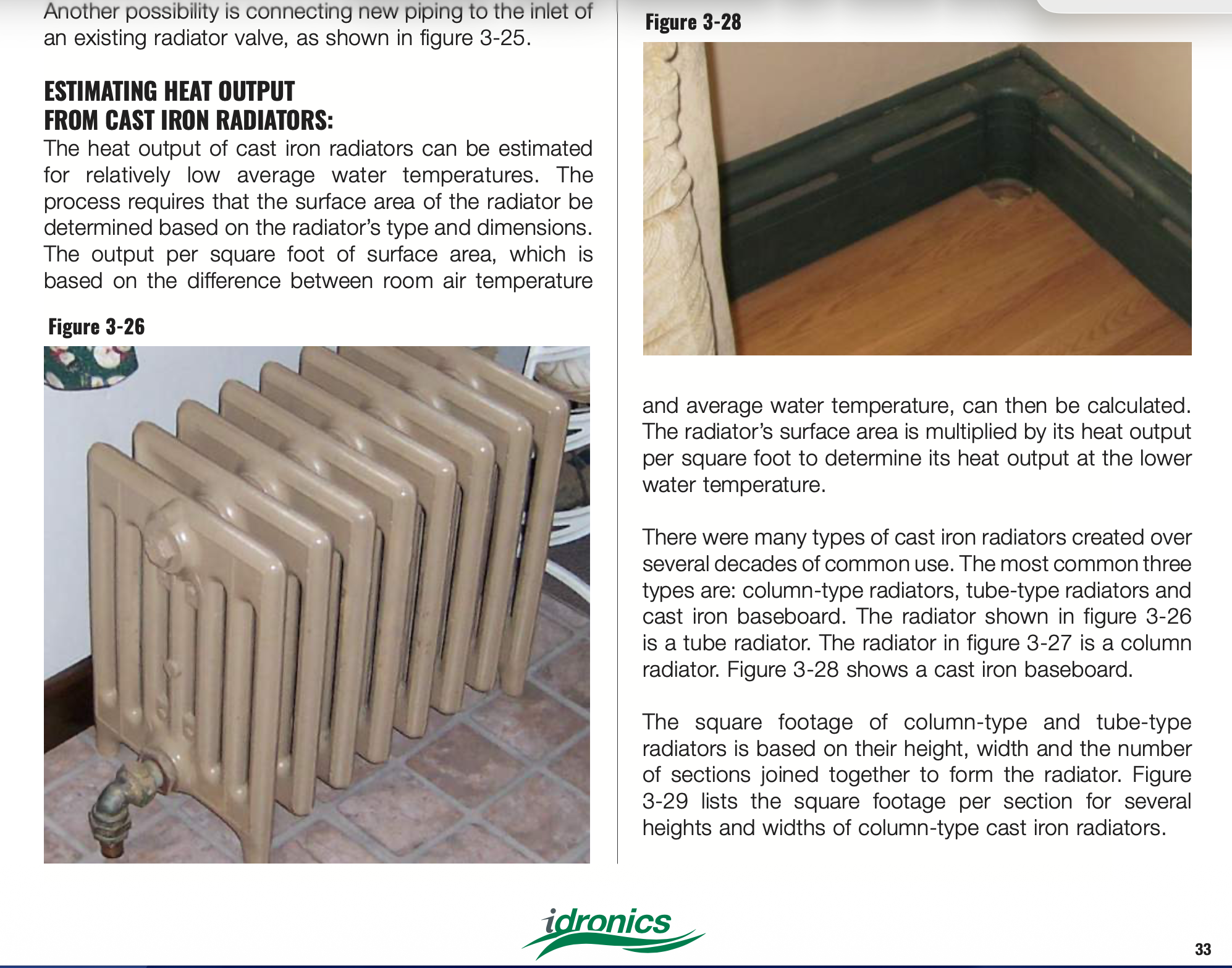
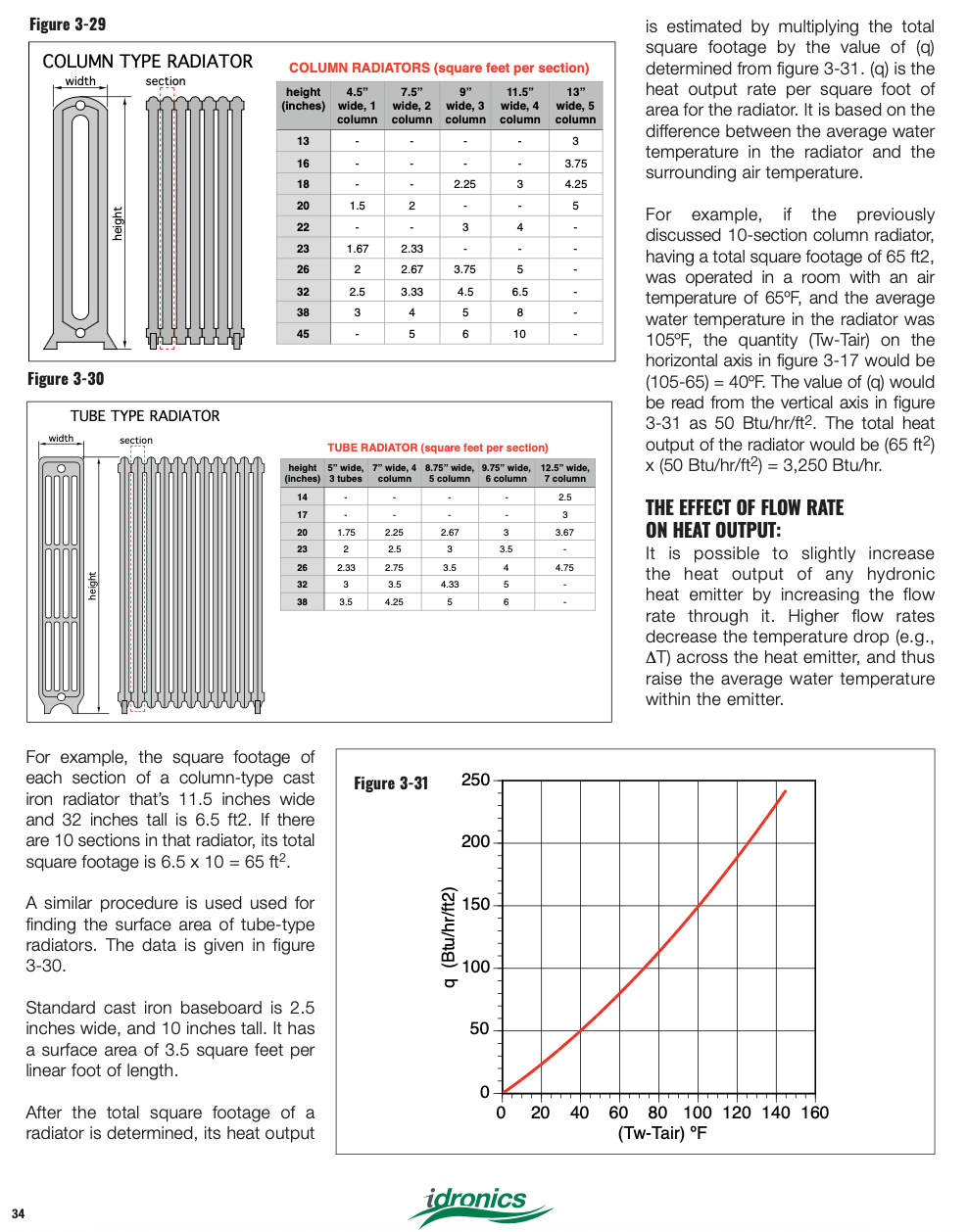
Running a 75° ∆ through the radiator loop? The radiator needs to be warmer than the ambient to give off heat.
Here is a generic derate sheet for CI radiators. The example shows a 32" tall, 10 section radiator at 105° in a room with 65° ambient air condition.
 Bob "hot rod" Rohr
trainer for Caleffi NA
Living the hydronic dream0 -
Isn’t it going to be a blend of 6gpm at about 140 plus 24gpm at whatever the radiators are returning? So if the radiators return 65 this is sending 80F out to the radiators and then as the system warms up that number rises.
0 -
You are bumping up against the issue of controllability with a “dumb” manual balance valve. If you set it to 6 gpm supply, it stays at 6 gpm always
With a thermostatic or motorized valve the flow modulates to match the load to the boilers output
On a cold start the majority of the flow just bypasses through the boiler or tank. You need to protect the boiler from that 65 rwt.
As return temperature rises, more flow is allowed to the supply.
Think of it as a thermal clutch. Able to disconnect completely or slip flow at the correct rate.
A temperature sensor is the brain in charge of the mix decision, either internal with a thermostatic valve, or a sensor modulating a pump or motorized valve.
Bob "hot rod" Rohr
trainer for Caleffi NA
Living the hydronic dream0


Categories
- All Categories
- 87.8K THE MAIN WALL
- 3.3K A-C, Heat Pumps & Refrigeration
- 60 Biomass
- 430 Carbon Monoxide Awareness
- 133 Chimneys & Flues
- 2.2K Domestic Hot Water
- 6K Gas Heating
- 124 Geothermal
- 170 Indoor-Air Quality
- 3.9K Oil Heating
- 79 Pipe Deterioration
- 1.1K Plumbing
- 6.7K Radiant Heating
- 397 Solar
- 16.1K Strictly Steam
- 3.5K Thermostats and Controls
- 56 Water Quality
- 51 Industry Classes
- 51 Job Opportunities
- 18 Recall Announcements