Open Loop Pressure Questions

My questions are regarding cooling towers specifically, but I suppose they could be aimed at any open loop system.
What determines where the differential pressure is allocated in an open loop system?
For a closed loop system, I believe I do understand where and how it is allocated. If there's a pump that can create 40 ft of head, an its pumping away from the point of no pressure change, than all 40 ft will be added to the discharge side of the pump.
But if it is an open loop system, is there a point of no pressure change? Would it be the basin, or the point where it becomes "open"?
When the pump turns on, what can cause all of the head to be added to the discharge? Or what's stopping it from creating part of the differential pressure on the suction side?
Apologies if I am confusing.
Comments
-
it physcial location to the open part of the system, the water level in the tank for example. At that point the pressure would read 0 on a gauge. As the pump starts it adds the dynamic pressure.
Head is the mechanical energy added to the system, in this case by the spinning circulator pump. The pump adds energy, the piping and components subtract or use up the added energy
Bob "hot rod" Rohr
trainer for Caleffi NA
Living the hydronic dream0 -
Open loop is very different from closed loop.
Lets say you have a pump sitting in a mechanical room on the floor next to a 100 ton chiller chiller with a water tower on the roof.
Water towers (at least the ones without a remote sump tank) have the MU water piped to the tower which usually has a float in the tower sump to maintain the tower water level because water is lost to evaporation and some is bled to drain to help control water quality
So lets say the tower water level is 25' above the pump inlet. The system is filled and there would be 10.8 psi on the pump inlet (25'/2.31=10.8psi
When the pump starts the pump the pump has to move 100 (chiller tons) x 3gpm=300gpm of water flow. The head or discharge pressure will consist of:
1.The pressure drop (in this case resistance to flow) of the chillers condenser of 300gpm of water. The chiller MFG would provide this information in feet of head. Lets call it 15' of head
2.The height in feet from the pump to the tower inlet. We had 25' on the suction side but the tower inlet is higher so call it 35'. 35'-25'=10' of head to lift the water. In this case the water coming dow the suction pipe offsets some of the discharge head
3. The resistance of the pipe and fittings from the pump through the condenser and to the water tower inlet + the resistance from the tower outlet to the pump inlet. Lets call this 15' of head. This would be 4" pipe probably
So you would tell the pump MFG you need a pump capable of moving 300 gpm @15=10=15=40' of head.
I addition to this I have seen some water towers where the MFG wants +5psi at the tower inlet so that would have to be added to the 40' above 40' + (2.31'/lb x 5lb) = 11.55 feet + 40' =51.55 feet.
a collum of water in a pipe 2.31 feet hihg with a pressure gauge at the bottom of the pipe would read 1psi.
0 -
The point of no pressure change is quite different in an open system and is not the same as the expansion tank in a closed system. If you had to identify the PONPC in an open system, it would be where the open system meets the atmosphere, such as at the water surface of the cooling tower basin or sump. That would zero (0) PSIG
The suction side of the pump may have positive pressure if the pump is located below the basin water level. It may have negative pressure if the pump is located above the basin water level. The pump cannot divide the distribution of its head energy arbitrarily. The pump’s head energy is affected by factors such as where it is connected in the system, the piping and fitting friction it must overcome on the discharge side of the pump, any valves or strainers in the system, and the pressure required to discharge through the nozzles or into the collection pan.
Some of the energy may show up as negative pressure on the suction side if the pump is located above the basin or sump water level, but most of the energy will usually show up as positive pressure on the discharge side, since the pump is usually located very close to the basin.
Edward Young Retired
After you make that expensive repair and you still have the same problem, What will you check next?
0 -
height of building times 2.31??? + 2 - 5PSIG more.
0 -
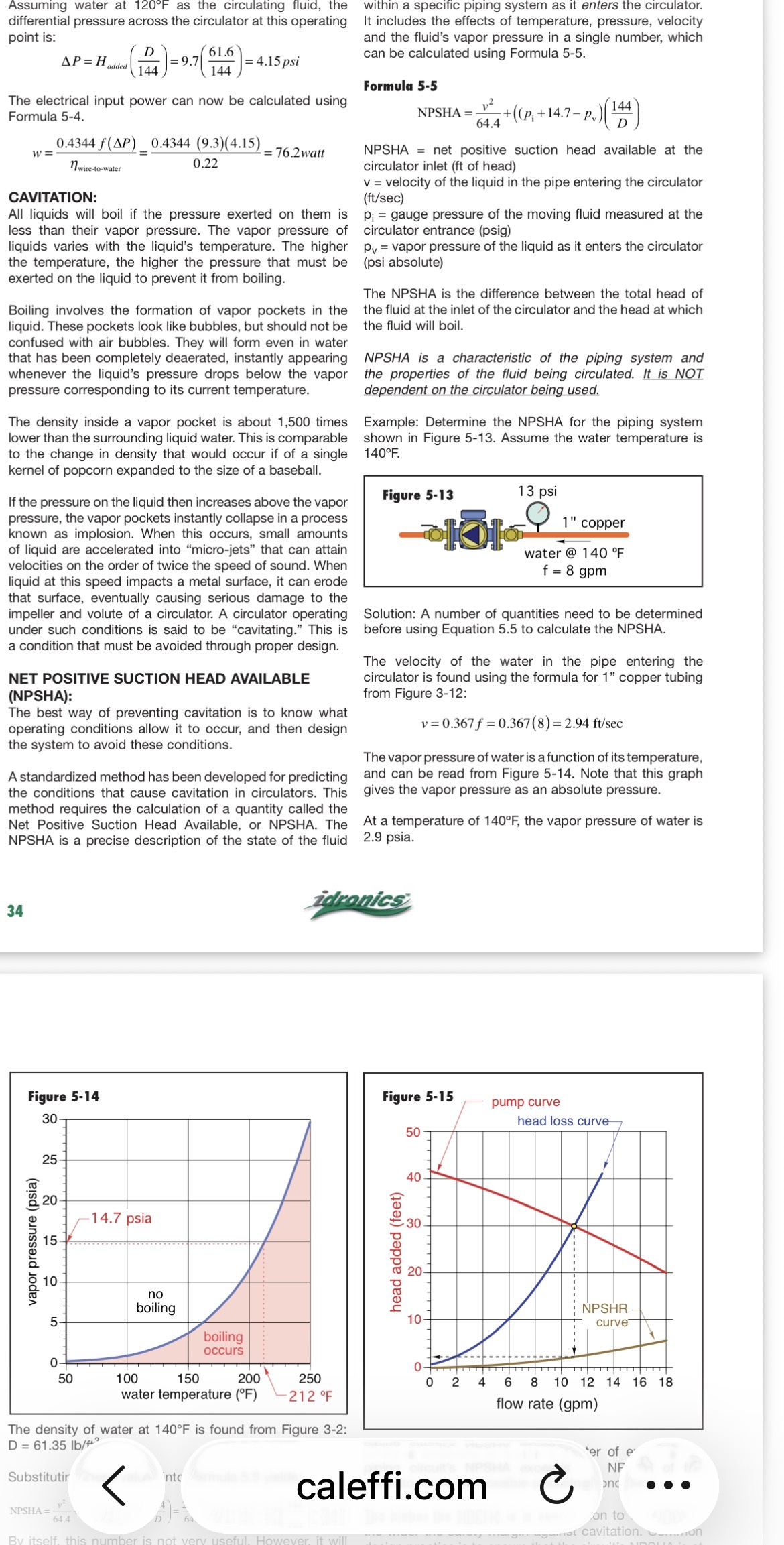
just be aware of cavitation issues when you start looking at no or negative pressure at the suction port of the pump
Water will boil, even 100 degree water, if you drop below the vapor pressure
From Caleffi Idronics 16
 Bob "hot rod" Rohr
trainer for Caleffi NA
Living the hydronic dream0 -
I understand what you are saying but your math may be a little off.
10 story building = 100 feet with the evap on the roof and the sump at the ground level. (not the best design) So 100 x 2.31 = 231 feet of head? or 231PSI? Both are incorrect. I believe you want to say that 100 feet of head is equal to 100 ÷ 2.31 or about 43.29 PSI plus 2 to 5 PSI to make sure you have enough pressure for the nozzles or outlet at the top if the system.
But I might be wrong.
Wrong about the pump head calculation, I think not
Wrong about the open system design being over 10 stories, I think not
Wrong about the NEST thermostat, NEVER
Wrong about @pecmsg' s math. Maybe but probably not.
🤣😁🤪😈🤣😁🤪😈🤣😁🤪😈🤣😁🤪😈🤣😁🤪😈🤣😁🤪😈🤣😁🤪
Edward Young Retired
After you make that expensive repair and you still have the same problem, What will you check next?
0 -
-
100’ x .443 gets you there the correct answer also
Static pressure, no pumps running is a measurement at any point in the system
Static at the top of a 100’ column of water will be different from static pressure measured at any other point
Bob "hot rod" Rohr
trainer for Caleffi NA
Living the hydronic dream 1
1 -
Thank you for all the responses this was very helpful
0


Categories
- All Categories
- 87.8K THE MAIN WALL
- 3.3K A-C, Heat Pumps & Refrigeration
- 60 Biomass
- 430 Carbon Monoxide Awareness
- 133 Chimneys & Flues
- 2.2K Domestic Hot Water
- 6K Gas Heating
- 124 Geothermal
- 170 Indoor-Air Quality
- 3.9K Oil Heating
- 79 Pipe Deterioration
- 1.1K Plumbing
- 6.7K Radiant Heating
- 397 Solar
- 16.1K Strictly Steam
- 3.5K Thermostats and Controls
- 56 Water Quality
- 51 Industry Classes
- 51 Job Opportunities
- 18 Recall Announcements