Help selecting a Circulator, Outdoor Reset Boiler Control, and 3-Way Thermic Valve

Hi everyone,
We have a hydronic heating system with an old H B Smith CI gas boiler. Input of 150K BTU/Hr and output of 120K BTU/Hr (80% efficiency by design). Oversized for our house.
4 heating zones.
Argo ARM-6P switching relay with priority.
Indirect tank for DHW.
We would like to economize our heating system and would appreciate your input regarding the following:
1). Circulators: All zones and DHW circulators are Taco 007. We are considering replacing them with the high-efficiency Taco 007e. Thoughts?
2). We plan to add an outdoor reset boiler control. We consider Argo DPM2 or Tekmar 256. Which one do you recommend?
3). We plan to add a thermostatic valve on the return side to protect the CI boiler. We consider Taco 280 or Danfoss ESBE VTC. Which one do you recommend? Do you recommend the 130F or 140F thermostatic elements?
Thank you
Comments
-
What is the heat load, how oversized is the boiler?
What type of heat emitters? Fin tube, radiators?
Four zones with 4 circulators?Bob "hot rod" Rohr
trainer for Caleffi NA
Living the hydronic dream0 -
First, I apologize, I was referring to Callefi 280.
The heat load is 70,000 btu/hr at 0F and 55,000 btu/hr at 15F. The boiler output is 120,000 btu/hr.The emitters are a mix of fin tubes and CI radiators.
Yes. 1 zone - priority DHW with a circulator. In addition, 4 heating zones with a circulator for each.0 -
are the fin tube and cast radiators in the same zone? The perform completely different. The fin heats quickly, within minutes, radiators need 15- 20 minutes or more to get up to speed.
Generally low mass fin tube systems do not need return protection. So it could depend on how many radiators you have, if the boiler is oversized the return protection may not be needed
Personally I would go with a single ECM delta P type circulator and low current draw zone valves. 70,000 is an easy load for one typical residential circ.
If you want max performance from the indirect a dedicated pump and 1” piping, or a 1” ZV with 7 or higher Cv.
Bob "hot rod" Rohr
trainer for Caleffi NA
Living the hydronic dream0 -
Thank you. This is very helpful.
In terms of the emitters, half are convector elements in one zone, and the other half CI radiators in the other 3 zones.
I also wonder if you could comment on the outdoor reset and thermostatic valve I listed above.0 -
yes ODR can provide some better efficiency and provide longer run times when set up properly. Tekmar usually shows a choice of emitters in the set up program. Mixing low and high mass will be some compromise.
With a cast boiler you don’t have a wide temperature range to work with as the return temperature should be above 130, so maybe a supply of 150- 180.
Yes the 280 is a good choice to assure boiler protection. So one zone of just fine tube, 3 zones of just radiators
Bob "hot rod" Rohr
trainer for Caleffi NA
Living the hydronic dream1 -
you might need a buffer tank if you're trying to zone and do odr with an already oversized boiler.
1 -
Thank you, both.
Just one more clarification, the 280 comes in 130F or 140F. They are fully open at the cartridge temperature + 18F. I understand that for CI, the lower limit is 130F. In this case, should I buy the 130F cartridge + 18F = 148F when the valve is fully open? That would give me a wider range on the ODR.
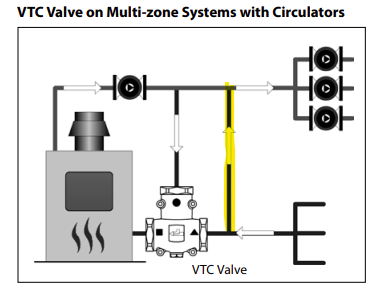
Also, in my case, do I also need the highlighted secondary bypass loop?
 0
0 -
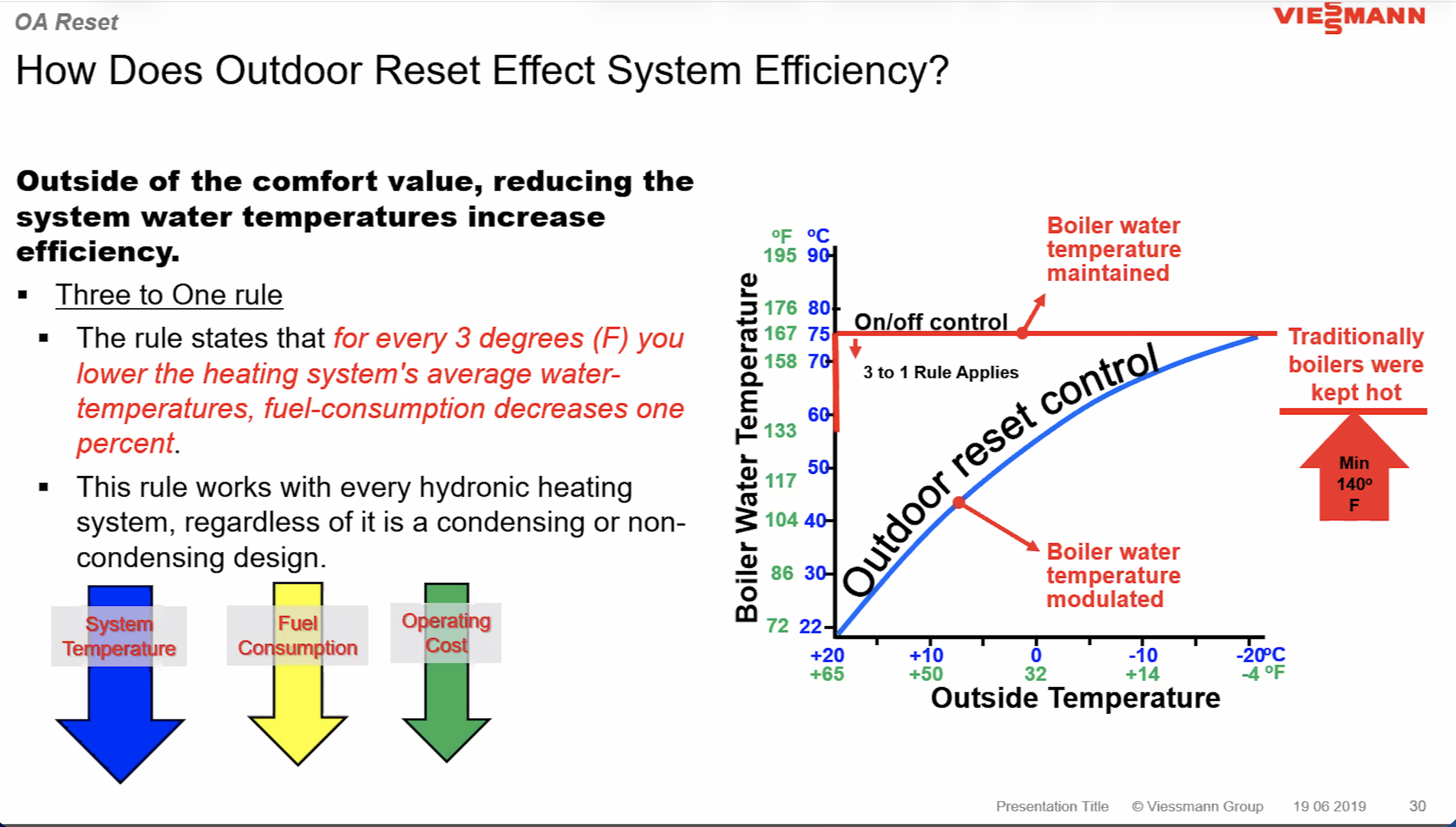
Actually I would order the 115 sensor also. 115+18= 133° F29633 part number. The ODR may start ramping down the boiler before the 130+18 148° cartridge. Depends on how aggressive you get with the ODR settings.
No need for the additional bypass pipe with the 280.
I would add a ball valve at all 3 port so you can quickly service or change cartridge without draining down.
Bob "hot rod" Rohr
trainer for Caleffi NA
Living the hydronic dream1 -
Got it. Thank you so much, Bob.
0 -
 Bob "hot rod" Rohr
trainer for Caleffi NA
Living the hydronic dream 2
2 -
That bypass pipe is needed. With boiler pump and zone pumps, you need to run primary secondary piping, the bypass pipe is what decouples the two primary flow rate from the secondary.
If you run a single boiler pump with zone valves instead of zone pumps, you don't need the bypass pipe.
0 -
I do have zone pumps (one for each zone, on the return side), but not a boiler pump. Would that change your recommendation?
0 -
A couple decesions to make.
Detemine the heat load of the home,then compare that to the boiler output. How much is it oversized.
If you have a room by room heat load, see how the heat emitters match at various temperatures. The lower you can run the system the lower the fuel consumption. But you are limited with a non condensing boiler.
If the system currently heats well on your coldest day, you probably have enough heat emitters.
With 3 zones and when only one zone calls the boiler will cycle on/ off a lot. That drives efficiency down and causes a lot of wear on componts. So is it worth adding a buffer or down sizing the the boiler?
At some point maybe a mod con makes more $$ sense than a buffer.
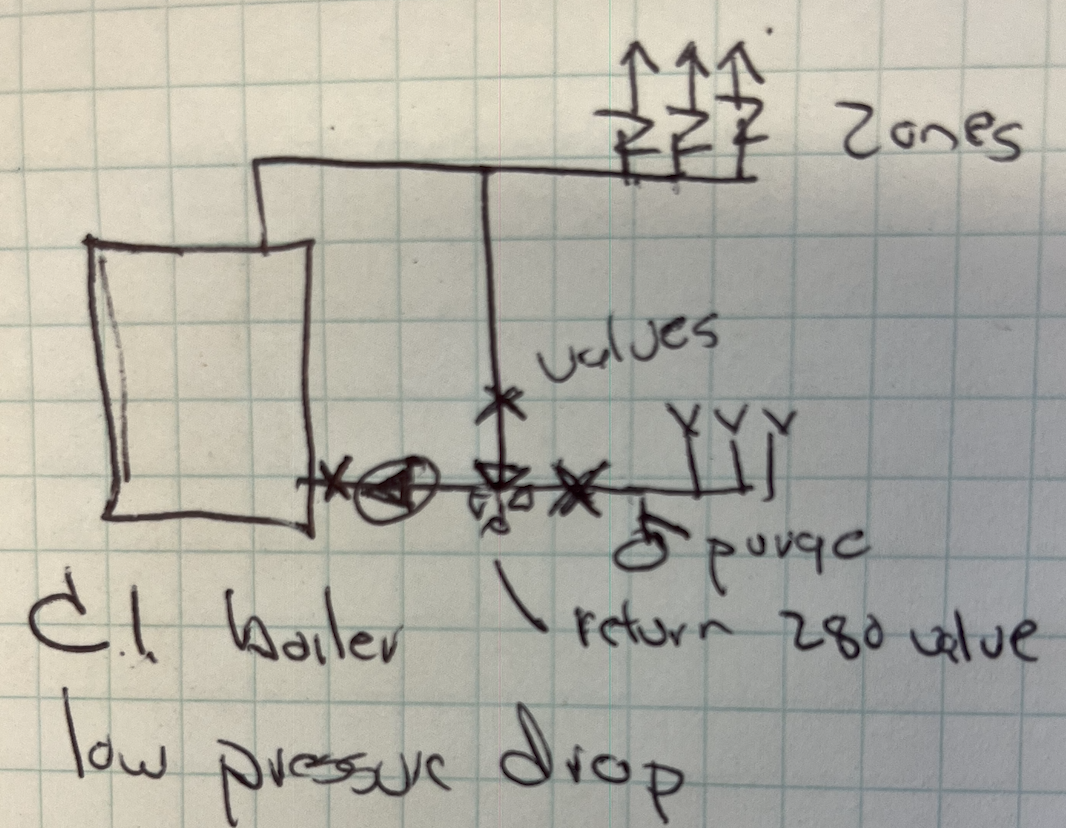
Then decide if you want to zone with valves or the pumps. The pic below shows a single pump, multiple zone valves. A different piping needed if you use the zone pump. You will need a dedicated boiler loop, a 4th pump as Kaos mentioned.
My thought is if the load is under 100,000 btu a single pump is a good option. If the system was larger and needed 4, 5 or more gpm per zone, maybe pumps make more sense.
 Bob "hot rod" Rohr
trainer for Caleffi NA
Living the hydronic dream0 -
The boiler output is 120,000 btu/hr.
The heat load is 70,000 btu/hr at 0F (oversized 170%) and 55,000 btu/hr at 15F (oversized 220%).
The emitters in the largest zone are using convector elements that are undersized, although it is never cold.
In the other zones, the emitters are using CI radiators that are oversized.
Thank you for sharing these options. You bring up a lot of good points. We will have to do some brainstorming before making a decision.
0 -
how did you figure that the convector elements are undersized? you really need to find an old catalog for that brand of convector to get a good output number for a convector, it is very hard to calculate it just from the characteristics of the element and the size of the cabinet.
0 -
This might be a good thread to read through:
In your case, probably the simplest is a 4 way mixing valve as you don't have to add any extra pumps. The motorized version with outdoor reset is pretty spendy though, might not be worth the savings.
1 -
We have a mix of convector elements and CI radiators.
My heat loss calculation was done a few years ago using the Slant/Fin app, which no longer works. It was recommended as a reliable tool. For me, this tool is most valuable in comparing the heat-emission/heat-loss ratio in the various zones, and concluding that one zone is undersized.
My other challenge is how to "optimize" the existing system (described above) with minimal capital investment.
Based on the data I provided above and your (all of you) smart advice, we are thinking of doing the following:
1). Substitute a couple of convector elements for larger CI radiators in the undersized zone, to achieve a reasonably close heat-emission/heat-loss ratio in all zones.
2). Add ODR: Tekmar 256 + Tekmar 003 (to bypass the 256 during the DHW priority).
3). Add a Thermostatic Mixing Valve on the Boiler's return, either Caleffi 280 or Danfoss ESBE VTC with 130F or 115F cartridge.
4). Replacing 3 of the primary zones circulators (Taco 007) with ECM circulators (Taco 007e)
I would appreciate your thoughts.
0 -
Thermostatic mix valve only works with zone pumps if you add in the extra boiler circ. You can't run just the zone pumps + mix valve.
Your options are:
-add boiler circ with 280/VTC+bypass and keep zone circs
-add boiler circ with 280/VTC, remove zone pumps and change to zone valves (what @hot_rod suggested)
-use 4 way mix with actuator+outdoor reset control on boiler with existing zone circs
0 -
in the areas that are under radiated with ci radiators i would probably add another ci radiator or a panel radiator rather than remove what is already there. the panel radiator will heat and cool more quickly than the ci but it probably will be ok just adding 30% more capacity or whatever you need.
0 -
Thank you. That makes sense.
0 -
Thank you, Kaos. Your summary is very helpful. I appreciate your insight.
Quick question: If I choose the option of the "add boiler circ with 280/VTC+bypass and keep zone circs"and my zone circulators are on the return side, should the boiler circulator be on the supply or return side of the boiler loop?0 -
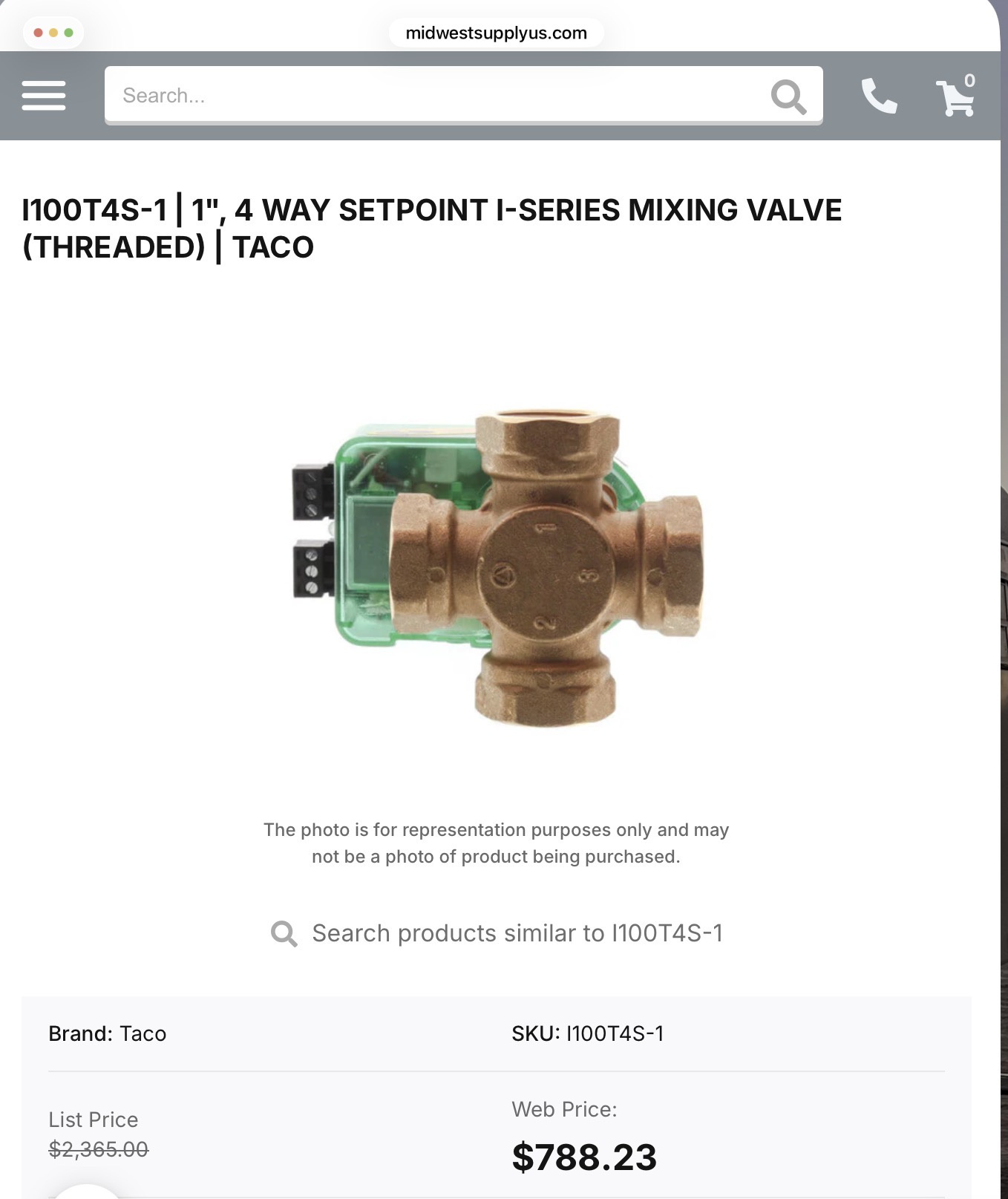
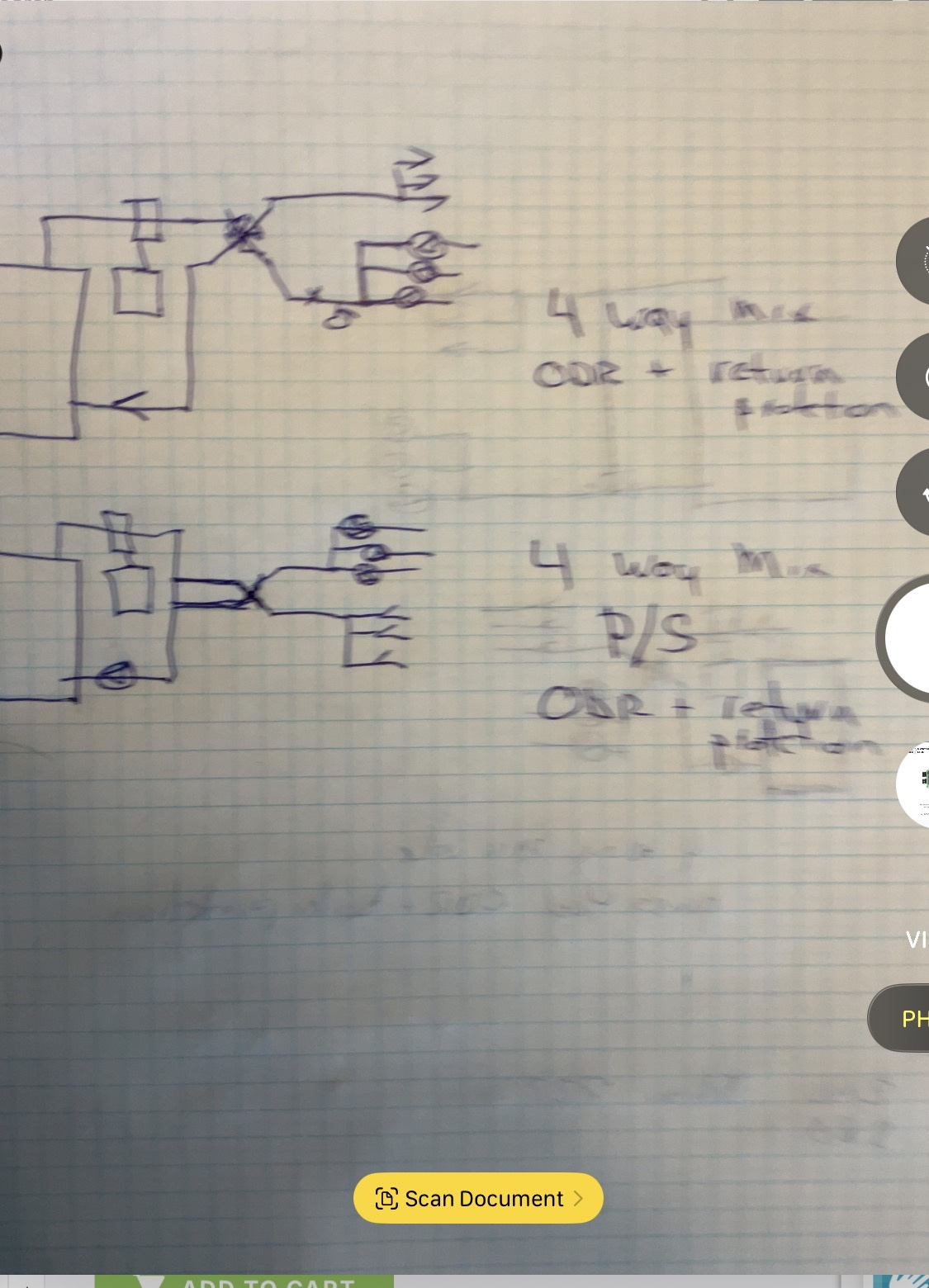
you might consider a 4 way valve which gives you mix, ODR and boiler protection in one device.
I have always piped them like the top drawing with low pressure drop cast boilers.
Taco shows a primary loop, so an extra circ is needed.
I think pumps could be on either supply or return.
Price wise this may be the better option as everything is in one package. Shop for prices, they vary widely on this product.
 Bob "hot rod" Rohr
trainer for Caleffi NA
Living the hydronic dream0 -
I like circulators on the bottom of the boiler on the return, self priming and little chance of air locks. So it would be VTC→air sep/exp tank/fill→pump→boiler.
One more option I just though of. Instead of the VTC+boiler pump+bypass, you can put 3 cheap mix valves on each of your exiting heating loops. You can use adjustable ones to set the return temp for each loop.
0 -
Thank you. Taco has discontinued the I-series 4-way mixing valves. I spoke with them this morning.
Below is a similar diagram to your suggested approach. This one is from Danfoss, but similar valves and controls are available from other manufacturers.
I plan to follow Kaos's option 1: "
add boiler circ with 280/VTC+bypass and keep zone circs"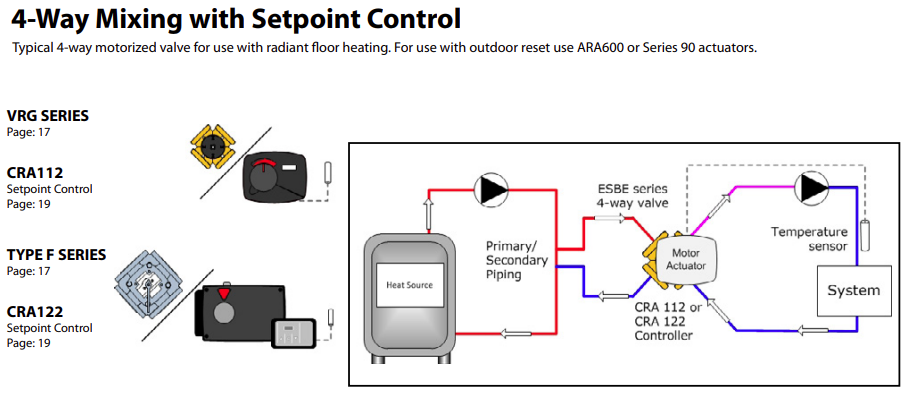 0
0 -
Thank you. This alternative is creative, but then I will have to adjust them manually based on the weather.
0 -
Sketch a drawing of your final decision. Some component placement is critical to a proper working system.
Pumping away from the expansion connection is important. Pumps on the returns make that tough to do, however.
I'm most familiar with the tekmar 4 way package it takes 3 components and can get $$. If you shop ebay you can still find the pieces to do a ODR motorized 4 way affordably.
The valve itself and actuator can mix and match with other brands of controls.
tekmar, HBX, ESBE, and LK are common names.
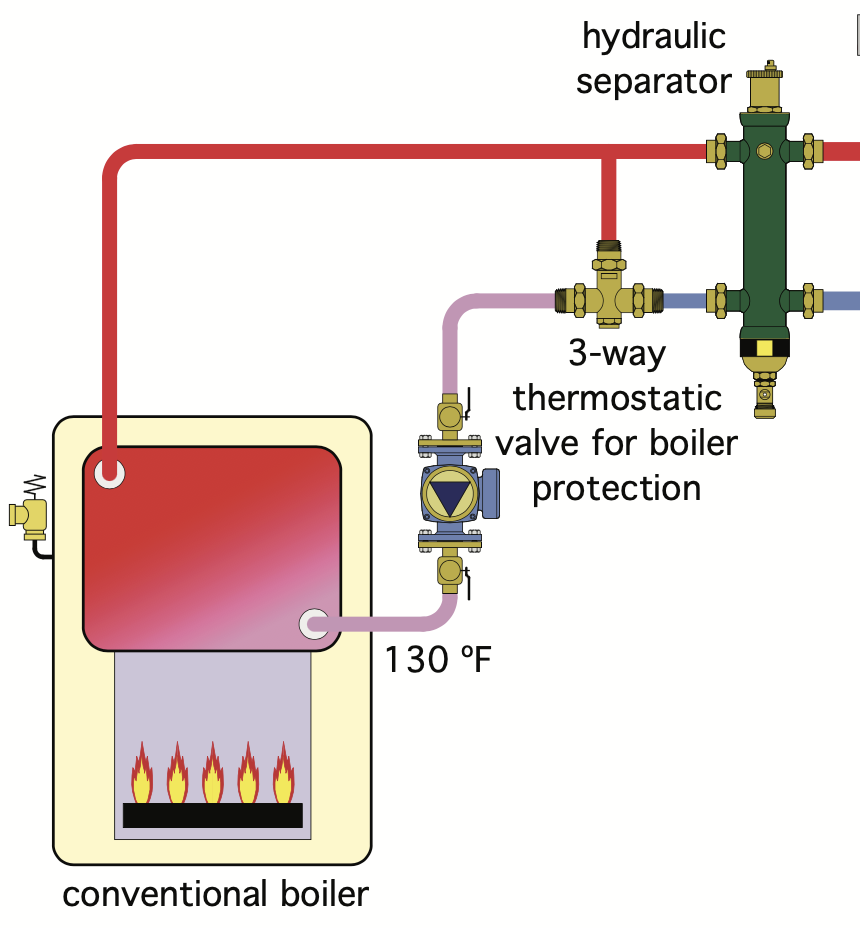
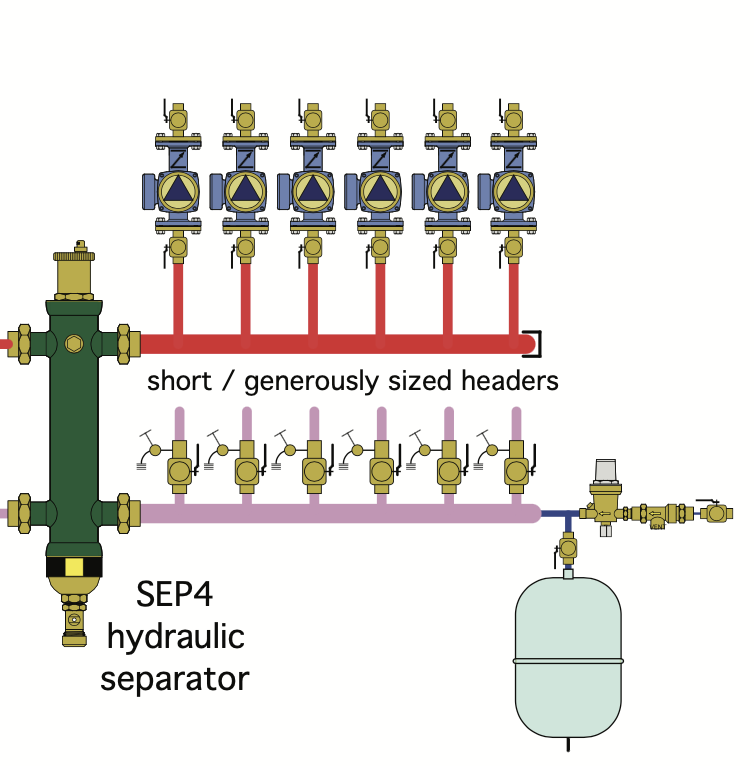
If you are sold on simple, the 280 with a hydrosep is another good option, giving you 4 important functions in one package. Air, dirt, magnetic, and hydraulic separation. Expansion tank on either of the "blue" pipes at the sep.
It looks like this with the zone pumps on the header pipes right of the sep.
 Bob "hot rod" Rohr
trainer for Caleffi NA
Living the hydronic dream0


Categories
- All Categories
- 87.8K THE MAIN WALL
- 3.3K A-C, Heat Pumps & Refrigeration
- 59 Biomass
- 430 Carbon Monoxide Awareness
- 133 Chimneys & Flues
- 2.2K Domestic Hot Water
- 6K Gas Heating
- 124 Geothermal
- 170 Indoor-Air Quality
- 3.8K Oil Heating
- 79 Pipe Deterioration
- 1.1K Plumbing
- 6.7K Radiant Heating
- 396 Solar
- 16.1K Strictly Steam
- 3.5K Thermostats and Controls
- 56 Water Quality
- 51 Industry Classes
- 51 Job Opportunities
- 18 Recall Announcements