Fill and Vent Pipes

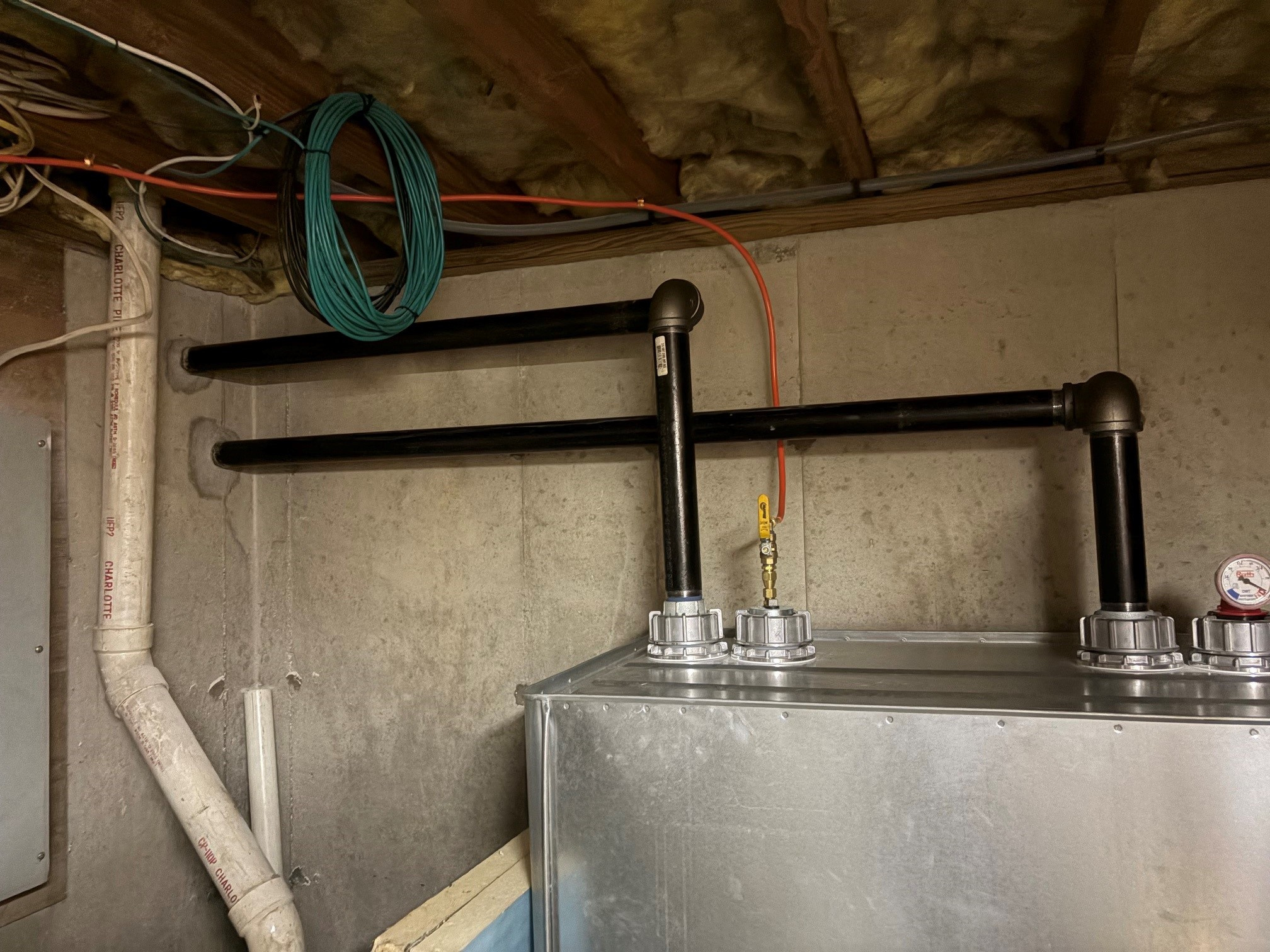
I just had a Roth 275 tank installed in my basement, the original copper pipes that ran through the siding were replaced by 2" steel through foundation
.
The pipes are horizontal, there is no pitch in either towards the tank. I'm aware of the reasoning behind having a pitch in both pipes: seeping through joints, the possibility of oil blowing out through vent after overfill, etc.
I've been told that having a pitch is not required, and that sometimes the run through the foundation prevents adding some pitch to the pipe.
Is this acceptable or do I need to insist that the installer return?
Please see the attached photo, thanks.
Comments
-
I doubt you will have any issues. The installer looks to have done a nice job from what I can see.
As far as the pitch issue goes, yes the pipes should be lower on the tank end. They look level.
The only reason for pitch is so any oil leftover in the pipes will drain to the tank.
As long as the pipes are not back pitched and are level you should be fine.
 2
2 -
Thanks Ed, I do believe that they did nice work and I couldn't imagine overfilling the tank to the point where oil got up into the horizontal part of the vent pipe, but I wanted to confirm with you experts.
The vent pipe is ~6 feet long: would you have given that some support from the joist above or not necessary?
0 -
Hopefully the fill is on the left. So its only about 2 ft horizontal.
The only concern would be if the piping is below grade outside. If so I would've used galvanized over the black steel.
1 -
Yes, the fill is just under 4' and the vent is 6', and both above grade.
0 -
Have you put a level on them?
0 -
Yes, I have a 2' level.
0 -
and what did it show?
0 -
That the pipes are horizontal as noted thanks.
0 -
ARE THEY LEVEL OR PITCHED???
0 -
In using my level to determine if the pipes were pitched towards the tank, I determined that they were not, so I wrote my original post. Naturally, I was referring to the horizontal sections as opposed to the vertical, so I assumed that it was clear what I meant by 'horizontal'. I guess I should have written either 'level' or 'perfectly horizontal' to make it clear, but others seem to have understood what I meant.
0 -
you can ask that they redo it
0 -
I don't want to be a PITA (but I will if I need to be), it looks like they'd have to chip out whatever they patched with and then shorten the vertical, adjusting the 'swing' section accordingly.
I posted in order to determine if it was something to be concerned with, it appears that it really shouldn't be.
What is the desired degree of pitch, 1/4" per foot or similar? And should they have supported the longer pipe via the joist above?
Edit: I took a closer look, both pipes are very slightly pitched towards the tank along the lines of 1/32" per foot.
0 -
then it’s not an issue!
0 -
It would appear that way, thanks.
0 -
It's fine. If the pipe is level then they can't hold any oil. You would only have an issue if they were back pitched.
No additional support needed.
Not that familiar with Roth tanks but is there a whistle on the vent line, a vent alarm?
1 -
Thanks Ed, I appreciate the reassurance!
Yes there is a vent alarm (I think it extends 6.5" down), plus a leak detector for the inner tank, and they recently replaced the plastic collars up top with metal, which I have on mine.
0 -
Should there be a Firomatic valve at the tank?
1 -
Hi Brent, I'm not familiar with this device, but I'm guessing that this was not included with my tank replacement.
0 -
One of the guys in the business will know if a Firomatic is required at the tank. I know my Roth has one but not sure if it’s required everywhere. I do like the metal fittings/nuts they used.
1 -
Most locations require a firomatic valve(s), 1 at the tank and 1 at the burner.
The Firomatic is a fusible valve that is spring loaded. In case of a fire it shuts off the oil flow to the burner. They are not expensive and most locations require them.
1 -
I checked: I have one at the input to the Tigerloop, and from what I was reading that seems to be the critical place to install.
(AI seems to say that NY State doesn't require a Firomatic at the tank but that Brookhaven NY does, but I take AI with a grain of salt)
Is an anti-siphon valve a type of OSV? It would seem that anti-siphon would make more sense at the tank output: can you tell if that's what I have now? If you need a photo I can send one.
From Inspectapedia:
- A second oil line shutoff valve on the oil supply line at the oil tank
is ok as long as you have also provided the first oil safety valve at the oil burner(s).
The oil line shutoff valve at the oil tank or at a location remote from the oil burner or other unlikely fire sources is often a normal plumbing stop valve.
0 - A second oil line shutoff valve on the oil supply line at the oil tank
-
@charlie123 That looks like a very nice installation. The swing joints on the fill and vent at the top of the tank appear, from here anyway, to be pitched up toward the fill and vent as they leave the building.
2 -
@Intplm. Thanks, while my phone might be distorting things a bit, the verticals aren't exactly vertical (fill is tilting slightly to the left (vent less so)) so the swing joint is accommodating that I believe. I guess that this helps a little with my original concern about the pipes holding oil.
Re: the valve on my tank: I assume that what I have there is a basic valve, hoping to determine if I need an anti-siphon or Firomatic there or I'm ok as is, thanks.
0 -
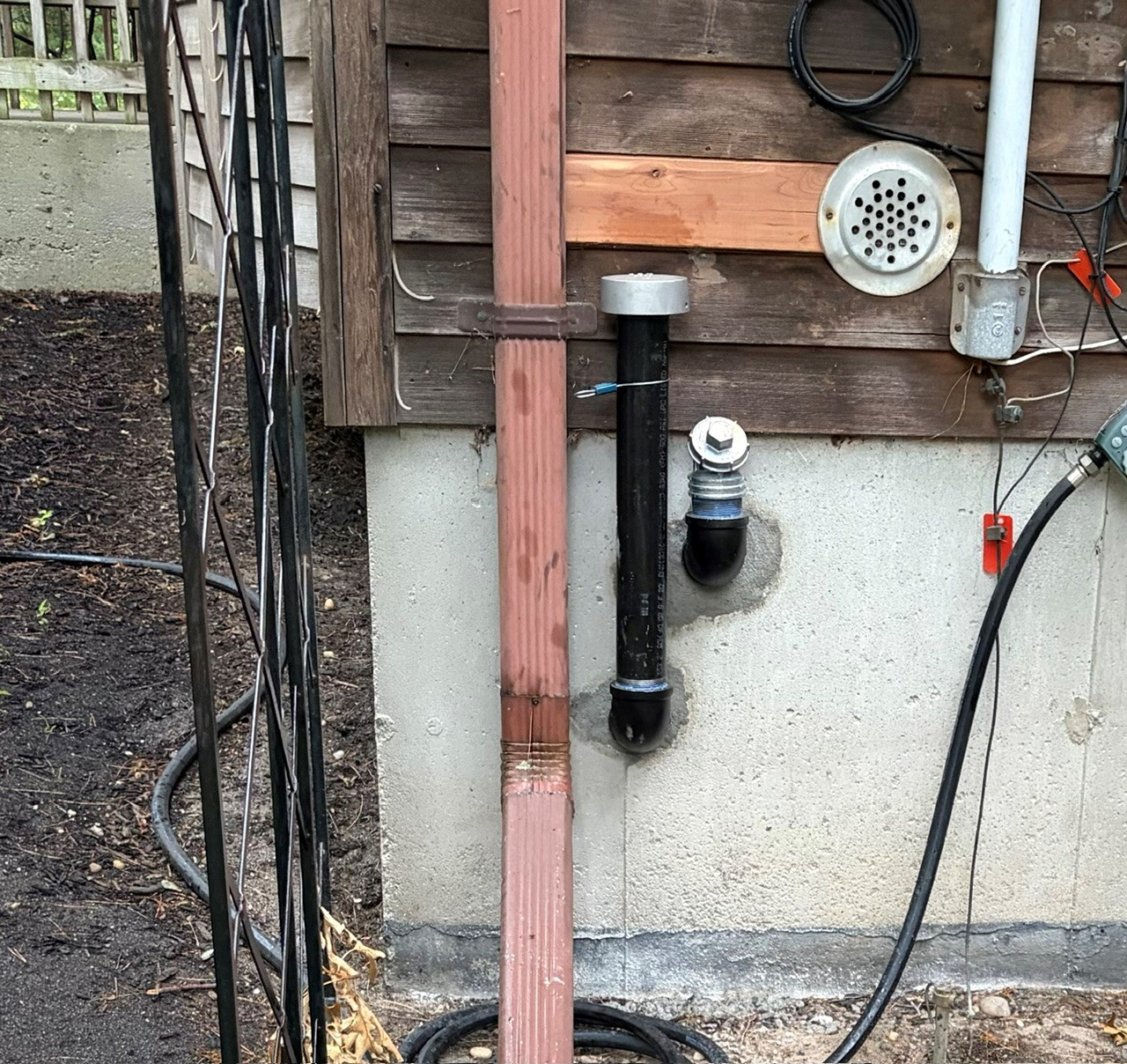
I like the installation from what I can see. What does it look like on the outside?
As far as pitch is concerned, so the oil flows back to the tank, I tend to think about what this will look like 20 years from now, or even 40 years from now. The swing joints should accommodate some settling of the building over that time.
My concern is that the building may be more likely to settle at the walls and foundation, while the floor under the tank may not settle as much. If that happens, it could eventually create a wrong-way pitch. Of course, I could be wrong. The weight of all that oil in a full tank over 20 summers may cause the floor under the tank to settle more, which would actually increase the proper pitch.
Regardless, you might just let it go for now. In 20 years, after the home has settled, you could have those vertical nipples cut off an inch to an inch and a half if needed.
Edward Young Retired
After you make that expensive repair and you still have the same problem, What will you check next?
0 -
@charlie123 at the tank now it appears you just have a normal ball valve for a shut off.
If your area requires a firomatic valve or an anti-syphon osv valve you do not have those. Most areas would require them yours may not.
0 -
Hi EdThe HeaterMan, if I'm still around, I'll keep an eye on it and get back to you in 19 years or so :) but for now I'm leaving it as is.
Hopefully the outside is acceptable…
@EBEBRATT Thanks for that, hopefully someone familiar with requirements in Brookhaven NY can advise.
If a different valve is needed at the tank, does it replace or follow the existing standard valve? Assuming that fewer breaks in the line are preferred, I'm guessing 'replace'.
0 -
Fire-o-matic valves need to be installed , just upstream from anything that can melt in a fire..
There was an error rendering this rich post.
0 -
I see that NFPA refers to needing a Firomatic valve when the tank's supply is at the bottom, no mention of a tank with the supply coming from the top.
 1
1 -
The outside looks fine for a right-handed delivery driver. I’m left-handed, and to me it looks like that vent pipe is a knuckle-buster.
It is all good-quality work: neat work, professional work. But the actual future use does not seem to have been fully considered. That is probably because the tank installer does not drive a fuel delivery truck.
Nice work, neat work, professional work. But like many engineers who draw things on a piece of paper, but do not actually have to perform the work, it may be structurally sound according to the book, while being ergonomically barely adequate.
Edward Young Retired
After you make that expensive repair and you still have the same problem, What will you check next?
0 -
I'm left handed so I appreciate what you're saying but it's not so bad at the cap itself as it protrudes outward a bit.
Unfortunately, based on the hole that they started for the 1st pipe, and trying to stay 3" out of the corner for the 2nd pipe, things wound up as they did.
Thanks for the assessment.
0





Categories
- All Categories
- 87.8K THE MAIN WALL
- 3.3K A-C, Heat Pumps & Refrigeration
- 60 Biomass
- 430 Carbon Monoxide Awareness
- 133 Chimneys & Flues
- 2.2K Domestic Hot Water
- 6K Gas Heating
- 124 Geothermal
- 170 Indoor-Air Quality
- 3.9K Oil Heating
- 79 Pipe Deterioration
- 1.1K Plumbing
- 6.7K Radiant Heating
- 397 Solar
- 16.1K Strictly Steam
- 3.5K Thermostats and Controls
- 56 Water Quality
- 51 Industry Classes
- 51 Job Opportunities
- 18 Recall Announcements