JB Weld to fill corrosion pitting.

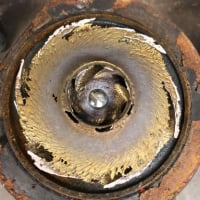
I am rebuilding my old Weil Mclain steam boiler. A steam leak eroded the elastomer seal and then corrosion caused pitting of the seal face. The deepest corrosion is less than 0.02". I used JB Weld to fill the void. The repair looks great and is solid, but does anyone have experience with such restorations that you can share?
Comments
-
Unless you got the surface down to clean metal, it won't stay put in any kind of long run.
Br. Jamie, osb
Building superintendent/caretaker, 7200 sq. ft. historic house museum with dependencies in New England0 -
The surface was well-prepared for a good bond. The repair is located directly underneath the elastomer seal, so there is no particular stress load. My concern is whether the JB Weld will hold up to thermal cycling and low pressures (<3 psi.)
0 -
I never used it on an internal boiler surface. But we serviced a ton of HB Smit CI boiler the "Mills Style" boiler. Thes boilers had sections that were connected to a CI header external to the boiler. The connections to the header were an 1 1/2" or 2" nipple (depending on the model boiler) with a locknut and an elastomer gasket. When the gasket leaked the surface on the CI header would get corroded and pitted. We used to grind them down and this worked as you could tighten the locknut to make up for the metal ground off.
But some of them were too pitted to take off that much metal so we ground it as much as possible then used JB weld.
It worked well.
How long it lasted I can't really say but we had no problem getting the gaskets to seal. At the very least it will buy you a few years.
 2
2 -
permatex would be better because it will flex the same as the o-ring but jb weld will probably work as long as you got it down to cast iron.
0 -
Not sure Permatex will get along with the gasket material
0 -
a belt sander works better than a grinder because it makes it at least somewhat flat.
i guess you couldn't be 100% sure without getting a bunch of engineers together but it is kind of designed to seal where 2 molded gaskets come together, it is very commonly specified for that on engines.
0 -
-
All good comments, thanks. I will proceed with JB Weld Original 8265 two-part to fill in the pitting (recommended by JB technical support), sand to flush then apply a thin layer of Permatex red to seal the entire face and let cure. Then I'll assemble the sections with the elastomer seals and do a hydrostatic test before building a head of steam.
0 -
filling it with something like this might help too by removing the chlorides from the water which is what the synthetic rubber compounds tend to not be compatible with so removing the chlorides may slow the hardening of the o-rings.
https://www.supplyhouse.com/Axiom-PUROPAL-1W-Puropal-1W-H2O-Demineralizer
1 -
@mattmia2 I used Rectorseal 8-way in this boiler since installation in '94. I had called Weil-McLain for their OK on compatibility with the elastomer seals. Other than this particular zone of leakage, the rings came out of their glands easily and still pliable, though not reusable. Thanks for your help.
0 -
For some reason I think their seals are EPDM, but, I have no idea why I think that and honestly wouldn't trust it without getting confirmation on it.
But I'm not sure of many things that aren't compatible with silicone RTV. I suspect silicone rtv will not want to stick to it, but I don't think it would hurt it.
@JMC3 is this an EG series you're fixing? I'd love to see pictures of the before / during / after.
Single pipe 392sqft system with an EG-40 rated for 325sqft and it's silent and balanced at all times.
0 -
permatex has some extra chemistry that ordinary rtv does not too. it sticks pretty tenaciously to a lot of stuff that rtv wouldn't, it spreads out more than rtv, and you can clean the uncured product off with solvent.
0 -
@ChrisJ Good call on the chemistry risk. Permatex Ultra Red is an oxime-cure silicone. Oxime-cure silicones are widely used around elastomeric seals because they are non-corrosive after curing and generally compatible with many rubber compounds. The attached TDS identifies the product as an oxime silicone rubber. Permatex specifically states the product is intended for use with rubber cut gaskets and is "non-corrosive." I intend to use a very thin layer of Permatex and let it cure before assembly with the elastomer seals.
The boiler block is a P-386 (old). The water side is beautiful since I used Rectorseal 8-way and blew down regularly. I will try to document my progress with photos.
 2
2 -
@ChrisJ I took some pictures, but not the best photography. I was working alone and had enough to think about to keep out of trouble. Attached is a pdf of some photos with captions describing some features of the boiler repair.
1 -
Many of you are too young to remember this and no I am not trying to be snarky. As best I can recall when I started in 73 most boilers had CI push nipples.
I have been trying to recall when the rubber gaskets started coming out. I know HB Smith started the #28 series boiler about 1977 and that was the first rubber gasket boiler I remember.
Certainly, Weil McLain could have been earlier but at that time Weil McLain was not big in my area.
I did install a bunch of the P68 series boilers, but they always came fully assembled.
At the beginning especially with Smith boilers, you would place the gaskets in the nipple port and slide the next section into place only to find that the gaskets had fallen out of the nipple port. A lot of people for that reason put some pipe dope or something in the nipple port to attempt to hold the gasket in place, both Smith and Weil McLain then came out and said use nothing on the gaskets because it will deteriorate the gaskets. Smith said to stretch the gasket to enlarge it so it would stay in the nipple port
So, the boiler would leak after a while and the installers complained because "the instructions didn't say not to use a sealant on the gaskets". After all push nipple boilers always had a lubricant used
Same thing happened with torquing the draw rods. Push nipples took a lot of torque, and we were told to pull the sections together until you have iron to iron contact.
But Smith (originally) had no torque spec with rubber gaskets so once again many were over torqued. The results were cracked sections from overtightening until Smith changed their spec.
Anyhow
Good luck with the Permatex hopefully it will hold up until you eventually replace the boiler
0 -
it is pretty common to glue automotive gaskets in place with weatherstrip adhesive so they don't fall off while you are assembling things.
0 -
Interesting history, thanks. I contacted Weil-McLain tech support and inquired about the tie rod torque specification. The agent put me on hold and then came back with 50-60 ft-lb for the 1/2" tie rods. When I asked about the smaller 3/8" rod, they said there is only one torque spec. I imagine newer boilers only use 1/2" rods. No way would I torque the smaller rod to 50 ft-lb! So I calculated the stress on a 3/8 thread cross section and used a torque within the yield of carbon steel. McMaster sent me the yield strength of the rod so I defaulted to regular carbon steel (60ksi). I torqued to 20 ft-lb. The elastomer seals sat proud about 0.08", so I felt confident there was plenty of compression to seal the 6" joint.
1 -
Permatex or Hi tack yeah, weather stripping adhesive I've never known anyone to use, or even own.
The problem with using Permatex is it tends to make gaskets want to squish out easier and you have to go easy especially on an oil pan gasket. I liked to just snug the bolts up and then come back later after the rtv sets up and tighten them.
Single pipe 392sqft system with an EG-40 rated for 325sqft and it's silent and balanced at all times.
0 -
weatherstrip adhesive is a really old way of doing it, before rtv was common. it is a sort of duro or speaker cement sort of product so it has a very short shelf life.
0 -
»has a very short shelf life«
Fresh epoxy outperforms stale. JB Weld is better than some no names. There are industrial epoxies superior to JB. I remember some factories taking delivery of glues and resins every third day. Containers were dated. Out of date were still better than what one could buy at hardware store.
0 -
many years ago I was helping a friend wire up his deck and hot tub. One run was 60 ft from the house and it all was in plastic conduit 4 ft deep - digging that trench by hand was work, luckily we had his 14 year old son helping. At the house we had some LB's at the house and a length of conduit going down into the trench.
We found one run was 5 ft short and we didn't have that much wire left (back then stores were not open on Sundays). We decided to splice the run down in the hole so I put a 4" box and made the splice in that, I soldered the splice so I knew it would hold. back then we both worked for a manufacturing company so we has access to a range of Castall epoxies so we selected one we knew would work and borrowed some epoxy and hardener. i used this epoxy a lot at work ( i was a senior technician back then working on HV power supplies that we sold to the navy) if it was ok for the US Navy it was good enough for this patch job
This stuff cures quick on a warm day so after cleaning everything with tricho, mixing and pouring it in it was ready to go in 30 minutes. I checked the line with a 500v meggohmeter and closed the box. We threw the breakers on and everything worked. That was back in 1985 and as of July 4th is was still holding (41 years later). It was not the right thing to do but it was outside four feet worn so there was no danger if anything went sideways. As we used to sat in the army ya gots to do what ya gots to do - just don't tell the old man.
Smith G8-3 with EZ Gas @ 90,000 BTU, Single pipe steam
Vaporstat with a 12oz cut-out and 4oz cut-in
3PSI gauge0





Categories
- All Categories
- 87.8K THE MAIN WALL
- 3.3K A-C, Heat Pumps & Refrigeration
- 59 Biomass
- 430 Carbon Monoxide Awareness
- 133 Chimneys & Flues
- 2.2K Domestic Hot Water
- 6K Gas Heating
- 124 Geothermal
- 170 Indoor-Air Quality
- 3.8K Oil Heating
- 79 Pipe Deterioration
- 1.1K Plumbing
- 6.7K Radiant Heating
- 396 Solar
- 16.1K Strictly Steam
- 3.5K Thermostats and Controls
- 56 Water Quality
- 51 Industry Classes
- 51 Job Opportunities
- 18 Recall Announcements