Best way to Transfer Heat

I had my basement walls sealed with closed cell spray foam insulation and then finished the basement with a dividing wall between the gas furnace and main room. There are two doors along the wall in opposite ends so the furnace isn’t completely blocked. Though Once the insulation was complete and the walls finished the heat in the basement especially the furnace area went up dramatically since there was no more cold walls or open areas. My question is how can I help remove the trapped heat? I was thinking of cutting an open vent/grate that is basically just off center to the furnace that would let the heat rise into the dining room. Is this a good solution and how much heat will transfer? I don’t really have a way to have a vent fan go outside. The only way due to floor joists would direct the heat to a crawl space under a back room.
Comments
-
The heat build up is one problem, but you may have created a more serious problem.
You furnace (and water heater if it is gas) need a fair amount of combustion air.
Lack of combustion air can cause carbon monoxide.
You have to replace the flue gas (the fuel mixed with combustion air) that is going up the chimney or out the vent if your appliances are taking air from the basement.
In most homes there is enough leakage into the basement to cover this. Now that you have enclosed the furnace and insulated it could be an issue.
We need the BTU rating of the furnace and water heater and the square footage of the basement on the furnace side.
You may have to install a combustion air duct.
 1
1 -
A small rectangular floor register above the furnace would work. Where is the cool air floor plenum?
One question, have you considered having the ducts covered with foam board insulation???? granted it would cost more than a floor register above the furnace but there would be less heat lost to the surrounding basement?
0 -
The sq footage of the furnace area is 135 sq ft. There are 2 78x30 doors on either side and I’m going to install a wall vent infront of the furnace that goes into a 300 sq ft room. There’s also a half bath adjacent to the furnace area that’s 22 sq ft.
the furnace BTU input is 164,000 with a HTG Cap of 136,000BTU per hr.0 -
I totally agree with @EBEBRATT-Ed above. Check that combustion air!
And I will add: you need a CO (Carbon monoxide) detector which will sense at low levels like this one:
21009942 - Kidde 21009942 - KN-COU-B Ultra Sensitive AA Battery Powered Carbon Monoxide Monitor
Br. Jamie, osb
Building superintendent/caretaker, 7200 sq. ft. historic house museum with dependencies in New England1 -
I’ve always had a carbon monoxide and smoke detector in my basement that is hardwired.
0 -
@EBEBRATT-Ed The sq footage of the furnace area is 135 sq ft. There are 2 78x30 doors on either side and I’m going to install a wall vent infront of the furnace that goes into a 300 sq ft room. There’s also a half bath adjacent to the furnace area that’s 22 sq ft.
the furnace BTU input is 164,000 with a HTG Cap of 136,000BTU per hr. The cubic feet of air in the furnace area is 1320 cubic ft. The total basement area is 3,872 cubic ft.
It’s never been an issue probably because heat went through the ceiling floor boards as well as a couple small openings along the top of the foundation. As well as the block foundation being cold in the winters.
0 -
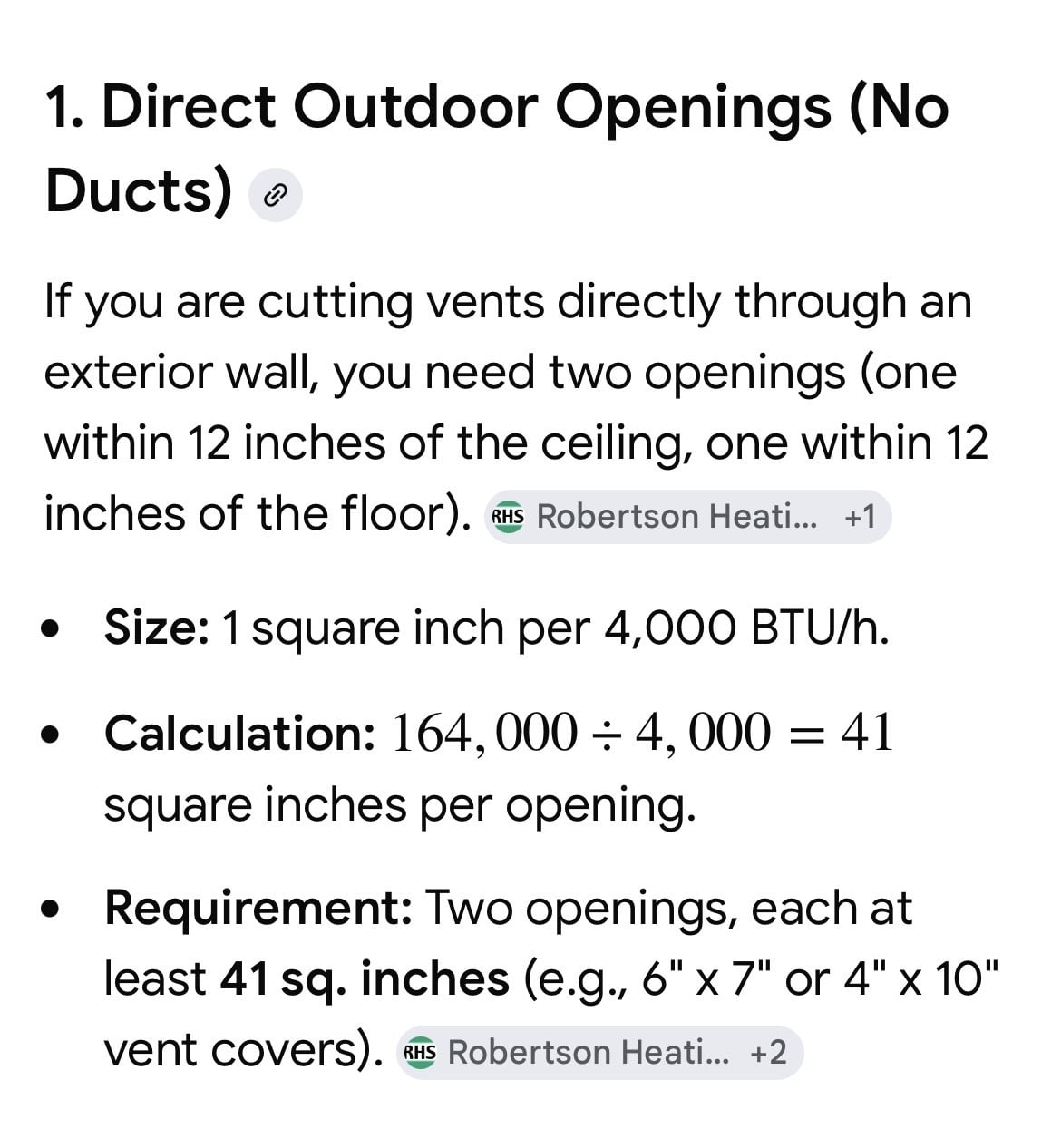
This is the NFPA requirement for the amount of air you need into that 135 sq ft space. It is a little different for a ducted combustion air requirement
Local code may vary a bit.
 Bob "hot rod" Rohr
trainer for Caleffi NA
Living the hydronic dream0 -
This is a classic example of spending money to seal up a home to keep all the heat inside the home and finding out that you need to cut a hole in the house to let in some cold air back in so the heater can breath. this makes total sense to me!
Sounds like all your work created a confined space: A confined space is: a space whose volume is less than 50 cubic feet per 1,000 BTU/hr of the total input rating of all fuel-burning appliances located in that space. According to your information you need 8200 cubic feet of space in the furnace/boiler room. More if there is a gas clothes dryer and a gas water heater in that room. Those count as gas appliances too. You say you have only 3872 cubic feet. You need to cut some holes in your house to let in some outside air.
Makes sense to me. Seal out all the cold air and the house gets too hot so you cut some holes in the house to let in cold air. If you don't want to let in all that cold air, maybe you can install an ERV or HRV to warm up the cold air you let in with the hot air you need to let out. That will cost some $$$ but save on the energy you will waste just letting cold air into your home thru a hole in the wall.
A lot of people in the trade call it by the slang term "a combustion air inlet", but the technical term is "a hole in the wall"
Edward Young Retired
After you make that expensive repair and you still have the same problem, What will you check next?
0 -
Couple of thoughts here. First, on the CO detectors. Check their literature and see what the minimum level which they measure is. If it is 30 ppm or more, they aren't really what is needed to prevent chronic low level CO poisoning. Rather, they are "get out of Dodge" devices.
It does sound from your descriptions that you have a confined space situation for the boiler — in which case the floor register idea may actually work in reverse, and draw conditioned air from the first floor into the boiler room.
Br. Jamie, osb
Building superintendent/caretaker, 7200 sq. ft. historic house museum with dependencies in New England0 -
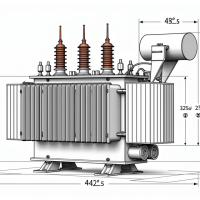
Best way to Transfer Heat.
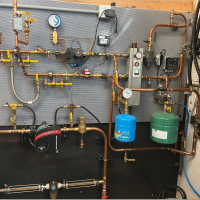
Have you tried this heat transfer machine?
They are quite simple to install and not as complicated as it looks to operate. All you need is a Masters Degree in Engineering and about $32,000.00 dollars!
Edward Young Retired
After you make that expensive repair and you still have the same problem, What will you check next?
 1
1 -
32K and it still leaks?
Bob "hot rod" Rohr
trainer for Caleffi NA
Living the hydronic dream
 3
3 -
@hot_rod, that photo was during standby.
You should see it when it is running full tilt
It's a thing of beauty!
Edward Young Retired
After you make that expensive repair and you still have the same problem, What will you check next?
1 -
Ahh, the green color is what I was missing.
Bob "hot rod" Rohr
trainer for Caleffi NA
Living the hydronic dream1 -
Maybe he won't have a problem because his furnace and water heater are direct vented. I don't remember seeing him stating what type of furnace or water heater.
0 -
We can only assume — and you all know what that spells.
…but to err on the side of caution would be prudent. Let's find out what the model number of the furnace is and if there even is a gas water heater, what model that might be.
I hope we have not scared @DSurette01 away with our replies about combustion air and not actually answering the question asked. (and of course the nonsense about the heat transfer machine). The important thing is that we help them to make sure that the home is safe for living.
Edward Young Retired
After you make that expensive repair and you still have the same problem, What will you check next?
0 -
No I wasn’t scared away and I always appreciate a good ruse/joke, lol.
I have a Burnham Series 2 furnace that is direct vented. This furnace was installed in that basement 18 years ago with the same sq footage and no outside vents. The ceiling was also open so all hot water pipes were exposed which kept the basement somewhat warm. I say that because the foundations were cold in the winter and I’m assuming some heat went up through the floorboards. Now that the basement is sealed that heat is more prevalent. The furnace ran well all winter just that the heat was a tad high and im looking for a way to move it.0 -
-
Hello and good morning DSurrette01,
Perhaps you should examine walling in that window and either installing a dryer vent in reverse letting cool air in or 3" white PVC pipe along the ceiling with a screen end to let excess heat out and another 3 inch white PVC pipe down to the floor near the boiler but away from the boiler base to allow combustion air at one atmosphere of pressure to enter for added air exchange to equalize the pressure in the basement.
As you have an electric damper control you will lose little to no heat from the steam chest of the boiler.
0 -
OK I have to correct some misunderstandings that the Professionals may have assumed.
- You have a boiler and although some call it a furnace and others call it a stove, the correct term is a Boiler. In the "pixcture" below
- is a furnace
- is a stove
- is a boiler
- Your boiler is a hot water boiler and there is no steam chest. Only a steam boiler will have a steam chest.
- You have the type of boiler that needs combustion air from the boiler room space. Since the amount of gas you are burning (INPUT) is 164,000 BTUh than you need 8200 cubic feet of space in that boiler room. Since you don't have that much space, Your boiler is in a room that is considered a "confined space"
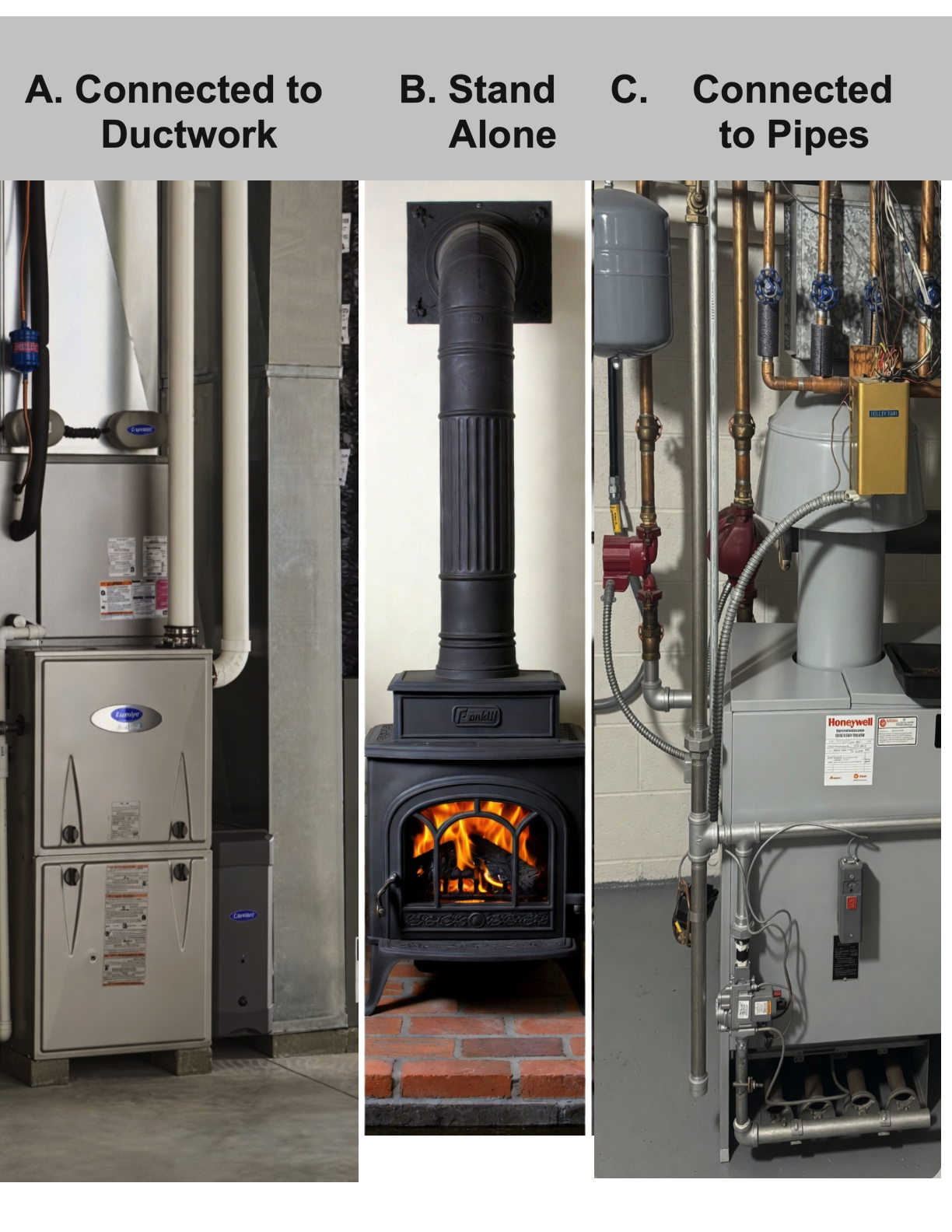
A furnace is connected to ductwork A stove is a stand alone heating appliance and a boiler heats water, So pardon my misunderstanding as to your actual situation. This makes more sense now. One of the ways that you can solve the problem in the basement is to cut a hole in the floor and let the heat out into the room above it. But that will not solve your combustion air problem, and you may end up with a real mess one day in the future. As a matter of fact, you may never have a sooting problem in that boiler for three years or longer, but one day — I don’t know when, and I don’t know how — you may have the perfect storm of occurrences happen, and it only needs to happen once for you to regret not following code for your combustion air to the boiler room.
The perfect storm is when the bathroom exhaust fan is on, the kitchen fan is on, and the clothes dryer is running. The gas furnace may also be operating. With all those automatic appliances and exhaust fans running at the same time in the winter, when all the windows are closed and your home is tightly sealed with new insulation, your home can become a negative pressure zone compared to the outside air pressure.
That is because all those fans and appliances are blowing air out of the house. Your home becomes like a plastic milk jug. Try putting your vacuum cleaner hose on an empty milk jug. With no place to let air in, the milk jug develops negative pressure and collapses. Your house is stronger than the milk jug, but the same thing happens up to a point.
Eventually, the furnace may not have enough air, and the flame will not get enough oxygen to burn cleanly. Then soot can form, clog the boiler flue passages, and potentially leak carbon monoxide into your home.
The combustion air opening fix is to use two holes in the floor. One of the holes will be ducted to about 12 inches above the floor, and the other hole will have no duct. This will satisfy the combustion air requirement for your boiler room. This creates circulation since there is a low opening and a high opening. Gravity, or the concept of thermosiphoning, will take over. Air will move naturally, and you should not feel any draftiness from those holes.
Both of those openings must have at least 1 square inch for every 2,000 BTU of heating input. That is because the air is coming from inside the home. (If the air was coming from outside the home, you can use 1 square inch for every 4,000 BTU of heating input.)
The openings for your 164,000 BTU will be 6"x10". to account for free space. the area blocked by the metal grill does not count. So get two 6x10 vents and one piece of 8 x 10 duct about 7 foot long and you will be good to go. Make sure that you never cover those vents with a carpet or you must shut off the boiler power switch.
Edward Young Retired
After you make that expensive repair and you still have the same problem, What will you check next?
0 - You have a boiler and although some call it a furnace and others call it a stove, the correct term is a Boiler. In the "pixcture" below
-
The Burnham Series 2 boiler is an atmospheric boiler so it vents into a chimney. It is not a direct vented appliance. Which brings up back to the original issue that everyone has stated. By closing in the boiler room and tightening up the house you have less infiltration air that would normally help with combustion. With the lack of infiltration your fossil fuel burning appliances now have more of a chance of producing carbon monoxide in the area and if enough oxygen is depleted then you can have a back draft condition due to a negative basement. Unless air is allowed into the room to replace what was used then you don't have any dilution air to allow a draft. it becomes a standstill until spilling.
My recommendation would be "A fan in a can" combustion air unit so you can have controlled combustion air entering the room.
0 -
The combustion air opening fix is to use two holes in the floor. One of the holes will be ducted to about 12 inches above the floor, and the other hole will have no duct. This will satisfy the combustion air requirement for your boiler room. This creates circulation since there is a low opening and a high opening. Gravity, or the concept of thermosiphoning, will take over. Air will move naturally, and you should not feel any draftiness from those holes.
Both of those openings must have at least 1 square inch for every 2,000 BTU of heating input. That is because the air is coming from inside the home. (If the air was coming from outside the home, you can use 1 square inch for every 4,000 BTU of heating input.)
The openings for your 164,000 BTU will be 6"x10". to account for free space. the area blocked by the metal grill does not count. So get two 6x10 vents and one piece of 8" x 10" duct about 7 foot long and you will be good to go. Make sure that you never cover those vents with a carpet or you must shut OFF the boiler power switch.
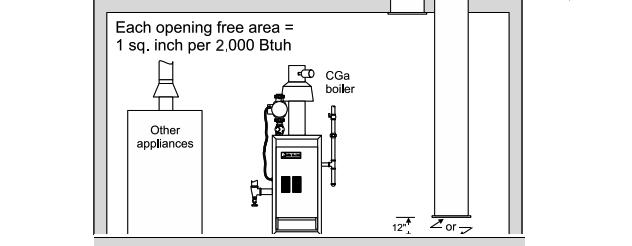
Yes that is correct. If you like the carpet and don't want to cut a hole in it, and you place the carpet over the vent, then you MUST shut OFF the power top the boiler. After the people, you want to impress with your new carpet, leave… then you can remove the carpet from covering the vent and turn the heat back on.
You can't use anything that can be considered temporary like: "I'll leave the basement door open so the air from upstairs can communicate with the basement air". That is considered temporary because when you are not home someone can do you "a favor" and close that door for you. Then when you get back from your 3 week skiing vacation in Aspen, you may end up coming home to a sooty mess of a home. Leaving a window open does not count either. It must be a permanent opening
Edward Young Retired
After you make that expensive repair and you still have the same problem, What will you check next?
0 -
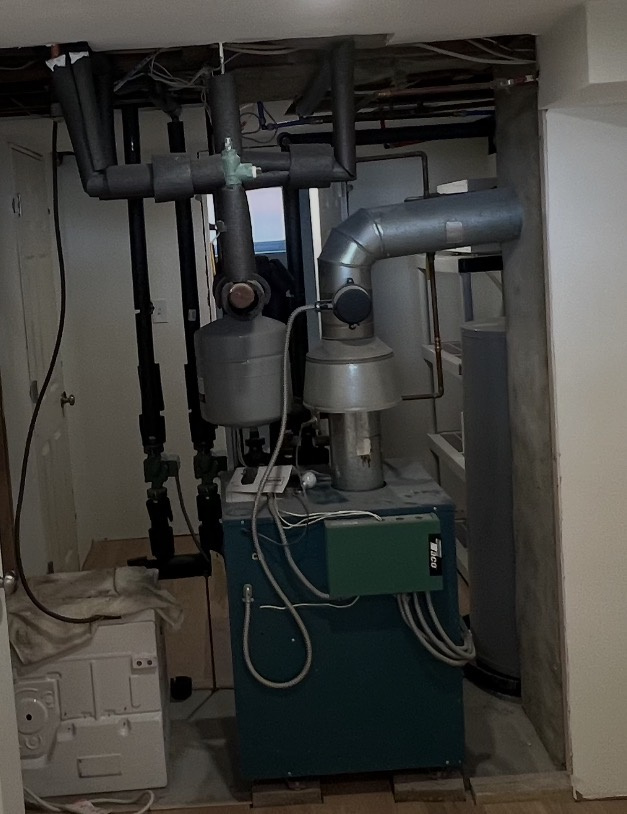
I also see a water heater peaking around the chimney. Since it is near the chimney I assume it could be gas fired.
We are not trying to give you a hard time.
But the facts are if your existing boiler was installed today under the conditions that now exist it wouldn't pass inspection.
It's about potential carbon monoxide issues.
0 -
i'd be more of a fan of the fan in a can for the combustion air problem. the vents through the floor do appear to be allowed in single family residential construction but unless you use vents with some sort of fire damper they are dangerous in a fire. they both will let a fire in the basement spread to the first floor and they will draw the products of combustion from the fire to the first floor both making the fire spread much faster and the ultimate damage greater and reducing the time and paths you have to escape.
perhaps adding post purge to the boiler will let more heat get in to the house instead of being stuck in the boiler block although I don't know of residential zone controllers that support post purge.
let's back up a step here, is the boiler set up as cold start?
0 -
The boiler is also a heat emitter, so whenever it is running, expect that space to get warm.
The only solution is to move the heat out of the boilers space, and at the same time allow fresh cooler sir into the space to support the combustion process.
Hot air ries, so getting the heat out to the space above is easy. Assuring the cooler, heavier air falls down to replace the hot air going out. That is how the venting method Ed shows is intended to work. Cooler air ducting down, hot more buoyant air rising up. It may carry some smells with it, but hopefully not CO into the upper lever. That is where the low level CO detector would want to monitor what is rising out of that room
An outdoor reset control on the boiler would increase efficiency and limit running hotter than needed for the job.
"Come on up for the rising" , lyrics from a Bruce Springsteen song also :)
Bob "hot rod" Rohr
trainer for Caleffi NA
Living the hydronic dream0 -
Alright now I feel like I’m getting somewhere. I will have to consider the options presented to me. I have heard of the “fan in a can” which may be an easier solution than having two vents into the floor. I just want to clarify though with the two vents. So the floor vent itself will remove some of the heat coming off the pipes correct? While the longer duct will bring in air?
0 -
Just a comment from the peanut gallery, so take it for what it’s worth (which is almost nothing), but wouldn’t stealing the indoor air from the 1st floor for combustion still have the possibility of putting the house under negative pressure? Or, maybe worse, could there be a persistent draft around first floor windows, doors, etc., as air is sucked down into the basement and then vented out the chimney? To me it seems like pulling outdoor air right into the boiler room would be a less efficient, but maybe it would have less negative impact on the living space.
Just my 2 cents. The idea of having my own basement air and basement noises vented to the 1st floor so openly and so unrestricted sounds pretty miserable to me lol.
0 -
In a basement usually air intakes are up high because in most case the grade around the house isup high. The code wants two openings 1 high and 1 low. But usually the low opening has to be ducted to the floor because a low opening would be underground. In some cases you can get away with 1 if it is double the size.
0 -
Your correct Erin in that you really don't want your air from the basement in your living space, In my opinion. In no world would i want my basement air drifting into my living space. My basement is a basement. not living quarters. So it comes with all the trappings of a basement.
0 -
Please have your basement and home tested for radon gas before you have any hacking and whacking done in the basement.
The radon mitigation folks will design the correct system for you and tell you where and how you need to increase your fresh air above ground atmospheric air flow into the basement that would also induce a negative pressure gradient (Hg. / water column pressure condition to expel the radon gas with an induced draft fan and ducting to expel the radon gas.
0 -
YES — and all that air will be from inside the home to inside the home. Fan in a can requires some wiring and will be that "Hole in the wall" that you might want to avoid.
Just double check the math. The total Cubic Feet of the home that will communicate with those vents in the floor needs to be 8200 CF total not including any room with a door (like a bedroom or bathroom) So here is a mock up of what I am talking about:
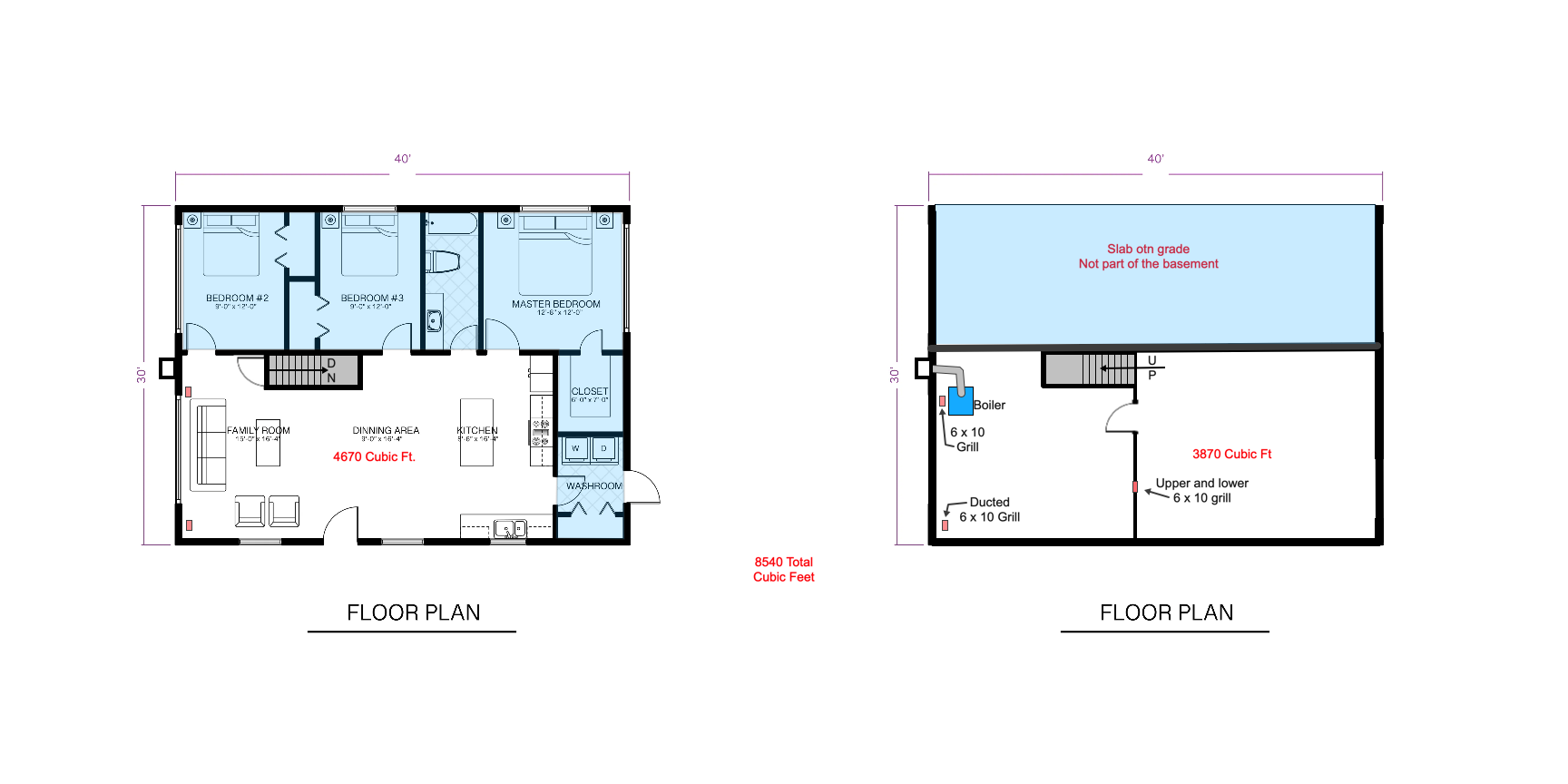
See on the left side of the home there are the two 6 x 10 register covers? One is ducted to within 12" of the floor As you can see from the first floor plan, any of the blue shaded area does not count for calculating the total Cubic feet since the bedrooms and bath have doors that can close. I also have used the existing 3870 Cubic foot of the basement since there are upper and lower 6 x 10 grills in the wall between the finished basement and the boiler room portion of the basement.
Also someone mentioned the water heater. If it is an electric water heater, then you should switch it to gas when the time comes. You should account for an additional 40,000 BTU for that water heater in your calculations. So 164,000 + 40,000 = 204,000 BTU. And just for your Info… if you have a small 3 bedroom 1 story home with that small of a footprint (30ft x 40ft)-ish then your gas boiler is way too big. even if it 2 story, it is still too big. unless it was built in 1906 when no one insulated the walls of homes. But that is another discussion.
Hope this helps
Edward Young Retired
After you make that expensive repair and you still have the same problem, What will you check next?
0




Categories
- All Categories
- 87.8K THE MAIN WALL
- 3.3K A-C, Heat Pumps & Refrigeration
- 59 Biomass
- 430 Carbon Monoxide Awareness
- 132 Chimneys & Flues
- 2.2K Domestic Hot Water
- 6K Gas Heating
- 124 Geothermal
- 170 Indoor-Air Quality
- 3.8K Oil Heating
- 79 Pipe Deterioration
- 1.1K Plumbing
- 6.7K Radiant Heating
- 396 Solar
- 16.1K Strictly Steam
- 3.5K Thermostats and Controls
- 56 Water Quality
- 51 Industry Classes
- 51 Job Opportunities
- 18 Recall Announcements