Heat exchanger or hydraulic separator?

I apologize for the fusillade of questions lately. I am getting very close to pulling the trigger on accepting a bid, and am trying to take care of a few details.
I have a converted gravity system, so ~170 gallons of water in the 100-year-old iron/steel pipes and rads. I specced a magnetic dirt trap, strainer filters, demineralized and treated water, etc.
However, the pro that won the job is offering two options for the primary/secondary interface: The expected/requested hydraulic separator, or an upgraded option of a flat-plate heat exchanger.
Naively, it seems like the flat-plate HX would be a big improvement for this application. I imagine that it would subject the boiler HX to a lot less gunk/scale, and presumably extend the service life. So I wonder why a HX is not used as the separator for the primary and secondary loops more often? The upgrade is not cheap, but not ridiculous, about the same as the sticker price on a middle-of-the-line modcon.
Any comments on desirability of the flat-plate HX option? Thanks!
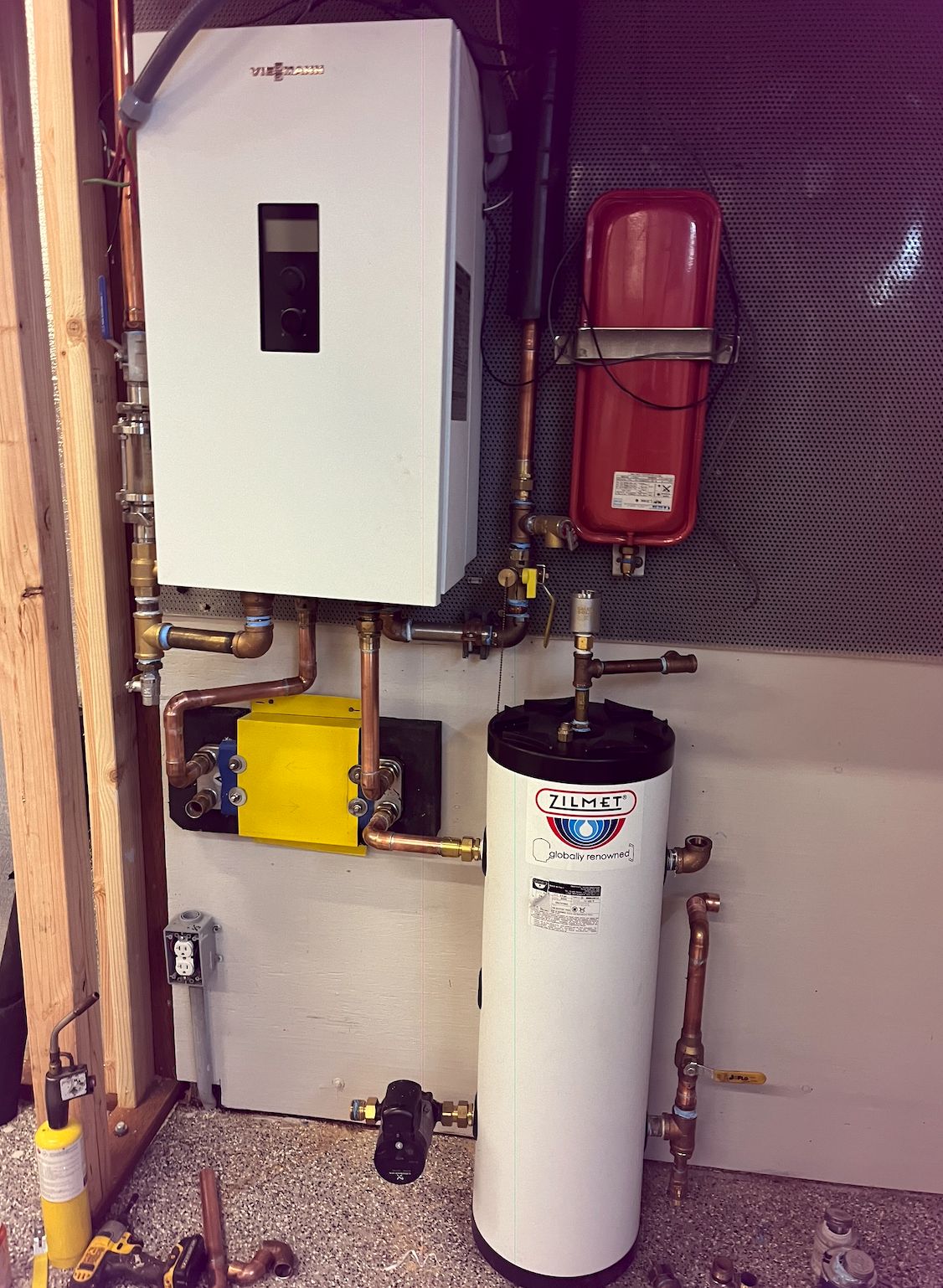
(I couldn't help but notice the one in @hot_rod 's AWHP project: )
Trying to keep Bernie burning!
Comments
-
any time you have a heat exchanger there is an efficiency drop. in smaller systems a hydro sep, or buffer tank can provide some added volume allowing for less cycling. There is an argument to be made where a heat exchanger can be a better option, but in my mind the heat exchanger is typically a last resort to protect the boiler due to site conditions.
Gunk and sludge is not good for your boiler, and it will also impede heat transfer. typically I would rather put money to cleaning the existing system and using something like a caleffi sep4, however your contractor may have info I don't have. with a heat exchanger you also will need 2 expansion tanks, and pumping requirements for the system may change with the added pressure drop of the additional heat exchanger.
an example of when I opted to use a heat exchanger, there was a system that was used as a chilled water pump and dump loop in the summer months. they were killing boiler heat exchangers annually so I recommended separating the boilers from the system via heat exchangers.
 3
3 -
For my application the HX is to separate glycol in the HP circuit from the buffer/ separator and the radiant loops.
If you select a separator with a 4 in 1 function you get the hydraulic separation with excellent air, dirt, and magnetic particles separation.
I don’t see a need for the plate hx and I would definitely add a Y strainer to it if you go that route
The Sep 4 is one of the high performance options.
But as @GGross mentioned, a good power flush of the rad and piping before you connect to it would be wiseBob "hot rod" Rohr
trainer for Caleffi NA
Living the hydronic dream3 -
the hx will be a lot less tolerant of the muck in the gravity system than a fire tube boiler will be. you will still have a circulator on the system side and that is the thing that is most likely to have a problem with the iron much in the system. it can stick to the magnets in the wet rotor circulator and damage things which is why the magnetic dirt separator is important.
if it is a single zone and you do your math right you probably don't need to do primary secondary on a gravity conversion with a modcon. if it is also running an indirect or is several zones primary secondary is probably better.
1 -
»and you do your math right you probably don't need to do primary secondary «
one pump is better than two. For one thing two pumps double pump trouble
0 -
Just for completeness: The system will have 3 space heating zones and an indirect. And we are planning on a thorough flushing (and demineralization and water treatment, as said earlier).
Trying to keep Bernie burning!
0 -
what type of boiler? The manual should typically show the required minimum flow and operating delta
So look at the gpm of the smallest zone to see how it matches up with the boiler requirements
While some fire tube boilers can be direct piped, installation manuals generally steer you to PS or hydraulic seps
Bob "hot rod" Rohr
trainer for Caleffi NA
Living the hydronic dream1 -
HX is good for one thing really. Exchange heat energy from one medium to another. As hot rod has stated you are much better off with a sep 4. You get four critical functions out of one device. In my mind its a no brainer.
1 -
You are better off with a steel compression tank, Airtrol valve and a drain-O-Tank valve to maintain your point of no pressure change.
A 30 or 40 gallon Quick Tank brand compression tank or a pair of them with two airtrol valves and two Drain -O-Tank valves properly plumbed will provide you with greater thermal mass, keep your circulator flooded with low pressure water and allow your circulator to work with less effort and you will have a greater air cushion than you would ever have with a bladder expansion tank air scoop and automatic air vents that will leak AND IF IT IS PLUMBED CORRECTLY YOU WILL NEVER HAVE TO BLEED AIR from your system as the 1/3 to 1/2 air to water ratio in a steel compression tank will absorb any air bubbles rising from the boiler through the Internal Air Separator feeding the air bubbles and hot water to the steel compression tank or tanks through the airtrol valves in the case of 2 steel compression tanks.
 1
1 -
if the airtrol is working properly the thermal mass of the compression tank is more or less isolated from the system.
2 -
I do not seek to bore anyone with the following information about my heating system.
For my 110,000 BTU keystoker kaa-4-1 coal stoker boiler my air management system includes the following items;
- 15-gallon B&G steel compression tank sold by Bell & Gossett and made by Wessels Tank Company
- 1.5" Internal Air Separator casting is made by Bell & Gossett
- 3/4" cast Airtrol valve is made by Bell & Gossett.
The Bell& Gossett Airtrol Valve has a casting that separates the hot water and air bubbles rising from the top tapping of the Bell& Gossett Internal Air Separator.
The entrained air bubbles continue rising through the water in the Bell & Gossett Steel compression tank and dissolve into the air blanket covering the water in the steel compression tank.
As the water cools in the steel compression tank it becomes heavier and sinks gradually and falls through the other half of the airtrol valve casting dropping into the water being circulated by the Bell & Gossett NRF 12 three speed circulator that is used in my system.
My hot water baseboard system (which I hate) consists of 225 feet+- of 3/4" fin tube baseboard.
My system has approximately 54 gallons of water including the 32 gallons of water in the coal stokers hot water chest.
I insisted on my boiler being plumbed with the pump module system pioneered by Mr. Holohan where the circulator is mounted on top of the boiler pumping away from the boiler feeding 2 loops in my poorly insulated home.
I have 2 isolation flange valves that will shut the boiler water off in the event of a circulator failure and I can replace the circulator with the spare that I have in the event it fails.
I was unable to purchase isolation flange valves with gauge ports so we ended up using 2 Tees with reducing bushings for the Vacuum Gauge (Hg.) on the inlet/suction side of the B&G NRF 12 and a pressure gauge (PSIG) on the outlet side of the circulator.
My system is much less complicated just like the original system in this old schoolhouse that had an open to air saddle tank used as a point of no pressure change that was mounted in the ceiling over the boiler.
In my opinion as homeowner that has become heating systems by reading Mr. Holohan's well written books about hot water heating and having grown up with steam heat and scorched air BOOOOO, HISSSSSSSSSSSS,
Needless to say I wish I had gravity hot water in this house with a an open to air ceiling tank mounted over the boiler.
In Bernie the brewers case his has a massive heating advantage with his hot water heating system because of the available thermal mass in his radiator piping, the total number of radiators in his home and the amount of water in his heating system.
It would help if photos of the system were added to this thread as that would help a great deal.
As Jumper has said you should only have one circulator not two as it only complicates matters in the event of a circulator failure.
I have to ask you this, how are you going to clean the system to begin with flushing each radiator with a high strength vinegar solution?
If it was my money I would ask a steam licensed plumber to look at your system as a steam licensed plumber would be much more familiar with a converted gravity hot water system. Properly designed and installed your "new" system could be gravity powered as well eliminating circulators.
Gravity hot water systems were properly designed and installed and used coal for fuel, when these systems were allowed to fail it is because they were not maintained and cleaned.
I hope the flow restrictor discs were not removed from the existing radiators and if they were they should be replaced as that is what created the balanced heat in your system.
0 -
I am not interested in going back to gravity or to a compression tank. About 18 months ago, I installed a new, generously sized expansion tank (Extrol SX-60V) to replace the undersized one that I inherited, and I intend to reuse that in the new installation. The current system is well balanced, with the exception that the first floor is (unsurprisingly) a few degrees cooler than the second/third floors. I am going to create separate zones for the 1st floor and 2nd/3rd floors to address that. I assume that they DID remove the flow restrictor discs when converting to a circulator in order to have the degree of balance that I presently enjoy, but we will check when the system is drained.
There are different kinds of simple: adding additional pumps (or zone valves) certainly makes a system more complex in some regards, but it also simplifies the operation and balancing. I view having several simple, independent heating zones fed as secondary loops (allowing each, for example, to have its appropriate pumping) as perhaps simplifying the problem. To each his own. Pictures of the current setup can be seen in this thread, but those pix still show a water discharge that was rectified by putting in a properly sized expansion tank. (And the premise of that thread was silly in retrospect!)
Trying to keep Bernie burning!
0 -
i don't think there is any boiler manufacturer that is going to warranty their boiler if you set it up as gravity circulation.
0 -
For gravity circulation you replace old boiler with large diameter pipe and inject hot water into circuit from new boiler. So there's still a circ pump on boiler. The injector should not be a simple tee.
To make things interesting OP can see if he can get an adequately sized vacuum expansion tank into attic. I've seen old multi-storey buildings heated with natural circulation that way. Do not know how well it worked but Toronto in olden days did get sub zero weather sometimes.
0




Categories
- All Categories
- 87.8K THE MAIN WALL
- 3.3K A-C, Heat Pumps & Refrigeration
- 59 Biomass
- 430 Carbon Monoxide Awareness
- 132 Chimneys & Flues
- 2.2K Domestic Hot Water
- 6K Gas Heating
- 124 Geothermal
- 170 Indoor-Air Quality
- 3.8K Oil Heating
- 79 Pipe Deterioration
- 1.1K Plumbing
- 6.7K Radiant Heating
- 396 Solar
- 16.1K Strictly Steam
- 3.5K Thermostats and Controls
- 56 Water Quality
- 51 Industry Classes
- 51 Job Opportunities
- 18 Recall Announcements