Weil-McLain Boiler - Reco for Indirect Tank for DHW

Greetings -
I have a 2013 Weil-McLain oil boiler WTGO 3 or 3R. Our DHW is coil-tankless. Our heat is also baseboard hot water.
Over the past few years, we have developed a problem regulating the water temperature in our 2nd floor shower. It will either be scalding hot or cool/cold. It's progressively become more difficult to set the fixture to hold a hot but not scalding temperature. When I say, "progressively", I mean, in the past 2 years this has steadily gotten worse.
I changed the Kohler mixing and balancing valves which did almost nothing to improve the issue. It was not an issue with the scald stop or anything like that and the valves were a little scaled up. The first floor shower doesn't have this issue but it has a different fixture and possibly a different stem (we're not sure).
Our plumber, who has done great work for us in the past, cautioned that based on his temp readings in the shower and other faucets in the house, that we likely had a coil lime scaling issue at this point. We do generally have a lime issue with our town water.
The plumber determined that the water coming from the boiler master mixing valve was much cooler than the water coming from the boiler, even when turned all the way up to 160 degrees. The boiler temp is 180 degrees and the water coming out of the faucets was 120 even with the valve turned to max.
He suggested that the mixing valve could be scaled up and preventing hot water from the boiler to mix properly and recommended replacing that as a first step.
He did that, at a cost of $$$$ and that seems to have provided little improvement. We have to set the temperature near 140 on the new value and he said that is not ideal because of course, it will be scalding hot if turned all hot in any faucet, and it really should be set at 120.
So now it's back to the idea that the lime scaled coil is not heating the DHW enough and recommending bypassing it and installing an indirect tank as another heating zone.
Of course, the cost of this will be much higher than the master mixing valve. The number that was thrown out was essentially the cost of an entirely new boiler.
I asked if the coil could be cleaned and I was told it couldn't be at this boiler age. I asked if the boiler could be opened to confirm this was the issue and was told it couldn't be.
We can manage with this for some time. It is not urgent to address, but at some point it will make sense to pay now instead of pay more later.
I've only had one other tankless oil boiler in the past (different property) and it did not have this issue.
I was told that the tank would have a lifetime warranty and could be hooked into a new boiler when that needs to be replaced in 12-15 years. And that it would be far more efficient that what we are doing today.
Is this common and reasonable to do with these boilers?
Thanks in advance -
Comments
-
Hi, My first thought is to compare the cost of getting your domestic hot water from a tank-type water heater, completely separate from the boiler. Compare this with the cost of getting the existing system to work properly/safely. So much depends on the level of technical ability available to you. Simple systems have their place.
Yours, Larry
 3
3 -
We do have solar panels so an electric water heater may not draw that much but I'm not sure. Then I'd need both a plumber and an electrician. This is nothing we ever thought we'd have to consider when we bought the house 5 years ago. We thought we were good to go with this boiler and tankless hot water for another 20-25 years.
I should also I think reiterate that we do have hot water and it is hot enough, and now can be overly hot. It's regulating the mix that is the biggest issue to us, and only in that shower. It seems like spending thousands of dollars no matter the path might be overkill.
0 -
Is the second floor shower the only location in the whole house that has a hot water issue?
0 -
it depends on what type of mix valve you have. If it is an ASSE 1070 listed valve it will not go above 120F. That is a point of use mix valve. Sometimes called an anti scald valve.
If it is a ASSE 1017, those adjust from about 85 to 180F
There are some valves that are dual listed and they have a stop built into the cap or the valve itself. That needs to be removed to allow over 120F
Got a pic of the mix valve?
If the tankless coil gets scaled that can cause temperature droop also. Has the coil been delimed?
Bob "hot rod" Rohr
trainer for Caleffi NA
Living the hydronic dream0 -
It's the only location where we notice that regulating water temperature can be sub-optimal. The first floor shower - we don't recall the same challenge but that one has a Symmons fixture/valve that was installed last year.
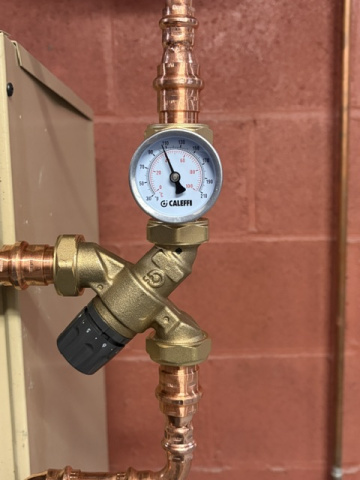
I don't have a pic of the old valve. It was just a dial that went to 160F and looked very basic in design. No gauge. I'm posting a pic of the one the plumber just installed. At present, we have it set to 5.5 on that dial. I've tried the shower a few times and it's "fine", meaning I can adjust the shower so that it is not scalding. It is hot, but the mixing from hot to cold is not a continuous or step-wise scale as the handle is turned. It goes to cold on movement to the handle rather quickly. Again, new Kohler mixing valve and balancing valve were installed. The scalding stop screw is not engaged on the handle. The lines were flushed.
The coil has not been delimed. I asked about that and the plumber said at this age (13 years) it could not be done, or done safely(?). I asked about opening the boiler to confirm the level of lime on the coil and was told that would be ill-advised as well(?).
I should add that this plumber is well-regarded in my area and has done good problem-solving for us in the past, but I don't know that heating is really their sweet spot.
A recommendation for a solution with a cost close to replacing the boiler itself just to better regulate temperature in a second floor shower seems like overkill and we'd rather live with it being fussy.
Another option could be replacing the shower fixture/valve with Symmons because that supposedly mixes coil-tankless hot water better, but if that requires a different valve body than Kohler, we would have to cut through the wall behind the shower to do that, which is better than the indirect tank, but will also have a high cost.
My wife and I are going to see how this goes for a bit. This kind of investment doesn't make sense to us unless we were not getting hot water, and not getting it everywhere, and that's not our current issue.
 0
0 -
As I see the problem, when everything in the system was new there was no issue adjusting the hot water temperature in the second-floor shower. Over time, mineral buildup has formed on the surfaces of the tankless coil, reducing heat transfer.
The first-floor shower has a valve that can compensate for this by adjusting the mix of hot and cold water, but the second-floor shower apparently does not have that same type of valve. Because of that, the reduced hot water output from the tankless coil becomes much more noticeable there. That, in my opinion, explains the problem.
You attempted to improve the situation by installing a better-designed mixing valve on the tankless coil. Unfortunately, that does not solve the root issue if the coil itself is losing efficiency due to mineral buildup.
The logical next step is to restore heat transfer in the tankless coil by removing that buildup. This can usually be done by chemically cleaning the coil, but only if the proper isolation valves were installed to allow maintenance. The problem is that many oil-boiler installations were not piped with the valves needed for that maintenance, so the cleaning never gets done until a problem like this shows up years later.
So at this point there are several possible directions:
- Install isolation valves and clean the tankless coil.
This may restore the coil's performance, assuming the coil is not already so deteriorated that cleaning it causes it to leak. - Replace the tankless coil.
This returns the system to its original condition when the coil was new. - Install a separate water heater and abandon the tankless coil.
There are several variations:- Electric water heater.
This may require plumbing and electrical upgrades. In many areas electricity is more expensive than oil or gas for producing the same amount of hot water.- 75 or 80 gallon electric minimum
- @ethicalpaul's favorite choice = Heat Pump water heater
- Gas water heater.
This may require new gas piping, or if natural gas is not available, a propane tank and supply line. - Oil-fired water heater.
These units are usually more expensive, but since the house already has oil supply and venting, most of the infrastructure is already in place. - Indirect water heater.
This uses the existing boiler as the heat source, so no additional burner is required and the tank does not need to be vented to the chimney. Indirect tanks are typically efficient and provide a good supply of hot water.
- Electric water heater.
All of these options involve some cost. The lowest-cost approach is cleaning the coil, but that may cause the coil to fail, making a replacement water heater necessary anyway. The lowest-cost replacements are usually either a new coil or an electric water heater. A replacement coil puts you back to the system’s original design. An electric heater may be inexpensive to install but can result in higher operating costs with little reduction in oil usage.
Gas and oil stand-alone heaters can cost more to install but may provide a larger supply of hot water at a reasonable operating cost. My preference would be the indirect water heater, since you already have a very efficient oil-fired boiler to generate the heat. The tank can then sit with very low standby loss, unlike the constant standby loss of a tankless coil in a boiler.
If I were in your position, I might go directly to the indirect. If money were tight, however, the first step would be cleaning the tankless coil. There is probably better than a 60% chance that this would solve the problem. The downside is that you would be spending money to repipe the plumbing and install maintenance valves that would not be used if you later decide to switch to one of the other options.
Edward Young Retired
After you make that expensive repair and you still have the same problem, What will you check next?
0 - Install isolation valves and clean the tankless coil.
-
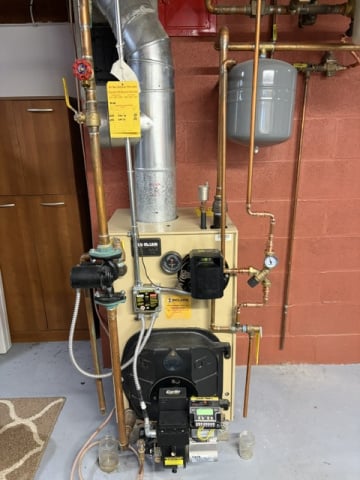
Thanks Ed for your well considered summary and review of options and the pros and cons. It's incredibly helpful. I'm attaching a picture of the entire system. As I mentioned, when I asked about cleaning the coil, I was told it could not be done now at this age (13 years) and that is something that maybe should have been considered as part of early maintenance, but wasn't done. I wasn't given a reason (lack of maintenance valves or potential leak in the coil). It was intimated that it was unlikely to withstand the effort.
Replacing the coil was not offered as an option by this plumber, which I would certainly consider as it would presumably be cheaper and would buy another 12-13 years and maybe matchup with the life of the boiler overall.
I can pursue that elsewhere if he doesn't want to do it, but it's $$ just to get a company to come look at it to tell me whether they want to do it or not.
I live south of Boston. The quote for installing a 40 gallon indirect tank was $K. That seems high to me, but it includes adding an extra heat zone to the boiler, and an electrician.
The plumber was not hyper selling this option but his perspective was that the indirect water heater would solve the problem permanently, and when the oil boiler goes in the future, the
new one could be hooked into the indirect tank, which comes with a lifetime warranty. Essentially, this would be a forever investment. We will only be in this house for another 10 years. Obviously, this issue will continue to get progressively worse and more costly with time, but it's a lot of money for what is right now, a fussy shower.
 0
0 -
Get a quote from a different plumber for a standalone water heater, especially one that takes into consideration utility or state credits for installing a heat pump water heater.
There is no "forever solution"
NJ Steam Homeowner.
See my sight glass boiler videos: https://bit.ly/3sZW1el0 -
I wonder what the boiler side of the coil looks like.
0 -
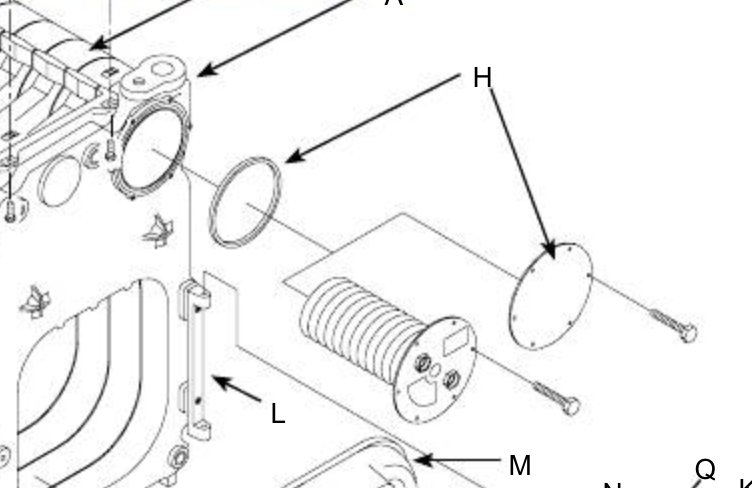
Hi, Here's a diagram of the coil. It looks like it should be replaceable. Seems you need to find the right person who has experience with this sort of job and see what $ they want to do it.
Yours, Larry
0 -
@digger5150 Thank you for seeking advice on our site. We have a rule here that we don't post estimates and job pricing. I've edited those out from your posts. Thanks, Andrew
Forum Moderator
0 -
Oops - sorry about that.
Yes, I will have to do some due diligence on that.
Thanks everyone - I appreciate all of your expertise!
0





Categories
- All Categories
- 87.8K THE MAIN WALL
- 3.3K A-C, Heat Pumps & Refrigeration
- 59 Biomass
- 430 Carbon Monoxide Awareness
- 132 Chimneys & Flues
- 2.2K Domestic Hot Water
- 6K Gas Heating
- 124 Geothermal
- 170 Indoor-Air Quality
- 3.8K Oil Heating
- 79 Pipe Deterioration
- 1.1K Plumbing
- 6.7K Radiant Heating
- 396 Solar
- 16.1K Strictly Steam
- 3.5K Thermostats and Controls
- 56 Water Quality
- 51 Industry Classes
- 51 Job Opportunities
- 18 Recall Announcements