changing Indirect H/W Boiler to Cold start

I recently had to replace a boiler aquastat, I replaced it with a Honeywell L7224U1002. The system has an indirect but is set up as a warm start boiler. So I want to switch over to a cold start operation. However, I can't yet because of the wiring of the indirect circulator and indirect Aquastat.
This is a small home that heats primarily with their mini split system so even in the winter time it doesn't make sense for this boiler to always be warm. Tt definitely doesn't during the summer.
The the system has single zone valve (it was once a two zone system but one zone has been removed) and a circulator that feeds the zone valve and then independently, a circulator that feeds the the indirect and does not use its own zone valve. The aquastat on the indirect provides L1 to the indirect circulator.
So the boiler is set up as a warm start because there's no call for heat when the indirect needs heat from the boiler. I'm thinking I need to add a switching relay and stop powering the indirect circulator through indirect Aquastat. Is there a simpler "less costly to the homeowner" way to do this. I'm also seeing the single zone valve as useless and just something to break in the middle of the night.
Thanks
Robert
Comments
-
You want the temp control on the indirect to start the indirect circulator and start the boiler.
You want the heating thermostat to start the heating circ and fire the boiler (or the thermostat opens the zone valve and the zone valve end switch pulls in a relay to start the boiler and the heating circ)
2 Honeywell RA832A relays would do it.
You only need an aquastat for a high limit. An L4006A would do that.
There are numerous other controls you could use.
1 -
You replaced a L8148 with a L7224U. is that what you are talking about?
OR
You replaced a L8124 for a tankless coil boiler with a L7224U and installed the indirect and want to convert to a cold start boiler. That is a little different.
In either case you don't need the burner to keep a minimum temperature. The L7224U can do that by setting the Low Limit to the lowest temperature then one more click past that low temperature. The temperature display will read
OFF. The L7224U will no longer operate the burner unless there is a call for heat at TT on the L7224U, or you get external 120 VAC input to the ZR on the L7224U from the DHW thermostat.How is your DHW indirect tank getting hot water from the boiler? …a zone valve or a circulator pump?
Edward Young Retired
After you make that expensive repair and you still have the same problem, What will you check next?
0 -
When there is more than one circulator that can operate the boiler, there needs to be a Flow Control device to prevent the water from the zone that is not operatinf from getting flow backweards from the circulator that is operating the other zone. In this diagram the space heating pump is operating and the water is flowing backwards thru the water heater loop.
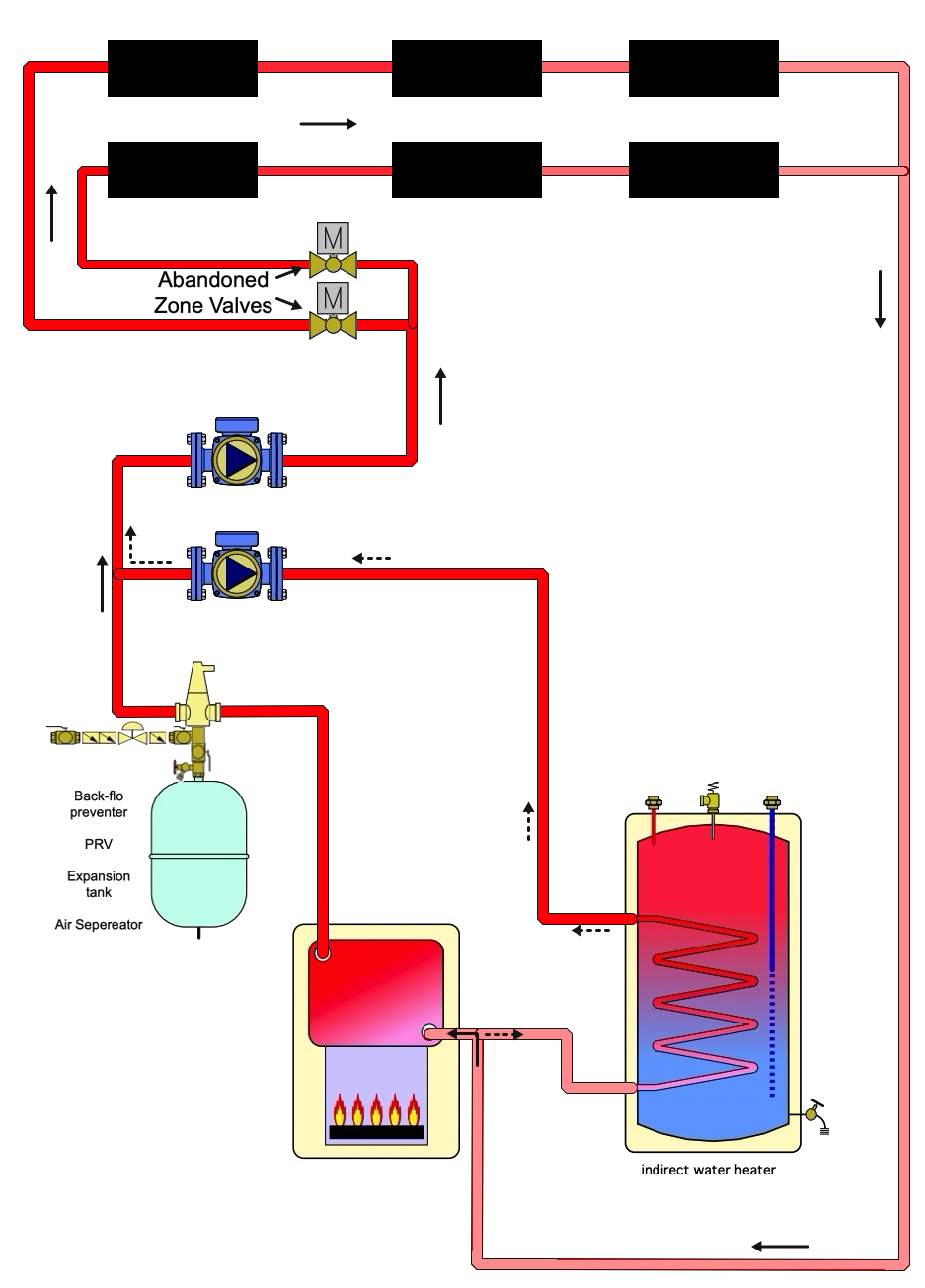
Think about what will happen in the summer when the boiler operates for DHW and the space heating loops get heat flowing backwards thru the loop.
Depending on what circulators you have you may be able to add the flow check with a small IFC device added to the existing circulator pump. Depending on the condition of the zone valves you ca nwire them to be the valve that prevents flow when there is no call for heat from the space heating zone and the DHW zone is calling for heat.
I would need to know more about what is already there to tell you how to do this,
Edward Young Retired
After you make that expensive repair and you still have the same problem, What will you check next?
1 -
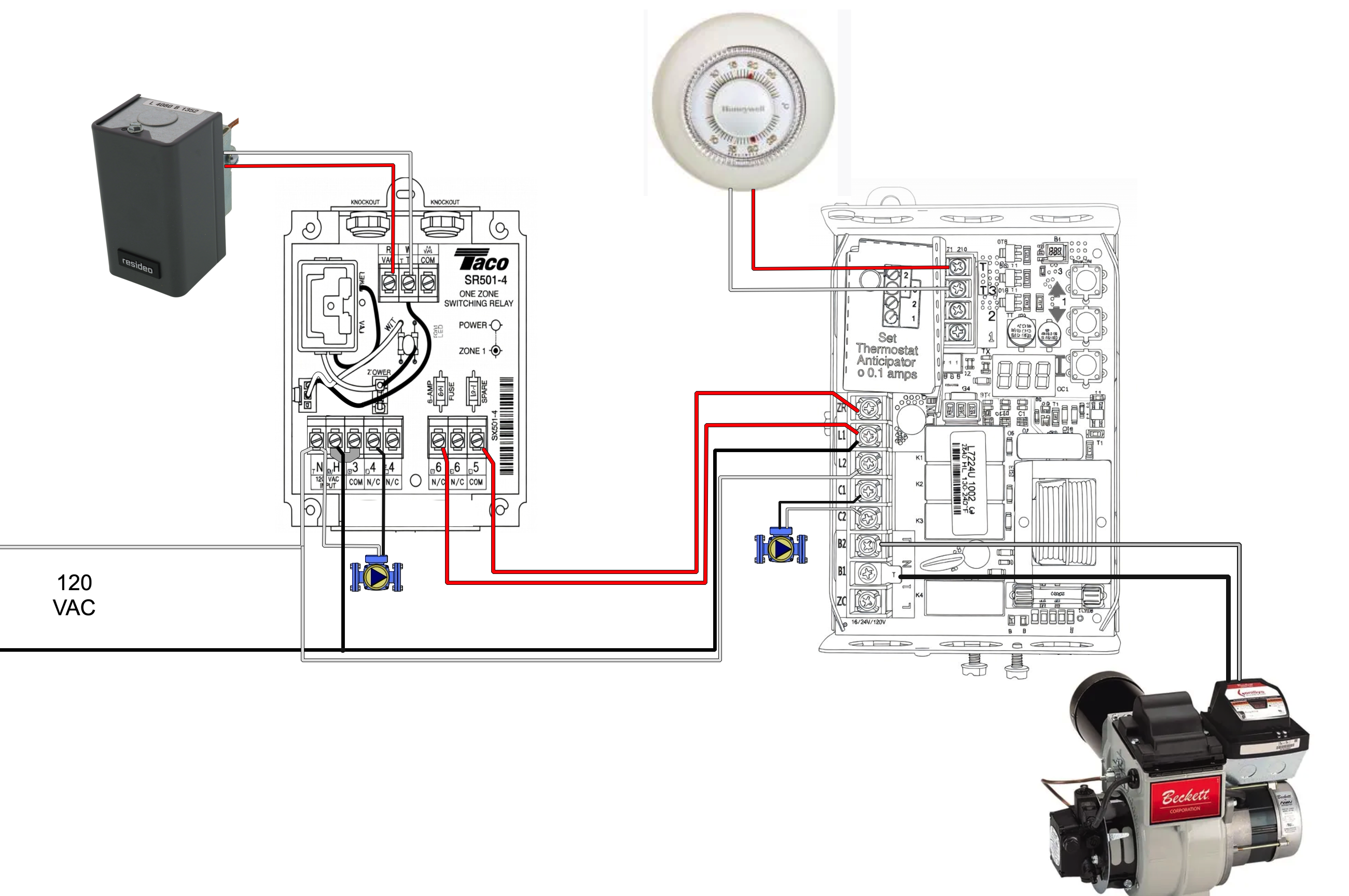
For the DHW part of the control system, that is easy, You need to get one switching relay like the Taco SR501 or the Resideo R845A. The L7224U for the boiler gets the space thermostat to R and W and the heating circulator connected to C1 and C2. The thermostat and circulator for the DHW gets connected to the switching relay. The contacts from the 5 and 6NO connect to the ZR and the L1 on the L7224U (shown in red). This will power the burner thru the high limit, without powering the space heat circulator.
Edward Young Retired
After you make that expensive repair and you still have the same problem, What will you check next?
0 -
I replaced a defective L8148 with a L7224U. Now that they have a L7224U I want to convert to cold start.
The system already has an indirect with an independent circulator for the indirect. that circulator get its power from the HL aquastat on the indirect.
If I read you correctly I can bring the 120 VAC that powers the indirect circulator over to the ZR on the L7224U and that will fire the boiler.
 1
1 -
This is a small home that heats primarily with their mini split system so even in the winter time it doesn't make sense for this boiler to always be warm. Tt definitely doesn't during the summer.
I couldn’t agree more. The answer is therefore a standalone water heater.
NJ Steam Homeowner.
See my sight glass boiler videos: https://bit.ly/3sZW1el0 -
So, Paul has a Heat Pump Water heater and believes that everyone should have a stand alone water heater even if it cost more to operate than the one that you currently have. There is no convincing him that an oil fired boiler that is operating at 85% combustion efficiency will cost less to operate an indirect than any other stand alone water heater. In Paul's mind using a huge heater that is so big that it can heat your whole house is the worst idea ever. A gas automatic using propane (if you can't get natural gas) might cost you $40.00 per month is better than an oil fired burner that can offer you 400% better recovery and only cost you $300.00 more per year above your heating only cost with that same oil burner is not possible. Although I have the numbers to prove this.
I believe that you should try Paul's idea only if Paul is ready to purchase you a water heater and have it installed.
Back to your query @Robert_H, about the ZR terminal on your L7224U. The ZR terminal is connected directly to the oil burner (B1) thru the limit. All you need is a relay to connect the thermostat to and the circulator to. My diagram is above.
Edward Young Retired
After you make that expensive repair and you still have the same problem, What will you check next?

 3
3 -
Yes I do definitely believe that heating up a 400 pound chunk of cast iron plus 10 or so gallons of water in order to then run a circulator and heat exchanger to heat a tank from 120 up to 140 or so is an idea only someone getting a markup could love (and they do seem to really love them!!)
The fact that I have a heat pump water heater is irrelevant—any water heater makes more sense than an indirect. Especially in this case where he told us they rarely even use the boiler. Come on guys, snap out of it 😅
NJ Steam Homeowner.
See my sight glass boiler videos: https://bit.ly/3sZW1el0 -
So who is going to pay for this new water heater, Paul? And what will it cost to operate it? Will it be vented like a gas automatic with an atmospheric burner that operates at about 68% efficiency, compared to the oil burner at about 85%?
If the device producing the heat for the water heater is 400 pounds of cast iron, and it still costs less to operate than natural gas or propane in a vented tank, then who is really not being realistic?
You are never going to convince me that a tank that is super-insulated and not connected to a vent is worse than a gas water heater that is vented, or an electric water heater that is essentially like the indirect—with no vent—but costs three times as much in fuel or energy to operate. or even a step further ans do what you did with a HPWH to get the lower operating cost. there is a substantial cost associated with that HPWH when compared to the cost of purchasing a control for less that $200.00 that should have been included in the first place. If done correctly @Robert_H would not even be here to talk about it and they won't need a new water heater or relay to solve the problem.
Sorry, Paul, but I have the experience and can tell you that you are wearing blinders on this topic. I believe it is because you once had a tankless coil, and you are comparing the worst water heater design ever to one of the best water heater designs ever. Because it was “oil heat” and you now have “gas heat,” and you saved money on operating costs, that comparison is not really apples to apples.
I can show you dozens of my customers who had lousy gas heating systems (mostly propane, but also many natural-gas coal conversions) who saved a lot of money by switching to oil heat with indirect water heaters, because the old equipment was inefficient and wasteful compared to the newer oil heat systems I installed.
If you like, Paul, I can get you a pair of rose colored glasses to put on after you remove those blinders.🤣
Edward Young Retired
After you make that expensive repair and you still have the same problem, What will you check next?
1 -
I don't really see it as an oil vs gas issue.
You are never going to convince me that a tank that is super-insulated and not connected to a vent
I never said anything about the water heater being connected to a vent (several varieties aren't). And given the energy regulations I assume all water heaters are pretty well insulated.
I haven't even mentioned the disadvantages of having your hot water system connected to your heating system so that if either fails you can lose the other…oops I guess I just did 😅
I do want you to know I continue to respect your views and input on this and all topics, Ed!
NJ Steam Homeowner.
See my sight glass boiler videos: https://bit.ly/3sZW1el1 -
@ethicalpaul, I believe I understand your point that firing a large gas or oil boiler simply to take a shower may appear inefficient at first glance. If I remember correctly, you had oil heat in that home—or perhaps another home—and I believe it used a tankless coil for domestic hot water. I may be mistaken on that detail, but the principle remains the same.
Anyone with experience using a tankless coil for domestic hot water knows that, without proper maintenance, it can eventually lead to high fuel consumption and inadequate hot water. In many cases, those problems can be corrected with proper cleaning and maintenance. However, when a homeowner’s only experience with a system has been a poorly maintained tankless coil, it can easily shape their perception of oil versus gas, and tankless coils versus stand-alone water heaters. In reality, the problem is often the condition of the equipment rather than the type of fuel or system design.
Unfortunately, in my experience, many plumbers are hesitant to work on oil systems. As a result, the easier solution for them is often to install an electric water heater and simply turn the boiler off during the summer months.
In my opinion, that approach does a disservice to the customer. It often reflects a lack of understanding of the underlying problem and results in taking the easiest path rather than the correct one. Two things commonly happen in these situations:
- The electric water heater frequently costs more to operate than the oil burner did when the oil system was functioning properly.
- The oil boiler may continue to maintain temperature for extended periods, wasting fuel and costing the homeowner money until the heating season ends and the boiler can finally be turned off.
If the plumber took the time to properly diagnose and service the system—for example, by cleaning and maintaining the tankless coil—the repair would often be less expensive for the customer. At the same time, the plumber could actually earn more on a properly priced service job than on installing a standard water heater. Water heater replacements typically have very low profit margins because many plumbing companies compete aggressively on price to avoid appearing overpriced.
Because I have seen many cases where a homeowner’s electric bill doubled after installing an electric water heater, I generally advocate for indirect water heaters when the heat source is a high-efficiency appliance such as an oil boiler or a modulating-condensing (mod-con) gas boiler.
In my opinion, an indirect water heater is often superior to a combi boiler. To produce sufficient domestic hot water with a combi system, the burner typically needs to be oversized—often approaching 200,000 BTU/hr—even though the heating load of the house may require only a fraction of that capacity. By contrast, an indirect water heater paired with a properly sized mod-con boiler allows the heating appliance to be sized appropriately for the home while still providing excellent domestic hot water performance.
Bottom line Paul, You are stating that standalone water heaters are the best and indirects are not to be considered based on experience. I can state with experience that indirects can be a better choice when properly applied. Your blanket dismissal of indirects is not in the best interest of every client's situation.
Edward Young Retired
After you make that expensive repair and you still have the same problem, What will you check next?
0

Categories
- All Categories
- 87.6K THE MAIN WALL
- 3.3K A-C, Heat Pumps & Refrigeration
- 59 Biomass
- 430 Carbon Monoxide Awareness
- 124 Chimneys & Flues
- 2.2K Domestic Hot Water
- 5.9K Gas Heating
- 120 Geothermal
- 168 Indoor-Air Quality
- 3.8K Oil Heating
- 78 Pipe Deterioration
- 1K Plumbing
- 6.6K Radiant Heating
- 394 Solar
- 16K Strictly Steam
- 3.5K Thermostats and Controls
- 56 Water Quality
- 51 Industry Classes
- 50 Job Opportunities
- 18 Recall Announcements