changing Indirect H/W Boiler to Cold start

I recently had to replace a boiler aquastat, I replaced it with a Honeywell L7224U1002. The system has an indirect but is set up as a warm start boiler. So I want to switch over to a cold start operation. However, I can't yet because of the wiring of the indirect circulator and indirect Aquastat.
This is a small home that heats primarily with their mini split system so even in the winter time it doesn't make sense for this boiler to always be warm. Tt definitely doesn't during the summer.
The the system has single zone valve (it was once a two zone system but one zone has been removed) and a circulator that feeds the zone valve and then independently, a circulator that feeds the the indirect and does not use its own zone valve. The aquastat on the indirect provides L1 to the indirect circulator.
So the boiler is set up as a warm start because there's no call for heat when the indirect needs heat from the boiler. I'm thinking I need to add a switching relay and stop powering the indirect circulator through indirect Aquastat. Is there a simpler "less costly to the homeowner" way to do this. I'm also seeing the single zone valve as useless and just something to break in the middle of the night.
Thanks
Robert
Comments
-
You want the temp control on the indirect to start the indirect circulator and start the boiler.
You want the heating thermostat to start the heating circ and fire the boiler (or the thermostat opens the zone valve and the zone valve end switch pulls in a relay to start the boiler and the heating circ)
2 Honeywell RA832A relays would do it.
You only need an aquastat for a high limit. An L4006A would do that.
There are numerous other controls you could use.
1 -
You replaced a L8148 with a L7224U. is that what you are talking about?
OR
You replaced a L8124 for a tankless coil boiler with a L7224U and installed the indirect and want to convert to a cold start boiler. That is a little different.
In either case you don't need the burner to keep a minimum temperature. The L7224U can do that by setting the Low Limit to the lowest temperature then one more click past that low temperature. The temperature display will read
OFF. The L7224U will no longer operate the burner unless there is a call for heat at TT on the L7224U, or you get external 120 VAC input to the ZR on the L7224U from the DHW thermostat.How is your DHW indirect tank getting hot water from the boiler? …a zone valve or a circulator pump?
Edward Young Retired
After you make that expensive repair and you still have the same problem, What will you check next?
 1
1 -
When there is more than one circulator that can operate the boiler, there needs to be a Flow Control device to prevent the water from the zone that is not operatinf from getting flow backweards from the circulator that is operating the other zone. In this diagram the space heating pump is operating and the water is flowing backwards thru the water heater loop.
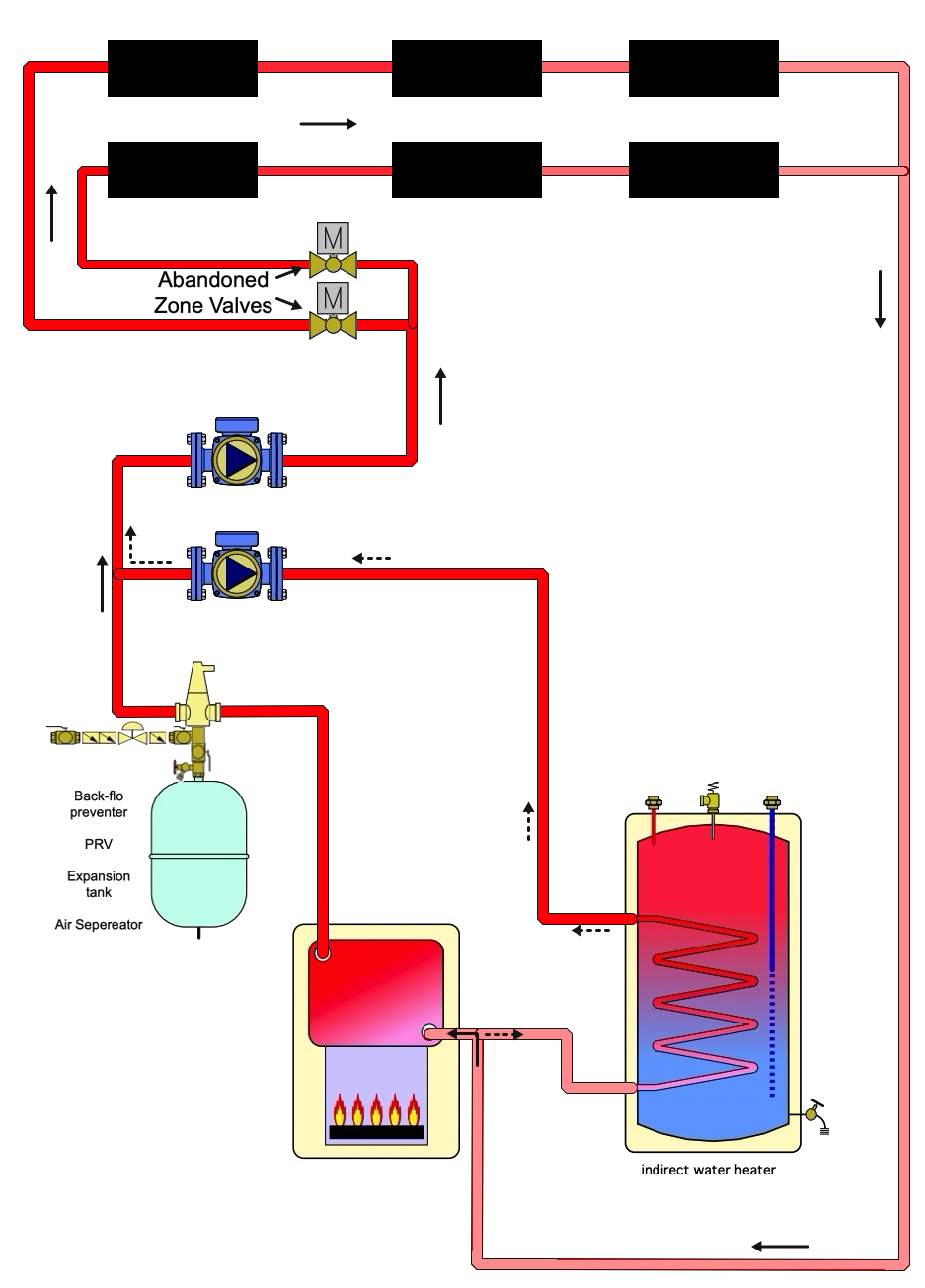
Think about what will happen in the summer when the boiler operates for DHW and the space heating loops get heat flowing backwards thru the loop.
Depending on what circulators you have you may be able to add the flow check with a small IFC device added to the existing circulator pump. Depending on the condition of the zone valves you ca nwire them to be the valve that prevents flow when there is no call for heat from the space heating zone and the DHW zone is calling for heat.
I would need to know more about what is already there to tell you how to do this,
Edward Young Retired
After you make that expensive repair and you still have the same problem, What will you check next?
1 -
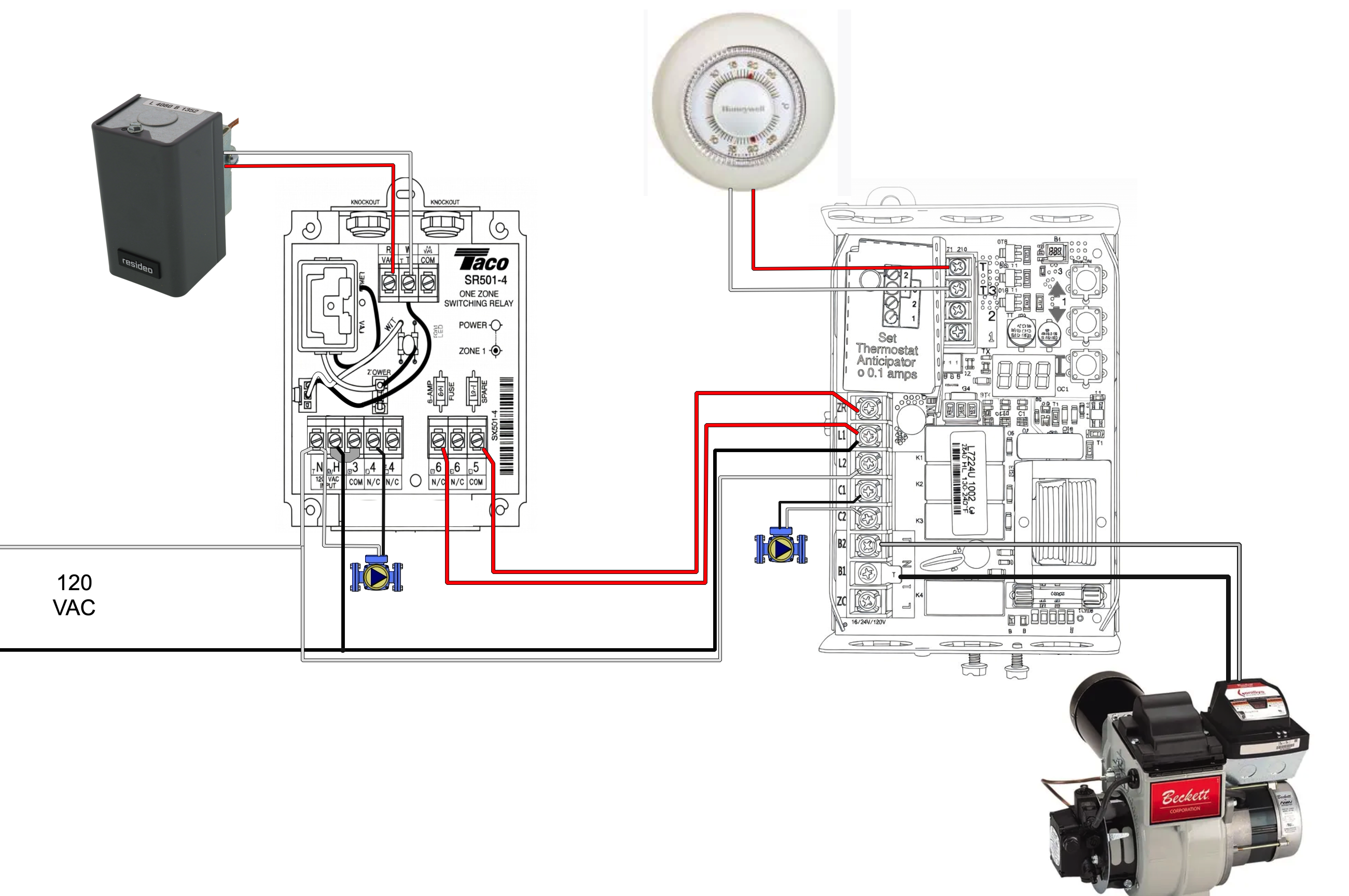
For the DHW part of the control system, that is easy, You need to get one switching relay like the Taco SR501 or the Resideo R845A. The L7224U for the boiler gets the space thermostat to R and W and the heating circulator connected to C1 and C2. The thermostat and circulator for the DHW gets connected to the switching relay. The contacts from the 5 and 6NO connect to the ZR and the L1 on the L7224U (shown in red). This will power the burner thru the high limit, without powering the space heat circulator.
Edward Young Retired
After you make that expensive repair and you still have the same problem, What will you check next?
0 -
I replaced a defective L8148 with a L7224U. Now that they have a L7224U I want to convert to cold start.
The system already has an indirect with an independent circulator for the indirect. that circulator get its power from the HL aquastat on the indirect.
If I read you correctly I can bring the 120 VAC that powers the indirect circulator over to the ZR on the L7224U and that will fire the boiler.
 1
1 -
This is a small home that heats primarily with their mini split system so even in the winter time it doesn't make sense for this boiler to always be warm. Tt definitely doesn't during the summer.
I couldn’t agree more. The answer is therefore a standalone water heater.
NJ Steam Homeowner.
See my sight glass boiler videos: https://bit.ly/3sZW1el0 -
So, Paul has a Heat Pump Water heater and believes that everyone should have a stand alone water heater even if it cost more to operate than the one that you currently have. There is no convincing him that an oil fired boiler that is operating at 85% combustion efficiency will cost less to operate an indirect than any other stand alone water heater. In Paul's mind using a huge heater that is so big that it can heat your whole house is the worst idea ever. A gas automatic using propane (if you can't get natural gas) might cost you $40.00 per month is better than an oil fired burner that can offer you 400% better recovery and only cost you $300.00 more per year above your heating only cost with that same oil burner is not possible. Although I have the numbers to prove this.
I believe that you should try Paul's idea only if Paul is ready to purchase you a water heater and have it installed.
Back to your query @Robert_H, about the ZR terminal on your L7224U. The ZR terminal is connected directly to the oil burner (B1) thru the limit. All you need is a relay to connect the thermostat to and the circulator to. My diagram is above.
Edward Young Retired
After you make that expensive repair and you still have the same problem, What will you check next?
 4
4 -
Yes I do definitely believe that heating up a 400 pound chunk of cast iron plus 10 or so gallons of water in order to then run a circulator and heat exchanger to heat a tank from 120 up to 140 or so is an idea only someone getting a markup could love (and they do seem to really love them!!)
The fact that I have a heat pump water heater is irrelevant—any water heater makes more sense than an indirect. Especially in this case where he told us they rarely even use the boiler. Come on guys, snap out of it 😅
NJ Steam Homeowner.
See my sight glass boiler videos: https://bit.ly/3sZW1el-1 -
So who is going to pay for this new water heater, Paul? And what will it cost to operate it? Will it be vented like a gas automatic with an atmospheric burner that operates at about 68% efficiency, compared to the oil burner at about 85%?
If the device producing the heat for the water heater is 400 pounds of cast iron, and it still costs less to operate than natural gas or propane in a vented tank, then who is really not being realistic?
You are never going to convince me that a tank that is super-insulated and not connected to a vent is worse than a gas water heater that is vented, or an electric water heater that is essentially like the indirect—with no vent—but costs three times as much in fuel or energy to operate. or even a step further ans do what you did with a HPWH to get the lower operating cost. there is a substantial cost associated with that HPWH when compared to the cost of purchasing a control for less that $200.00 that should have been included in the first place. If done correctly @Robert_H would not even be here to talk about it and they won't need a new water heater or relay to solve the problem.
Sorry, Paul, but I have the experience and can tell you that you are wearing blinders on this topic. I believe it is because you once had a tankless coil, and you are comparing the worst water heater design ever to one of the best water heater designs ever. Because it was “oil heat” and you now have “gas heat,” and you saved money on operating costs, that comparison is not really apples to apples.
I can show you dozens of my customers who had lousy gas heating systems (mostly propane, but also many natural-gas coal conversions) who saved a lot of money by switching to oil heat with indirect water heaters, because the old equipment was inefficient and wasteful compared to the newer oil heat systems I installed.
If you like, Paul, I can get you a pair of rose colored glasses to put on after you remove those blinders.🤣
Edward Young Retired
After you make that expensive repair and you still have the same problem, What will you check next?
1 -
I don't really see it as an oil vs gas issue.
You are never going to convince me that a tank that is super-insulated and not connected to a vent
I never said anything about the water heater being connected to a vent (several varieties aren't). And given the energy regulations I assume all water heaters are pretty well insulated.
I haven't even mentioned the disadvantages of having your hot water system connected to your heating system so that if either fails you can lose the other…oops I guess I just did 😅
I do want you to know I continue to respect your views and input on this and all topics, Ed!
NJ Steam Homeowner.
See my sight glass boiler videos: https://bit.ly/3sZW1el1 -
@ethicalpaul, I believe I understand your point that firing a large gas or oil boiler simply to take a shower may appear inefficient at first glance. If I remember correctly, you had oil heat in that home—or perhaps another home—and I believe it used a tankless coil for domestic hot water. I may be mistaken on that detail, but the principle remains the same.
Anyone with experience using a tankless coil for domestic hot water knows that, without proper maintenance, it can eventually lead to high fuel consumption and inadequate hot water. In many cases, those problems can be corrected with proper cleaning and maintenance. However, when a homeowner’s only experience with a system has been a poorly maintained tankless coil, it can easily shape their perception of oil versus gas, and tankless coils versus stand-alone water heaters. In reality, the problem is often the condition of the equipment rather than the type of fuel or system design.
Unfortunately, in my experience, many plumbers are hesitant to work on oil systems. As a result, the easier solution for them is often to install an electric water heater and simply turn the boiler off during the summer months.
In my opinion, that approach does a disservice to the customer. It often reflects a lack of understanding of the underlying problem and results in taking the easiest path rather than the correct one. Two things commonly happen in these situations:
- The electric water heater frequently costs more to operate than the oil burner did when the oil system was functioning properly.
- The oil boiler may continue to maintain temperature for extended periods, wasting fuel and costing the homeowner money until the heating season ends and the boiler can finally be turned off.
If the plumber took the time to properly diagnose and service the system—for example, by cleaning and maintaining the tankless coil—the repair would often be less expensive for the customer. At the same time, the plumber could actually earn more on a properly priced service job than on installing a standard water heater. Water heater replacements typically have very low profit margins because many plumbing companies compete aggressively on price to avoid appearing overpriced.
Because I have seen many cases where a homeowner’s electric bill doubled after installing an electric water heater, I generally advocate for indirect water heaters when the heat source is a high-efficiency appliance such as an oil boiler or a modulating-condensing (mod-con) gas boiler.
In my opinion, an indirect water heater is often superior to a combi boiler. To produce sufficient domestic hot water with a combi system, the burner typically needs to be oversized—often approaching 200,000 BTU/hr—even though the heating load of the house may require only a fraction of that capacity. By contrast, an indirect water heater paired with a properly sized mod-con boiler allows the heating appliance to be sized appropriately for the home while still providing excellent domestic hot water performance.
Bottom line Paul, You are stating that standalone water heaters are the best and indirects are not to be considered based on experience. I can state with experience that indirects can be a better choice when properly applied. Your blanket dismissal of indirects is not in the best interest of every client's situation.
Edward Young Retired
After you make that expensive repair and you still have the same problem, What will you check next?
0 -
i"ll add my two cents because i have done tons of indirects and they are the best. Whether its oil or gas is not the issue. it's totally absurd to think that a chimney vented water heater that run less than 70% efficiency would even be considered in place of an indirect. An HTP super only loses about 1/2 a degree an hour according to them. They blow in 2" foam between the tank and jacket. i've been at their facility and it's something to watch. You can shut the hot water down for the weekend and come back and still take a warm shower. Show me chimney vented water heater that does that and I have a bridge to sell you.
Chimney vented water heaters are so good the government is trying to ban them. They have already done it on the commercial side and its only a matter of time before the residentials follow.
1 -
I think they are dumb today too. I always recommend heat pump water heaters but then everyone laughs at me. In the end we are all just saying what we think is best. Plumbers like indirects, and oil guys like them too. This homeowner (me) doesn't. None of us have any real data.
NJ Steam Homeowner.
See my sight glass boiler videos: https://bit.ly/3sZW1el0 -
I think indirect are the best choice for gas or oil. Electric tanks don't lose heat up the chimney and hold temp for a long time if shut down.
To me a HPWH is an expensive throw away appliance.
0 -
I have real data. Not laboratory data. i have real life lets take as many showers back to back and see how everything operates data. Adults and kids showering away at the same time and back to back. I've posted it before and i'm not doing it again.
I've installed so many its it's hard to keep track. Only had one complaint and that was due to scaling on the coil. Which i descaled. I honestly think ethicalpaul is the first person i've heard bash an indirect
 2
2 -
Indirects sound great as long as your boiler is trustworthy. Having no heat AND no hot water at the same time is a real kick in the nuts.
 2
2 -
But everything has drawbacks. You want to talk about warranties? 6 years or 10 years vs a lifetime? We can play this game but i would rather take my chance with an indirect.
2 -
I've posted in another thread measured efficiency of different DHW options from this study:
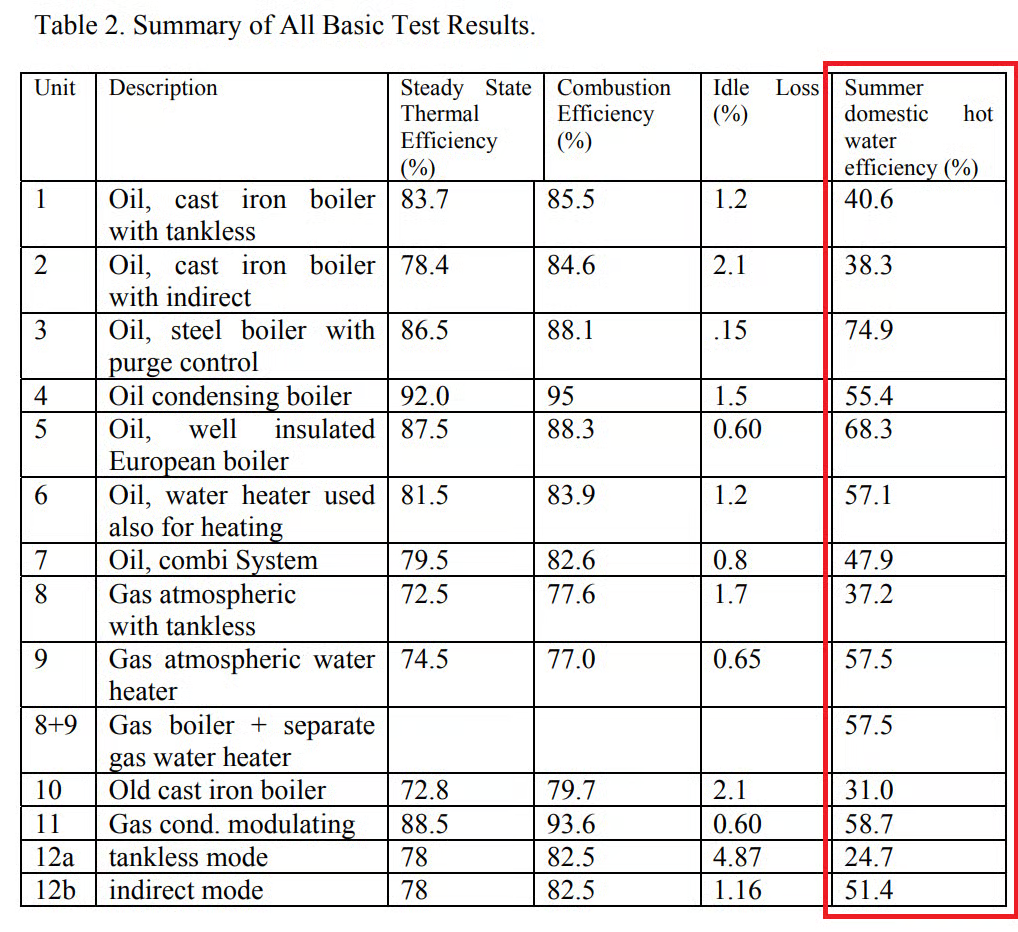
From experience, about the only efficient fuel burner DHW option is a condensing tankless water heater. ROI on an indirect vs power vented tank is never as the install cost is higher and efficiency is less.
0 -
Oh indirects definitely heat water, you won't get any complaints about that. But the cost is what I'm talking about, to install, maintain and yes, to operate the boiler all summer, heating hundreds of pounds of cast iron and water in order to heat a tank from 120 up to 140.
NJ Steam Homeowner.
See my sight glass boiler videos: https://bit.ly/3sZW1el0 -
Paul Said:
None of us have any real data.I Have offered this data more times that I can remember. I was using the manufacturer's sales pitch without verification and so one day I decided to do this non scientific test just for my own benefit, so I could talk from experience, not just what the manufacturer told me:
Since I install these 4 basic water heaters on a regular basis I thought I would do this test:
- oil fired water heater connected to a chimney.
- filled with 32 gallons of water from the city water system that has 58° inlet water temperature
- started oil burner with 0.50 GPH nozzle at 120 PSI
- Burner stopped operating after 16 minutes firing with a full tank of 120° water
- gas fired water heater connected to a chimney
- filled with 40 gallons of water @ 56° degrees
- burner was atmospheric rated at 40,000 BTU
- burner fired for 29 minutes 10 seconds with a full tank of 120° water
- Electric 40 gallon water heater
- filled with 40 gallons of 58° water from city water
- two electric elements 4500 watts. operating one at a time
- electric meter was operating at an excelerated rate for 3 hours and 57 minutes but was not operating at an accelerated rate at time 4 hours and 12 minutes, so I estimate the run time at 4 hours.
- Indirect connected to my Buderus boiler with in June (no heat zones were on)
- filled tank with 58° well water at my home 36 gallons capacity
- Riello burner operating with a .65 GPH nozzle at 140 PSI
- burner operated for 12 minutes and 36 seconds from a cold start where the boiler temperature may have been about 75° in the boiler room shed with a black roof in the summer. (your basement may be cooler)
So, putting those numbers into a BTU calculator, we find that the cost to make hot water in southern New Jersey in 1989 was roughly as follows:
The electric water heater took the longest to make a full tank and cost the most: $2.52.
The gas automatic water heater connected to a chimney was fairly fast in comparison, taking about 30 minutes, for a total cost of about $0.75.
The oil-fired boiler only made 32 gallons of hot water, but the recovery rate was about half the time, so the faster recovery would make up for the smaller amount of stored hot water. That cost about the same as gas at $0.78.
The indirect water heater used slightly more oil to make the first tank, with a cost of about $0.79.*
Now, when you leave the four tanks idle and do not use any hot water, you can determine how long it takes for the temperature to drop enough to cause the thermostat to bring the burner back on.
The gas water heater with the center flue took 3 hours and 47 minutes (which I round to 4 hours when I talked to customers). The burner then operated for 9 minutes to recover the tank before shutting off.
The oil-fired water heater with a center flue connected to a chimney took a little over 3.5 hours to do the same, and the burner operated for 5 minutes and 12 seconds to recover.
I never tested the electric heater for standby loss, but I will yield to the indirect that is not vented to a chimney and say it likely held temperature for over 12 hours but less than 16 hours, since the insulation in that tank was somewhat less than the indirect. I also do not know the exact amount of electricity it used to recover, since I did not test it. However, I believe the large cost difference between gas and oil heaters already leaves the electric heater out of the running for this comparison when it comes to lowest cost to make hot water.
I did put a timer on my indirect that is connected to my Buderus boiler, and it took 18 hours and 12 minutes before the temperature in the non-vented indirect dropped enough to call for heat. I was hoping for a longer time, but the water heater is located inside the air-conditioned home rather than in the non-air-conditioned boiler room with the dark roof.
The recovery time was only 6 minutes and 8 seconds of burner operation. After 18 hours, the boiler was back down to room temperature, so it took slightly longer to heat the indirect tank because it had to start from a cold boiler.
*However, the indirect stays off for about 18 hours, while the chimney-connected boiler needs to recover with 5 minutes and 10 seconds of burner time, on average five times during that same period. When the indirect only recovers once in that same time span, you can clearly see the savings.
Paul, I never tested a HPWH because they were not a thing in 1989, but I would like to find out how much electricity it uses from a cold start to a satisfied thermostat if you ever need to shut down and drain your heater for some reason. I could plug it into the 1989 electric prices and figure the COP in the efficiency side of the BTU calculator and if there was no resistance heater in the test or if there was a resistance heater for part of the time.
Edward Young Retired
After you make that expensive repair and you still have the same problem, What will you check next?
0 - oil fired water heater connected to a chimney.
-
Nothing is black and white in this business. A HPWH might make sense in one home where a tankless coil is the only option in another. There's more than efficiency and cost that come into play.
1 -
that’s good stuff but I think the data I was referring to was how long they last.
I can add to your data I think, especially since my water heater has an upper and lower temp reading.
Your data is also missing how much the boiler heats the house during cooling season, and I didn’t see installation cost noted (not that it could be reported here anyway)
It would be good to report the fuel usage since all fuel costs are very different today. Your electric cost looks pretty high but that is just gut feeling.
NJ Steam Homeowner.
See my sight glass boiler videos: https://bit.ly/3sZW1el0 -
The boiler doesn't affect the temperature of the house during the summer when heating the indirect. We've been over this a thousand times. The basement stays nice and cool regardless of the boiler.
1 -
@ethicalpaul dont forget to add how much your HPWH cools your basement during the winter.
0 -
You make my point for me, we don't have the data. But it doesn't cool it in a noticeable way. SuperTech says a boiler doesn't make the basement warmer and I have a hard time believing that…is it a cast iron or is it a high efficiency type? My main hate is reserved for a CI boiler driving an indirect.
My basement in the winter is already very warm 5 feet away from my boiler where my water heater is.
the amount of BTUs needed to heat domestic water just isn't very much. That's why I am nauseated when I think of heating up a 400 pound chunk of cast iron in order to heat a few gallons of water.
Eventually a couple of you guys might try a HPWH and I'll be looking forward to what you think about them in actual use.
NJ Steam Homeowner.
See my sight glass boiler videos: https://bit.ly/3sZW1el0 -
I've had a cast iron Peerless with a indirect in my basement and I now have a Energy Kinetics EK-1F and my basement stays nice and cool all summer. The boiler firing up a couple of times a day to maintain the indirect temperature doesn't affect it. Probably around half of my customers have indirect tanks and I have never noticed an uncomfortable basement in any of their homes. Maybe if the basement was tiny enough to just fit the boiler and indirect I would see it getting warm.
Even the homes with boilers with tankless coils the basement stays cool, I don't notice the heat from the boiler unless I'm standing over it and working on it.
2 -
OK, I'll withhold my concern about how much heat the boiler adds to the house during the summer (even though I do think it's still a concern). In exchange, people can stop telling me about how cold the HPWH supposedly makes my basement in the winter.
I'll stick with my concern about heating up the mass of a boiler to then heat up some gallons of water, and the expense of installing that setup.
NJ Steam Homeowner.
See my sight glass boiler videos: https://bit.ly/3sZW1el0 -
Installation costs for an electric water heater are the lowest, of course.
The installation cost of a gas water heater connected to a chimney is very competitive. There is significant competition in that segment of the trade, and it often serves as a benchmark for what a plumber might charge for the rest of their services (customer perception).
The oil-fired, chimney-vented water heater is comparable in cost to an indirect water heater. These tanks cost about the same when you include a circulator pump with the indirect. Both are significantly more expensive than the more competitive gas or electric models mentioned above — often more than double the price in some cases. That is why replacing a tankless coil with an electric unit is so appealing to customers when the indirect option is presented.
I would guess that a heat pump water heater (HPWH) is also in a comparable price range to oil-fired chimney-vented units and indirects, since there is not a highly competitive market for these unvented tanks.
Here is the problem I have with your blanket disapproval of indirect water heaters, Paul. Someone with a tankless coil may choose to install an indirect because of its longevity and lower operating costs, yet you discount that decision based solely on the fact that the oil or gas burner that heats the entire home must run to produce hot water in the summer.
This information is not helpful without understanding the rest of the heating system. If they were to choose a tankless wall-mounted water heater, the burner is large enough to heat four or five houses at 199,000 BTU, yet it only runs when hot water is being used. Therefore, the oversized burner argument does not hold water in your reply to indirect proponents. (See how I did that — “not holding water”? Haha.)
The hot water requirements of some small homes can actually demand a higher BTU output than the space-heating burner. The fuel type and installation cost are not the issue here, Paul. The real issue is that an indirect water heater is more cost-efficient than the lower-cost options in terms of the amount of hot water you get per dollar spent, and those tanks lasts significantly longer than the cheaper alternatives. The data supports this. You simply refuse to look at the numbers closely. You have simply made up your mind that an indirect water heater is a bad idea, and that is that.
Well, I might say that anyone who sticks with a steam heat “dinosaur” boiler must be out of their mind. You cannot achieve the benefits of condensing boiler efficiency with such a product. You are automatically limiting yourself to less than 86% AFUE permanently. Who would want to do that to themselves? Tear out those old radiators and replace them with a ModCon boiler paired with European panel radiators and get with the program.
That is my blanket statement about all steam systems — because they all make noise anyway. Of course that assumes that you have unlimited funds to actually purchase all those radiators and a new boiler and have an expensive plumber install it for you. And you actually know that I don't believe a word of that blanket steam boiler statement. LOL
Edward Young Retired
After you make that expensive repair and you still have the same problem, What will you check next?
1 -
You make a lot of sense, but the price of a HPWH is very easy to calculate. It's exactly as easy to install as an electric water heater (and there are 120v models that are even easier), and it's usually less expensive thanks to state and utility incentives (whether you agree with them or not, they are there, much like all the fossil fuel subsidies over the years), in addition to the lower operating cost, which I will get to you ASAP.
NJ Steam Homeowner.
See my sight glass boiler videos: https://bit.ly/3sZW1el0 -
@ethicalpaul said : “usually less expensive thanks to state and utility incentives.”
I have discovered that utility bills are divided into several different charges. In my area, the gas bill includes:
- Basic Gas Supply Service (BGSS) — this is the actual cost of the natural gas that passes through the meter.
- Delivery charges — these cover the cost of the infrastructure (pipelines), employee wages, building maintenance, advertising, and all the other overhead required to run the utility. This portion also includes a minimum monthly charge that you pay even if you use no gas at all (typically around $10 in the summer months if you only use gas for heating).
Delivery charges are usually tiered: you pay a higher rate for the first block of therms, then a lower rate for any usage above that threshold.
Here’s the key point: embedded in those delivery charges are state-mandated fees that go into special funds used for incentive and rebate programs. The gas company is not generously giving rebates out of its own pocket — those funds come directly from the fees collected from all customers on their bills.
Atlantic City Electric operates the same way. Their bill includes the cost of electricity plus a delivery charge that covers transmission lines and overhead. They also have a separate line item called the Societal Benefit Charge, which specifically funds rebate programs, low-income assistance, energy efficiency incentives, and similar initiatives.
Bottom line: You are already paying for these rebate programs, low-interest financing, and assistance for others through your monthly utility bills — whether you take advantage of the incentives or not. If you don’t use the rebates and incentives for your own project, you’re simply helping to subsidize everyone else who does. You may as well install equipment that qualifies and get some of your own money back.
In your area your utility might cover both gas and electric services like PSE&G does. if you look close into your bill, you will see that you are paying for Paul's rebate for using a HPWH. I'm sure that he appreciates it. Your welcome Paul!
Edward Young Retired
After you make that expensive repair and you still have the same problem, What will you check next?
0 -
Just to put the cold basement to bed lets do some math.
A HPWH to produce typical household hot water needs uses on average 2000BTU of heat from the space. Compared to losses in a typical basement, this is pretty much squat.
Jacket loss on a mid efficiency boiler is about 2%, so the common 200k boiler, that is 6000btu (or 3x what we need), never mind extra heat from piping.
1 -
Great discussion, all!
First, for years, DOE used 64.3 gallons per day of hot water with a 77°F rise. That's 41,350 BTU per day for hot water. A HPWH uses 1 unit of electricity and extracts heat from the space (cools the space) for the balance of hot water production. So a coefficient of performance of 2 (COP of 2 means 200% efficient) would use about 20,675 BTU of electricity and cool the space by 20,675 BTU per day. If it operated with a COP of 3, then that is about 13,800 BTU from electricity and 27,550 BTU of space cooling. Per this HPWH article, originally printed in ASHRAE last year, HPWHs need a safe space to discharge cold exhaust and they generally have insufficient access to thermal resources in the building. It highlights these results that need to be addressed in any HPWH installation:
- Inadequate heating capacity compared to advertised specifications.
- Real-world efficiency significantly lower than rated efficiency.
- Moisture-related damage and mold growth.
From the earlier post, Department of Energy Lab testing using the temperatures and volume mentioned above identified summer hot water efficiency of (sorted from best to worst efficiency):
- Low mass boiler with thermal purge (87.5 AFUE) at 74.9%
- Well insulated high mass boiler with indirect (89 AFUE) at 68.3%
- Gas modulating condensing boiler with indirect (95 AFUE) at 58.7%
- Gas fired water heater (59 EF) at 57.5%
- Cast iron two section boiler (83.5 AFUE)
- Tankless coil mode at 24.7%
- Indirect mode 51.4% efficiency
As this demonstrates, and to @ethicalpaul 's point, heating up a high mass boiler can cause substantial waste, especially in the summer. Proper insulation can play a very substantial role (see item 2 above). Low mass helps even more (heat up in 90 to 120 seconds), and thermal purge means that the heat energy is recovered instead of left in the boiler to dissipate until the next call for heat or hot water. For reference, the EK1 Frontier (see item 1 above) mentioned by @SuperTech has 2.5 gallons of water and over 90 lbs of jacketing and insulation in addition to thermal purge for heat and hot water.
The cost to heat 41,350 BTU per day for a year are:
- $508 for the low mass with thermal purge (74.9% HW efficiency, oil at $3.50/gallon)
- $552 for a HPWH (COP 2 and 200% HW efficiency, electricity at $0.25/kWh - about half the cost of straight electric), without accounting for thermal resources to recover added winter heating load or summer cooling gain. Accounting for this using oil at 85% efficiency for heat over 7 months of heating (add $130) and 2 months of cooling at 16 SEER (3.5 COP - subtract $9), that would shift from $552 to $675.
- $1202 for an electric water heater (92 EF at 92% HW efficiency, electricity at $0.25/kWh)
Roger
President
Energy Kinetics, Inc.3 -
I think COP 2 for a HPWH is quite a large understatement, but I'll see what my "heat the tank from cold" experiment results are.
NJ Steam Homeowner.
See my sight glass boiler videos: https://bit.ly/3sZW1el0 -
As the article states, the real world efficiency and recovery rates are significantly lower than shown in manufacturers ratings (the room gets colder and efficiency and recovery rates fall). A generous COP of 3 shifts the annual cost for the above examples away from electric and toward parasitic heating season load (less summer cooling gain) to $531 per year, which is more than the low mass thermal purge oilheat indirect tank solution.
President
Energy Kinetics, Inc.0 -
Not to be a broken record, but my room at least doesn't get very colder. It might be 2-3 degrees occasionally (not consistently). But I'll report back.
NJ Steam Homeowner.
See my sight glass boiler videos: https://bit.ly/3sZW1el0 -
Does that mean that your basement temperature does not transfer any of the heat in the ambient basement air to the refrigerant in the process of heating the water? Is that because you use steam to heat your home? And that steam does no use any more fuel because it is steam that is keeping the basement from loosing any temperature to the hot water in the tank?
Is there a video that we can watch that shows this phenomenon that defies the basic laws of thermodynamics?
Edward Young Retired
After you make that expensive repair and you still have the same problem, What will you check next?
0 -
I think you may need to read his comment again? pretty clear that he is not claiming to defy the laws of thermodynamics lol "It might be 2-3 degrees occasionally (not consistently). But I'll report back."
2 -
I'm saying it's so small that it doesn't matter. Don't get pedantic on me, Ed 😉
I have several times attempted to explain the following in terms of my water heater:
- There is often excess heat adjacent to my boiler
- This heat isn't completely wasted, because it does heat up the floor above it, which pleases my wife
- But a lot of the heat is wasted because there is a 50 degree or so basement wall and windows right there as well, so that heat is always getting lost
- The water heater is able to use (SOME OF) that heat sometimes before it's lost to the walls, and the BTUs it needs are rather small anyway, so the result is no noticeable refrigeration is occurring in my basement
Earlier in this thread I was told that boilers heating water in the summer don't warm houses, and I made you all a deal that I would accept that if people would stop telling me how cold my water heater makes my basement. You're breaking the deal, Ed!
NJ Steam Homeowner.
See my sight glass boiler videos: https://bit.ly/3sZW1el1 -
From here:
"Basement air temperatures elsewhere in the basement dropped by ~1°C (~1.8°F). Once each heat pump cycle was complete, the air temperatures did return to comparable temperatures to the control house basement. There was also no detectable lasting impact on foundation surface temperatures. In general the temperature changes were transient and other areas of the house were unaffected"
An that is in a house without a boiler in the basement.
@Roger They found the COP to be around 2.5. This was a decade ago, newer stuff would be closer to 3.
1 -
From the ASHRAE article, heat pump water heaters need an external thermal source - they pump heat from the home into the water, and then the home needs to be reheated. The photos show examples of substantial damage to homes from uncontrolled cold discharge air, condensation, and mold. Here is the description of the impact without heat from another source:
The best-case scenario for installation in an enclosed space would be a closet the size of an entire house. For example, a 1625 ft² room with 8’ ceilings has an air volume of 13,000 ft³. If that volume of air enters the water heater at an airflow rate of 120 cfm (typical for many HPWHs), the HPWH would extract all the available heat in less than 2 hours (assuming no new heat is added to the air). Assume the air in the room started out at the DOE test conditions of 67.5ºF and 50%RH, passed through the HPWH once, and left the evaporator coil at 45ºF and 100%RH. The HPWH would be able to extract about 6.2 kBTU of heat from the air (5.3 kBTU sensible + 0.9 kBTU latent). This is not enough heat for a single heating cycle in a typical 3 to 4-person household of this size. Furthermore, cooling indoor surfaces down near 45ºF for more than an hour, multiple times a day, carries a high risk of moisture damage and mold in most climate zones.
President
Energy Kinetics, Inc.0




Categories
- All Categories
- 87.8K THE MAIN WALL
- 3.3K A-C, Heat Pumps & Refrigeration
- 60 Biomass
- 430 Carbon Monoxide Awareness
- 133 Chimneys & Flues
- 2.2K Domestic Hot Water
- 6K Gas Heating
- 124 Geothermal
- 170 Indoor-Air Quality
- 3.9K Oil Heating
- 79 Pipe Deterioration
- 1.1K Plumbing
- 6.7K Radiant Heating
- 397 Solar
- 16.1K Strictly Steam
- 3.5K Thermostats and Controls
- 56 Water Quality
- 51 Industry Classes
- 51 Job Opportunities
- 18 Recall Announcements