Near boiler piping upgrades, recommendations

Hi guys. Hope everyone is productive and well. Curious to hear your favorite near boiler upgrades. I know at least one of you employs a stainless fitting at the Hartford connection for protection against galvanic action with a copper return. I thought that was mighty clever.
Personally, I don’t think an install is complete without a hydrolevel vxt or some way to monitor feed water…if money is not a concern for the job, how are we piping it?
THINK
Comments
-
I think a hydrolevel vxt leads to inattention to system leaks and keeps the water level at a disadvantageously low level for too much time. I greatly prefer a manual makeup water system, monitored and topped-off weekly to be able to understand and recognize water use over time so that any variation can be dealt with in a timely fashion.
NJ Steam Homeowner.
See my sight glass boiler videos: https://bit.ly/3sZW1el0 -
i would use a water meter if i really wanted to know how much water the system was using.
 1
1 -
if only the vxt measured water…
You can easily log how much you add by graduating your gauge glass, and not have a low water level half the time
I get what you’re saying, separate actual water meter
NJ Steam Homeowner.
See my sight glass boiler videos: https://bit.ly/3sZW1el0 -
Meh, not was I was hoping for…what do YOU like to do? If you’re willing to share please do!
Paul, there can be no question that would be the most effective way to monitor feed water and keep levels consistent. Nevertheless, I can’t imagine a single client of mine willing or able to do so. I certainly don’t have the time to do that for them, perhaps a few special jobs I could swing that. I’ve always had good luck with the vxt as a reasonable substitute to that extremely accurate method you prescribed.
Considering the shortcomings of the vxt, they do in fact have a crude means of measuring feed water. I missed it the first time I saw one. Look close at the face and there is a window with a digital output of feed water in gallons. Look closer and inside the control you’ll see dip switches to adjust feed delay, rate, probably other important features as well.
What am I missing?
A water meter is a fantastic way to go as well!
THINK
1 -
the vxt only measures how long it has turned the valve on, in some environments that can be somewhat close, in other environments the feed rate can vary wildly. If you have a steam boiler you should be looking at it once a week or so even if you have a probe type lwco.
1 -
never mind. Thanks anyways fellas. Have a good night
THINK
 2
2 -
JMHO but I agree with @ethicalpaul a feeder is ok……sometimes. Like anything else it has its place. But a building owner that has steam needs to know that steam is a little more of a hands-on system. Someone should be taking a peak at and around the boiler once a week and maybe more if it is cold out.
When I was a kid we had steam and it was my mother's job to check the boiler when she went downstairs to do laundry
1 -
I wish I had more clients that cared about their steam heat, especially their boiler function and water usage...but they dont. The hydrolevel is a great resource for the guy that shows up to service the boiler when the customer cant be bothered. Would a meter be better? Sure, but thats assuming someone goes down to check or feed when necessary. Most of my clients dont call until steam is blowing out of vents or they have no heat. I usually recommend manual feed, but I also ask them realistically if they will monitor or not. To be honest, most of the people I work for just dont give a **** and want a feeder so they never need to enter their mechanical room until they see water flowing out the door.
0 -
Best upgrades are a well prepped skim port and more importantly a vaporstat. Bigger main vents are always better (i cant think of a time they arent right now).
0 -
you can make the water seal for the vaporstat and the gauges out of tees and ells and nipples and plugs such that you can clean it out by just removing the plugs.
you can use a drop header although that is mostly unnecessary, it just makes it more tolerant of water quality issues unless you need it because you have limited headroom for a normal header.
 1
1 -
if one main is bigger than the other you may need to slow the main vents in the smaller main to balance the system.
0 -
They aren't better if they vent faster than the steam can move through the pipe and if they cost 3 times as much as the one that vents just as fast.
Bigger vent = bigger mass of metal to heat = ironically the bigger vent can cause a delay vs the correct size
NJ Steam Homeowner.
See my sight glass boiler videos: https://bit.ly/3sZW1el0 -
You are both right, pardon me for having a few cocktails before thinking the whole thing through. It is only an upgrade for the 90% of steam mains that are under-vented. Otherwise a detriment.
0 -
From what I can tell 304 and 316SS are just as far away from copper as steel and cast iron are on the chart, just in the opposite direction.
I'm not seeing a benefit of using stainless steel as a coupler between steel and copper?
My personal preference is I did not install a feeder on my system. I feel a boiler should at least be visited occasionally. During extreme cold I often check on mine every night. I understand that's highly unrealistic in today's world especially when dealing with customers, so I'd think a VXT is the next best thing.
Single pipe 392sqft system with an EG-40 rated for 325sqft and it's silent and balanced at all times.
0 -
the close nipple being brass or stainless is probably helpful but not for galvanic protection but because the threaded part is thinner and it will tend to rust through at the close nipple first, by making it brass or stainless it won't rust.
0 -
Or you could do as I did and make the entire thing copper, right to the header. There's nothing wrong with a copper equalizer as long as you can solder 1.5 - 2" properly.
I have a good heavy steel tee at the boiler, but then a male copper adapter into that. It may rott out eventually, but, who knows.
I do feel brass and bronze are a good compromise though, they don't seem to be as bad as copper when used with steel.
Single pipe 392sqft system with an EG-40 rated for 325sqft and it's silent and balanced at all times.
0 -
There are many different installation types to consider. A small residential boiler with an automatic feeder will probably never be visited. A multi-family one with a licensed man will be regularly checked.
Know your customers.
In general, we throw out the steel pigtails that rust closed in five years and we install electronic and float low water cutoffs in our larger boilers. The VXT is a handy package and is much better than nothing as far a alerting a customer to water usage. We put blow down valves on gauge glass sets and king valves on larger jobs or those with multiple boilers.
We also put boilers up off the floor on a concrete base of sorts and strictly use American made fittings, pipe and valves. And we wire most things in conduit.

 2
2 -
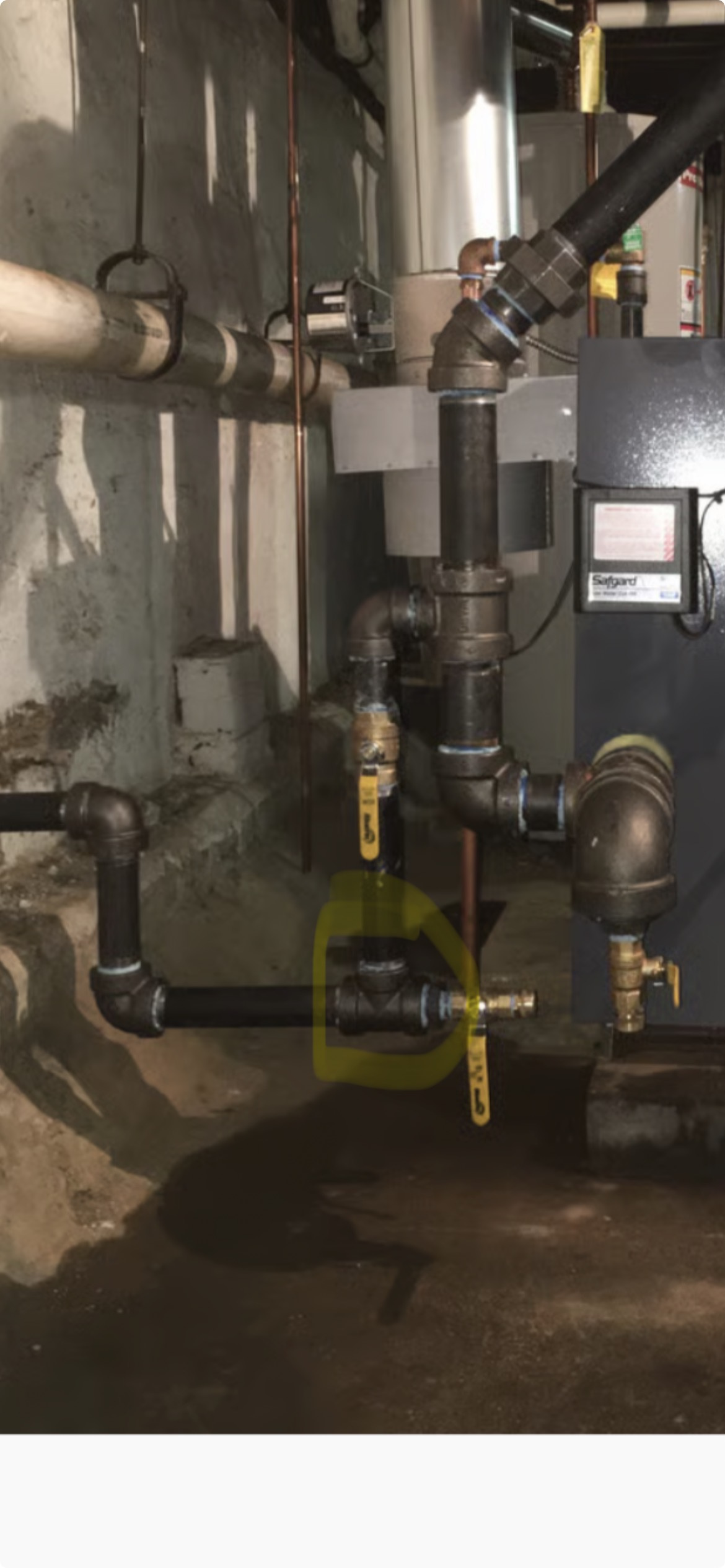
Can you please elaborate more on the stainless fitting at the Hartford connection? Would it be the highlighted tee if the return was copper?
 0
0



Categories
- All Categories
- 87.8K THE MAIN WALL
- 3.3K A-C, Heat Pumps & Refrigeration
- 60 Biomass
- 430 Carbon Monoxide Awareness
- 133 Chimneys & Flues
- 2.2K Domestic Hot Water
- 6K Gas Heating
- 124 Geothermal
- 170 Indoor-Air Quality
- 3.9K Oil Heating
- 79 Pipe Deterioration
- 1.1K Plumbing
- 6.7K Radiant Heating
- 397 Solar
- 16.1K Strictly Steam
- 3.5K Thermostats and Controls
- 56 Water Quality
- 51 Industry Classes
- 51 Job Opportunities
- 18 Recall Announcements