Is my Hartford loop piped correctly?

Hi,
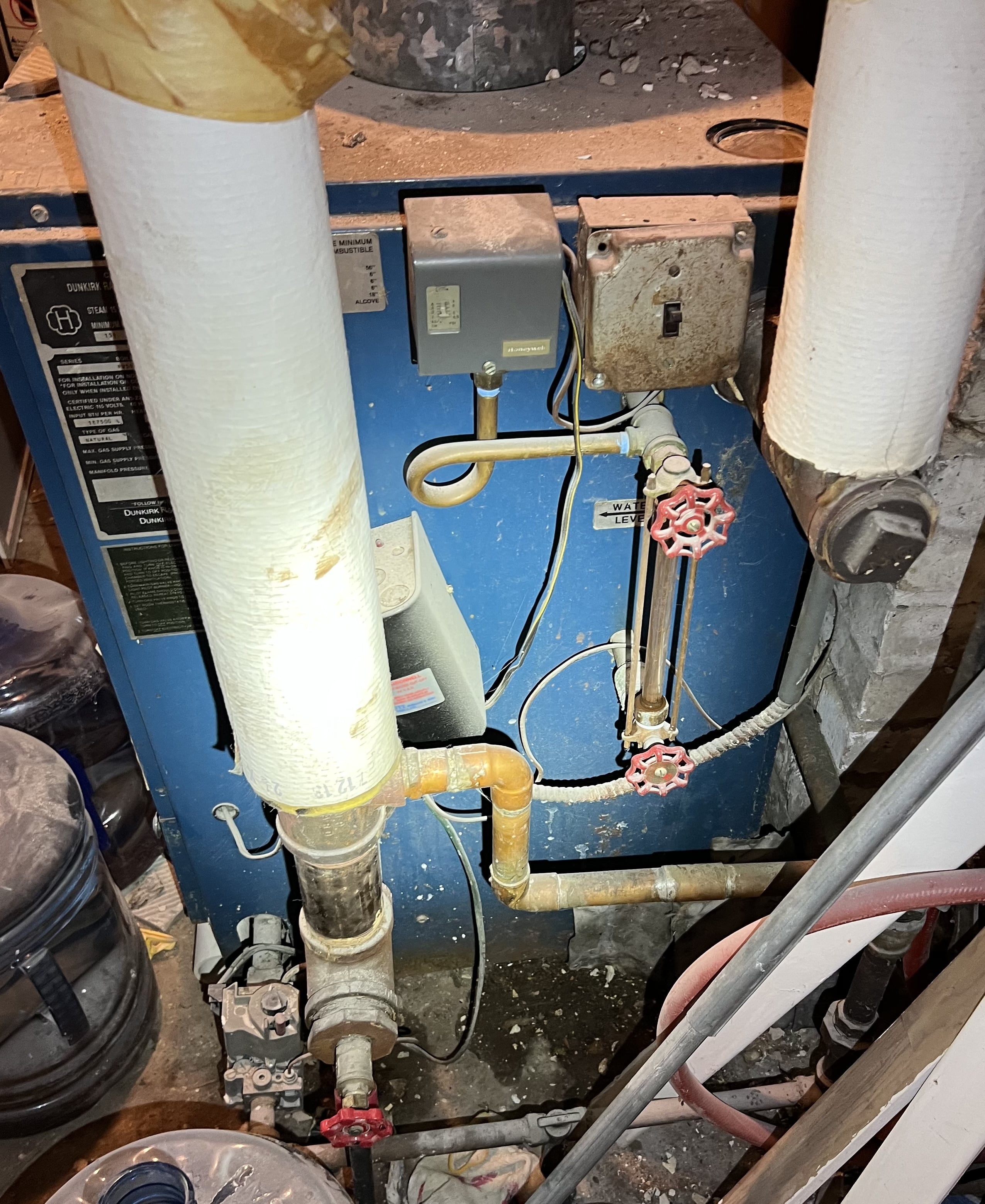
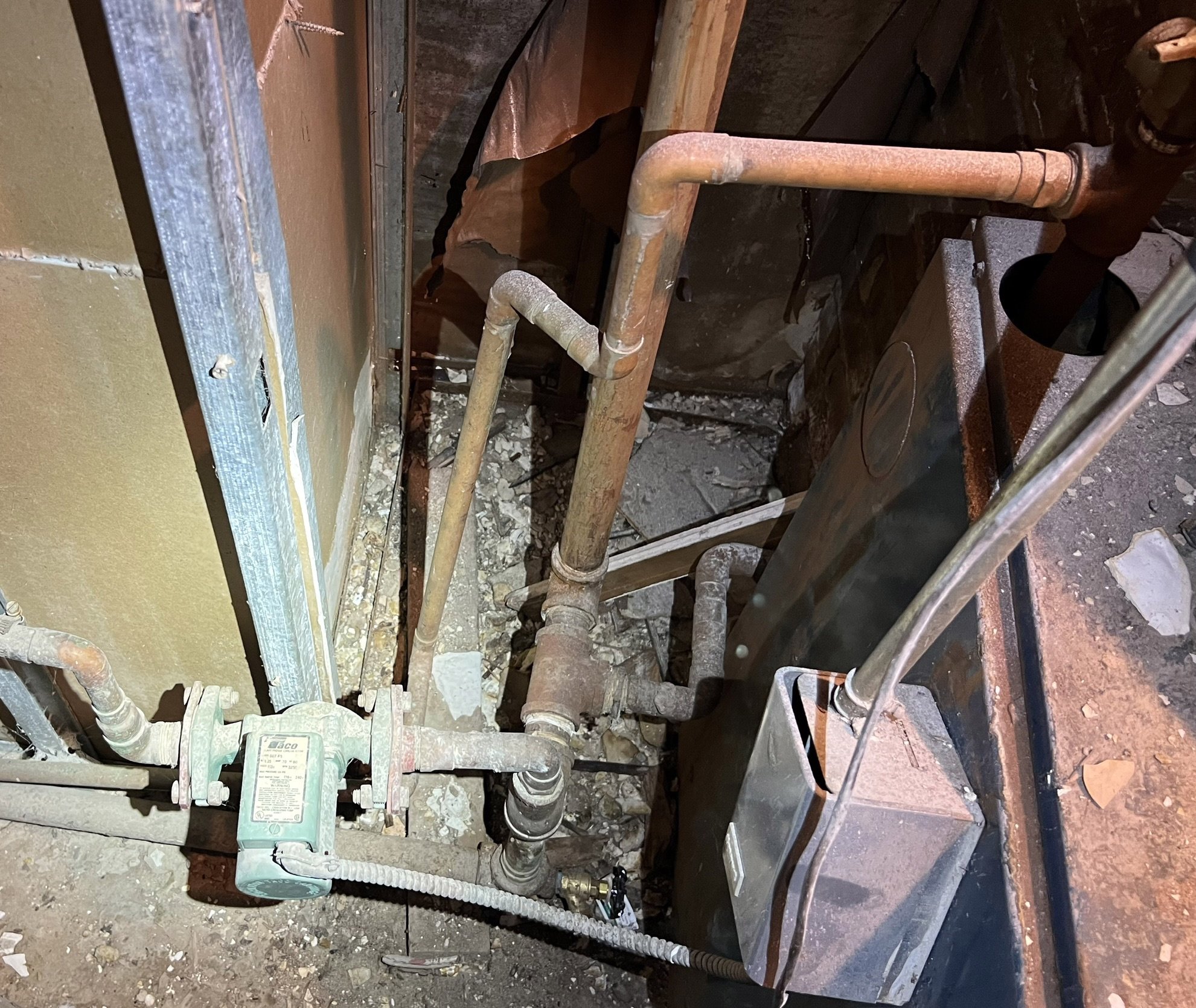
I just bought an old house. I'm wondering if my Hartford loop is piped correctly. It is currently off a 2"x2"x1" tee. I understand the nipple should be a close or shoulder nipple. Does it have to be a full 2" tee or can it be a 2"x1-1/4"? My current configuration works out to 5" center to center. Also, should the horizontal portion be located lower? Perhaps to the floor?
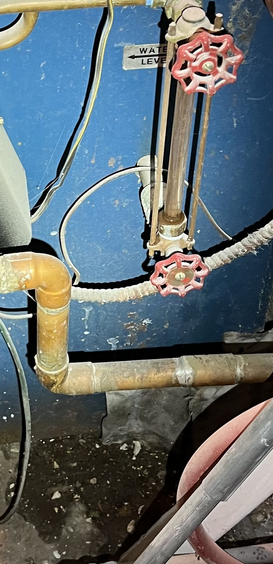
The two pictures below show both sides of the boiler. You can see the hartford loop wrap around the boiler to the other side and tie into the wet return.
I know the hot water loop for the basement zone is piped incorrectly and will address this very soon. I plan to lower the circulator pump to the floor, add a few valves, boiler drains, and swing check valves, as well as a bypass. I will circle back in a seperate thread on this as I will have a few questions on this.
Comments
-
The installer could've made the transition from copper to malleable iron somewhere other than there. He could've use a malleable iron street ell or a close nipple and an elbow. Do you have any water hammer there? The idea is really just to keep that as short as possible so that any shock wave doesn't have as long of a launch pad for acceleration before hitting the elbow, or at least that is the explanations I have read. It is basically the horizontal section where steam can be trapped between waves and implode. The longer that section the worse it is. I think that is why in some boiler mfg. diagrams they say a Wye is actually preferred.
You may already know that the height is important. Most say top of close nipple 2 to 4 in. below the normal water line although I have seen as much as 6 in. Can't tell at all how high it is with the vantage point of your photo.
Another thing I have seen is the installation of a full port ball valve in the vertical section before the water returns to the equalizer. That lets you do a "no return flush" should you ever need it. I will be putting that in when I re-do my too high Hartford Loop someday, if the boiler doesn't fail before I get to it that is. How much lower is the wet return horizontal section, below the Hartford Loop? Yes I would like to see a bit more there and that would give more room for a valve. Vantage point problems again with the photo but it doesn't even look like yours is much lower than the lowest permissible level of the boiler.
0 -
Also it seems like your boiler drain for the mud leg will leave stuff inside the boiler due to that being a concentric reducer. You could use a close nipple and another Tee with a plug for cleanout (and any future wanding) and the Tee angled down slightly to the concentric reducer and the drain valve, which should be a full port ball valve. Just a thought and the pros here may have a better idea.
0 -
There are things which might have been done differently, as @Captain Who has mentioned — but in direct answer to your question, the Hartford Lopp is OK as is.
Br. Jamie, osb
Building superintendent/caretaker, 7200 sq. ft. historic house museum with dependencies in New England 1
1 -
It works as well as any of them
NJ Steam Homeowner.
See my sight glass boiler videos: https://bit.ly/3sZW1el
 2
2 -
I love this answer.
Contact John "JohnNY" Cataneo, NYC Master Plumber, Lic 1784
Consulting & Troubleshooting
Heating in NYC or NJ.
Classes
 3
3 -
When you go after that leaking sight glass make sure you hake a replacement glass and rubber washers (with brass slip washers) on hand. The sight glass might break as you remove it. that glass tends to thin out over the years.
Bob
Smith G8-3 with EZ Gas @ 90,000 BTU, Single pipe steam
Vaporstat with a 12oz cut-out and 4oz cut-in
3PSI gauge 1
1 -
thank you all for your responses!
0


Categories
- All Categories
- 87.8K THE MAIN WALL
- 3.3K A-C, Heat Pumps & Refrigeration
- 60 Biomass
- 430 Carbon Monoxide Awareness
- 133 Chimneys & Flues
- 2.2K Domestic Hot Water
- 6K Gas Heating
- 124 Geothermal
- 170 Indoor-Air Quality
- 3.9K Oil Heating
- 79 Pipe Deterioration
- 1.1K Plumbing
- 6.7K Radiant Heating
- 397 Solar
- 16.1K Strictly Steam
- 3.5K Thermostats and Controls
- 56 Water Quality
- 51 Industry Classes
- 51 Job Opportunities
- 18 Recall Announcements