Venting an oil furnace

Hello - We own a hundred-plus year old three-family home and recently had a new oil furnace installed in the basement for the first floor. The first floor furnace has always vented into the chimney, which also vents the two gas furnaces and the three gas hot water heaters. Since the installation we have noticed an oily smell in the second (not the first!) floor. We can't figure out why this is happening and what to do about it. It was not a problem with the furnace we just replaced. Thank you.
Comments
-
As a general rule, chimney codes restrict venting appliances that use different fuel types into the same chimney liner. There are some exceptions, but they are fairly specific, and unfortunately there are also installations where the rules were simply not followed.
What you have could be one of those exceptions, or it could be a situation where the system was not installed correctly when the original furnace was put in, and the issue is only becoming apparent now that the new furnace has been installed.
Since you mentioned that you are smelling fuel-oil odors from the basement on the second floor, a couple of possibilities come to mind.
One possibility is that there is damage or a defect in the chimney tile liner around the second-floor level, allowing flue gases to leak into the house at that point.
Another, and in many cases more likely, possibility is that the second-floor furnace is pulling basement air into its return ductwork, and that air may contain oil burner fumes from the basement. If that’s happening, the furnace would then distribute those odors to the second floor through the supply ducts.
If you can, please post some photos of the new furnace, the other furnaces, and how they are vented into the chimney. It would also help to see how the ductwork and return air connections are arranged.
That will make it much easier to narrow down what’s going on.
Edward Young Retired
After you make that expensive repair and you still have the same problem, What will you check next?
 2
2 -
3 furnaces and 3 gas fired water heaters into the same flue?
0 -
And while you are at it in getting us more information, determine whether the appliances are venting into the same flue, or into the same chimney but with different flues…
Br. Jamie, osb
Building superintendent/caretaker, 7200 sq. ft. historic house museum with dependencies in New England0 -
Yep. it happens and there are instructions and charts and diagrams on how to do it:
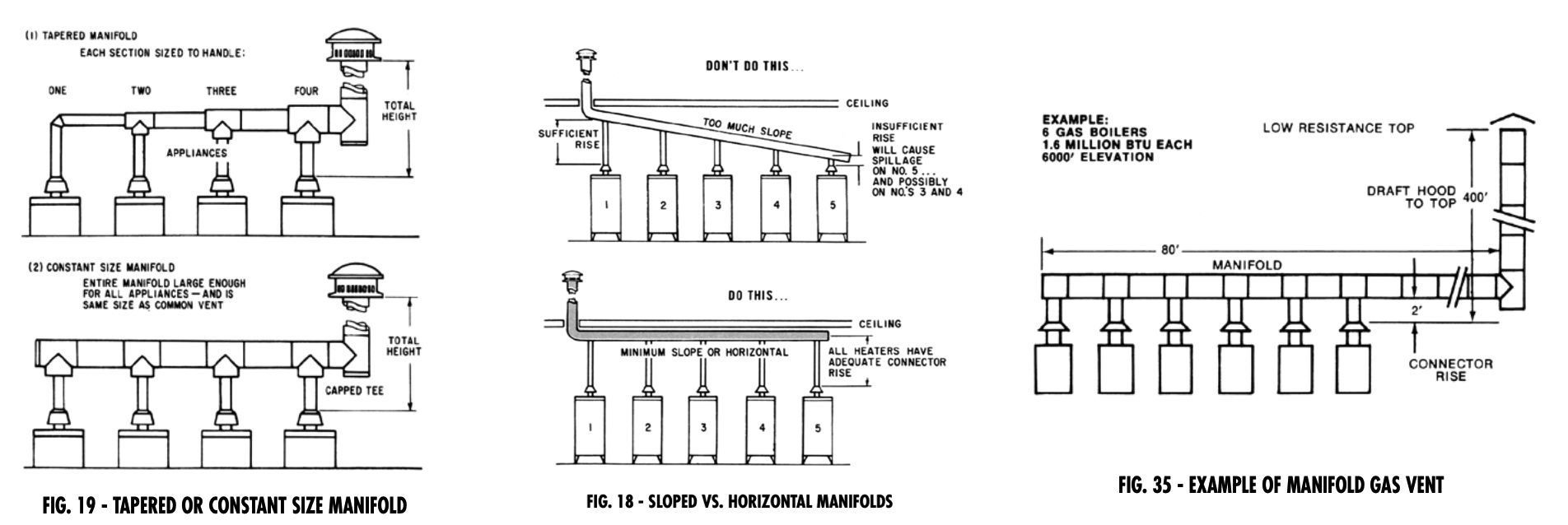
I just don't see any place that include one oil appliance with several gas appliances. That said, @pegbwhite is an example of one that does. Now what are the ways to fix this? We are waiting for more info from @pegbwhite
Edward Young Retired
After you make that expensive repair and you still have the same problem, What will you check next?
0 -
The code allows common venting of Liquid and Gaseous fuel-fired appliances… IF:
The chimney is sized for all 6 firing simultaneously.
The respective vent and chimney connectors are sized for the combination of appliances downstream or towards the chimney. For instance, let's say on one side you have one oil-fired furnace that shares a common connector before entering the chimney. Then that connector would need to be able to handle both simultaneously. However, if there is another appliance upstream, meaning away from the chimney but shares the common connector then from the furthest appliance towards the chimney the connector would have to increase. Now, the fun part is, if you look at the sizing charts in the gas code, they will place limits on connectors being either too small or too big for various combinations.
The next part of IF would be that ALL attached appliances have Primary Safety Controls. That term is up for debate. For years, it simply meant the oil burner had to have a CAD cell/ primary control, which did not do a blooming thing to ensure combustion safety or success. Now NFPA 31 calls for blocked vent switch, which is basically a high limit switch in the connector just downstream of the oil-fired appliance. The typical CAT I draft hood-equipped water heater does NOT come with a spill switch nor is there a reliable effective means of providing circumferential protection. What does work extremely reliably is to remove the draft hood and replace it with a bullhead tee to a double acting barometric damper with a spill switch at the mouth of the gate. This switch should be wired to knock out the burner or the pilot(preferred, depending upon the design.
IF,,,,, you have sufficient draft pressure.
When you have a sextopus, it may work great or it may blow back out the draft hood of an attached appliance. Having adequate vent rise helps in this regard but everything must be properly sized, and the chimney must be capable of providing the requisite draft pressure for just one appliance or all, year-round. Good luck. Again, consider indirect tanks instead of dangerous draft hood equipped WH's.
 1
1



Categories
- All Categories
- 87.8K THE MAIN WALL
- 3.3K A-C, Heat Pumps & Refrigeration
- 59 Biomass
- 430 Carbon Monoxide Awareness
- 132 Chimneys & Flues
- 2.2K Domestic Hot Water
- 6K Gas Heating
- 124 Geothermal
- 170 Indoor-Air Quality
- 3.8K Oil Heating
- 79 Pipe Deterioration
- 1.1K Plumbing
- 6.7K Radiant Heating
- 396 Solar
- 16.1K Strictly Steam
- 3.5K Thermostats and Controls
- 56 Water Quality
- 51 Industry Classes
- 51 Job Opportunities
- 18 Recall Announcements