When to let water out of boiler drain. Burnham Gas Steam

Hi, I am confused , just had new Burnham steam master max installed in 2 floor townhouse in Brooklyn. Every plumber I have talked to says ' Yea u should open the drain and drain a a gallon or two every week. maintenance, moreso if it comes out brownish to start' But on Page 3 of their manual it states DO NOT CONTINUALLY ADD FRESH WATER YOU WILL SEVERELY DAMAGE BOILER. I understand draining water means replacing water, so what is going on with this? Thanks for any help.
Comments
-
DO NOT drain any water, especially weekly.
If it was a float type LWCO, you should be dumping that weekly with the burner on, but I assume this new install has a probe type LWCO. Pictures would help us.
You may want to have the system flushed out every few years but other than that, no, no draining.
Single pipe 392sqft system with an EG-40 rated for 325sqft and it's silent and balanced at all times.
 1
1 -
Did they follow ALL the installation instructions in the manual or did they take the money and run? They should perform skimming which can take the better part of a day to do and I think it is best to run the boiler for a couple days and then do it.
 1
1 -
That instruction of draining water weekly comes from an old style LWCO control that requires that procedure. They actually have the necessary valve as part of the control.
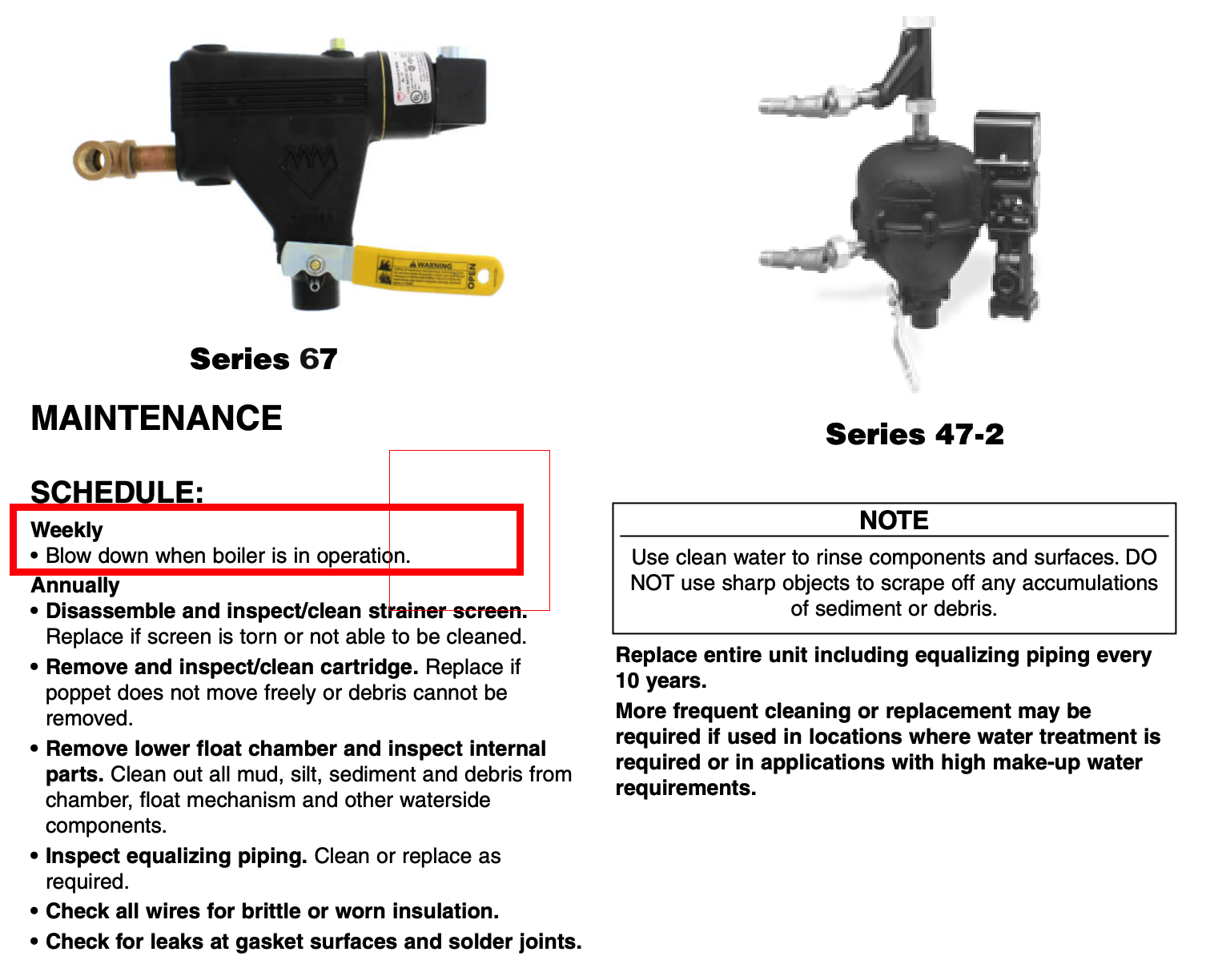
Unless you have one of the float type LWCO controls that instruction is not for you. Most new boilers are equipped with a probe type electronic LWCO control. They only require annual maintenance. Do not open any water drain valves during the heating season to let water out of the boiler unless it is required for servicing some other part of the system. You want to keep from adding fresh water on a regular basis.
That water in your boiler is actually equivalent to distilled water after several weeks of operation because it will all have been boiled off at some point to make steam then returned to the boiler as condensed water. That is the process for distilled water, boiling off the water and condensing it back into water. That way all the contaminants are left behind. That is what you don't want in your boiler or float type LWCO so you flush them out. But the new water added will contain more contaminants.
So if you don't have a float type LWCO, don’t add new water every week. Wait for the entire year of operation then you can flush out any muck that forms inside the boiler from that entire year of operation all at once. Make sense?
Hope this answers your query.
Edward Young Retired
After you make that expensive repair and you still have the same problem, What will you check next?
 1
1 -
once a month Max to check your LWCO. What company from Brooklyn said this out of curiosity cause that’s horrible advice. Even if you had an Older style 67, just enough to check proper function, not gallons. Do you have a picture of the install??
0 -
if it is a float type lwco it isn't just to test it, it is also to flush muck out of the float chamber so it doesn't end up binding up so a bit more water than what it takes to shut it down isn't a bad idea.
1 -
No I know but generally you open it 2-3x even four times testing it and you’re getting enough out to accomplish both. Certainly don’t need gallons of water, at least in my opinion. But I’d also be very shocked if he had a 67
0 -
So, I was talking to a Burnham rep that told me they have a water quality issue that the chlorides stay dissolved and get to a higher concentration because of the location of the flue. Apparently they have a tendency to rot the return nipple so draining the steam max is actually a good idea. Could have been BS but it sounded like logic unless the water was treated.
 1
1 -
The return nipple mostly sees condensate so I'm not sure how draining the boiler would assist with that. And in any case I would much rather replace a return nipple than a boiler. If I owned it I wouldn't be draining it more than once per year for no more than a gallon.
NJ Steam Homeowner.
Free NJ and remote steam advice: https://heatinghelp.com/find-a-contractor/detail/new-jersey-steam-help/
See my sight glass boiler videos: https://bit.ly/3sZW1el1 -
they don't know what they're talking about. sodium chloride gets in water supplies largely as road salt. If anything draining and adding water will allow you to put more chlorides in the boiler with the fresh water you have added while some of the chlorides in the previously added water have precipitated somewhere in the system. unless you are adding deionized water any water you add to the boiler increases the minerals in the boiler. Unless you have a float type low water cutout the only times to drain water for maintenance are to remove and clean the probe for the lwco or if you are going to flush the mud out of the returns and the boiler every couple years or so and with certain water chemistries flushing the mud doesn't need to even happen that often.
1 -
I dont remember everything he said since I usually use Weils or Uticas I didnt pay much attention, but he claimed it had something to do with the flue height relative to the steam chamber since they moved it down it lowered where the chlorides tend to build up, now below the water line which, when steam is out in the system makes a more concentrated solution left in the boiler. I dont think it makes a difference when the boiler is idle. Then again Im just telling you what the rep said, I've never even seen the new design.
0 -
I don’t think the boilers actually distill the water because probe type LWC do not work in DI or distilled water
We bought a handful if different brands and tested them with the DI water from the cart
Any sludge, sodium, dirt in the water will raise the conductivity of the water high enough for the probe to detect
Adding any fresh water brings in new minerals and O2. The steam conditioners help scavengers the O2and also help keep minerals in suspension to prevent sludge generation
Bob "hot rod" Rohr
trainer for Caleffi NA
Living the hydronic dream0 -
@4GenPlumber
Burnham has claimed for years that chlorides kill their boilers and that the redesigned Steam Max has solved that issue.
0 -
They're the only ones getting chlorides in their boiler water. If you have another brand that doesn't happen apparently.
Single pipe 392sqft system with an EG-40 rated for 325sqft and it's silent and balanced at all times.
 3
3 -
the water in the system is distilled, minus any carryover but it leaves the minerals behind in the boiler so there are plenty of ions to make it conductive there. that water diffuses through the wet returns so there are plenty of ions there too. anyplace that there is water sitting you'll get some iron ions from the piping too. the steam leaving the boiler is distilled unless there is carryover but it soon picks up ions from the piping once it becomes liquid water.
1 -
Yes, thats what the dude said. Now since it doesnt kill the boiler, it rots out the return nipple. Any boiler company that claims they solved the problem...but now there is another problem, doesnt get my patronage.
0 -
And just using distilled water totally solves the problems of chlorides and minerals, but the boiler companies don't make adding makeup water "by hand" easy and so must people don't set up their boilers to do so. And I think water feeders are a ticking time bomb with a chance of destroying your house.
Rotted return nipples? Why don't they use a SS one?
0 -
How exactly do you want boiler companies to make adding water by hand easy?
That's up to the installer and how they pipe things.
Single pipe 392sqft system with an EG-40 rated for 325sqft and it's silent and balanced at all times.
1 -
By their advice in the manual.
0 -
axiom makes a number of products that make adding water automatically from a nonpresurized source easy.
0


Categories
- All Categories
- 87.6K THE MAIN WALL
- 3.3K A-C, Heat Pumps & Refrigeration
- 59 Biomass
- 429 Carbon Monoxide Awareness
- 124 Chimneys & Flues
- 2.2K Domestic Hot Water
- 5.9K Gas Heating
- 119 Geothermal
- 168 Indoor-Air Quality
- 3.8K Oil Heating
- 78 Pipe Deterioration
- 1K Plumbing
- 6.6K Radiant Heating
- 394 Solar
- 16K Strictly Steam
- 3.5K Thermostats and Controls
- 56 Water Quality
- 51 Industry Classes
- 50 Job Opportunities
- 18 Recall Announcements