Thermostat replacement

Thinking of upgrading my really old Honeywell thermostat. Single pipe system, appears to only have 2 of the 3 wires connected at the boiler. I have yet to take the thermostat off the wall to see what it has connected. Thermostat is located on an interior wall of my first floor dining room. There no steam pipes running through that wall to effect its operation. There are 2 radiators about 8 feet away along an exterior wall, they both have MoM with #4s installed. These 2 radiators are at the opposite end of where my boiler is located in my basement.
My system doesn’t appear to have long run times and cycles more than I believe it should. Ptrol is set to .7 with the differential set to 1. Gauge is a 0-5, it’s fairly new and I checked its operation. Pigtail is completely clean. I barely get a reading above half a pound now that the weather has stabilized.
Not looking for anything more than a set and forget style thermostat. Once in a while I might drop the temp 2-3 degrees at night, but I typically set it and leave it alone. Simplicity is ideal, I don’t need to change my home’s temperature while standing in line at the supermarket. I did a search on the subject, but there’s a lot to take in. I see there are ways to change the system cycling and run times (not sure if that’s something that I even need to consider) but I’m not sure which direction I need to go towards. Any assistance is greatly appreciated.
Comments
-
What thermostat do you have?? I guess you could run into trouble with some thermostats that don't play well with steam, which has a system dependent delay to get the steam even to the supply of the radiator. I'm amazed that my White Rodgers Series 90 works as well as it does without anything more than 2 settings; fast and slow. It seems to have learned that it needs to have a certain minimum burner time.
0 -
Before we start to worry about that old Honeywell thermostat — which is likely to be far more reliable than anything you could buy today, by the way — we need to be sure what it is we are trying to do.
The first, and probably most important question, is how is the space comfort in the house? Does the temperature hold fairly constant, or does it go up and down more than you would like? If the space temperature is comfortable, changing the thermostat isn't particularly reasonable — if it aint't broke, don't fix it!
Now on cycles. You mention that the system "cycles more than it should" and has "long run times". These are actually opposite conditions. If the thermostat is what is controlling the cycles and run times, there are ways — even with that old one — to get shorter run times. There are also ways to get fewer cycles. Unhappily, you can't do both. Your house needs a certain amount of heat to stay warm. You can do this either with shorter bursts of heat more often, or longer bursts of heat less often. It's a compromise act — the idea is to get the thermostat set so that the temperature of the space holds reasonably constant, whatever combination of "how often" and "how long" that takes.
Now if it is the boiler that is cycling — the boiler turns on and off usually on pressure — while the thermostat is still calling for heat, that is a very different problem and changing the thermostat isn't going to make a difference at all.
So we sort of need to know if the boiler is turning on and off — but your comment on pressure suggests that it isn't. And, incidentally, NOT seeing pressure while the boiler is running is a good thing, provided the radiators are warm. You don't need much pressure to get nice warm heat from steam!
Br. Jamie, osb
Building superintendent/caretaker, 7200 sq. ft. historic house museum with dependencies in New England0 -
Apologies on any confusion on what I stated………to clarify:
My heat seems to be fine, the house is mostly comfortable. The pressure is typically low, so low that I don’t think the system is ever shutting off from the Ptrol registering significant pressure except when it’s really cold out. It seems to be shutting off by the thermostat. But I’m just wondering if the thermostat is cycling the system too often. The system will run, I’ll get little heat from the 2 closest radiators to the thermostat and then shut down. 5-10 minutes go by and the system cycles again.
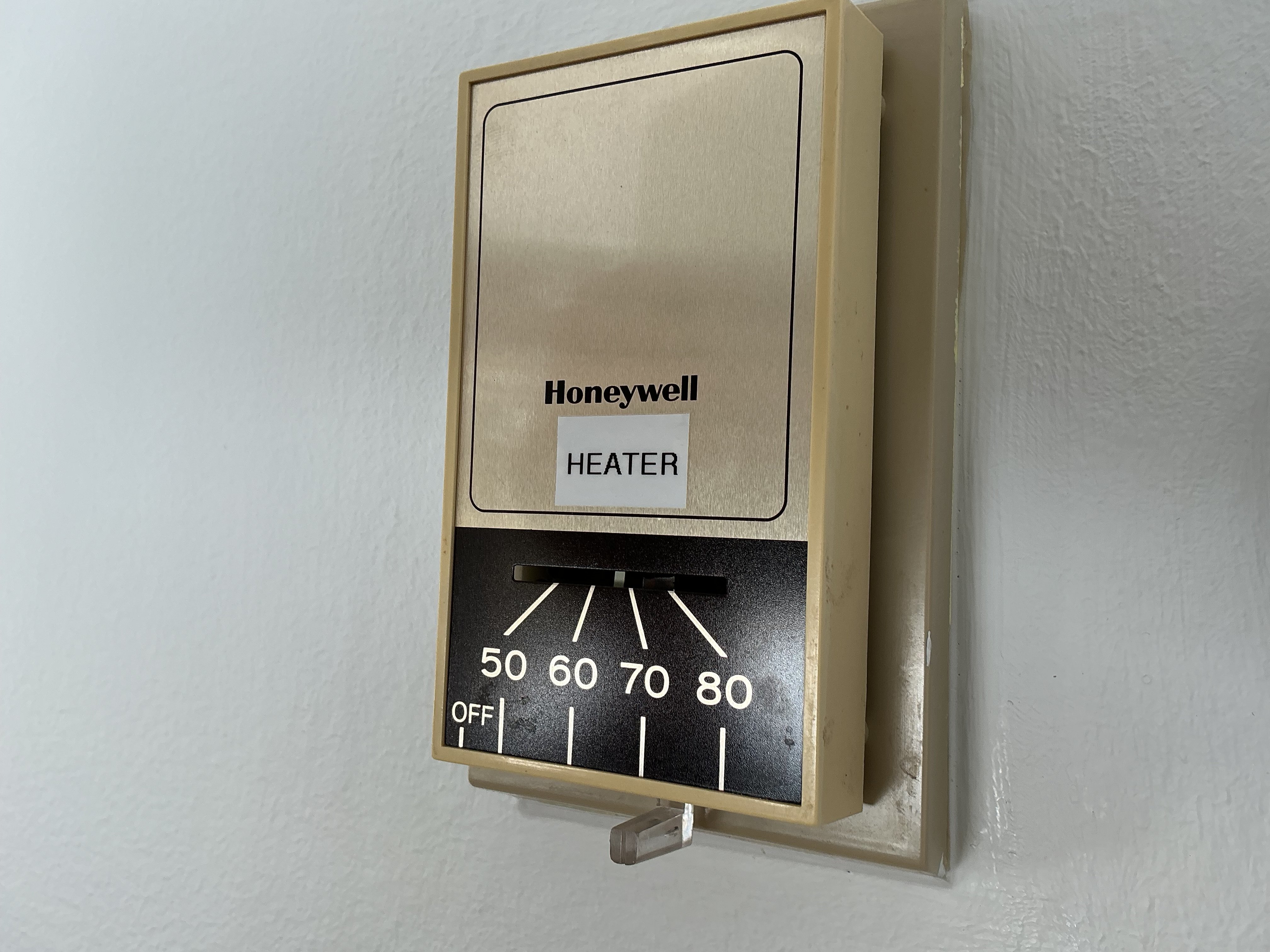
Heres what I currently have………..been here for the 25 years I’ve been in this house. Maybe I’m over reacting and everything is working fine. I just wanted to be sure the cycling of the system was ideal. From what I’ve read here, longer cycles are ideal. Maybe the cycling its running at is normal and I’m just over thinking it.
0 -
Maybe you need to take the cover off and adjust the anticipator setting. Is this a mercury thermostat? IIRC they have a variable resistor heating element near the mercury glass bulb that heats up the bimetallic coil. If that is set to a slower heating setting the burner should run longer.
0 -
0
-
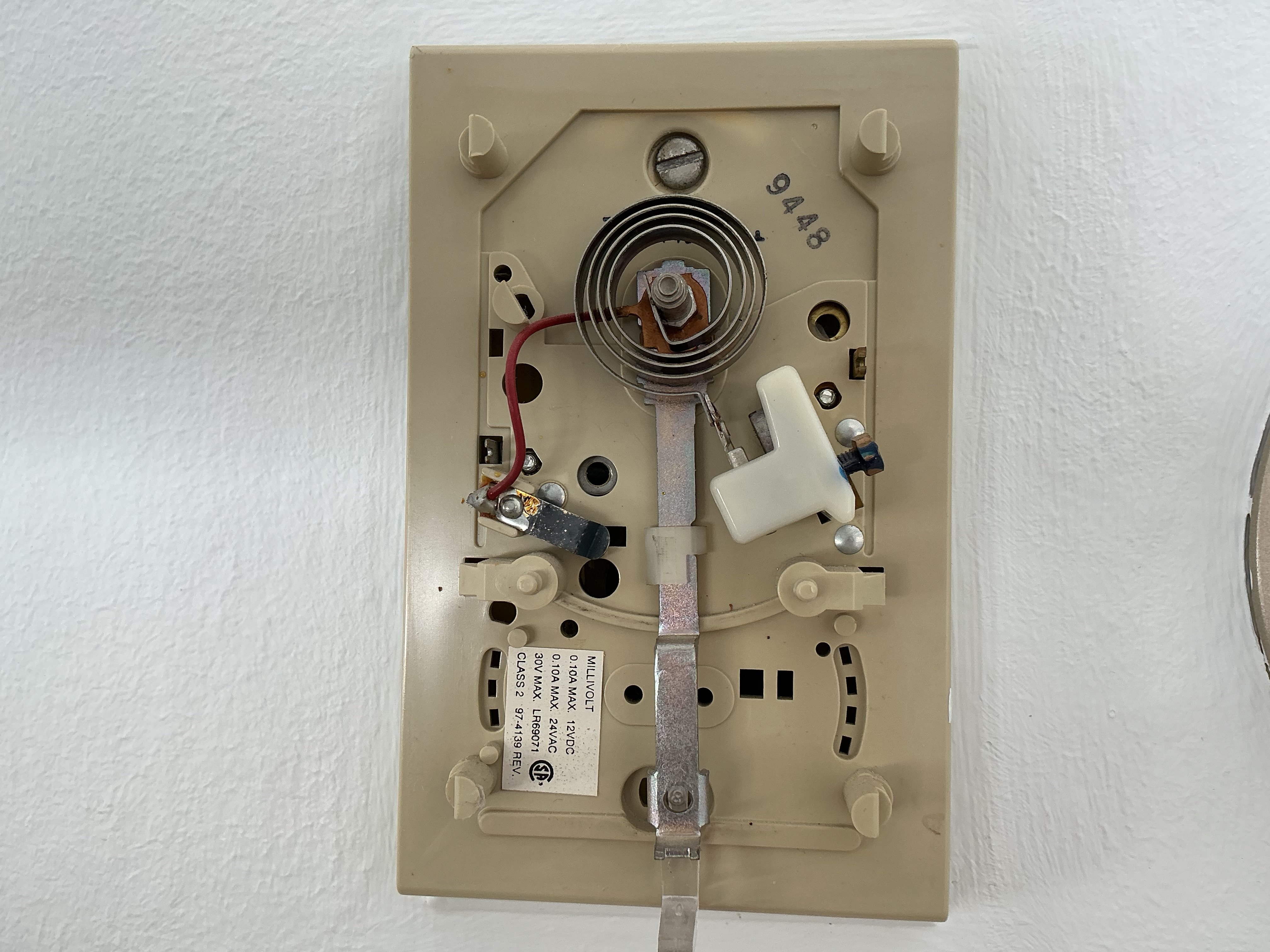
Unless I’m missing something it appears to be an on / off style thermostat. Nothing in the way of additional setting capabilities other than the temperature. Or is the screw on the white L shaped portion it……….i thought that was just a micro adjustment of the metallic spring
 0
0 -
That looks like a snap switch type with no mercury and no anticipator (or at least not an adjustable one). Typical adjustable anticipator heater would draw too much current for a "millivolt" thermostat. This one was designed to be powered by a thermopile only. Date code may be 48th week of 1994.
I think that varnished adjustment screw is just for factory calibration of the switching temperature.
Do you have a millivolt boiler or is there a 24V transformer?
You definitely need a more sophisticated thermostat.
0 -
Hmm. No, that's one of the REALLY simple thermostats! And, in my view anyway, your "on" cycles are a little short for steam — and a little frequent. Again, in my view, you might be well served to replace it with almost any one of the battery powered modern digital ones — they're available Amazon of at the Big Box home stores. It would take the same two wires, but they do need a battery (there are ones which don't — but with just two wires your life will be much simpler with a battery powered one) and is easy enough to hook up.
Something like this
would probably do just fine.
Br. Jamie, osb
Building superintendent/caretaker, 7200 sq. ft. historic house museum with dependencies in New England0 -
Jamie Hall had selected a thermostat that is compatible with a millivolt gas valve system. You should post a photo of the gas valve that operates the burner. If you have a millivolt gas valve operating your steam boiler, you have a power failure proof heating system. You do not need electricity from the grid to operate that boiler.
That said, you must replace that thermostat with one that is compatible with 750 millivolt systems. If you use a 24v. thermostat, there is a possibility that the thermostat contacts will have too much resistance to reliably make the connection on every heating cycle. That could leave you with no heat at times until you cycle the thermostat to reestablish the contacts (off then on)
If, however, you have a different system, and that is the old thermostat from a previous boiler, then that is the wrong thermostat for your system, and that may be the problem with your system cycling problems.
Edward Young Retired
After you make that expensive repair and you still have the same problem, What will you check next?
0 -
@geemalar , you say "The system will run, I’ll get little heat from the 2 closest radiators to the thermostat and then shut down. 5-10 minutes go by and the system cycles again."
If only those first two rads are getting steam, the problem isn't the thermostat. It is the steam distribution in your system.
First thing I'd check is your main vents. If they are missing or inadequate, the radiators further from the boiler will not heat well. Main vents allow the steam leaving the boiler to clear the air from the mains quickly. When the steam reaches them, they close, and now every T joint where a radiator is connected has steam in it. So the steam rises to all the radiators at the same time, and the boiler doesn't have to run as long to get heat to all the radiators. This can save quite a bit of fuel.
Take some pics of your boiler, the ends of your steam mains and one or two radiators, and post them here. Let's have a look at this.
All Steamed Up, Inc.
Towson, MD, USA
Steam, Vapor & Hot-Water Heating Specialists
Oil & Gas Burner Service
Consulting0 -
@Steamhead - I don’t think I explained it properly……what I meant was that all my radiators get heat, but these 2 being the furthest from the boiler in my dining room and they both have MoM 4s on them, I get less heat on these 2 radiators due to the distance and the small vents. I think I have all my vents set up close to what I want, as the house is comfortable throughout when the system is in full operation.
The point I was trying to make was that there doesnt seem to be a significant amount of heat in the thermostat area yet to continuously make it cycle. It’s as if it’s cycling on its own, the heat isn’t sufficient enough to trip the thermostat. But it must be the thermostat as the system hasn’t generated any pressure to trip the Ptrol.
We just had a mild day here where I live. I happened to be in my basement a half hour ago. …..the boiler had not run for at least an hour or more. The boiler came on, ran for 2 minutes, then shut off. There’s absolutely no heat from the 2 radiators close to the thermostat to affect its operation. It’s puzzling to me……..0 -
Puzzling to me, too. Where is the water level on the sight gauge?
Br. Jamie, osb
Building superintendent/caretaker, 7200 sq. ft. historic house museum with dependencies in New England0 -
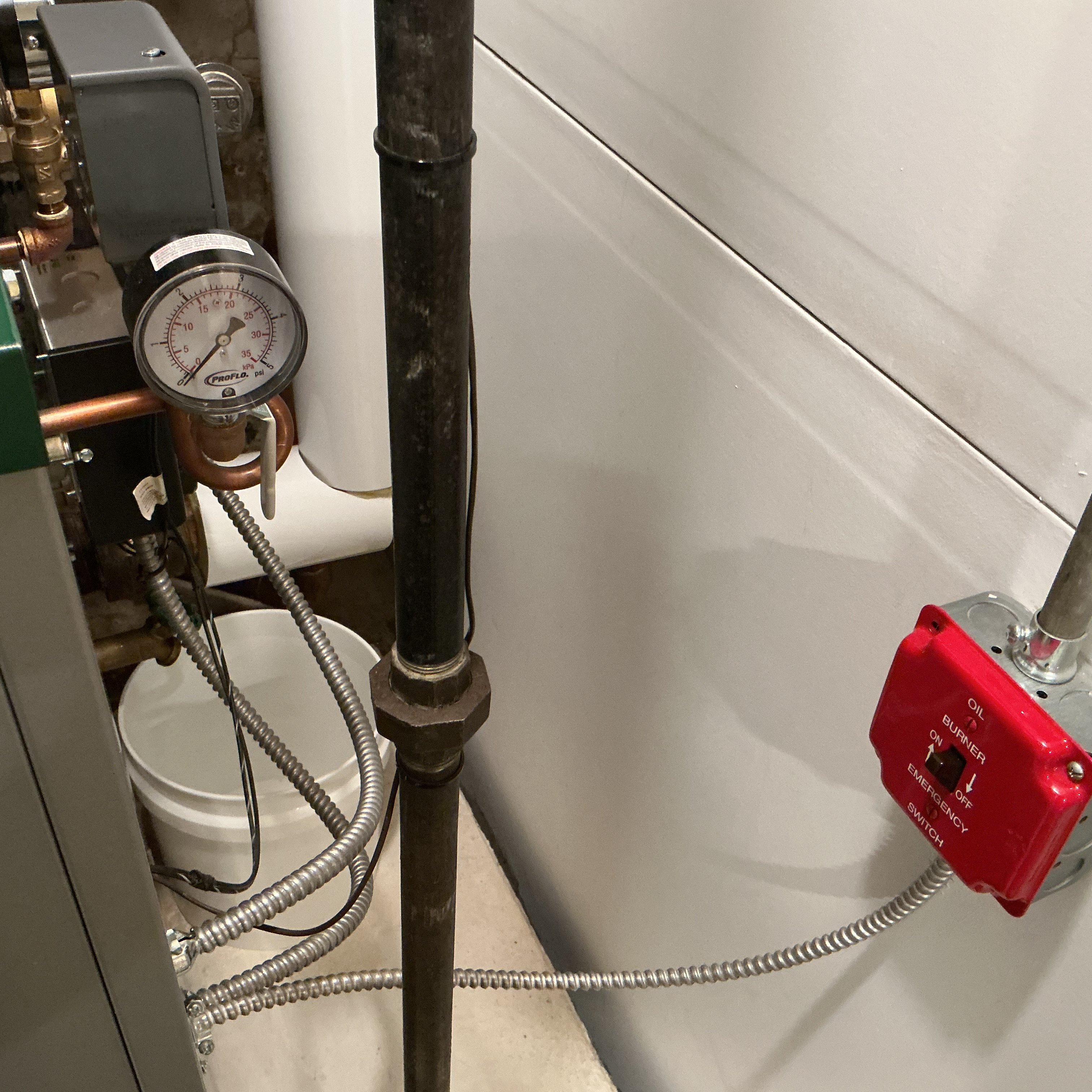
Here’s a picture of the power to the system…..if I need to take a picture of the gas valve that will have to be tomorrow.
 0
0 -
That boiler looks brand new. It couldn't be a millivolt gas valve and you have AC power to the boiler. That thermostat you have has a snap switch in it where the contacts are only rated for 100mA at 24VAC. It is probably in series with controls that are drawing far more than that, unless it is just driving a relay. If it is driving a relay that relay itself may draw more than 100mA.
We would need to see the circuit diagram.
There are so many inexpensive thermostats out there it seems like a no brainer at this point to get one and swap it in.
If you wanted to tinker in the meantime, you could remove the two wires from the thermostat and twist them together and make sure there aren't some defective controls on the boiler causing the early shutdown. Flip that boiler switch off by the boiler before doing that, twist the thermostat wires together and then go down and flip the switch back on and see what's what.
0 -
Some systems have a low water level control that periodically shuts the flame off to do an intermittent test. level check. Here's a link to some info on it. If you have something like this there is are two lights on the top. The green one comes on when the test is performed. But these devices only interrupt the flame for about 2 minutes (see the info)
0 -
@geemalar Said: "It’s as if it’s cycling on its own, the heat isn’t sufficient enough to trip the thermostat. But it must be the thermostat as the system hasn’t generated any pressure to trip the Ptrol."
With the photo of the boiler having a power switch connecting it to the 120v. house power I know exactly what your problem is.
You have the wrong thermostat. that thermostat is from the older boiler that your existing boiler replaced. You can not expect a millivolt thermostat heat anticipator to operate properly when 24 VAC is applied to that thermostat. You need a different thermostat. Just about any thermostat rated at 24 VAC will do what you need without the short cycles you are experiencing with the T822? thermostat you have now.
Replace the thermostat and set it to 1 cycle per hour and see of that solves your problem. This would be a good one to try: https://www.supplyhouse.com/Honeywell-Home-TH1100DV1000-PRO-1000-Non-Programmable-Heat-Only-Vertical-Thermostat
Or you could try the one that @Jamie Hall suggested above.
This has been a problem since the new boiler was installed, Your installer didn't do you any favor by keeping that old thermostat.
Edward Young Retired
After you make that expensive repair and you still have the same problem, What will you check next?
 1
1 -
pretty sure new peerless's usually come with a cyclegard type lwco that stops the burner every x minutes to check the water level. they can be wired 2 ways, one to start the timer when the burner starts firing, and the other is for the timer to continuously run with no information about when the burner is firing. it sounds like yours is wired to do the latter so it might get to its 10 or 15 or 20 minute count 2 minutes after the burner stared.
or it could be a millivolt thermostat with a millivolt anticipator going crazy at 24v ac as @EdTheHeaterMan said. or both.
0 -
0
-
@jamiehall - the water level is consistent, it’s just below the normal level mark. It drops slowly about a half inch or less during a full call for heat. There’s no jumping of the water level, it pulses ever so slightly when in operation.
@Edtheheaterman - Thank you for the information. I thought the thermostat was on its way out, sounds as if it was never the correct one with the current system. I’m going to order the TH1100 now, as a heat only vertical thermostat is what I am looking for.
I will report back with the results ………Thanks again all for your assistance in my questions.
 1
1


Categories
- All Categories
- 87.5K THE MAIN WALL
- 3.3K A-C, Heat Pumps & Refrigeration
- 61 Biomass
- 430 Carbon Monoxide Awareness
- 122 Chimneys & Flues
- 2.1K Domestic Hot Water
- 5.9K Gas Heating
- 118 Geothermal
- 170 Indoor-Air Quality
- 3.8K Oil Heating
- 78 Pipe Deterioration
- 1K Plumbing
- 6.6K Radiant Heating
- 395 Solar
- 15.9K Strictly Steam
- 3.5K Thermostats and Controls
- 57 Water Quality
- 51 Industry Classes
- 51 Job Opportunities
- 18 Recall Announcements