Every single vent hissing/leaking at low pressure

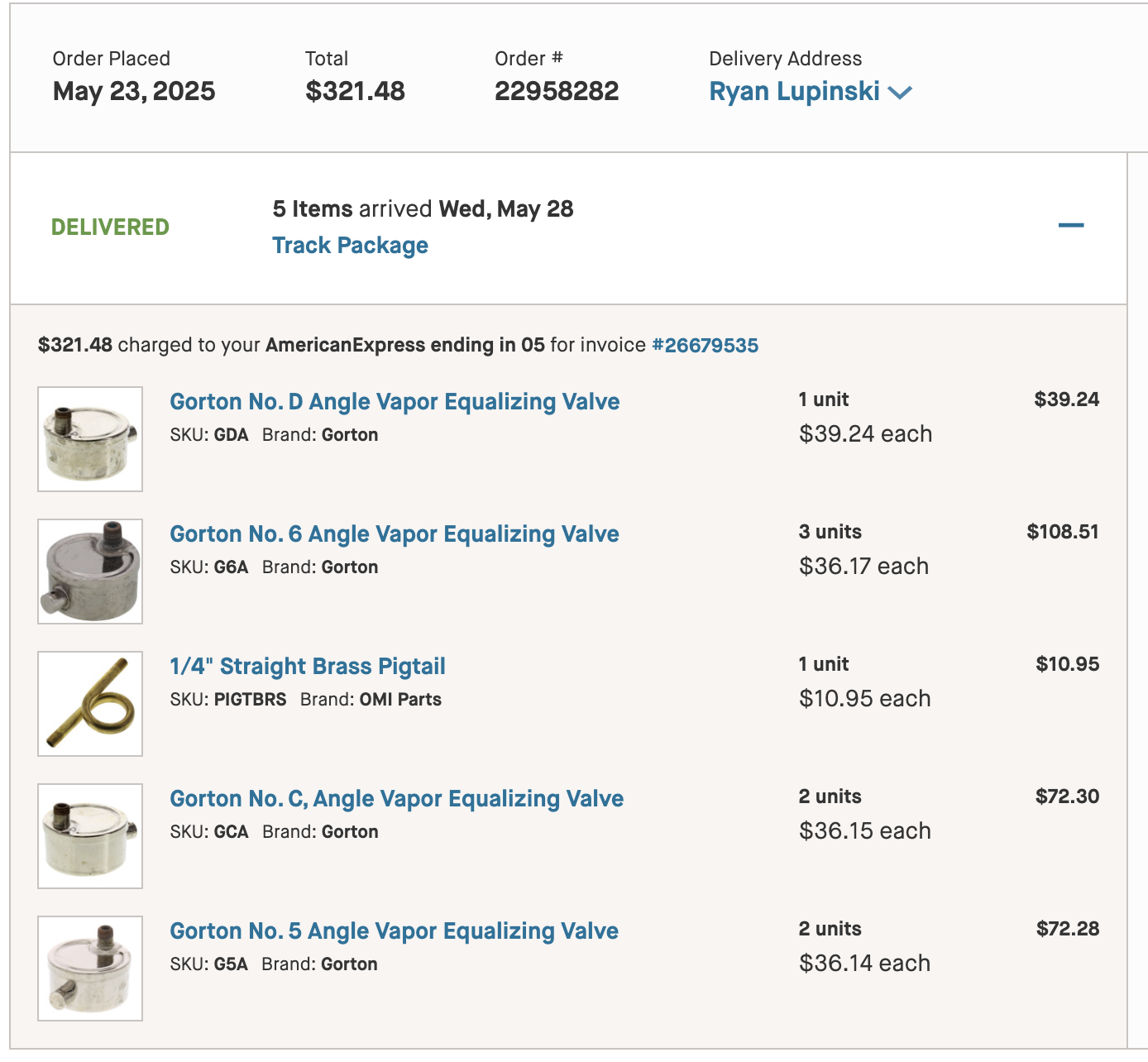
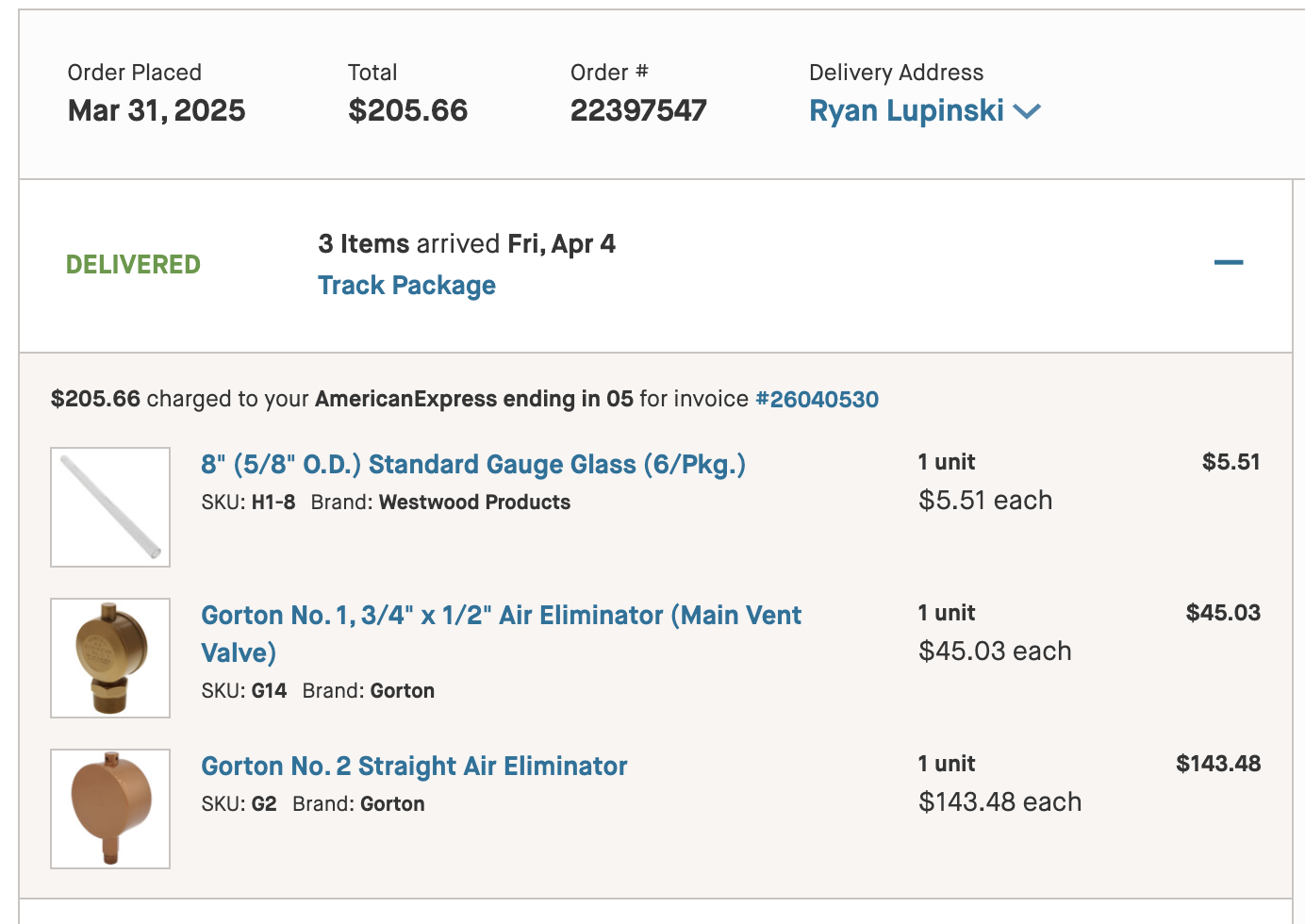
Gorton and Supply House are the biggest scams in HVAC. I bought 2 main vents and 8 radiator vents last year before the heating season. EVERY SINGLE ONE HAS FAILED AND IS LEAKING STEAM. I have to refill my boiler minimum once a week. What a complete scam.
I set the temp from 71 from 72 and notice the vent on my living room radiator is hissing so I take a video showing the inspection mirror fogging severely.
https://www.youtube.com/shorts/ghuXKxh-UxQ
I take a video of my upstairs radiator that is stone cold even though the riser feeding it is 200+ deg and the vent is panting
https://www.youtube.com/shorts/w8Y6uONdSrc
I set the temp from 72 to 74 so I can take a longer video showing the pressuretrol operating with settings of 0.5 cut in and 1.5 cut out. Every vent is leaking
https://www.youtube.com/watch?v=9LCdhGwalAM
I set the temp from 74 to 77 because the previous video shows set point being met before the pressutrol can cut out. It ends up cutting out at 2PSI and back in a 3/4PSI.
https://www.youtube.com/watch?v=JrRzmFDRnlo
Every single vent I bought from Supply House is broken and my system is completely ****.

Comments
-
That's frustrating and exasperating when you pay up for the Gortons instead of the Maid O Mists.
Just one thought about your radiator in the bathroom with the panting vent and the horizontal runout to it that is hot in the basement…….next time take the radiator cover off and feel the supply valve to see if it is hot. Check the pitch of the radiator too. There doesn't have to be very much pitch but it will help to have a small amount back towards the supply valve. Panting usually means the steam is being killed by a big puddle of water. Probably you have done so but make sure the valve is all the way open. You could check the inside if the valve by either removing the radiator or taking the bonnet off of the top of the valve. Make sure it hasn't fallen apart.
1 -
@Captain Who I double checked the pitch on every radiator in my house and shimmed them up a bit if they needed it. My last video shows that the radiator eventually heats up if I just set my thermostat to 80 and run it for about 2 hours. That's a great solution /s
This whole system is **** and I hate this **** boiler.
0 -
Sometimes the problem is hidden in the wall or floor as insufficient pitch between the valve and the riser. You may have to raise the radiator up incrementally until you fix that.
I have a problematic teeny tiny radiator up in my bathroom that last year stopped heating and I was able to get it going again by raising it up about 3/4 in. and tilting it a bit towards the wall at the top. It has a horizontal gate valve and an L shaped piping arrangement above the floor and visible in the room between the radiator and the wall and I didn't like the lack of downward pitch on the segment going into the wall. That fixed the problem. I also opened up the valve to check and saw that it was a gate type with a removable gate which I took off to give it a little bit more help and closed the valve back up sans gate.
No problems since. I know the pitch in the basement on the runout to this radiator is wacky and circuitous and excessively long with reverse pitch in one spot so it needs all the help it can get. It gets steam late because of this. I may try to fix that in the off season.
Insulation will only help the steam to win the battle against any existing puddles until you can fix them because it doesn't have to lose as much to the piping.
 1
1 -
I'm not at all sure about entering into this thread. I do not think you have a vent problem. Hissing vents are usually a pressure problem, so I suggest you start with a low pressure gauge on your boiler and verify that the pressuretrol is, in fact, opening at not more than 2 psig.
A panting vent is almost always indicative of a pool of condensate somewhere in the piping between the boiler and the vent in question. This would also keep the radiator from heating, or at best make it very slow to heat. Check the entire length of the piping from the boiler to that radiator and ensure that not only is the pitch adequate from end to end but that there are no sags.
If you can do that without attacking the manufacturer and the supply house and reply back, maybe we can continue.
Br. Jamie, osb
Building superintendent/caretaker, 7200 sq. ft. historic house museum with dependencies in New England0 -
@Jamie Hall bro are you even listening to what I am saying. I HAVE A VIDEO SHOWING THE PRESSURE GAUGE AND EVERYTHING IS LEAKING. Am I taking crazy pills? Jesus chist
If you actually read anything or watched 5 seconds of the video I show that I have already done literally everything you just said. I checked the pitch with strapping, I checked the pitch of the radiator. I can't open up the walls and I can't remove the asbestos. WHAT IN THE WORLD IS GOING ON?!
0 -
This is insane. I might need mediation from @adminstrator for how I am treated literally 3 posts into my thread. I AM DOING EVERYTHING I CAN TO POST AS MUCH INFO AS POSSIBLE AND I AM TOLD TO STFU. THIS IS WILD. WHAT IN THE WORLD IS GOING ON
0 -
You're good. Don't let it phase you.
I don't blame you for being angry. I've had good luck from Supply House for the most part. There seems to be a lot of people reporting getting vents that are bad out of the box and it isn't like the manufacturers don't make it easy with unsealed packages, for them to sell returns as new. Not making the accusation……just sayin'.
0 -
I HAVE POSTED 4 VIDEOS SHOWING THE PRESSURE GUAUGE AND THE LEAKING VENTS. IT'S NOT ROCKET SCIENCE @Jamie Hall @adminstrator
0 -
What kind of forum is this where literally everyone just plays the "well I'm a pro I've repipe over 10 tillion boilers, you're an idiot it's not the vents you idiot. Just repipe your whole house and buy $1000 worth of sensors and treatment"
I have kindly and respectfully taken every bit of advice on here and have done my best to try and implement the knowledge and suggestions and I'm hit with "You're an idiot it's not the vents". Bro I'm an aerosapce engineer I know what the **** I'm talking about.
0 -
@Captain Who @Jamie Hall is a bully and this is why it's impossible to post on this forum. @adminstrator please advise. Jame wades into the threat stating he doesn't want to enter the thread and then doesn't even read or watch my through and thoughtful videos. Absolutely wild. This forum is garbage.
0 -
test the vents. it is possible that you got a bad batch of vents but it is much more likely you have several otehr system problems.
try to blow through a cold vent, you should be able to. Rig up a piece of vinyl tubing to the vent either by shoving it over the threads or by using a hose barb adapter. Put the vent in a pan of boiling water and keep it there for a minute or 2. Try to blow through it. You shouldn't be able to.
If it passes both of these tests, it isn't the vents.
Keep the vent upright while testing.
0 -
I believe @offdutytech is in the metro detroit area.
0 -
@Day_Tripper not sure what the big deal is. If they are legitimately defective, you should be able to return them and get a refund or replacement. There is the possibility that you have wet steam. Even the best air vent, will have trouble closing properly, when the steam is wet. The extra moisture in the steam, or maybe more accurately, the moisture being carried by the steam, will prevent the element in the air vent from heating properly and shutting.
0 -
I was just going to say it could be wet steam. What Steam Doctor just said. They do have trouble staying closed with wet steam.
Put a 6 in. engineering scale on your sight glass with some electrical tape. Make a note of exactly where it is at before the boiler fires up. Watch what happens to it during a whole tstat call for heat cycle.
When mine is working properly it only goes down maybe 1/8 to 1/4 in. from the initial level in steady state operation. Anything more than that and I would strongly suspect wet steam, I mean excessively wet. I saw that yours looked pretty low but I don't think your vids made note of what the initial level was. 1/8 in. in my boiler is one pint of water and multiply that by 1,700 and you get 57 sq. ft. of steam.
You may have areas where your pipes are sagging and those will just be pools of condensate making your steam that hits your radiators very wet. The only way to check is with a short magnetic level and bite the bullet and slit and temporarily remove all the insulation in the supply mains and runouts to the radiators.
I don't know if you ever checked the height of the top of your close nipple on your Hartford Loop either. Bite the bullet and run a string around the boiler with a level and some tape and see where it comes in relative to the NWL. Keep in mind that if the water level goes down in operation you are exposing that Hartford Loop and you really don't want it to be doing that. Depends upon what height was put in at by the installer.
It is good that you don't have an auto feeder IMHO. Those things can destroy houses when they fail. The manual feed should be repiped some time in the future to come from the hot water side of the water heater, with a backflow preventer.
0 -
Deleted. I'm done.
Br. Jamie, osb
Building superintendent/caretaker, 7200 sq. ft. historic house museum with dependencies in New England0 -
You have done an excellent job relative to most posters laying out and presenting your situation and I can certainly understand your frustration after buying all those vents to see them all leaking. Vents "should" be able to handle a couple psi without failing, but, often they don't and seemingly more so with recent Hoffmans and Gortons radiator vents which were good names at one time. We have seen some failures on Gorton main vents as well but less so and usually as received and it does seem yours were working at least initially in your first video. You can try to see if Supplyhouse would replace the vents (suggest with MoM's for the radiators) but whatever you do put on there is going to need a little TLC in the system control. Early on you showed your sqft radiation vs the boiler rating and it is pertinent that you are indeed 30% oversized. The absolute sqft may seem small but it is the percentage that matters. I too have a similarly oversized boiler and the one thing I have learned is that we have to be more creative in keeping pressure down and what I mean by pressure down is nowhere near the pressuretrol cutout and really shouldn't ever be more than what you see once the boiler starts producing steam and the main vents close. Practically speaking that is less than 0.1-0.2psi. This translates into trying to keep your thermostat demands in line with not needing to fill every radiator with steam to the point that it's vent needs to close on steam. This is not easy but there are ways to succeed. Minimizing swing temperature if your thermostat has that as a setting, increasing the cycles per hour and initially eliminating setbacks. You can start experimenting with setbacks once you have reached a balance with steady state constant temperature control but you will find they need to be broken up into small increments or you will be banging off the pressuretrol cutout opening yourself up to potential problems with vents. Certainly the returns should not join above the waterline but that is more toward establishing balance than protecting your vents.
So, see what you can do about politely trying to get some compensation from Supplyhouse via new vents (no guarantees but it has been done), keep your pressure way down and next summer look at repiping those returns. Everyone here does want to help and are doing so freely on their free time and it really is quite a knowlege base. There are dozens of cases going on at the same time so a few pics or videos or comments will get missed from time to time. Have patience and play nice.
0 -
is your #pigtail clear and free breathing all the way back into the boiler?
if I see the video right, the gage and Ptrol are both after the same pigtail, maybe the boiler is at +5psi, and a patially slugged pigtail is delaying pressure reading at the Ptrol?
known to beat dead horses0 -
Wet steam definitely has less enthalpy and it can't heat the bimetallic spring in the Gorton vents as well as dry steam, even though they are both at saturation temperature. The moisture entrained only has sensible heat and can't release the latent heat of vaporization that the steam can, to heat the bimetal.
Even though I didn't see a lot of surging in your sight glass (mine gets much worse when dirty!) I wouldn't be one bit surprised if your water is dirty and/or oily. I think a drain and reverse flush of the boiler and your wet returns is in order and a refill. I'd use distilled water and Rectorseal 8-Way at maybe a light dose to start to see how your system handles it first, and to make sure you avoid alkalinity foaming. You could experiment with higher doses up to or even slightly more than the directions in the future, with pH testing.
I recommend the distilled in order to eliminate hardness as part of the problem and chlorides are bad for boilers anyways.
0 -
He has a new pigtail.
0 -
that doesn't mean the tapping in the boiler is clear or that the gauge is accurate
0 -
Maybe, but it cutout in his video about where it should according to the gage and ptrol.
0


Categories
- All Categories
- 87.5K THE MAIN WALL
- 3.3K A-C, Heat Pumps & Refrigeration
- 61 Biomass
- 430 Carbon Monoxide Awareness
- 122 Chimneys & Flues
- 2.1K Domestic Hot Water
- 5.9K Gas Heating
- 118 Geothermal
- 170 Indoor-Air Quality
- 3.8K Oil Heating
- 78 Pipe Deterioration
- 1K Plumbing
- 6.6K Radiant Heating
- 395 Solar
- 15.9K Strictly Steam
- 3.5K Thermostats and Controls
- 57 Water Quality
- 51 Industry Classes
- 51 Job Opportunities
- 18 Recall Announcements