Equalizer
Comments
-
This is a new installation.
It's still very easy for them to make it correct. Nothing has gotten hot, rusted etc, all of that will come back apart super easy. It's annoying, and a pain, but not that big of a deal. Yet.
New systems should still be installed correctly as per the manufacture's instructions.Single pipe 392sqft system with an EG-40 rated for 325sqft and it's silent and balanced at all times.
0 -
I mostly did commercial. The boiler headers were all 4" and up. 5", 6" 8" etc.
In my 46 years in the business, I have NEVER seen a boiler header pitched. Totally ridiculous. you don't pitch 8" welded pipe.
Plus pitching the header looks like crap.
I really don't know how we survived all these years with no drop headers and no pitched headers
 2
2 -
This is an unusual situation where because of that tee, the steam has to flow in two 180deg opposing directions in the same header. That cannot be good.
0 -
steam has no trouble going in 2 directions. the issue is that any water that is with that steam has no place to go but up the riser with the steam. that is why the equalizer is beyond the tee going up to the mains, any water with the steam having a higher mass than the water will tend to continue moving horizontally toward the equalizer rather than up the tee to the main with the steam. the height of the riser to the main and to the header both also help let the water fall out of the steam.
if the water quality is good it isn't likely to be a problem. while the system is forst operating and oil from the boiler and piping is causing the water to surge, it will be more tempremental until you get the oil out.
2 -
My header doesn't have the problem of the bad tee installation, but it is 2 in. when it is supposed to be 2-1/2 in., it's copper, and it's angled downward away from the equalizer. I can attest to the fact that pitch in a header matters when it is the wrong way and is undersized.
@mattmia2 I already said previously that the water will be forced up into that 2nd main. That's why I think he could pitch it downwards towards the equalizer in this situation and that might help, although I would bite the bullet and rework it so it is correct.
Of course. Yes. When water quality is good, especially right after you've flushed and filled the boiler lol, things are less likely to be a problem. The manufacturers guidelines are to provide a factor of safety of operation.
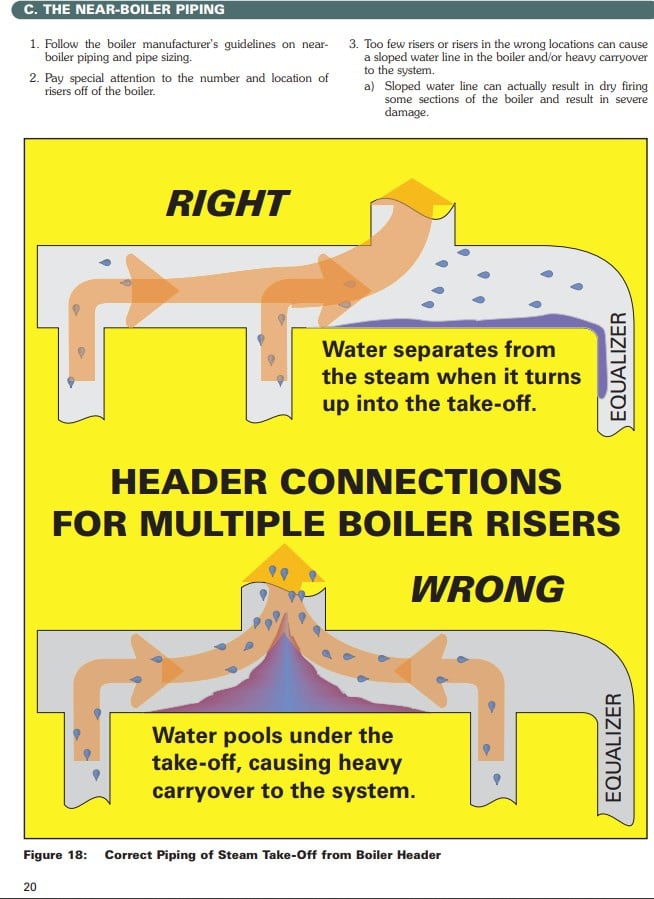
Here's what happens in one tee'd header situation. Water gets cast out and builds up at the Tee encouraging wet steam. I know the steam flow is in the opposite direction in this case, but is still not a good thing.
 0
0 -
it isn't as bad as your illustration because it still does have a path for the water to get to the equalizer. in the main between the supply risers situation the steam coming in will trap the water in the middle of the header if there is enough velocity.
0 -
Can't.
As others pointed out I forgot about WM's rule about using the supply on the same side as the controls.
You either use the control side one, or both. Though, it seems odd doesn't it? If it's pulling the water to one side, wouldn't you want the LWCO to trip early rather than late? Pulling the water towards the backside would cause the LWCO to tend to trip sooner rather than later, if anything.
Single pipe 392sqft system with an EG-40 rated for 325sqft and it's silent and balanced at all times.
 1
1 -
It's not.
But it's the truth.
Single pipe 392sqft system with an EG-40 rated for 325sqft and it's silent and balanced at all times.
0 -
This is a rule, that is worth ignoring. Doesn't make sense. And don't worry about voiding the warranty. They are never honored regardless.
 3
3 -
Eliminate surging and the whole point is irrelevant
2 -
The only thing I've been able to figure is that this rule may have something to do with slanting waterline phenomenon, where when "things go bad" you can get a severely slanting waterline. I think it tends to happen that the water will be highest where the takeoff is located when that happens. If the LWCO probe is on the other side it could get tripped. Just my 2c.
0 -
This is precisely why the rule makes no sense. In the slanted water line scenario, I would prefer my LWCO being tripped, over the right section being cracked, because the LWCO is tricked by the slanted water line.
1 -
Would it tend to happen earlier in the cycle before condensate has had a chance to return to the boiler and then settle down later in the cycle after the initial condensate load has tamed down to steady state values?
0 -
If that's an EG-30, or even an EG-40 with a single 3" supply, I highly highly doubt it could ever pull the water more towards one side.
A single 3" has a lot more surface area than a 2". More than double.
Single pipe 392sqft system with an EG-40 rated for 325sqft and it's silent and balanced at all times.
0 -
I'm not arguing but in my Peerless 63-04L, the "Lowest Permissible Water Level" is actually a hair below the sight glass, which is about 2 in. below the level that trips the LWCO. I have never been able to make sense of that really.
0 -
Because they want to shut down the boiler before it gets to the lowest permissible level, not after.
This is precisely why the rule makes no sense. In the slanted water line scenario, I would prefer my LWCO being tripped, over the right section being cracked, because the LWCO is tricked by the slanted water line.
Well someone dead must have come up with it, and there's no sense questioning it, I have been told.
NJ Steam Homeowner.
Free NJ and remote steam advice: https://heatinghelp.com/find-a-contractor/detail/new-jersey-steam-help/
See my sight glass boiler videos: https://bit.ly/3sZW1el0 -
Depends what style system it is. Counterflow mains pitch up away from boiler (highset point at end). Parallel flow mains pitch down away from boiler (highest point at boiler)
0 -
Yes of course. I was referring more to the fact that you can't even see that on the sight glass because it is too short.
I recall you telling us that the waterline never slants though.
0 -
Never took a close look at this. But where is the bottom of the glass, relative to the bottom of the boiler? The glass placement in various boilers is not necessarily the same. We don't really care less about the bottom of the glass. We care about the bottom of the boiler
0 -
I'm curious. Even though Paul doesn't believe that a tilting waterline will ever occur, what would you expect a properly piped boiler to have as a maximum tilt from one side to the other, when certain conditions like water quality are allowed to get bad through neglect, and maybe some other things that could go wrong that I'm not thinking of at the moment? How much? Maybe something like 2 in., or would that even be too much?
I'm not sure what the answer to your question is but I would guess it has to be more than the distance from that "LPWL" mark to the bottom of the lowest tapping. I'll try to check it next time I am down there.
0 -
The tilting waterline would only happen in really extreme circumstances. Severely under piped, maybe together with really horrible water conditions.
1 -
If it is piped half decent you won't get a slanted water line. i remember a guy I knew that had a problem with a HB Smith commercial boiler. He ended up piping an additional sight glass on the back of the boiler temporally so he could see how the water line differed from the front and it did.
The reason was strange as the boiler was piped the way it should be.
He was in effect overfiring the boiler.
But the burner input was correct.
How can that be?
Because the boiler was rated for 160 degree condensate and his condensate was coming back at 180. So BTUs are BTUs.
If the condensate is hot you are effectively overing the boiler. At least that is what HB Smith told him
 1
1


Categories
- All Categories
- 87.5K THE MAIN WALL
- 3.3K A-C, Heat Pumps & Refrigeration
- 59 Biomass
- 429 Carbon Monoxide Awareness
- 124 Chimneys & Flues
- 2.2K Domestic Hot Water
- 5.9K Gas Heating
- 119 Geothermal
- 168 Indoor-Air Quality
- 3.8K Oil Heating
- 78 Pipe Deterioration
- 1K Plumbing
- 6.6K Radiant Heating
- 394 Solar
- 15.9K Strictly Steam
- 3.5K Thermostats and Controls
- 56 Water Quality
- 50 Industry Classes
- 50 Job Opportunities
- 18 Recall Announcements