At last! Or... not quite!
Comments
-
My wife was venting to me a few weeks ago that I spent more time with our boiler than with her. My reply; But you are warm right??? Good thing I bought a comfortable sofa! ;)
 1
1 -
Your story is really interesting @BobC and I'm glad you had the good sense not to flood water into a red-hot boiler. I suspect this is in fact what caused a good number of boiler explosions back in the day (and could still do so today in the case of a LWCO failure). In fact one of my "clients" called me with a case of a failed boiler that had resulted in that same "hot" smell that someone noticed—and we see a few people writing into this forum with similar situations. They all have Hartford Loops, and yet still their boilers dry-fired. No one ever seems to notice except for me. I try my very best to let it go, but sometimes I have trouble.
I never did see how just dry firing (without the introduction of water) could cause an explosion. A fire, possibly, but how does a dry firing boiler explode unless someone throws the makeup water valve open in a panic? And this is why I remain quite skeptical that it was the Hartford Loop that made some kind of dramatic reduction in boiler explosions. I just can't connect the dots. I have never heard anyone say they could connect the dots either, they just seem to take it as gospel that the Hartford Loop was the salvation of the problem.
You mentioned the Delco boiler didn't have a Hartford Loop. Would you see a different result in your story if it did have a Hartford Loop?
NJ Steam Homeowner.
See my sight glass boiler videos: https://bit.ly/3sZW1el 1
1 -
If you had an oil fired boiler correctly sized you could install it with no LWCO, no Hartford, no pressure control and no burner primary control and no safety valve.
If nothing ever goes wrong it might run 100 years without an issue.
I have see steam boilers converted from coal that never had a lwco (don't know when they became mandatory)
I have also heard of a "technician" that removed an oil primary and ran the burner with no safety and nothing happened until another tech found it that way and corrected it. It ran that way for a year.
If the boiler is correctly sized you shouldn't need a pressure control either as it shouldn't build pressure so why need a safety valve?
But things do go wrong. Coal fired boilers had no LWCO or pressure control or thermostat or burner safety control. All they had was a safety valve and maybe a Hartford loop.
Many steam boiler don't have and don't need a Hartford loop if they have a boiler feed tank they are not required.
The most important reason for the equalizer and HL is to drain the header.
0 -
It's a shame steam heating systems haven't really been looked at or improved in what………80 years?
It sure would be nice to see some new boiler designs, new controls etc.
Wifi linked radiator vents etc. Improved vent quality………Single pipe 392sqft system with an EG-40 rated for 325sqft and it's silent and balanced at all times.
 1
1 -
Not enough market share. Those of us in the NE in boiler country (or what's left of it) don't realize that most of the country is gas warm air or heat pumps. The steam boiler market is a replacement market unless its process steam or high pressure etc. Residential steam is a fraction of the market that drops every year as systems get scrapped for warm air or heat pumps or converted to HW. Look at the boiler mfgs for residential steam:
HB Smith…gone
Slant Finn…gone
That leaves
Utica Dunkirk
Burnham and clones Force, Crown etc
Weil McLain/Williamson
Peerless even they are slipping into the Burnham thing.
 1
1 -
That is the reason there is less innovation on steam boilers, oil burners and coal shovels. Less and less people are using them.
But if you want to get in on a real moneymaker…. I have this idea for a shoelace tip restoring machine. Don't you hate it when you have a shoelace that the tip falls off of? You can never get it to go through the lace hole in the wingtip shoes everybody was wearing in the 1950s. With a shoelace tip restoring machine in your very own home, you don't need to stop at Walmart on your way to the sock-hop dance to pick up a new set of shoelaces. Just pull out your tip restoring machine and your laces will work just like new ones. Everyone will want more than one in their home
I think this will take off and be a real hot item next Christmas. The gift for the man that has everything. I'm looking for investors, any takers?
Edward Young Retired
After you make that expensive repair and you still have the same problem, What will you check next?


 3
3 -
I don't buy shoelaces any more, I use 550 Paracord instead.
National - U.S. Gas Boiler 45+ Years Old
Steam 300 SQ. FT. - EDR 347
One Pipe System1 -
My laces break before the tips come off.
This reminded me of an old story. My boss at the oil company was loaded with $$$ but was cheap. I guess that why he was loaded.
We had a guy working there as an oil tech. He wasn't the best. There were 3 of us there at the time I was the oldest at 23 and the other two were 3 years younger. We all started at like $2.25/hour.
Because this guy wasn't so hot he hadn't had a raise in a while. One day he was walking past the owner's office to the shop out back.
Later the owner came to me and said "He has his work shoes taped together with duct tape, I guess I better give him a raise".
0 -
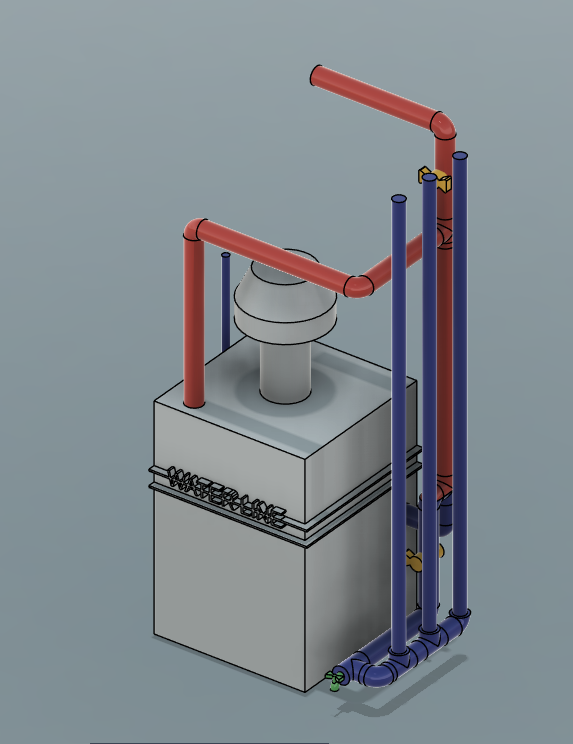
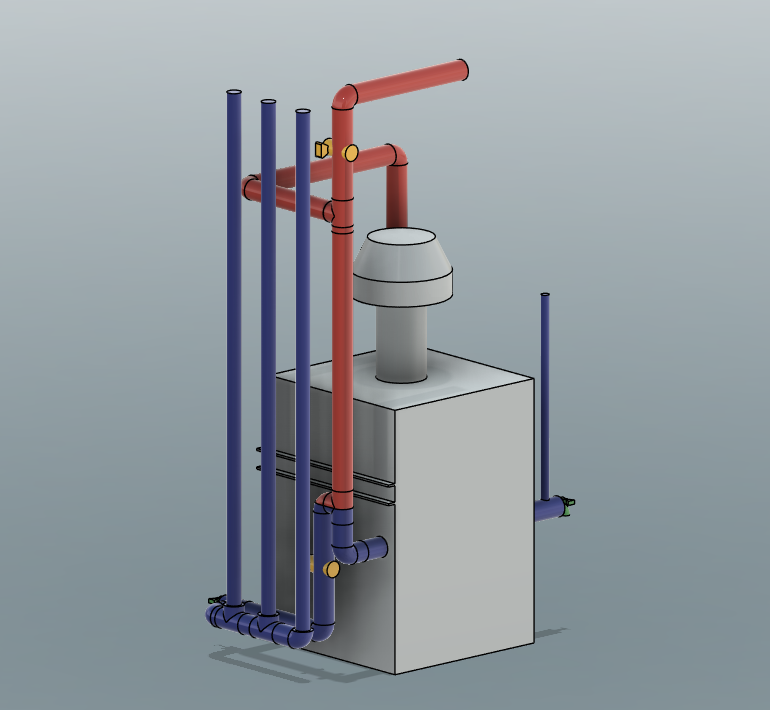
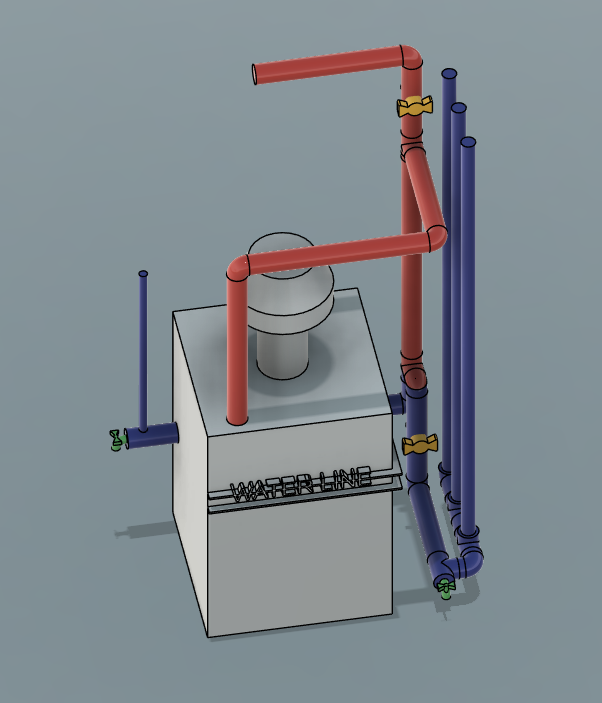
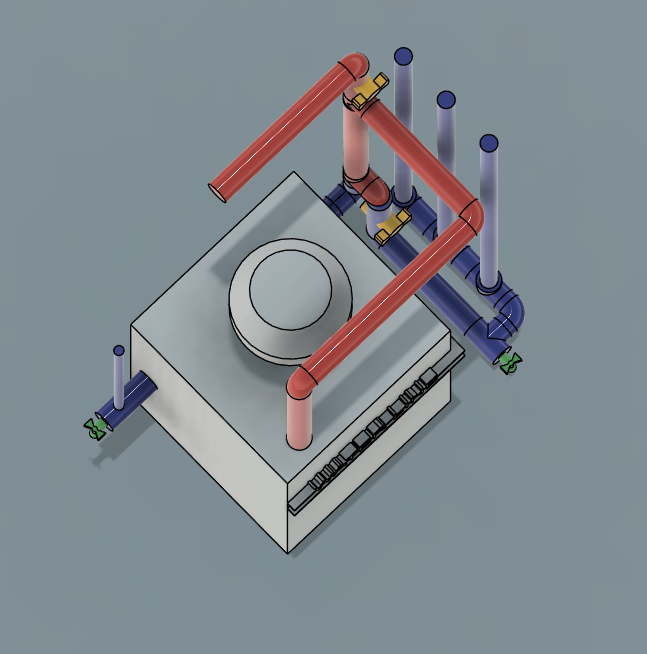
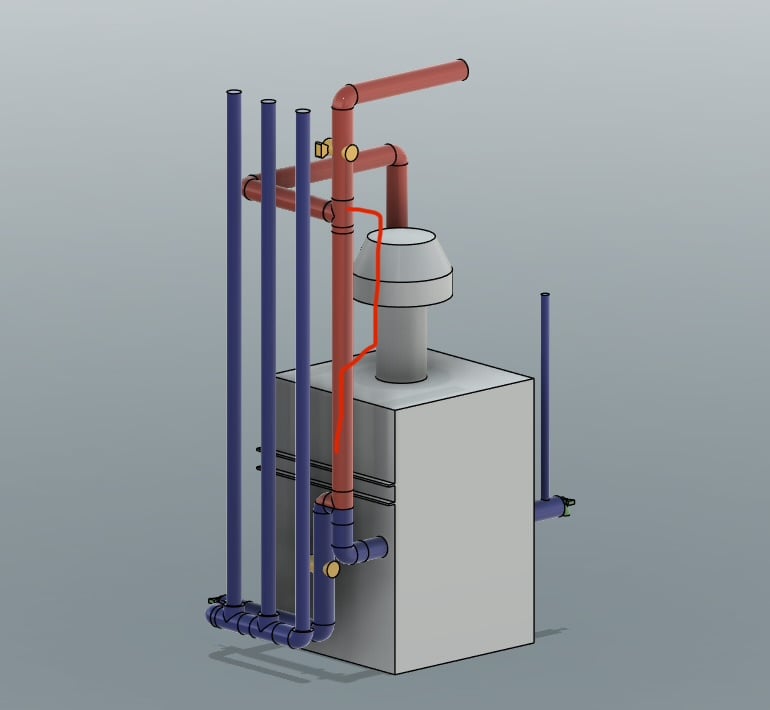
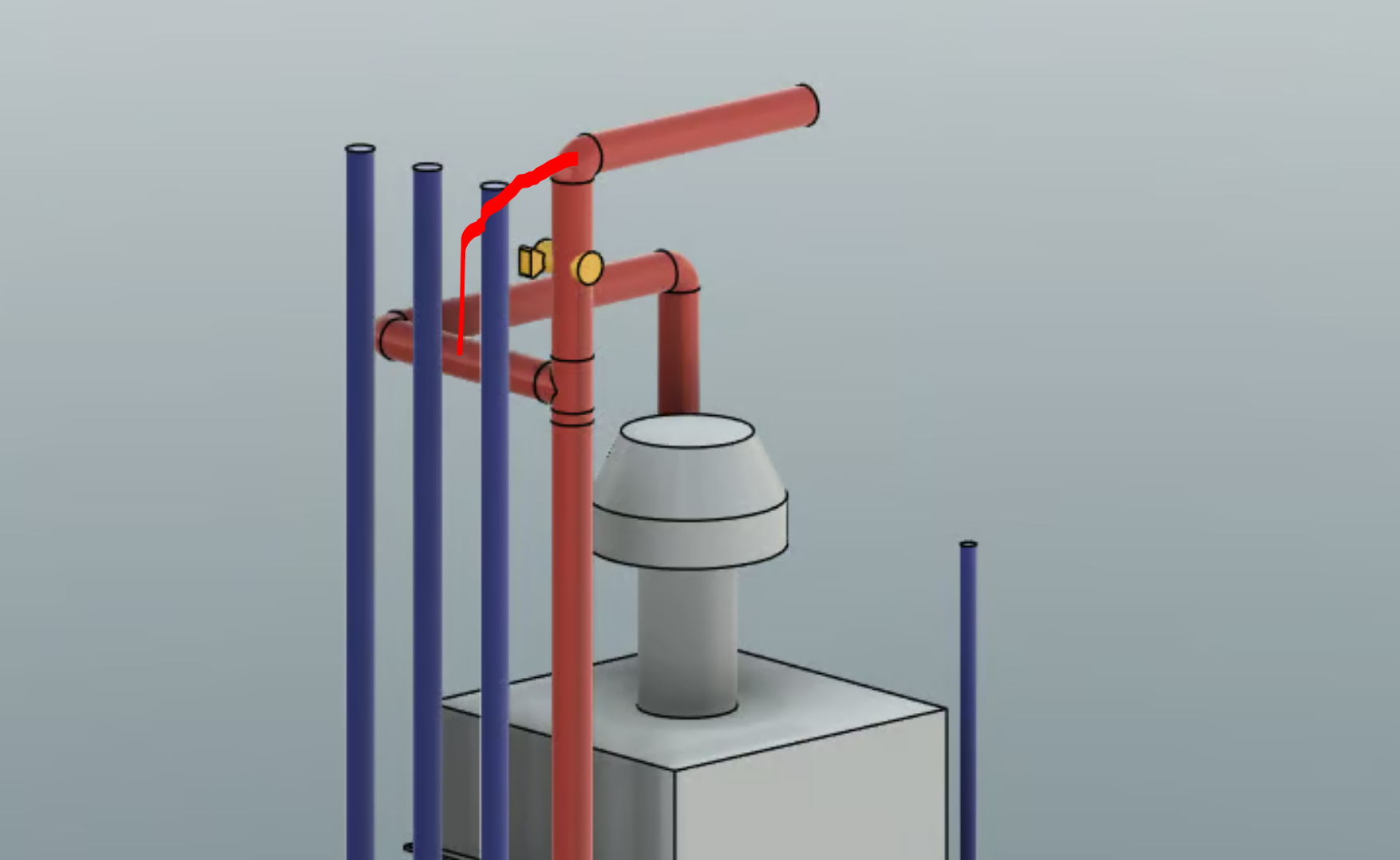
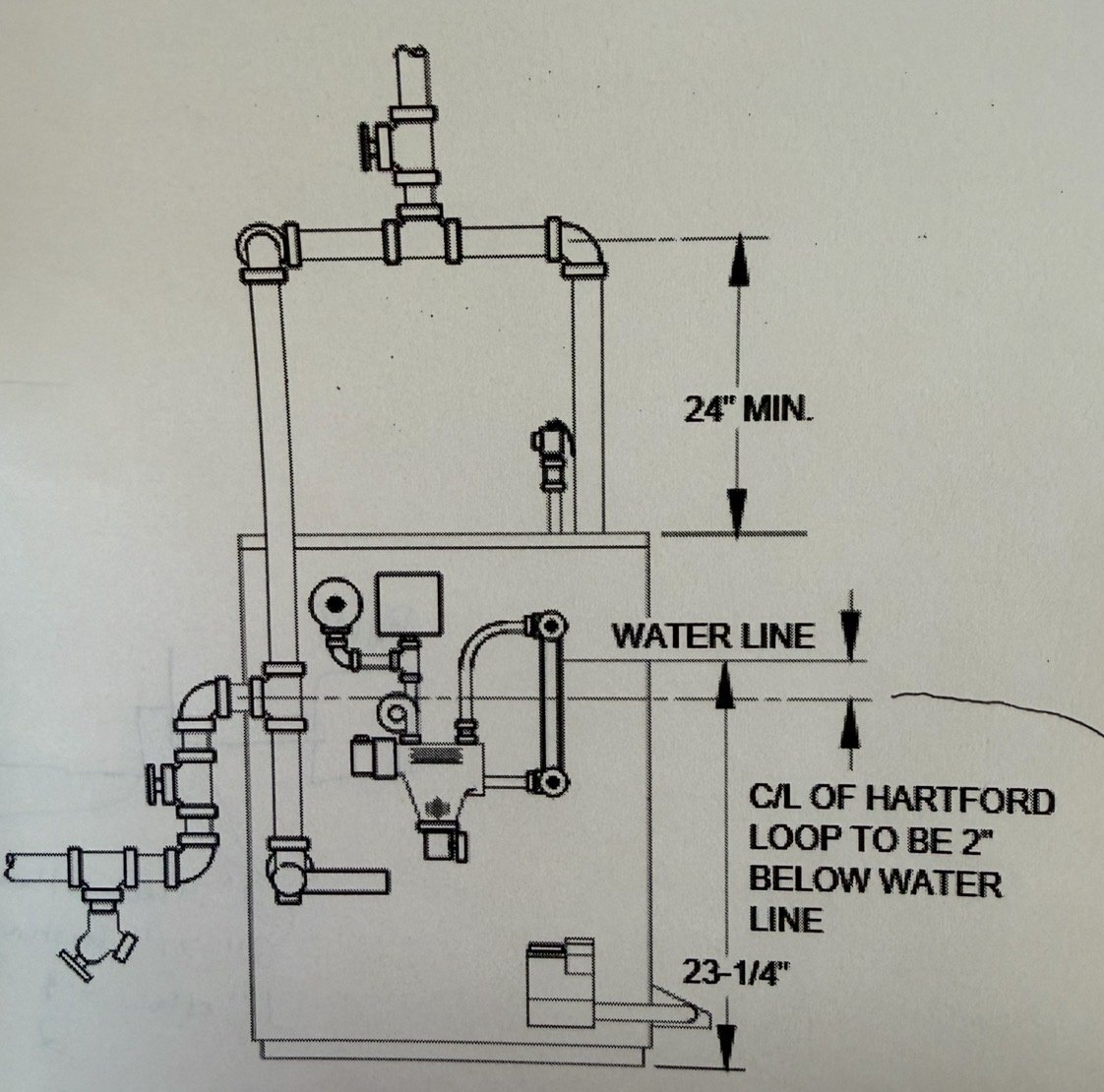
The technician and I teamed up to do a CAD of the next pipe rework. Thoughts?
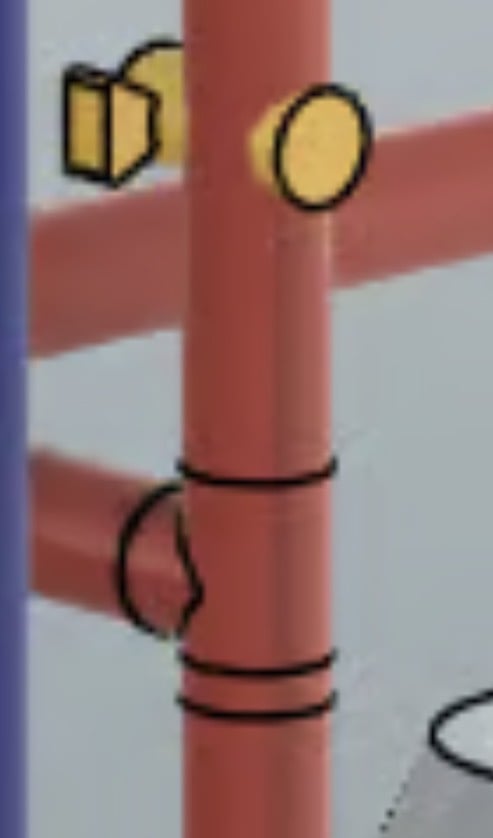
Any issue with the tee in the equalizer pipe vertical position?:
 0
0 -
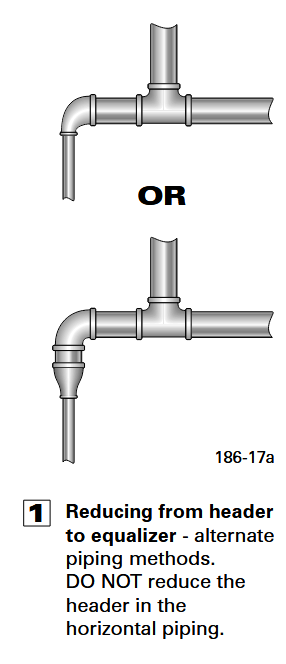
the header isn't right, the main should connect to a horizontal tee in the header then the end of the header should turn down to the equalizer. the horizontal tee where the main connects encourages any water to continue on to the equalizer. what you have now forces the water to turn when it hits the tee and it will tend to divide between the steam traveling up and gravity pulling it down to the equalizer.
0 -
I see a Sharktank appearance in your near future…
 2
2 -
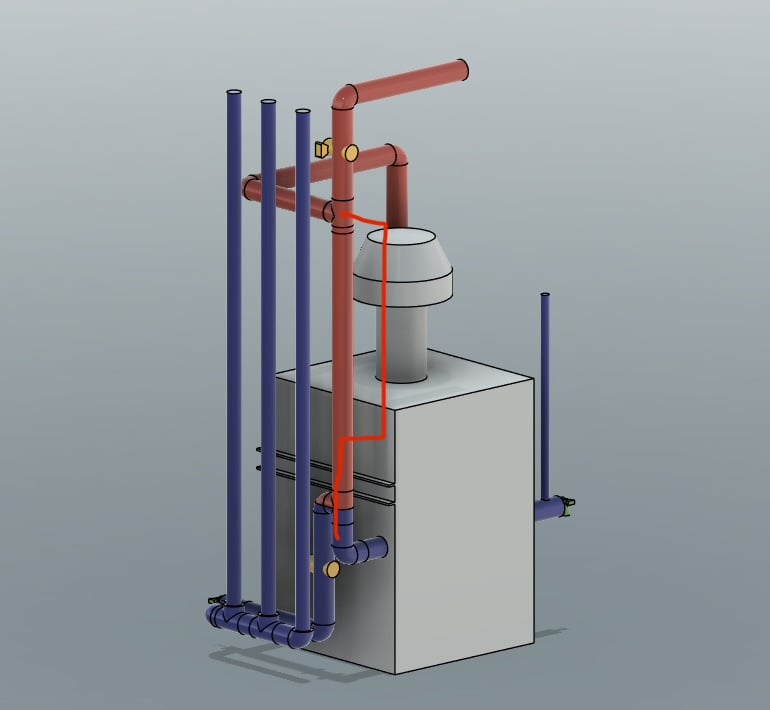
Could we come past the horizontal tee the into an elbow then down into other elbow to keep the placement of the exiting vertical in the picture:
 0
0 -
you could if you make the offset in the equalizer with 45s so it doesn't have a horizontal section or you make sure the horizontal section has pitch and is above the water line. what would be better would be to use 2 45s and offset the riser to the main if you have the distance to do it. or 1 45 in the riser and turn the ell at the end of the main at a 45.
0 -
-
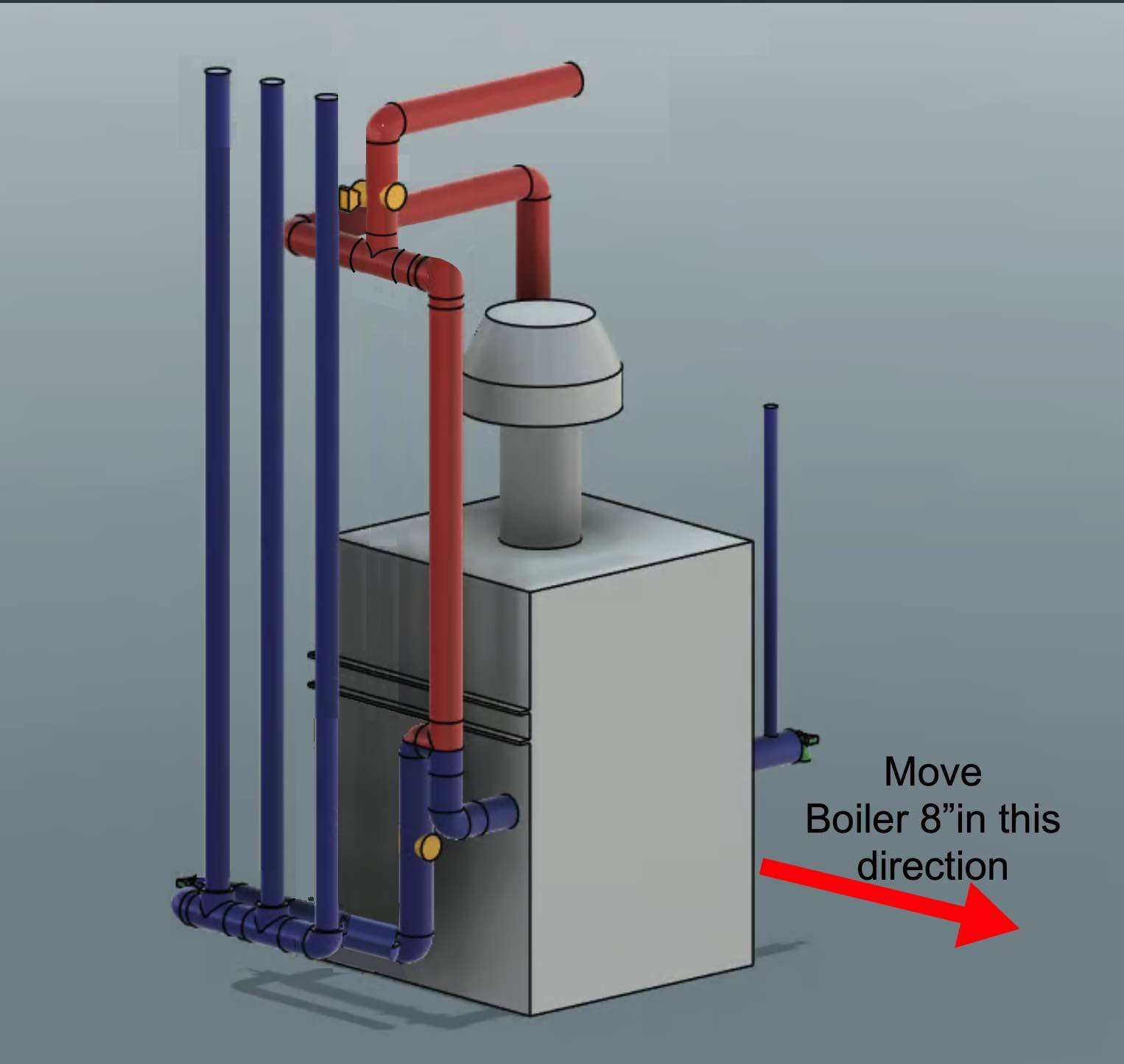
You could just move the boiler 8" to get the piping just right
Edward Young Retired
After you make that expensive repair and you still have the same problem, What will you check next?
 1
1 -
Cannot move this direction without getting boiler too close to wall sadly.
0 -
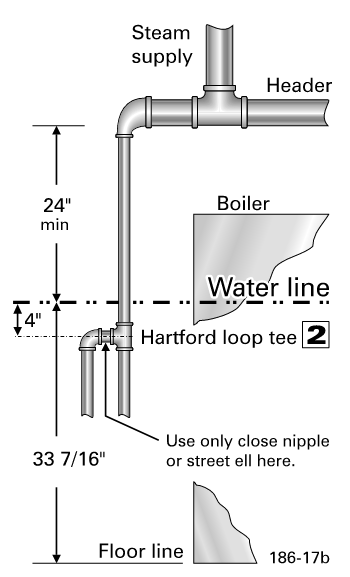
It’s a color misplacement in the CAD, the elbow is positioned at 2 inches below water line to center of the elbow.
0 -
Looks to me if your are going to go with the pipe center it would be more than 2 inches. That 2 inches would be to the top of the pipe. I think the idea is the have that short horizontal section of pipe always submerged or full of water within the boiler's usable water level range. If steam can't get in there there won't be any water hammer.
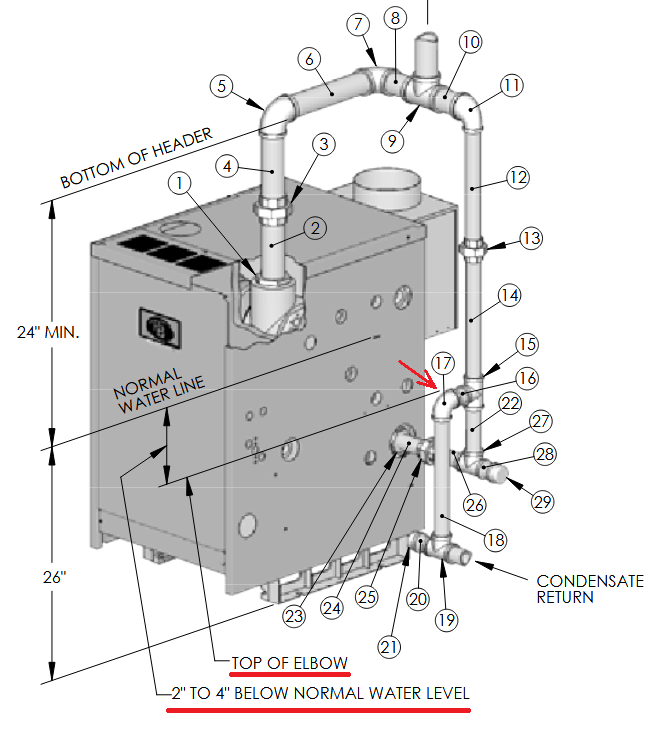 National - U.S. Gas Boiler 45+ Years Old
Steam 300 SQ. FT. - EDR 347
One Pipe System0 -
-
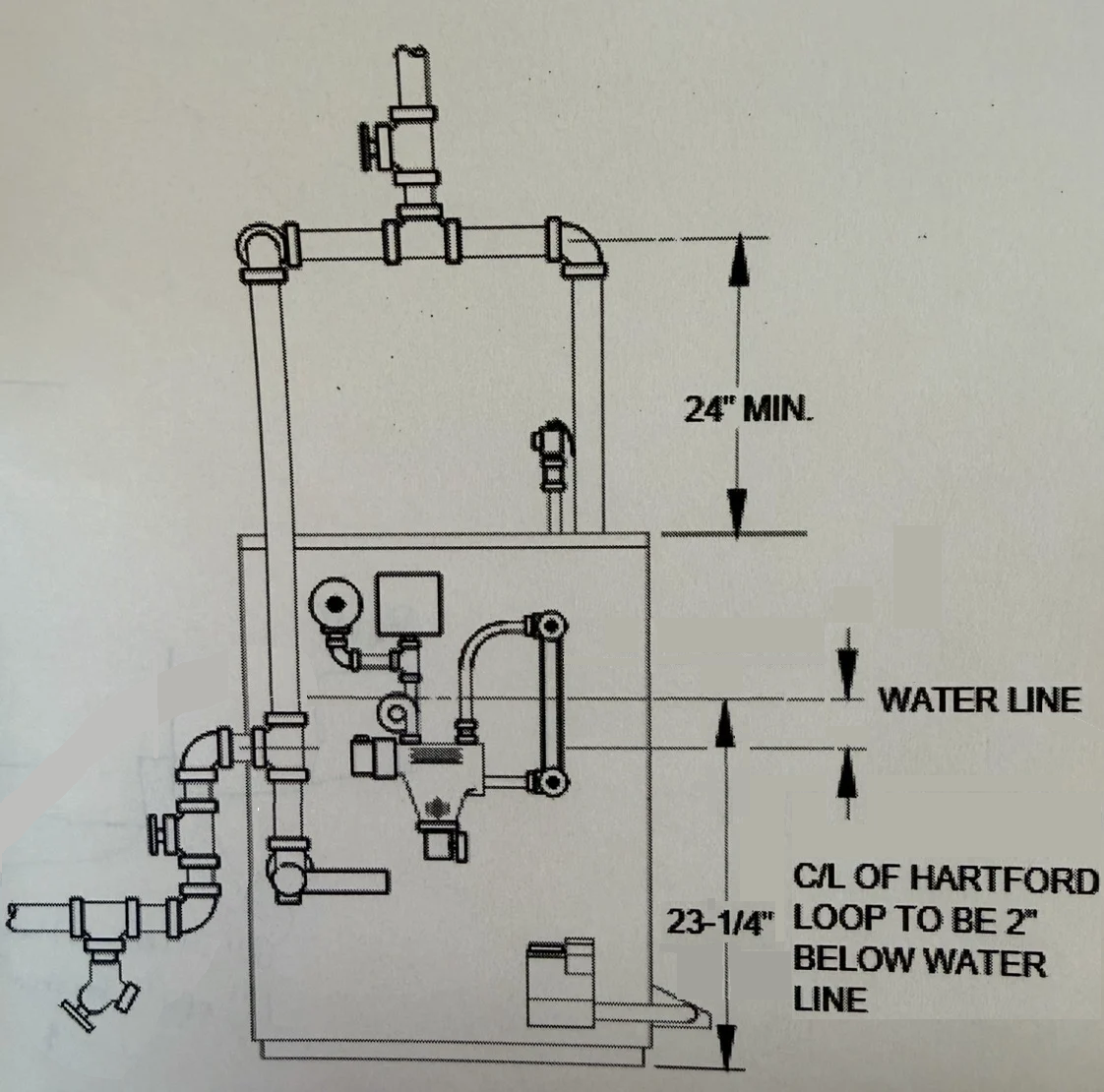
OK, I can't fault you for that. Did you actually measure the 23-1/4" ? The water line in the boiler's drawing seems kind of high the way it is drawn.
I would have thought it would have been more like this.
 National - U.S. Gas Boiler 45+ Years Old
Steam 300 SQ. FT. - EDR 347
One Pipe System0 -
the model in the CAD is not to scale of this boiler as it’s taller. All measurements will be followed per the HB Smith diagrams and documents.
0 -
When people know how to pipe there is no need to 'line things up".
0 -
Then just MOVE THE WALL.
Edward Young Retired
After you make that expensive repair and you still have the same problem, What will you check next?
 3
3 -
the height of the Hartford loop shouldn’t matter (within reason).
I know the thought is out there that it can cause water hammer, but I don’t see how steam can get down there.
Maybe I’m missing something 🤷🏻♂️
NJ Steam Homeowner.
See my sight glass boiler videos: https://bit.ly/3sZW1el1 -
There was a recent post that claimed that is where the hammering was coming from the Hartford loop area.
To me the short horizontal part of the Hartford loop is mostly full of water within the boiler's normal water line range. Or with a Gifford loop is mostly air or steam with the return condensate just sneaking by with no real liquid depth.
I'm thinking the issues happen when the short horizontal part of the Hartford loop is too long, partially filled with water and steam also gets into that pipe.
National - U.S. Gas Boiler 45+ Years Old
Steam 300 SQ. FT. - EDR 347
One Pipe System1 -
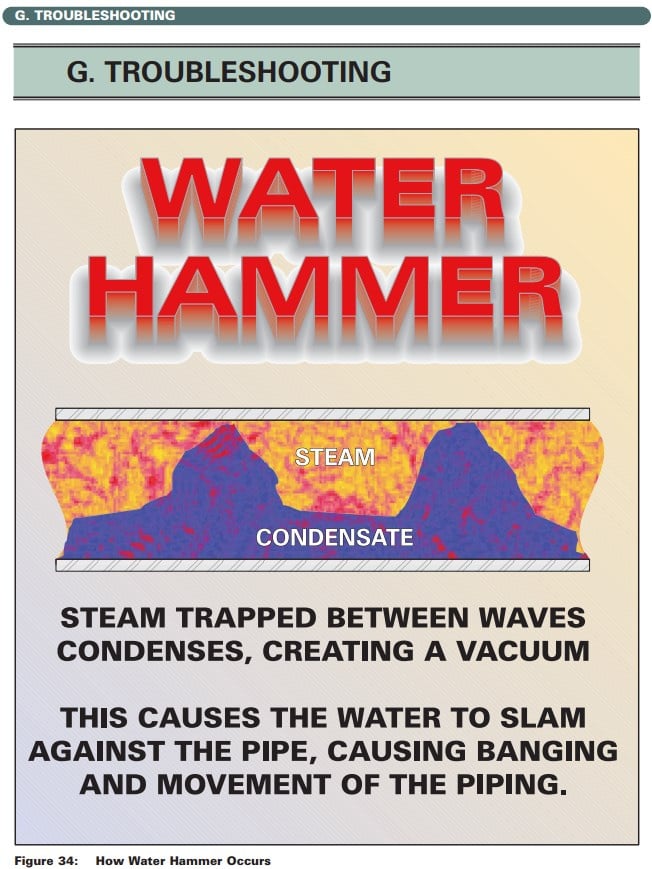
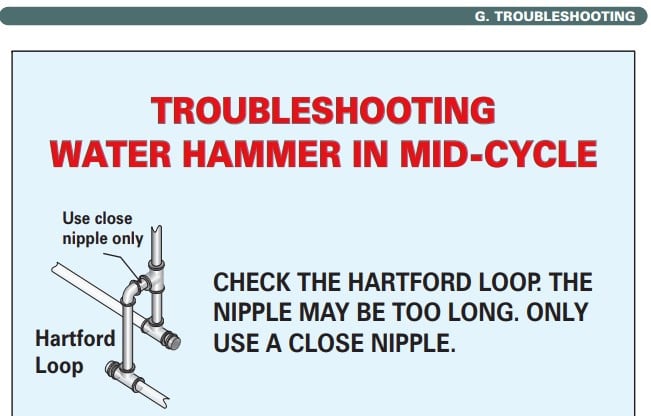
This just may be Wye the manufacturers prefer a Wye but where can I get one in copper to fix my high Hartford Loop?
0 -
Right, I know what causes water hammer but how does steam advance down there when there is nowhere for it to flow? (It doesn’t)
NJ Steam Homeowner.
See my sight glass boiler videos: https://bit.ly/3sZW1el0 -
It absolutely does go there. What do you think would be there if not steam? Condensation is occurring virtually everywhere in a steam system. When steam condenses it occupies roughly 1/1,700th the volume. Steam flows in to take the place of that. It is the same way that radiators continuously get replenished by the boiler during the burner on time and up until the vent opens and there is a small pressure drop from the boiler to the radiator.
0 -
air is there. Unless your Hartford loop features a vent
And if you’d like to save typing, I know how much more voluminous steam is than liquid water
NJ Steam Homeowner.
See my sight glass boiler videos: https://bit.ly/3sZW1el0 -
OK so do you think the entire header after the last supply and the rest of the equalizer remains full of air? Or does a gradual interaction occur that removes the air aided by the venturi effect of the steam rapidly flowing through the last supply remove that air? Why do you think hammer doesn't occur early in the cycle but tends to occur mid cycle?
0 -
there can be some mixing (even though I’ve read they don’t mix). But by then the water is pretty warm and shouldn’t be hammering anyway. There’s no hammering in the main for example, even though it has condensate running all along it.
And regardless of the height of the Hartford loop if there is steam down there, it will contact the water, and yet there’s no hammer so your high loop may not be the problem.
Some consider it a feature. Ignore the incorrect diagrams showing that system pressure causes water to rise at the end of the main, just like in those otherwise good peerless diagrams that you post.
NJ Steam Homeowner.
See my sight glass boiler videos: https://bit.ly/3sZW1el0 -
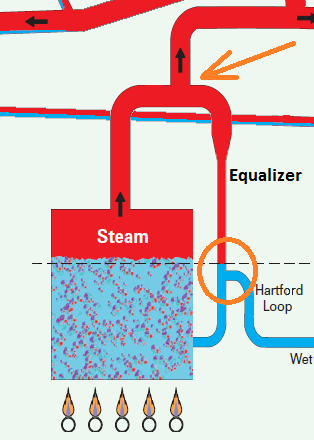
air can't get out of the equalizer so no steam gets in, in a 1 pipe system. if the radiator doesn't vent no steam gets in. in a 2 pipe system if the equalizer ends up equalizing then it could push the air in to the return and get full of steam. in a gravity return 1 pipe system the mains and returns are connected so they can't get out of balance pressure wise. the equalizer will be hot because it is partially filled with the near boiling water in the boiler but it shouldn't have steam in it with a 1 pipe gravity return system.
 2
2 -
the steam will rise to the top of the header and push the air around. it won't rise to the bottom of the equalizer.
1 -
@DanHolohan says:
"Steam rises up through the equalizer, just as it does through the boiler sections. When the relatively cool return water meets that steam at the close nipple, the rising steam bubbles quickly condense. Naturally, the return water rushes in to fill the void left by the collapsing bubbles, and this creates a slight water hammer inside the tee connecting the return to the equalizer."
EBEBRATT-Ed (who's been around forever) @EBEBRATT-Ed said it well: 'Steam goes down the equalizer until it hits water. The air rises up and goes out with the supply steam. If the equalizer stayed full of air it would be cooler and they are always steam hot."
The venturi idea was sort of my own and may be not the main effect here actually. But as the steam bubbles in the boiler can pass out through the return nipple into the equalizer they will naturally rise within that column, being lighter than the hot condensate and when they reach higher up and cooler strata they will implode, shrinking in volume and creating mild hammer which is probably inaudible. But this collapse in volume, along with the steam pressure in the header will cause steam to flow down towards the Hartford Loop within the equalizer displacing the air and pushing it out up through the header, into the main. This steam is also condensing which further pulls more steam in to make up for that.
Then later in the cycle, like mid cycle, you can get an audible hammer in that nipple of the Hartford Loop, if it is long enough to allow enough velocity from the acceleration, but it is again due to the implosion of trapped steam between water waves, and only if the water level in the equalizer is low enough.
Even if there is no problem mid cycle, there can also be late cycle water hammer in the Hartford Loop that can happen later in the cycle when the water level drops too low. From Dan:
"If [the water level] drops below the close nipple, steam will push down through the equalizer, enter the wet return and create water hammer. This usually happens near the end of the firing cycle, and it causes a very noticeable racket."
"Check to see if the water level in the boiler can drop to a point where steam gains access to the wet return through the boiler's equalizer. If it can, the steam will quickly push down into the wet return and create water hammer. This usually happens toward the end of the cycle."
Peerless Boilers:
"WATER HAMMER ON SHUTDOWN... CHECK THE HARTFORD LOOP. THE NIPPLE MAY BE TOO CLOSE TO THE BOILER WATER LEVEL. IT MUST BE 2 TO 4 INCHES BELOW."
0 -
I think I have grabbed my equalizer at various times to see how hot it is. I’ll have to refresh my memory. It will certainly be warmed by conduction but I’ll see if it gets “steam hot”. I’ll report back, I’m away from home at the moment.
In the history of writing, some things that have been written are mistaken, it turns out.
NJ Steam Homeowner.
See my sight glass boiler videos: https://bit.ly/3sZW1el0 -
From Dan:
"If [the water level] drops below the close nipple, steam will push down through the equalizer, enter the wet return and create water hammer. This usually happens near the end of the firing cycle, and it causes a very noticeable racket."
If this happens, then why doesn’t it happen when the water is above the nipple? Same steam supposedly in equalizer. Same water it comes into contact with. What’s the difference?
NJ Steam Homeowner.
See my sight glass boiler videos: https://bit.ly/3sZW1el0 -
For god's sake don't do that. Use a thermocouple meter with the thermocouple taped to the equalizer maybe 6 in. above the waterline, starting from time 0 at commencement of firing. I will do it with my copper one, but I have no doubt that Dan and the boiler manufacturers and Ed are correct on this.
1



Categories
- All Categories
- 87.8K THE MAIN WALL
- 3.3K A-C, Heat Pumps & Refrigeration
- 59 Biomass
- 430 Carbon Monoxide Awareness
- 132 Chimneys & Flues
- 2.2K Domestic Hot Water
- 6K Gas Heating
- 124 Geothermal
- 170 Indoor-Air Quality
- 3.8K Oil Heating
- 79 Pipe Deterioration
- 1.1K Plumbing
- 6.7K Radiant Heating
- 396 Solar
- 16.1K Strictly Steam
- 3.5K Thermostats and Controls
- 56 Water Quality
- 51 Industry Classes
- 51 Job Opportunities
- 18 Recall Announcements