Trane Forced Air Furnace Leaking Water
Comments
-
Good points, and under normal circumstances I might go that route. Reminder that there are TWO identical units twinned together. I doubt I’ll find one that I can replace to match the other. I’ve searched the model # and it shows “unavailable” and if I could find a neeed model to match I’ve got one new and one 15 yrs old. How long until the old one has a major issue? So I’ll need to pay for the replacement and installation of two furnaces.
I’m guessing that’s what? $20-25K? Because the black plastic piece on the front of one of the secondary heat exchangers developed a crack and is leaking.
Infuriating.
0 -
i'm not sure if they both need to be replaced just because they are twinned. even if they are the same model they won't be identical so i would think 2 furnaces with similar blowers could be twinned.
0 -
you need 240K BTU/h ?
 1
1 -
The HVAC co that did the initial install thought so. House is almost 6000 sq ft - 3 stories - built circa 1900 with single pane windows, multiple sets of single-pane french doors, and many rooms with no insulation.
I think he took a WAG to size the furnaces, since doing a normal calc for heat loss was nearly impossible. It may be oversized, but they run constantly and the house is always COLD. Last month gas bill was $1000+.
0 -
heat loss calculations are absolutely possible. it would make more sense to have had the ductwork split up instead of one huge zone. was there a huge gravity furnace there before?
0 -
I know some folks here are gonna give me slack for this comment….
But another option ( like lots of people do ) is just walk away and let it leak ! A little bit of water leak is not the end of the world. It's not likely gonna cause any more damage that hasn't already occured. As long as it's not so bad that it's running like a river out onto to floor. But either way, it's still something that can wait until spring/summer when you have more time to figure things out.
And I'm not saying that this is the BEST option.. I'm just saying that it is a common issue. I've seen many furnaces with similar issues that have been leaking like this for years and years and the owner had no idea. Until they called for service for some other reason.
1 -
1St get an accurate Manual "J" heat load/loss calculation done.
2nd Find a contractor you can trust
Begin the process for replacing both systems.
1 -
I think an "accurate" heat loss calculation for my house may theoretically be possible, but in practice not so much. You'd have to see it to understand. In any event, I have no reason to believe the 250K ISN'T correct.
I'm currently working on two things:
- I'm gluing up a "drip pan" that I'm going to use to catch the condensate and then run it to the condensate pump. I'm hoping this will get us through the winter. I'm expecting that installing a new furnace will take 3-5 days and doing that when it's 0-20 deg outside just isn't going to work.
- I've been trying to identify a possible replacement unit for the leaking one. I found a similar Trane (model A952V120DU5SB) which is also a 120K BTU upflow with the same cabinet dimensions but it's about 6" shorter than the existing model. If I can get a decent tin knocker to make a transition piece to make up the difference it might work. Hard to get anyone on the weekend, but either I or the service provider can call Trane on Monday to see what they think. I'll also ask the installer what the incremental cost would be for replacing BOTH units, and if reasonable I might bite the bullet and replace everything.
0 -
I think an "accurate" heat loss calculation for my house may theoretically be possible, but in practice not so much.
It's defiantly possible and is required! What makes your house so unique? Or you dont want to spend the money?
1 -
pecmsg - thats the second time you've called me cheap. Perhaps the orig installer didn't know what he was doing. Maybe the software used today is more sophisticated than it was 15 years ago. My experience with this is that the installer said to me: "I need to know the square footage and how many windows you have in your house". That was it. Those were the ONLY inputs he asked for. No interest in the size of the windows, how many are single pane from 1910 vs. newer, what the square footage of the exterior walls is, whether the walls are insulated (and which ones are and which ones are not), whether the attic is insulated, the R-value of the insulation, wall construction, how many fireplaces (and which ones have dampers), etc. etc. He wanted me to tell him "5900 sq ft and 37 windows" and was going to use that. Based on that, do you think the calculation would have been "accurate"?
In any event…
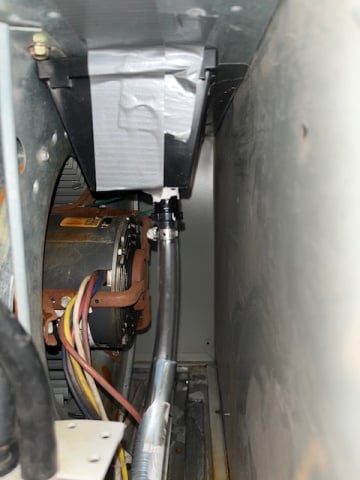
I jury rigged a drip pan. I used a $6 plastic mud pan from HD, drilled a hole in it and glued a plastic nipple under the hole to which I attached a length of tubing. There was a knockout close by and just a few inches above the condensate pump, so the "piping" (plastic tubing) was easy. I used some pex 90 deg bend supports to prevent the tubing from kinking. I thought about screwing or riveting the mud pan to the underside of the shelf but didn't want to risk going too deep and puncturing a coil so I just duct taped it in place. I'll see if I get any water draining and how it holds up. I bought two mud pans so in the meantime I may work on an improved design should the glue for the nipple or tubing not hold up.
I did notice that the leak is not as much as it was, maybe because we shimmed the furnace to facilitate condensate running down the drain hose.
 0
0 -
you don’t size by Sq Ft
Manual J takes in ALL requirements
All they have to do is read a ruler and know the r value of the insulation
Not that hard but can be time consuming
1 -
a blower door test can help a lot with accuracy in an old building to get a better infiltration number
0 -
you could put a disposable plastic food container under it to catch it and evaporate it so it doesn't rust up that furnace. i used the plastic lid from a peanut butter jar to catch the drip under my old inducer fan with a crack in it.
0 -
agreed
A lot of thing can be done
1 -
The more information you have the better the results!
0


Categories
- All Categories
- 87.6K THE MAIN WALL
- 3.3K A-C, Heat Pumps & Refrigeration
- 59 Biomass
- 429 Carbon Monoxide Awareness
- 124 Chimneys & Flues
- 2.2K Domestic Hot Water
- 5.9K Gas Heating
- 119 Geothermal
- 168 Indoor-Air Quality
- 3.8K Oil Heating
- 78 Pipe Deterioration
- 1K Plumbing
- 6.6K Radiant Heating
- 394 Solar
- 16K Strictly Steam
- 3.5K Thermostats and Controls
- 56 Water Quality
- 50 Industry Classes
- 50 Job Opportunities
- 18 Recall Announcements