HELP - NO ONE can figure this out!! (STEAM System)

I have been desperately trying to get help from our contractor since our new install has not worked correctly since it was put in in September.
Thanks to some amazing folks on here, we were able to see that the contractor installed the wrong domestic hot water coil and that was why we didn't have heat. He put a HOT WATER coil in instead of a STEAM coil. (Weil McLain EG-40 can be installed as EITHER hot water or steam and has a slot for each coil.) He had the water level ALL THE WAY up the boiler so that the coil was submerged but then there was no room for steam.
Switching the coils gave us heat, but two radiators (which worked with the old system) aren't getting heat.
However. when they put in the correct coil, they left the other one in the chamber. The manufacturer insisted that we won't get the correct performance as long as the 2nd coil was in there (even though it was unhooked). The steam chamber is very small and the coil took up almost all of the area for steam. We lost the battle to get him to remove the wrong one and had to pay someone else to do it!
We have MUCH better performance, but those two radiators are still not heating up all the way.
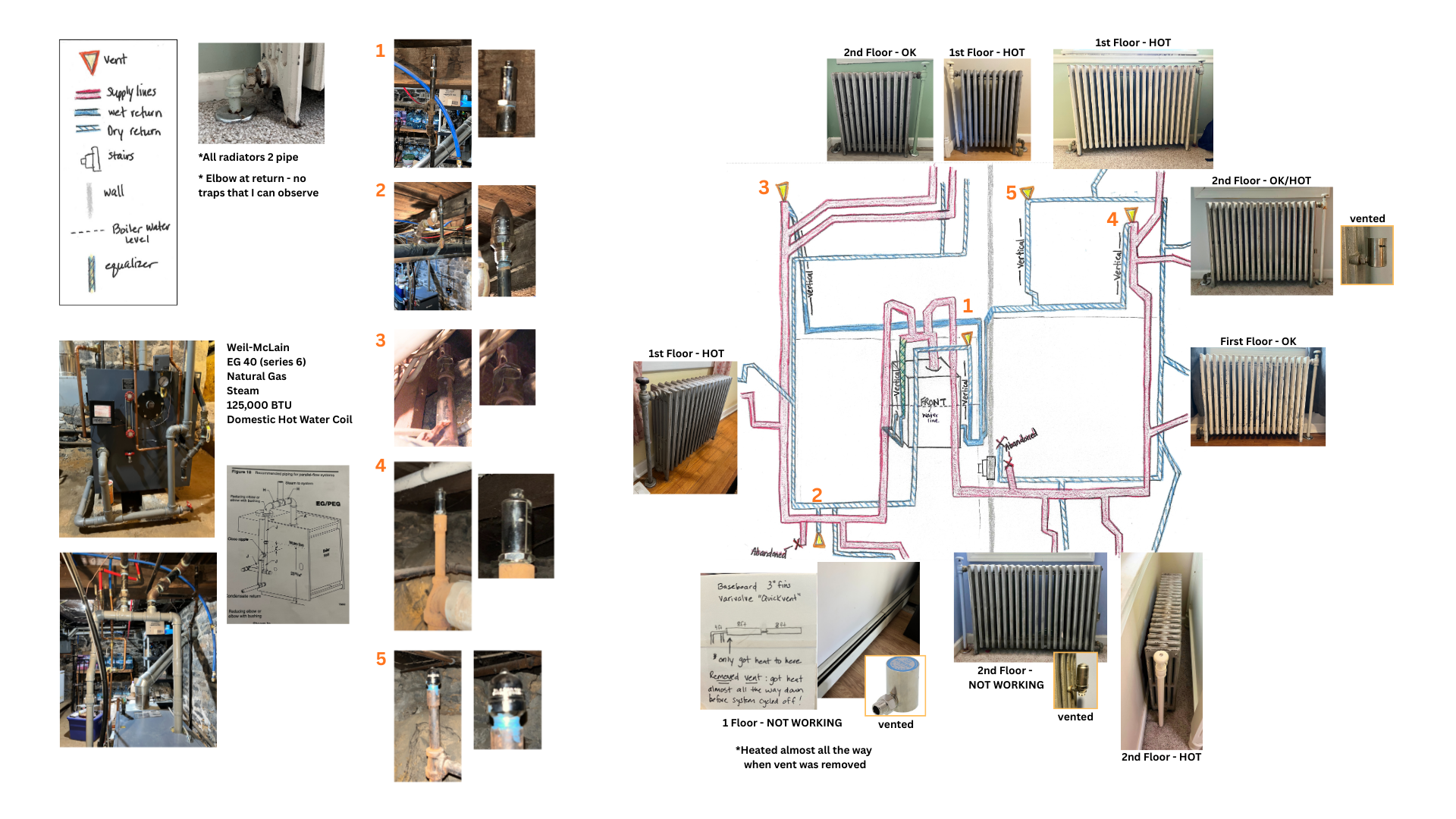
Here is where things get even more complicated. We have a TWO pipe system WITH vents. And the contractor has not been willing to help us balance the system. We don't know how, but we are trying to learn.
The contractor has worked with us for 6 years and has always told us this was once a HOT WATER system that someone converted to STEAM. But with all I have learned now, I am wondering if this is what Dan Holohan refers to in his article, "Grabbing the Elephant." Here is an excerpt:
There was a time in American Heating History when they didn’t use thermostatic radiator traps. They didn’t use these devices because no one had invented them yet; and you cannot install what has not been invented. This lack of traps, however, didn’t stop the Dead Men from installing steam heat. They just put in these two-pipe, air-vent systems, which look remarkably like two-pipe, direct-return hot-water systems.
The steam leaves the boiler and heads up into the building. It favors the supply lines, of course, because these are usually larger than the return lines by at least one size. Steam follows the path of least resistance. The Dead Men put an angle valve on each side of every radiator so that tenants could shut off the heat if it got too warm. The air left the radiators through the one-pipe-steam air vents. The steam heated the radiators, and the condensate dribbled down the return lines. The steam flowed into the return lines along with the condensate because there was nothing there to stop it. After a while, there was steam everywhere, and that was perfectly normal for this system. And since there were so few moving parts, these systems lasted for as long as the building stood.
I've had 2 additional experts look at the system and no one can tell me what needs to be done to get heat to these two problem areas. They have ideas, but no guarantees. I'm sure they could figure it out with enough time, but that costs SO much money!
So, what do we do to get these two rads working?????
I know the near piping is wrong. They didn't put in a Hartford Loop, but will that matter for the rads all heating up? The header he installed is 2" but should have been 2.5" - will that make a big difference? The equalizer should be 1.5" but it is 1.25" and it is not shaped correctly. One of the guys I have consulted with mentioned that maybe it is pressurizing the return. I am not sure I fully understand that, but can anyone help me see if that could be why those 2 rads are not working? The quote to fix all this is a lot! And I just paid for the new system!
I feel like I have to become the expert here… but I need to know where to even go next in my research. I suspect the system needs to be balanced with vents, but is that the right direction? Am I missing something?
THANK YOU IN ADVANCE for your time, expertise and ideas!
NOTE: I have made a detailed map of my system and put in pictures of everything. One of the radiators that isn't working heated ALMOST all the way over when we took the vent off to test. There are notes on the image.
Comments
-
I know the near piping is wrong. They didn't put in a Hartford Loop, but will that matter for the rads all heating up? The header he installed is 2" but should have been 2.5" - will that make a big difference? The equalizer should be 1.5" but it is 1.25" and it is not shaped correctly.
You can ignore all of this. None of this would prevent only two radiators from working while the rest worked fine.
Your own experiment of removing the vent and seeing better heating, plus my own experiences and logic, tells me that your issue is that air is getting trapped somewhere.
The vents on those radiators might be bad. The supply or return pipes connected to those radiators might have settled and are now trapping water that is blocking the steam or air or both.
Forget everything else and look for things that could cause the steam to not make it in, or the air to not make it out, of those two radiators.
You can also forget the pitch of the radiators, that's not the answer either.
NJ Steam Homeowner.
Free NJ and remote steam advice: https://heatinghelp.com/find-a-contractor/detail/new-jersey-steam-help/
See my sight glass boiler videos: https://bit.ly/3sZW1el 2
2 -
I will add that your main vents are garbage. They may or may not be involved in your issues, but they should be replaced with Gorton #1 or #2
As another data point, I for the first time recently saw a system really close to yours where there were two pipes on each radiator with no traps and no vents. Yours could have been like this one.
Your radiator with the vent probably had the vent added to try to fix this same problem which would make me think the focus should be on the supply pipes sagging and trapping water in them.
NJ Steam Homeowner.
Free NJ and remote steam advice: https://heatinghelp.com/find-a-contractor/detail/new-jersey-steam-help/
See my sight glass boiler videos: https://bit.ly/3sZW1el 2
2 -
Im not trying to throw anyone under the bus, but did you use this site "Find a Contractor" BEFORE installation; now that your looking for advice from this site to correct improper installation and other uncorrected issues
Its just that the experts here could have prevented the problem in the first place, though to posters credit, this site is being used
Regards,
RTW
0 -
I don't think you have a 2 pipe air vent system. You have a 2 pipe system. 2 pipe air vent has both connections at the bottom because it's essentially a 1 pipe with drain. Since yours are connected top (inlet) and bottom (outlet) I'd suggest you have a "normal" 2 pipe system. Not all of them had traps. Some used orifices, some used oversized radiation, others used regulating valves etc. There is no one size fits all on 2 pipe.
Personally I'd start by removing all the radiator vents first. After that look at the main venting, 2 pipe will need more main venting because it's venting all the radiation too. This also depends on the location of the vents in the basement. It appears that you have vents on the main and the dry return based on what you posted. I'm with Paul about those vents, garbage and definitely inadequate.
Looking again, you seem to have vents in the basement all over the place. Definitely some crazy going on here.
 1
1 -
I had NO idea about how rare these systems were. I'm honestly just a simple woman who thought I could trust the "experts" - I know better now. And I have learned SO much about how steam works…enough to live in a house with a steam boiler… but that only helps me so much NOW. :)
1 -
I kind of had the same thought - why would only two not work… One contractor said he thought the return was getting pressurized, but I am not understanding that. I'm trying, but there are not a lot of resources directly about steam heat for me to read.
Do you also think I should remove all the vents?
I really appreciate your thoughts.
0 -
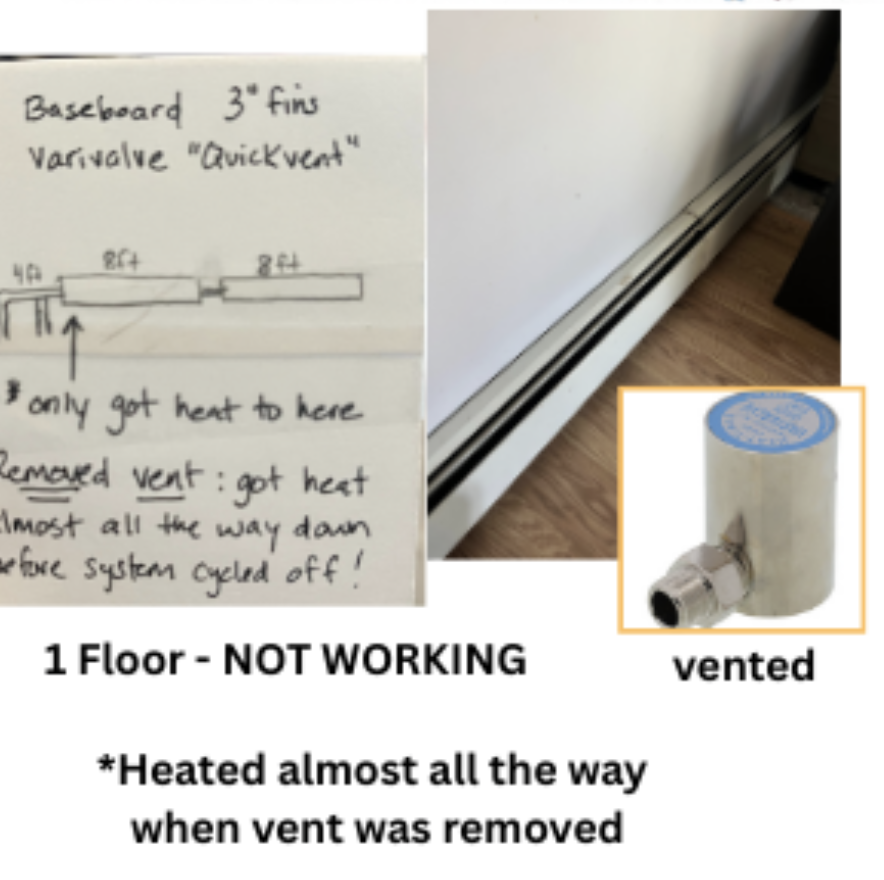
Thanks for commenting, if this is the case, why does the long baseboard get hot when we remove the vent all together and leave it open?
And if I do need to remove all the vents how do I "plug" them?
Thanks again!
0 -
I would not be confident enough to say you should remove all vents. I would have to spend time with this system I think to be able to understand what it currently is vs what it might have been.
I do think it's safe to say that for this baseboard at least, there's no hope of it getting hot without a vent on the end. It seems likely that it is an outlier that was added much later than the system was built (your diagrams are very good by the way):
NJ Steam Homeowner.
Free NJ and remote steam advice: https://heatinghelp.com/find-a-contractor/detail/new-jersey-steam-help/
See my sight glass boiler videos: https://bit.ly/3sZW1el0 -
That varivalve may have failed, on the baseboard radiator. Shake it and see if it rattles. If it does it is definitely bad. See if you can blow through it easily. Even if it doesn't rattle if there is resistance when you blow it is also bad.
1 -
You're right - this baseboard was added in an addition, but quite a long time ago. It is not efficient at all, and doesn't offer much heat even when it works since when the system cycles off, the regular rads stay hot for a while and this gets cold in minutes. BUT that said, I want it to work so we have whatever heat it does offer and so we can sell out home when we're ready and the steam reaches all the rads!
I'm limited by what vents I can put here since it's on the wall. But I have been thinking about adding a straight Gorton by using a 90 degree brass elbow. I know it will stick up and I will probably have to alter the baseboard cover, but do you think that would work?
Would you replace all the vents in the basement with the Gorton 1 or 2s - including the ones on the return lines? And then which would I choose for this baseboard - maybe a C or would I use a 1 or 2 like on a main line since it is SO long?
And would you vent the rooms upstairs? I don't understand the steam enough to conceptualize what venting these things more or less will do. I don't want to change something and then make other radiators not heat up.
Thank you again! (And thanks for the encouragement on the drawing.)
0 -
My husband just also reminded me that before the new boiler install (when all this started) the radiators in question both worked. I forgot to mention that. I would think if it were the sagging pipe idea, they wouldn't have heated with the old boiler either…?
0 -
Yeah the problem with all of our advice on this forum is we can only give ideas based on the facts we know 😅
And sometimes things that seem causal (new boiler install) aren't actually, or can be for very weird reasons.
You're right - this baseboard was added in an addition, but quite a long time ago. It is not efficient at all, and doesn't offer much heat even when it works since when the system cycles off, the regular rads stay hot for a while and this gets cold in minutes. BUT that said, I want it to work so we have whatever heat it does offer and so we can sell out home when we're ready and the steam reaches all the rads!
That is expected for those kinds of baseboards on steam systems…they are not a good match with cast iron radiators and they don't work well with steam regardless because it can be difficult for the steam to pass by the condensate in those little baseboards. Trust me, homes sell all the time without all the radiators getting steam!
I'm limited by what vents I can put here since it's on the wall. But I have been thinking about adding a straight Gorton by using a 90 degree brass elbow. I know it will stick up and I will probably have to alter the baseboard cover, but do you think that would work?
Yes, you can add fittings to a vent connection as long as everything is pitched to allow the condensate to drain back out of the vent.
Would you replace all the vents in the basement with the Gorton 1 or 2s - including the ones on the return lines? And then which would I choose for this baseboard - maybe a C or would I use a 1 or 2 like on a main line since it is SO long?
If it were me I'd probably start with Maid O Mist #1 in the basement just because they are less expensive than Gorton #1 and basically the same mechanism: https://www.supplyhouse.com/Jacobus-Maid-O-Mist-J1-1-3-4-x-1-2-Main-Vent-Valve-3563000-p
I would probably try a mid-size vent like a #6 on the baseboard.
And would you vent the rooms upstairs? I don't understand the steam enough to conceptualize what venting these things more or less will do. I don't want to change something and then make other radiators not heat up.
I would try that same test you did on the baseboard. Remove the vent and see if it heats up and eventually steam should come out. Then you'll know there is at least a good path. Then you can try a different vent and you can try no vent by rotating the vent upside down to disable it.
There's probably nothing you can do to that radiator to make other radiators not heat up, but any change has some risk of course.
NJ Steam Homeowner.
Free NJ and remote steam advice: https://heatinghelp.com/find-a-contractor/detail/new-jersey-steam-help/
See my sight glass boiler videos: https://bit.ly/3sZW1el1 -
A hybrid steam system with 3/4 fin-tube baseboard and cast iron steam radiators almost never works. 3/4 piping is too small for steam and condensate to occupy the same cross sectional area to co-exist.
You need to have a condensate return on the other end of the copper fin-tube opposite the steam supply to even have a chance. it needs to pitch away from the supply. Drop the condensate return into a wet return. And even then it has no thermal mass so it will cool down within minutes.
 1
1 -
If you have space I'd replace the fin tube with a new or salvaged cast iron radiator. You can make it heat properly by setting it up as 2 pipe but it will never balance with the rest of the system because of the difference in mass.
If i remember right this is a 2 pipe system and either a 2 pipe air vent system or a bastardized vapor system or possibly a gravity hot water system someone tried to connect a steam boiler to.
0 -
This is all amazing help! Thank you!
I'm about to order my vents - one more questions… Should I be ordering the same vent for all 5 basement vents?
0 -
I probably would. It's really impossible to say from here what size is the "right" size main vent, especially in your situation with all of those you have, some on the "steam side" and some on the "return side".
After you get them in and can see what the system is then doing you can always go with the larger Gorton #2 vent if necessary on any parts of the main that are taking too long to get steam to them.
Just keep in mind the general purpose of a "main vent" is to let the steam at the start of a call for heat quickly push the air out of the main to help all the radiators start to get steam at roughly the same time for improved balance. So if you have a section of your main that you find is taking minutes longer to get steam in it at the start of a call for heat, you can try a larger vent for that section.
NJ Steam Homeowner.
Free NJ and remote steam advice: https://heatinghelp.com/find-a-contractor/detail/new-jersey-steam-help/
See my sight glass boiler videos: https://bit.ly/3sZW1el2 -
if it worked well with the old boiler but not with the new boiler I would look at something that was below the water line that isn't with the new boiler.
2nd i'd look at pitch that got changed
i would also look for oil that it in the boiler from the new piping that is causing it to surge
1st i would look at near boiler piping
 2
2 -
Has anyone skimmed and cleaned the boiler?
Retired and loving it.
 3
3 -
There is also quite a variance in the vents on the radiators at least on the couple I can see from the pictures. You obviously have Varivalve vents on a couple radiators which can be extremely fast vents and on the "2nd floor not working radiator" you have a very slow Ventrite 1a radiator vent. The Ventrite at highest setting is still slower than the Varivalve at its lowest setting. Do all the radiators have vents and if so what types? Hard to tell from the pictures. If so what vents and if they are variable vents what setting are they on? I hear you talking about Gorton #1 main vents in the basement but those Heat Timer Varivents on the radiators are just as big as a Gorton #1 on their halfway setting and bigger fully open.
The main vents in the basement should be significantly bigger than the radiator vents in general. Currently I think you are venting mostly through the radiators vs mains which is not the best way to get a system balanced.
1 -
the maid o mist vents have interchangeable orifices so you can change the vent speed by swapping orifices around (or temporarily slow them down by partially plugging the hole). i think you can by a model that comes with all the orifice sizes.
 3
3 -
Mr. Holohan, thank you so much for commenting!
This whole thing has been a mess. The contractor not only didn't skim the boiler on install… he installed a HOT WATER domestic coil instead of the STEAM domestic coil (this unit is made for either steam or hot water) and then ignored the fill line/sight glass and filled the water all the way up (to submerge the coil) so we could get hot water.
It was September so we didn't realize his error until we tried to use the heat in November.
Then we started learning about steam boilers as fast as we could. We had been with this company for 6 or 7 years with the original boiler so we really thought they knew what they were doing.
It was the amazing people on this forum who helped us figure out what they had done wrong!
So to answer your question, there was no way he could skim the boiler since the skim port in this unit it right where the domestic HOT WATER coil goes.
We had him put the correct coil in and asked him to clean it, but I think he only put a chemical in that he told me would do the job. He refused to remove the abandoned hot water coil and told me it wouldn't affect the operation of the unit.
We stopped fighting with him and had another contractor remove the abandoned coil. The system worked a lot faster, but those two rads still didn't work any better. He also put in a chemical and told me it was correct. I don't know if he actually skimmed it or if the chemical does that job instead… He left the bottle it is called: Silver King Squick Boiler Cleaner.
1 -
The only vents are what is pictured on the diagram. So one on the first floor - that is the vari-valves on the long baseboard. Then two on the 2nd floor. One in the room that is not heating and one in another room that is heating well.
To be honest, I don't even know if I'm venting through the rads at all. I am unconvinced that these valves are even working. Especially since when I remove the one on the base board - the thing heats up. But I am just learning so I have no idea really!
I was under the impression that the Gorton vents would vent much better/faster than the Vari-Valves if I got the correct ones - #1 or #2. …???
0 -
detergent will make skimming easier but it is not a substitute for skimming.
0 -
Something for sure is wrong where most radiators have no vents and only a few have them. Question is which was the way this system was designed to be.
Varivalves vent faster than Gortons and are adjustable but there seems to be anecdotal evidence accumulating that quality has slipped, and they don't have the float design of the Gortons and Maid O Mists and others, to prevent some water spitting if something goes wrong and the radiator gets carryover.
0 -
If I had to guess, it's a Kribel system that has some stuck flappers in the return ells so someone put vents on those to get them working. Those can be opened up and freed, then the vents can be eliminated on those.(not the baseboard)
I'd scrap the copper baseboard and put in Baseray with a 1" feed. It'd be an improvement.
Trying to squeeze the best out of a Weil-McLain JB-5 running a 1912 1 pipe system.0 -
if there’s nothing in those return elbows. You can install orifice plates from Tunstall.
ASM Mechanical Company
Located in Staten Island NY
Servicing all 5 boroughs of NYC.
347-692-4777
ASMMECHANICALCORP@GMAIL.COM
ASMHVACNYC.COM
https://heatinghelp.com/find-a-contractor/detail/asm-mechanical-company1 -
@ncg101 , those main vents look pathetically small. There should be one on each steam main and at least one on the dry (overhead) return. How long is each steam main, and what pipe size?
Also, where are you located? We might know someone who can help get this straightened out………….
All Steamed Up, Inc.
Towson, MD, USA
Steam, Vapor & Hot-Water Heating Specialists
Oil & Gas Burner Service
Consulting1 -
Have you looked at the Find a contractor Feature? You may have someone close by that can save you alot of time, money and aggravation. Mad Dog
0 -
I was under the impression that the Gorton vents would vent much better/faster than the Vari-Valves if I got the correct ones - #1 or #2. …???
Vari-Valves are radiator vents that have a very large capacity, for a radiator vent
A Gorton #1 is a main vent that is the same size as the largest Gorton radiator vent, the D. Vari-Valves can apparently pass even more air than those.
But a Gorton #2 is a nice large main vent and it can vent more than a Vari-Valve.
NJ Steam Homeowner.
Free NJ and remote steam advice: https://heatinghelp.com/find-a-contractor/detail/new-jersey-steam-help/
See my sight glass boiler videos: https://bit.ly/3sZW1el0 -
That looks like hot water baseboard, it will not work well on steam because the pipe is too small to handle steam and condensate especially on a one pipe system. It also sb vented SLOWLY, varivents are too fast.
Bob
Smith G8-3 with EZ Gas @ 90,000 BTU, Single pipe steam
Vaporstat with a 12oz cut-out and 4oz cut-in
3PSI gauge0 -
This is a 2 pipe system
0 -
This is very helpful info as I continue to try and understand venting. Thanks
1 -
Yes but he means that length of baseboard convector you have was made for a hot water system. That's why it can be challenging or impossible to make it work well with steam.
NJ Steam Homeowner.
Free NJ and remote steam advice: https://heatinghelp.com/find-a-contractor/detail/new-jersey-steam-help/
See my sight glass boiler videos: https://bit.ly/3sZW1el0 -
I have used the feature and there is no one really near me. I am not sure if anyone knows of someone in the Harrisburg, PA area. I am in a really tough spot. I had to take a home equity loan just to afford the new install. My system worked before the new boiler went in so I never expected this!
0 -
So I read what I could find on the Kribel system and I am seeing there would be a "vapor-vacuum controller" feature in the basement. I don't have anything like that that I have come across. Also, seems like they had a good bit of branding at least in the photos I found online. I don't see any items in the house that appear to have that logo/brand mark. Not sure if that changes your thoughts… but I appreciate your input.
0 -
I see. Not sure if it helps to consider that it did work previously before the new install.
0 -
It does help to know it's possible to get it working. There are a lot of variables. If it were my boiler I would focus on getting it skimmed and/or washed out. It could be carrying water over into the mains and radiators. This is the line of thinking of several of the respondents above.
NJ Steam Homeowner.
Free NJ and remote steam advice: https://heatinghelp.com/find-a-contractor/detail/new-jersey-steam-help/
See my sight glass boiler videos: https://bit.ly/3sZW1el0 -
-
I can't do any work on your system, but I'd be happy to come up and do a free consultation for you and write up a short report or punch list of things that need done. Can't promise anything, but it could help to get a more educated set of eyes on things. I'm just an educated homeowner trying to help people out. If that is something you'd be interested you can send me a private message on here and we can set something up.
I live south of you in Hanover.

 3
3 -
It's probably long gone. In any event, it looks like it's two pipe vapor. You wouldn't be running it under vacuum anyway, so I wouldn't sweat over that.
If it were me, I'd pull one of the non working rads that has a vent installed and look into the elbow at the bottom end. There's probably either a flapper or some kind of restriction with a drain. That's likely indicative of what type of vapor system you have.
Trying to squeeze the best out of a Weil-McLain JB-5 running a 1912 1 pipe system.1





Categories
- All Categories
- 87.5K THE MAIN WALL
- 3.3K A-C, Heat Pumps & Refrigeration
- 59 Biomass
- 429 Carbon Monoxide Awareness
- 124 Chimneys & Flues
- 2.2K Domestic Hot Water
- 5.9K Gas Heating
- 119 Geothermal
- 168 Indoor-Air Quality
- 3.8K Oil Heating
- 78 Pipe Deterioration
- 1K Plumbing
- 6.6K Radiant Heating
- 394 Solar
- 15.9K Strictly Steam
- 3.5K Thermostats and Controls
- 56 Water Quality
- 50 Industry Classes
- 50 Job Opportunities
- 18 Recall Announcements