Help with cast iron radiator decision

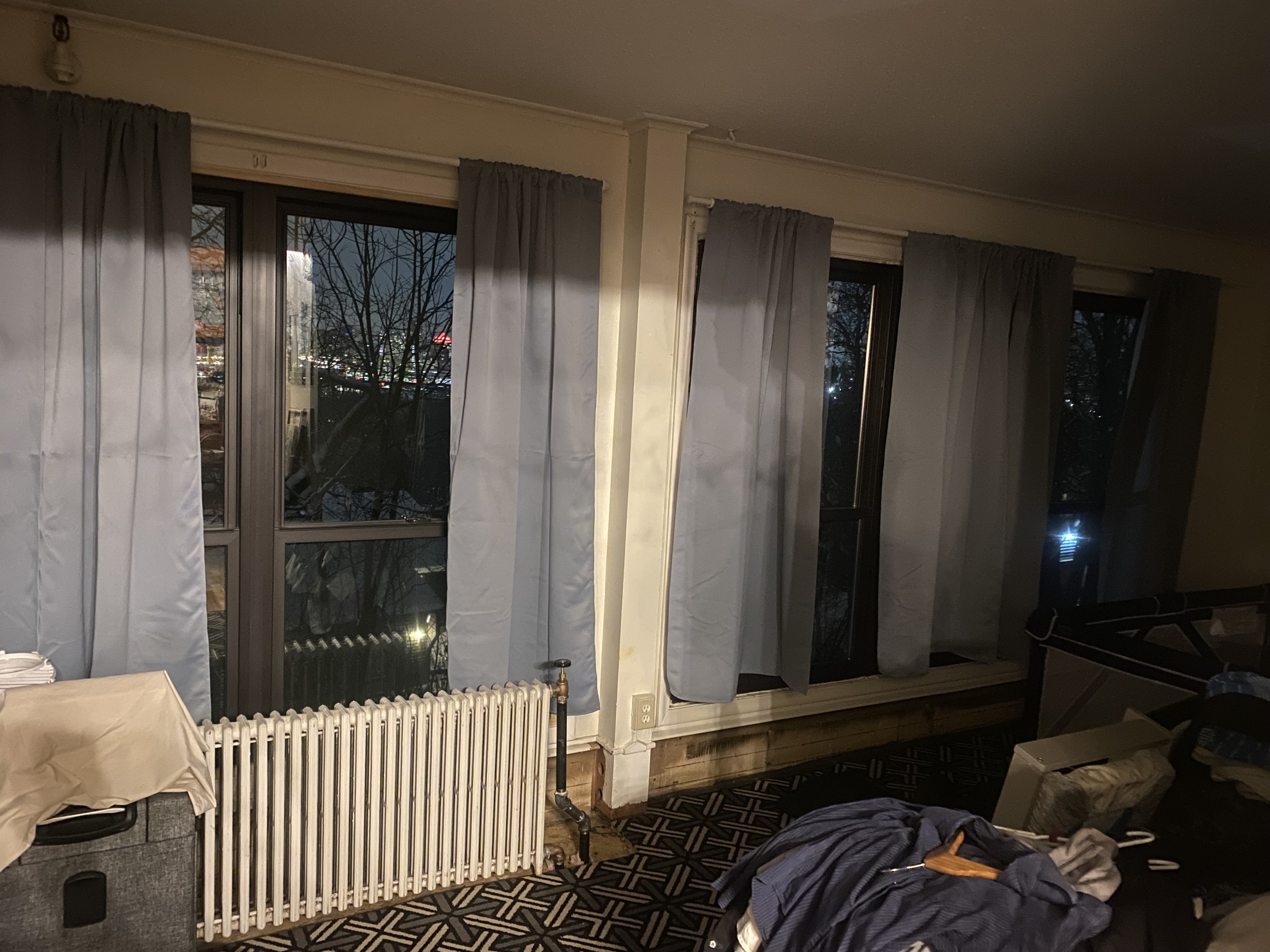
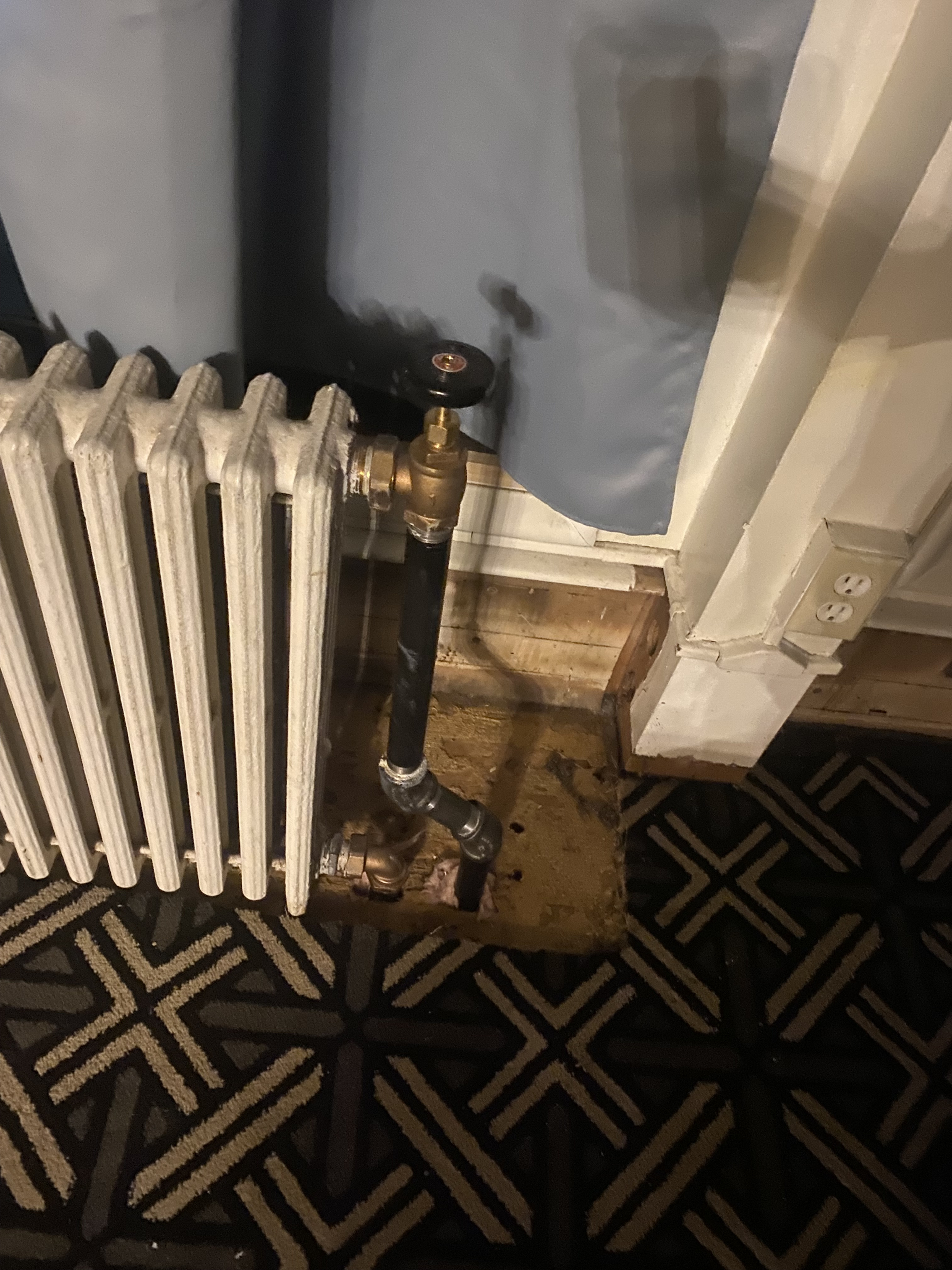
Hello all, I have these 2 banks of windows that span about 25’. I have this dinky radiator there at the moment. My question is, would I still flow if I elbowed the supply and return on opposite ends of a 20’ cast iron baseboard radiator? Or should I just find a larger radiator? I worry about it flowing efficiently with the baseboard. I don’t want to add another circulator on the return.. ideal would be the baseboard as it would be under the window. But I’m not going to spend the money if it won’t flow. There are 2 rads on this loop. The other is the same layout on the perpendicular wall.
When I renovate this area, I will add insulation where there isn’t, which will help a lot but still don’t want this radiator there. I would find one that’s 12-15” tall and longer. Thanks for any input
Comments
-
I don't fully understand what you are asking.
- Never mix cast iron radiators and copper tube aluminu fin baseboard on the same zone, pipe, loop, or thermostat.
- What are you looking to accomplish? Is that room not getting enough heat?
- Cast iron baseboard radiators can be on the same zone or thermostat as cast iron standing radiators but the piping design may not be a good match and cause unbalanced heating in one area to another area with different design radiators.
- You mentioned future renovations, what is the plan? Remove the tall radiators and replace with low profile baseboard? That may not work out well. Look at the EDR of the radiator you are removing and compare it with the EDR of the radiators you plan to replace it with.
- A 20 foot piece of CI baseboard may not have the same heating capacity as a 4 foot long radiator that is 36" tall
- Separate thermostat and separate zone may be your best option to heat a room with lots of glass connected to other rooms in a building that don't have lots of glass
Hope this info helps.
EDIT: after a reread of your post you can get a good glow thru 3/4" pipe of about 4 GPM and that would be enough to heat 40,000 BTU of radiator. That is equal to about 50 to 60 feet of Baseboard.
Edward Young Retired
After you make that expensive repair and you still have the same problem, What will you check next?
0 -
I think you will be fine. I attached a Burnham Base ray manual. 20' of base ray will give you about 10,000 btu/hour and you need to flow about 1 gpm. You could check the 10,000 but against the edr
of you existing radiator. 10,000 btu =42 EDR
0 -
Let me give it a shot.
I think I can understand why you might want to get rid of that radiator in front of the window. I would. Now. What to put into its place? I presume this is hot water heat? If so, flow is not likely to be your problem, although you may have to get somewhat creative with pipe routing. This is especially true if the radiator you have there now heats the room adequately.
However, as @EdTheHeaterMan said, what could be a problem is the emitter itself. The baseboard. You really want to use cast iron baseboards if you can get them, as they will behave in much the same way as your radiator in terms of how fast they heat up and cool off. Then the second aspect is to match as closely as you can the output of the new baseboard to that of the existing radiator.
Br. Jamie, osb
Building superintendent/caretaker, 7200 sq. ft. historic house museum with dependencies in New England 1
1 -
I think the Op wants to remove the rad and replace it with CI baseboard. I don't see an issue. he only needs 1 gpm to get 10,000 btu at 170 average water temp.
0 -
I think they want more capacity. Baseray appears to be similar capacity to fin tube so it is about 500 btu/hr/ft at 180f swt. That means a 20' section would be about 10,000 btu/hr if the water temp is around 180f. I don't know how much of that radiator we can't see so I can't take a guess at its output. There are short and wide radiators which also would be an option.
0 -
wow thank you all for the quick responses. My current rad isn’t sufficient enough to heat that area. I want cast iron baseboard, not copper fin tube. Where the supply and return come up, is the only place for it to be. I cant move it in the basement. If I elbow the supply to the right 10’ and attatch to the end of the baseboard ci rad, and also elbow the return 10’ to the left, would that affect my Flow? Future renovations would just be to insulate best as possible. It’s an old gravity fed converted. I can’t zone separately. Just trying to get most heat in this area. Yes it is hot water radiant heat.
0 -
In many cases that might work, but what if it dose not?
Here is an illustration I used to explain why Baseboard and standing rads don play nice together. although CI baseboards play better
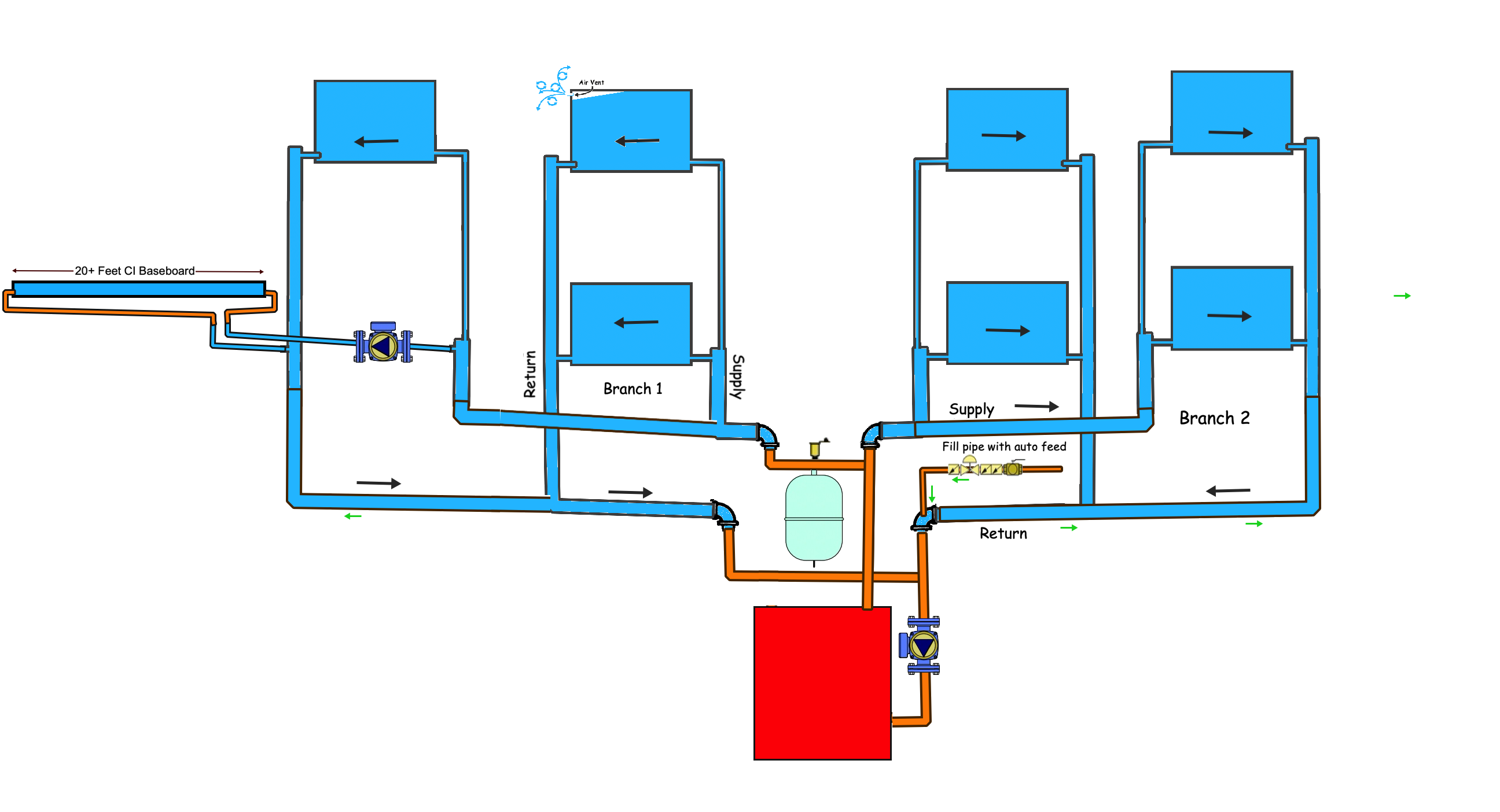
Picture this old gravity system with a replacement boiler and the circulator on the return as we have all seen over the years. Works fine but one day someone wants to renovate the kitchen and remove the CI standing radiator.
Imagine in your mind's eye all the CI standing rads are getting about 0.5 to 0.75 GPM flow each, in this old system (on a 12 radiator system that might be 70,000 to 80,000 BTU or 7 to 8 gallons per minute). Now take out one of the 0.5 GPM branch CI radiator and add 20 feet of 3/4" pipe and 20 feet of CI Radiator. In your mind's eye will that make the water flow easier or will that be more restriction? You don't really know until you try it and it does not work.
I have had this happen several times and have fixed it a number of ways. This was the easiest one. I added the Taco 007 on the Baseboard loop with a valve to throttle the flow as needed. The add on Circ. operated when ever the system pump operated. Simple. The cold zone then over heated, so I was glad I had valves on that pump.
Edward Young Retired
After you make that expensive repair and you still have the same problem, What will you check next?
0 -
A heat load calculation for that room Is where I would start before you start making changes that may not improve the heat output
Bob "hot rod" Rohr
trainer for Caleffi NA
Living the hydronic dream 1
1 -
A careful look at the OP's photos suggests that this area was previously heated by fin tube baseboard. Both the dust shadows at the baseboard level and the pipe holes drilled through the column indicate this.
Judging by the look of the piping, the existing cast-iron radiator was installed after that baseboard was removed, probably because the fin tube did not adequately heat the room.To avoid compounding what appears to be a series of mistakes, the first step is a heat loss calculation of that room and a comparison of the load with other rooms and the sizing of their radiation, since if other rooms have oversized radiators this one will need one (or more) oversized to the same percentage to stay in balance on a single zone.
—
Bburd0 -
In addition you can feed the baseboard supply and return from the same end.
The OP didn't mention in his first post that the rad was inadequate to heat the space.
That's why I asked that he compare the 10,000but output of the 20' of CI radiation to the EDR of the existing rad.
You only need to flow 1 gpm for 20' of baseboard. Looks like maybe a 1" supply and at least a 3/4" return.
Is forced circulation now. I would keep the pipe size as large as practical up to the BB
0 -
bburd is correct. Old copper fin tube on an old seperate boiler, which all froze and burst every couple feet before I bought the house and the boiler didn’t work as it was 50 years old ish. So these rads were piped in. And are actually balanced well with the rest of the house. They just aren’t big enough. Yes all ci rads in the house are oversized. Ed seems to have the best ruling out of the 3/4 and 20’ of baseboard as I can’t run a circ on that loop.
0 -
If the rest of the house is cast-iron standing radiators, I would stick with that in this room as well, perhaps not in front of the window like that and properly sized. And I would stay with the same type of radiator, whether it is column, large tube or small tube.
The water content of cast-iron baseboard is a good deal less than standing radiators of the same heating capacity, and varies considerably between the standing radiator types. Water has very high thermal mass.Unless you run your circulator constantly during the heating season, that room is likely to underheat if it has even cast iron baseboard while the rest of the house has standing radiators.
—
Bburd0 -
I am very grateful for all of your advice and knowledge. I’m thankful to have this group. Bburd that’s exactly the answer I’m looking for. Thank you so much!
 1
1 -
@zman11 this comes from professional knowledge as well as personal experience in a house with hot water heat and large tube cast iron radiators, except for one room that had a small tube radiator installed during a renovation. That was always the coldest room in the house.
—
Bburd1 -
@bburd ah I see, the rest of my house is large tube just like yours. Make sense why these couple thin tube rads aren’t cutting it. Gotta love these old boiler systems. I do high end cabinetry and I wish I switched trades to work on boiler and radiant systems. They peak my interest. I just can’t take the pay cut to be an apprentice plumber. I want to work on these systems. But I have mine to play with I suppose.
0 -
you can also use the valves on the other radiators to throttle them to balance the system
0 -
Or install more CI baseboard so you don't block the windows. Do a heat loss and compare the heat loss of the other rooms to the size of the rads originally installed. If they are 20% over the heat loss the make the baseboard 20% over
0


Categories
- All Categories
- 87.6K THE MAIN WALL
- 3.3K A-C, Heat Pumps & Refrigeration
- 59 Biomass
- 429 Carbon Monoxide Awareness
- 124 Chimneys & Flues
- 2.2K Domestic Hot Water
- 5.9K Gas Heating
- 119 Geothermal
- 168 Indoor-Air Quality
- 3.8K Oil Heating
- 78 Pipe Deterioration
- 1K Plumbing
- 6.6K Radiant Heating
- 394 Solar
- 15.9K Strictly Steam
- 3.5K Thermostats and Controls
- 56 Water Quality
- 50 Industry Classes
- 50 Job Opportunities
- 18 Recall Announcements