The electric heat regulator company damper flapper, and thermostats
Options

Ed_32
Posts: 33
About 20 years ago while working on a boiler in Seattle, I found a old control on the wall that consisted of a copper spring, brass gears, and some wiring. Of course it had been long ago disconnected, and somehow I was able to convince the owners of the house to give it to me. Through some recent research, I was able to find out that it is what was called a damper flapper, manufactured by the electric heat regulator company, and when connected to a thermostat and battery, would open or close the damper of a coal furnace or boiler. Through searching the company name I have narrowed it down to be manufactured between 1893, and 1912. I haven't been able to find any of the original thermostats, but have been able to find some from the 20s, when the company became the Minneapolis heat regulator company. If anybody could help me find one of the earlier thermostats, or any of the paperwork instructions for the damper flapper, or thermostats, it would be greatly appreciated. I plan on trying to make some videos of the items I have and post them here or on Youtube.
Thanks for any help!
Ed Harrison
American Craftsman Plumbing And Heating
Thanks for any help!
Ed Harrison
American Craftsman Plumbing And Heating


4
Comments
-
Good grief! The thing was spring wound! What did that mainspring do????Br. Jamie, osb
Building superintendent/caretaker, 7200 sq. ft. historic house museum with dependencies in New England0 -
The spring was what actually moved the dampers. The battery only operated the thermostat circuit and the device that released the spring mechanism.
@Ed , how many thermostat terminals does that thing have- three, or just two? 1
1 -
3 terminals, I can manually trigger it, and it goes through it's quarter turn beautifully. I don't know if the electromagnet still works but the wiring looks really sketchy.0
-
This was from a time before electricity in houses, and before electric motors. You would have to have a battery, to power the electromagnet when the thermostat switched on or off.0
-
There are two thermostat possibilities. The first is the "Series 10" type which made two contacts in sequence to open the dampers and broke them in sequence to close them. This can use a standard 2-wire thermostat. The second is "Series 20" which is a single-pole, double-throw hookup- you switch the Common terminal to one terminal to open the dampers and to the other to close them.
Do you have the model number of that unit? It may tell us which Series to use.0 -
So far I've been able to pick up two thermostats, a model 55–24, and a model 77. They aren't as old as the damper flapper, so I am hoping to find one of the earlier thermostats.


1 -
Can you tell what the contact arrangement is in that thermostat?0
-
That stat was named "77" after Red Grange"s jersey number.
There was an error rendering this rich post.
0 -


0 -

0 -
-
Ed_32 did you ever find anymore info out about the damper flapper? I am helping with a clean out on a place that was exclusively heated by stoves and fireplaces which were in almost every room. The owner was also a blacksmith. We have a couple of them that look to be NOS. They are in great condition and seem to function perfectly. Trying to find out if there is a market for them and where the market is. There is a wealth of information about the invention but so far very little specific to this model.0
-
Post some pictures here. Someone would want at least one...probably me
There was an error rendering this rich post.
0 -
Probably too late for the OP, but I have a copy of this patent for my thermostat that may show how the damper was wired, with the battery.
There was an error rendering this rich post.
0 -
-
-
-
Moving parts0
-
-
Guys I have no idea what I'm doing here. I cant seem to get the pictures to post more than one at a time or get the video to post. If someone wants to help me out I can be reached using this name at gmail0
-
Hi @katie86myers, this site doesn't support video upload due to file size, but you can use a third-party like YouTube and embed the video here.
President
HeatingHelp.com0 -
Katie86myers, I have found some of the original patents online, I will try to find the links. I finally discovered a manufacture date on the Damper/Flapper - 1906, it looks like yours may be a bit later.0
-
I have been wondering for 30 years: What is that gizmo in my basement?
Have a look here:
rexswain.com/gizmo.html
Now I am discovering that it was part of a damper flapper!
0 -
Yes, the control circuit was battery-powered. The big spring did the actual work.0
-
I can see the spring moving a damper in one direction but how did it move in reverse?
As I type this I can visualize weights being lifted by the spring and held, but what released the tension so the damper could return to prior position?
Another point to make is that electricity was not readily everywhere in the early 1900's.
We in the far mid west did not have it until the 20's.0 -
Think steam locomotive @JUGHNE . the push pull of the steam piston makes the wheel turn on the locomotive. The box of gears turns 180° to open the damper then turns 180° in the same direction to close the damper. Notice the arm on the shaft in this picture.JUGHNE said:I can see the spring moving a damper in one direction but how did it move in reverse?
.
Edward Young Retired
After you make that expensive repair and you still have the same problem, What will you check next?
0 -
I am visualizing the exhaust damper and comb air inlet damper connected by chains & pulleys.
But can't fit the control into that system.0 -
@Ed 32; The only item I have left is the 8 day 7 jewel clock for the thermostat you show. According to guys that worked for Honeywell in the 1950's and 60's that thermostat was one of Honeywell's first attempts at a day night thermostat. On a coal fired furnace or boiler, the night setting, what was usually called the "bank cycle", the combustion air damper would close and the flue damper similar to a barometric damper was opened, if one was present, to allow the coal fire to go dormant. My Grandpap had a chain device to actuate the bank cycle for his coal furnace.
The company I worked for sold a lot of coal units for schools and hospitals to cut heating costs in the 1980's and 1990's The new boilers were called "Tri-fuels, that could burn coal, nat gas or fuel oil and in some cases coal and 1 other fuel at the same time. Old steel boilers could be retrofitted with a coal stoker to burn coal only and had a fire brick arch to improve the coal burn thus eliminating the installation of gas or fuel oil burner except in some cases. ( Ah, those were the good old days)0 -
I have added a nice drawing to my web page rexswain.com/gizmo.html although using a different kind of valve.JUGHNE said:I am visualizing the exhaust damper and comb air inlet damper connected by chains & pulleys. But can't fit the control into that system.
Scroll down near the bottom and look for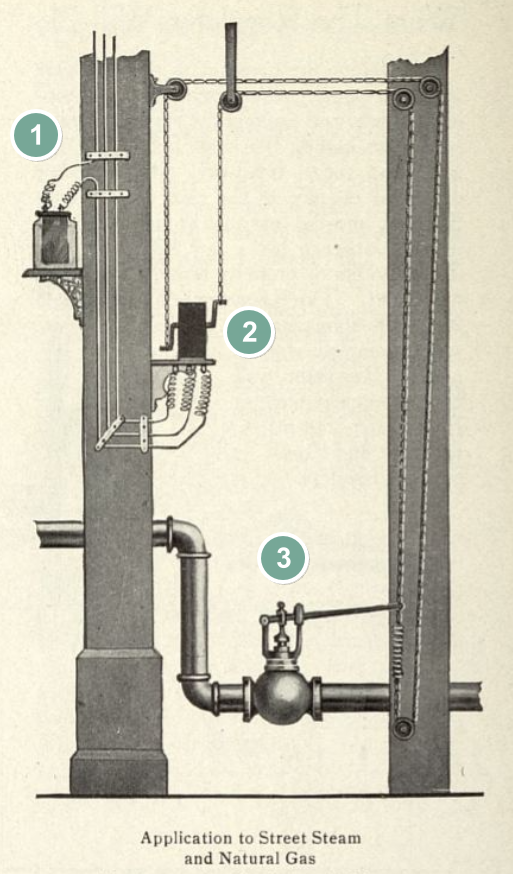
I have also added a little movie of my gizmo running.
0






Categories
- All Categories
- 87.8K THE MAIN WALL
- 3.3K A-C, Heat Pumps & Refrigeration
- 60 Biomass
- 430 Carbon Monoxide Awareness
- 133 Chimneys & Flues
- 2.2K Domestic Hot Water
- 6K Gas Heating
- 124 Geothermal
- 170 Indoor-Air Quality
- 3.9K Oil Heating
- 79 Pipe Deterioration
- 1.1K Plumbing
- 6.7K Radiant Heating
- 396 Solar
- 16.1K Strictly Steam
- 3.5K Thermostats and Controls
- 56 Water Quality
- 51 Industry Classes
- 51 Job Opportunities
- 18 Recall Announcements