Stop steam vent whistling

But for those that are bothered by it, there's an easy fix. Acoustically speaking, vents are like miniature flutes. With sufficient air velocity, they will resonate at three frequencies and their harmonics, related to the length of the orifice cylinder, the circumference of the vent orifice, and the circumference of the surface around that orifice. The orifice dimensions are the dominant components. The smaller the hole, the higher the pitch, and the less audible it willl be (for humans; your dog or cat may have a different opinion...
 ). If any of those three dimensions are close to being integer multiples of each other, their resonance (and harmonics) will add, be much louder, with a more distinctive pitch.
The easy solution is to chamfer (countersink) the hole. This shortens the cylinder and makes the transition from the orifice into free air happen gradually, i.e. over a range of frequencies, like I've done to the MoM screw-in valve shown below. On this valve, I enlarged the hole with a 5/64" drill bit, which makes it a "#5.5", in between a #5 and a #6, and then countersunk the flat top with a 7/16" drill bit. This small countersink is sufficient to turn a whistle into a hiss.

1950 Bryant boiler in a 1-pipe steam system at 7,000 ft in northern NM, where basements are rare.


Comments
-
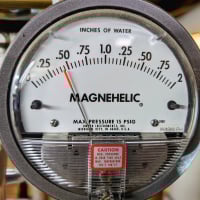
The better solution might be to keep the system pressure down, below a pound or so that the air/steam velocity is low enough to avoid whistling or hissing. That may mean resetting and/or calibrating the Pressuretrol and making sure the pigtail is clean and open so that the Pressuretrol can see the system pressure and manage it.
 1
1 -
My Gorton vent's still make some noise even at 2 oz when venting the cool air with three big mouth main vents. I think they would be quieter if the hole was on the top instead of the side as I think the side hole gives a flute/organ effect. I didn't hear anything with Ventrites but my system is much more responsive with larger Gorton's so I am happy to live with a little non-offensive noise.
Maybe I just made the case for MoM but I still think Gorton's are better quality. Just my opinion.0 -
Not really. My system shows no measurable pressure at any point in the cycle.Fred said:The better solution might be to keep the system pressure down, below a pound or so that the air/steam velocity is low enough to avoid whistling or hissing.
1950 Bryant boiler in a 1-pipe steam system at 7,000 ft in northern NM, where basements are rare.
0 -
Fred,Fred said:The better solution might be to keep the system pressure down, below a pound or so that the air/steam velocity is low enough to avoid whistling or hissing. That may mean resetting and/or calibrating the Pressuretrol and making sure the pigtail is clean and open so that the Pressuretrol can see the system pressure and manage it.
Please read his post again.
except air being drawn in through open vents at the end of a cycle.
Not to mention if pressure is high enough to make a Pressuretrol of any kind "see the pressure and manage it" it's too high to be silent and most certainly will make some sound.
From what I recall, both Hoffman and Gorton vents will produce noise at 1/4 PSI.Single pipe 392sqft system with an EG-40 rated for 325sqft and it's silent and balanced at all times.
0

Categories
- All Categories
- 87.8K THE MAIN WALL
- 3.3K A-C, Heat Pumps & Refrigeration
- 59 Biomass
- 430 Carbon Monoxide Awareness
- 129 Chimneys & Flues
- 2.2K Domestic Hot Water
- 6K Gas Heating
- 124 Geothermal
- 170 Indoor-Air Quality
- 3.8K Oil Heating
- 79 Pipe Deterioration
- 1.1K Plumbing
- 6.6K Radiant Heating
- 396 Solar
- 16.1K Strictly Steam
- 3.5K Thermostats and Controls
- 56 Water Quality
- 51 Industry Classes
- 51 Job Opportunities
- 18 Recall Announcements