Welcome! Here are the website rules, as well as some tips for using this forum.
Click here to Find a Contractor in your area.
If our community has helped you, please consider making a contribution to support this website. Thanks!
issue with goodman rooftop heating

We are having an issue with a Gas fired goodman rooftop unit that is about 15 years old. both the flame sensor and circuit board have been replaced. The issue is at times there is no micro amps being sent back to the board, then obviously the unit locks out, and does not heat. All electrical connections are clean, and the flame sensor's wire is good. A few weeks ago the unit was doing it repeatably while we were on site. You can see the flame sensor is directly in the flame path, but was reading 0 ua. We ran some ground wire from the board's ground to the unit's main ground lug, and the unit seemed to work for a while, until today. Th heat exchanger was checked recently , and appears to be in good shape, no cracks. Has anyone else experienced an issue similar to this issue? Does not necessarily have to be with goodman, where the flame sensor is in direct line with the flame, but no micro amps is read?
Thanks to all
Comments
-
Almost certainly you still have an intermittent bad connection somewhere in there. Any flame sensor of that type is appallingly sensitive to poor connections.
It could also, of course, be a fault in the flame sensor itself — there's no law that says they never have an internal intermittent…
Br. Jamie, osb
Building superintendent/caretaker, 7200 sq. ft. historic house museum with dependencies in New England0 -
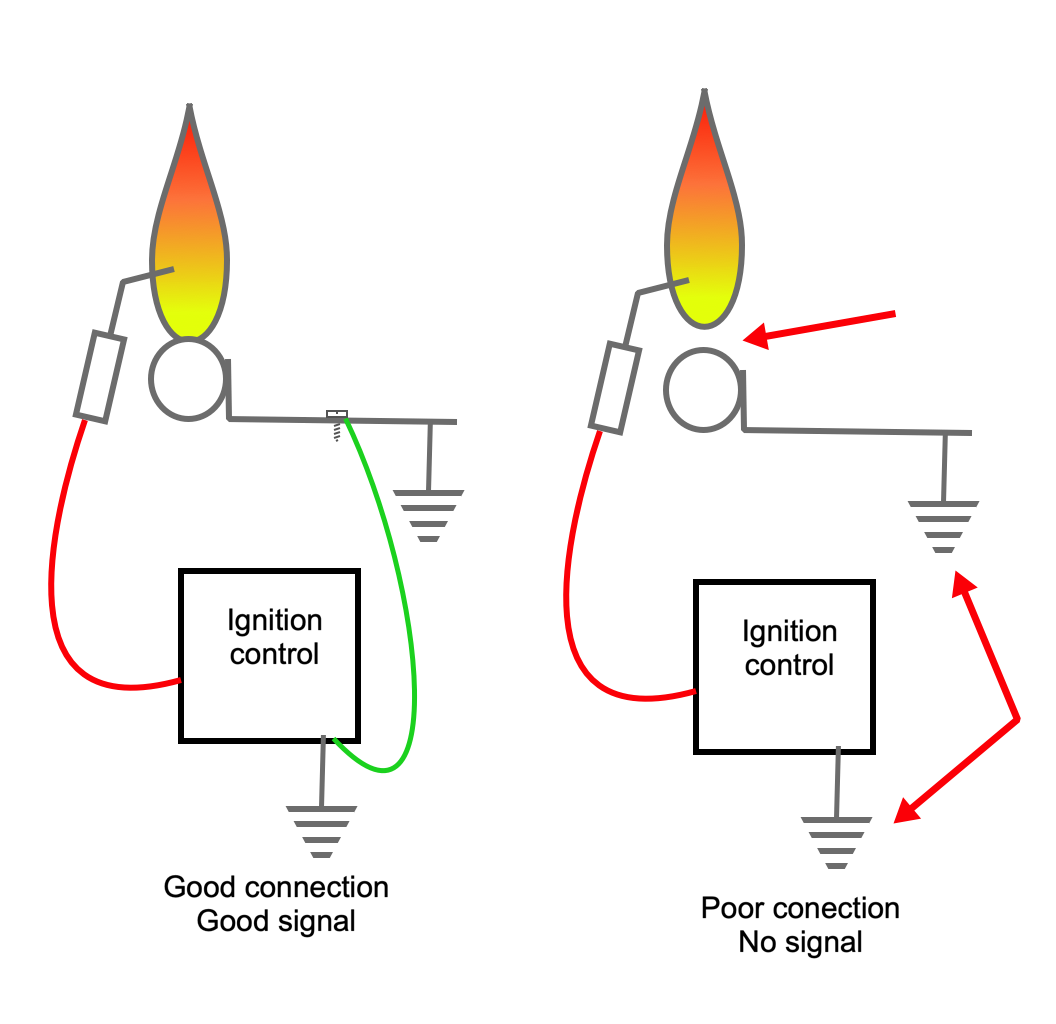
Fifteen years on the roof can lead to corrosion between the screws and metal panels that form the ground path from the flame sensor back to the control.
The flame-rectification current starts out as a microamp AC signal that is sent to the flame rod. The flame acts as a rectifier, converting the AC current into a DC current that passes to the equipment chassis near the burner, where the flame sensor is located.
Look closely at the condition of the metal in that area. Is there any sign of rust or corrosion? Is there a clear path for the DC current to return to the control's ground terminal without having to pass through a corroded or rusted metal-to-metal connection?
I see in your statement that you added a ground wire somewhere at the "main ground lug." What about running that ground wire from the control directly to a location at the burner, close to where the flame is positioned in relation to the flame rod?
The physics of flame rectification indicates that the flame rod should be completely immersed in the flame, and the receiving surface (the burner chassis) should have an area many times larger than the flame rod. In fact, the effective receiving area can be as much as 10 times larger.
If the flame is actually lifting off the burner and is not in contact with the burner assembly, the flame-rectification signal may not have a reliable path from the flame rod, through the flame, to the burner chassis and back to the control. Without that completed electrical path, the control may not reliably prove the presence of flame.
Edward Young Retired
After you make that expensive repair and you still have the same problem, What will you check next?
1 -
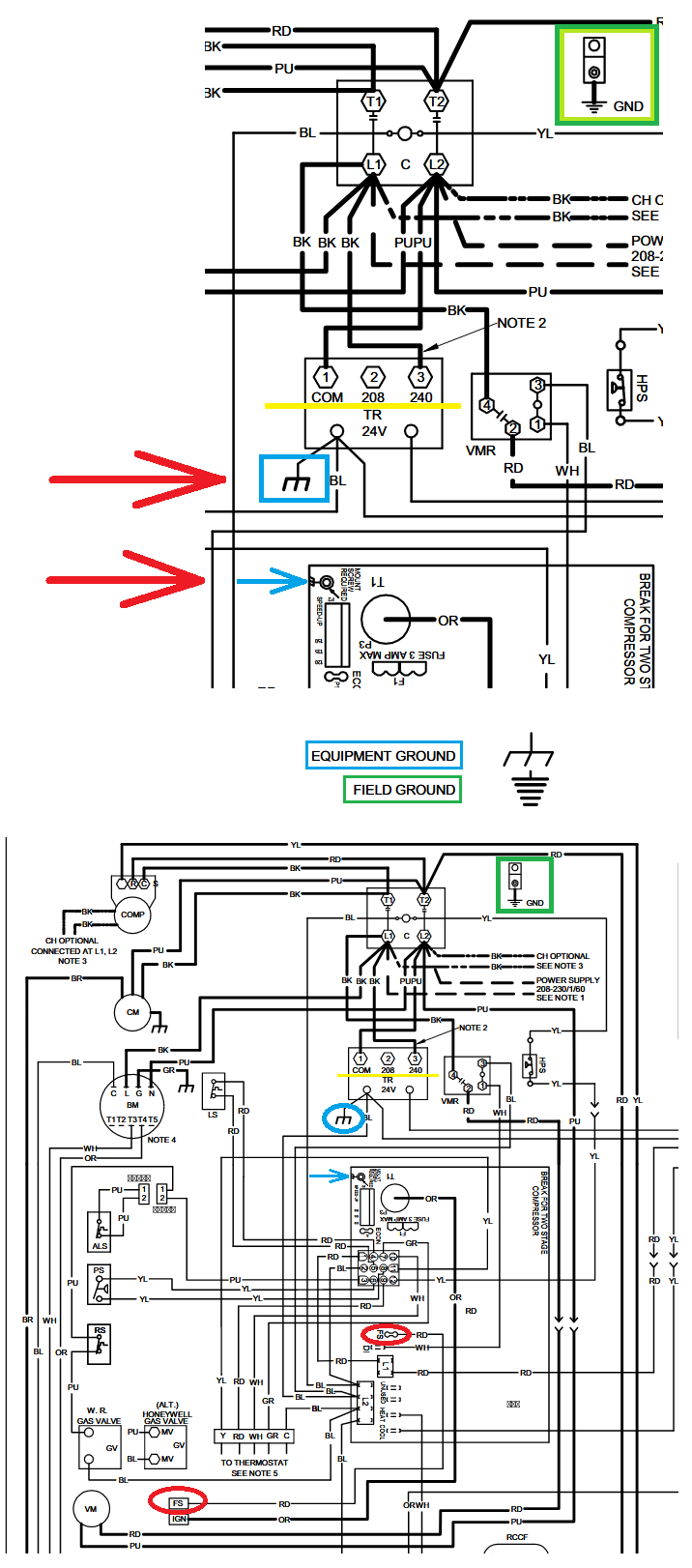
Maybe not the same Goodman as yours but it will server as an example. Bonding the burner to the GND (Field Ground) (Green annotation) may not help any.
I'd be curious about the integrity of the Equipment Ground (Blue annotation), since that probably is part of the Flame Rectification current path. See Red arrows. The cabinet / chassis probably bonds the two Grounds together.
If I was to add a wire to enhance the Flame Rectification ground side current path I would connect it between the burner and the screw at the corner of the control board.
 National - U.S. Gas Boiler 45+ Years Old
Steam 300 SQ. FT. - EDR 347
One Pipe System

 4
-
I have had issues with the reticfication. Its a common issue. Small current and finicky. Other than checking and rechecking connections and cleaning and scraping I got nothing.
The only other thing is make sure the line voltage connection and the line voltage is up to snuff (not low voltage)
People sometimes forget
If the line voltage is low, ignition transformer output is low, flame currents will be low. It can drag anything down.
2 -
What @109A_5 said is exactly what I was trying to say. He said it much more detailed.
Edward Young Retired
After you make that expensive repair and you still have the same problem, What will you check next?
0 -
more specifically i would connect a bare copper wire(so it wouldn't have insulation to burn in the heat of the burner) with a ring or spade terminal between the pilot burner and the ignition control. maybe put a little silicone grease between it and the pilot burner bracket. make sure the pilot burner is making a good connection to the bracket too.
0 -
but don't use dielectric grease to make up the connections! Fine to put around the connections after they're made up — but dielectric grease is specifically intended to be a good insulator — which is exactly what you DON'T want!
Br. Jamie, osb
Building superintendent/caretaker, 7200 sq. ft. historic house museum with dependencies in New England0 -
15 years for a RTU is a great life.
check that heat exchanger0 -
it technically is an insulator but it won't be in the spots where the metal is contacting, it will push out at the microscopic level. it will just keep air and moisture out of the interface between the parts so it doesn't corrode. it is pretty common to pack connections with silicone grease to keep them from corroding.
0 -
optimist. I've run into more than one hopelessly glitched connector on a vehicle and discovered that the glitch was the dielectric grease which someone had gotten in there.
Great stuff. For what it is intended.
If someone has managed to get some on the connecting surfaces, you can usually get it off with some acetone followed by DeOxit or similar.
Br. Jamie, osb
Building superintendent/caretaker, 7200 sq. ft. historic house museum with dependencies in New England0 -
As far as silicone grease, I believe @Jamie Hall and @mattmia2 both have reasonable points. You want to keep the environment out of the electrical connection.
The issue the way I see it is the contact pressure. Assembling a ring terminal that the securing hardware is torqued to provide a reasonable contact pressure it will probably displace the silicone grease enough to make a reasonable connection. With automotive and other small connections that often have pin fitment issues without a foreign material being involved, the silicone grease should be used to seal the connector body and not introduced into the electrical pins.
National - U.S. Gas Boiler 45+ Years Old
Steam 300 SQ. FT. - EDR 347
One Pipe System0 -
if the metal isn't touching it isn't going to make a connection with or without grease. the grease isn't any more of an insulator between the parts that aren't touching than the air is. if you find a connector packed with grease that is failing it is likely because someone had a problem and didn't correct the underlying issue, they don't usually come from the factory that way, someone was in there before for some reason.
0


Categories
- All Categories
- 87.9K THE MAIN WALL
- 3.3K A-C, Heat Pumps & Refrigeration
- 60 Biomass
- 430 Carbon Monoxide Awareness
- 136 Chimneys & Flues
- 2.2K Domestic Hot Water
- 6K Gas Heating
- 124 Geothermal
- 170 Indoor-Air Quality
- 3.9K Oil Heating
- 80 Pipe Deterioration
- 1.1K Plumbing
- 6.7K Radiant Heating
- 397 Solar
- 16.2K Strictly Steam
- 3.5K Thermostats and Controls
- 56 Water Quality
- 52 Industry Classes
- 51 Job Opportunities
- 18 Recall Announcements