Welcome! Here are the website rules, as well as some tips for using this forum.
Click here to Find a Contractor in your area.
If our community has helped you, please consider making a contribution to support this website. Thanks!
Gurgling from old expansion tank

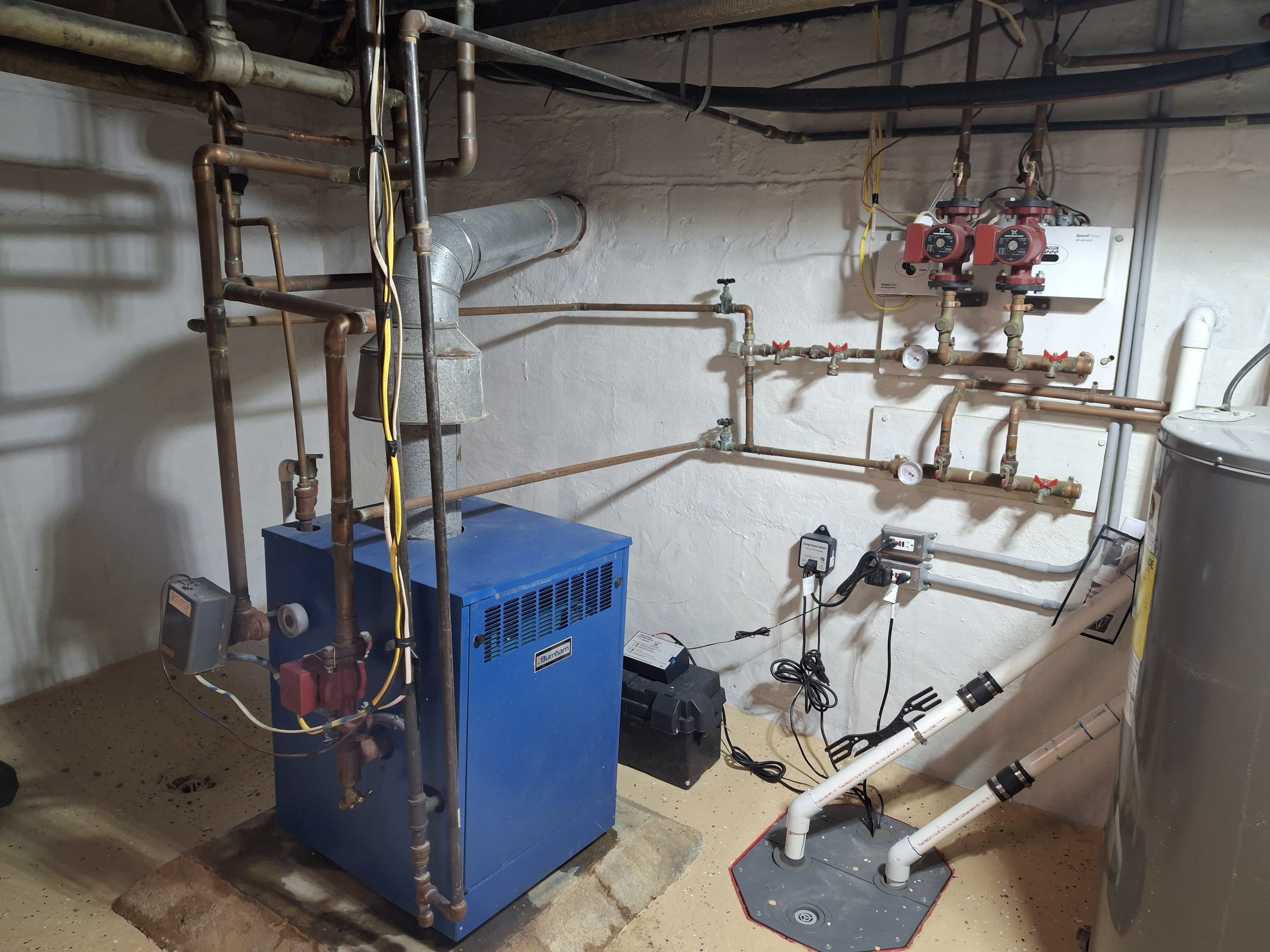
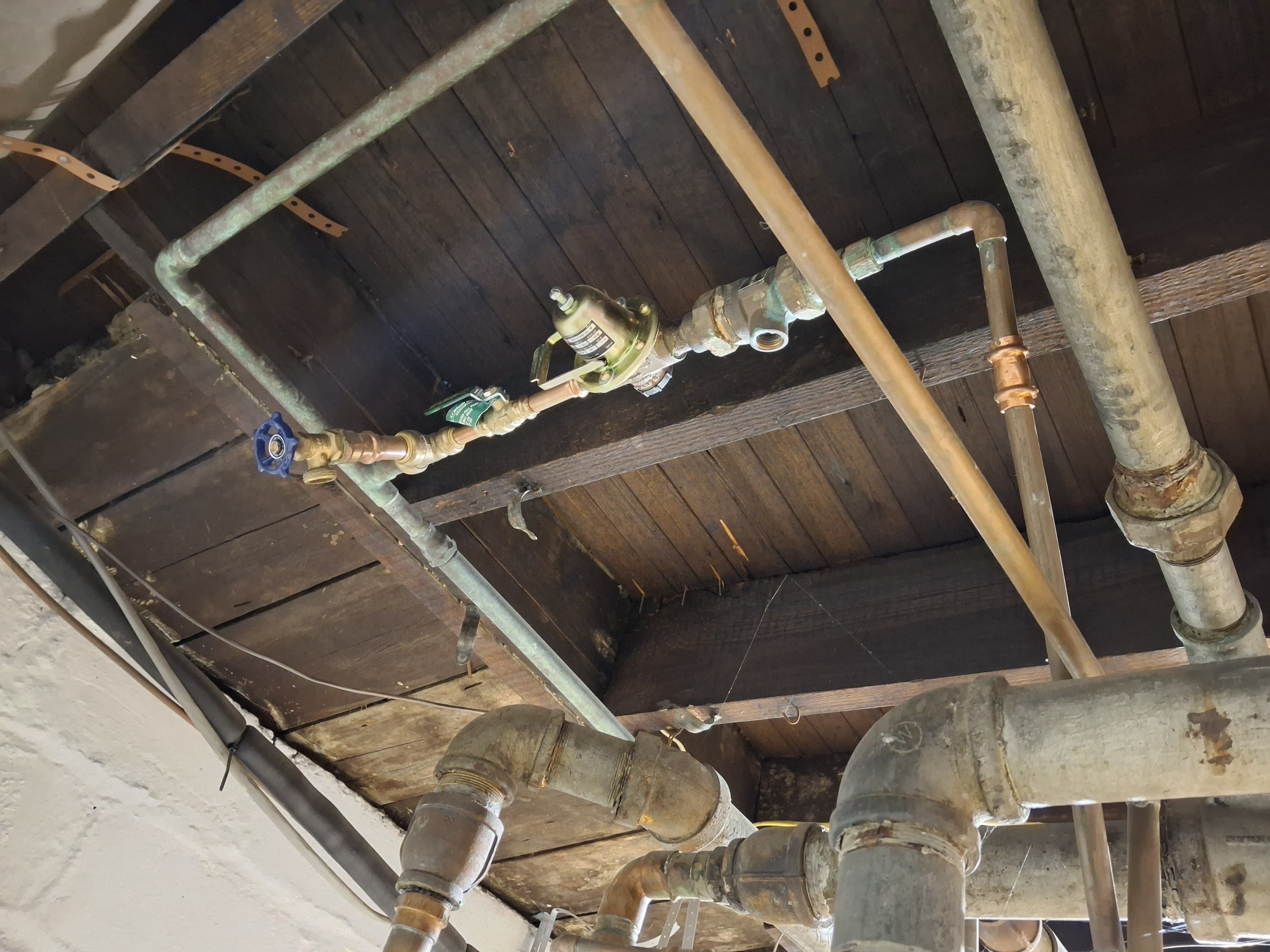
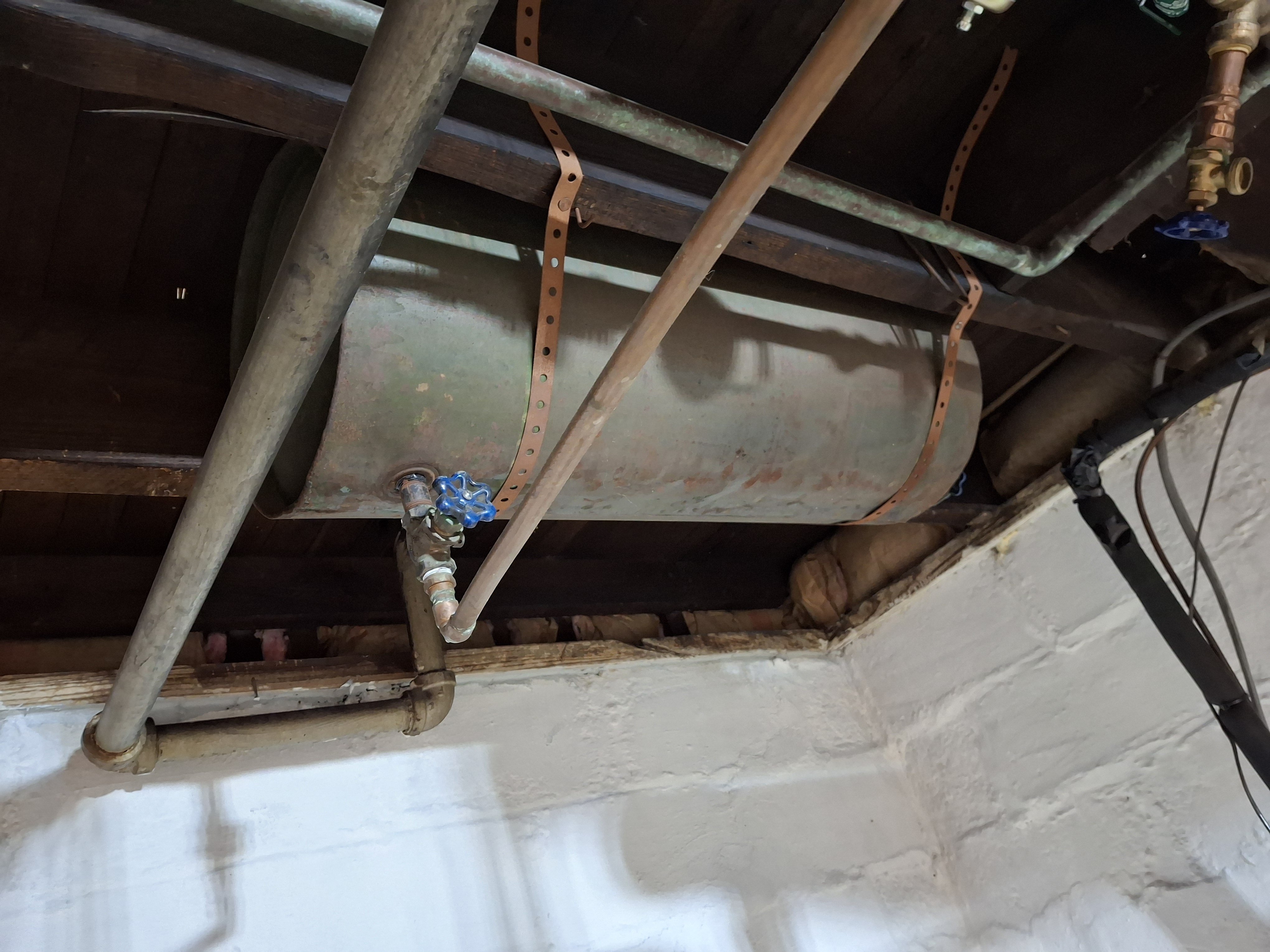
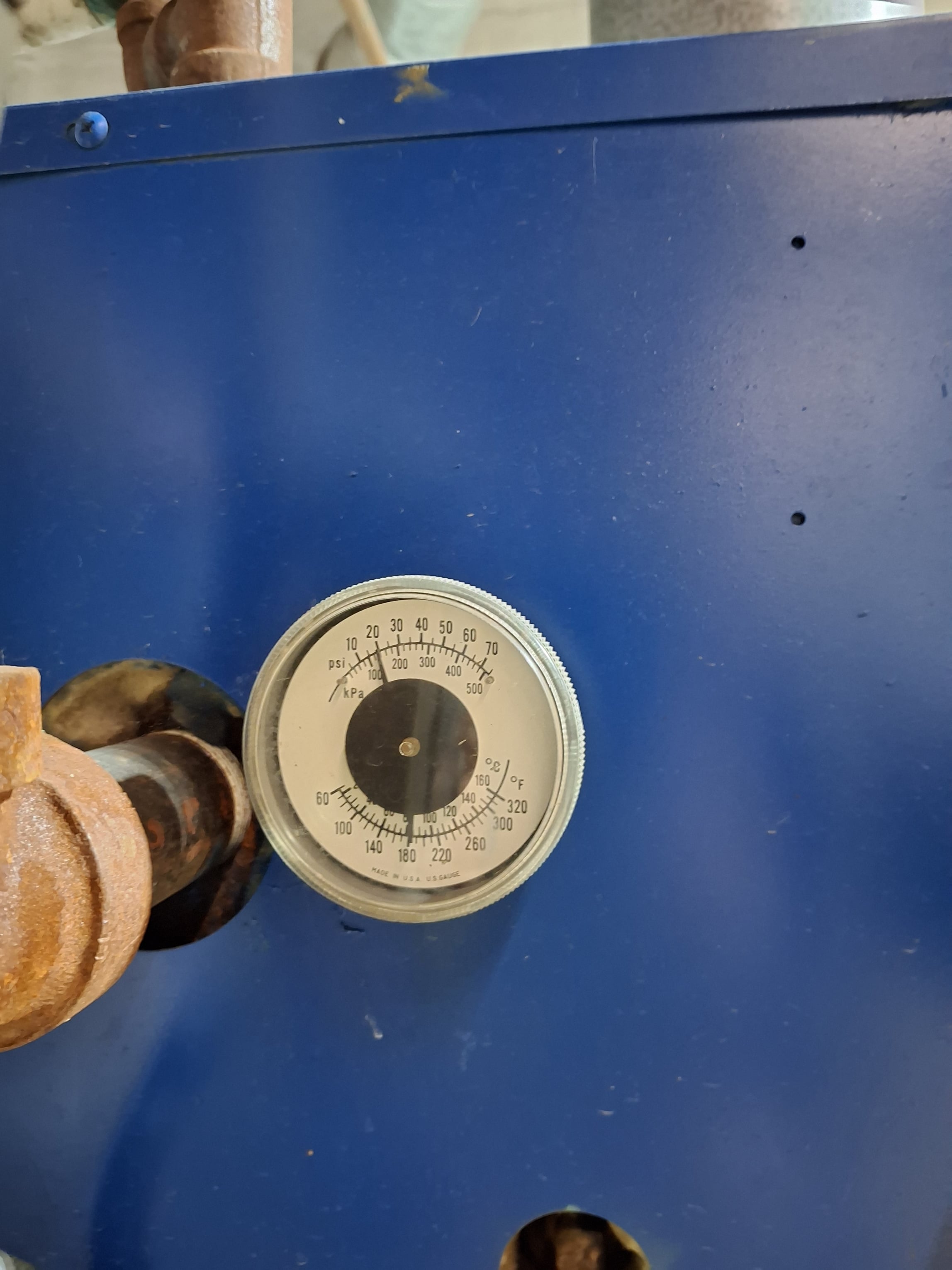
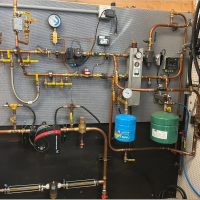
I have a 1920s house with cast iron radiators. When I turned the system on this week for the first time this season and it got up to temp, I heard gurgling/bubbling coming from the old expansion tank. The tank is so old, I wouldn't be surprised if something inside it has failed, but I don't know if it even has anything inside it to fail. Does it have a bladder in it like more modern tanks or is it just an open space inside? If it does have a bladder, should I assume it has failed and I need a new tank? If it is just a tank without a bladder, what is causing air to bubble inside like this? Has something else in the system failed? Will it blow a hole in the tank or something catastrophic like that?
A few things to note:
- I have been using the system as it is for the past 20 years with no issues.
- Water pressure hasn't changed (it's always been pretty high)
- Water on the floor in one of the pics is from me flipping the pressure valve on the boiler to see if that helped
- Radiators are giving off heat as they should throughout the house, so I assume the pumps are working properly (there are 3, one on the boiler for the radiators and two for additional underfloor heat system that I installed 20 years ago
- I bled all radiators — none had air in them. No way to see if there's air in the underfloor heating tubing.
Thanks to anyone who can help.
Gavin
Comments
-
It's just a big tank with nothing but air and water in it. Probably mostly water. Over the years they get waterlogged and should be drained.
Their purpose is to allow the correct pressure both when the system is cold and also when the system is hot when the water expands.
But good luck finding a plumber who understands that. They only understand bladder tanks (or do they!??!) One person on this forum had 3 plumbers come in to discover why her pressure was always high with prv dripping and none of them could figure it out. She had already paid for a new PRV and autofiller thing to be installed with no improvement to the problem.
Out of desperation she contacted me. We drained her tank which was exactly like yours and she never had another problem. It takes a long time to drain them because back then they didn't allow for air to easily displace the draining water, but in an hour or two you can drain it.
She had a separate drain valve on hers which makes it much easier.
Beware plumbers who tap on the tank and tell you it's not waterlogged. Hers was completely full of water yet some old plumber (this is not an insult, I am old myself, but an old plumber should know better) thought he could tell from tapping if a tank was full. He couldn't.
NJ Steam Homeowner.
See my sight glass boiler videos: https://bit.ly/3sZW1el0 -
Hello GAVNCATS,
Is that one inch galvanized pipe connected to side of the steel compression tank????
Please have a plumber come and install a Bell & Gossett ATF12 Airtrol valve to replace the existing connection to your steel compression tank.
The ATF12 Airtrol valve allows the proper amount of air and water to enter the steel compression tank. after the water starts squirting from the drain valve you shut it off and leave it off and the air charge remains in the steel compression tank.
The plumber will be able to reuse the same copper feed line with an extra 15 degree elbow to create the slope needed to allow bubbles to rise to the steel compression tank to be absorbed in the water.
The Bell& Gossett Drain-O-Tank air charger valve also does this as well but it requires a separate water connection to the steel compression tank.
The ball valve that feeds water to the Boiler through the back flow preventer and fast fill valve MUST BE SHUT OFF AND LEFT OFF!!!!!!!!! I cannot emphasize this enough as the steel compression tank will become flooded waterlogged and the point of no pressure change will be lost.
IF you have no leaks in your heating system you never have to drain the Steel Compression Tank as the air charge blanket over the water level in the steel compression will not be lost.
 0
-
Hi LEONZ!
Thanks for the quick response. No, don't worry, that galvanized pipe goes to one of the radiators not the compression tank. And thank you for correcting my terminology - compression tank not expansion tank. Got it! :-)
Got your ALL CAPS on the ball valve. Message received and I've turned that off! Could that be the reason for the problem in itself? Just too much water in the system?
Easy enough to get the Airtol valve installed, but it doesn't explain why this is happening now when it never has before. What has changed after 20 years that I now need to put a new valve in the system?
And how much water should be in the compression tank anyway, and how do I know if there's too much/too little?
0 -
It's an expansion tank because it takes up the expansion of the hot water. I answered some of your other questions above.
NJ Steam Homeowner.
See my sight glass boiler videos: https://bit.ly/3sZW1el0 -
As @ethicalpaul previously said, you drain the tank. That's it.
The system uses that tank full of air as a pillow to allow for thermal expansion. Yours is full of water, so no pillow.
Well tanks used to be the same.The cool thing is, they never fail unlike bladder tanks.
Single pipe 392sqft system with an EG-40 rated for 325sqft and it's silent and balanced at all times.
 1
-
Doesn't matter whether one thinks of it as an expansion tank or a compression tank (us old fogies tend to thnk compression, but…). Point is it compresses the air in the tank as the water in the system expands… thus holding th epressure more or less constant.
And as @ChrisJ said, they never fail. So long as you start it up full of air when it is first connected to the system,, there's nothing TO fail.
What you don't want to have happen is some brilliant young expert hooking up an air eliminator to your system. You need those for the bladder tanks — but not for compression tanks.
Br. Jamie, osb
Building superintendent/caretaker, 7200 sq. ft. historic house museum with dependencies in New England0 -
The expansion tank absorbs the pressure from the expanding water. It is not intended to keep the pressure stable.
Here is an example. A system that hold 100 gallons of water
temperature goes from 65 degrees, 12 psi to 180 degrees. If you wanted a tank to maintain a 1 psi increase you need a 134 gallon expansion tank.
Most of these sizers assume a 10 psi or more pressure increase.
The Amtrol sizer assumes a 12 psi cold system will increase to 28 psi for their sizing.
A critical size method shown here allows you to plug in the exact numbers.
You tank may have a gallon listed on it,12 gallon is common size
If you knew or estimated the total water volume you could use this Wessel calculator to determine the pressure increase across the temperature range.
But that assumes the tank is pre-charged properly. A waterlogged tank will show a very rapid pressure increase as the boiler heats.
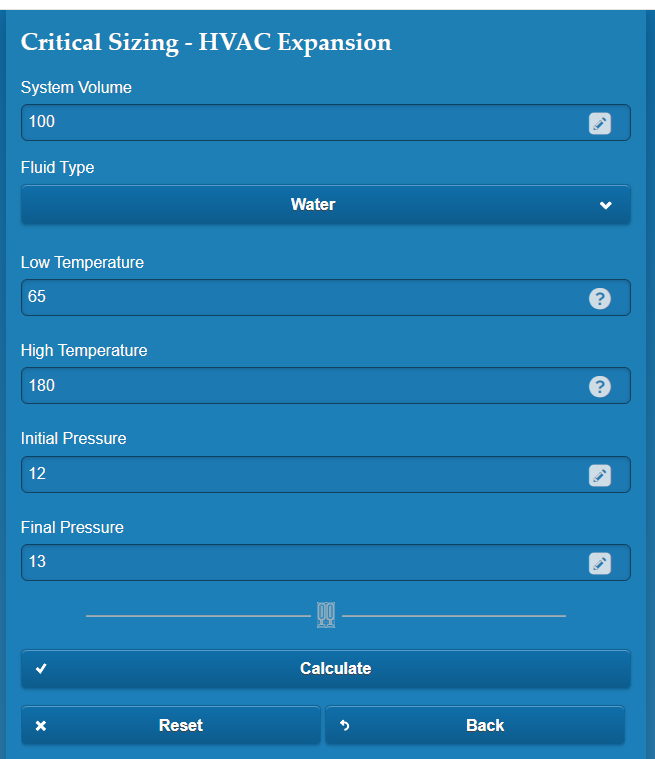
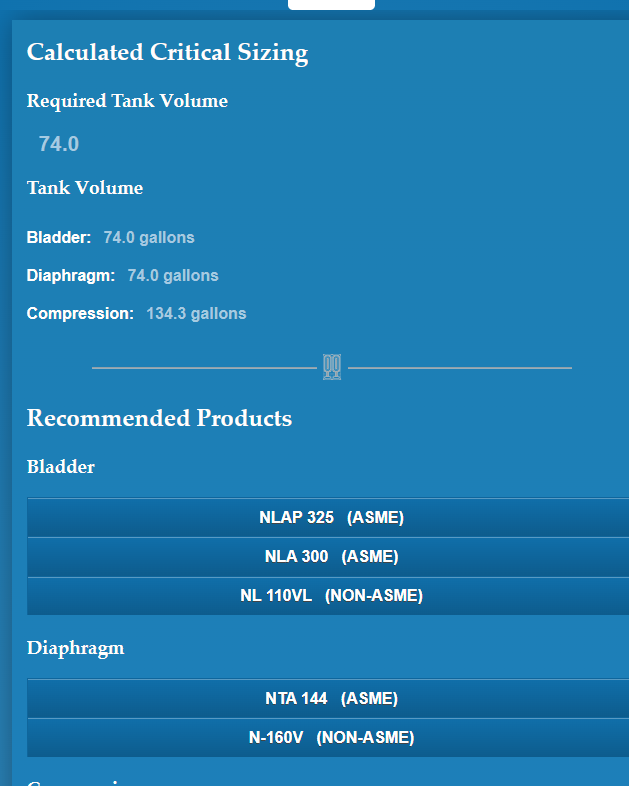
Assume your system holds 100 gallons, for a system pressure increase of 12- 25 psi at 65-180 degrees, a 12 gallon compression tank is about right.
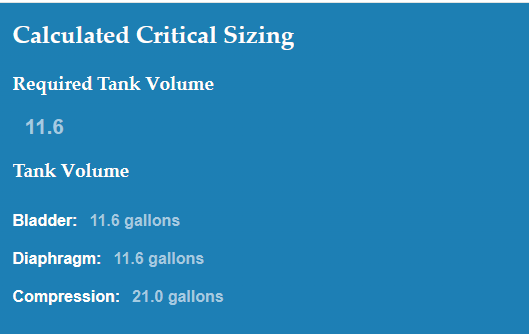
Bladder or diaphram tanks are usually 1/2 the size of compressioin tanks as they have a captive air bubble.
Bob "hot rod" Rohr
trainer for Caleffi NA
Living the hydronic dream0 -
The expansion tank absorbs the pressure from the expanding water. It is not intended to keep the pressure stable.
I didn't say it kept it stable but maybe I was not as absolutely positively accurate as I could have been (although maybe it was accurate enough for the needs here in the forum).
I said:
Their purpose is to allow the correct pressure both when the system is cold and also when the system is hot when the water expands.
I guess I could have said:
Their purpose is to allow your system to work both when the system is cold and also when the system is hot when the water expands. Because without one, one of two states is likely to occur:
1. When the system is cold the pressure will be too low to allow circulation to your higher radiators (and I use this term generally for all radiator types that might be in one's home so that I don't get corrected on this).
or
2. When the system is hot, the pressure is higher than we'd like it to beMaybe Jamie was getting corrected—if so I'll let him defend himself 😅
NJ Steam Homeowner.
See my sight glass boiler videos: https://bit.ly/3sZW1el0 -
I SEE A VERY IMPORTANT MESSAGE HERE.
I have been using the system as it is for the past 20 years with no issues
Water pressure hasn't changed
DON'T CHANGE ANYTHING!
Edward Young Retired
After you make that expensive repair and you still have the same problem, What will you check next?
0 -
I wasn't trying to correct anyone, just giving an opinion on expansion tanks and sizing.
If I were trolling you I would have used the "quote" button :)
Bob "hot rod" Rohr
trainer for Caleffi NA
Living the hydronic dream0 -
@ethicalpaul understands the tank you have, however you may not need to drain that tank as Paul has suggested. You do not have a relief valve leaking problem like his client did.
@leonz is recommending you add a part to a system that has no current problem. I'm against advice like that. Knowing that a part exists that can fix a problem that you are not experiencing does not automatically mean you need that part. @leonz also insists that you MUST leave a valve off or your tank will get waterlogged. This is clearly not your problem and therefore his advice is suspect in this case. Maybe not in every case, but it is in this case it does not apply.
@ChrisJ and @Jamie Hall are spot on with their comments. And I don't see then telling you to do something that you don't need to do or spend money you dont need to spend.
@hot_rod is an expert in this field. He has all the technical answers and the math to prove it. However in this particular case it might be TMI.
Simple explanation is that your system is set up perfectly with the air scoop that is built into the boiler directing any air that accumulates in your system into the expansion tank. This makes it so your expansion tank will never water log. if theere is any air that finds it way to the air scoop portion of the boiler, it will go to the tank where it will do the most good. That is the reason you heard the gurgle of bubbles. the system was self correcting.
Edward Young Retired
After you make that expensive repair and you still have the same problem, What will you check next?
0


Categories
- All Categories
- 87.9K THE MAIN WALL
- 3.3K A-C, Heat Pumps & Refrigeration
- 60 Biomass
- 430 Carbon Monoxide Awareness
- 134 Chimneys & Flues
- 2.2K Domestic Hot Water
- 6K Gas Heating
- 124 Geothermal
- 170 Indoor-Air Quality
- 3.9K Oil Heating
- 80 Pipe Deterioration
- 1.1K Plumbing
- 6.7K Radiant Heating
- 397 Solar
- 16.1K Strictly Steam
- 3.5K Thermostats and Controls
- 56 Water Quality
- 51 Industry Classes
- 52 Job Opportunities
- 18 Recall Announcements