Welcome! Here are the website rules, as well as some tips for using this forum.
Click here to Find a Contractor in your area.
If our community has helped you, please consider making a contribution to support this website. Thanks!
Help with 2 Radiators Not Heating on Hot Water Boiler System!

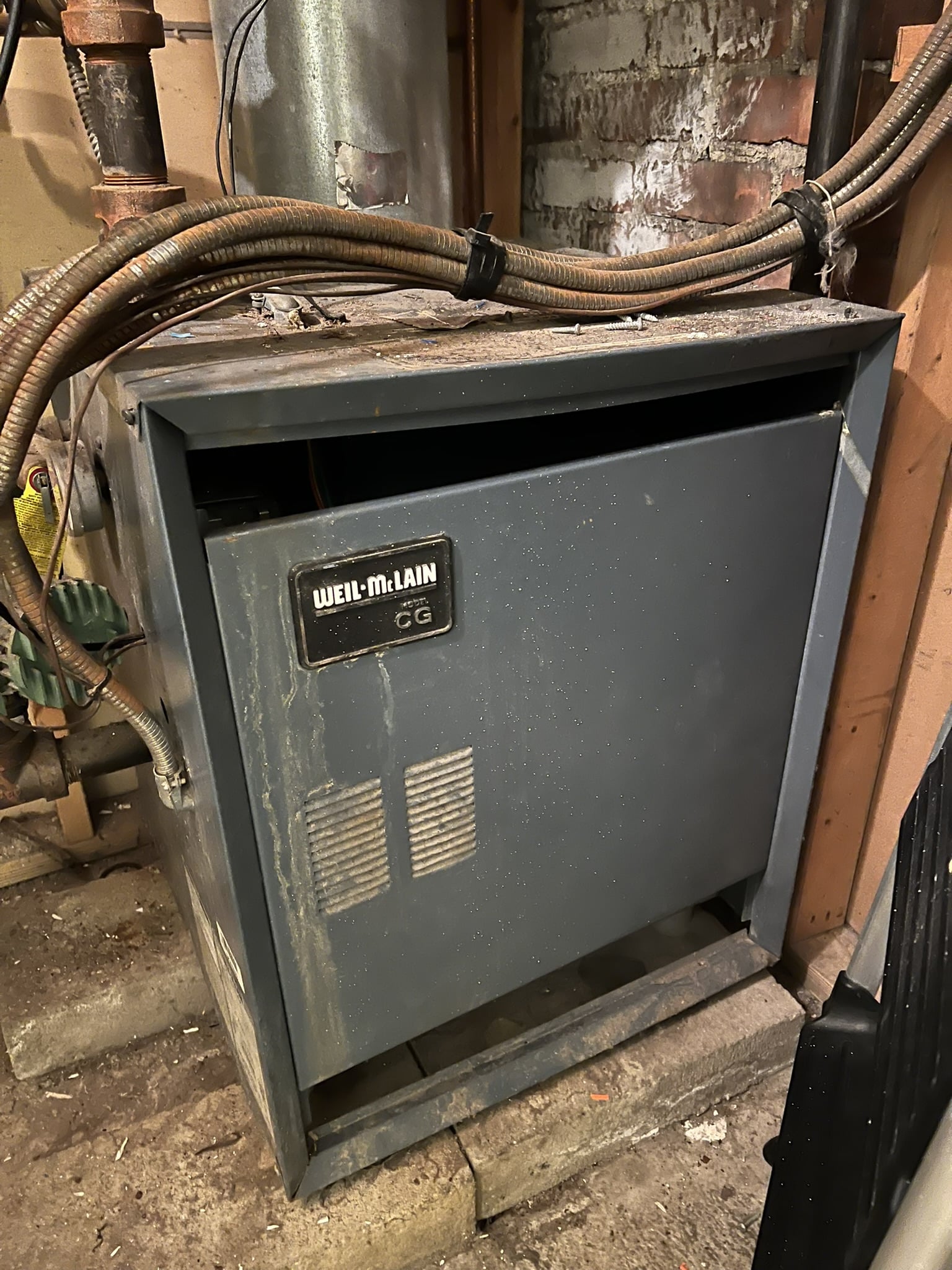
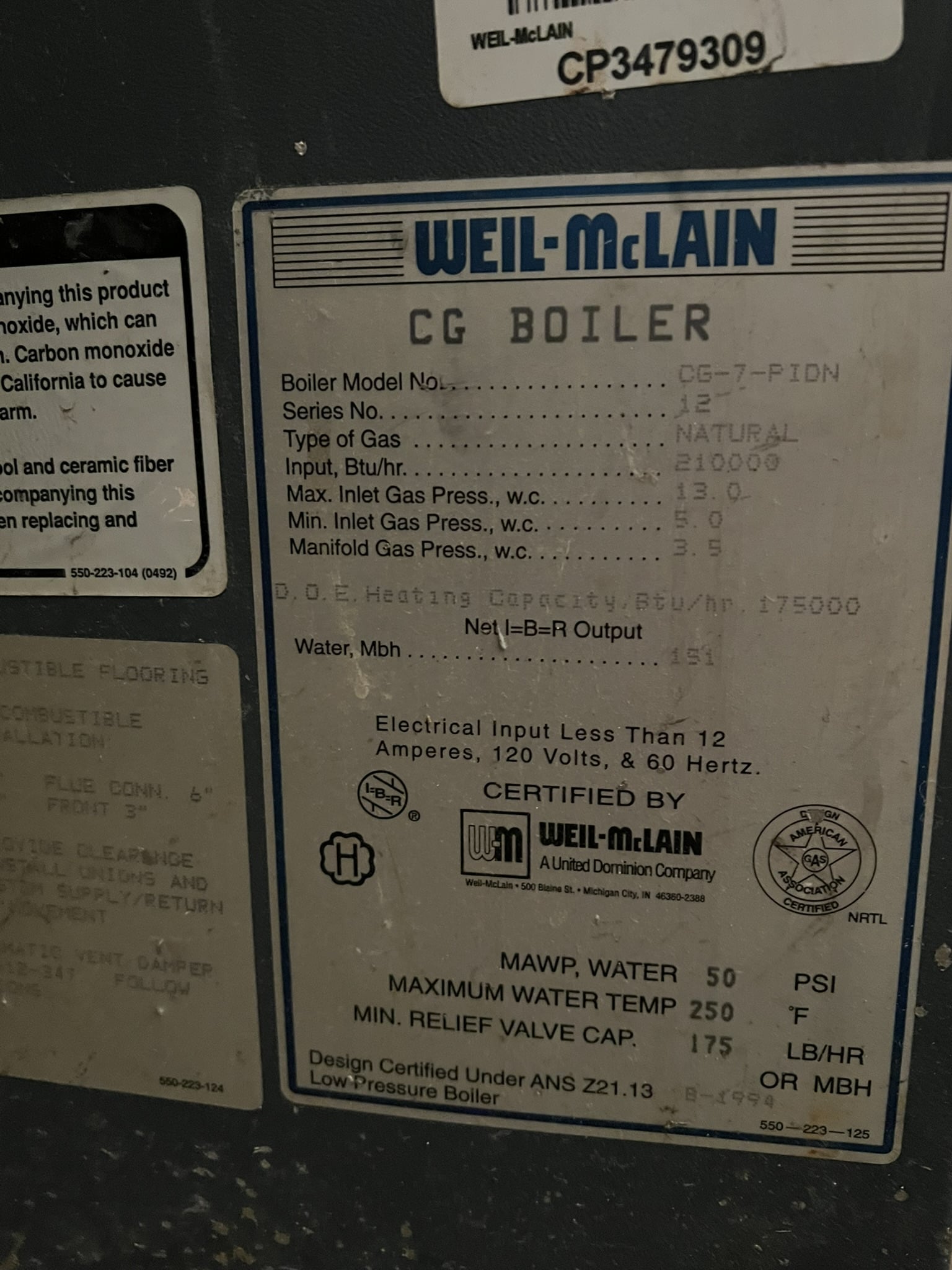
I moved into a house last year with a Weil McClain CG hot water boiler.
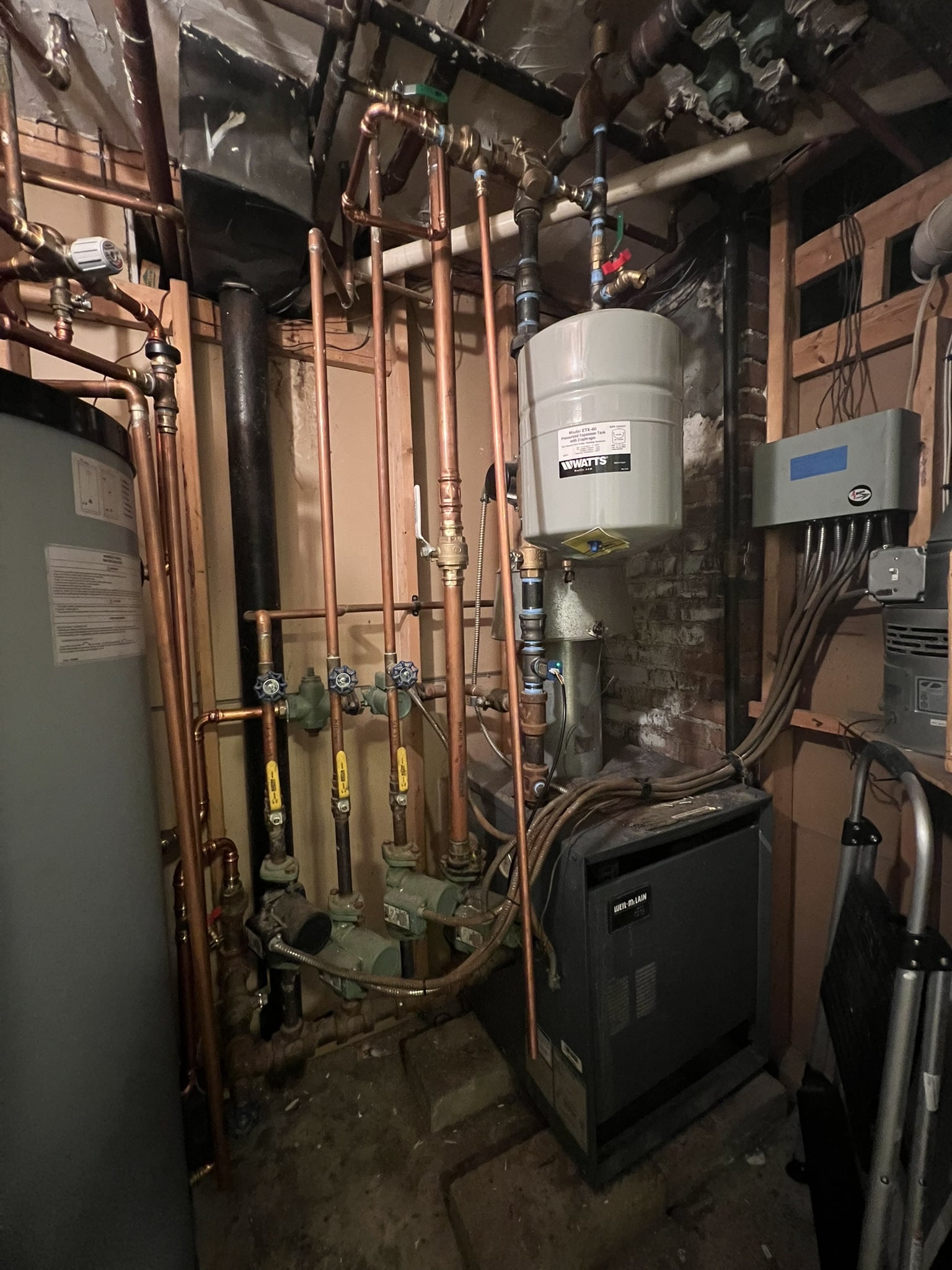
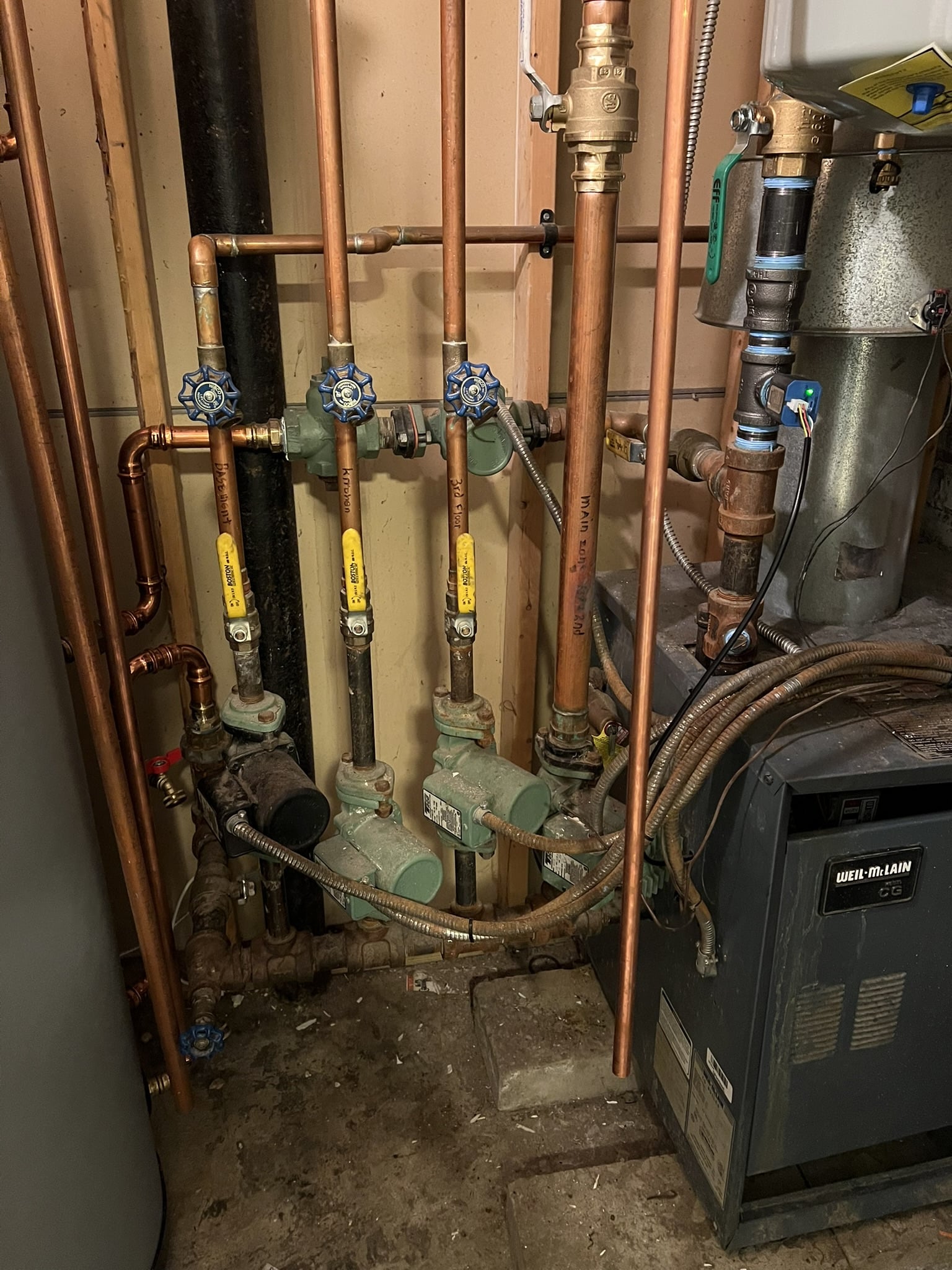
It has 4 heating zones and a domestic hot water zone connected to a
storage tank. The largest heating zone is for the 1st and 2nd floors of the
house and contains 12 cast iron radiators. The other 3 heating zones are for the
basement, kitchen, and attic zones which are all baseboard heat.
Last winter everything heated well and evenly and there really were no
issues. For future ease of maintenance and safety I wanted the heating
company to do a few things:
1. add a few additional ball valve shut offs (one zone didn’t have any
separate shut offs which would make future maintenance like changing a
circulator difficult)
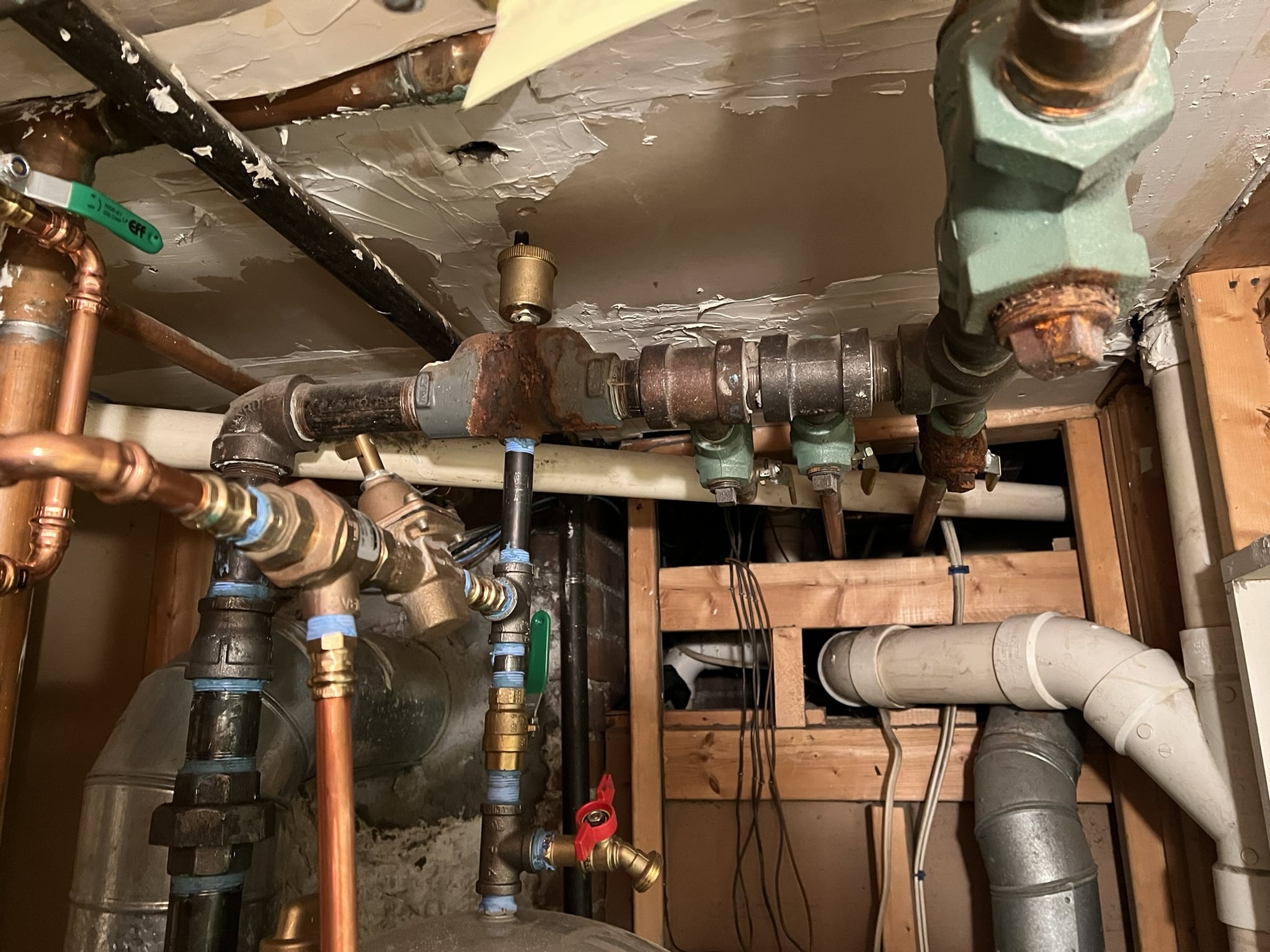
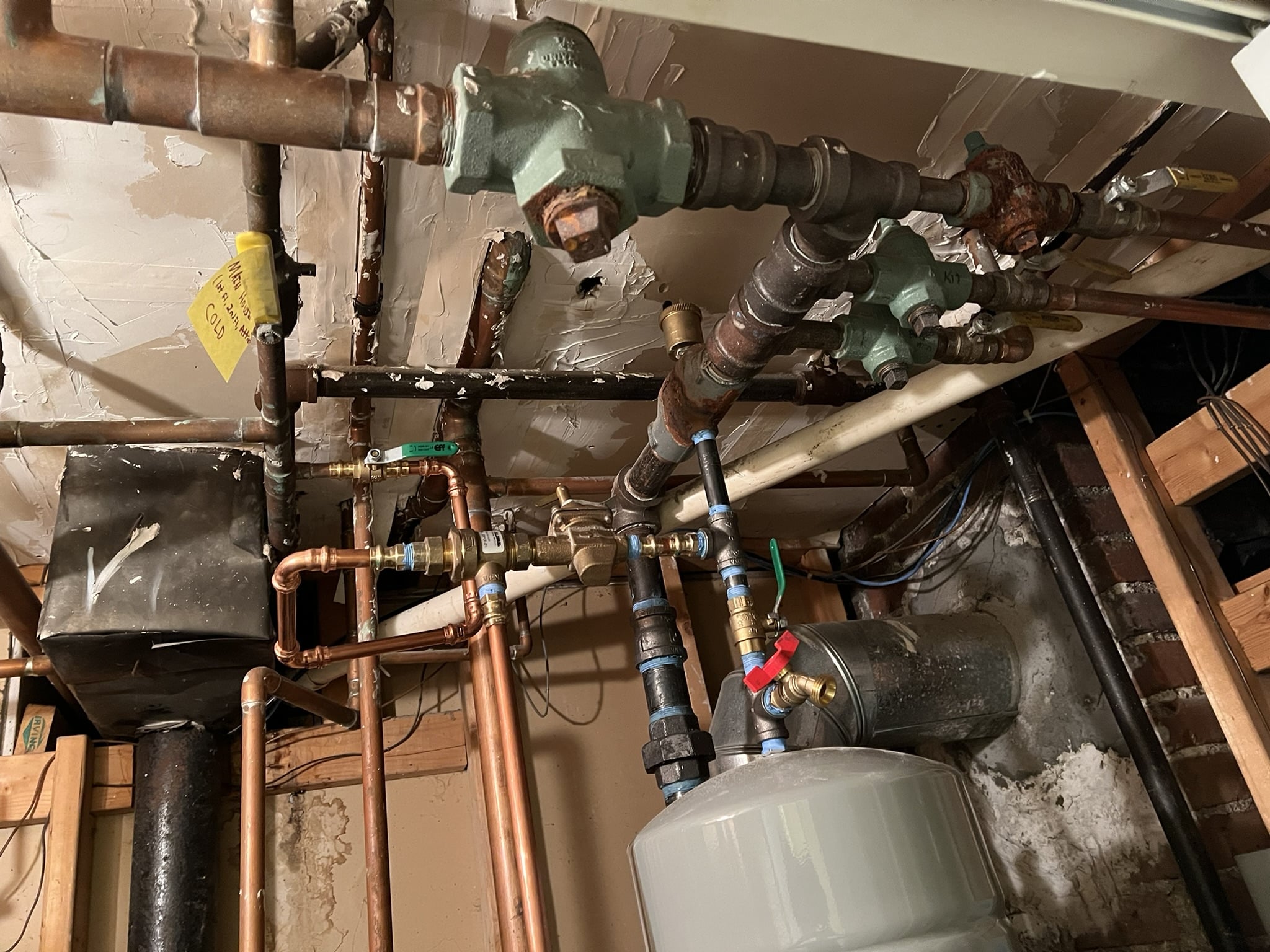
2. add a spirovent for better air elimination (there was a tiny scoop before which was improperly placed)
3. replace the air bleeder valves on the radiators which were painted shut/broken
4. Add a low water cut off device above the boiler.
When they did this work they accidentally ordered the wrong size
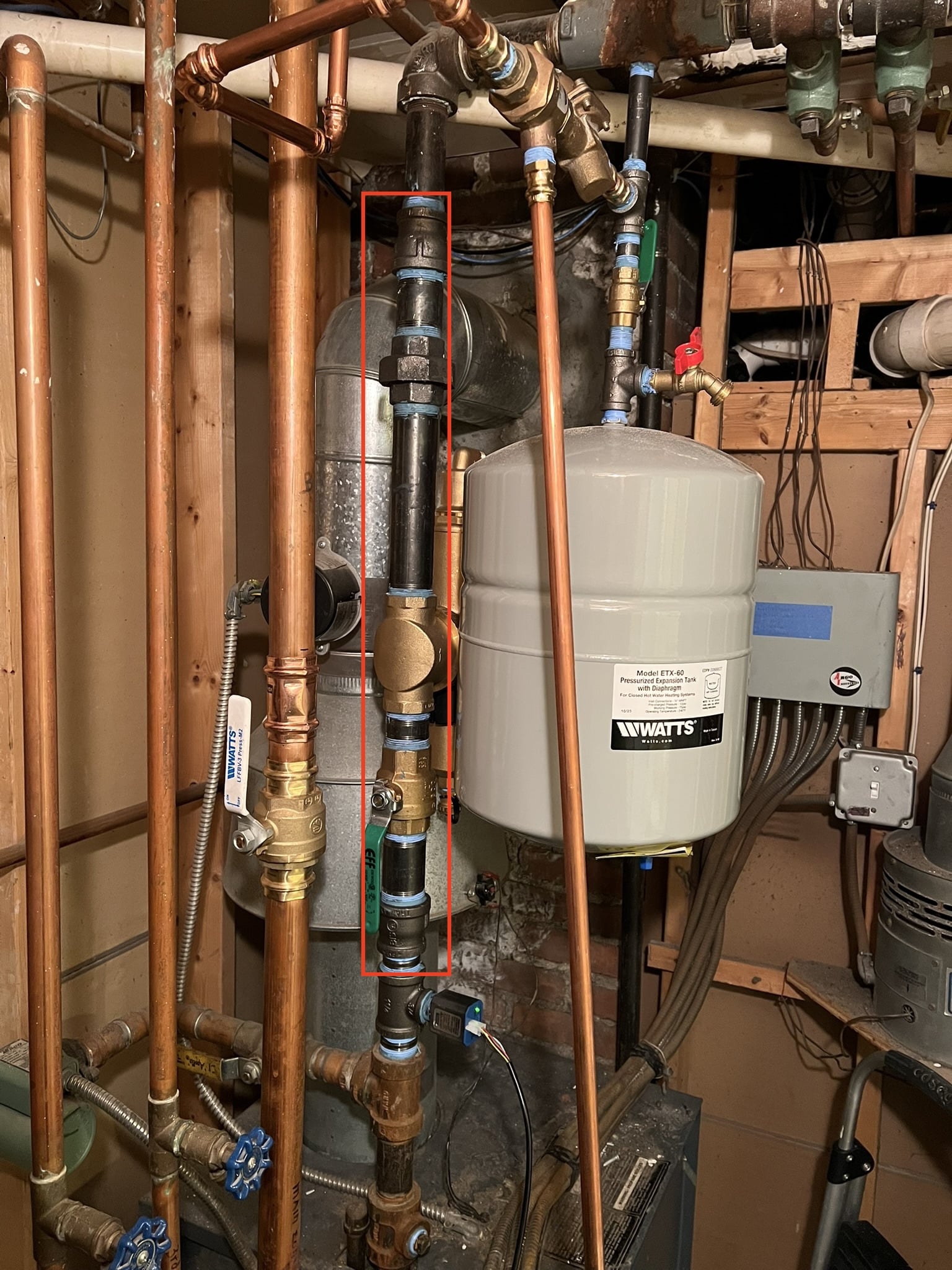
spirovent air eliminator for 1.5” diameter pipe even though the piping coming out of the boiler was 1.25” in diameter. They went ahead and adapted from 1.25” to 1.5” to
add the spirovent air eliminator and then reduced back to 1.25” before
any of the flow checks or take offs to the cast iron radiators.
They had to drain the system to do this. When they connected it all back
and repressurized the system, 2 of the radiators furthest from the
boiler no longer heated well or at all. One radiator gets warm at the
handle, but even after 2-3 hours will not heat. The other radiator will
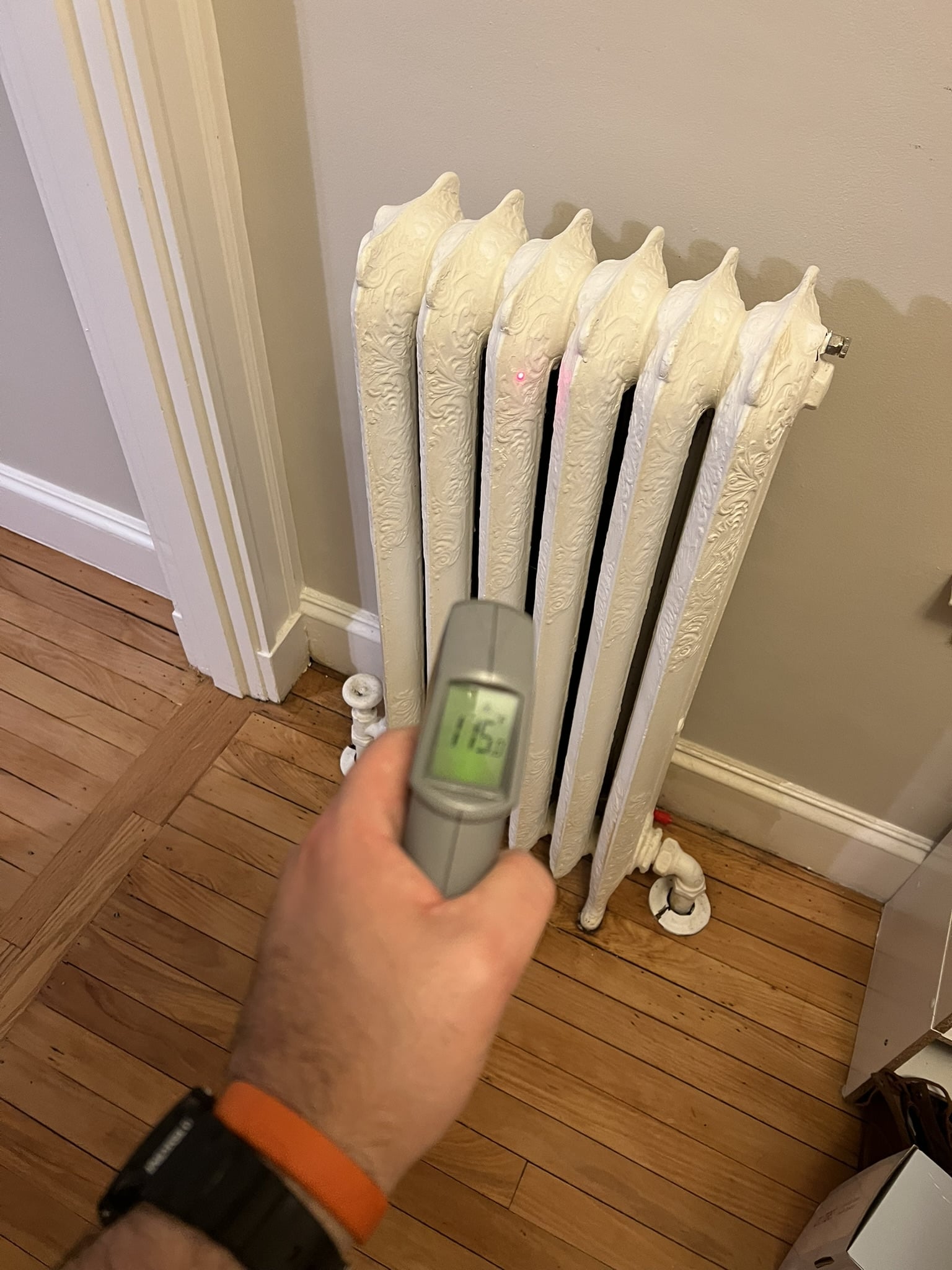
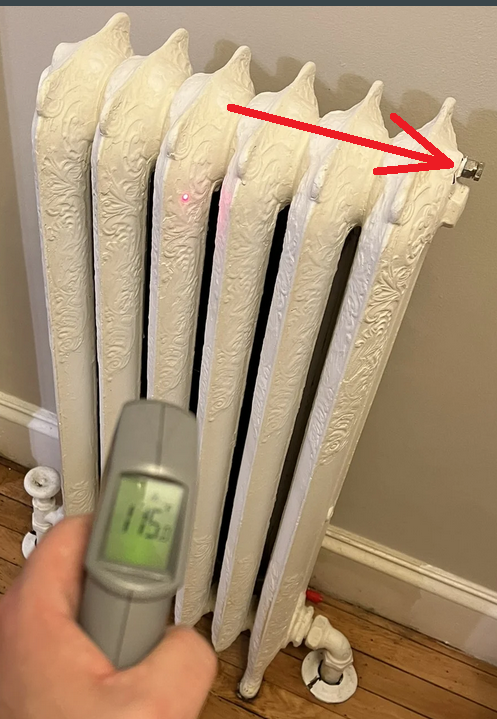
get warm (around 115°) but not hot like the other radiators that work (which all reach
about 155°).
The supply and return pipes to the boiler are all coming back hot which
means the way the cast iron radiator heating zone is piped is not a
simple circuit but I’m guessing has lines that T off of the main line
at different points.
The tech thinks the radiator handles at the non heating radiators may
have disintegrated or have something broken to be causing a problem. The radiator that heats to115° seems to be heating backwards from the return to the supply valve
and the other non-heating radiator isn’t really heating at all - it just gets warm
at the supply valve handle. The tech is suggesting replacing the
radiator valves on the 2 problem heating radiators to fix the issue.
I’m wondering if the problem is the radiator supply valves or instead
the increased 1.5” supply pipe size out of the boiler that is causing
a flow/ short-circuiting issue (or something else I’m thinking of).
Everything was heating well before, which is why this is so frustrating.
What do you all think is going on? Could a 1/4” upsize in diameter of a couple feet of
that supply pipe cause this issue or is more likely to be the individual radiator valves for the 2 problem radiators? Please let me know what you think! Thank you in advance for your help.
Comments
-
I would highly suspect the old valves at the radiators, AFTER making sure they are free of air. You made this statement: "has lines that T off of the main line at different points:" Are these "monoflo T's"? If so, these can be problematic.
0 -
@109A_5 - yes, the techs made sure to bleed all of the newly installed bleeder valves on each radiator (including the problem ones). I even opened one bleeder valve up myself after they left and water squirted right out. There was no air left.
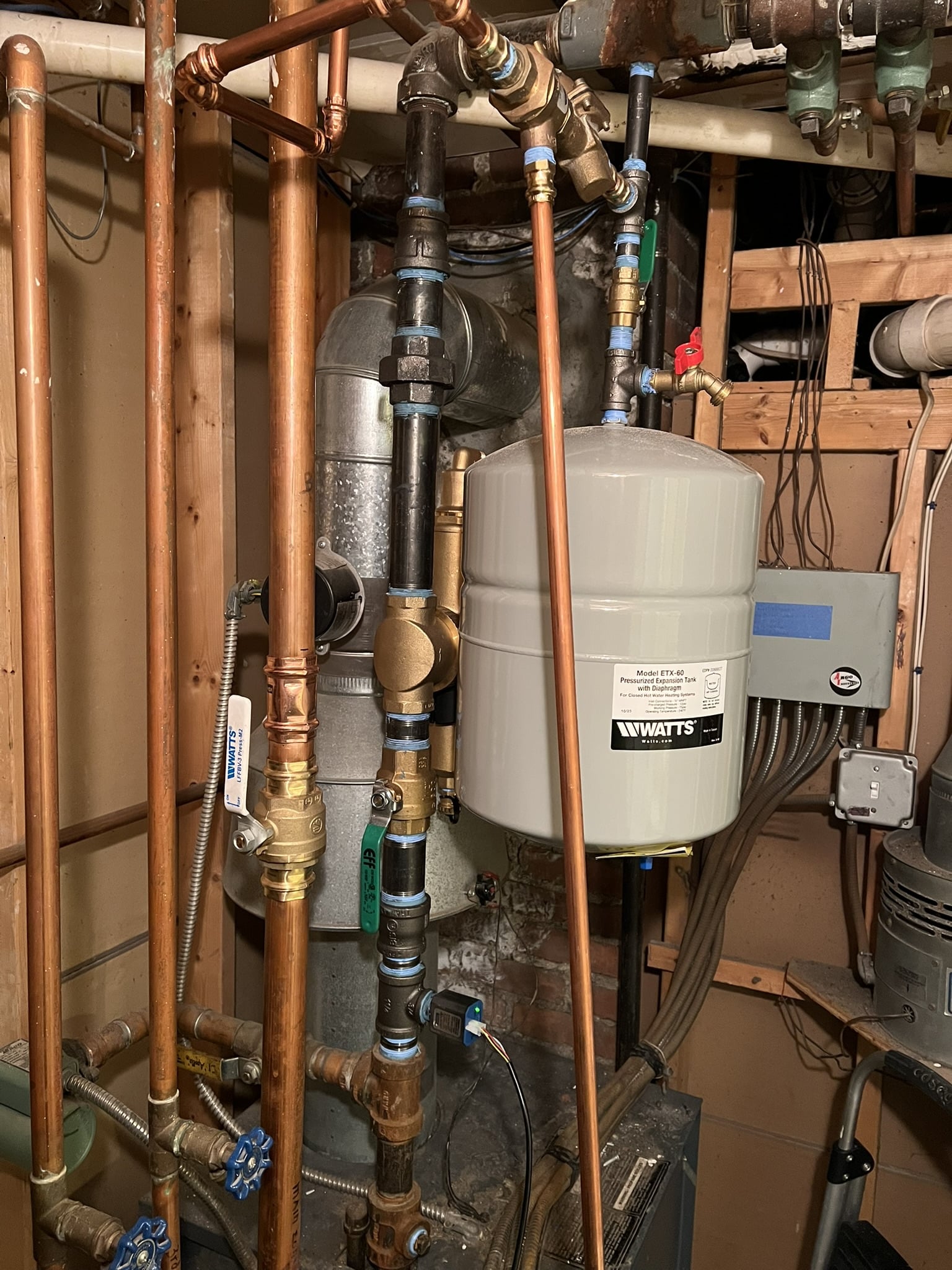
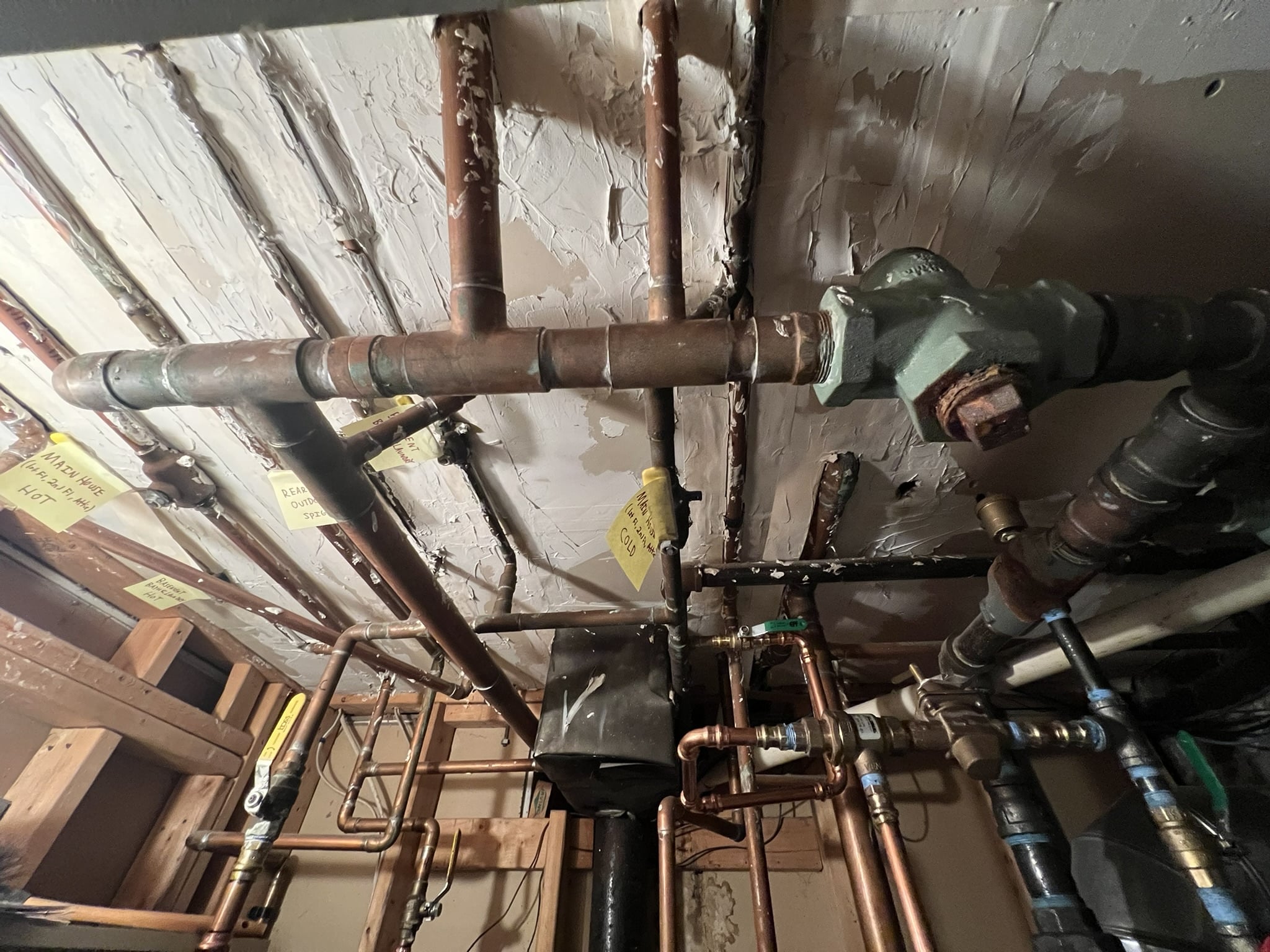
@psb75 - It's confirmed they are free of air from the bleeder valves on the radiators. The main tech said that they are not monoflo T's (or at least they don't appear to be based on there being no markings on them - see up close pics attached of 2 of the accessible T's which are located right after the flow check valve for the cast iron radiator zone).
Based on what you all see so far, is the logical best first step to just replace the supply valves on the radiators as the tech suggested and hope that solves the problem?
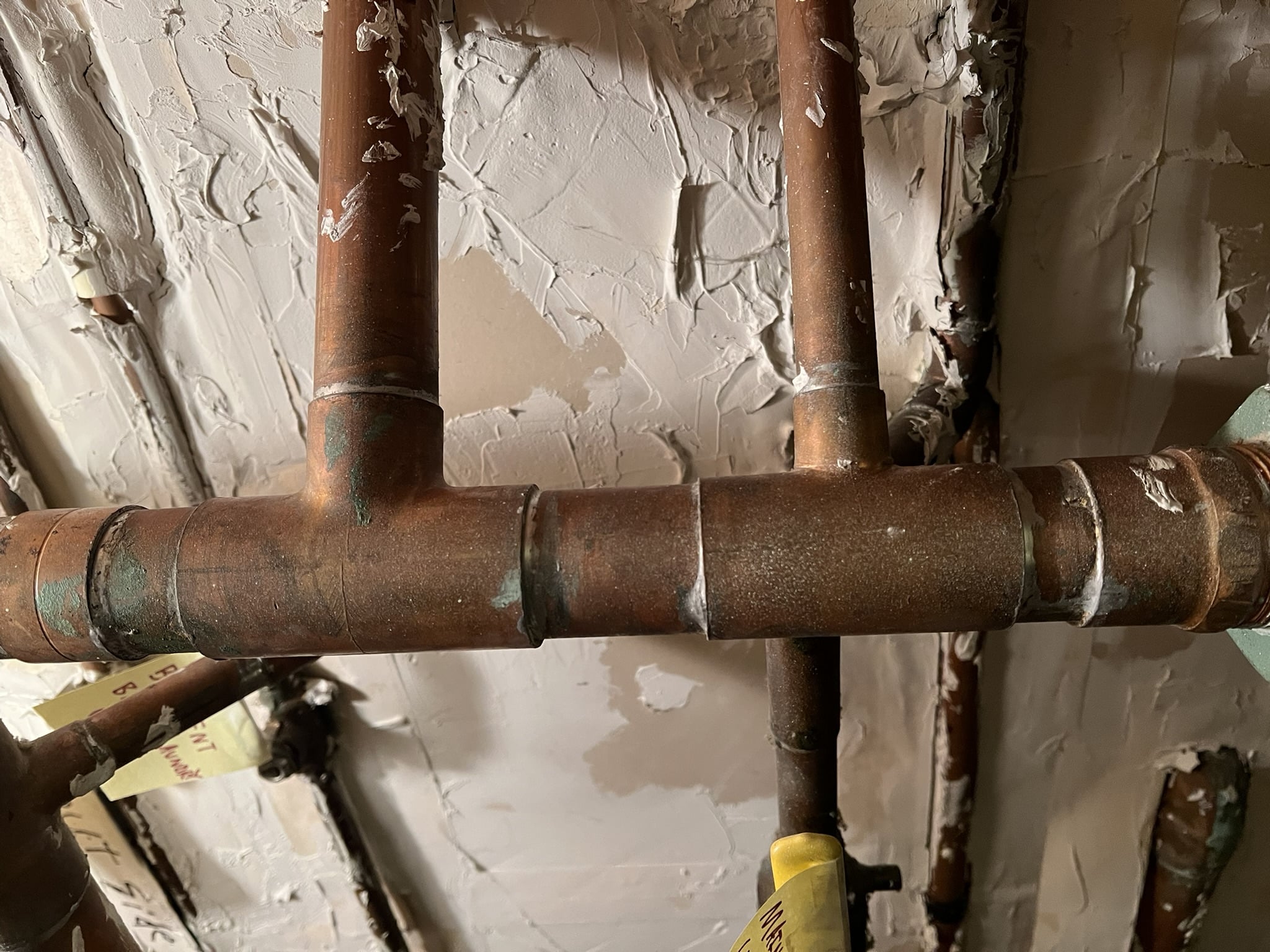
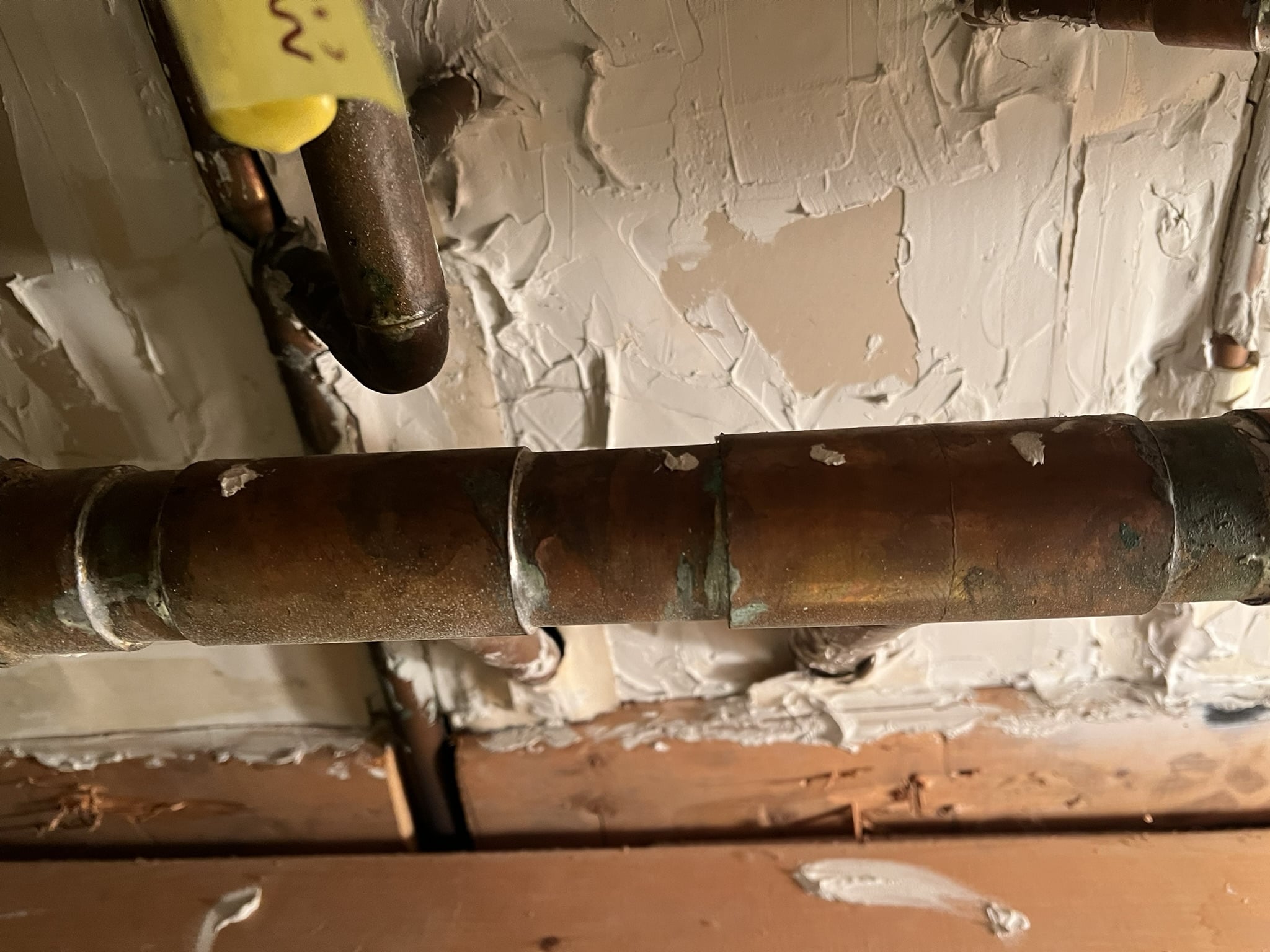 0
-
maybe try manually opening those green flochecks, see if that changes flow,
Bob "hot rod" Rohr
trainer for Caleffi NA
Living the hydronic dream 1
-
They got air in the system that is now trapped and not letting the heat flow. Can you shut off the zones that do heat to try to get more velocity through the underheated zone temporally?
 1
-
close the supply and bleed.
Close the return and bleed.
repeat as needed 1
-
looks like you have individual purge points on every zone, should be an easy purge. Raise pressure to 25 psi to purge.
Sadly circs are on return. One on the supply for some reason,but before the purger and exp tank?
If they were on the supply pumping away it would self purge in minutes 😉
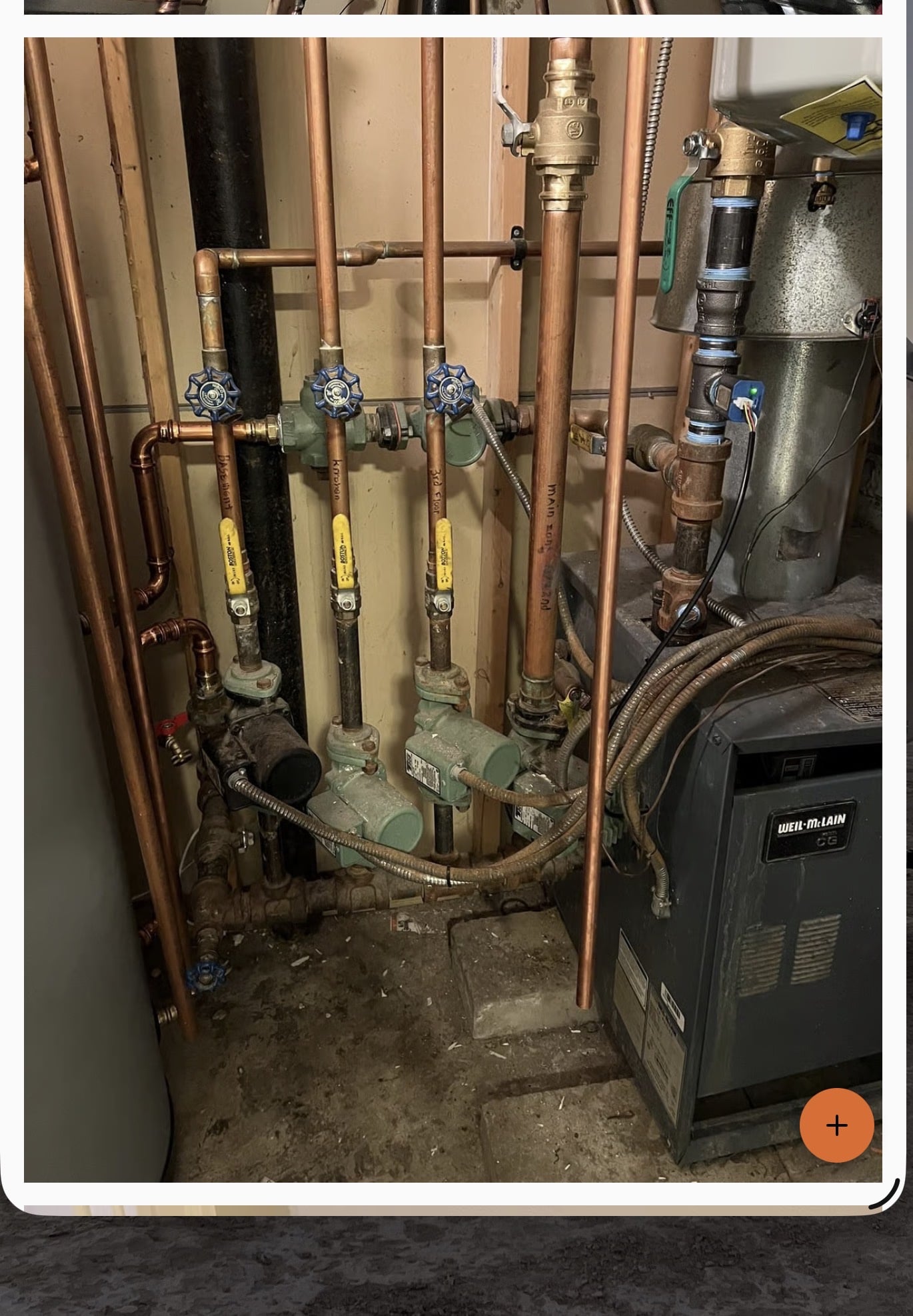 Bob "hot rod" Rohr
trainer for Caleffi NA
Living the hydronic dream0 -
@hot_rod - I've never messed with the flow checks before so I'm not sure how to open and don't want to screw anything up. With that being said, there is only one flow check valve for the cast iron radiator zone on the supply side (the other 3 flow checks are for the other 3 zones which each have their own circulator / thermostat control). The circulators are all on the return side for each heating zone and are pulling the water back to the boiler. The picture you screenshotted shows the 3 baseboard heating zones with their own draw off / purge point. The main zone with the cast iron radiators with the largest, white colored ball valve does not have it's own isolated draw off / purge point (it would have to be purged from the blue gate valve on the bottom left below all of the circulators). We do also have a spirovent on the vertical supply line that serves all heating zones. There's currently no air at all in the baseboard zones. Those were purged successfully and since they're in a simple loop we know they leave hot and come back hot so there's no air. I thought for the cast iron radiator zone once most of the air was purged we could bleed all the radiators directly from the radiator bleeder valves (which the techs did before they left the first day).
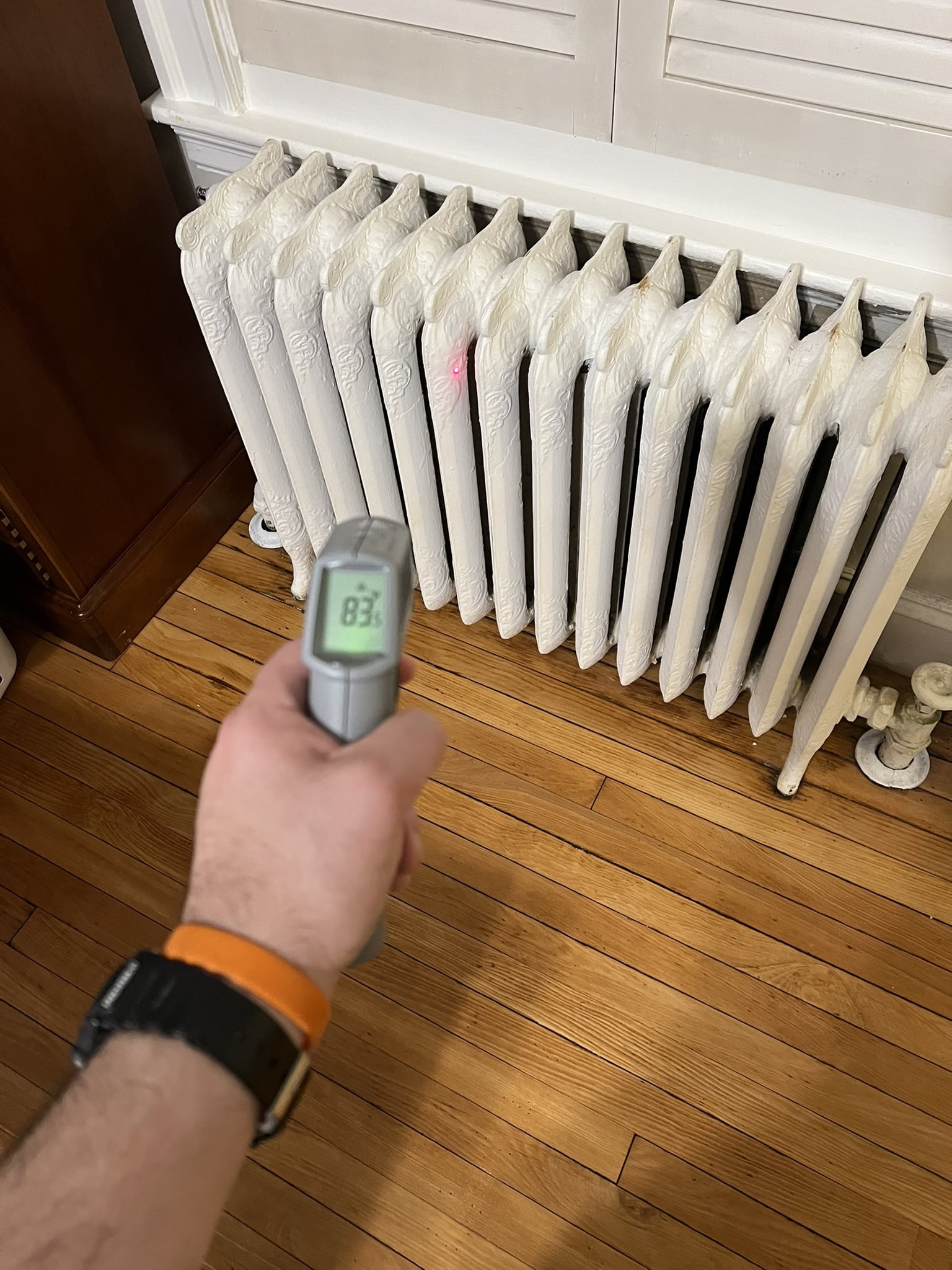
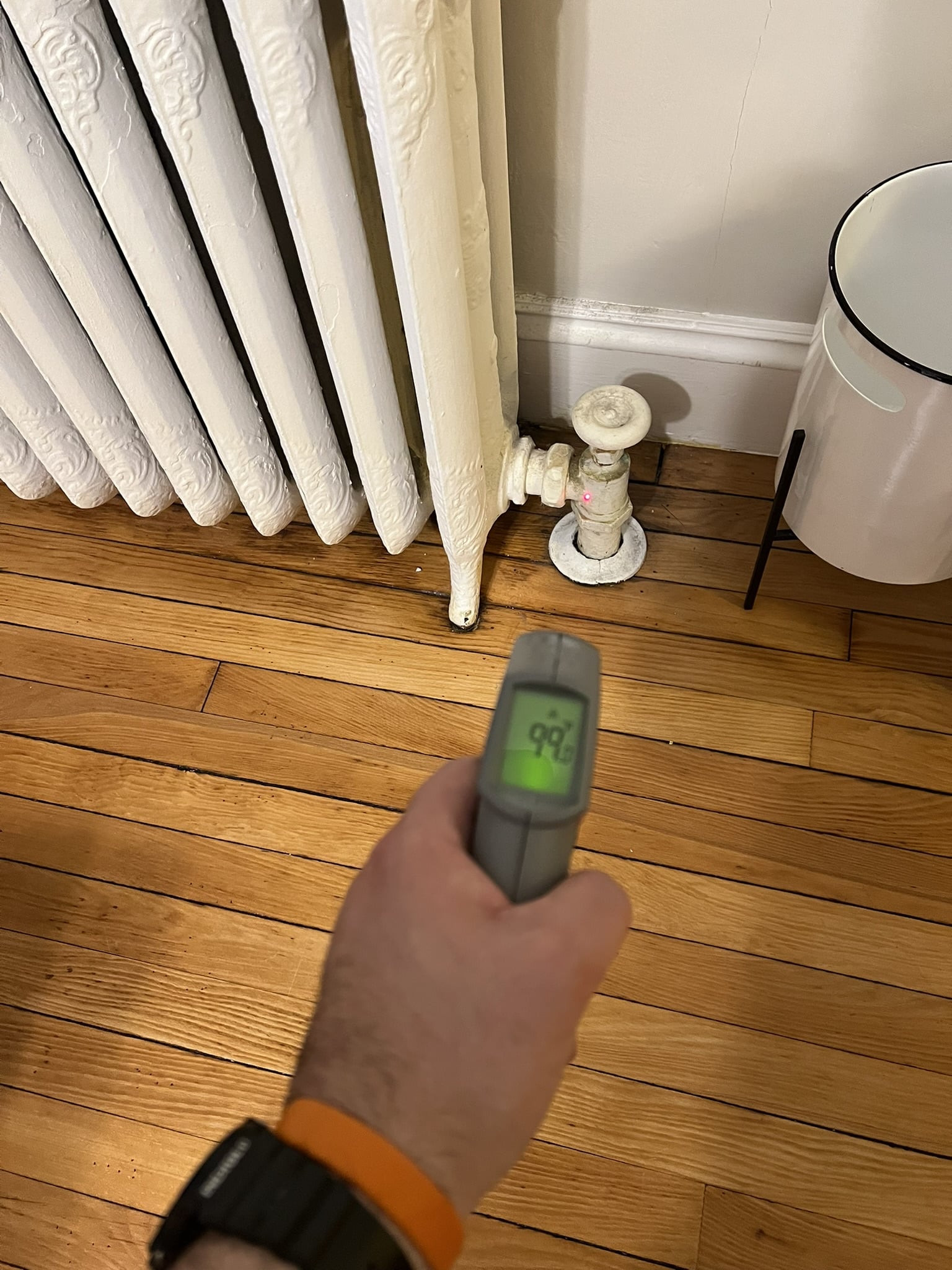
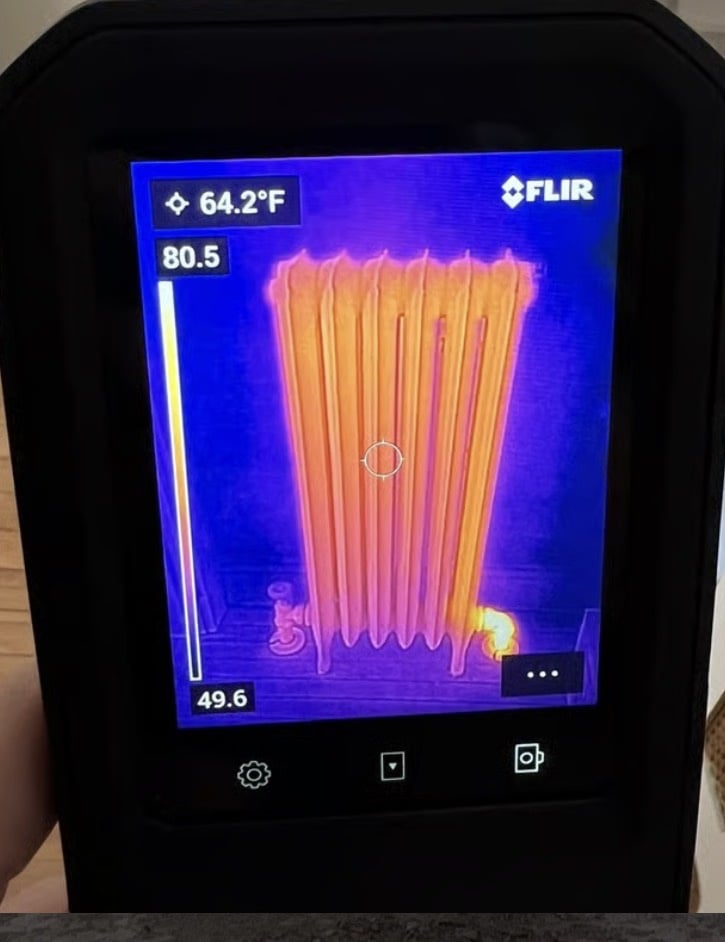
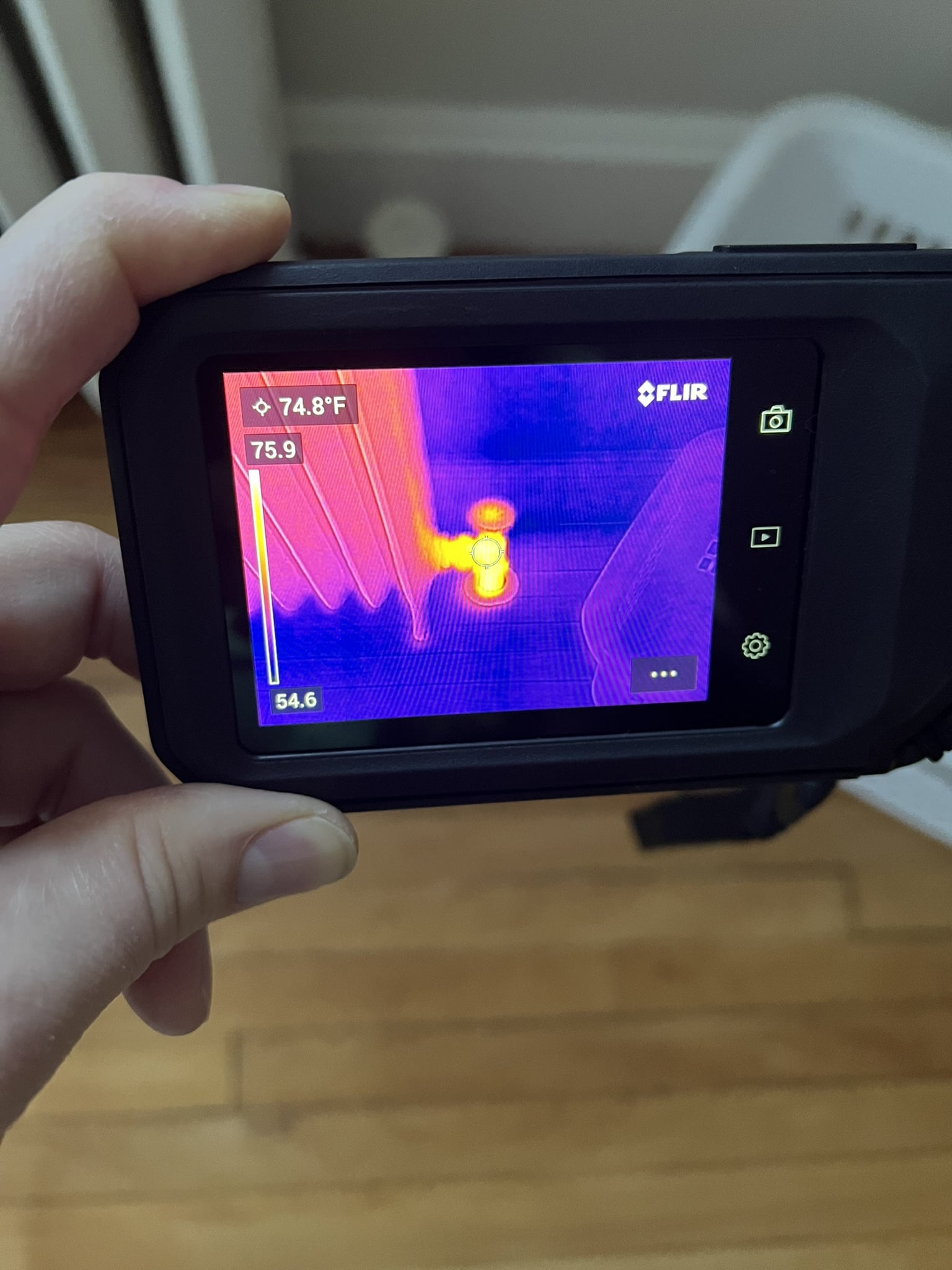
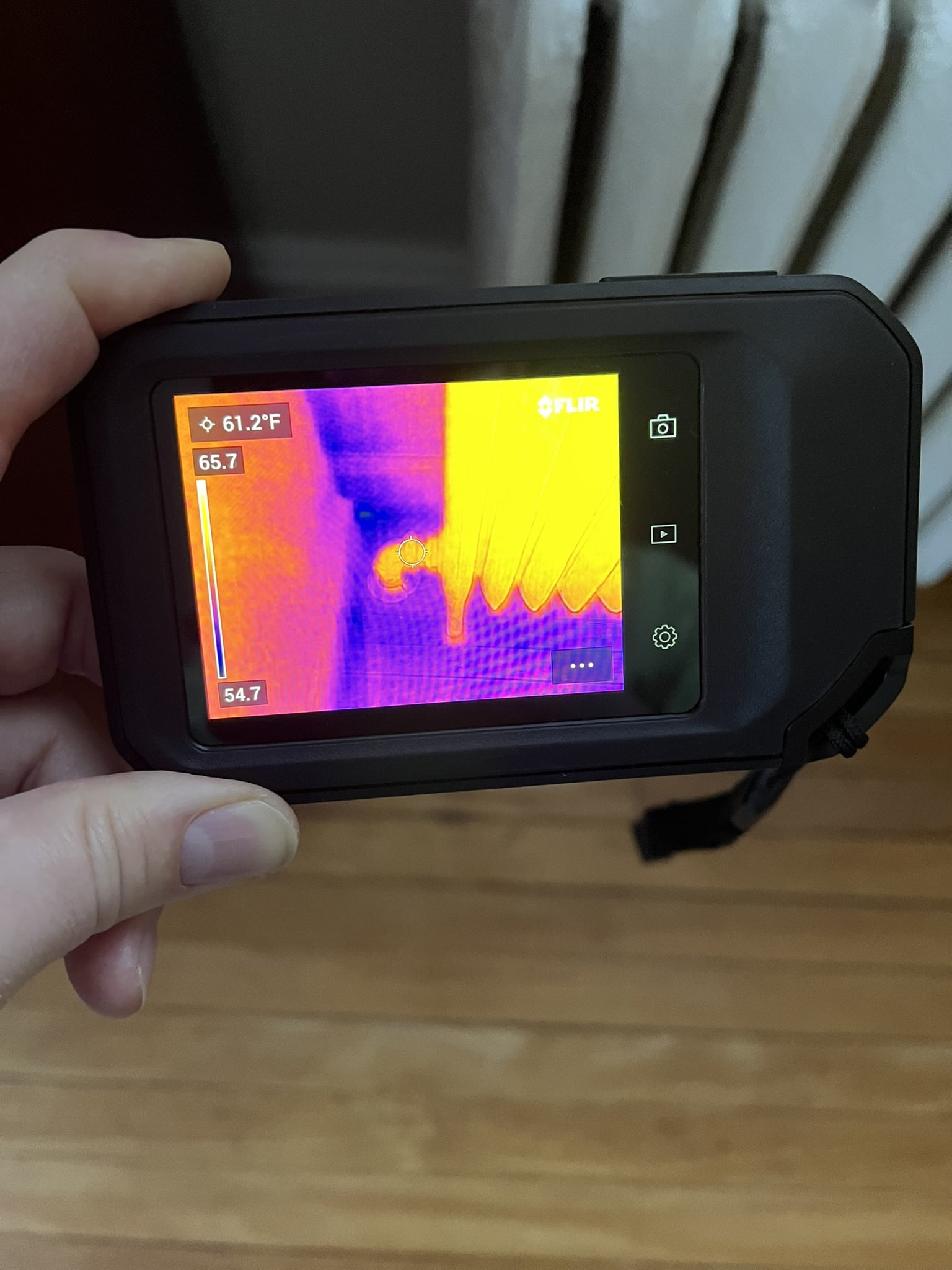
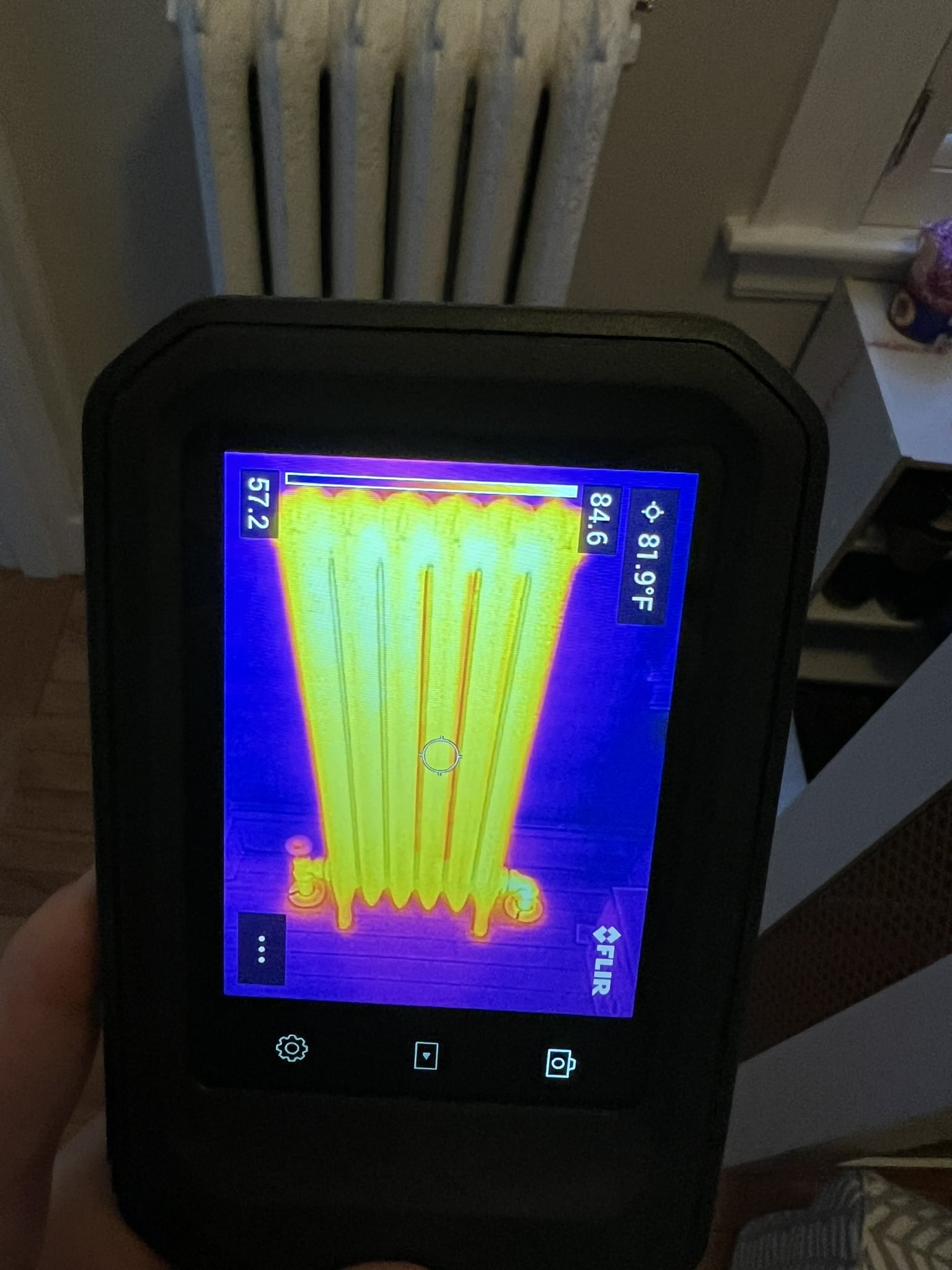
@EBEBRATT-Ed This afternoon I shut the ball valves on the supply and return side for all heating zones except for the cast iron radiator zone with the 2 problem radiators. I could trace the supply and return pipes (which I believe may go to the problem radiators) all the way to the front of the house in the basement before they disappeared in a wall (the problem radiators are on the 2nd floor above the area where I was in the basement). The supply and return pipes felt very hot where they were accessible for me to touch them. Oddly enough it seems both problem radiators are not getting heat from the supply valve side. They seem to be getting heat from the return side (see first 2 pictures below from my IR camera - excuse the picture of a picture, but I can't find my cord to upload the pics directly from the IR camera). The radiator that didn't really heat much at all seemed to get a tiny bit of heat now (99º with IR gun) where before I felt almost no warmth at all (83º with IR gun the other day - although the supply valve the other day got up to 99º). It seems the flow has reversed for that radiator since the first problem day ( it's heating now from the return side instead of supply side). I had the heat run for about 45-60 minutes this afternoon. The rest of the working cast iron radiators got up to 145º-155º and were heating well (see 3rd IR picture to see a working cast iron radiator fully heating).
@pecmsg - I tried bleeding the individual problem radiators from the bleeder valves again while the heat was running. No air came out - only cool water. I also tried opening and closing the ball valves for the supply and return on the cast iron radiator heating zone while the circulator for that zone was running - I don't think that did anything.
As of now the heating company is planning to come back next week to replace the supply valves on the problem radiators. I really hope that fixes them, but if anyone else has other ideas or thoughts on this, please let me know.
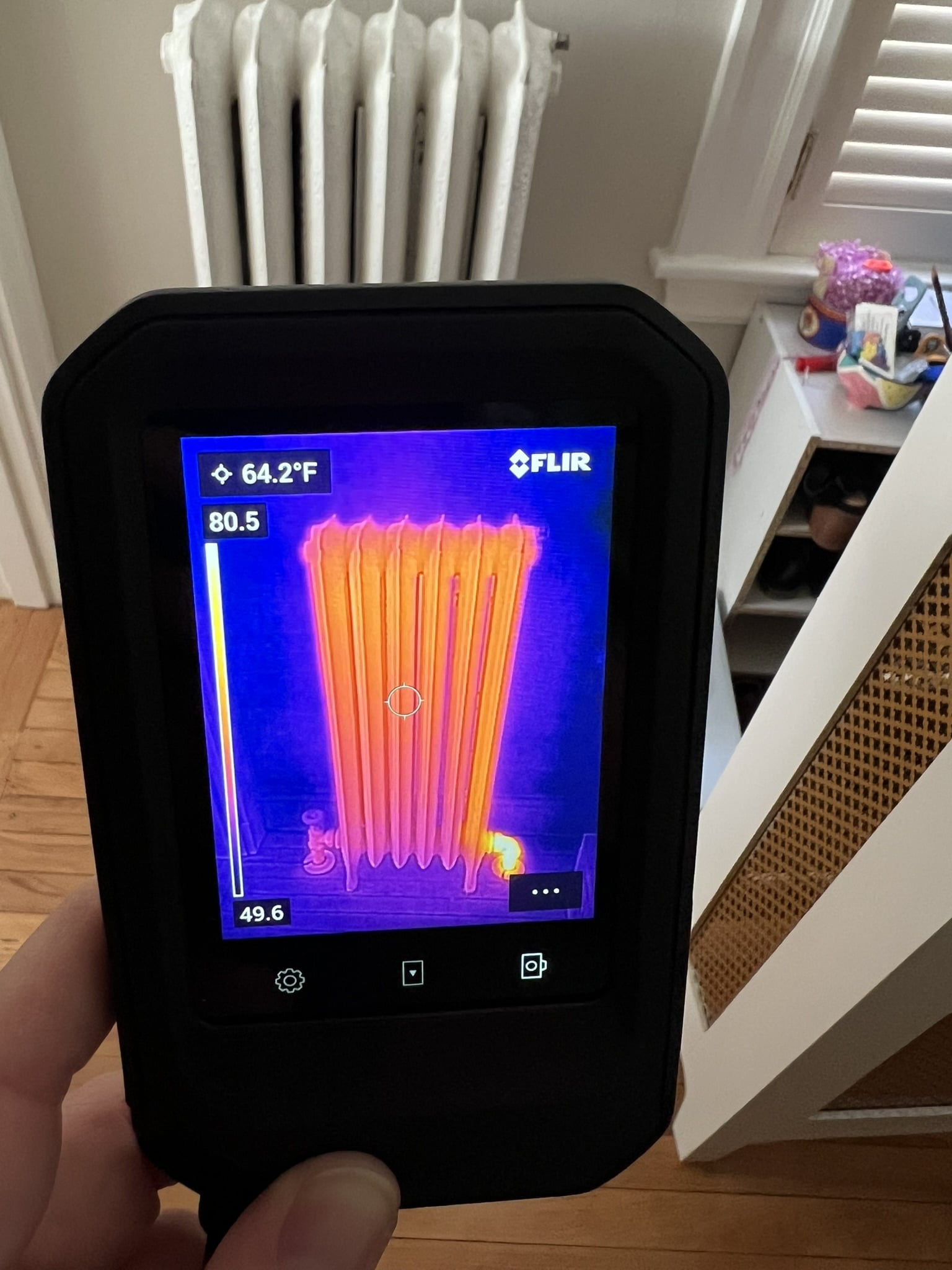
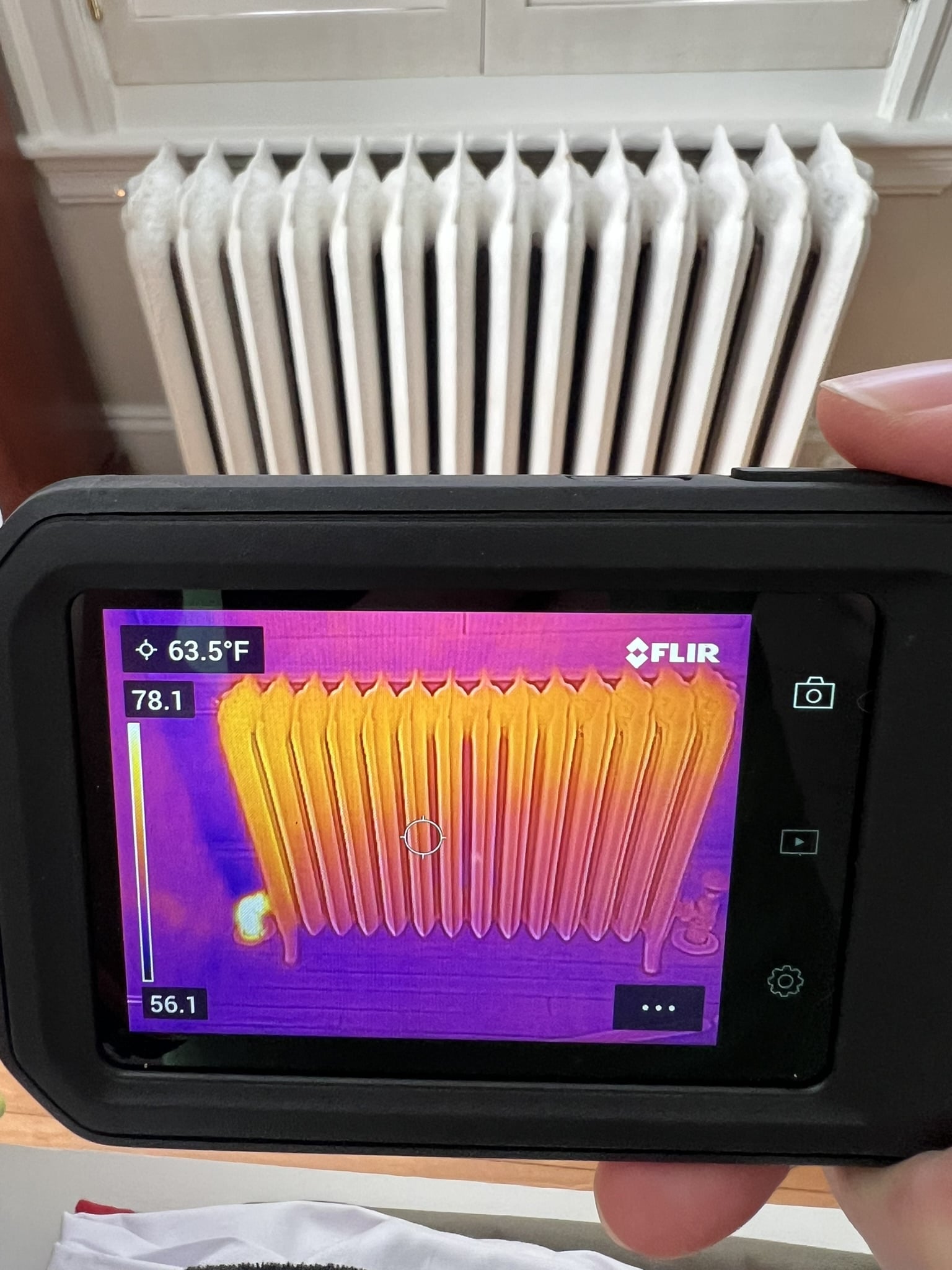
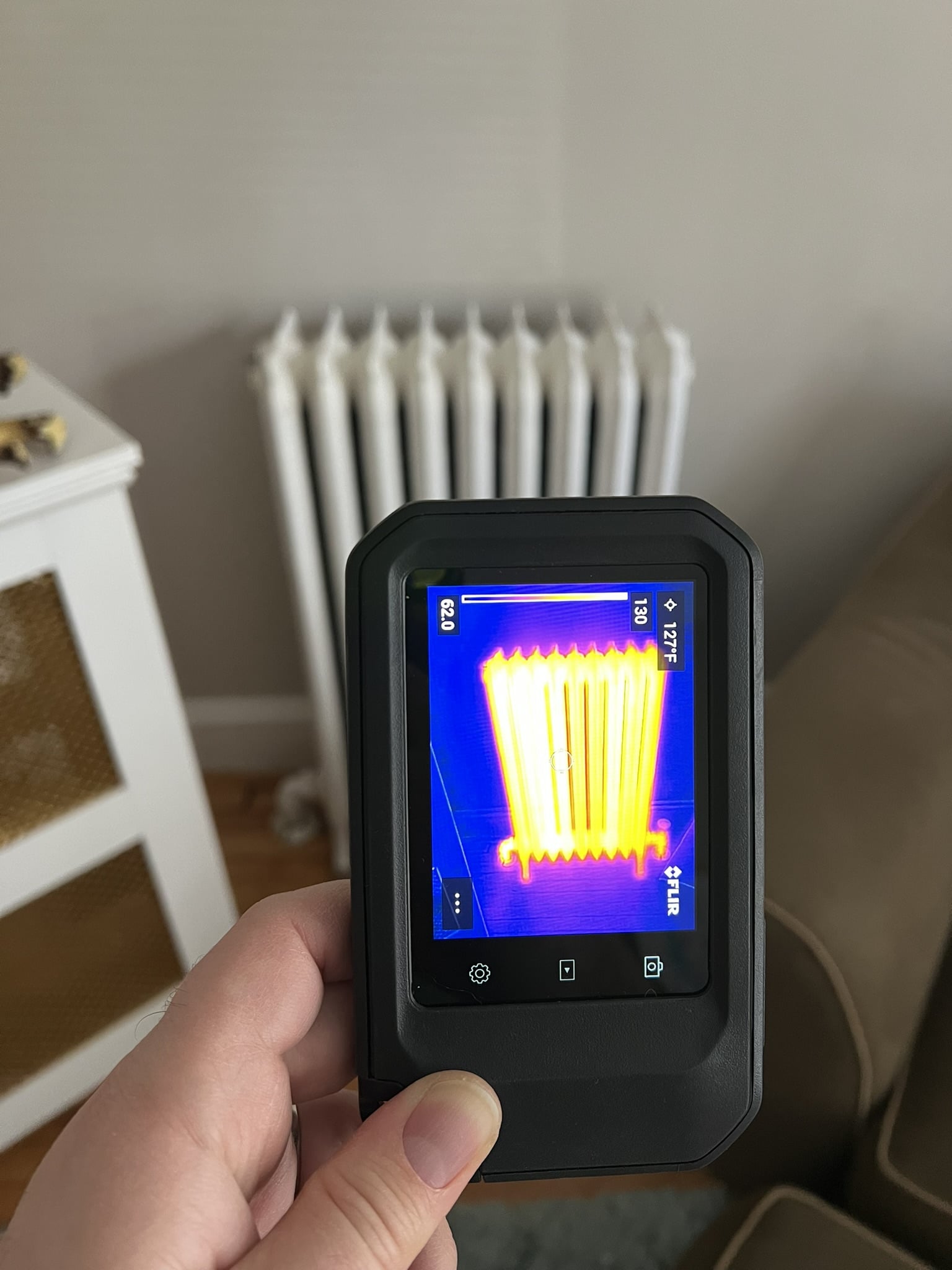 0
-
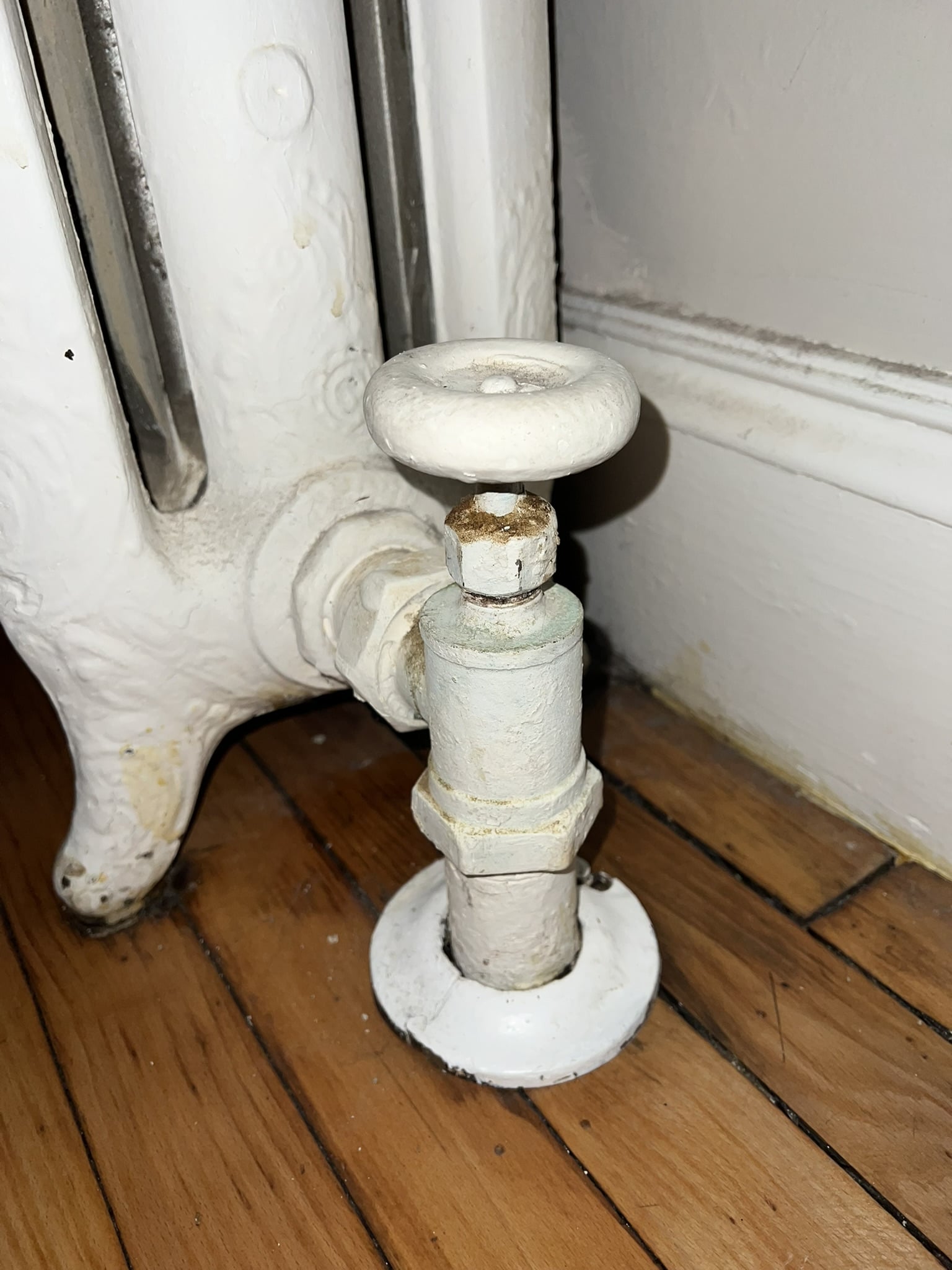
This may be too obvious, but did they ever touch (close) those radiator valves during their work? The closeup of the one radiator valve shows paint and crud on the stem, looking like it hasn't been closed in a long time. And if they didn't close the valves, how are valves now the problem? If air is in the system elsewhere, replacing the valves is only going to add more air…
And what is your water pressure now? Try raising to 20 psi
0 -
My question is: if the radiators have "T's" coming off the main circulating zone and there are NO mono-flow T's…what makes the supply water go reliably into a given radiator?
0 -
maybe the circulator is locked up, or not getting power.
Does it get really hot when powered? That can indicated a locked impeller.
.
Bob "hot rod" Rohr
trainer for Caleffi NA
Living the hydronic dream0 -
try this again, but shut the power off so it's just feed water flow, don't do it with the circs running, do it with hot boiler water and when the bleed water warms up you'll be more sure any air trapped elsewhere has pushed thru, and like was said elsewhere, raise the pressure upwards of 20, while bleeding also,
known to beat dead horses0 -
@Jeremy_16 Said: "Last winter everything heated well and evenly and there really were no issues."…
…and to this I say "If it ain't broke … don't fix it!"
But that is water over the dam…. as you asked for several repairs including:
2. add a spirovent for better air elimination
So I will ask this question: "Is this a before or after photo? If it is an after can you point out the Spirovent?"
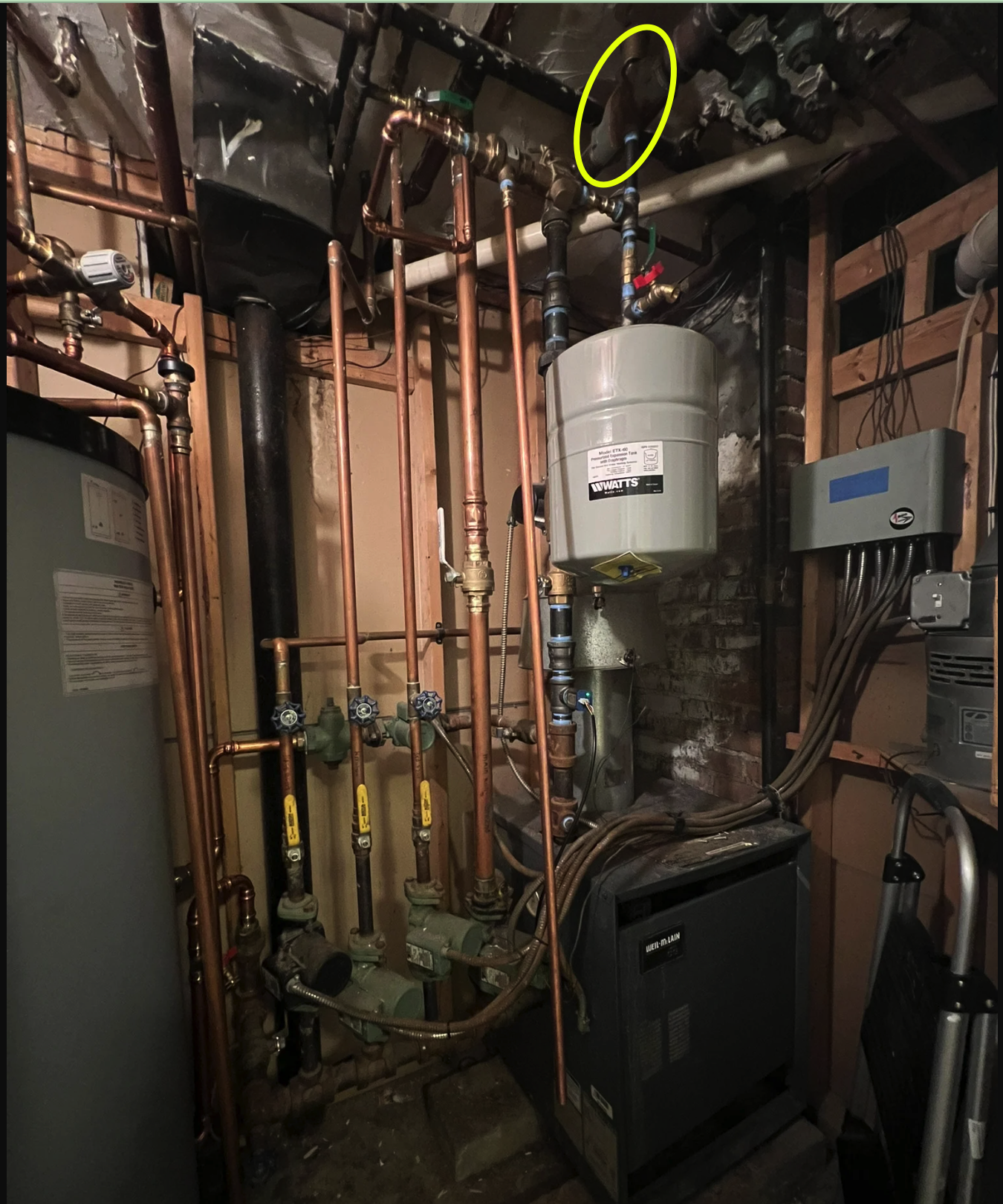
Edward Young Retired
After you make that expensive repair and you still have the same problem, What will you check next?
0 -
-
@jesmed1 - I don't think the techs touched any of the radiator valve handles. After a couple of hours with the heat on, I tried to touch the valve to see if it would move and when I did the packing nut started to loosen as I turned the handle. It was all basically stuck together so I left it alone ; I didn't want to cause it to leak. The lead tech said something in the interior of the valve could have broken or disintegrated causing an obstruction. He did say it's an unusual thing to have happen, but there was always a chance it could happen when the water was drained and then system was filled back up. It looks like the pressure gauge on the boiler is reading 22psi right now. That's around where I've seen it when things were working before this work was done.
@psb75 - I am just guessing how the system is set up from the little I can see. I really can't see much besides what's in the boiler room and in another closet in the basement towards the front of the house. The tech said they were not monoflow Ts and I don't see markings on them to indicate that they are. I don't know how the supply and return are set up once they get to each radiator. The lead tech told me that systems like mine were set up using pipe sizing to favor certain runs. I believe the larger diameter pipes are usually favored or something like that.
@hot_rod I don't think the circulator is the issue, but I'll check it again the next time I run the heat. I think I did touch it after the problem started and didn't notice it being too hot, but I'll look again. There are 12 radiators on this zone and 4 of them on the 2nd floor are getting plenty hot all around the same time as each other. One working radiator is actually one room over from the problem radiators. I think if the circulator weren't working, they wouldn't heat very well or at all.
@neilc - Are you suggesting bleeding it from the radiator bleeder valves again with the system hot but circulator off? Or are you suggesting trying to bleed it from the return piping below the circulators? From what I understand once the radiators are full of water and you open the bleeder valves, if no air comes out and only water comes out the air is completely purged. Is this incorrect?
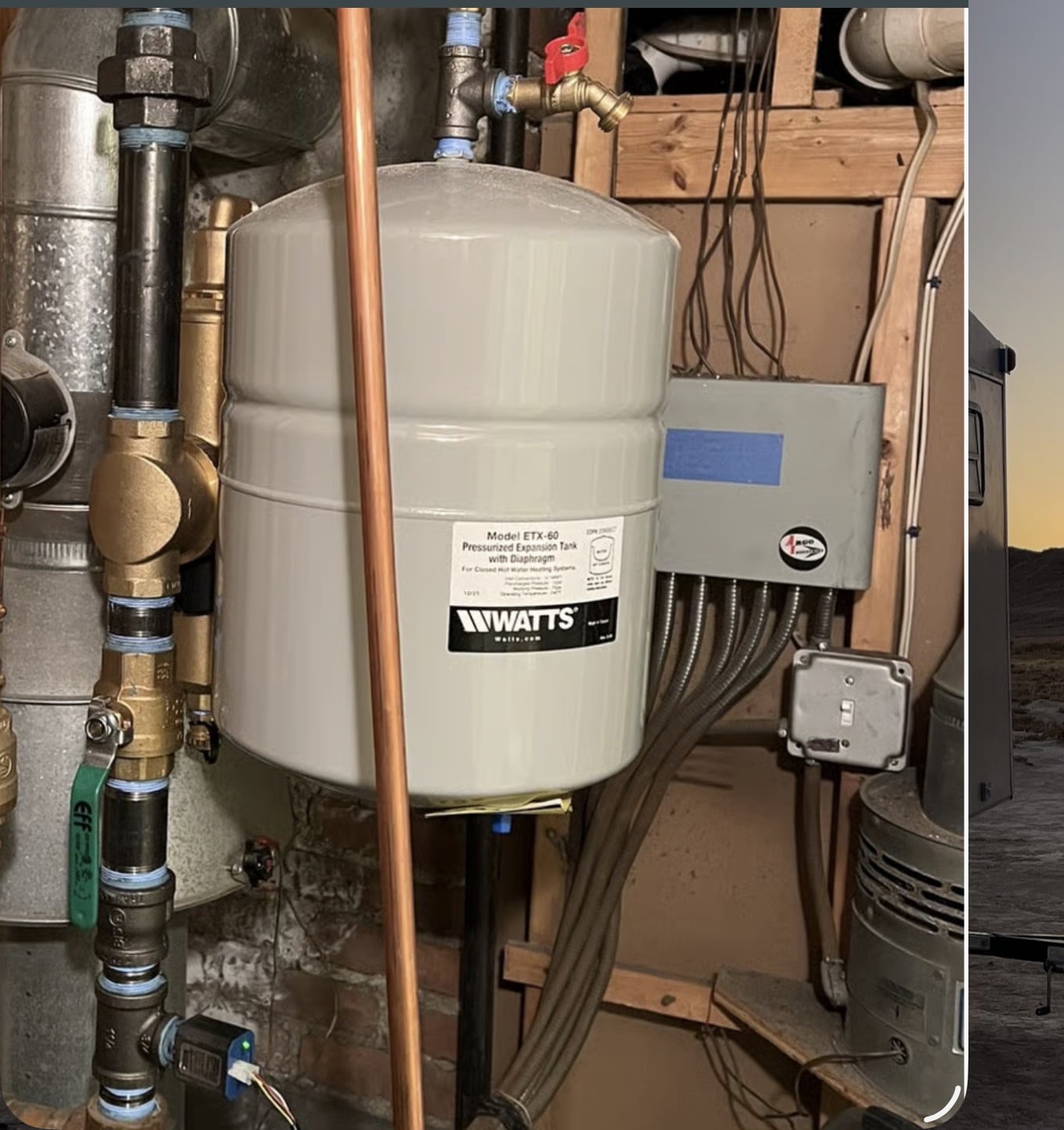
@EdTheHeaterMan - I know, I'm kicking myself a little bit now, but the intent was to be prepared. I had several radiators enclosed with permanent covers that were completely inaccessible and I needed a contractor to make access to the covers and cut some small holes in some areas in order to make access to change the radiator bleeder valves. I didn't want to get into a situation in the dead of winter where we had to drain the system to change a circulator pump or something and then not be able to bleed the air from bleeder valves that were inaccessible or broken. It's an old house from early 1900s and we've already had to do way more work than I wanted to do under more urgent circumstances. At the same time I figured better venting with the spirovent would be prudent etc. Anyway… As you said, what's done is done and now I just need to fix it. See below for a few pictures of the spirovent including packaging. The photos I attached are all AFTER photos so what you circled in your pic is the old air eliminator which they left in (I suppose they could have just plugged it). It's hard to see the spirovent in the pictures because it's behind the Watts expansion tank on the vertical supply piping coming up from the boiler (right above the green ball valve handle). I included a few different angles in the pictures below.
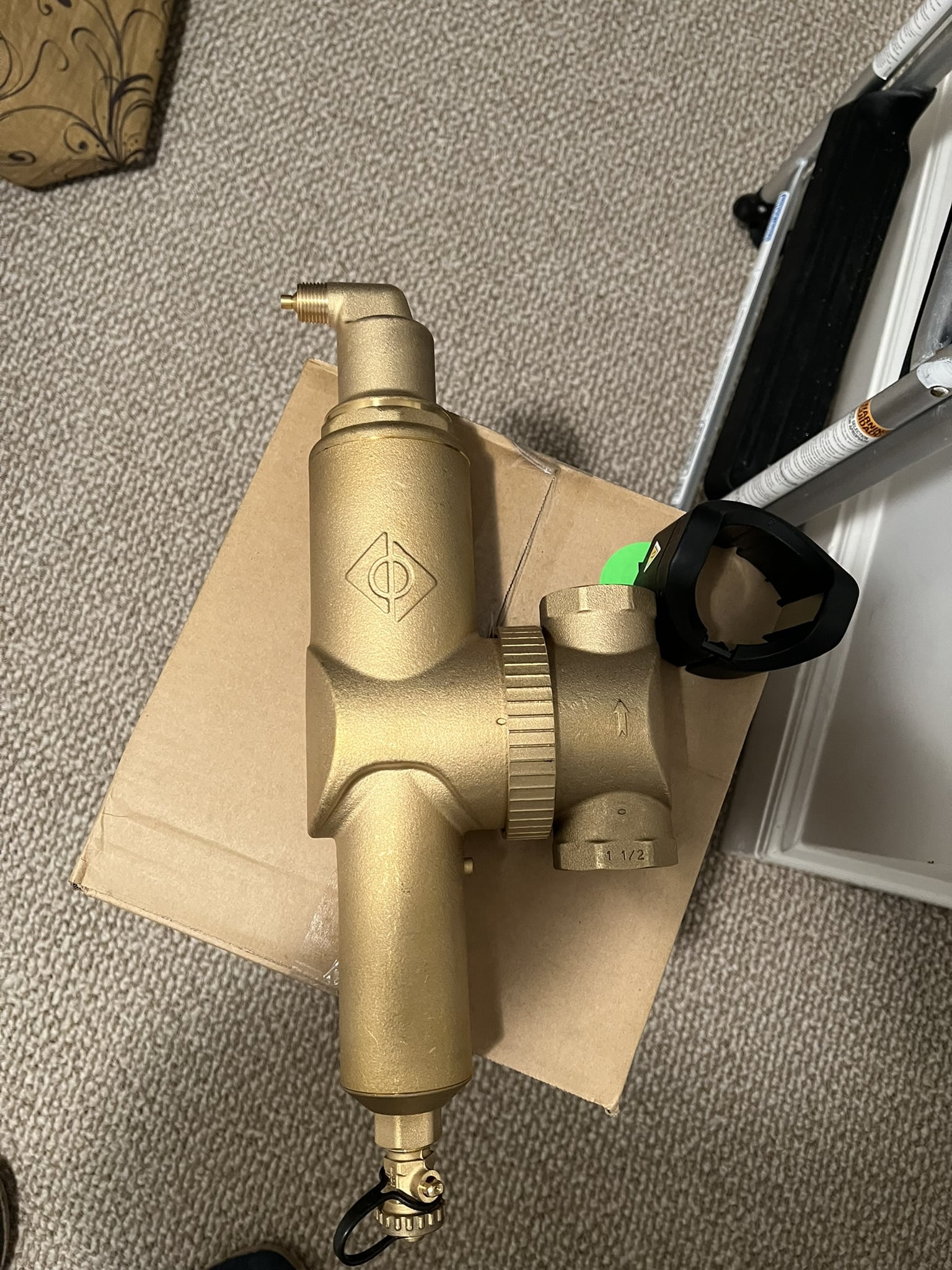
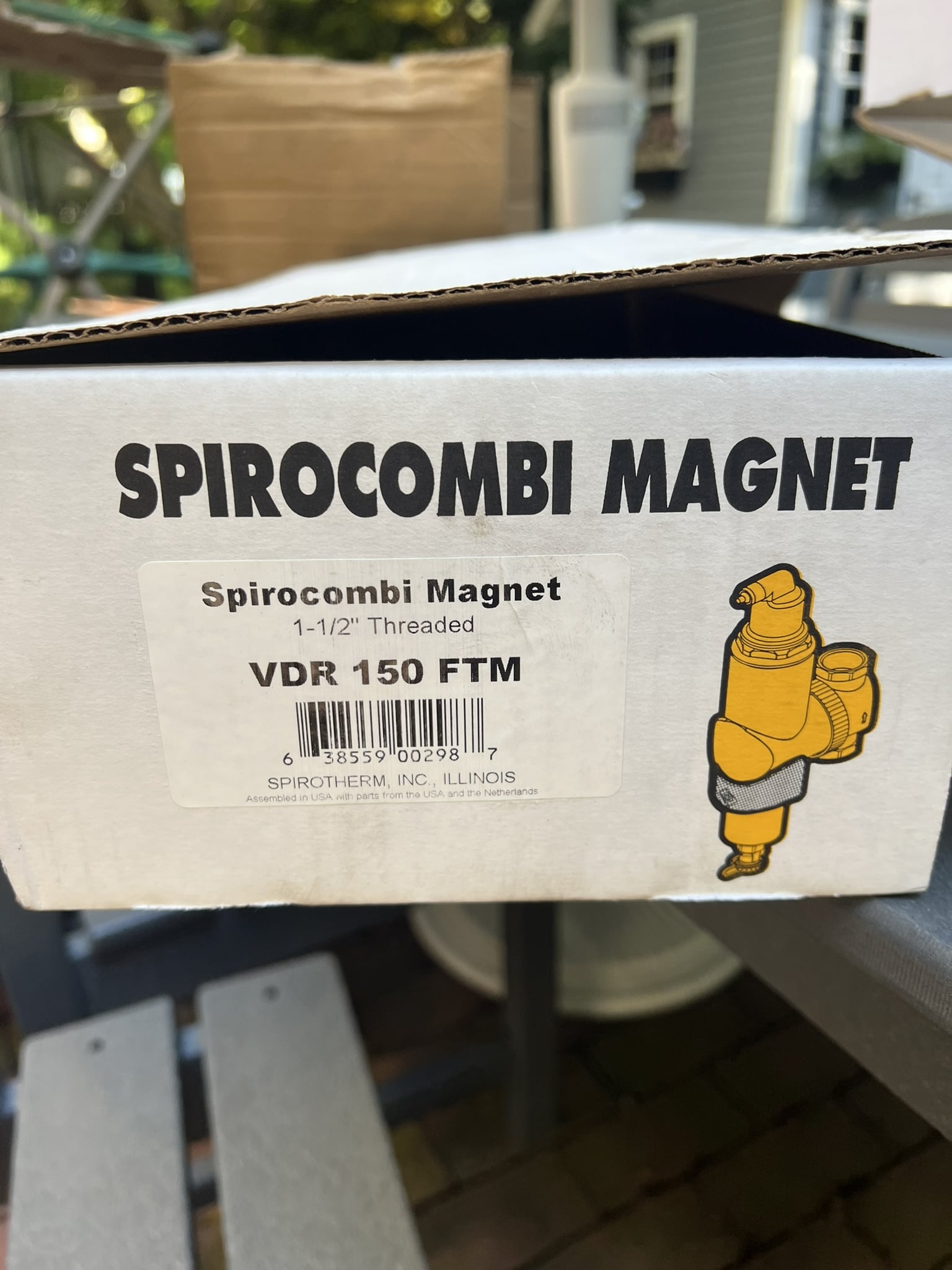
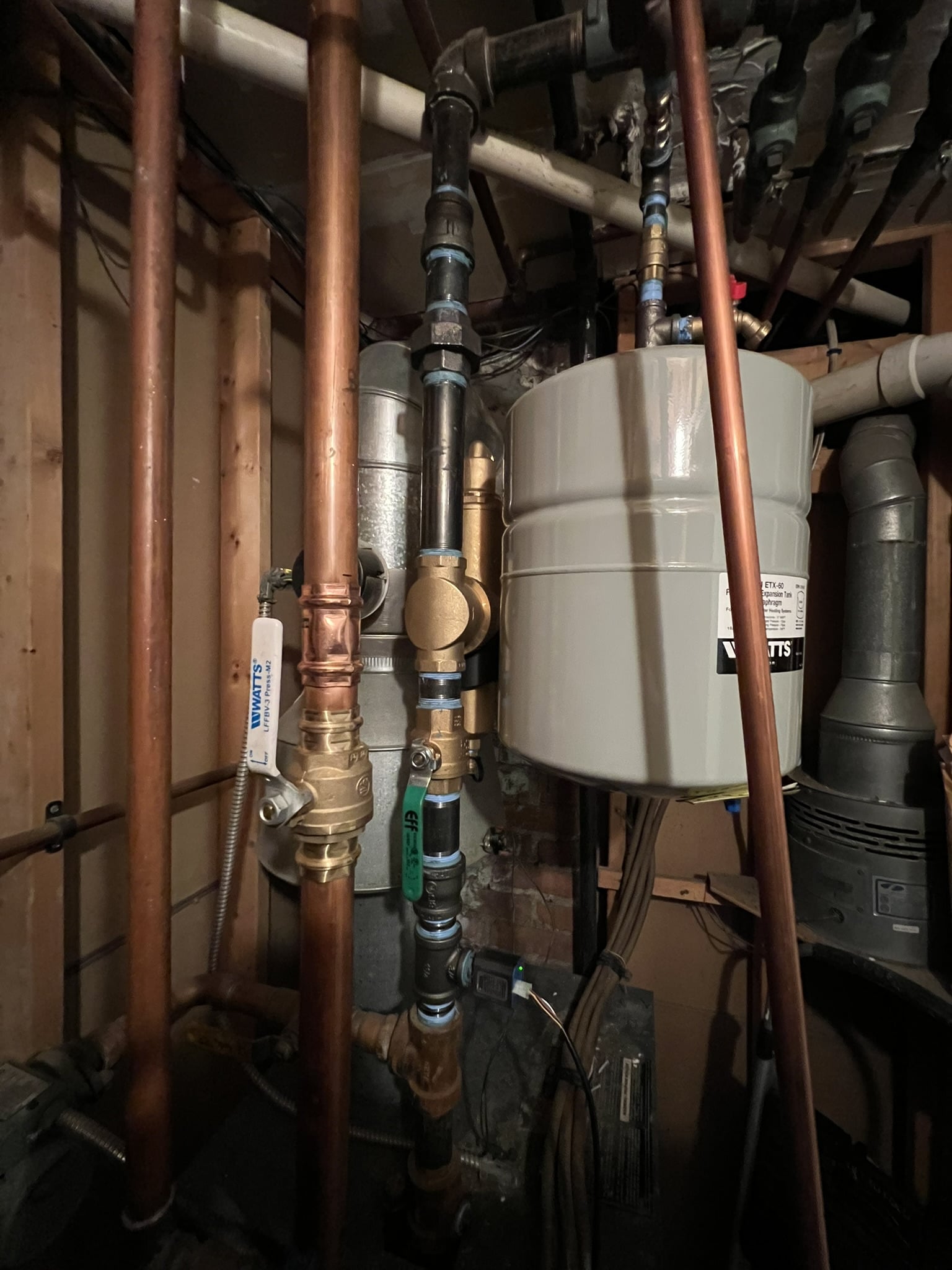
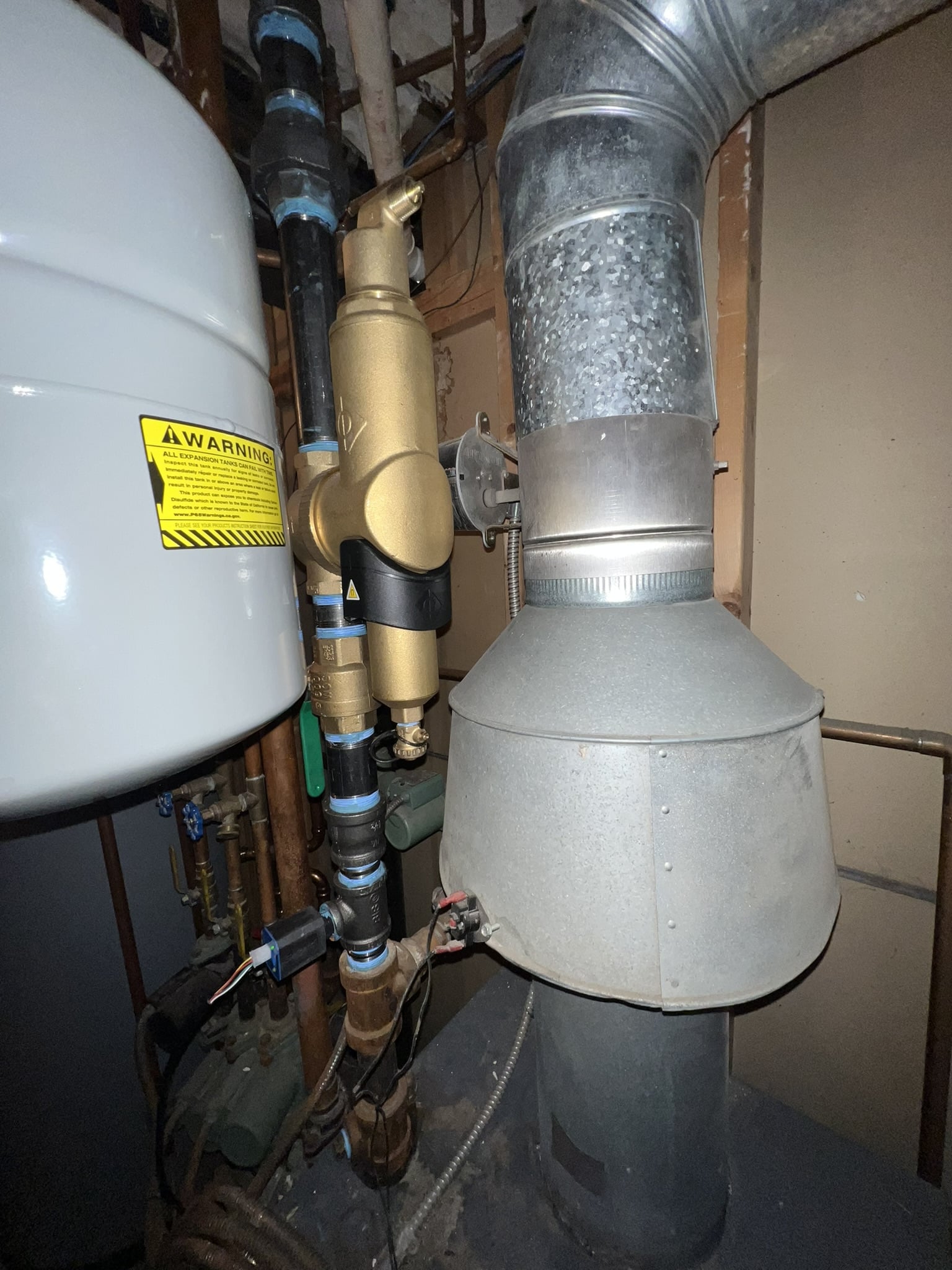 0
-
Yep there it is! Hiding behind the expansion tank.
Edward Young Retired
After you make that expensive repair and you still have the same problem, What will you check next?
0 -
it takes some time for those chunks of cast iron to warm. What is the delta from one end to the other delta x flow gives you the btu being transferred.
Bob "hot rod" Rohr
trainer for Caleffi NA
Living the hydronic dream0 -
So, if I understand the problem correctly, you have one older zone with cast-iron radiators that appear to be from an original gravity system. When additions were made, copper-tube baseboard radiators were installed.
To remove air from these two different types of systems, you need two different procedures.
The copper-tube systems, or zones, can be purged easily. The water flowing through a 3/4-inch tube will entrain the air and force it down any vertical riser until it reaches the purge valve. When you get a solid flow of water for about 15 seconds, you can be reasonably confident that you have removed all the air from that zone.
Since those zones are operating properly, there is no need to fix anything there.
The older system appears to have been modified at some point in the past. The old gravity-system iron pipes, which were head knockers in the basement, may have been removed and replaced with similar-size or even smaller-diameter pipes installed closer to the ceiling.
Purging will not work on this system because of the design, so don't try to purge it.
Since you are using circulator pumps to move the water, you no longer need the lower, head-knocking piping to maintain the proper pitch required for gravity circulation, or thermocycling, to move the heated water. The pumps will force the water up and down through the system.
To remove air from a system like this, you need to bleed the air from the high points of the system, namely the radiators. However, if the redesign has created other high points that cannot be opened to let the air out, you need to figure out how it was done in the past, since the system worked without problems before.
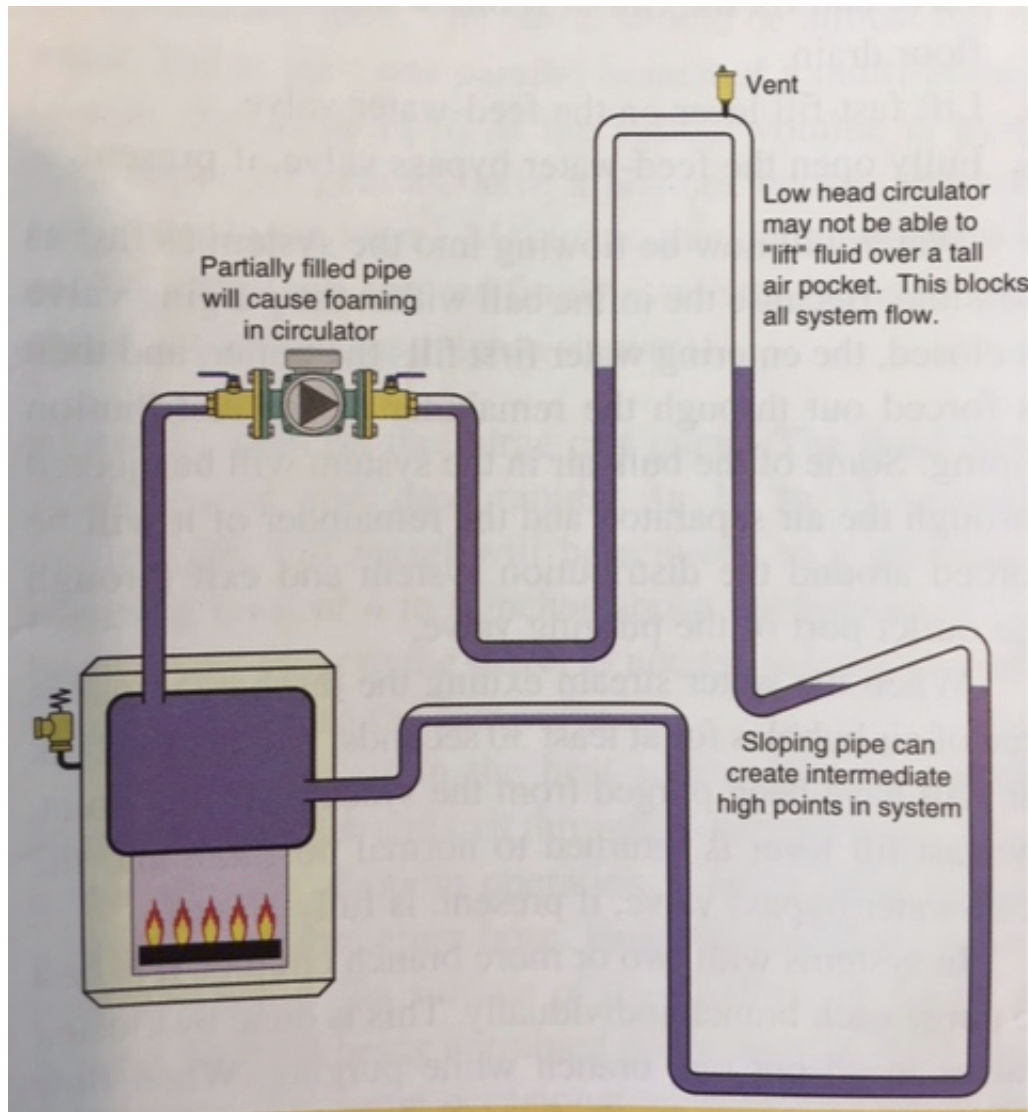
The redesign of the main piping may be the problem, as illustrated in this drawing.
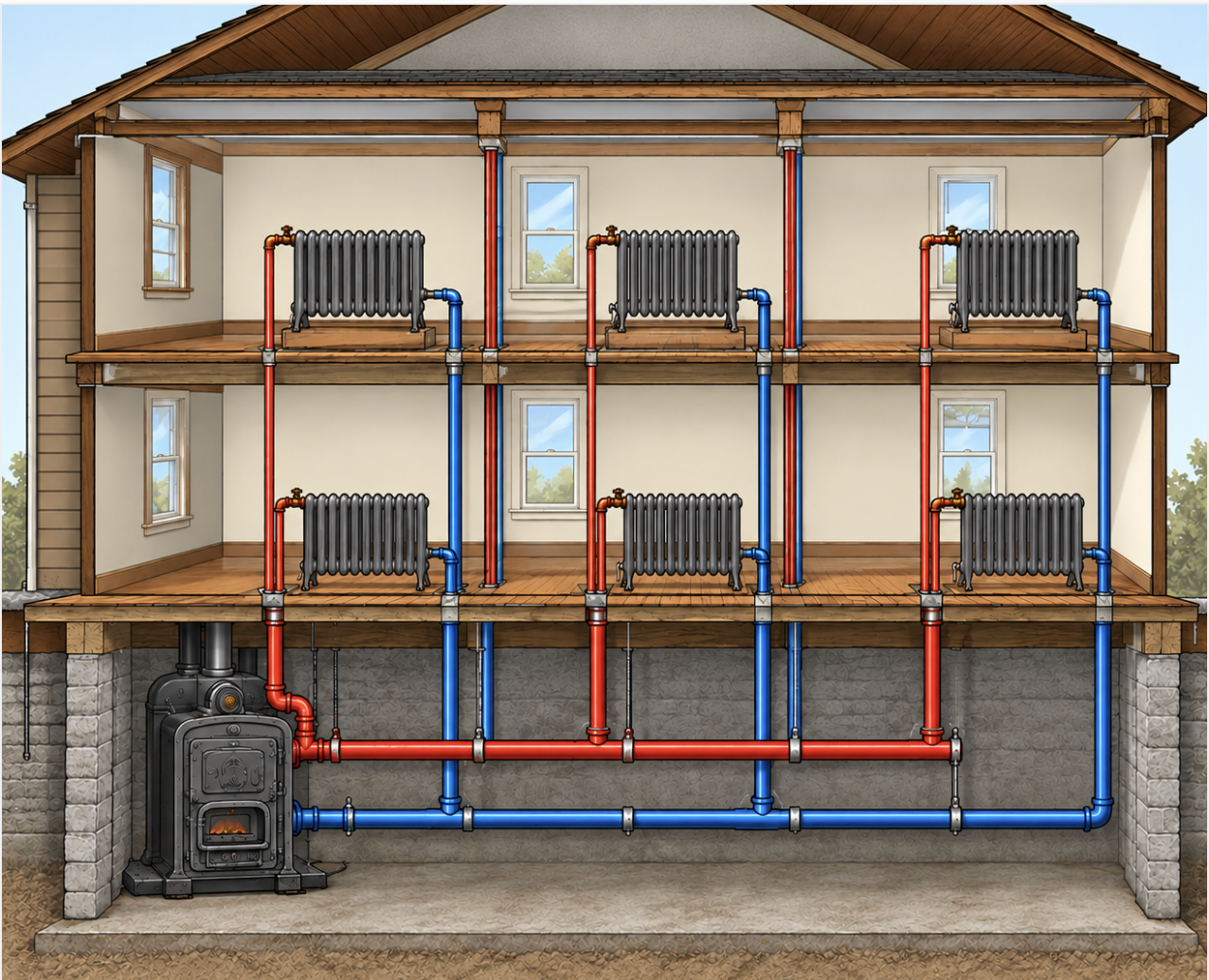
This is an exaggerated gravity system, where the pipes in the basement are in the way, making the space useful for little more than servicing the heating plant. Gravity allows the hotter water to rise to the radiators and the colder water from the radiators to fall back to the basement, returning to the heating boiler.
here is the same system after a new boiler and some piping modifications to get rid of the low hanging pipes
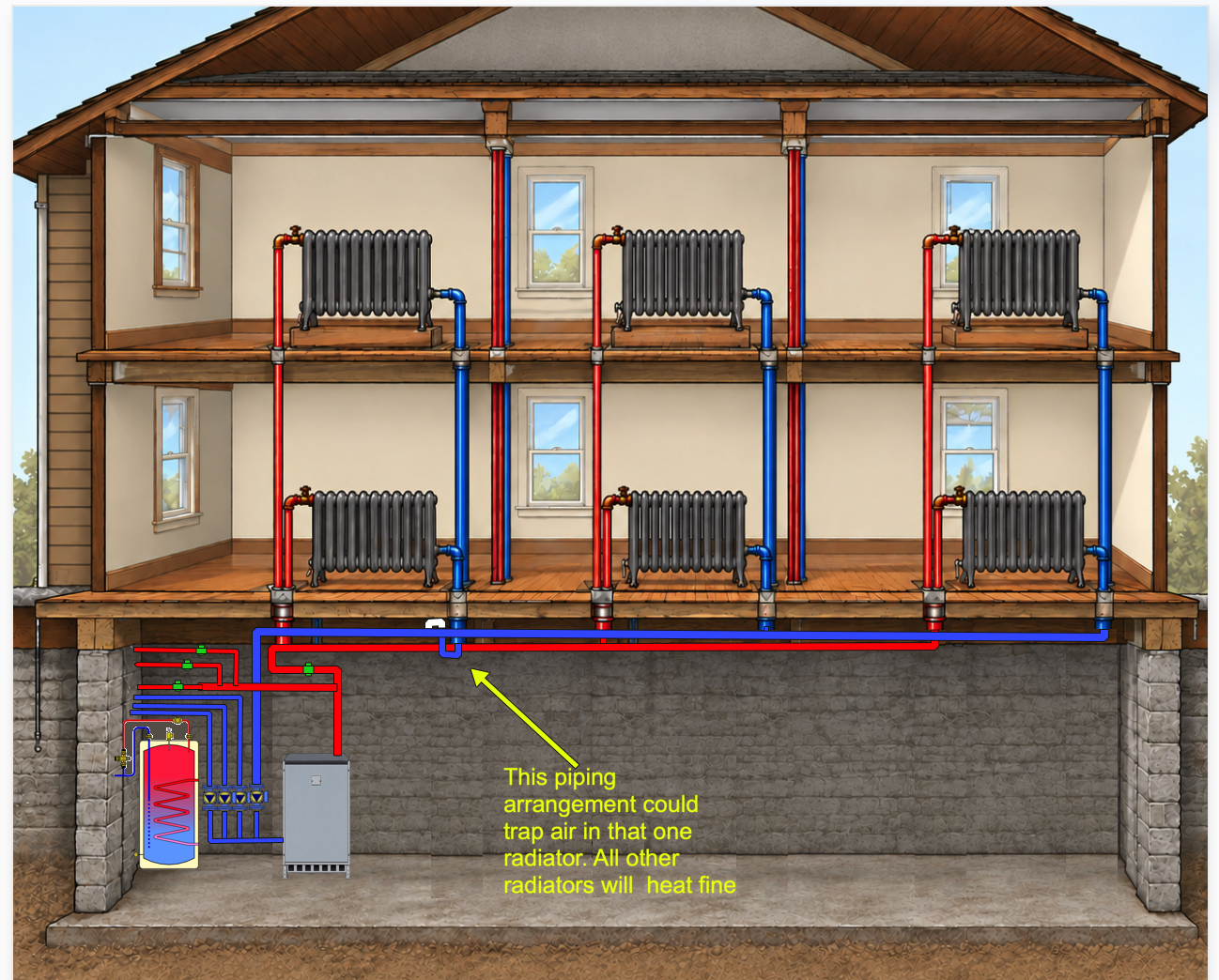
Notice the one poor design pipe connection where air can get trapped in a high spot and there is no easy way to get the air out. (see the white portion of that pipe indicates air) It might only be a partial air blockage, but enough to cause a problem. If it is on the supply side of the radiator, that could explain what appears to be a reverse flow, as the "Ghost Flow" happens to the problem radiator. Read about Ghost flow in this booklet Zoning Made Easy at the top of page 12. It is not called Ghost Flow in the book but it explains how some heat can get in a radiator without proper circulation.
I believe this is the best explanation of what is happening with your system.
Edward Young Retired
After you make that expensive repair and you still have the same problem, What will you check next?
0 -
Close the supply / return at the boiler!
Air could be trapped in the supply, return or both. Force it to the high point.
0 -
looks like the radiators are connected bottom to bottom. So a small air pocket at the top should not stop flow. That pocket of air in the top of radiators is sometimes called secondary expansion tanks.
You do need a good flow to push air through large pipes. Use the fast fill function on the fill valve so you can get around 8-10 gpm. A fill bypass, even better.
This radiator looks to have some flow based on the S&R pipe colors on the IR scan?
 Bob "hot rod" Rohr
trainer for Caleffi NA
Living the hydronic dream0 -
How?
Edward Young Retired
After you make that expensive repair and you still have the same problem, What will you check next?
0 -
I still believe that if there is air, you won't get it by purging the zone with CI radiators. there are too may tee fittings. and where there is a tee fitting the water will push to the direction of least resistance. If that is in the direction of the outlet of the tee that does not have air, then the air will stay.
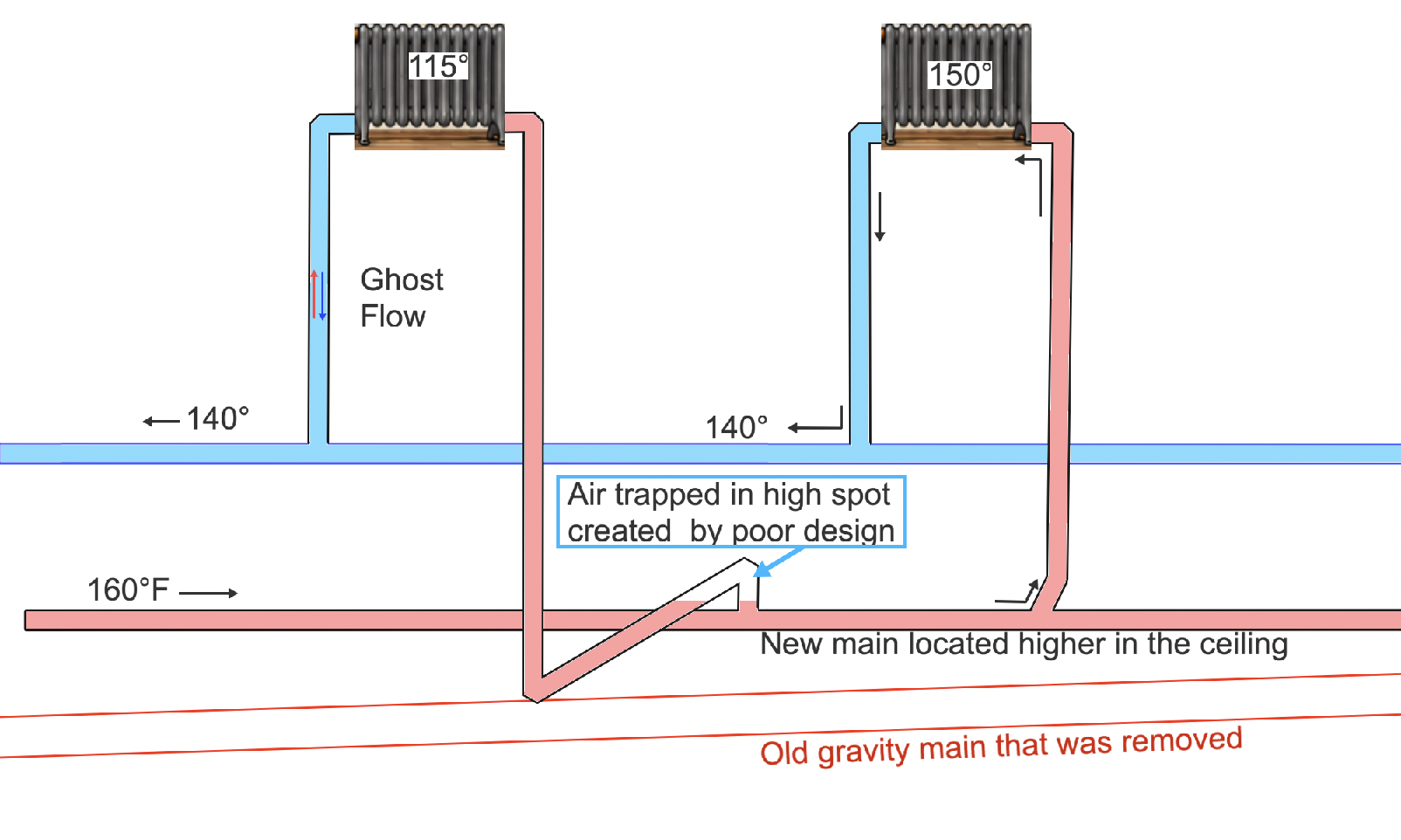
In this illustration the radiator on the left has an air lock by poor piping design. Purging will not get that air out because the path of least resistance is thru the other radiators in the system that don't have an air lock. Venting at the radiator will not move the trapped air.
You could try increasing the pressure and operating the circulator at a lower temperature in order to get that air to be absorbed in the water (google BOYLE'S LAW) and carried off into some other place in the system where it can be vented or purged.
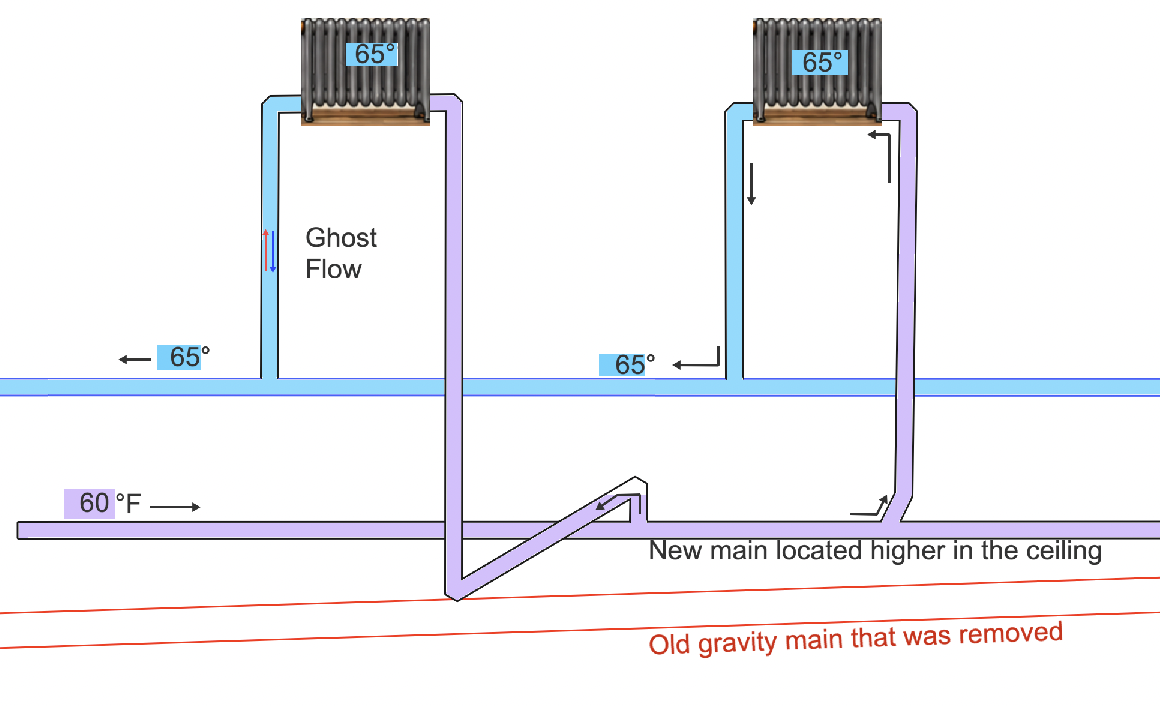
The increased pressure may be enough to compress the air pocket so water can move past the air pocket and absorb more air over time. After several hours of this procedure, reduce the pressure and operate the burners and see if the problem is resolved.
Just a thought . . . because the only other option is to spend lots of $$$ with professionals that may not be able to solve this since it is such a rare problem. Do this with all other zones off and only the CI radiator zone operating
Edward Young Retired
After you make that expensive repair and you still have the same problem, What will you check next?
 1
-
Not a pro, but I agree with Ed. If there was no air pocket on the supply side, your IR pics would show the supply pipes heating right up to the supply valve, even if the valve was closed, because of the ghost flow Ed explained. We have that phenomenon in our gravity conversion heating system where one radiator doesn't heat because the occupant of that apartment won't bleed the radiator, so no flow goes through it. But both the supply and return pipes still get hot after long boiler runs because of the ghost flow Ed described.
Don't waste your time swapping radiator valves. They're fine. Find the air pockets.
0 -
@EdTheHeaterMan - I have one picture from the previous owners of the house from about 30 years ago when they renovated the basement (see pic below).
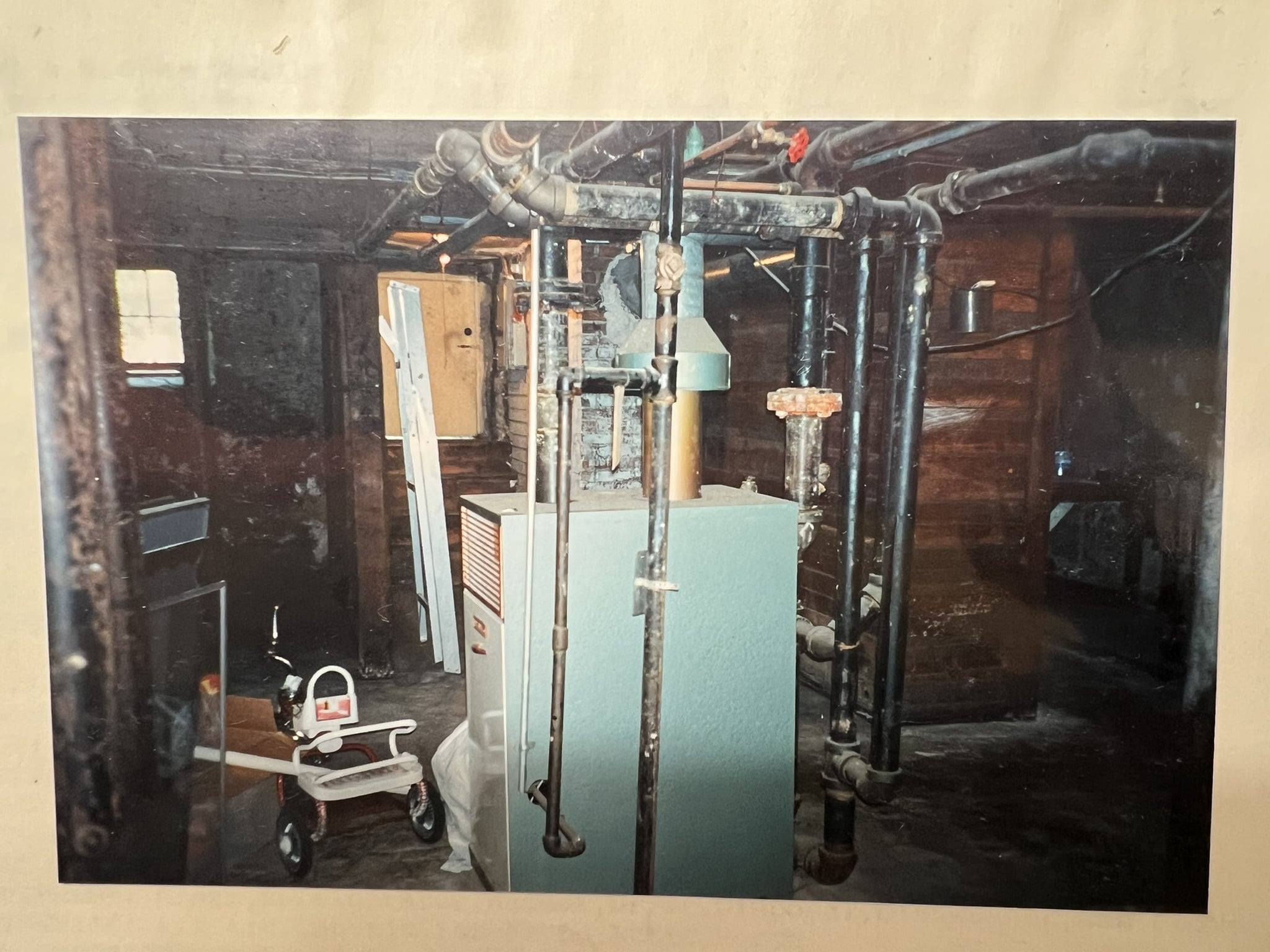
They moved the boiler from the middle of the basement about 10 feet towards the back of the house (which would be to the right in the picture above) when they finished the basement. Supply and Return piping must have been re-routed to accommodate the new boiler location but the pipes in that picture still seem pretty high up. What you're saying about the copper-tube systems makes sense and yes those are easy to purge. What you're saying about the cast iron zone is making sense, but there are some concepts and terminology you used that I don't quite fully understand.
What do you mean by the old gravity return pipes being "head knockers in the basement?" Does that literally mean you'd hit your head on them because they were near head height and they were raised up when circulators were installed on the systems?
You wrote, "However, if the redesign has created other high points that cannot be opened to let the air out, you need to figure out how it was done in the past, since the system worked without problems before." Somehow they got the air out before and the system worked. Is it possible they filled the system with water slower than we did this time? Would that help or no because of how a potential supply pipe is routed that could trap air? Also, are you of the mindset that the supply valves are definitely not the issue or is that still a possible issue in your mind?
You wrote, "Read about Ghost flow in this booklet Zoning Made Easy at the top of page 12. It is not called Ghost Flow in the book but it explains how some heat can get in a radiator without proper circulation." Are you suggesting adding a flow control valve (is this another word for flow check valve?) on the return side of the boiler? Is Ghost flow essentially when heat travels by gravity up the return pipe and cool air also flows back down so you're getting water moving in two different directions?
You wrote, "You could try increasing the pressure and operating the circulator at a lower temperature in order to get that air to be absorbed in the water (google BOYLE'S LAW) and carried off into some other place in the system where it can be vented or purged." Do I increase the pressure by just hitting the fill valve to manually force more water in? How much can I add? The pressure was around 20-22PSI when I last looked. What's a safe amount to add?
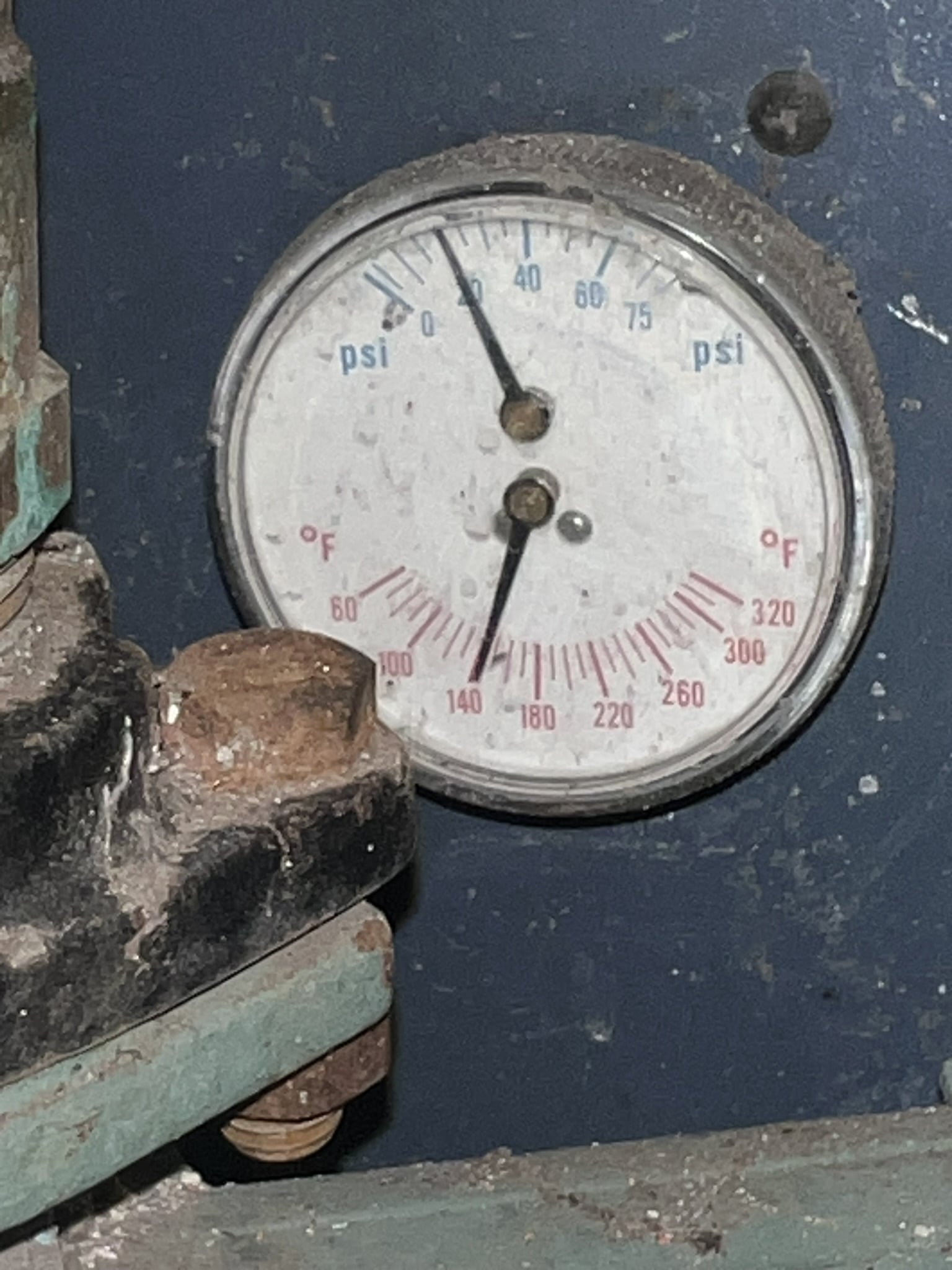
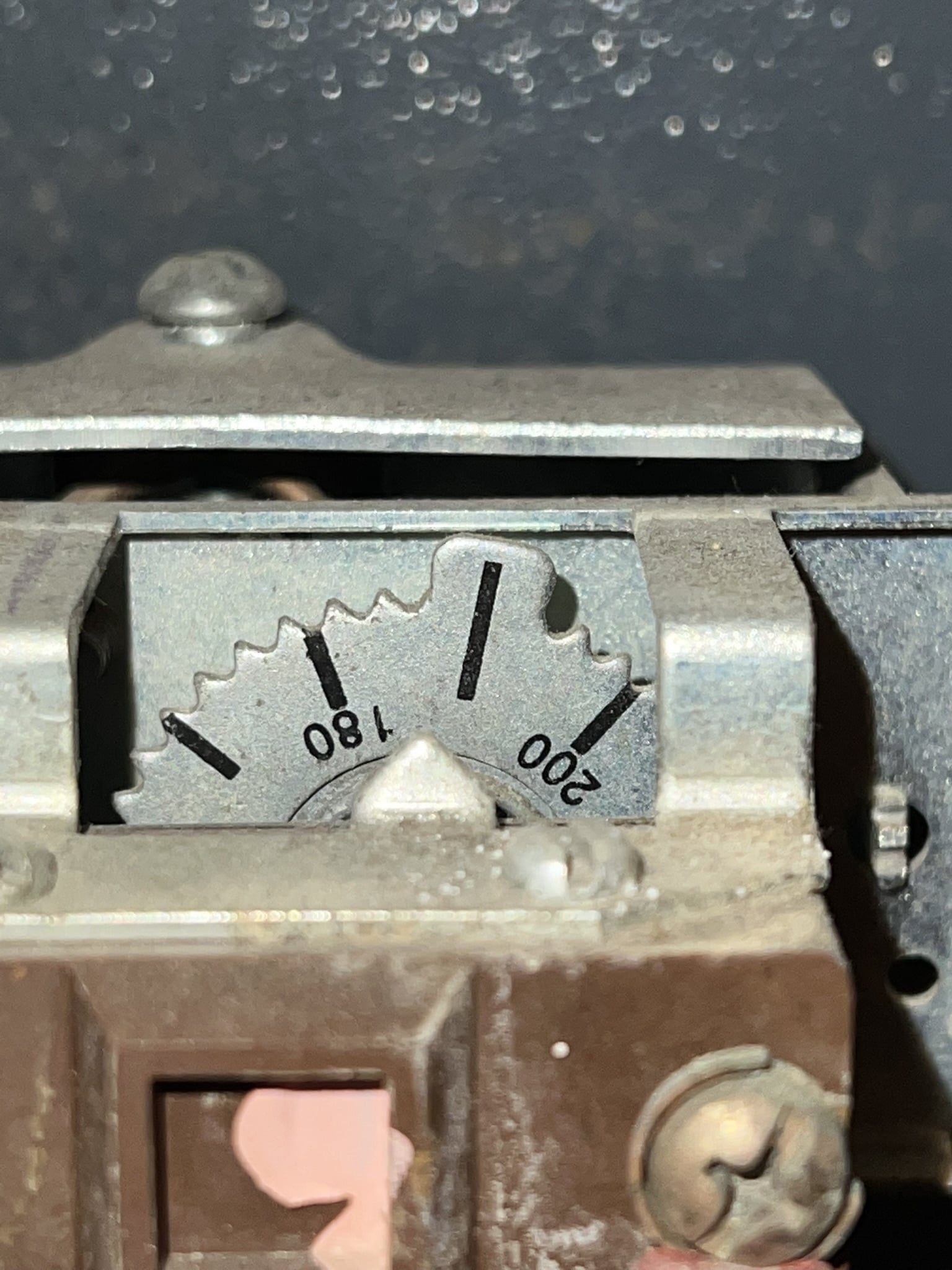
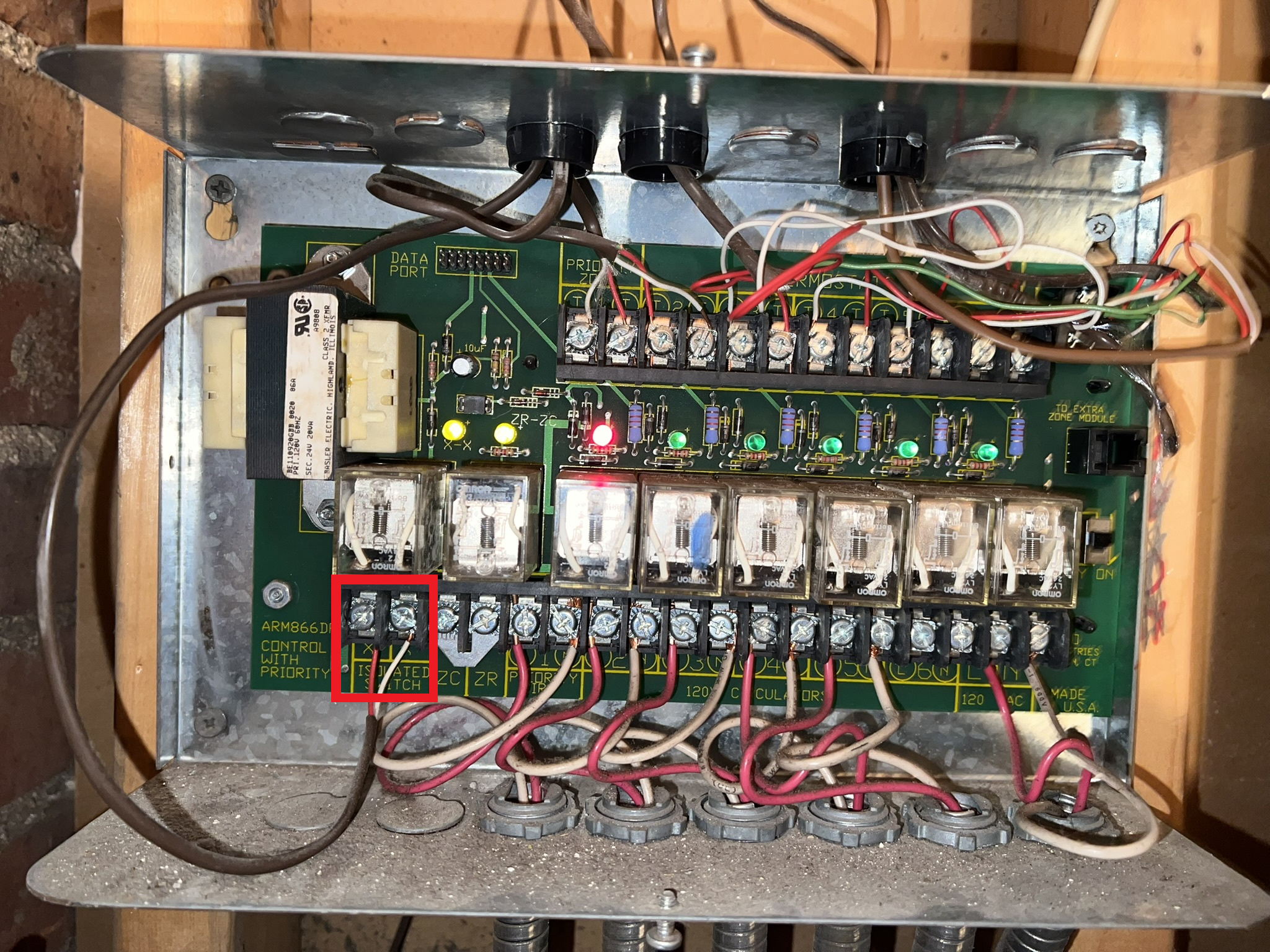
Also, how do I operate the circulator at a lower temperature? Do you mean jumping the zone out at the relay box to get the circulator to turn on while the boiler is off? Or do you mean lowering the temperature on the boiler thermostat and then turning the thermostat on so the water is heated to a lower temperature than it is now with the ciruclator running? (See pics of my boiler thermostat and relay box for heating system below). If I should lower the temp on the boiler thermostat, what temperature should I adjust it to?
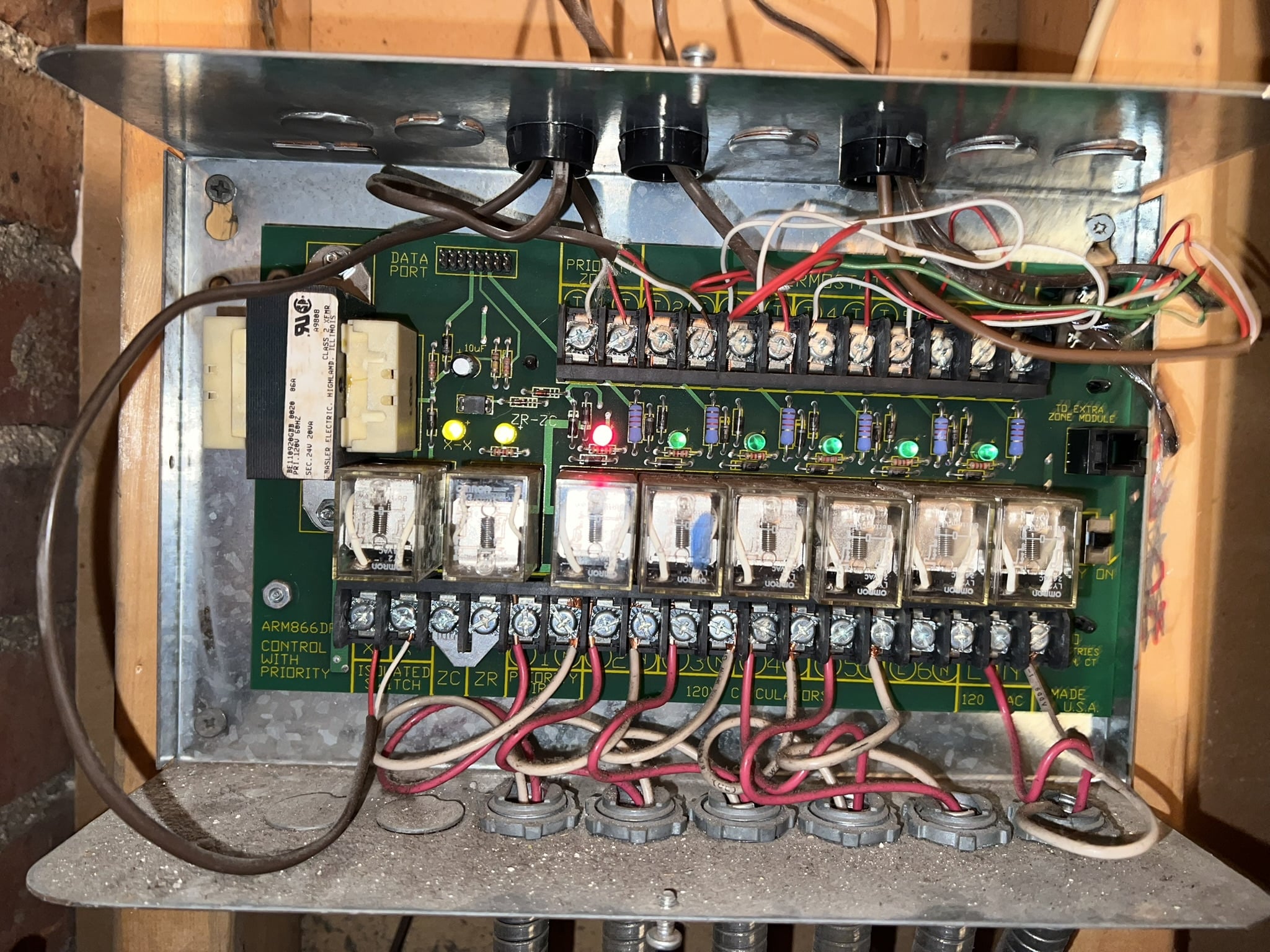
You wrote, "The increased pressure may be enough to compress the air pocket so water can move past the air pocket and absorb more air over time. After several hours of this procedure, reduce the pressure and operate the burners and see if the problem is resolved." How do I reduce the pressure later? Do I just open the drain gate valve at the bottom of the return side of the system? And by operate the burners you mean just turn thermostat up and let the boiler run normally?
@pecmsg - You wrote, "Close the supply / return at the boiler! Air could be trapped in the supply, return or both. Force it to the high point." If I close the supply and return, the circulator will not be able to pump because it's below the ball valve on the return. If the problem is as EdTheHeaterMan described then I'm not sure how it will get the air from the problem piping after a T connection on the supply where it is potentially stuck. Right now the both the supply above the boiler and return above the circulator are coming back piping hot. Since the system is not just a simple circuit, it seems purging will not work.
@hot_rod You wrote, "You do need a good flow to push air through large pipes. Use the fast fill function on the fill valve so you can get around 8-10 gpm. A fill bypass, even better." If the system is already full of water, will hitting the fill valve do anything? Are you saying to do this while purging water or just try to fill it more without purging? How much water can I safely add before the pressure is too high? Also, what's a fill bypass?
@jesmed1 - Would the supply valve get heat if it's completely shut off or obstructed? Or would the water not move up the supply pipe because there's no flow? I do think the tech I'm using is pretty knowledgeable. He knows a lot, but the issue we are having seems to be a pretty rare kind of situation…
Question for everyone: In my original post I also asked if anyone thought changing the supply pipe diameter after it exits the boiler from 1.25" to 1.5" to accommodate the spirovent before reducing back down to 1.25" could be an issue (they did this for about 2 feet of the vertical pipe right after it comes out of the boiler but it's reduced back before it 90's at the top. They accidentally ordered the wrong size spirovent instead of just getting one that would fit on the 1.25" pipe). Would that change in pipe size cause any kind of change in speed for the flow? That's the only other thing that was changed with the piping on this repair job. Is that 1/4" larger diameter enough to cause some kind of short circuiting issue on that last supply pipe or does it not matter because everything is reduced back to 1.25" before any of the take offs to the zones?
0 -
Don’t worry about the Spiro vent, that is not the problem.
Year ago I met a company called PurgeRite at a GEO seminar in Oklahoma
They travel North America purging problematic systems. Much larger than yours but the concept is the same.
They determine the largest piping in the system. Then using a flow/ velocity chart the determine how many gpm is needed to get flow velocity above 2 fps.
That is the velocity where air moves along with the fluid flow. They throttle the pumps up, read the flow meters to know when they reach the required gpm/ flow.
In their booth they had samples and pics of stuff they had flushed from systems. Tools, nuts and bolts, pipe dope lids, piles of dirt, typical jobsite stuff.
If in fact you have air traps in the piping, my opinion is you need some big flow, tell me the largest pipe size and I can tell you how much flow you might need. It’s possible a 1/2 fill line will not get you there.
Next step would find someone with a purge cart. Those start around 10-11 gpm, with 1/2 hp pumps.
GEO installers have carts that do 20 gpm, homemade versions with 2 hp pool pumps mounted on a plastic garbage can.
GEO loppers that do 2” and up loop fields get used fire truck to use for purging large loop fields.
PurgeRite has capacity to purge 24” pipe.
Looks like they merged recently with an eye on the lucrative data center work😏
So my point is, IF you suspect some airlocked sections, I would opt for some serious horsepower to blast the system.
I’d try a garden hose connected directly to the system. It’s a 2 man job to keep an eye on the purge and stay below 30 psi
Unless you can bypass the boiler and it’s 30 lb relief, then you could main pressure, 40, 60 psi or more. With ci radiators you might stay below that 30 psi, but high gpm
Assuming this system has worked in the past, it should be able to flow properly again.
 Bob "hot rod" Rohr
trainer for Caleffi NA
Living the hydronic dream0 -
That is definately a gravity system… No circulator anywhere!
And that boiler may have replaced an older boiler
You never know what a person is thinking but if the bottom of the floor joist (basement ceiling joist) are at 7' 6" and there is a section of old piping that is a head knocker for a tall guy of 5' 9" you don't want to box those pipes in with framing lumber and make the ceiling only 5'7" off the floor to cover the 5'11" pipe with some air space between the lumber and the pipe. So you ask the plumber… how high can you put the new pipes when you install the new heater?
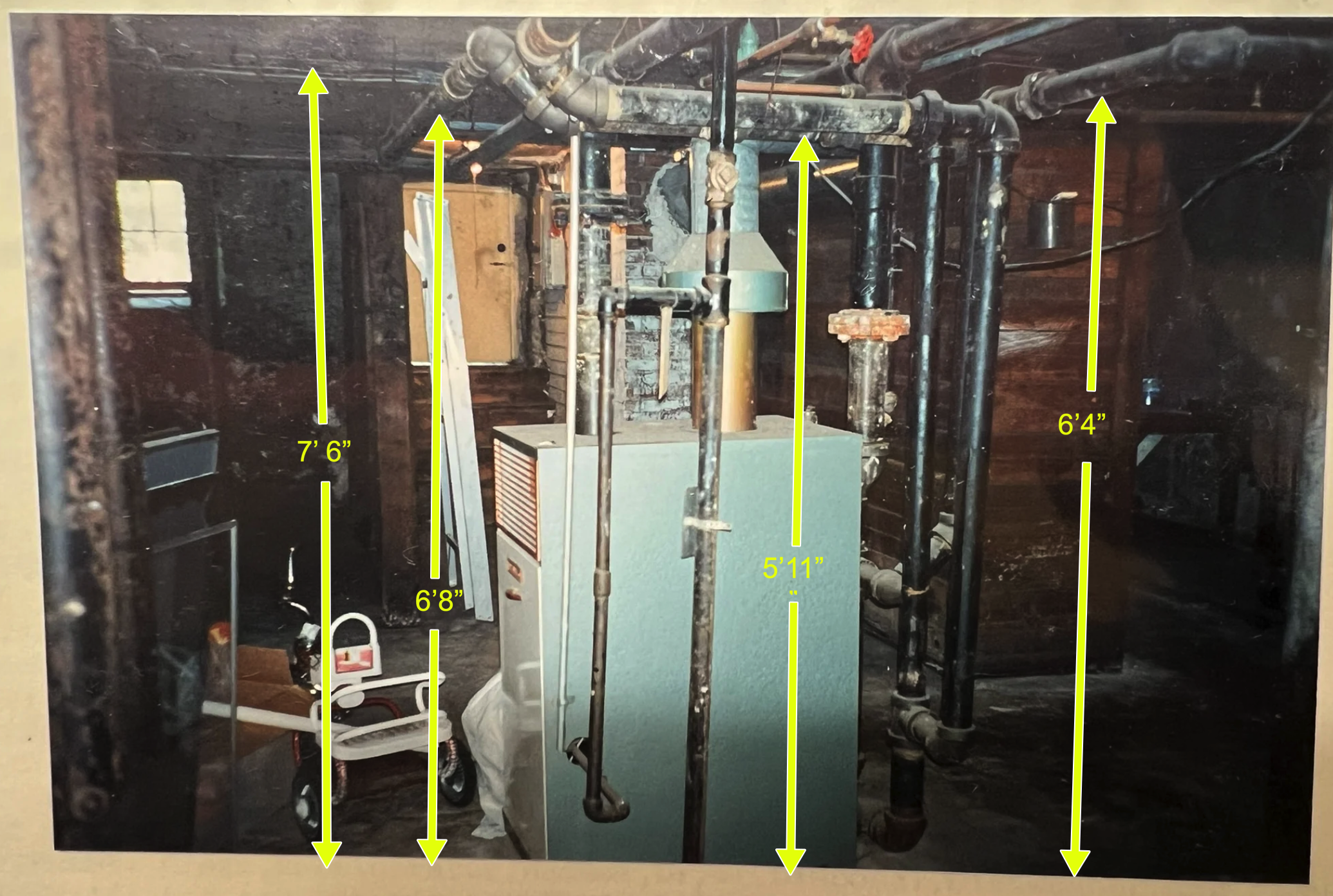
All I'm saying here is look for some piping arrangement where air can be trapped on the pipes that connect from the main — to the problem radiator.
Edward Young Retired
After you make that expensive repair and you still have the same problem, What will you check next?
0 -
What do you mean by the old gravity return pipes being "head knockers in the basement?" Does that literally mean you'd hit your head on them because they were near head height and they were raised up when circulators were installed on the systems?
Exactly right
Somehow they got the air out before and the system worked. Is it possible they filled the system with water slower than we did this time?
No.
Water seeks its own level and that will happen across your own house from one end to another. If you start out empty and you put water in the boiler it will find it's way into the connected pipes and go left and right in a tee and create the same level wherever the water line stops at any given moment. This illustrates the water level is the same where ever you look in the home.
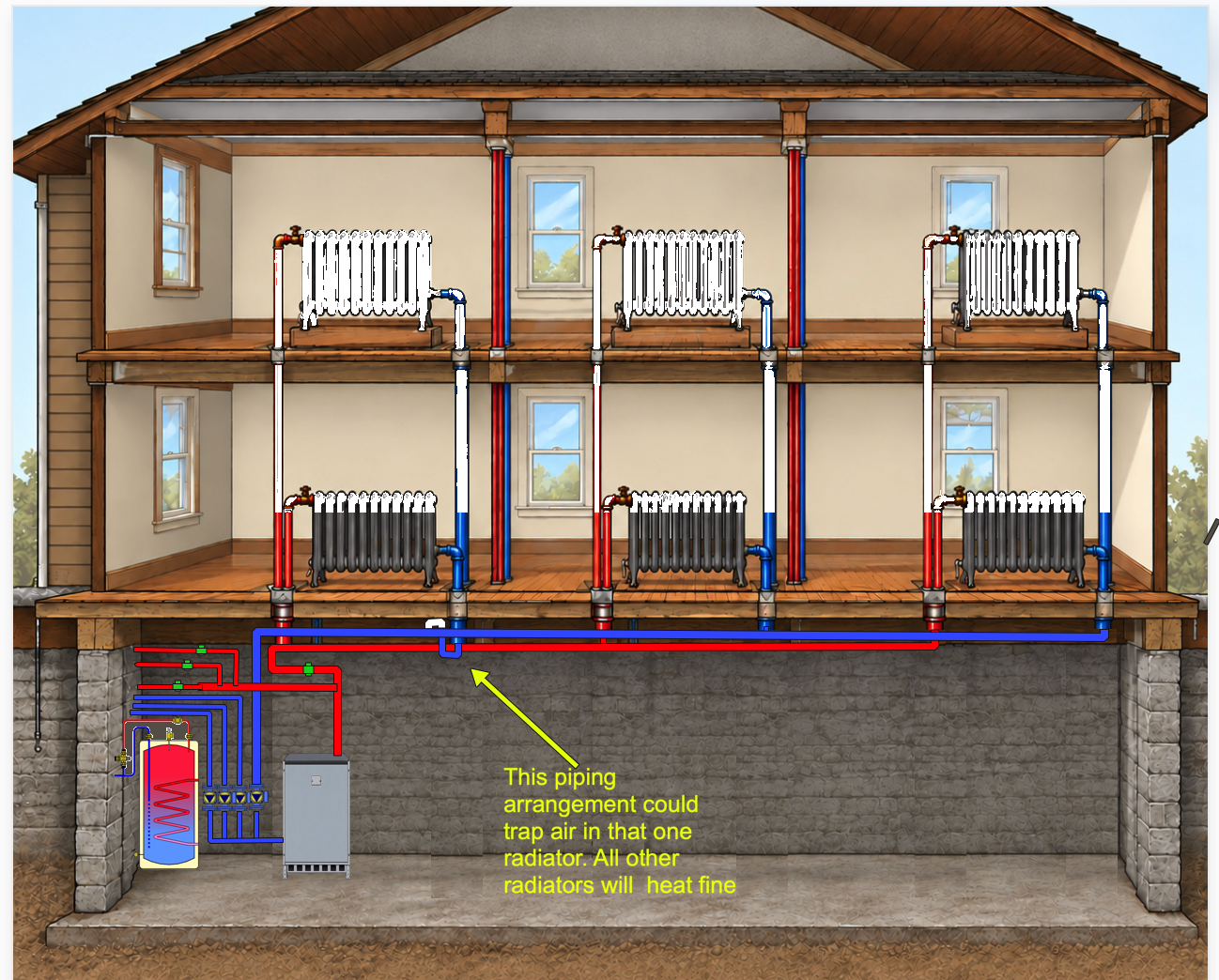
How fast or slowly you fill the cast-iron system will have no effect on the location of the air in the system. That is why purging does not work on systems where there are tee fittings.
Also, are you of the mindset that the supply valves are definitely not the issue, or is that still a possible issue in your mind?
No, the valves could be a problem. I just don't think they are. The problem started after air was introduced into the system. The valves were in the open position before the problem occurred, and no valve was changed until after the problem was discovered. Valves don't mysteriously close when you drain a boiler for repairs.
Are you suggesting adding a flow control valve?
NO. You don't need more valves of any kind. The system worked fine the way it was. Don't fix something that ain't broke.
I was giving a possible reason for the radiator getting warm when the flow seems to be going backward. If the airlock is in the radiator supply pipe, the hotter water will not ghost-flow through the supply. This was only an explanation for the anomaly of heat getting into a radiator that has no pumped flow. (Maybe that was TMI on my part.)
Do I increase the pressure by just hitting the fill valve to manually force more water in? How much can I add? The pressure was around 20–22 PSI when I last looked. What's a safe amount to add?
You increase the pressure by adding water. More water = more pressure. The relief valve will discharge water from the system at 30 PSI, so stay at or below 25 PSI.
A normal two-story home operates just fine at 12 PSI. So, when you are all done, you should adjust your automatic water feed valve to 12 PSI.
Also, how do I operate the circulator at a lower temperature?
You can do this a number of ways. The easiest way would be to raise the thermostat for the cast-iron radiator zone only, well above room temperature, to something like 85°F. Then close the manual gas valve so the burner does not run. This will allow the cooler water to circulate through the cast-iron radiator zone at approximately room temperature. All the other thermostats should be off or set low, like 55°
Boyle's law describes the relationship between gas pressure and volume. In addition, water can hold more dissolved air when its temperature is low and its pressure is high.
So, what we are trying to create is flow past the problem area using cooler water at a higher pressure. If this experiment works, the trapped air will gradually be absorbed into the water, and the flow will increase over time.
After several hours of this, you can turn the gas valve back on and let the burner operate to heat the home. Heating the water will cause the dissolved air to come out of solution, allowing the Spirovent to expel it as the water passes through the microbubble separation media.
NOTE: Before you operate the burner, you want to lower the boiler pressure to 12 PSI while the boiler is cold. If the automatic feed valve wants to add more water and you cannot adjust it to a lower pressure, shut off the manual water feed valve to keep the boiler pressure at 12 PSI. Then start the burner.
I hope this answers some of your questions.
Edward Young Retired
After you make that expensive repair and you still have the same problem, What will you check next?
0 -
when you have a system with high spots or air pockets, either you install a bleeder, like you see on the top of radiators, or you provide sufficient purge flow to shove the air out.
Often is you can isolate sections to do the purging, that may help. If not you need to force a lot of flow.
Large piping and high pockets are the toughest purge job.
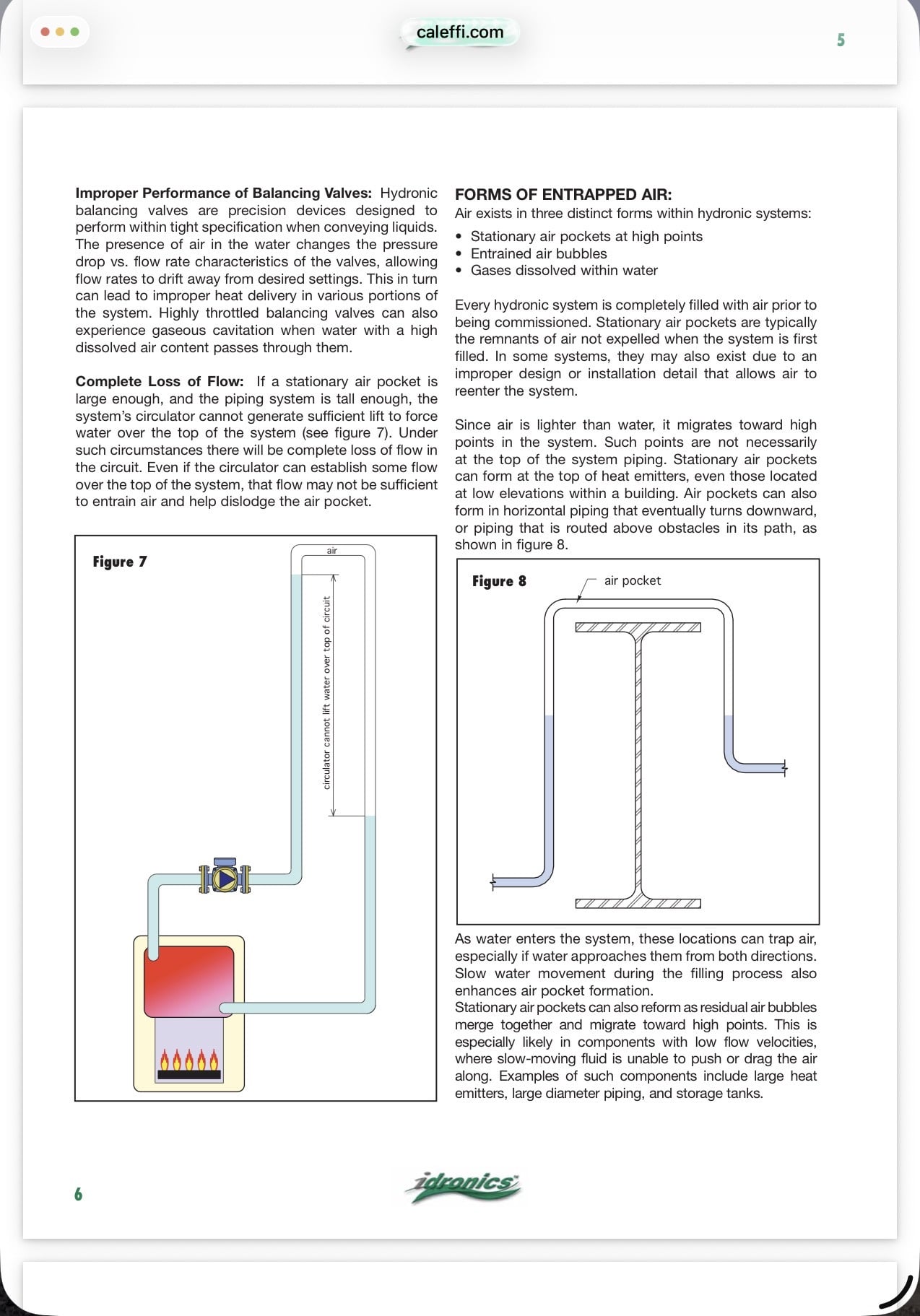 Bob "hot rod" Rohr
trainer for Caleffi NA
Living the hydronic dream0 -
Thank you @EdTheHeaterMan and @hot_rod for your latest responses and help so far. I have some questions and want to go through your responses when I have more time, but for now just wanted to let you all know about a new development. It seems the larger problem radiator that got almost no heat and seemed to be getting warm from the return side is now getting a warm from the supply side (barely warm, but something is getting in there - temps are only like 70 degrees so it's still not working in terms of heating normally) See pics below. I even put the focus right on the supply and return in the last 2 pics so you could see the temps (78.4º at the supply valve and 63.1º at the return). I observed this last night and this morning. Does this change any assumptions about the cause of the problem? I found it odd so figured I would post about it.
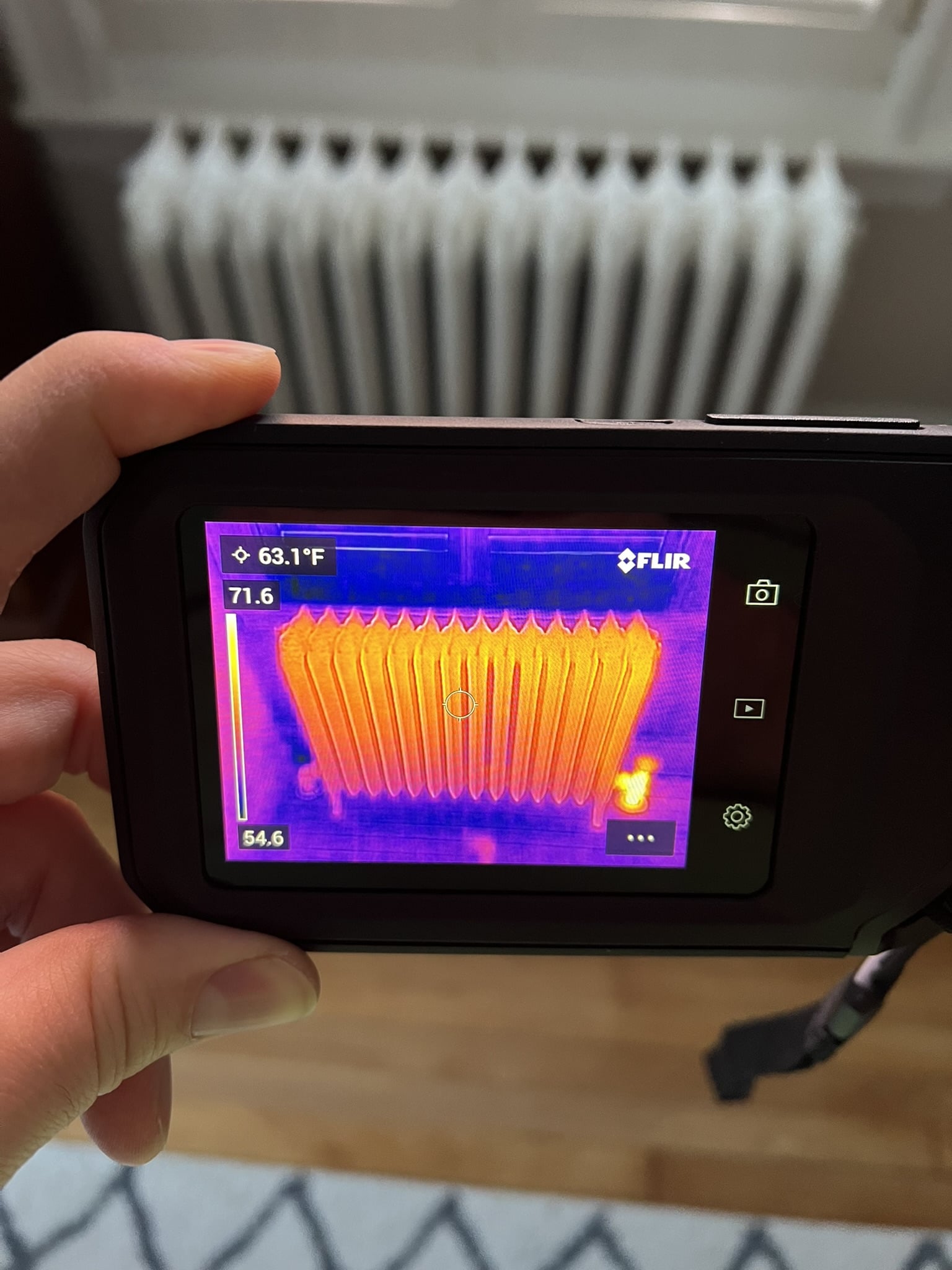
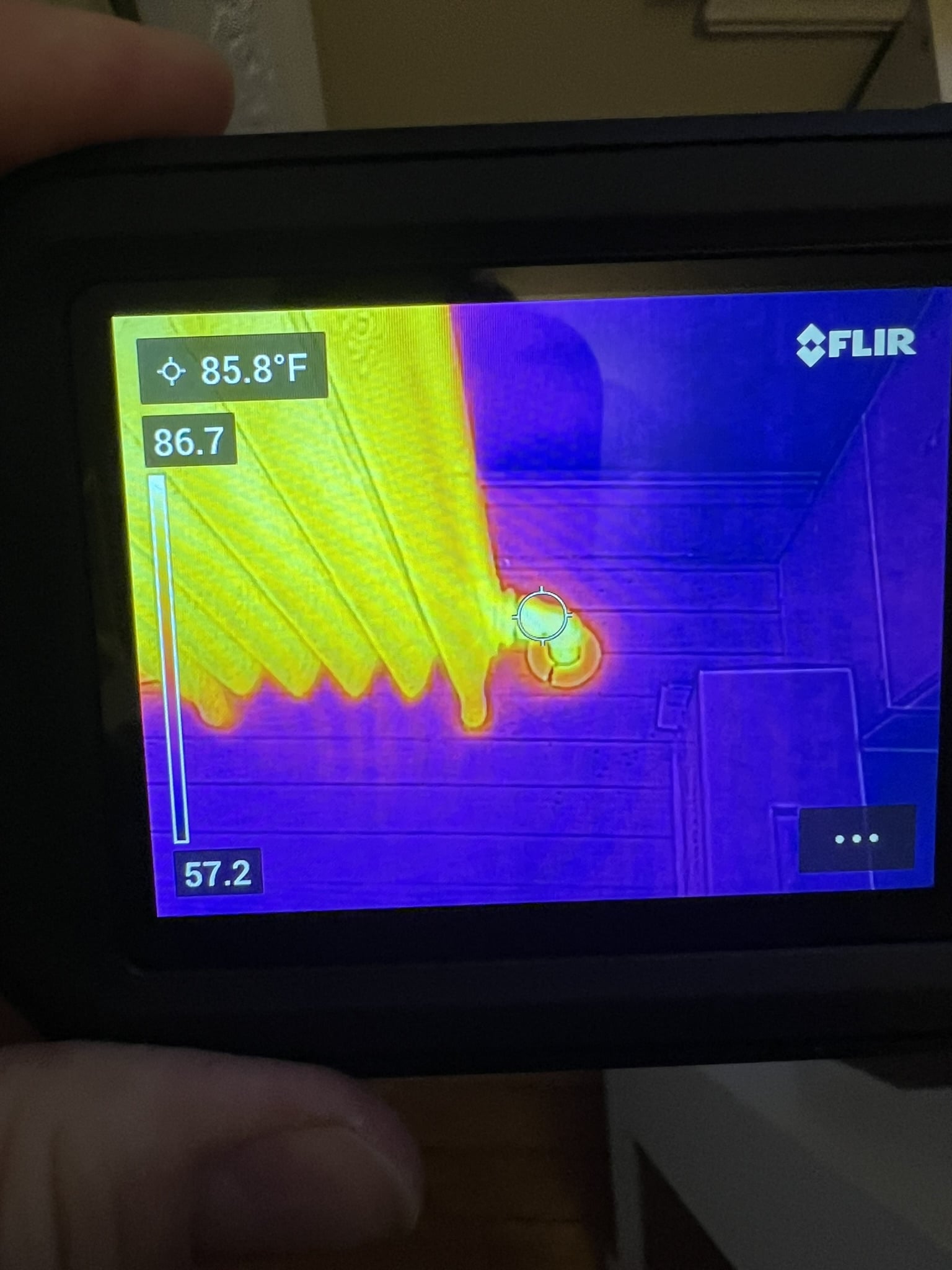
The smaller problem radiator may still be heating from the return (temp 85.8º at return vs. 80.1º at the supply), . See IR pics of the smaller radiator below.
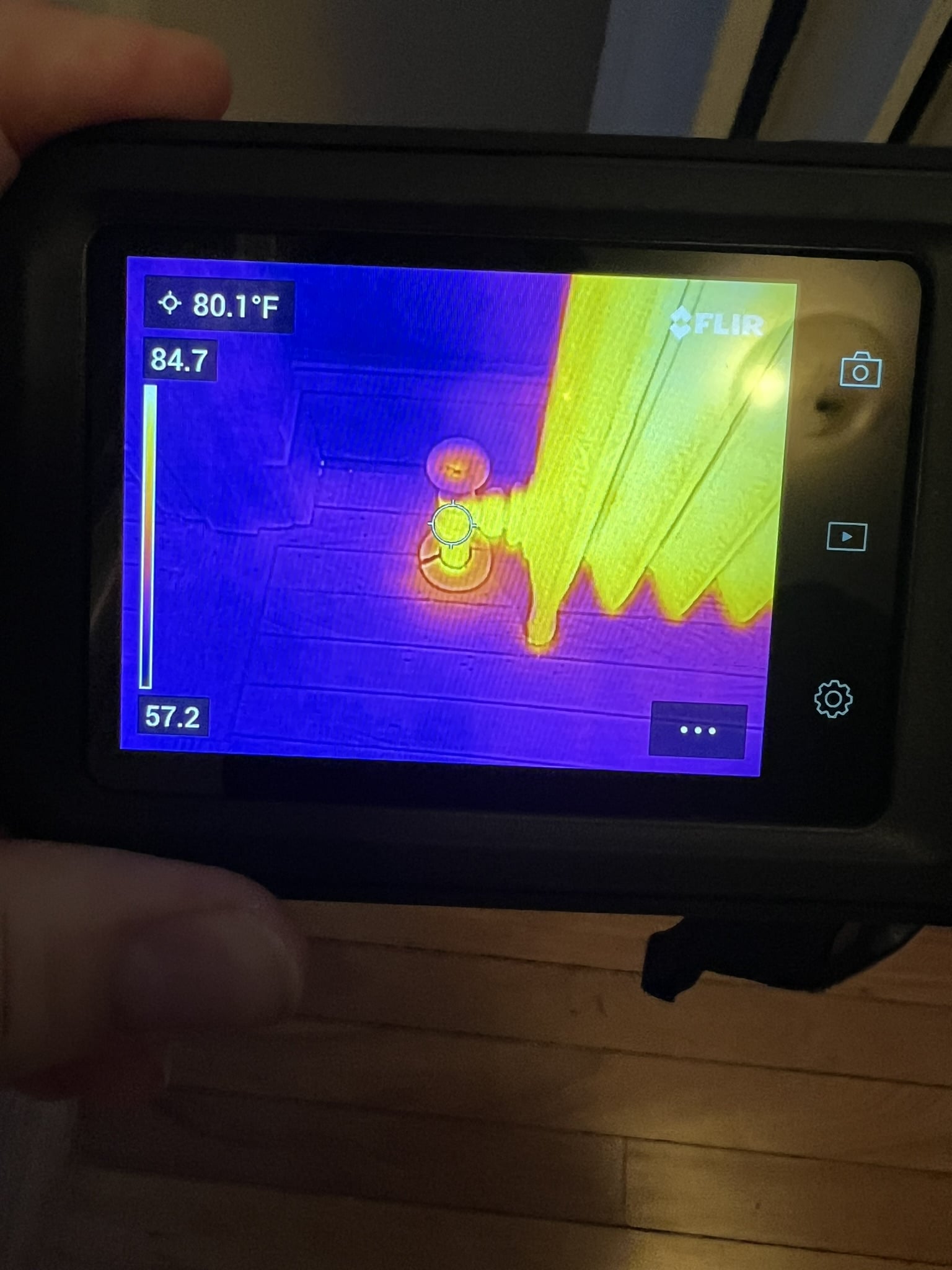
I was trying to use the camera to see into the walls to trace the supply and return piping. I can see where there are some hot pipes in the wall, but it's not powerful enough to really get much more information such as which pipe in the wall is a supply or return, or if there is some kind of air pocket where there is lack of heat, etc.
0 -
It is hard to predict flow inside a system that may have air pockets. Water tends to find the path of least resistance, which could be the return piping in your case.
I think most agree another "power" purge would be a simple first step.
Assuming all valves are open, pumps, including the impeller are spinning.
After any repair work or commotion on the piping, debris can get loosened and lodged in the pump impeller. It is another easy check.
You have fairly good isolation on the circulators, the yellow handle valves, and the large green valve, and the yellow one below it, would work without losing much water.
I think it is a 5/16 nut driver or socket to pull the motor and impeller cartridge from those circ. All; valves off and power down the system first!
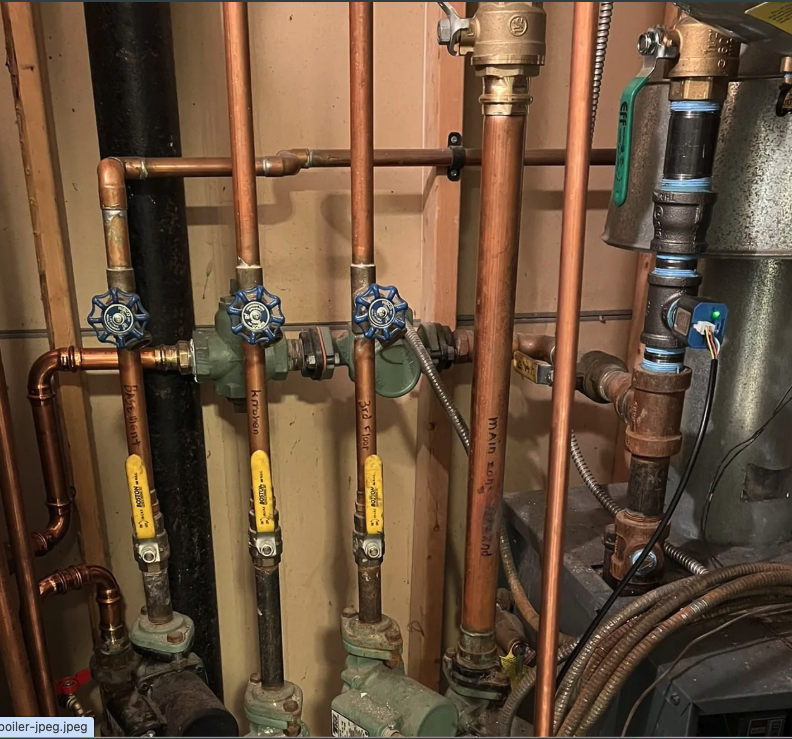 Bob "hot rod" Rohr
trainer for Caleffi NA
Living the hydronic dream 1
-
This is progress! Boyle’s law is working, and that slug of air in the supply pipe is now smaller. The longer the water circulates—even at a very slow rate—the more air can gradually dissolve into the water. Eventually, the air pocket may disappear completely. then the problem with that radiator will be solved.
After that one is done, maybe the other one will also resolve and be solved by dissolveing the air involved, wait and see how the situation evolves.
I have just renewed my poetic license. It came in the mail today!
Edward Young Retired
After you make that expensive repair and you still have the same problem, What will you check next?
0 -
@hot_rod - You wrote, "Don’t worry about the Spiro vent, that is not the problem." I wasn't specifically meaning to ask about the Spirovent but more the piping that it is attached to. They were going to put it on a 1.25" diameter pipe (which would have been the same size as the rest of the pipes leading out from the boiler) but they accidentally bought a spirovent for a 1.5" size pipe. So I was wondering if the upsizing of that section of pipe would have an effect on the flow. When I was googling about it I found various information that seemed to indicate it could.
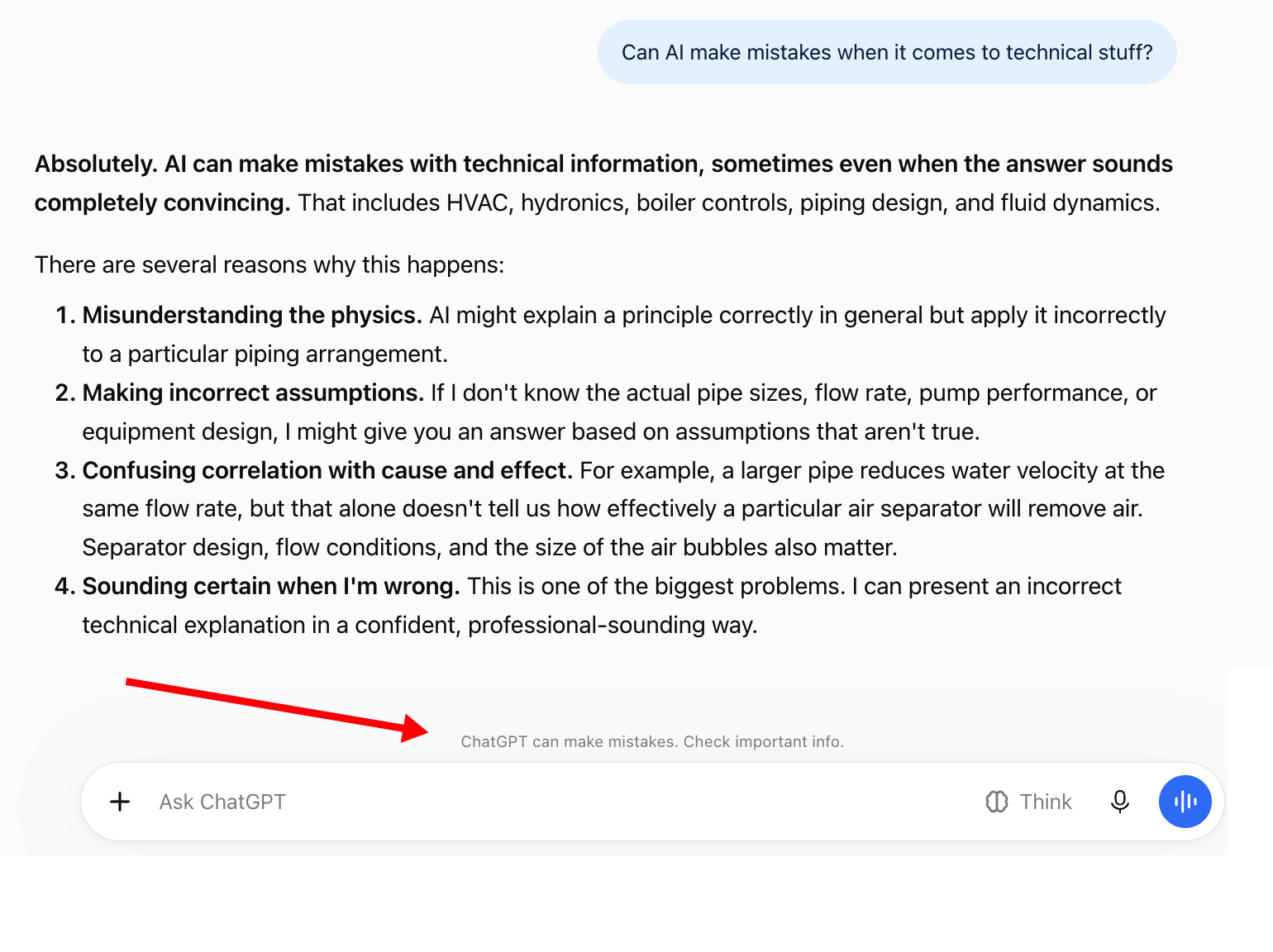
I asked, "can upsizing and then reducing the piping coming out of a hot water boiler affect heating distribution" and the AI overview said yes (I know can't always trust these, but it said the following below)
"Yes, upsizing and then reducing the piping coming out of a hot water boiler can significantly affect heating distribution. This configuration alters the fluid dynamics of your hydronic system, creating local changes in velocity, pressure, and flow resistance that can disrupt how heat is delivered to different zones or radiators.
Here is how this piping change impacts your system:
1. Pressure Drop and Flow Resistance
The Venturi Effect: When the pipe transitions from a larger diameter back down to a smaller diameter, the water is forced to speed up. This restriction creates a local pressure drop and increases friction.Reduced Flow Rate: If your circulator pump was sized based on a uniform pipe diameter, this sudden restriction adds unexpected "head loss" (resistance). This can reduce the overall flow rate (gallons per minute) traveling through the rest of the system.
2. Uneven Heat Distribution
Starving Remote Zones: Because the restriction increases resistance, the hot water will naturally take the path of least resistance. Nearby heating loops or zones may get plenty of heat, while radiators at the end of the line or on upper floors may become sluggish, lukewarm, or starved of heat entirely.
Slower System Response: Lower overall flow rates mean it will take longer for the entire house to
reach the thermostat's set temperature.
3. Air Trapping and Circulation Issues
Velocity Drop: When water enters the wider, upsized section of the pipe, its velocity drops drastically.AirPockets: Hydronic systems rely on a certain velocity (usually at least 2 feet per second) to push microbubbles to the air separator. If the velocity drops too low in the upsized section, air bubbles can separate
from the water and get trapped at the top of that larger pipe, creating an air lock that completely blocks water flow. "This is why I was asking about the pipe size, but no one seems to think this could be part of the issue. Am I missing something?
@hot_rod Anyway, everything else you wrote about the power purging at least makes it seem like I have other options if nothing else works. I will need the techs to do this - I don't have any of that kind of equipment. Also I'll definitely mention to the techs about checking the circulator to make sure it's operating correctly and nothing caught in there. I think the largest pipe is 1.5" diameter on the cast iron zone. The smaller baseboard zones are 3/4" diameter.
@EdTheHeaterMan You wrote, "No, the valves could be a problem. I just don't think they are. The problem started after air was introduced into the system. The valves were in the open position before the problem occurred, and no valve was changed until after the problem was discovered. Valves don't mysteriously close when you drain a boiler for repairs."
I think the tech was suggesting that when the system was repressurized something could have broken apart inside the old valve. He was describing to me what they looked like inside, but I wasn't understanding exactly what it was because I haven't seen the insides of these particular valves.
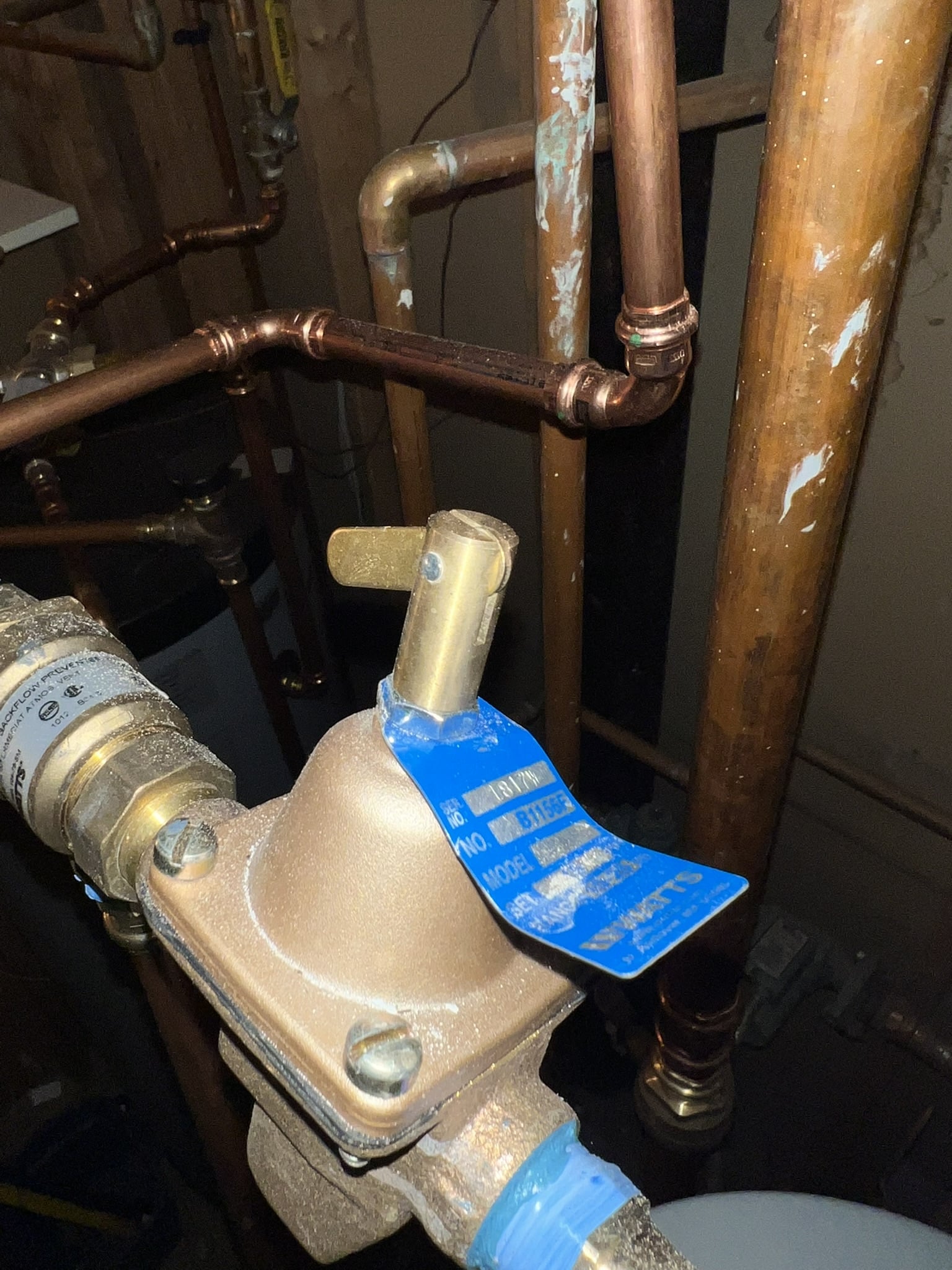
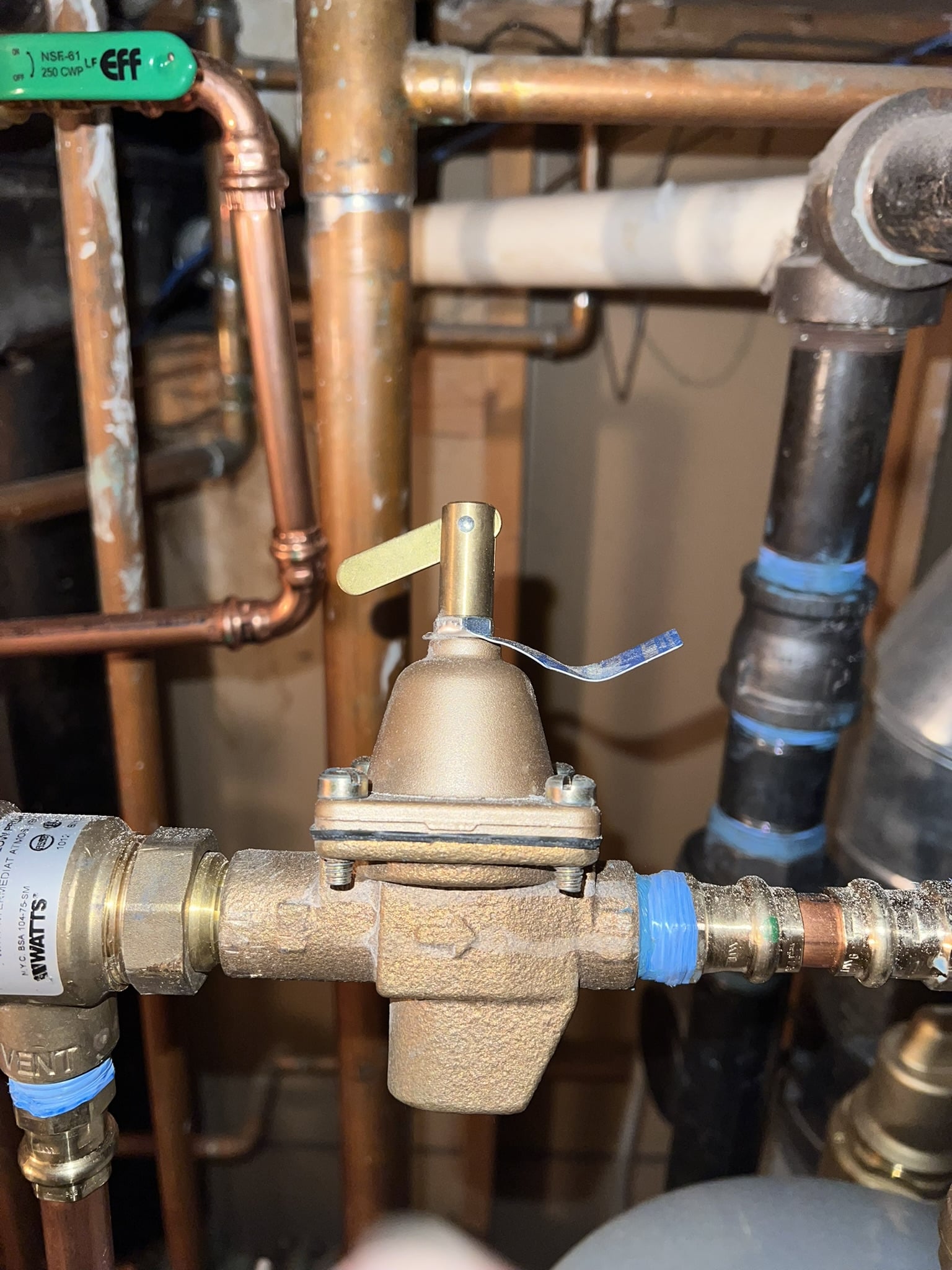
Anyway, I understand that it seems air could definitely be the issue instead of the valve… I don't know why the heating company wants to start with the valves, but that's what they're suggesting. I still will try your suggestion of running the circulator without the heat and adding water pressure. I'm not sure if the pressure guage on the boiler is accurate. The automatic water feeder on the system has a tag that says "Set 15 PSI" and "Range 10-25PSI" (see pics).
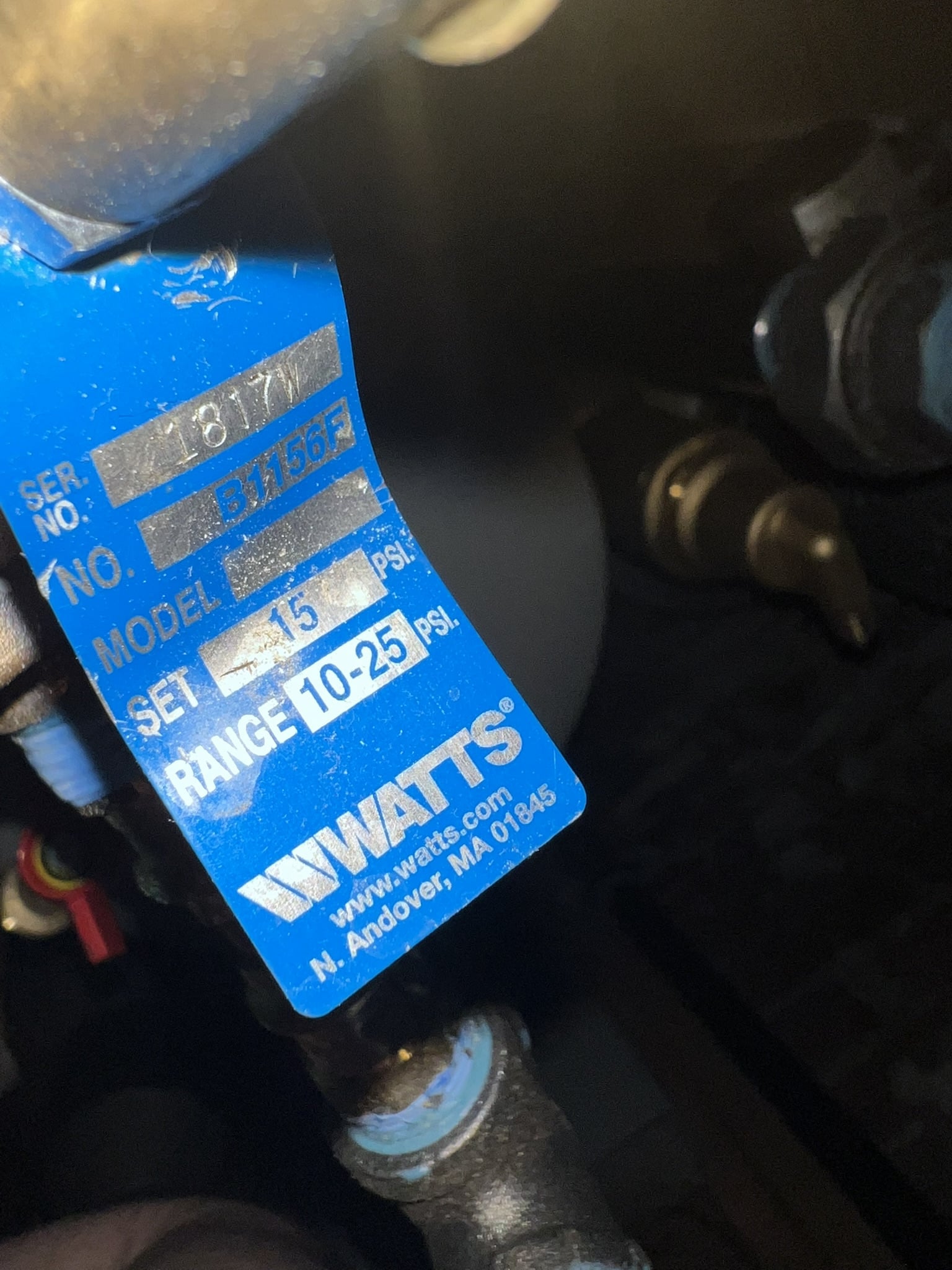
Once I add water to increase the pressure, you mentioned lowering the pressure to 12PSI while the boiler is cold before firing it again. I assume I just need to open the draw off to let water out in order to lower the pressure, right? Will this introduce more air to the system though? Does it not matter because I have that spirovent? Also, while I'm running the circulator on the cast iron radiator zones should I shut the ball valves on the supply and returns for the baseboard heating zones? Does it matter?
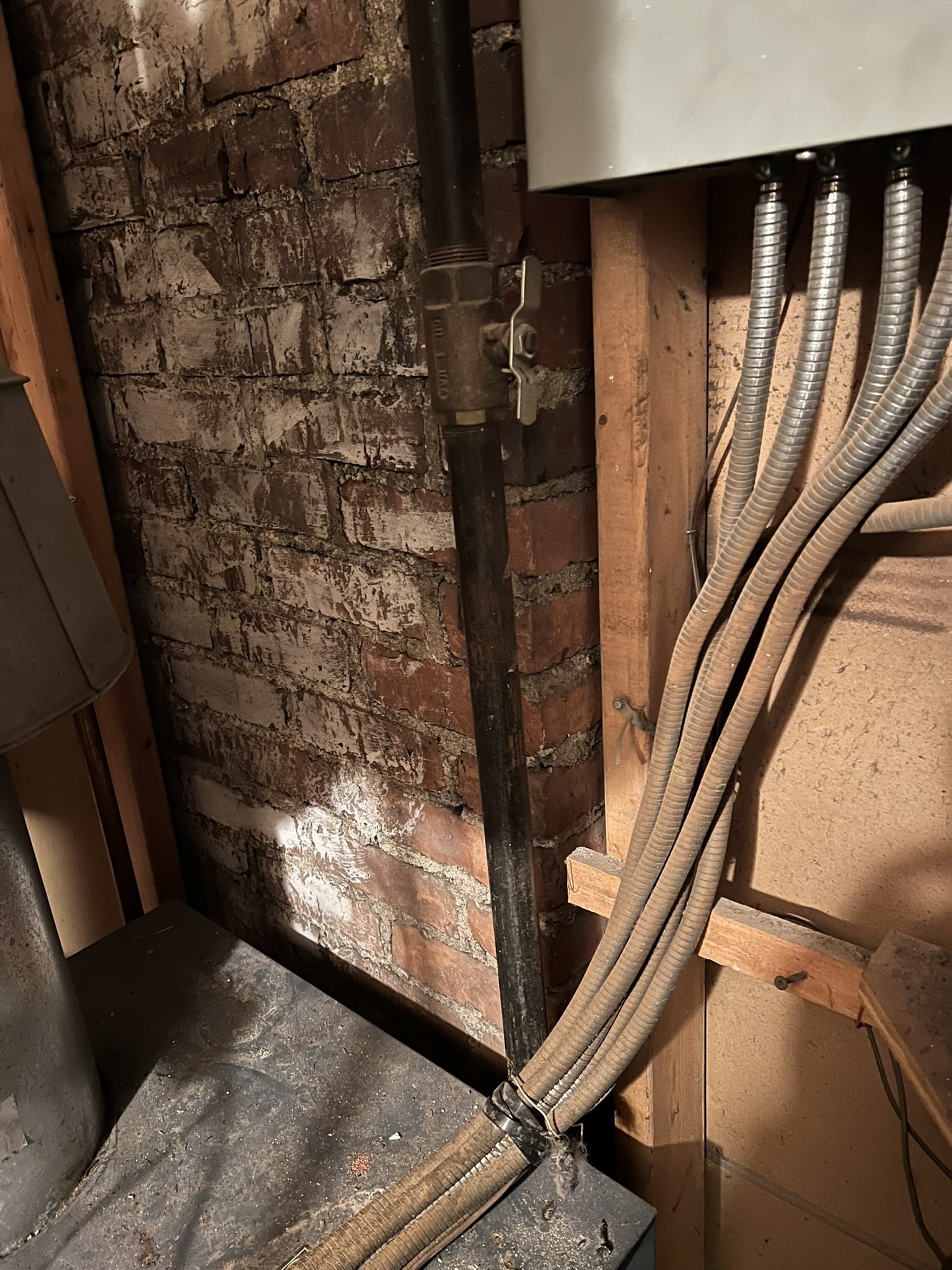
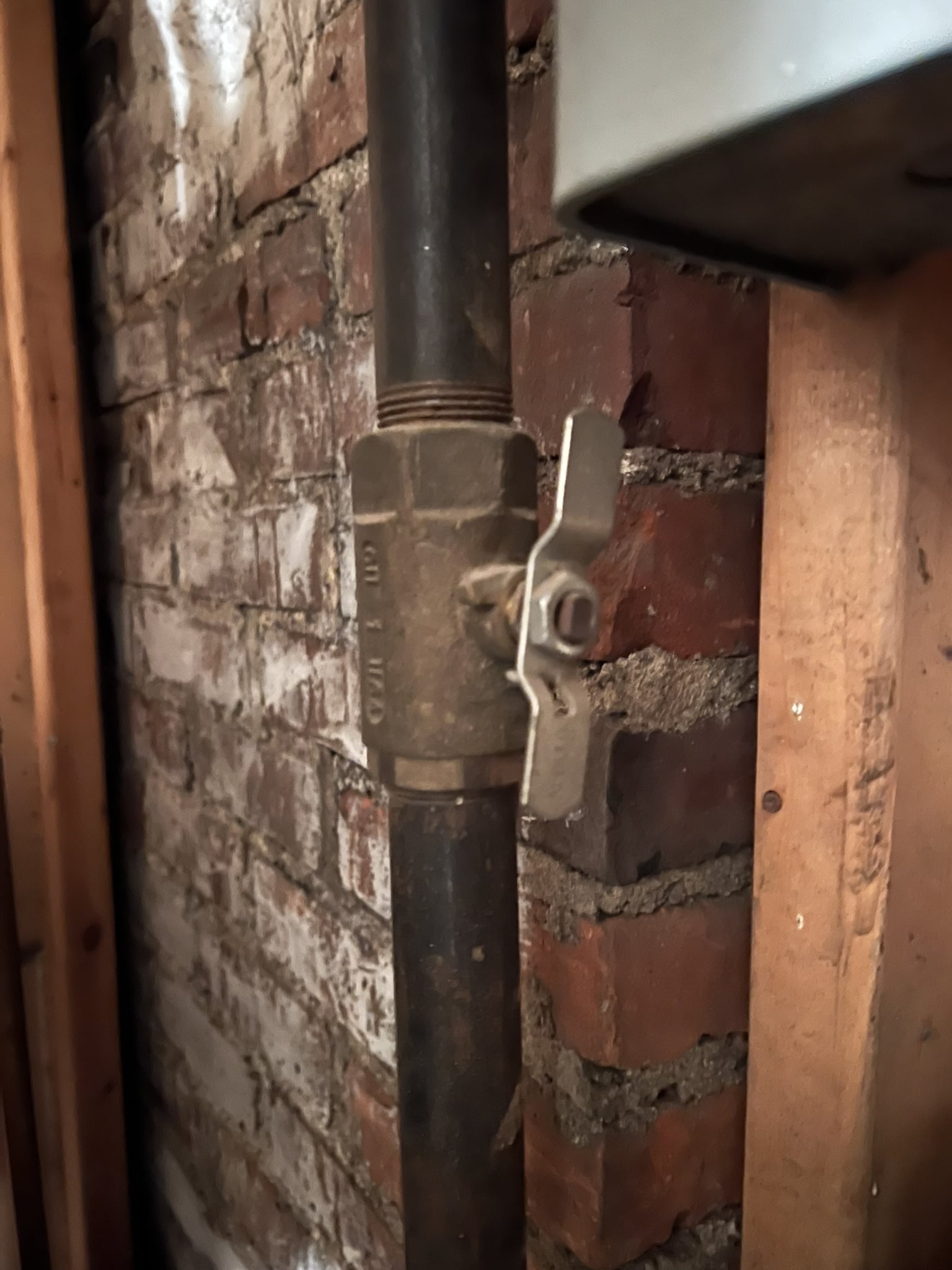
When I run just the circulator without the heat, you mentioned shutting the gas to the boiler so it doesn't fire. You're suggesting shutting the gas valve that leads to the boiler as a way to do this? Like this one in the pictures below? Will I need to do anything besides just opening this valve after to get the boiler to light again? Thanks.
 0
-
" This is why I was asking about the pipe size, but no one seems to think this could be part of the issue. Am I missing something? "
So you changed the pipe size to the poorly performing radiators ?
National - U.S. Gas Boiler 45+ Years Old
Steam 300 SQ. FT. - EDR 347
One Pipe System 0
-
If I wanted to disable the boiler (no heat) while running a circulator, I would disconnection one of these wires 'Isolated Switch', or at the boiler's end of the wire. This way the boiler does not keep trying to start with no Gas available. However I am quite comfortable with electrical work.
 National - U.S. Gas Boiler 45+ Years Old
Steam 300 SQ. FT. - EDR 347
One Pipe System0 -
Are these two questions related:
"I assume I just need to open the drain valve to let water out and lower the pressure, right? … Will this introduce more air into the system?"
The answer to the first question is YES, and the answer to the second is NO, provided the system remains sealed and no air can enter through a leak or opening.
Releasing water from a closed system lowers the pressure, but it does not introduce air that wasn't already in the system.
The expansion tank contains air compressed to 25 PSI. When you open a drain valve, that compressed air pushes against the water and forces it out. Once enough water has drained for the system pressure to drop to 12 PSI, close the valve. The system will then be at 12 PSI, with the air in the expansion tank compressed to 12 PSI at the gauge level
In a closed system, the static water pressure decreases as you go higher above the pressure gauge. At 12 PSI, the system can support a water column approximately 28 feet high above the gauge. If the highest point is above that height, the pressure there could drop to zero or below, allowing air to enter through an opening or leak.
Since your system has no piping more than 25 feet above the gauge, there should still be positive pressure at the highest point when the system is at 12 PSI. Therefore, lowering the pressure from 25 PSI to 12 PSI should not introduce air into the system, provided the system is sealed.
Edward Young Retired
After you make that expensive repair and you still have the same problem, What will you check next?
0 -
@109A_5 I wanted to find the easiest way for @Jeremy_16 to operate a circulator without firing the burner. When you get into disconnecting wires, I get the feeling that @Jeremy_16 might be uncomfortable doing that.
I feel that using a thermostat to operate the circulator is easy enough for @Jeremy_16 , and closing the gas valve is also straightforward. That's why I suggested this as the best option for this procedure.
Now, to answer your question about the other zones: As long as the zone circulators are off by setting their thermostats below room temperature (for example, to 55°F), the Flow Check valves in those zones should remain closed.
Closing an additional valve won't hurt, but it isn't absolutely necessary.
I was hoping this procedure could be completed before the service technicians return so you can demonstrate that the valves are not the problem.
Edward Young Retired
After you make that expensive repair and you still have the same problem, What will you check next?
0 -
" This is why I was asking about the pipe size, but no one seems to think this could be part of the issue. Am I missing something? "
Yes you are missing something and it is simple to explain using a highway analogy.
Picture a 3/4" pipe as a one lane roadway and all the cars are moving at 60 mph. When that happens you get 66 cars to pass a given point X in the highway every minute as long as each car has 3 car lengths between them.
Now, think of a 1" pipe as a two-lane highway. If you want a total of only 66 cars to pass point Y, with 33 cars in each lane, the cars will need to move at a slower speed than they would on a single-lane highway carrying 66 cars.
At 30 MPH, 33 cars will pass point Y in each lane, for a total of 66 cars passing that point in both lanes per minute.
Does that make sense?
The same principle applies to water flowing through a pipe. For the same flow rate in gallons per minute, water will move more slowly through a larger pipe because the larger pipe has more cross-sectional area.
This is the principle used in the older-style air scoop, like the one you have at the top of the supply pipe in this picture. By slowing the water velocity, the air bubbles have more opportunity to separate from the water and rise to the top of the scoop, where they can be collected and vented.
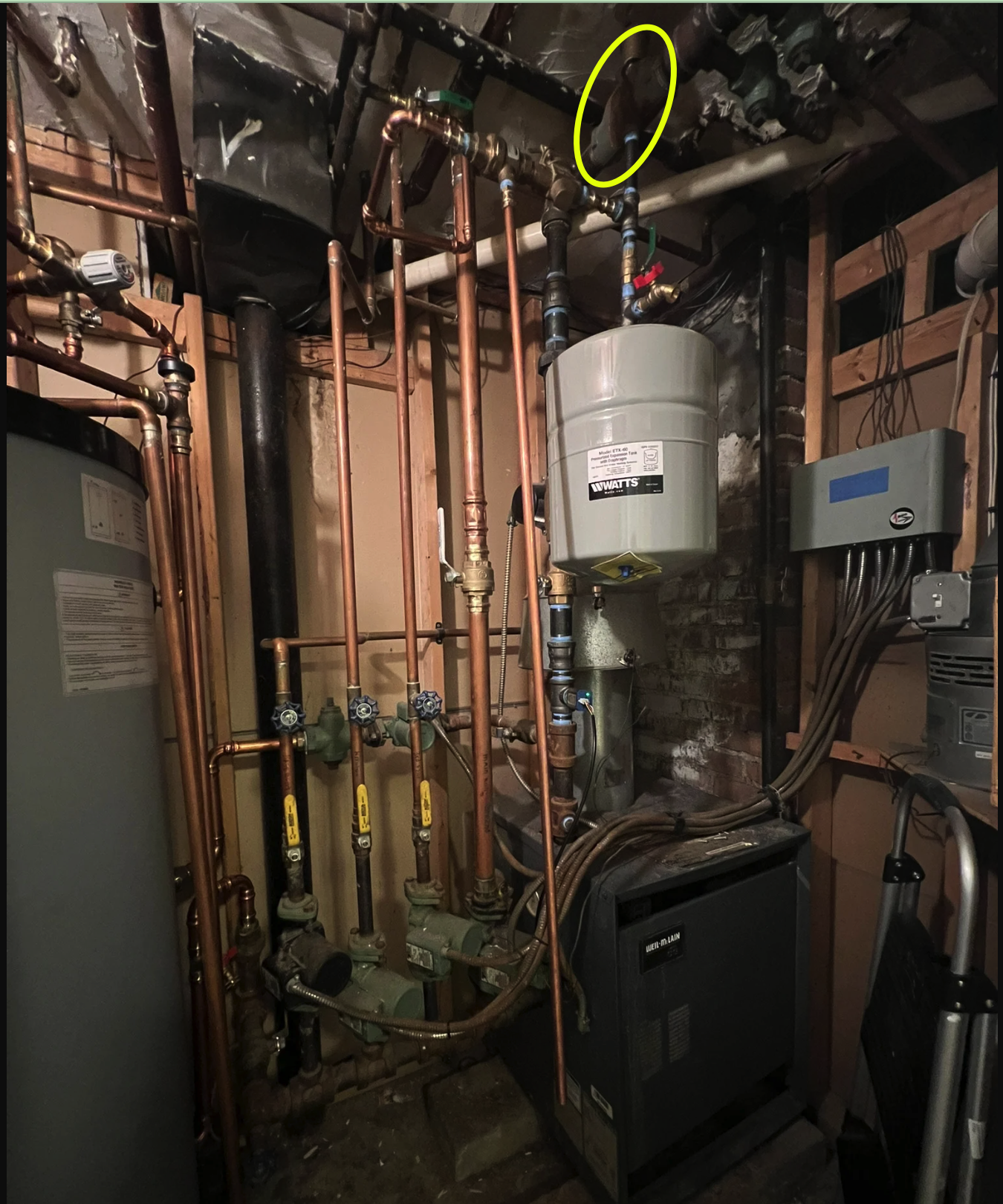
That air scoop has an interior equivalent to a 2-1/2" pipe, which slows the water down a lot. This allows the air bubbles to rise to the top because the water is moving so slowly, giving the air in that section of the system more time to separate from the water and rise to the top.
In the smaller pipes, the water moves too quickly for the air to separate and rise to the top as effectively. Therefore, placing an air vent on a piece of pipe that is the same size as the 3/4" baseboard zone piping will not help remove air nearly as effectively. The water and air bubbles would rush by too quickly for the vent to release the air effectively.
So, the bottom line is that your 1-1/2" Spirovent installed on the vertical 1-1/4" pipe will slow the water down a little more, basically making air removal a little more efficient.
After the water, now containing less air, returns to the 1-1/4" pipe and passes the air scoop on its way to the rest of the system, there should be no effect on how the water enters the radiators. So that is not a reason for you radiator problem.
Edward Young Retired
After you make that expensive repair and you still have the same problem, What will you check next?
0 -
@109A_5 - You wrote, "So you changed the pipe size to the poorly performing radiators ?" No, we didn't touch anything that far into the system. We only changed about 2.5 feet of linear pipe where the cast iron pipe exits the boiler in order to accommodate the new spirovent. The area in the red rectangle in the picture below is what the techs changed from 1.25" diameter pipe to 1.5" diameter pipe because the spirovent the heating company brought was for a 1.5" diameter pipe. You can see the reducing couplings on each end of the red rectangle.
@109A_5 and @EdTheHeaterMan Thank you both for your tips on how to run this experiment without having the boil fire to heat the system. Hopefully I'll be able to get this test done today and once I do I will report back.
@EdTheHeaterMan You mentioned running the circulator for several hours without the boiler running so the water stays cold. Is there a more precise amount of time you think would be most beneficial (such as minimum of 3-4 hours?)? Or just the longer the better?
@EdTheHeaterMan Thanks for your highway explanation. I think the tech was saying the same to me about how upsizing the pipe there can only help slow down the water to separate the air. I can understand what you're saying, but I guess I don't understand what my internet results turned up when I typed my question about upsizing the pipe out of the boiler. Does the answer I got just not apply to this set up because it's upsized with the spirovent and then also downsized back to the original size before any of the take offs into the system? In any case, I'm glad that the work they did isn't a suspected culprit to my potential issues…
0 -
@EdTheHeaterMan Thanks for your highway explanation. I think the tech was saying the same to me about how upsizing the pipe there can only help slow down the water to separate the air. I can understand what you're saying, but I guess I don't understand what my internet results turned up when I typed my question about upsizing the pipe out of the boiler. Does the answer I got just not apply to this set up because it's upsized with the spirovent and then also downsized back to the original size before any of the take offs into the system? In any case, I'm glad that the work they did isn't a suspected culprit to my potential issues…
There are some videos where a DIY auto repair enthusiast is shown with a transmission on the garage floor while the car is on the lift.
The AI's response is: "I'm sorry, I gave you the wrong information. Apparently, you don't need to remove the transmission to change a spark plug!"
Edward Young Retired
After you make that expensive repair and you still have the same problem, What will you check next?
0 -
part of the way a air scoop or air purger works is it creates a "wide spot" in the piping road. The larger the chamber the more flow velocity drops.
As flow speed decreases, air comes out of the fluid easier.
That is why the top of a tank, like a buffer tank, is such a good spot to put an auto vent.
So if anything a larger air sep, both piping, and if the chamber is larger, adds to air removal efficiency.
They did a nice piping job threading in the ball valve, air sep and LWC, really no reason to change that piping.
Bob "hot rod" Rohr
trainer for Caleffi NA
Living the hydronic dream0




Categories
- All Categories
- 87.9K THE MAIN WALL
- 3.3K A-C, Heat Pumps & Refrigeration
- 60 Biomass
- 430 Carbon Monoxide Awareness
- 134 Chimneys & Flues
- 2.2K Domestic Hot Water
- 6K Gas Heating
- 124 Geothermal
- 170 Indoor-Air Quality
- 3.9K Oil Heating
- 80 Pipe Deterioration
- 1.1K Plumbing
- 6.7K Radiant Heating
- 397 Solar
- 16.1K Strictly Steam
- 3.5K Thermostats and Controls
- 56 Water Quality
- 51 Industry Classes
- 51 Job Opportunities
- 18 Recall Announcements