Welcome! Here are the website rules, as well as some tips for using this forum.
Click here to Find a Contractor in your area.
If our community has helped you, please consider making a contribution to support this website. Thanks!
Help with 2 Radiators Not Heating on Hot Water Boiler System!
Comments
-
@EdTheHeaterMan yes, I've seen some funny clips showing how AI screws up. It's much better to ask a real person to verify things of this nature so I'm thankful your your help and this website/forum.
@hot_rod thanks for the continued explanations and feedback.
UPDATE: I added pressure and then ran the circulator for the cast iron radiator zone while the boiler was off for about 5 hours. This allowed the colder water to circulate at the higher pressure. After 5 hours, I reduced the pressure back down and fired the boiler.
Both problem radiators heated from the return side again (despite one of them seemingly getting warmer first at the supply side a few nights ago). Several 2nd floor radiators that are working well started to feel warm in about 15-20 minutes from a cold start. They heated up to about 135-145 degrees in about 45 -50 minutes. Meanwhile the problem radiators heated to only 77 and 93 degrees after 45-50 minutes. They didn't feel very warm at all. (see IR pics below of problem radiators).
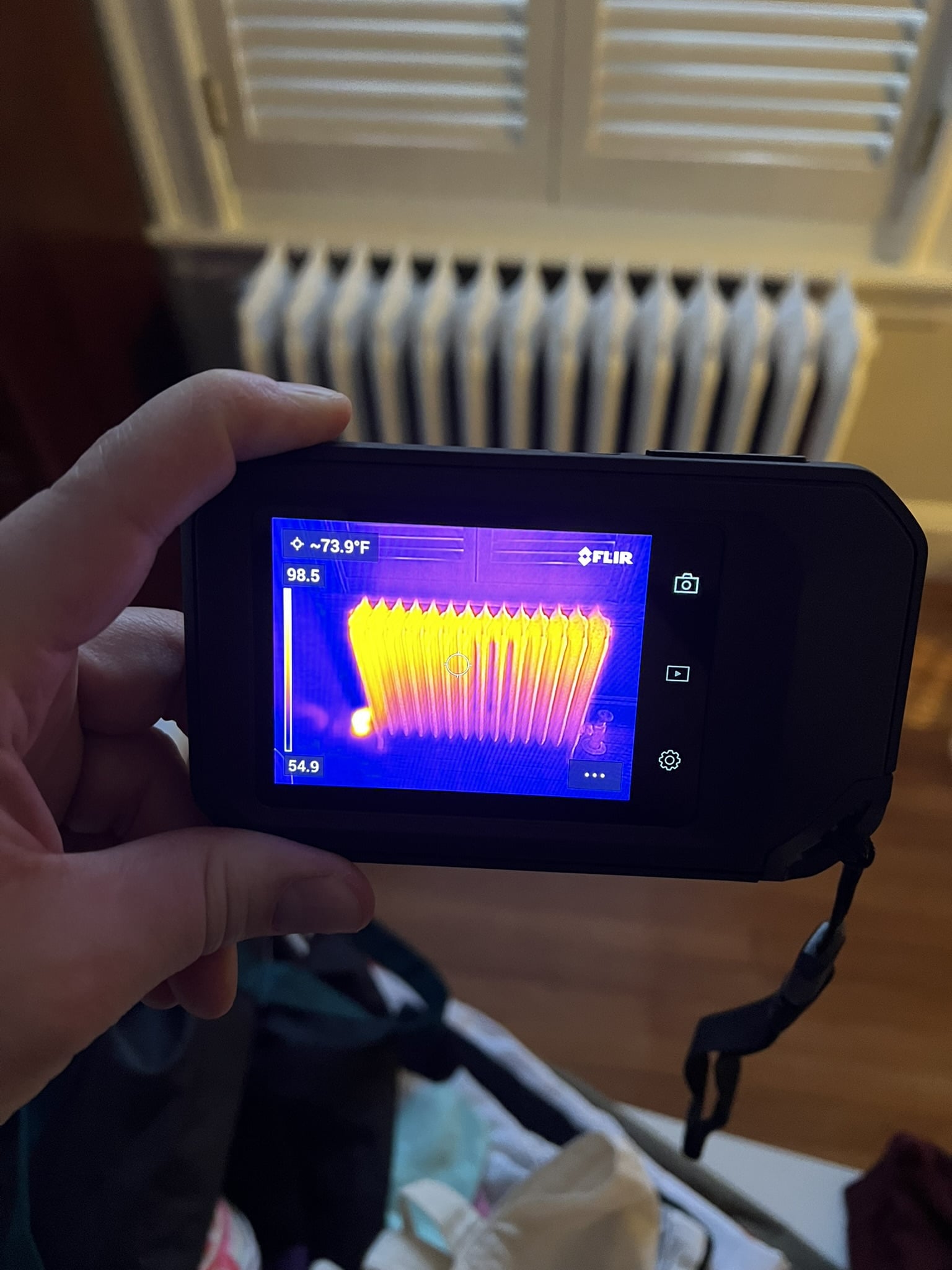
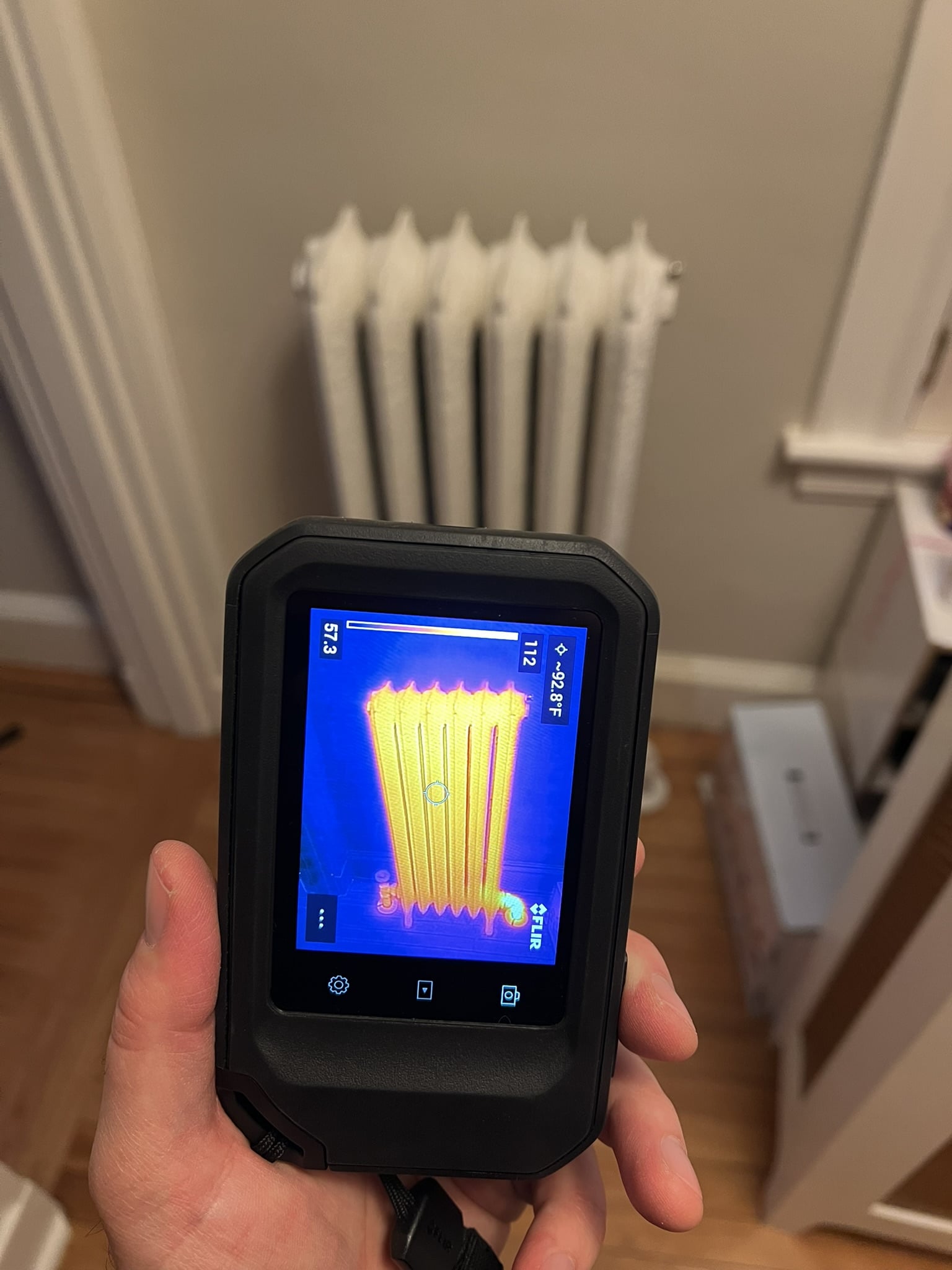
After 70 minutes the well heating radiators on the 2nd floor heated to 145-155 degrees and the problem radiators heated to 96 and 103 degrees. The problem radiators were around 115-120 degrees on the return side piping going into the radiators (which you can see get hotter in the IR pics). The well heating radiators stayed about 150-155 degrees at that point (I think that's the temp they max out at).
After about 100 minutes the problem radiators heated to about 105 degrees and the supply handles were only about 95 degrees each. See pictures below for problem radiators after 100 minutes of the boiler being on.
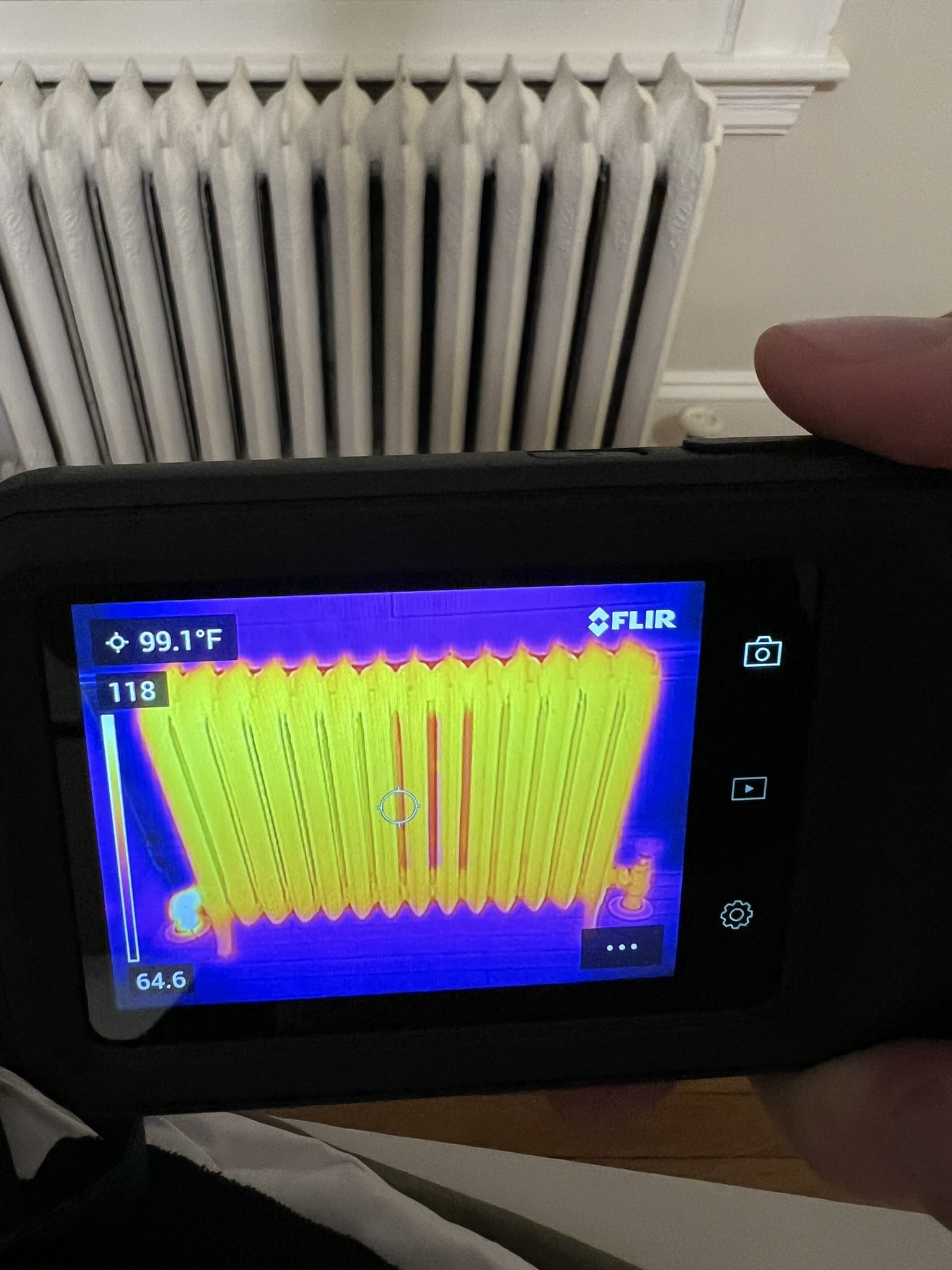
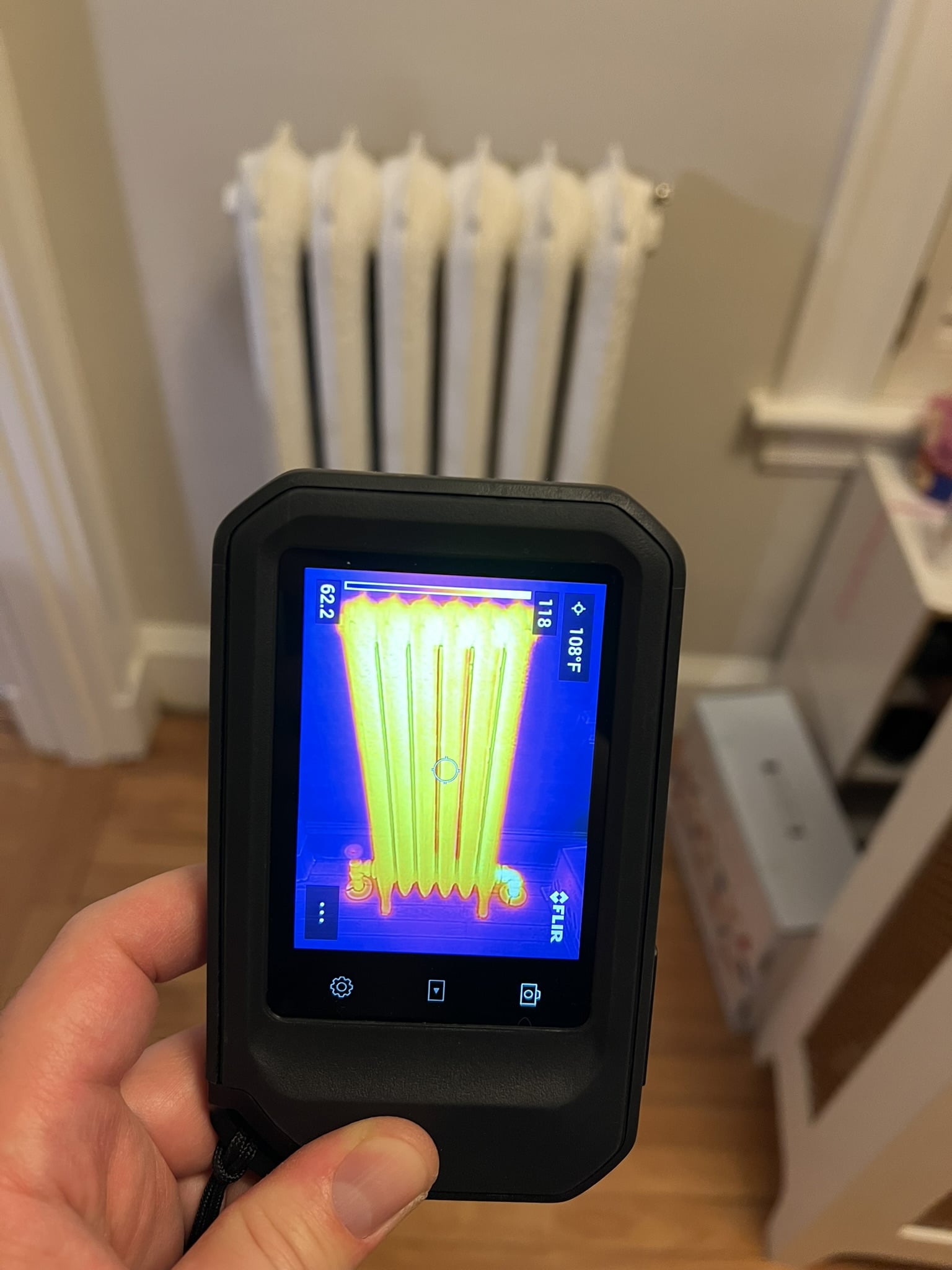
For comparison, please see IR pictures below of 2 well heating radiators after 100 minutes:
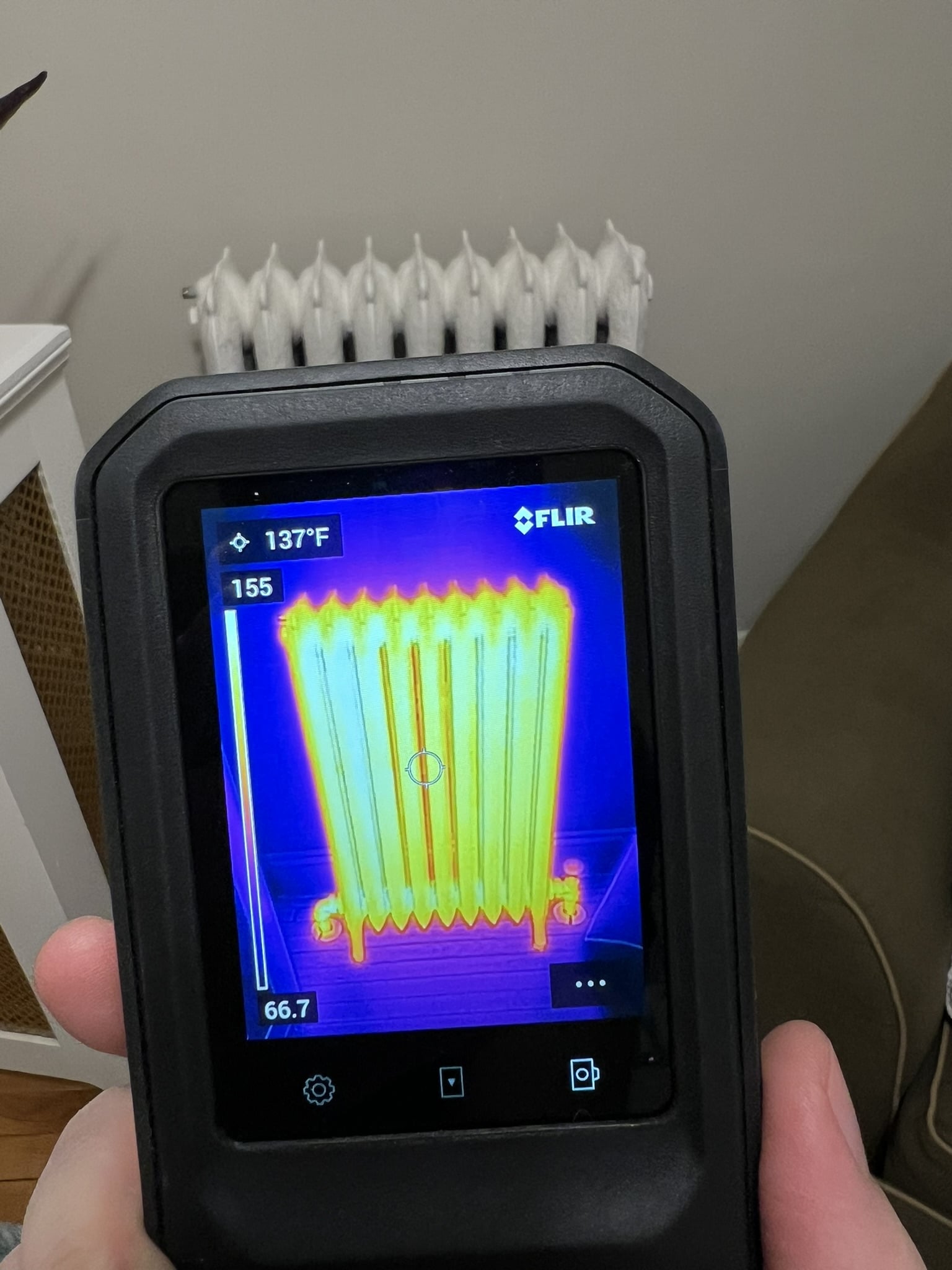
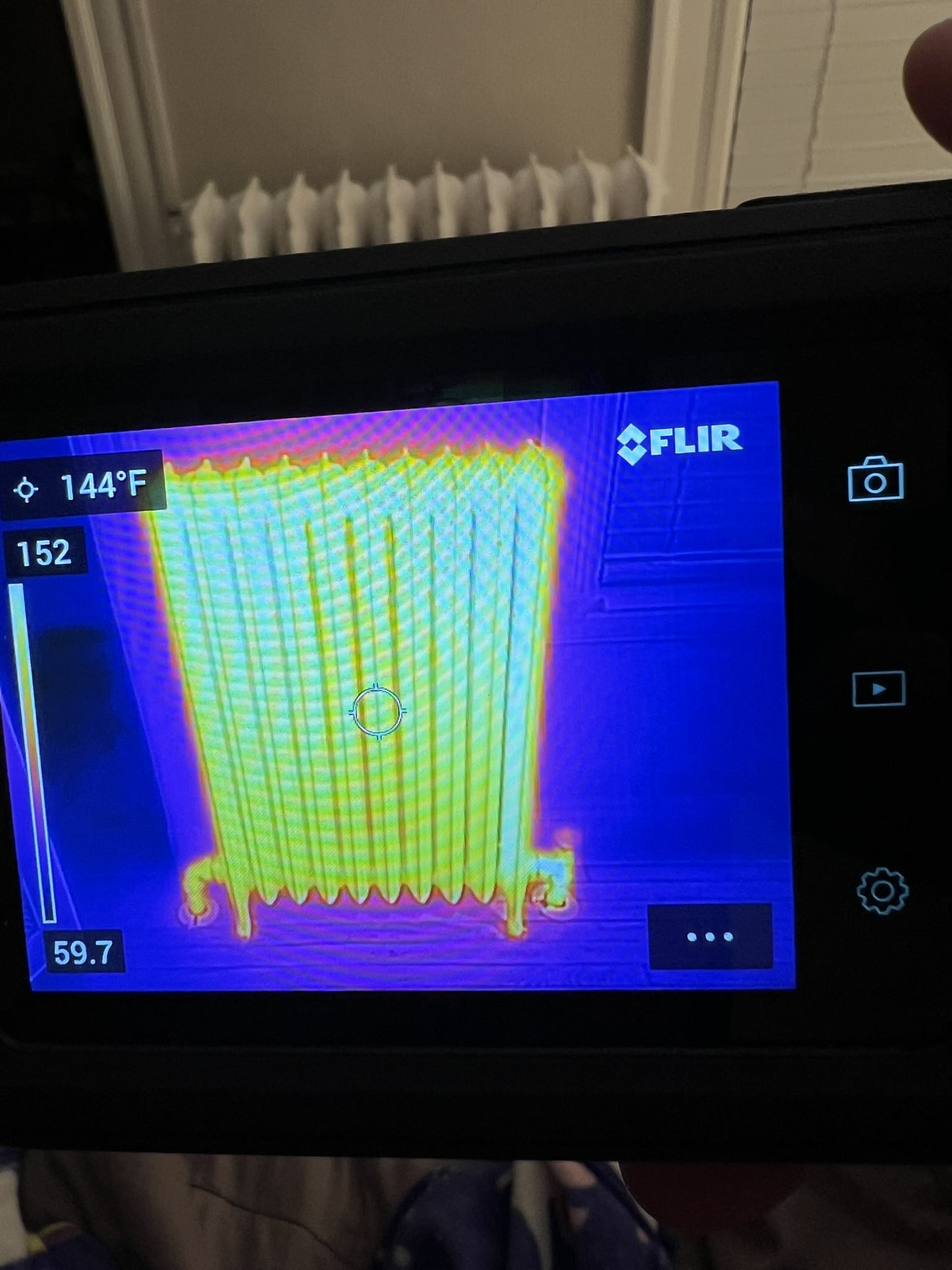
I think the problem radiators got a little bit hotter than they had been getting, but I had the heat on for an abnormally long time. There must still be something obstructing the flow. They are definitely still not heating normally or getting nearly as hot as they used to. I'm guessing at this point it may be worth having the valves replaced on the problem radiators just to rule that out as an issue. What do you guys think?
0 -
So both radiator valves failed at the same time by draining the system to do work elsewhere ???
National - U.S. Gas Boiler 45+ Years Old
Steam 300 SQ. FT. - EDR 347
One Pipe System0 -
I agree with your observation, there is no flow through the boiler.
Highly unlikely that both valves are failed 100% closed. But in your effort to rebuild them you may end up with the system adequately purged and it will heat😙
Bob "hot rod" Rohr
trainer for Caleffi NA
Living the hydronic dream0 -
@109A_5 you wrote, "So both radiator valves failed at the same time by draining the system to do work elsewhere ???" It does seem odd that both deteriorated/failed just by draining and repressurizing the system, but that's what the tech suggested could be a possibility and why he suggested replacing them both. The work we did was right above the boiler - no where else in the system except for changing the bleeder valves at each radiator.
@hot_rod you wrote, "I agree with your observation, there is no flow through the boiler." Did you mean boiler or radiator? Do you think that there is still air in one of the pipes leading to those problem radiators? It's got to be either that or an issue with the valves or both, right?
@hot_rod You wrote, "Highly unlikely that both valves are failed 100% closed. But in your effort to rebuild them you may end up with the system adequately purged and it will heat😙" I hope so… Are you thinking that if they are even partially closed that flow could be affected and that by draining and replacing them everything could go back to the way it was? Or that somehow air will be purged in the process of just draining and refilling after they are replaced?
0 -
I’m thinking draining down to work on the valves then refilling and purging sufficiently will more likely be the fix.
Anything is possible maybe something has gotten into the valves to reduce the flow.
Bob "hot rod" Rohr
trainer for Caleffi NA
Living the hydronic dream0 -

Will the Tech guarantee a resolution, if not, and if there is no change after the work you get stuck with the same situation and an additional bill.
Is it known that the radiator valves are actually on the supply side. If so, since the return seems consistently hotter it seems the obstruction is on the supply side. If the valves are replaced I'd make an adapter to positively flush out both the supply and probably the return to prove reasonable flow is possible.
National - U.S. Gas Boiler 45+ Years Old
Steam 300 SQ. FT. - EDR 347
One Pipe System0 -
@hot_rod I hope that's all that needs to be done…
@109A_5 No, I don't think they'll guarantee changing the valves will fix the problem, so that's why I am trying to troubleshoot the issue first. I don't know if the radiator valves are actually on the supply side. I suppose it's possible they are reversed. Would that change anything about your advice? Can you explain more about the adapter for the valves to be able to flush them out to prove flow? Is this something I should mention to the techs?
0 -
Well I am still in the camp that it is a trapped air issue. Given enough time it may cure itself. And I get wanting to know and having the situation remedied and over with.
Draining the system changing some stuff that has nothing obvious to do with those problematic radiators, refilling the system and everything appears to work except those two radiators it logically seems to be a trapped air issue.
Sure some object that is now not where it should be could have shifted and become an obstruction. To me what make it less likely is two radiators have been affected.
A few things.
There looks like there is enough valves around the boiler area that when work is done in that area all the space heating zones can be isolated and not drained.
Maybe purge the zone in the opposite direction. Maybe forcing any air in a pipe into the radiator. You would have to manually open the Flow Check valve.
If all the radiator valves or even if many still work close them off and purge that zone. If they don't turn don't force them, it would probably make more problems. Optimum would be only one problematic radiator purged at a time. If you can get the full purge flow through each of the problematic radiators one at a time maybe that will help purge the air out (presumably in the piping somewhere). After that individual purge, bleed any air from each radiator again.
If you go the route of replacing the problematic radiator's valves. While the valve is removed that affords an opportunity. When the valve and its spud is removed there are pipe threads available. With a few pipe fittings and a garden hose adapter and a garden hose you could prove both paths to and from the radiator can support water flow in either direction. Cap off the pipe when using the radiator tapping for the test or plug the radiator tapping when using the pipe for the test, don't want to make a mess. Again you would have to manually open the Flow Check valve for at least one test.
National - U.S. Gas Boiler 45+ Years Old
Steam 300 SQ. FT. - EDR 347
One Pipe System0 -
Well it was a good try, I can't tell you anything else from what information is available from your posts. I would need to be on site for more detailed diagnosis. Too bad I live in South Carolina now.
I'm guessing there is no way to look at the pitch of the pipe from the radiator to the main without taking some ceiling sections apart.
During the first 100 minutes, what did your pressure increase to?
Edward Young Retired
After you make that expensive repair and you still have the same problem, What will you check next?
0 -
@EdTheHeaterMan - Yeah, I have no way to see the pitch of the pipes from the radiators to the mains. I can only see some area in the basement where the pipes run across the basement and then along the perimeter, but I don't know for certain if those are the specific supply and return pipes for the problem radiators because I can't trace them all the way. Based on some IR scans I did looking into the walls (fuzzy picture at best), I'm guessing the pipes 90 up from the basement runs to the 2nd floor. I can't tell if each radiator has its own supply and return pipe or if it 90s up and then Ts under the 2nd floor going left and right to each radiator (both of the problem radiators are about 5-6 feet apart). Since they're very close to each other they may share supply/return pipes, which could be the reason both are affected if there is air in the pipes.
During the test, the pressure actually got pretty high (maybe 28PSI). I don't think I reduced the pressure low enough to start from when I raised it (It was maybe 16-18psi to start). I was a little worried my pressure gauge was faulty and I erred on the side of caution to not lower the pressure too much, which may have been a mistake. I ended up draining the system a little bit more to make sure it didn't get too close to 30PSI and set off the pressure release valve when I saw it get close…
@109A_5 Yeah, it could definitely still be some trapped air depending on how these pipes are configured. As I wrote in the first paragraph above, I don't know the exact way the supply and returns are piped, but both problem radiators are right next to each other about 5-6 feet apart, so it is awfully suspicious that only those 2 could have bad handles vs. trapped air.
During the work we added a ball valve on the return piping of the cast iron zone because it didn't have one before. All of the baseboard zones already had them. They are all operating well with no air.
I don't think I can touch any of the radiator valves without risking leaking. They are all painted over and look like they haven't been touched in decades. It's too bad because if I could force a purge into just the problem radiators I could probably get the air out if that were the issue.
I'm not sure how I would purge it in the opposite direction, especially since I can't isolate the problem radiators. I've never messed with the flow check valves. Is opening them just turning something at the top? When you mention taking a garden hose and filling the radiator valve from the 2nd floor, is the purpose to just see if the water ends up coming out the bottom of the system to make sure there's not a physical obstruction in the pipe?
0 -
Yes, with a garden hose if the water flows good both ways to and from the problematic radiator the chance of a major restriction is minimal. I believe there is a knob on top of those check valves to lift the valve inside, however age is not in your favor.
How about this.
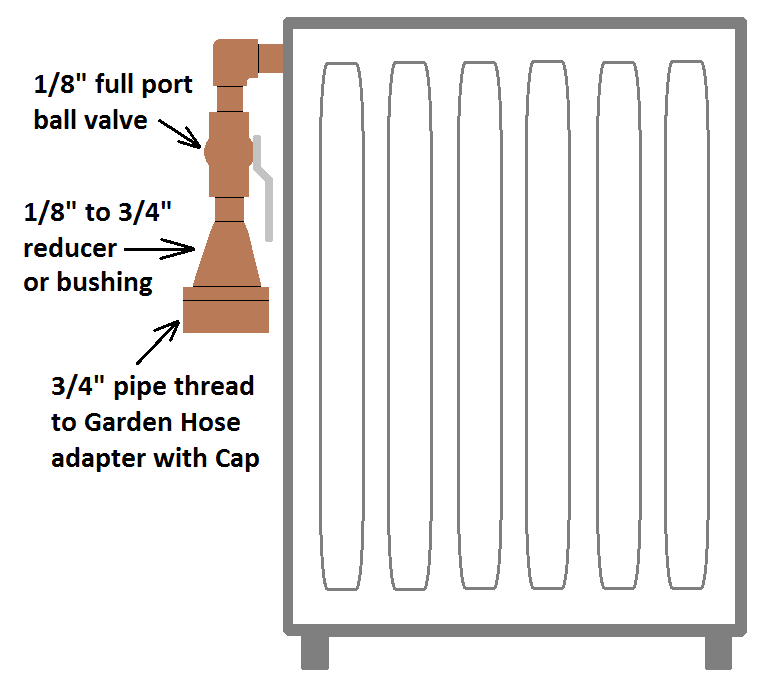
I believe you replaced at least one of the air bleeder valves on the problematic radiators. Lower the system pressure, remove air bleeder valve on one of the problematic radiators and with some 1/8" pipe fittings to a garden hose adapter purge that way in as many directions as possible. With the dedicated purge at that radiator it may coax the air out of the pipe. Probably ending the purge effort with pushing the water toward the radiator from both pipes. Don't let air in from the basement.
Use an elbow so the garden hose is 100% vertical next to the radiator, you don't want to snap off the nipple in the radiator with the hose sticking out horizontally.
National - U.S. Gas Boiler 45+ Years Old
Steam 300 SQ. FT. - EDR 347
One Pipe System0 -
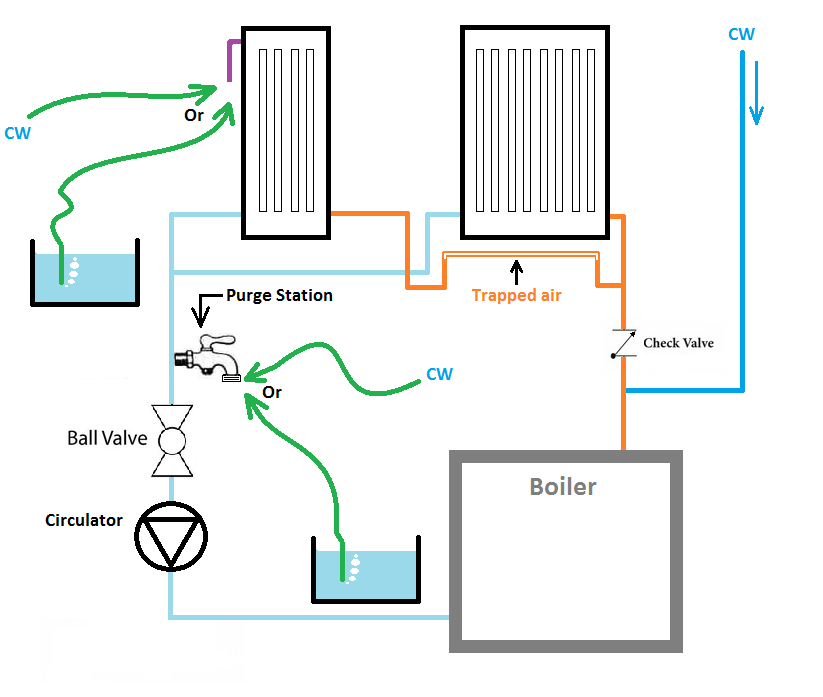
The ball valve shown would be closed. The obvious goal (the way I see it) is to get the trapped air into the radiator. Since it is not known where the trapped air is, Supply or Return I would probably push water towards the radiator and out the bleed vent tapping.
Due to the unknown condition of the Check Valve purge flow may only be in one direction on the Supply side. Increase the pressure regulator's flow by lifting the regulator's handle.
I would purge the Return side both ways to prove flow. Lastly I would purge the Supply and Return towards the radiator, lots of room there for air and it is easy to bleed it out of there.
 National - U.S. Gas Boiler 45+ Years Old
Steam 300 SQ. FT. - EDR 347
One Pipe System0 -
UPDATE: SOLVED - It was trapped air…
Thanks to everyone for your advice. It seemed like most of you still thought my problem was trapped air and the valves were not the issue and you were right. After reading your advice, I kept thinking that the chances of 2 valves failing/deteriorating in radiators 5 feet away from each other seemed to be incredibly low compared to them sharing a common supply pipe / return pipe that had trapped air. When the tech arrived today, he walked the entire house and I went over what I had tried already and the advice that you all gave on this discussion board. He took the time to listen and also thought the problem seemed to be more likely trapped air.
The first thing he did was have me fire up the boiler while he opened up the flow check valve. He removed the cube relay to stop the circulator from turning on (everything was heating by gravity only). After a few minutes the handle near one problem radiator started to get a tiny bit of heat (as seen from my IR camera), but the problem radiators were still not getting very warm. This made the tech thing the valve was fine and it had to be something else.
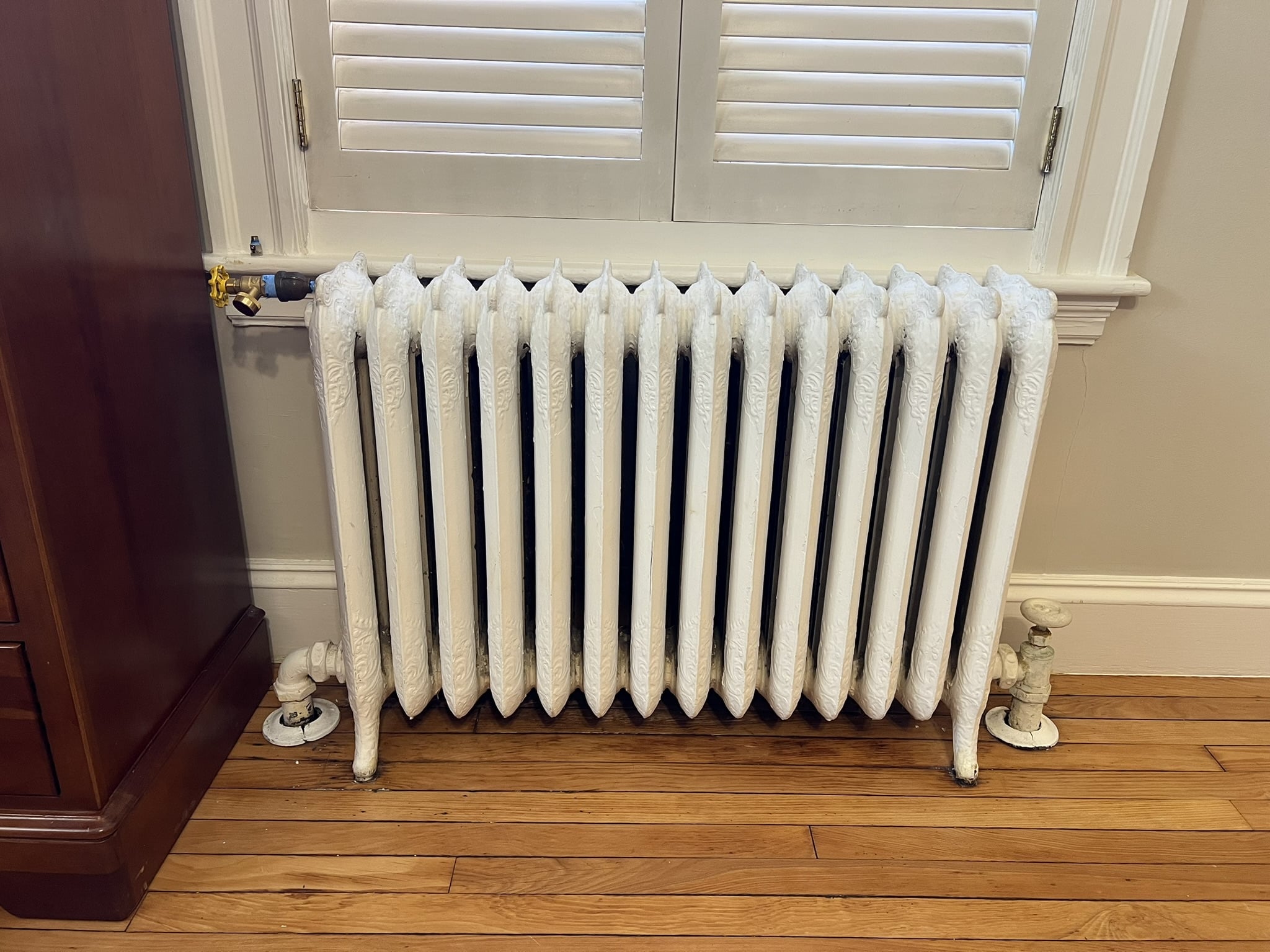
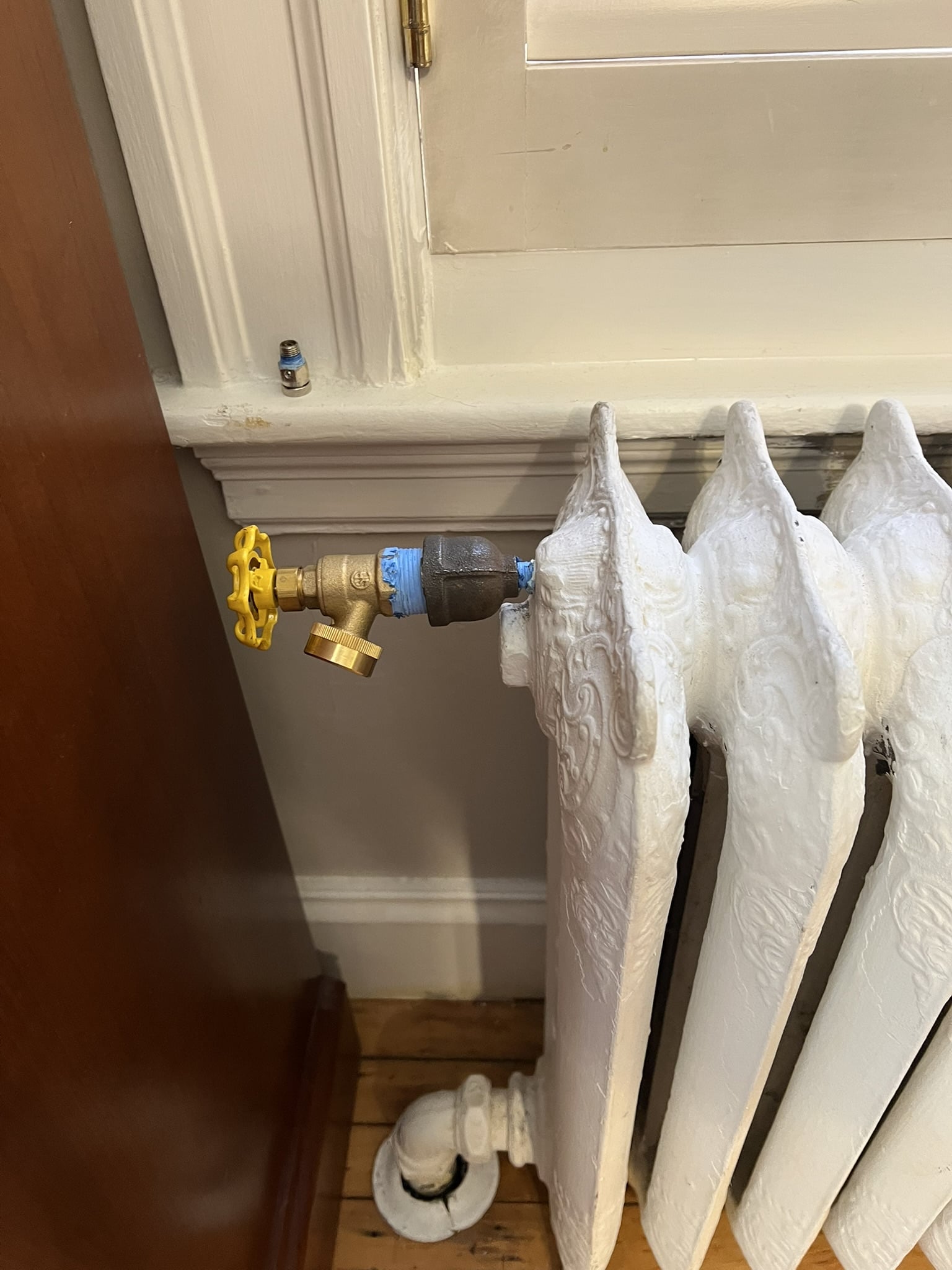
I mentioned the idea of purging the problem radiator from it's air bleeder port and he said he had done that in other cases before and it worked. He went out to his truck and created a 1/8" adapter to 3/4" (see pics below) so he could attach it to the air bleeder port and connect a laundry hose to it to purge from the problem radiator. He drained the system down slightly to take the pressure off so he could remove the air bleeder vent and attach the purge station.
He put the cube relay back in so that when the boiler fired the circulator would run too. He took a 5 gallon bucket and opened up the gate valve on the purge station and started to purge. He then went around the 2nd floor and used the air bleeder vents on each radiator to purge the bit of air that he had let into the system when he took the problem radiator's bleeder vent off.
He then went back to the large purge station on the problem radiator and bled more. We heard a lot of trapped air exit from that radiator. I can't be certain if the air was in the supply or the return, but he purged until four 5 gallon buckets were filled. At that point both problem radiators started to heat (we only needed to purge from one of the problem radiators but it fixed the entire problem). Both problem radiators started to heat pretty evenly with the rest of the radiators in the house.
When I checked all radiators with my IR gun, they were all heating within 5-10 degrees of each other (pretty well balanced). So we did not end up changing any radiator valves and simply purged a ton of air from the new purge station the tech created. Since I have radiator covers, he left the purge station on there in case we ever needed to drain the system again. The purge station is not visible under the radiator cover so it doesn't bother me. This way we'll have it to use again (which I imagine we'd need to do), if we had to drain the system.
Thanks again for your advice and thoughts. Glad I spoke up and didn't spend money replacing radiator valves that were not the issue. Most importantly, I'm glad the problem is actually finally fixed before the cold weather sets in. Thank you!
 2
-
Excellent !!! I figured if you got the air out it would fix both radiators.
I thought about pulling the relay but some control boxes don't have socketed relays.
The new purge station looks scary to me. 1/8" pipe nipples are not too strong, if that gets snapped off you have a flood on your hands. If I was to leave it permanent I would have done it differently.
National - U.S. Gas Boiler 45+ Years Old
Steam 300 SQ. FT. - EDR 347
One Pipe System0 -
Yeah I wouldn't leave that boiler drain on the radiator. But I would also never cover up beautiful ornate radiators like you have.
0 -
@109A_5 and @SuperTech The previous owner covered all of the radiators and a lot them are permanent and would need some remodeling to remove, etc. The one in my room is removable, but then you get into the issue of potentially balancing the heat when some have covers and others don't. I don't know if it would be an issue, but I just left them all in place because it was easier and nice to have the extra surface space (and everything heated relatively balanced and well).
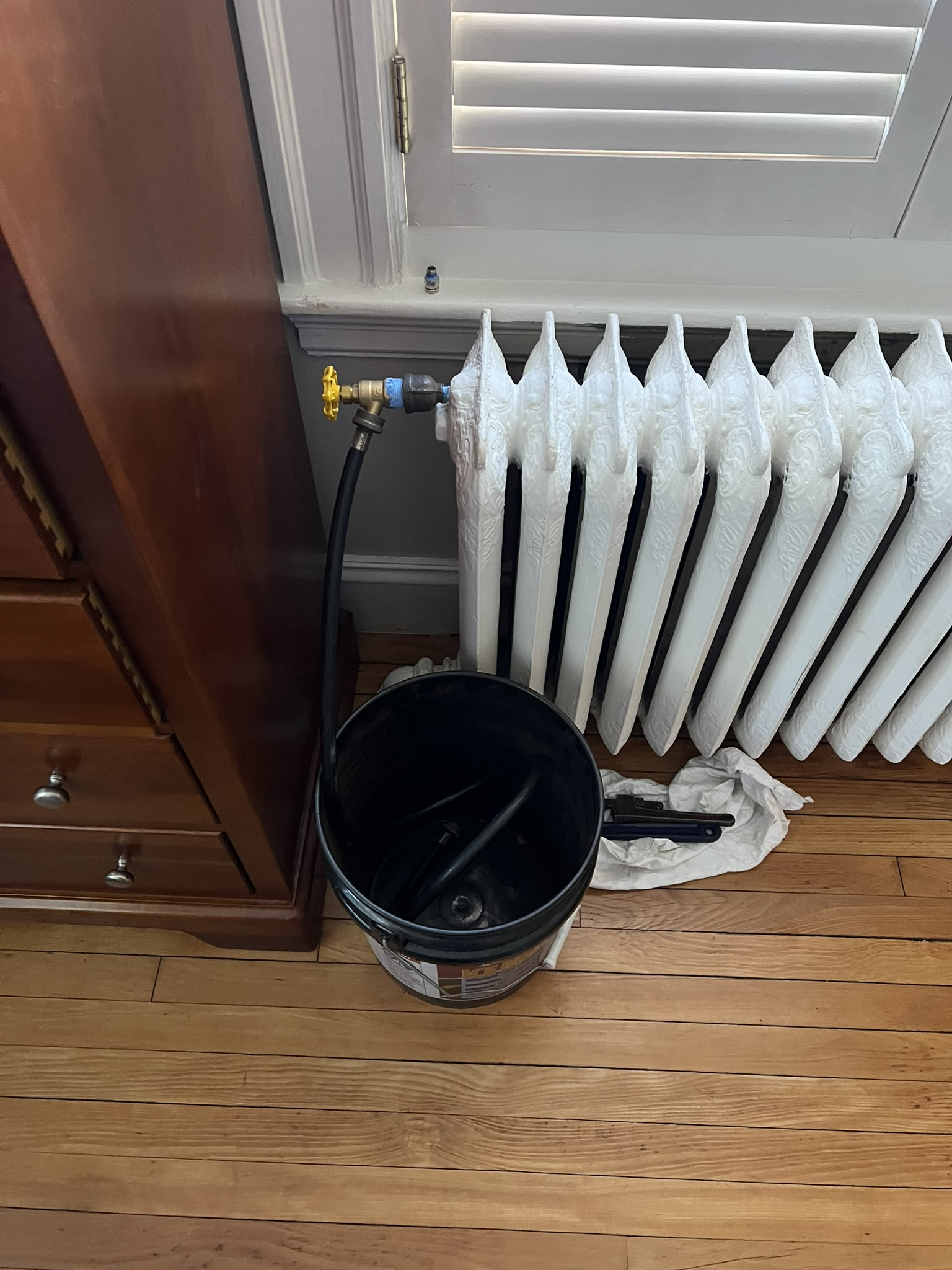
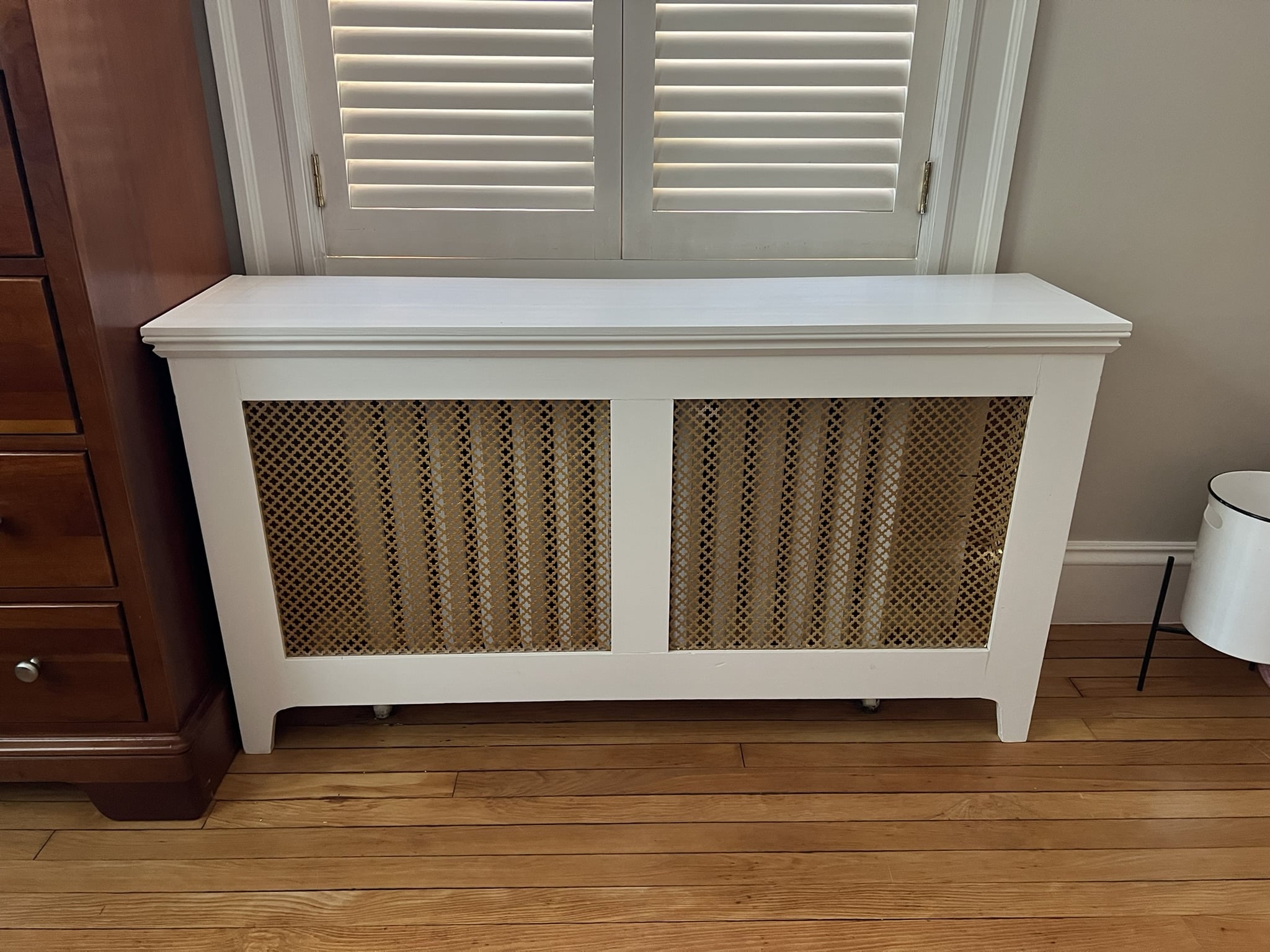
With that being said, we plan to leave the cover on (at least for now). See picture below of how it looks.
Is the danger that someone accidentally leans on the valve or something falls on it and then it snaps off? In that case, is it that different than a TRV that sticks out on a steam radiator?
If we plan to leave the cover on as shown below, do you still think it's an issue? The cover is not touching it at all - it's completely below the top of the cover and not touching the side end of the cover either.
I have the tech coming back next week for something else, so I can have him change it, but then we would have to drain the system a little again. I don't think we'd have to drain a lot - same as when he put the purge port on - so it probably wouldn't re-introduce any air into a supply pipe - just the tops of the radiators themselves, right?
If the purge port/ drain port is completely covered in the radiator enclosure, is it worth messing with it at this point? What do you think? Thank you!
 0
-
I'd leave the 1/8" nipple and put a brass cap on it. Many plumbers would do that without dropping water or even pressure :)
Bob "hot rod" Rohr
trainer for Caleffi NA
Living the hydronic dream0 -
I'm old and running out of time, so, forgive me if I don't read all the comments, good as they are. My thoughts.
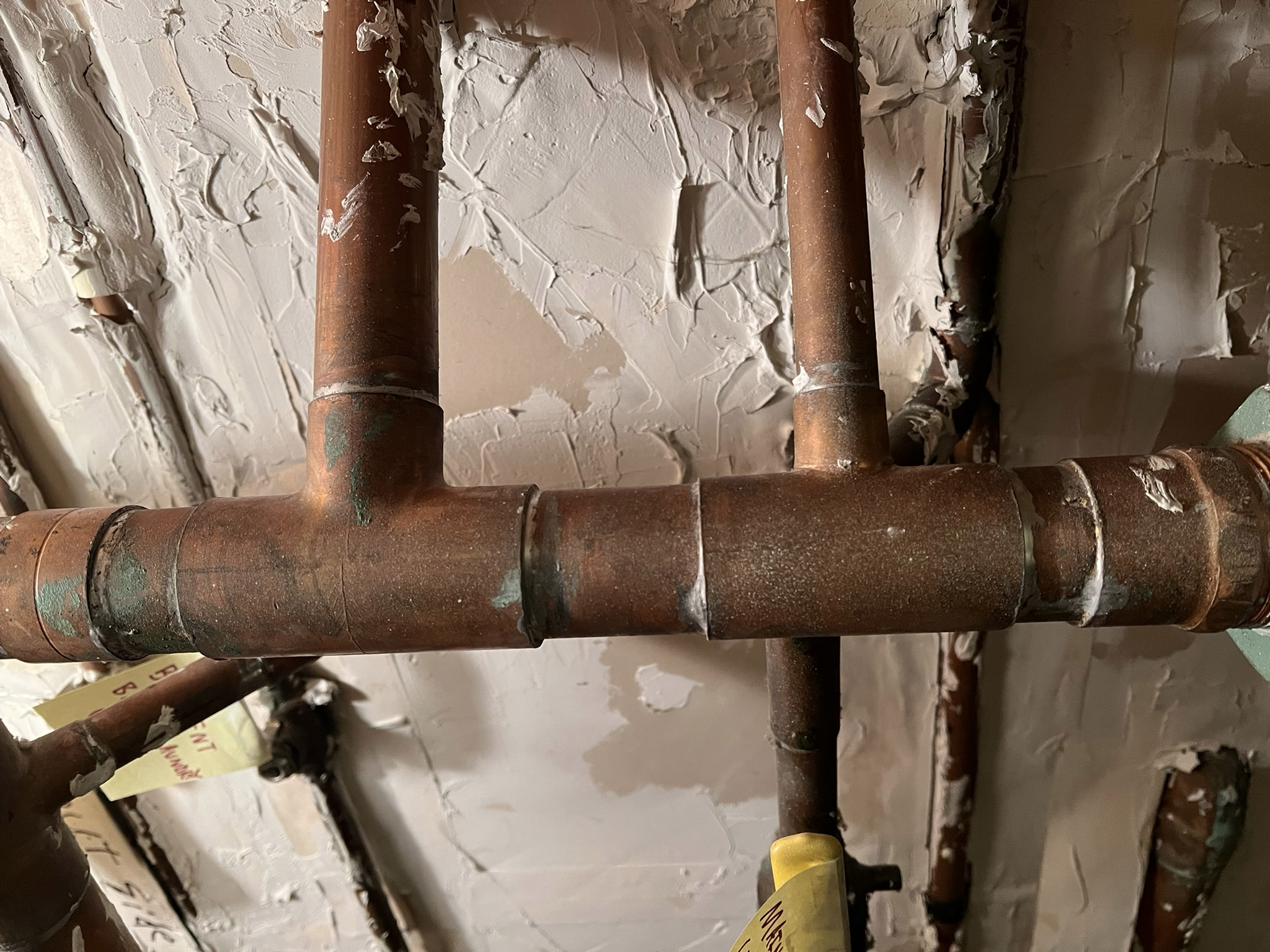
Temperature emitted by a heat radiating device is dependent upon temp of the fluid and flow of the fluid and, of course, the temp delta T. If the photo below is what is connected to your radiators. there could be a flow problem. Yes, there are no Monoflo tees. Should there be? I would think, yes. Flow moves from a higher pressure to a lower pressure. Monoflo tees create a pressure differential by redirecting some of the flow. You have the same pressure on both tees even tho the supply and return pipes are different sizes. You may be getting convection flows in those radiators. A diverter tee would move flow carrying the heat energy into them .
I hope I got this right.
 0
-
" Is the danger that someone accidentally leans on the valve or something falls on it and then it snaps off? In that case, is it that different than a TRV that sticks out on a steam radiator? "
Yes that is the danger. With breaking off a TRV or an air vent on a steam radiator (been there done that) it will not flood your house. And in some cases the steam leaking out may be minimal, or there may not be steam there at that time. With a hot water system the water and water under pressure is almost always there.
Your cover looks substantial so with day to day activity it should not be an issue. However for future service when lifting the cover On or Off if it gets away from you, it could end badly.
What you have now probably produced the best flow with minimal restrictions.
This is what I had in mind, tucked in a bit more than what you have now. Not immune from damage, just minimized a bit. The image is not to scale with the radiator.
 National - U.S. Gas Boiler 45+ Years Old
Steam 300 SQ. FT. - EDR 347
One Pipe System0 -
How often would you expect to need the unique purge setup?! Rarely, if ever again?
No need to accommodate it inside the enclosure. The 1/8 port isn't going away, keep the purge setup near the boiler for any future need.
A recessed 1/8 brass plug if you want a tight plug off connection.
Bob "hot rod" Rohr
trainer for Caleffi NA
Living the hydronic dream0 -
Theres a piece of debris stuck in it.
The pressure is not high enough.
Pump is whimpy.
Air is trapped in piping.
System is not running long enough/bad balance.
0 -
The one first big issue I see is that the circulators are mounted on the return piping.
I realize that those changes shouldn't have caused the current problem but sometimes changing one thing changes everything.
I would have to personally inspect the entire system to absolutely narrow it down.
 1
-
Before I start… The old adage "Leave well enough alone"
Seriously, I do not see how it can be a zoning issue. Only 2 radiators have the issue.
Looks to be the 2nd floor?
I think its an air pocket in the piping
Remembering Dan Holohan in one of many of his seminars
Try raising the boiler pressure to just below relief blow off
This my push the air pocket out and establish flow
0 -
I believe air introduced but not removed into your system is the culprit. Did you say they replaced the float vent on top of your cast iron air separator? If it is new or old it must be in working order, and the top cap must be loose for it to allow air to escape your pressurized loops when new water is added. Also, to be clear about your system pressure, the fill valve tag reads “set@15” that means when new it was set to stop filling the system when reaching that pressure, but that is only part of the equation. The pressure tank (expansion tank” should have a matching 15psi of air pressure inside when it was on the shelf at the supply house (with no system pressure applied), so when the valve fills the system it matches the expansion tank pre-charge. To me from what I can tell from the photos the main zone has branches leaving, each with flow control checks that have been there all along and that’s ok but there’s no way to isolate each one individually because they all return to the main return without having valves and purge drain valves so any air that gets into the radiators gets trapped and it’s hard to get it all out from bleeders on the radiators because the air isn’t in the radiator when it doesn’t come out when you open the air vents.
If there is enough room on the return pipes (for any of those copper lines) right before it connects back onto the main return, I would install a webstone brand ProPal shutoff with hose drain. That will allow the ones you were able to add, the ability to purge air before it gets back to the return.My guess is that (like others have said) part of the main loop is harboring air and there is currently no way to force clear it.
Good luck with your heating system repairs!
0 -
@CSACH, @Kickstand55, @bmcservice, @pmerritt, I believe if you read back a few posts the problem has been solved.
 National - U.S. Gas Boiler 45+ Years Old
Steam 300 SQ. FT. - EDR 347
One Pipe System0 -
I have found success with hidden air by going to the non-working radiators and shutting off the valve, then open the bleeder fully into a 5gallon bucket and wait several minutes before reopening the valve just to see if maybe purging from the return end works for either radiator.
0 -
Hi All, thanks for the continued interest. @109A_5 is right that we've figured out and solved the issue. It was trapped air that needed to be purged - see my post in this thread from October 29th for details.
It's been very warm outside this week, but luckily all of my radiators in the house are ready for the cold. They are all now back to heating in a pretty balanced way - all radiators heat to within 5-10 degrees of each other. Thanks again for all your help and advice.

 2




Categories
- All Categories
- 87.9K THE MAIN WALL
- 3.3K A-C, Heat Pumps & Refrigeration
- 60 Biomass
- 430 Carbon Monoxide Awareness
- 134 Chimneys & Flues
- 2.2K Domestic Hot Water
- 6K Gas Heating
- 124 Geothermal
- 170 Indoor-Air Quality
- 3.9K Oil Heating
- 80 Pipe Deterioration
- 1.1K Plumbing
- 6.7K Radiant Heating
- 397 Solar
- 16.1K Strictly Steam
- 3.5K Thermostats and Controls
- 56 Water Quality
- 51 Industry Classes
- 51 Job Opportunities
- 18 Recall Announcements