Welcome! Here are the website rules, as well as some tips for using this forum.
Click here to Find a Contractor in your area.
If our community has helped you, please consider making a contribution to support this website. Thanks!
Need help- hydronic system with cast iron radiators

I am trying to install a hydronic system on a single story 1100 sqft ranch style house. I have a heatmaster MF5000 outside stove and old cast iron radiators of varying sizes that are likely overkill (but what I could find used). I need to install 6 radiators that I would like to have set up on 2 zones or have individual valves on each radiator (preferably). Currently have a single circulator pump mounted on the stove but willing to change that. Thanks
Comments
-
that seems like a large stove for1100 sq ft it may idle a lot. Any other buildings going to be added?
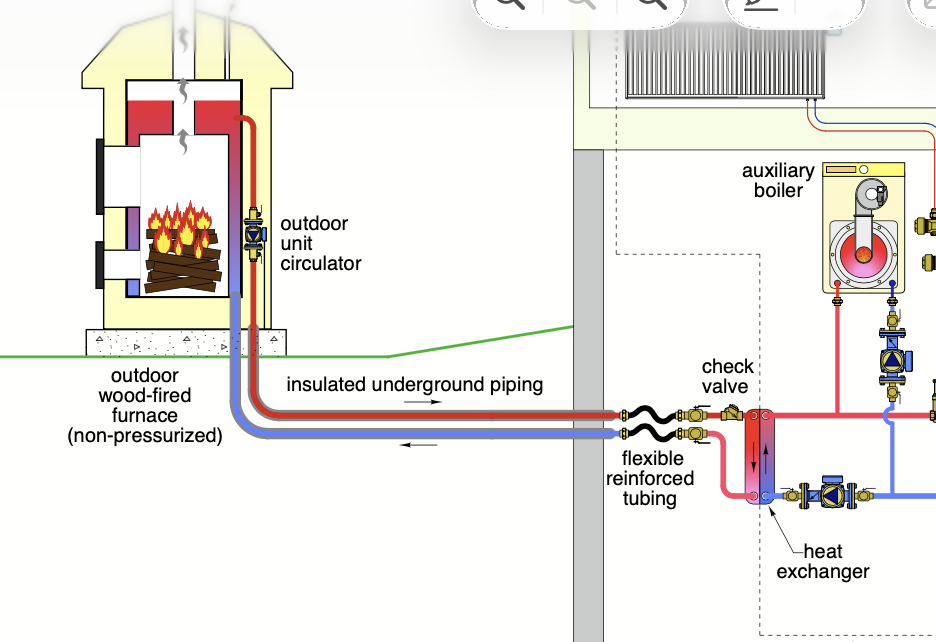
I think those are all unpressurized type stoves, some installers add a plate heat exchanger to make the home loop pressurized
Bob "hot rod" Rohr
trainer for Caleffi NA
Living the hydronic dream1 -
is this a job you are going to pipe yourself? Here is an example that includes a backup boiler. One pump and two zone valves is a way to get 2 zones. The red line to the right of the pic is where two zone valves would pipe in.
 Bob "hot rod" Rohr
trainer for Caleffi NA
Living the hydronic dream 1
-
Don’t let any of the outdoor wood boiler people convince you that you can connect the house system directly to the ODWB. You need to separate the house from the ODWB using a heat exchanger as hot rod has shown.
You will have several long term issues if you try to short cut this, not the least of which will be oxygenated water which will rot the radiators.
Think about it: if houses could run unpressurized systems, then why has this industry been requiring it for well over 100 years?
Bob Boan
You can choose to do what you want, but you cannot choose the consequences.
 2
-
That wood boiler can heat a small neighborhood of houses that size. If it were me i would look to selling that thing and using the money to pay for a small gas unit and several years worth of fuel personally. I could take care of my heating bills plus the cost of a DIY boiler for around 6-10 years for just the cost of that boiler and my house is about twice that size in a cold climate, zone 6, just a thought..
 1
-
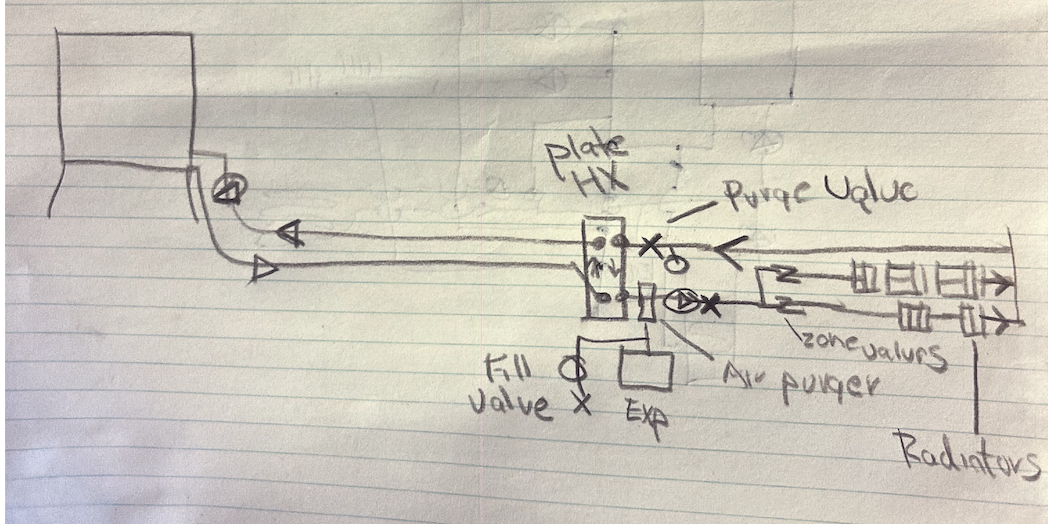
Here is what your piping might look like. Find the plate heat exchangers at most wood boiler suppliers.
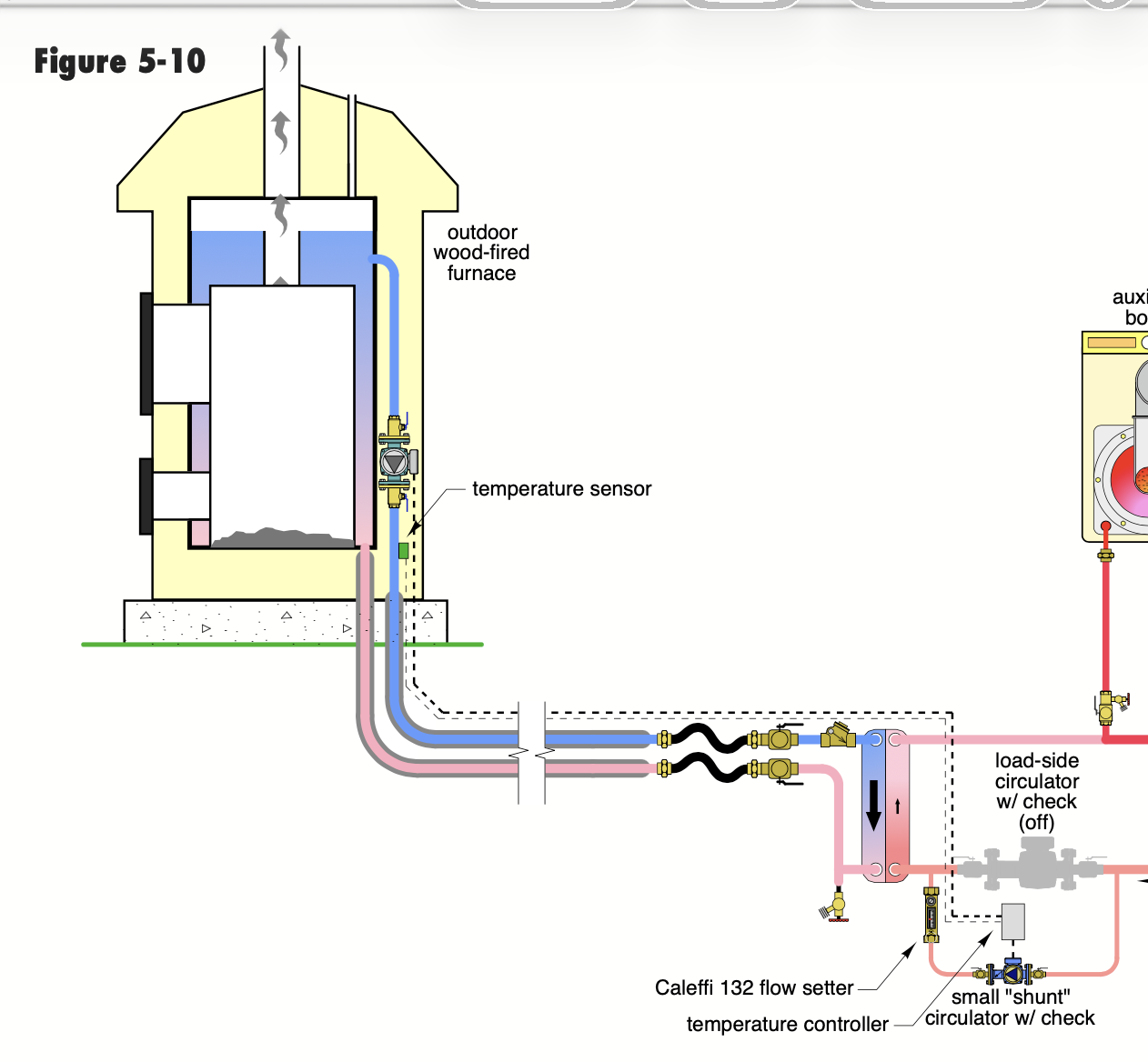
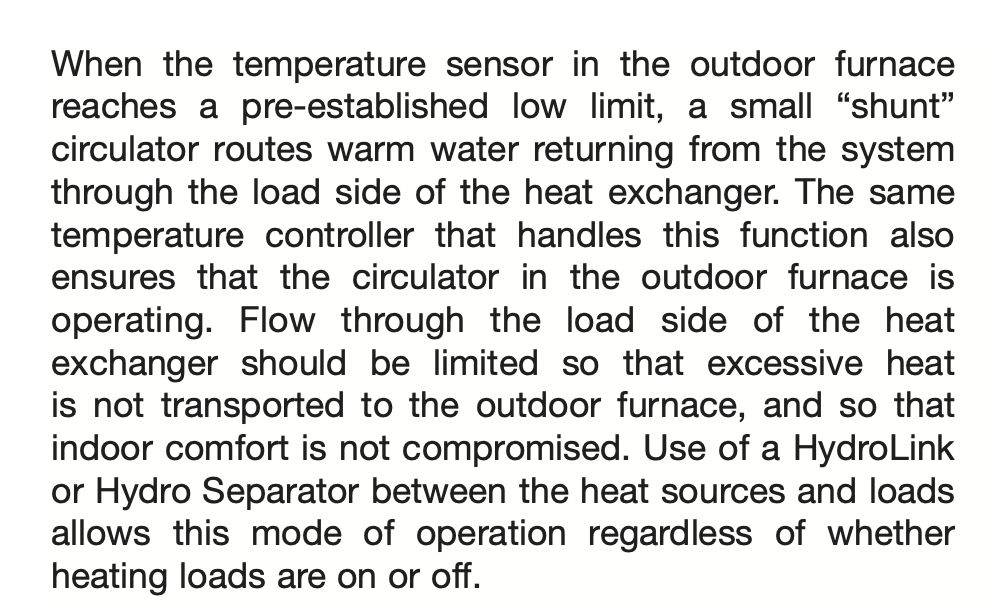
If you do tie in a back up boiler,here is a piping that adds a shunt pump that sends a small amout of heat backto the OWF to prevent it from freezing if it is left un-fired.
 Bob "hot rod" Rohr
trainer for Caleffi NA
Living the hydronic dream0 -
The outdoor boiler you have is much too large for your home UNLESS you install more hot water storage and do batch burning every few days and use a heat exchanger in the home to push the homes cool water back to the heat exchanger keeping the homes circulation as a closed circuit with a second circulator.
0 -
You really don't have a boiler that is too big for the home. You actually have a home that is too small for the boiler. You need to add several thousand sq ft of living space to your home in order to make that heater operate efficiently for your location. Maybe you can add 3 more stories above your first floor, and rent them out to your mother in law, and your brother in law. They are always the best tenants to have in my opinion. Your boss's daughter is another great tenant to have in there. Especially if she is college age and has lots of parties late at night. That will keep you young and on your toes.
Edward Young Retired
After you make that expensive repair and you still have the same problem, What will you check next?
 2
-
I appreciate everyone's replies. That's a lot of help. I know the stove is oversized but I've had it for 15yrs at a previous home that was 1300sqft. Keeping fire on warm days can be an issue but I've learned to deal with it. Living in the mountains of WV it really works as it should in January and February when the temps are single digits and below a lot of days. I burn a lot of coal so that helps to keep a few hot coals on a warm day. On that house it was hooked to forced air but this house was only set up with electric baseboard heat so I thought radiators would be a better option than installing duct work. I do have a garage (720sqft) that I would like to hook to it in the future. I did not understand about the closed system using a plate heat exchanger. Thankful for that info. I think using the diagrams that you all provided I can get this thing going before the snow flies. Thanks everyone.
1 -
Where are you in WV?
Bob Boan
You can choose to do what you want, but you cannot choose the consequences.0 -
Crawley in Greenbrier County
0 -
Hot Rod, your diagram looks to be what I have in mind. Will I need a pressure tank and manifolds or can I just tee off of my main lines into to radiators and tee back into my return line to the plate heat exchanger?
0 -
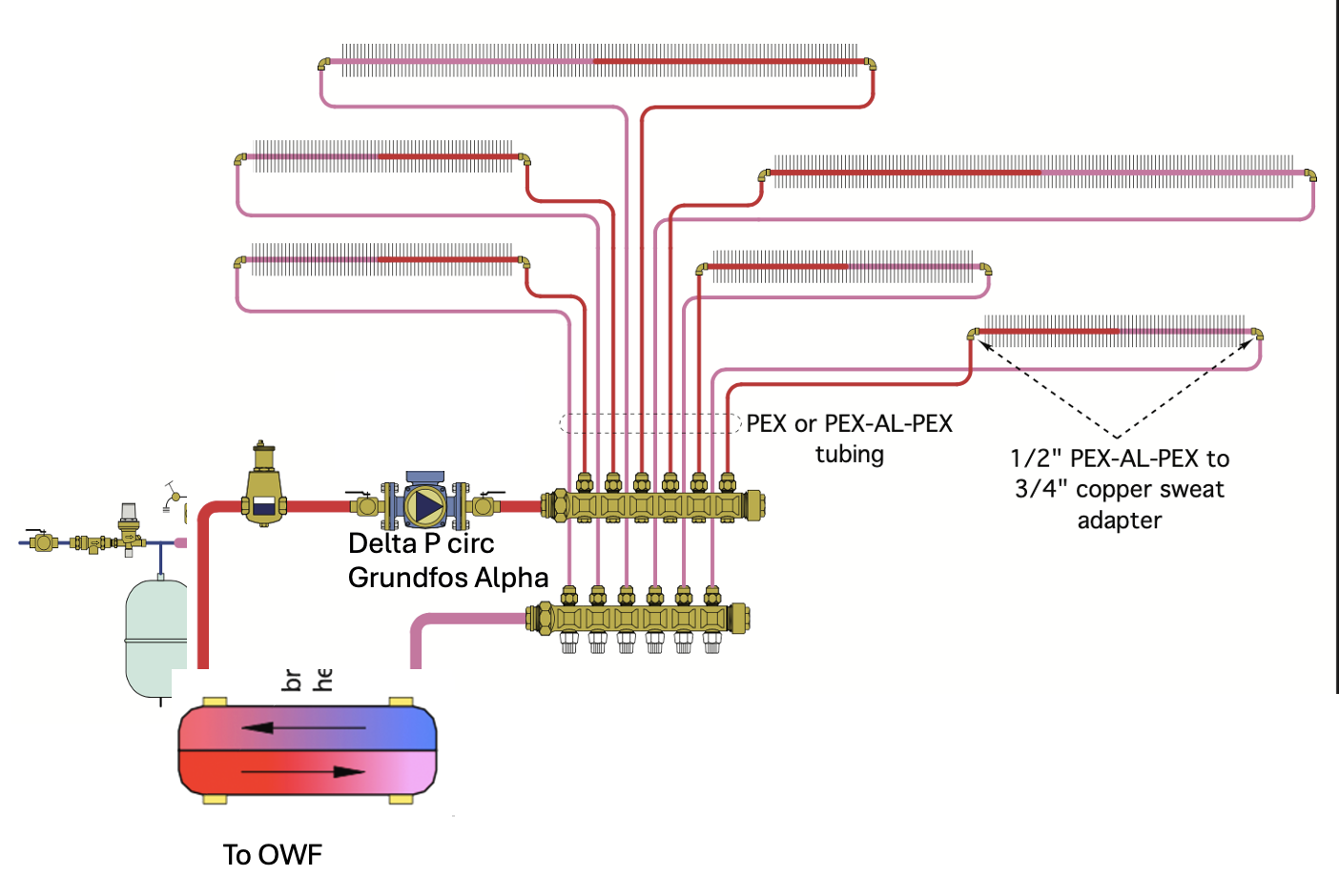
Depending on the radiator size you could run 3 in series with 3/4" pex tube. or.
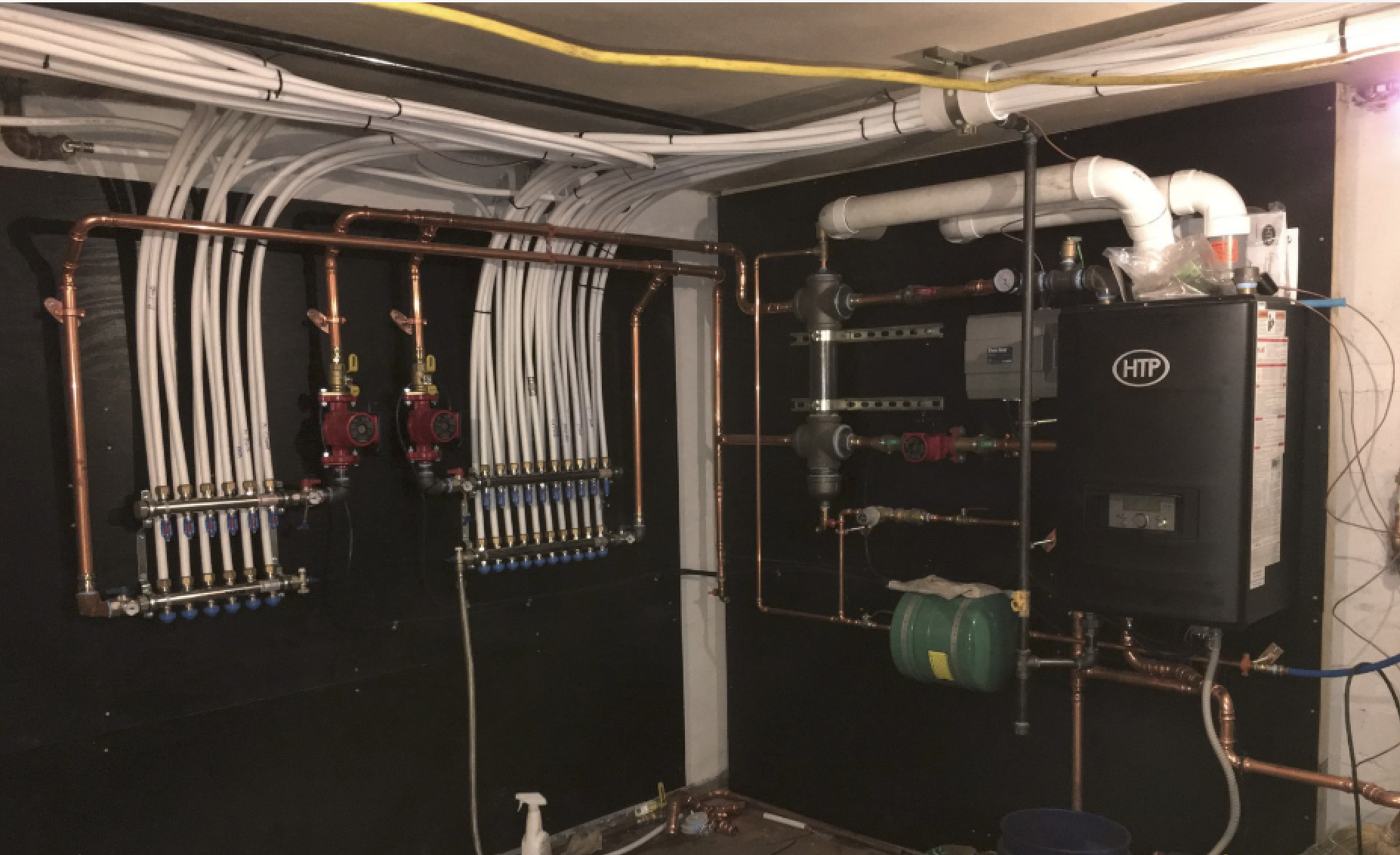
A home run piping uses1/2 pex loop to each radiator back to a manifold.
Home run gives you the ability to zone or adjust every radiator, 1/2" pex is easy to retrofit into homes.
This is an example with fin tube baseboard
Here is a homerun system @Ironman did with the tubing neatly organized in PVC pipe.
 Bob "hot rod" Rohr
trainer for Caleffi NA
Living the hydronic dream0 -
A series loop will work if you have fin tube baseboards, but you’ll wanna use parallel piping with standing cast iron rads.
The homerun/manifold will work well with either.
I’m near Staunton, VA.
Bob Boan
You can choose to do what you want, but you cannot choose the consequences.0



Categories
- All Categories
- 87.8K THE MAIN WALL
- 3.3K A-C, Heat Pumps & Refrigeration
- 60 Biomass
- 430 Carbon Monoxide Awareness
- 133 Chimneys & Flues
- 2.2K Domestic Hot Water
- 6K Gas Heating
- 124 Geothermal
- 170 Indoor-Air Quality
- 3.9K Oil Heating
- 79 Pipe Deterioration
- 1.1K Plumbing
- 6.7K Radiant Heating
- 397 Solar
- 16.1K Strictly Steam
- 3.5K Thermostats and Controls
- 56 Water Quality
- 51 Industry Classes
- 51 Job Opportunities
- 18 Recall Announcements