Welcome! Here are the website rules, as well as some tips for using this forum.
Click here to Find a Contractor in your area.
If our community has helped you, please consider making a contribution to support this website. Thanks!
What a nightmare. Chimney is thick as a brick.

Need to get my flue pipe into the chimney. Its 3 inch PVC but getting a hole in the chimney is like trying to tunnel out of prison with a spoon. I gave up on the 4-inch carbide core bit. Using a hammer drill and lump hammer and chisel at the moment. Any suggestions would be appreciated. Might rent a chipping hammer but don't want to go over kill either. Any suggestions on good quality bit for a hammer drill?
Comments
-
I assume your running a MOD cON flue up the chimney.First makesure you can use PVC as some boilers require polypropylene.
Your going to have to make a big enough hole to get and elbow on as well so make the hole big enough from the start. Your going to have to patch anyhow.
What kind of hole saw did you try?
You might get a better drill or a chipping hammer at a rental store.
But Amazon you can buy a rotary hammer for $75. I have one my cousin gave me for free as Amazon sent him 2 by mistake and wouldn't take it back. Comes with a few bits and chisels. I used his it was pretty good.
1 -
you can also drill a bunch of 3/8" holes and connect them with a hammer and chisel. brick or concrete block are usually fairly easy to break out but poured concrete can be very tough.
0 -
When I had to move the breeching in my chimney, I bought a cheap Amazon/eBay wet core drill & core bit. All together it was around the cost of having it done professionally, but I've used it several times since then, for free, so I'm in the black now.
(edit to remove naughty words)

 2
-
-
What is the material of the chimney? A core drill usually works, but there are some materials (oddly, sometimes "softer" one) where it gets bound up and stops drilling. Then @mattmia2 's idea should work.
A bit of a warning — if there is a clay tile liner, you may shatter that when you get to it, so be prepared for some additional work on that… and a metal liner may tear and pull partly down leaving separations…
Br. Jamie, osb
Building superintendent/caretaker, 7200 sq. ft. historic house museum with dependencies in New England0 -
@scatgo …No Andy Dufresne needed here. If you are cutting through brick, chip away the bricks and refit the brick around the new flue pipe. If it is cement, and from the sound of things, it is. An SDS hammer drill, drill bits, and a chipping bit should work, but that's a lot of work. Finding an SDS core bit and/or a combination of bits and chipping attachments will be needed. As you can tell, there isn't an easy way.
0 -
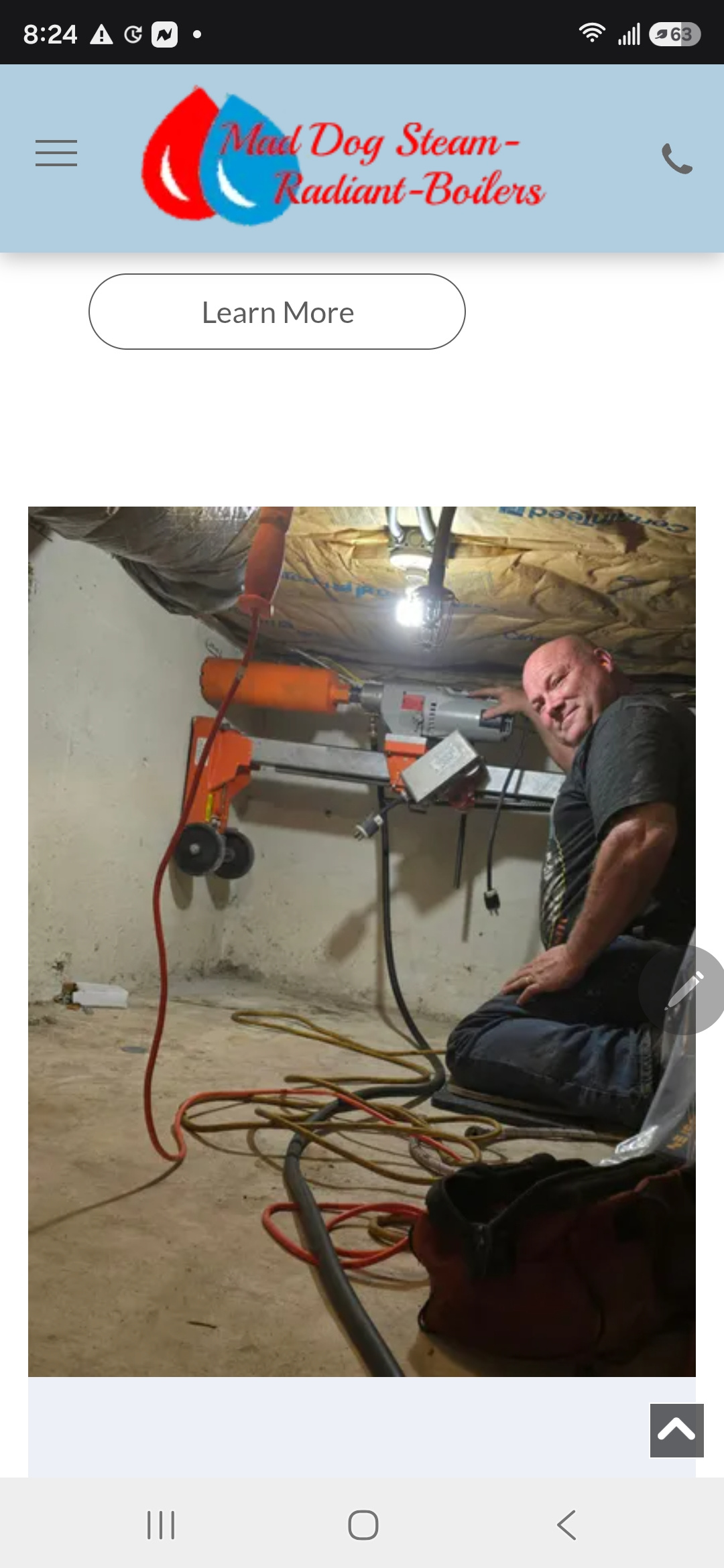
Cores will go through any reinforced concrete, brick, block, rubble, it leaves a neat hole and does much less damage to the building and the body. Much faster too. Mad Dog
 2
-
Thanks for the help. Brain fart on my part. The hammer drill I was using is as old as me. My nephew came over with a nice big Dewalt and I could see right away thing were going to get a lot easier. I did have to go with the drill a bunch of holes and hammer away with a lump hammer and chisel because it was close to a foot of brick and cement before I got to the clay liner. And yea that liner is going to need some more work now. Time for my afternoon nap and then Ill be right back at it. Gas line and plumbing are next. Then of course nothing is going to work without electricity.
0 -
I had to core some holes on a hospital job and the only day they would let me do it was a Sunday. 4" 6" holes brick/block.
We had some core rigs that were smaller "Bantam" I think they called them they were a lot smaller and lighter. I asked the guy at our shop ahead of time to get me one but of course he blew me off and I got stuck with the big one.
I had to pull it up a ships ladder onto a roof, so I took the motor off to make it lighter.
I drilled some anchors and put it on the wall then went to put the motor on but I was backed up to an air handler so not enough room for the motor. I had to take it down remount the motor and lift the whole thing up on a 6" step ladder to mount it. So I am drilling away (on my last hole) when maintenance came up to tell me water was dripping in a hallway. Good thing I wasn't over an OR LOL.
Then take it all apart and rope it down.
The drilling was the easy part. All the rest not so much.
 2
-
Wasn't there an existing opening for the appliance that was removed?
0 -
It's never where you need it to be. That's a corollary of Murphy's Law.
Br. Jamie, osb
Building superintendent/caretaker, 7200 sq. ft. historic house museum with dependencies in New England0 -
Its about two feet below where i would need it. The vent on the modcon I am installing has the vent coming out of the top and gas and water pipes going down from the bottom of the unit.
0 -
And Re-bar.
1 -
sometimes going through rebar or especially conduit is not desirable.
this is kind of like ed's story, do you get the tool that will do it in 10 minutes but spend a couple hours over a couple weeks gathering the better tools or do you just spend 3 hours chipping away at it. when i'd do stuff at my mom's house i'd have limited time to do it so i'd gather stuff. at my house i can spend more time doing it the hard way.
or decide i'll do it later indefinitely…
1 -
never put off until tomorrow what you can do the day after…
Br. Jamie, osb
Building superintendent/caretaker, 7200 sq. ft. historic house museum with dependencies in New England
 6
-


Categories
- All Categories
- 87.8K THE MAIN WALL
- 3.3K A-C, Heat Pumps & Refrigeration
- 60 Biomass
- 430 Carbon Monoxide Awareness
- 133 Chimneys & Flues
- 2.2K Domestic Hot Water
- 6K Gas Heating
- 124 Geothermal
- 170 Indoor-Air Quality
- 3.9K Oil Heating
- 79 Pipe Deterioration
- 1.1K Plumbing
- 6.7K Radiant Heating
- 397 Solar
- 16.1K Strictly Steam
- 3.5K Thermostats and Controls
- 56 Water Quality
- 51 Industry Classes
- 51 Job Opportunities
- 18 Recall Announcements