Welcome! Here are the website rules, as well as some tips for using this forum.
Click here to Find a Contractor in your area.
If our community has helped you, please consider making a contribution to support this website. Thanks!
Using the EDR method for sizing boiler in 100 year old house

Homeowner - please bear with me. Thank you for your help.
I live in a two story 20x40 house that is 100 years old on Long Island in NY (outdoor design temperature = 15). I am replacing the current oil boiler with a new gas boiler located in the unfinished cellar. In the 1990s there was a renovation/addition and I have a good idea on the insulation in the newer portion of the house; however I'd be guessing on the older section.
For this reason using the EDR method to calculate boiler size seemed to be a good idea. Trying to determine if I'm doing the EDR calculation right.
Three main questions:
- For all BTU calculations for EDR method 180 degrees at one gallon flow was used. Given the detail below, is this appropriate or should another temperature be used given the radiators/baseboard involved? Of course, changing the temperature will mean a different outcome for BTUs/hour.
- If the total BTU calculation for EDR method is 73067.4 BTUs/hour, is a boiler that has a net AHRI water rating of (MBH) equal to the size just above 74 appropriate using the EDR method?
- If (I think) I know the insulation for the rear 20x20 first floor renovation/addition, and the second floor and (unfinished) attic 20x40 renovation/addition, can someone point me to how I can complete a heat loss calculation myself? I used the "Weill-McClane Boiler Replacement Guide" and came up with total heat loss of 32,180. I could provide another post on the detail of that calculation. Obviously a big difference between 32 and 74.
Detail on EDR calculation (radiators/baseboards listed in order of supply to return on the loop):
All is 3/4" copper pipe except as noted.
First floor front zone 20'x20' (original part of house) Total BTUs/hour = 32521.8
- "Radiant" style recessed cast iron radiator (22.5W, 20H, 5D - 10 sections) 10 x 382 = 3820
- "Radiant" style recessed cast iron radiator (22.5W, 20H, 5D - 10 sections) 10 x 382 = 3820
- "Radiant" style recessed cast iron radiator (35.75W, 20H, 5D - 16 sections) 16 x 382 = 6112
- Slant/Fin Fine/Line 30 Residential Baseboard with E-75 heating element 28.41 feet of fin on 3/4" copper pipe 28.41 x 580 = 16477.8
- "Radiant" style recessed cast iron radiator (13.5W, 20H, 5D - 6 sections) 6 x 382 = 2292
Note - in the cellar 1, 2, 3, 4 were installed supplied with 1/2" plastic pipe rather than 3/4" copper (should this be changed?)
First floor rear zone 20'x20' (addition-1990s) Total BTUs/hour = 17220
- Embassy Industries Hide-A-Vector Model 88 kick-space heater (with short 1/2" copper loop supply and return pipe connected to main 3/4" copper pipe for zone.) BTUs/hour = 8460
- Slant/Fin Baseboard Multi/Pak 80 High Output Low-Profile Baseboard with H-3 heating element 12 feet of fin on 3/4" copper pipe 12 x 730 = 8760
Second floor zone (addition-1990s) Total BTUs/hour = 23325.6
- Slant/Fin Fine/Line 30 Residential Baseboard with E-75 heating element on 14.46 feet of fin on 3/4" copper pipe 14.46 x 580 = 8386.8
- Slant/Fin Fine/Line 30 Residential Baseboard with E-75 heating element on 7.23 feet of fin on 3/4" copper pipe 7.23 x 580 = 4193.4
- Slant/Fin Multi/Pak 80 High Output Low-Profile Baseboard with H-3 heating element 11.58 feet of fin on 3/4 copper pipe 11.58 x 730 = 8453.4
- "Radiant" style recessed cast iron radiator (13.5W, 20H, 5D - 6 sections) 6 x 382 = 2292
Thank you.
Comments
-
Just do a proper heat loss calculation. In the older part of the house, I'd assume no insulation at all, unless you are opening walls for some reason- then you can see and/or add insulation.
 1
1 -
A room by room heat load number would be good to have, but there will be some assumptions required. So a bit of a wild guess.
Does the home heat adequately now, with what size boiler?
What type of gas boiler? A modcon is a good choice as the output modulates.
If you sized it to the radiation total btu, it could run at that output or anything lower at a 10-1 turndown;
Is this correct 32,521 +17,220 + 23,325= 73,066 total?
If so a 100,000 mod con would match the heat emitters. Really no reason to size the boiler larger than the connected load. This size boiler would turndown to around 10,000 for low load and single zone operation.
A 1600 total sq ft home, a WAG of 20- 30 btu/ sq ft?? Worse case 1600X 30= 48,000 btu/hr.
It is a good thing if the radiation is oversized, then you can run at a lower boiler temperature, which increases fuel consumption. A mod con on outdoor reset control would be a great match.
Bob "hot rod" Rohr
trainer for Caleffi NA
Living the hydronic dream0 -
For hot water the boiler should be sized by a heat loss calculation.
To runs some checks against the above heat loss calculation you should calculate the btu output of the radiation. I would use a 170 deg. average water temp to calculate this. (180 supply temp 160 return. This is only to see that you have enough radiation and to determine what you water temps would actually be.
Then if you can find your fuel usage for the year you can calculate a heat loos to confirm the above heat loss. Look at this thread which is active now "deciding what boiler to purchase" where @Robert O'Brien explains the fuel usage calculation.
0 -
How do I do a proper heat loss calculation? I am going to try the method that Robert O'Brien posted, as suggested by EBEBRATT-Ed (post above) but wondering if you use a different method. Thanks.
0 -
The fuel usage calculation is supposed to be as accurate as a heat loss. Many use the manual "J" which cost $165 new. You can find one on E-Bay used for around $50. They are plenty of on line calculators as well. Many of us used the "Slant Finn" calculator but that is no longer availabel.
Google Heat loss calculators and see what you can find. Others may have some recommendations.
0 -
Current boiler is Peerless WBV-085-W (.85 GAL./HR.) DOE = 102000 and Rating is 89000, Riello Mectron 5M fitted with a .75 nozzle, (also states 60 degree W where the .75 is indicated).
The home is heated adequately now.
Can you give me a brand and model example for a suggested modulating condensing gas boiler so I can look that up?
Note however, that since various plumbers who have come (and have not yet provided estimates) all recommend the 84% efficiency I'm leaning towards installing what is known locally for purposes of servicing.
One has recommended 1) 140000 BTU 84% efficiency Burnham boiler and keeping separate hot water heater, or 2) 140000 BTU Burnham power vent boiler (includes another zone to replace a separate hot water heater).
Another has recommended 105000 BTU 84% efficiency boiler.
I have to admit ignorance on turndown so I will have to look that up. Also WAG meaning but I can gather from the context. Again bear with me. Thanks.
0 -
I found the post you referenced.
Deciding which Boiler to Purchase as a replacement (Burnham, Pure Pro, EK1)
I will have to do some more homework.
In that thread you indicated you would keep repairing an older boiler. I have an oil tank with a slow leak, and given the boiler is from 1989 I thought it prudent to replace the boiler rather than get a new oil tank.
People do tend to move around, but at this point I see myself staying here.
Current boiler is Peerless WBV-085-W (.85 GAL./HR.) DOE = 102000 and Rating is 89000, Riello Mectron 5M fitted with a .75 nozzle, (also states 60 degree W where the .75 is indicated).
I'm planning on replacing because I'm worried about the age of the boiler but I'd appreciate your thoughts.
0 -
@Bawstin , that Peerless is a good boiler. If it's in good shape, I'd just have someone give it a good cleaning and fit it with a Carlin EZ-Gas burner and get rid of the tank. I did that to my 1983-vintage boiler and it runs great.
 2
2 -
Whichever way you go, get the boiler closest to what you have,If the 102,000 does the job, I would not upsize to a 140,000.
If you do go with a mod con type boiler, Lochinvar is a good brand. Viessmann, NTI, US Boiler are other brands.
A good service person could look over your current boiler, but it is hard to tell the condition inside the boiler, 37 years is getting up there. A mod con would run around 87% or higher
look for the heat Load calculator here in Excel format
https://www.pprbd.org/Download/ResidentialHandout
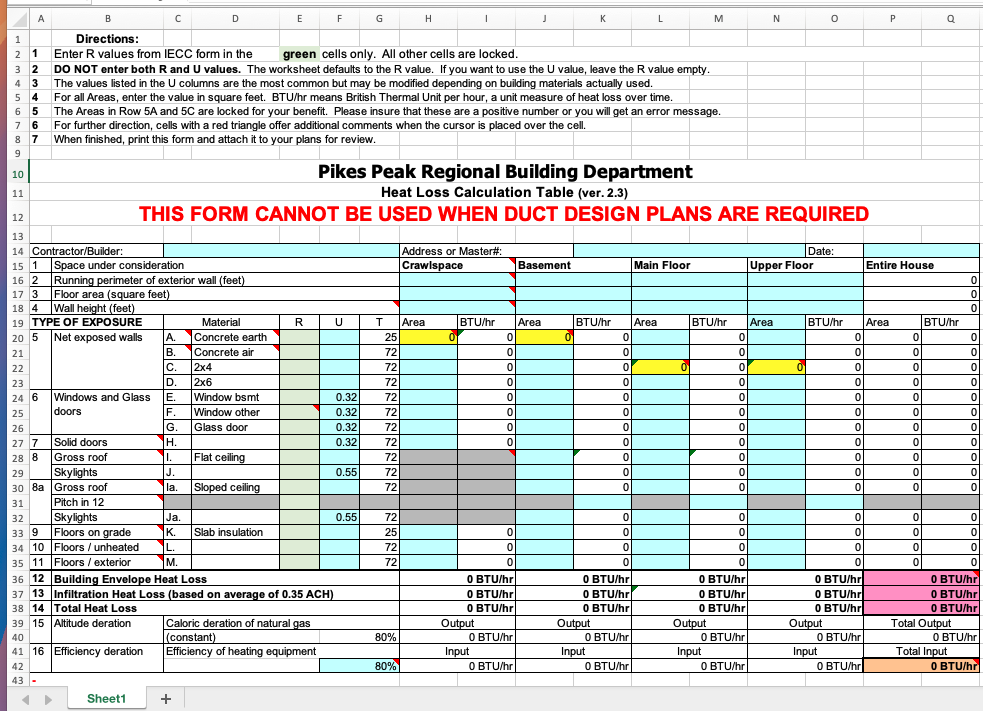
If you know the actual delivered cost of oil vs NG, go here for a $$ comparison. Fuel oil $$ is fairly fickle currently
https://coalpail.com/fuel-comparison-calculator-home-heating
Bob "hot rod" Rohr
trainer for Caleffi NA
Living the hydronic dream0 -
-
Just a couple of thoughts. First, the EDR approach to boiler sizing is correct for steam — but not hot water. As has been said, some sort of heat loss estimate is needed.
Now having done the heat loss, analyzing the relationship of heat loss and EDR will give you an idea of what temperature that hot water boiler needs to run at — but not how big it needs to be.
Now on the heat loss… I prefer a Manual J type estimate to the fuel use method, as the latter is very dependent on how the house has been treated. But that's just me. If you do do some form of Manual J, though, use a slightly higher than "normal" method for the insulating quality of your outside walls and windows — unless someone has gutted the house and "renovated" it. If you still have the original lathe and plaster, it has surprisingly good insulating qualities — unlike dry wall, which might just as well be paper. And old windows with decent storms are as good as the best modern fancy replacement windows.
Br. Jamie, osb
Building superintendent/caretaker, 7200 sq. ft. historic house museum with dependencies in New England0 -
I tried your recommended fuel usage calculation; this is what I did:
For the period 9/1/24 to 8/31/25, 542.9 gallons delivered (actual deliveries occurred between 11/1/24 and 3/20/25).
542.9 gallons * 139000 BTUs per gallon = 75463100 BTUs produced.
I'm not sure what AFUE would be for the current boiler. Peerless WBV-085-W (.85 GAL./HR.) DOE = 102000 and Rating is 89000, Riello Mectron 5M fitted with a .75 nozzle, (also states 60 degree W where the .75 is indicated).
Heating Degree Days for the one year period ending 8/31/25 = 4109
Design Temp = 70, Outdoor Design Temp = 15, Difference = 55
At the following AFUEs, the results for the 75463100 BTUs are:
0.70 = 52824170 BTUs DELIVERED / 4109 = 12855.72 BTU/HDD / 24hrs. = 535.65 BTU/HDD-hr. * 55 = 29461
0.75 = 56597325 BTUs DELIVERED / 4109 = 13773.99 BTU/HDD / 24hrs. = 573.92 BTU/HDD-hr. * 55 = 31565
0.80 = 60370480 BTUs DELIVERED / 4109 = 14692.26 BTU/HDD / 24hrs. = 612.18 BTU/HDD-hr. * 55 = 33670
0.85 = 64143635 BTUs DELIVERED / 4109 = 15610.52 BTU/HDD / 24hrs. = 650.44 BTU/HDD-hr. * 55 = 35774
So using the fuel usage method, the range is 29461 - 35774 BTUs, depending on the assumed AFUE.
Again, I used the "Weill-McClane Boiler Replacement Guide" and came up with total heat loss of 32,180.
I chose the 9/1/24-8/31/25 period because I was trying to end up this past season with an empty oil tank so '25-'26 will be less accurate.
I will try to work on doing a heat loss calculation now. Thanks.
1 -
Thank you for pointing me to the heat loss calculation spreadsheet. I will work on figuring that out.
As far as the boiler sizing, my thought was that the house in 1989 (when the current boiler was installed) is different than the house that exists now. I'd guess about 20x20 of the first floor is original (maybe slightly more) and 20x20 is from mid 1990s, and everything from the second-floor floor up (20x40) is from the mid 1990s. All the windows are 1990s era Andersen. The house generally seems tight to me. My thought was that the current boiler is probably oversized for the house that exists today.
Thanks for the recommended boiler manufacturers.
I will work on the heat loss calculation. Thanks.
0 -
I'm getting ahead of myself here (need to do heat loss calculation first), but how do you "analyze the relationship of heat loss and EDR to find an idea of what temperature the hot water boiler needs to run at"?
Thanks.
0 -
There are a few ways to come at this
You are trying to reverse engineer the system
Usually you start with the heat load, then select and size radiators for each room to meet the heatload. That total room by room load number is the required boiler size
You chose a design temperature for the radiators, say 170 for cast or fin tube
Now you know what size radiator or fintube each room or space needs
If efficiency is a goal you want to run a boiler at the lowest supply temperature while getting the home heated to your desired temperature, maybe 70
In your case the home heats well, that would indicate the boiler and radiators are adequate
I suspect you may find the radiators are oversized if you do a room by room heatload, based on your observation. That’s common when homes get energy upgrades
What then? Would you remove or downsize radiators?
It is a good problem to have, oversized radiation as you can heat with lower water temperatures
I think what you will find is the boiler could be much smaller than what you have
If you select a modulating boiler, adjust the control properly , it determines the water temperatures required at any time.
On a mild day maybe the boiler runs 130, maybe ramps to 170 on the coldest day
Bob "hot rod" Rohr
trainer for Caleffi NA
Living the hydronic dream0 -
If you know the heat requirement of a space and you know the EDR of the space, it's direct: the heat output of the radiation, for each square foot of EDR, is very closely related to the temperature of the water feeding the radiation; as a first approximation, the heat output in BTUh per square foot is equal to 1.4 times the water temperature -70. Thus, if you are running your hot water at 180 F, the heat output will be 1.4 times (180-70) or about 150 BTUh per square foot of EDR.
Or going the other way, if you need say 10,000 BTUh in a certain space, and you have an EDR of 47, you will need to run the water at 180.
Br. Jamie, osb
Building superintendent/caretaker, 7200 sq. ft. historic house museum with dependencies in New England0 -
Here are some derate graphs for fin tube and ci radiators
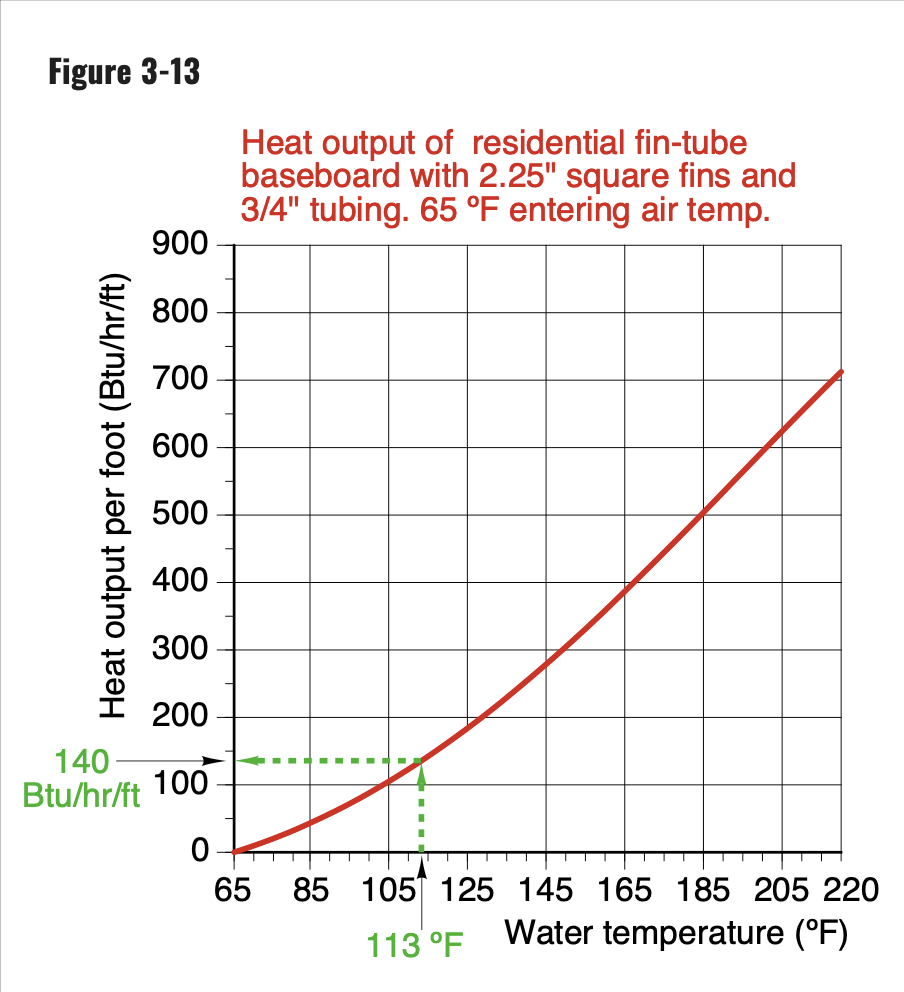
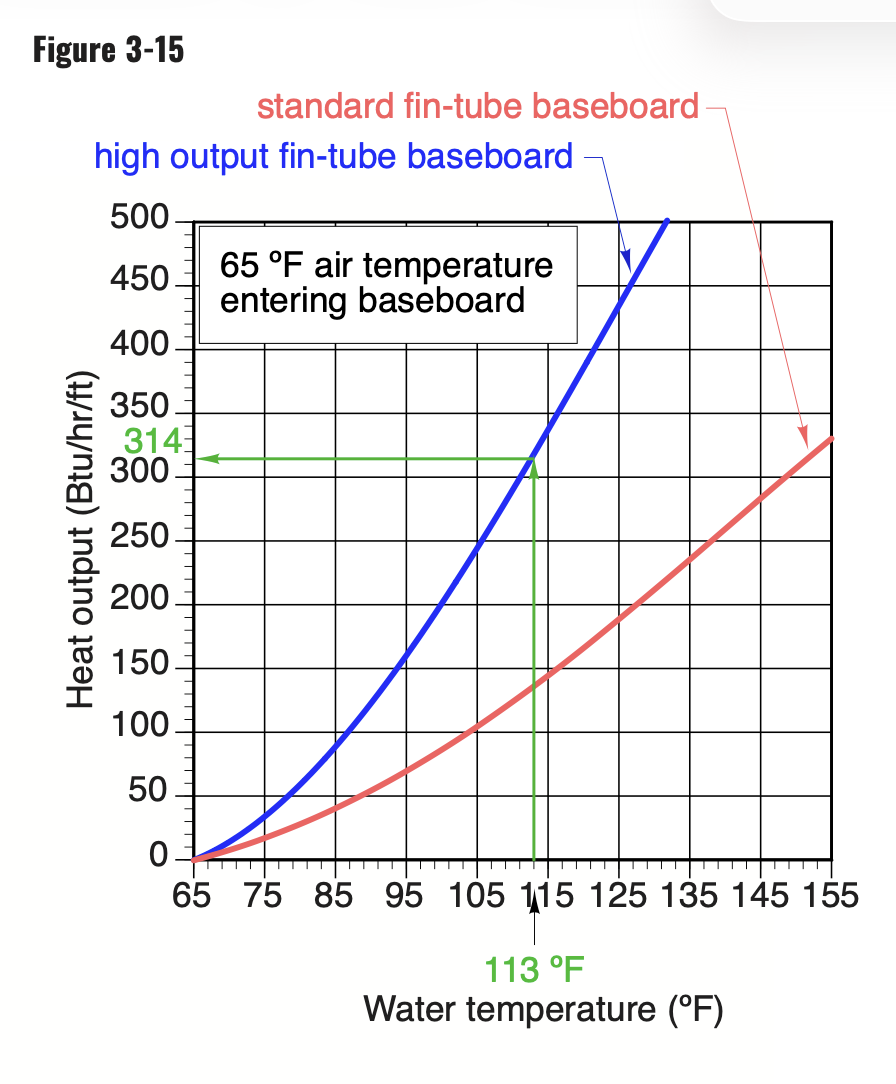
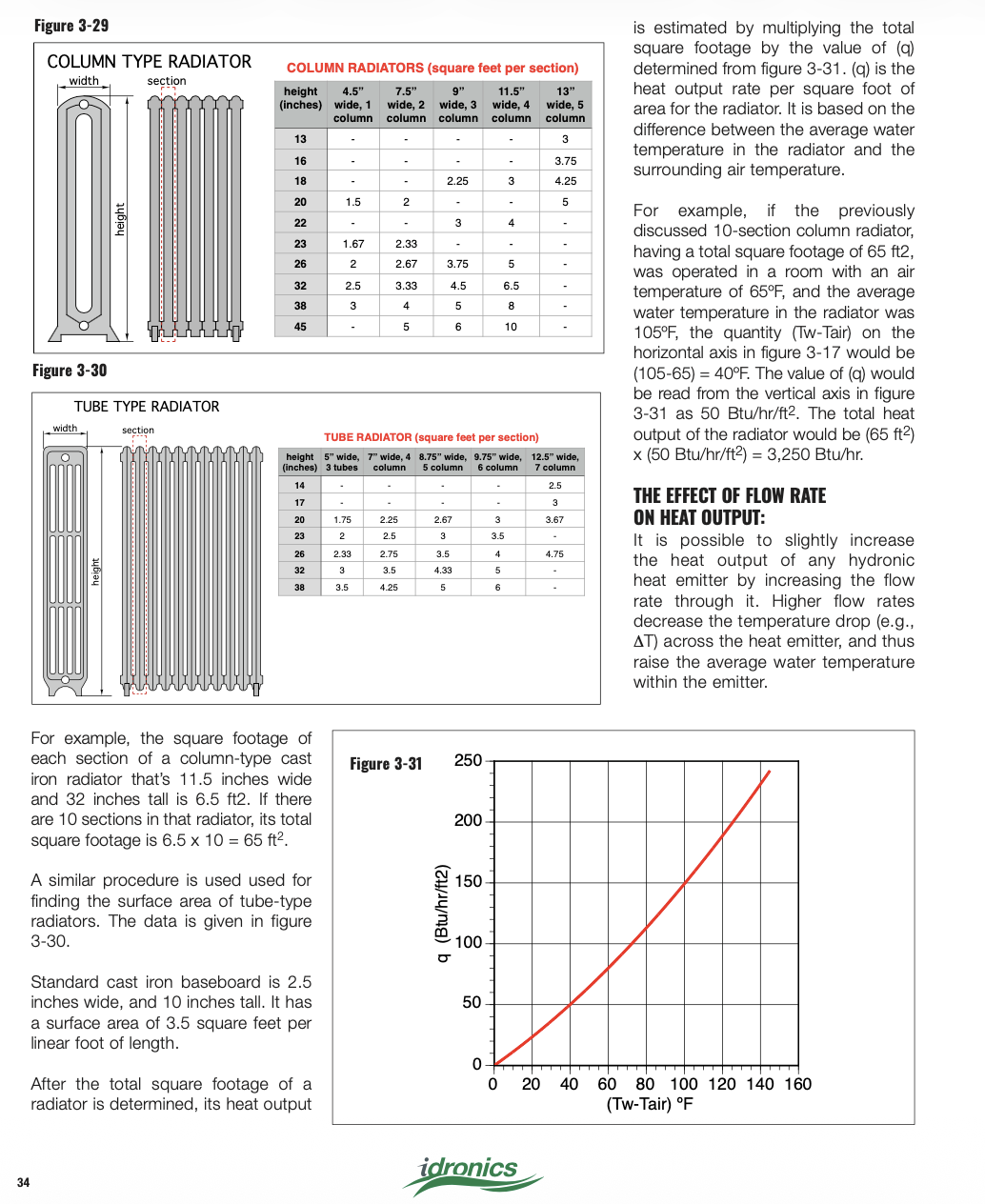 Bob "hot rod" Rohr
trainer for Caleffi NA
Living the hydronic dream0 -
Okay great. This is very helpful information.
I am going to work on the heat load calculation.
Overall - the goal is to replace with a boiler sized just above what is needed on the coldest day to heat the house to 70 degrees.
And have the boiler provide the heat at the lowest, safe temperature (130 degrees on warmer days and 170 degrees on the coldest day) because this will keep the boiler running most efficiently (rather than on/off, on/off if the boiler is oversized).
A modulating, condensing boiler sized correctly with the control adjusted properly will accomplish this.
Hoping I am understanding what you are recommending. Thanks.
0 -
Your on the right track. You have 32K with the Weil mcLain guide and 27K-34K with fuel usage so if the calculations are correct, you mostly where you need to be.
0 -
Unless you have rooms or areas that do not get adequate heat, I'm not surer a room by room load calc will add much to your project?
Unless you plan on moving, adding or downsizing radiators if you find over radiated areas?
You have a load number as accurate as need be, so the boiler sizes around that.
If you are comfortable with those load estimates, an 80,000 boiler would be plenty and have some reserve for any future add on. It would modulate down to 8,000 on mild days.
Bob "hot rod" Rohr
trainer for Caleffi NA
Living the hydronic dream0 -
Thank you for the information and all your help.
0 -
Thank you - all this information is very helpful.
0 -
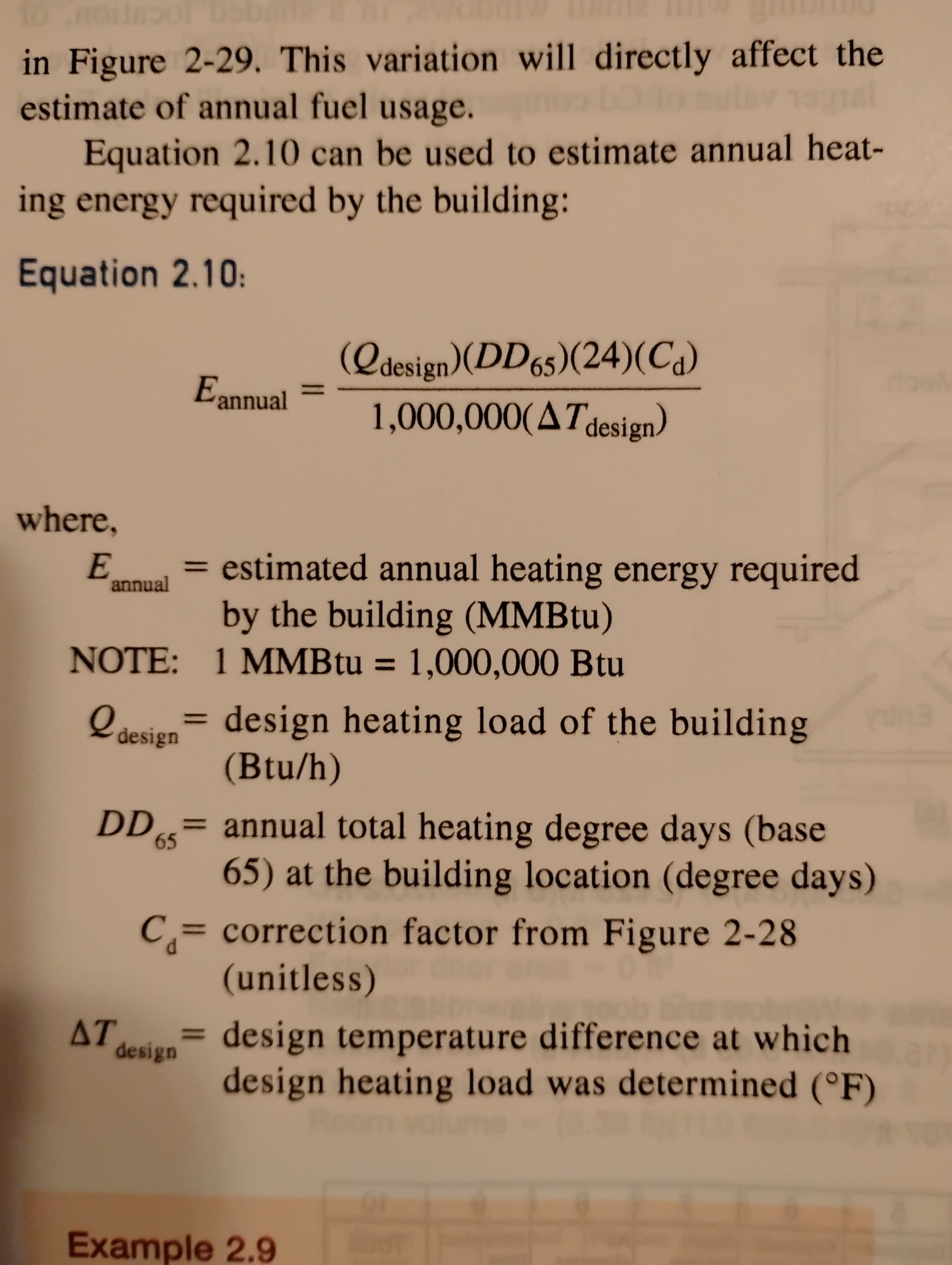
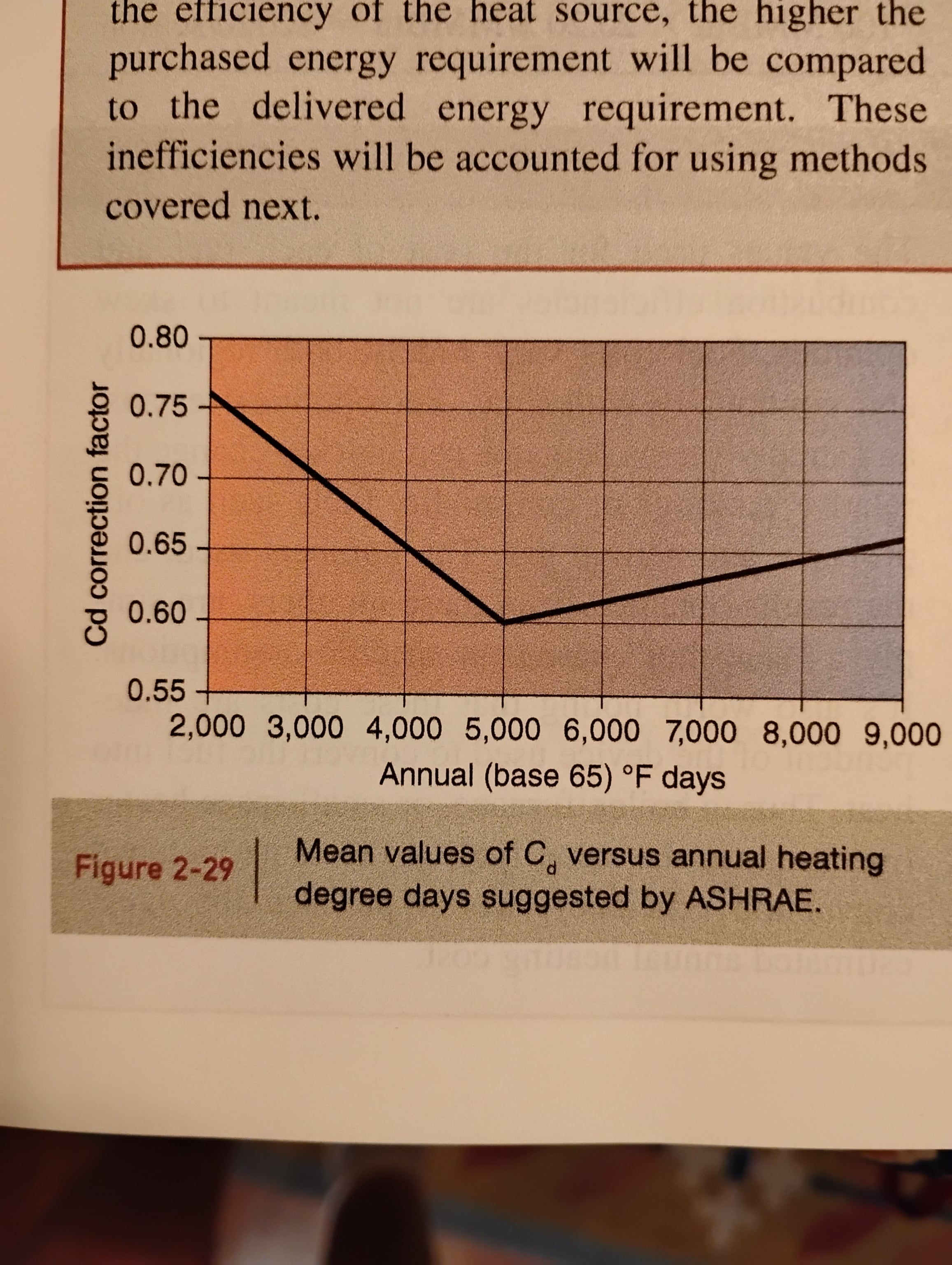
@Bawstin You're on the right track with your heat loss calculation based on annual energy consumption, but there's a correction factor you have to apply because the annual energy consumption is not linear with HDD's. The correction factor is the "Cd" in the equation below (from Siegenthaler's Modern Hydronic Heating & Cooling, pg 44). Cd is a unitless correction factor that can be pulled from the graph below based on the number of HDD's in your location. For your 4109 HDD's, the graph gives a Cd of about 0.65. So you need to divide all the heat loss numbers you derived using the same equation but without the correction factor by 0.65. That puts you around 50,000 BTU/hr, which for 1600 sq ft = 31 BTU/hr/sq ft. Which is believable for a leaky 100-year-old house in your zone.
It's also possible your old boiler was running at lower cycle efficiency than you think, meaning that (for example) if your real overall efficiency was, say 65%, then your actual heat loss was closer to 40,000 BTU/hr. I'm guessing it was in fact running closer to 65% because of low water volume in those baseboard loops probably causing short-cycling. So figure 40,000-50,000 BTU/hr, or 25-30-ish BTU/hr/sq ft, which sounds reasonable.
 0
0 -
Ok, do I have this correct:
If I use 70% efficiency, from my post above.
E Annual is what I am solving towards.
Q design = 29461 (using 70% efficiency - from my post above)
DD 65 = 4109 (not sure if I understand the "65" part of this, and the "65" is involved - needs to be the same? - in the correction factor)
Cd = 0.65
and
T design = 55 (70 outdoor degree - 15 indoor degree = 55, for my location)
__
Also, if we take 29461 (70% efficiency above) and divide by .65, the result is 45,324.
So a NET 51,000 boiler is an acceptable size?
—
I still have not completed a heat loss calculation, partly due to time and partly due to not being sure I am inputting correctly.
0 -
@Bawstin Not quite. You got the right answer but by a backwards path.
Start with a known total annual energy consumption (543 gal) and then "derate" that by your assumed boiler efficiency, because you know that, say 30% of that total consumption was wasted up the flue, and only, say 70% of it went into your house.
So your total annual energy lost through the building envelope, E(annual), was:
543 x 139,000 x 0.70 = 52,833,900 (at that assumed efficiency, which you can vary as appropriate)
Then you want to solve for design day heat loss Q based on the above E(annual) and your other parameters:
Q = (52,833,900)(55)/(4190)(24)(0.65) where the 0.65 is your Cd correction factor (which confusingly has nothing to do with the 65 in HDD65, it's just a coincidence.)
So Q=44,457 BTU/hr as your design day heat loss at a delta T of 55 F.
And you can redo the math assuming different boiler efficiencies. The worse your boiler efficiency was, the less energy actually went into the house as useful heat, and therefore your calculated Q design day heat loss goes down. But 70% assumed efficiency is probably close enough.
Then how do you use that calculated Q of 44,457 BTU/hr? First, remember that it's not exact. @hot_rod came up with a WAG worst case of 48,000 BTU/hr just based on square footage and probable heat loss per sq ft in a house of your vintage. Your calculated Q is quite close to that, and therefore probably reasonable.
Then ASHRAE recommends sizing heating equipment to 1.4 of the design heating load, which gives you around 62,000 BTU/hr. So I wouldn't go higher than that. But obviously if you get a mod-con, oversizing doesn't matter so much because it can modulate down to 10%-15% of output.
If it were me, I'd take @Steamhead 's advice and keep the boiler but convert to a gas gun. Then you can size the gas gun input to get you a net output of around 60,000 BTU/hr, which should be more than enough. Note that the Carlin EZ gas burner he mentioned can be rated down to 50,000 BTU/hr input, so you could set it up for around 75,000 BTU/hr input, which at about 80% efficiency would give you 60,000 BTU/hr. So the Carlin EZ gas would give you the right-sizing flexibility, which is nice.
Disclaimer: I am not a heating pro, just a homeowner/mechanical engineer.
0 -
@jesmed1 , when doing this, one would need to make sure the stack temp was over 350° or so. Any less and you might get condensation in the chimney. This would limit how far down you could go.
0 -
For what it's worth — just tried that equation for Cedric (never have before!) and it's not too bad… comes out to around 36 BTUh per square foot at 0 degrees F outside and 65 inside. And that's not too shabby for a building with almost no insulation and built in stages between 1780 and 1893…
Br. Jamie, osb
Building superintendent/caretaker, 7200 sq. ft. historic house museum with dependencies in New England0 -
@Steamhead Yes, and I forgot to mention that a stainless steel flex liner in the chimney will also be required for the gas conversion of an oil boiler that likely is venting into a brick chimney with an old terra cotta liner. I looked at doing that gas gun conversion on our boilers, and a new liner would have been the first step for us, but we never went down that path for other reasons.
0 -
@Jamie Hall That sounds reasonable. One interesting result of that equation is that if you assume a worse boiler efficiency, you get a better heat loss result for the envelope, and vice versa. So you can find yourself wondering which is more likely, a 60% boiler efficiency or a 40 BTU/hr/sq ft heat loss. It's like having to decide which child you like better…😅
0 -
For what it’s worth, if you think the heat loss is around 40,0000 btu, stop wasting your time refining. Boilers don’t come in that many sizes.
0



Categories
- All Categories
- 87.9K THE MAIN WALL
- 3.3K A-C, Heat Pumps & Refrigeration
- 60 Biomass
- 430 Carbon Monoxide Awareness
- 133 Chimneys & Flues
- 2.2K Domestic Hot Water
- 6K Gas Heating
- 124 Geothermal
- 170 Indoor-Air Quality
- 3.9K Oil Heating
- 80 Pipe Deterioration
- 1.1K Plumbing
- 6.7K Radiant Heating
- 397 Solar
- 16.1K Strictly Steam
- 3.5K Thermostats and Controls
- 56 Water Quality
- 51 Industry Classes
- 51 Job Opportunities
- 18 Recall Announcements