1 or 2 raisers?

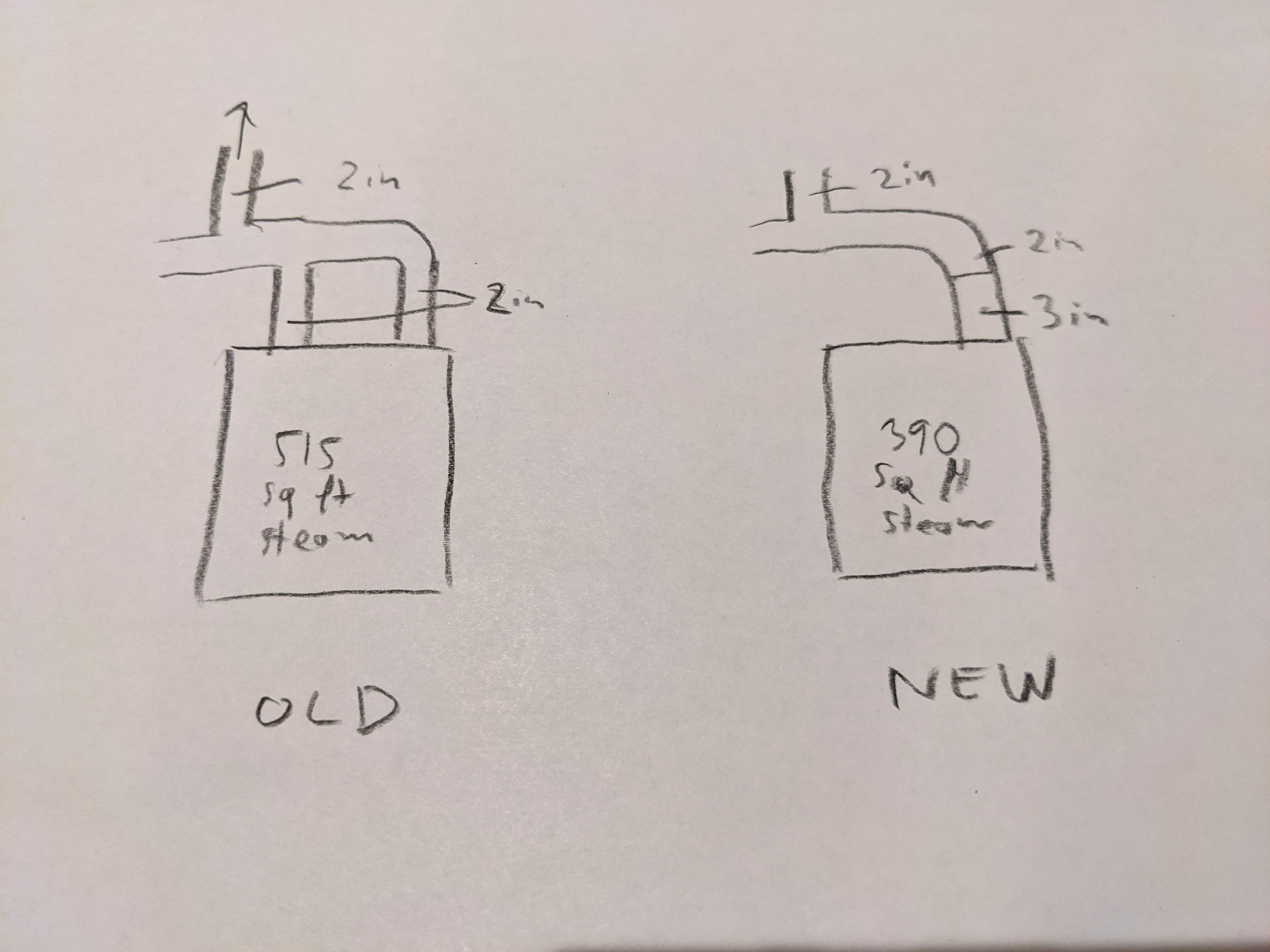
I'm slowly replacing my steam Burnham boiler (capable of producing 515 sq ft of steam) with slightly smaller Williamson GSA-150 Series 2 (390 sq ft). The boiler comes with 2 top opening (1 is sealed at the factory).
My original set-up (Burnham) had two 2in raisers coming together in a header and sending the steam via 2in pipe further into the system. It worked very well.
I'm trying to keep as much of original piping as possible. The new boiler (Williamson) has two 3in openings (despite manual claiming 2.5in). I'm thinking of having one 3in raiser reduced to 2in header to send steam to the system via original 2in pipe. Am i OK in my thinking?
»»» See my steam heat YouTube videos:
https://www.youtube.com/@HeatingBlog
Comments
-
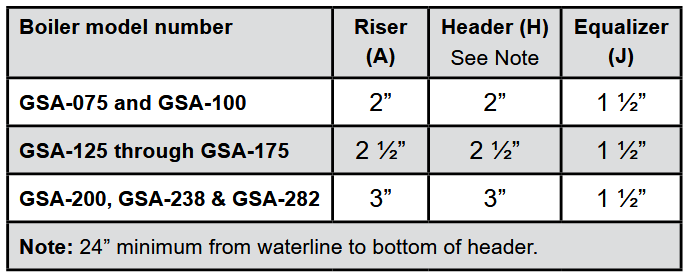
The manual for that boiler states 2 1/2” riser and header which is the answer to your question about a 2” header.
0 -
the manual should be followed, however it might be quite conservative in its sizes, meaning smaller pipes would work fine.
We’ve all seen big boilers with 2” pipes work fine.
You only have a single 2” main?
Well if that worked with a 515 sq ft boiler, it will work with a 390 sq ft boiler.
The idea that too small pipes will cause water to get “sucked out” or carried over is pure fiction based on what I have seen (and I do mean seen). If anyone has ever seen it happen I’d love to hear about it.
What is the total EDR of your radiators?
Do you plan to skim your new boiler? You must. Water quality is a far greater determinant of success than pipe size
NJ Steam Homeowner.
See my sight glass boiler videos: https://bit.ly/3sZW1el0 -
I would follow the boiler manufacturers minimum requirements.



 4
4 -
The fact that the system worked with old piping, doesn't mean that it worked optimally. If you were discussing an existing boiler and system, and it was working relatively well, then certainly would not be a justifiable expense to start repiping. But you are putting in a new boiler. Now is the time to optimize the boiler piping. And of course, optimize the water quality as well.
2 -
You don't want to do it the find out you have to re-do it.
The larger piping will be more tolerant of the oil that accumulates in the system between skimmings as you get the oil from the new piping out. If it were my system I would keep it the size of the tappings in the boiler or the minimum from the manual, whichever is larger for both the risers from the boiler and the header.
If the water quality is perfect the header doesn't need to separate anything but the bigger piping will let you spend less time skimming.
1 -
The manual calls for 2.5in raiser and 2.5in header.
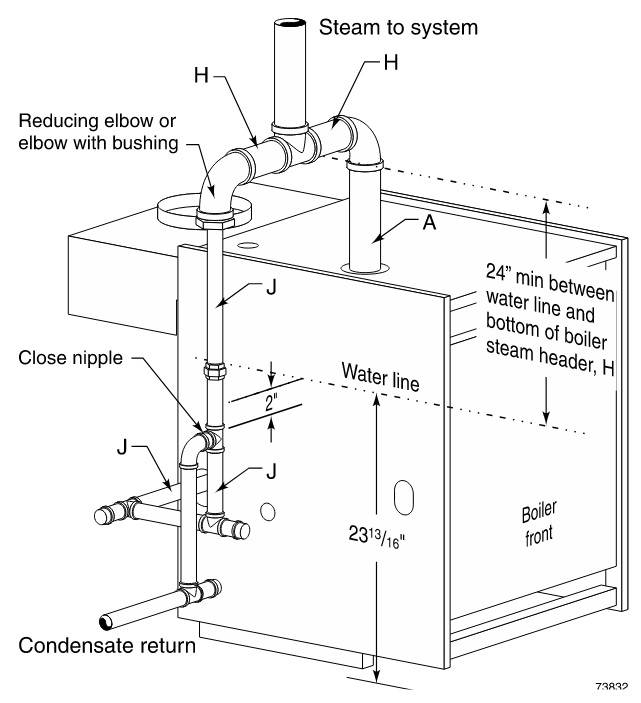
The manual doesn't says whether i should use 1 or 2 raisers.»»» See my steam heat YouTube videos:
https://www.youtube.com/@HeatingBlog0 -
look in the manual it wiil show a drawing of the piping for your boiler
0 -
"The new boiler (Williamson) has two 3in openings (despite manual claiming 2.5in). "
Well the way I see it the end castings of that series boiler are probably all the same. The boiler simply gets wider as the capacity increasing and they may also change burners to change capacity with the same size block. So since the chart shows the maximum riser to be 3 inches I would expect that is the tapping size for that whole series to be 3 inches. If you stick with the recommended minimums it will probably work fine.
If you go above and beyond the minimums and have a 3 inch drop header with two 3 inch risers it will work fine too. Maybe it will work better, maybe no real measurable difference with that size boiler. Is the one time cost of the larger pipe and the aggravation of getting the 3 inch pipe plug out worth it to you ? Probably only you can answer that question.
 National - U.S. Gas Boiler 45+ Years Old
Steam 300 SQ. FT. - EDR 347
One Pipe System0 -
The manual does not say that the boiler has a 2 1/2 in tapping for the supply. The manual just suggests using a pipe size of two and a half inch. The boiler does have two, three inch Supply tappings. But the manual does not recognize the one on the right side. But you are certainly welcome to use it.
0 -
since the tappings are 3” and the riser needs to be 2 1/2” don’t put a bushing in the boiler. Buy a 3” nipple that will get the header 24” minimum above the water line. Come out of the boiler 3” and put a 3x2 1/2”90 on top of the riser. The 3” riser will hep keep water in the boiler and bushings leak
1 -
This seems like an easy and reasonable solution. Unless you really want two risers.
National - U.S. Gas Boiler 45+ Years Old
Steam 300 SQ. FT. - EDR 347
One Pipe System0 -
Practical needs aside.
If my old (larger) boiler had two 2in raisers going into 2in header into 2in main… Would the fact that there were TWO 2in raisers rather then ONE 2.5in raiser like i plan to do, REALLY keep the steam that much drier?
»»» See my steam heat YouTube videos:
https://www.youtube.com/@HeatingBlog0 -
I understand you trying to save work. Don't do it. Steam does not always follow things that make sense.
The inside of the new boiler does not match the inside of the old boiler. It is not the right choice to do a cut and slide.
Might it work…yes
Might it not work…yes
Do you want to pull it all apart and do it over if it doesn't work?
If it doesn't work and you call the mfg they will tell you to do it right. No one can predict what will happen. If you want to try it go ahead.
1 -
No. It’s 4.9 sq in for the single 2.5 vs 6.3 sq in for the dual 2”.
However, my observation is that it doesn’t matter. Other people will disagree but I don’t think they can prove it. I’d be welcome to see any contrary evidence though!
NJ Steam Homeowner.
See my sight glass boiler videos: https://bit.ly/3sZW1el0 -
For those who don't know the easy way to find the surface area of a circle is radius x radius x pie.
For a 2" riser you've got 1 x 1 x 3.14 = 3.14. So 6.28 for two
A single 2.5" would be 1.25 x 1.25 x 3.14 = 4.9
A single 3 gives 7.
Single pipe 392sqft system with an EG-40 rated for 325sqft and it's silent and balanced at all times.
0 -
No to beat the dead horse over and over... If my current boiler (390 sq ft) is 24% smaller than my previous one (515 sq ft), then it seems ONE 2.5in raiser = TWO 2in raiser x .76. (more or less)
Or am I missing something?
»»» See my steam heat YouTube videos:
https://www.youtube.com/@HeatingBlog0 -
it has to do with the internal geometry of the boiler too. some may have more space for the water and steam to separate before it gets to the riser than others so the riser has to do less work letting th water fall out of the steam.
 1
1 -
NOBODY knows what will happen if you pipe it too small.
Why take the chance?
Easiest way to find the area of a circle is to multiply the dia. x itself x .7854. Just easier to remember for me
Draw a square the same dimensions as the pipe ID. Multiply 2 sides. The area of the circle will be 78% of the square.
0 -
.7854 is easier for you to remember than pi?
Who doesn't like pie!
Single pipe 392sqft system with an EG-40 rated for 325sqft and it's silent and balanced at all times.
 1
1 -
What is this above trying to prove or disprove ?
If you follow the manufactures recommendations, it will probably work fine and no one can say you did it wrong. Going above and beyond (larger than recommended pipe size) will cost more and may have no actual benefit.
National - U.S. Gas Boiler 45+ Years Old
Steam 300 SQ. FT. - EDR 347
One Pipe System0 -
Corrected for my error in parenthesis.
If I remember correctly Mr. Holohan has written that 2 or more (riser pipes from the steam chest) is ideal for making drier steam as the steam vapor has more room to rise with more openings allowing it to leave the steam chest safely and rise into the header piping to reach the radiators faster and keep them hotter longer as long as all the vents are working as they should by expelling the air in the radiators as the steam enters the piping and then into the radiators.
It seems that having one or two three inch risers will only help you make drier steam using a drop header or double drop header.
The three inch pipe will cost more but it will allow you to have greater thermal mass to create drier steam that will heat the radiators and in the process heat them at a higher temperature to allow them to shed heat longer.
0 -
There is always the need for balance. Of course there is benefit to more and larger boiler piping. However, installing a 75, 000 BTU boiler, with two three inch risers and a 4" header, is probably overkill by most accounts. For example...
0 -
Paul and Chris both provided the math supporting the two 2" piping providing greater flow are than single 2.5 (6.28 versus 4.9). They just didn't say "Yes, it should be fine"
😀
follow @EBEBRATT-Ed -recommendation to use 3" to 2" nipples for the boiler to piping
 1
1 -
Just the way my brain works or not works I guess. I just know a circle cut out of a square has 78% of the squares area
1 -
My EG-40 has two 2" risers into a 3" header.
If I was doing it again, I'd do a single 3" instead. More flow and easier to pipe. I was stuck on using both supplies rather than doing what would be easier and better at the same time.
As far as a single 3" up into a 2" header………… I don't know, but Paul's videos suggest it would be perfectly fine and the 3" coming out of the boiler would certainly slow things down in that area for sure.
Single pipe 392sqft system with an EG-40 rated for 325sqft and it's silent and balanced at all times.
1 -
it has nothing to do with the mass. the larger diameter pipe slows the velocity of the steam so any mist or larger water droplets entrained in the steam will slow down and have a better chance of being pulled down by gravity vs being pulled up by the steam pushing on them.
 1
1 -
Mattmia2,
My mistake, I was thinking about the greater amount of metal in the three inch pipe in general terms and I neglected to mention- I forgot actually that the steam would slow down and the heavier water droplets and mist would drop out.
0 -
Theoretically this is more or less sound, but in reality it just doesn't matter. No droplets remain entrained in residential steam. They hit the pipe wall within inches. And that's on a straight pipe. If they hit an elbow, it's curtains.
NJ Steam Homeowner.
See my sight glass boiler videos: https://bit.ly/3sZW1el0 -
have you tried it with other boilers? there is probably a reason why peerless boilers are preferred for steam. do we see many people with problems with water being thrown out of peerless boilers?
0 -
When water is thrown out it's not due to entrained droplets, it's due to a violent "boiling over" event caused by bad water quality.
This is based on what I have seen with my Peerless and my Utica, and applying what I have seen with the other boiler section designs I have seen.
But really regardless of the design of the boiler, what I am seeing is inside the pipes how droplets move and react with the steam and they simply don't remain entrained.
If someone can show me otherwise, I'll gladly look!
NJ Steam Homeowner.
See my sight glass boiler videos: https://bit.ly/3sZW1el0 -
As shown in the drawing in the first post, I'd go with one riser — when using two risers, swing joints are needed. They are not shown in the sketch, but maybe they are there… If not, it'll be cheaper and more effective to go with one riser, and going up in size.
I learned in physicist school / vacuum technology class that laminar flow in a round pipe — assuming a fixed pressure differential — goes with the THIRD power of the diameter of the pipe, not the square.
The square gives you cross-sectional area, but laminar flow means the gas' velocity is zero at the pipe surface and fastest in the center. That velocity profile is where the extra power comes from.
Two 2" pipes give 2 x 2^3 = 16.
One 2.5" pipe gives 2.5^3 = 15.6 — so, basically the same.
One 3" pipe gives 27.From a practical point of view, not a lot of folks have access to pipe threaders > two inches… any plumber worth his salt will have that. That's where to 2x two-inch pipes & swing joints can make sense. It's what I have on my boiler — with a net rating of 308 sq. ft. — and it's fine.
And finally, I agree with Paul about good water quality covering just about any piping sins. But I'm on a two-year journey to skim all the oil from my water, and I think™ I'll finally be done once the third season gets underway. I did have serious surging at times, and once the oil is in the system, it takes a long time to return to the boiler. Since I'm not putting any new oil in, I know it'll get fixed, but I'm amazed by how long it takes.
If corners are cut on the piping, and I'm not saying that would be a bad decision, I'd think hard about what I'd do to keep my water clean. I'd probably start with carefully wiping all my new pipe threads with rags and alcohol and then washing with hot water and Dawn liquid soap in a big container. I wish I'd done that. Also wash out the boiler itself with "washing soda" before you send steam to the main.1 -
you still need a swing joint between the equalizer and the header. if the riser comes up and makes a 90 with a threaded fitting and connects in to the side of the header that makes enough of a swing joint for the risers.
0 -
The boiler is installed. I flushed the crap out of it with pressure washer before installing the raiser. I ended up going with 2in raiser. We tested it. It heats up surprisingly quickly (probably because the previous one had 3 gallons of water more than this one) . I'll skim it sometime next week and show you some photos when i'm back to the house in next few days.
BTW, i just re-watched some of Paul's videos. They are insanely valuable!»»» See my steam heat YouTube videos:
https://www.youtube.com/@HeatingBlog2 -
Why do you need a swing joint between the header and equalizer?
Single pipe 392sqft system with an EG-40 rated for 325sqft and it's silent and balanced at all times.
0 -
because the boiler block may expand at a different rate than the pipe, just like with the risers. technically soemwhere between the header and the return connection from the equlaizer/hartford loop. usually you end up with enough play in there somewhere if you do it with threaded fittings.
0 -
Do you have any manuals calling for this?
I know it's common across all brands if there's two risers that they must have swing joints but I do not recall ever seeing it for the equalizer. I assume because the return tapping doesn't line up with the supplies, so you need an offset regardless?
Single pipe 392sqft system with an EG-40 rated for 325sqft and it's silent and balanced at all times.
0 -
That's a swing joint? I don't see how that would prevent issues with the block expanding at a different rate than the piping…
I would say the swing joints are the elbows at the top of the risers…not that they actually swing, but they give more distance for the pipe to flex.
NJ Steam Homeowner.
See my sight glass boiler videos: https://bit.ly/3sZW1el0 -
I suppose anything with 2 elbows is a swing joint although we usually only call it a swing joint if the elbows are close together. Bottom line a 3-4' piece of 1 1/2 with an elbow on each end is going to move enough to not cause any issue.
 3
3


Categories
- All Categories
- 87.8K THE MAIN WALL
- 3.3K A-C, Heat Pumps & Refrigeration
- 59 Biomass
- 430 Carbon Monoxide Awareness
- 133 Chimneys & Flues
- 2.2K Domestic Hot Water
- 6K Gas Heating
- 124 Geothermal
- 170 Indoor-Air Quality
- 3.8K Oil Heating
- 79 Pipe Deterioration
- 1.1K Plumbing
- 6.7K Radiant Heating
- 396 Solar
- 16.1K Strictly Steam
- 3.5K Thermostats and Controls
- 56 Water Quality
- 51 Industry Classes
- 51 Job Opportunities
- 18 Recall Announcements