Welcome! Here are the website rules, as well as some tips for using this forum.
Click here to Find a Contractor in your area.
If our community has helped you, please consider making a contribution to support this website. Thanks!
Symptoms of low refrigerant

I installed a system in my house that's in the thread below. I ended getting cold feet (pin intended) when it came to flare the lineset ends and purge/dump the coolant so I hired an HVAC tech to finish that. All the literature said the unit is pre charged for up to 50' of lineset, I have about 8' left over from a 50' roll. Sticker on the outside unit contradicts the literature and says it's only pre charged for 25'. The HVAC tech did not add any refrigerant because he never does for units this small size. What symptoms or diagnosis can I do myself to see if I need more?
I ask because I am having high humidity in the house, 65-70%, but it will chill it down to 68 and keep it there no problem. I put it on dry mode and let it run over night and temp got to 63 and RH was 62%. I know high RH is a sign of an oversized system, but could it also be a sign of low refrigerant? For info, for now outside temps peak at low 80's during the day and low 60's at night.
Comments
-
does the whole evaporator get cold? you could measure the subcooling but if the whole evaporator is getting cold the superheat is probably staying where the expansion valve is set to keep it so the evaporator won't get any colder than it is.
it is probably oversized. if there is a way to limit the maximum capacity that the compressor runs at if it is a modulating system, slowing that down could help with dehumidification.
0 -
Check and see if the vapor (larger) line gets cold and sweaty after the unit has been running for 10 minutes. If so, the charge is probably okay and I’d trust the label on the unit over the literature.
A small single zone mini split won’t have a liquid line between the indoor and outdoor unit: the smaller line is downstream of the electronic expansion valve and contains saturated low side refrigerant. So, you can’t check sub cooling there.
Usually, the fan on the indoor unit will run continuously because that’s where the return air sensor is. This can cause any water on the coil or in the drain pan to be evaporated back into the air. It’s usually not an issue, but check that you drain line has continuous slope and is not trapped anywhere.
How did you determine what size unit was required?
Bob Boan
You can choose to do what you want, but you cannot choose the consequences. 1
1 -
I determined the size based of my crack at a manual j calculator and then input from people in my original post. There was quite a lot of controversy on size in that original thread for the square footage the 15k way high, yet when you add it all the exterior windows/walls and the fact that the whole end of the house is open concept with a kitchen it started to make some sort of sense. I was between the 12k and 15k, ultimately went with the 15k because per the literature it said it was pre charged for up to 50' vs the 12k was pre charged for 25'. I knew I'd be over 25' lineset so that was the tipping factor. Course after I got into it I had a HVAC tech do the final connection that concern should have been a mute point.....
0 -
The old rule of thumb was 600 square feet/ton but with modern construction that is probably too much.
appliances, people, amount of glass, blinds or trees (shading) building construction and insulation all play a role in the cooling load.
0 -
Hindsight is 20/20, but with the unit being able to turn down to 3600 BTU I expected it would be enough not to oversize it. Hopefully as the season gets warmer the humidity won't be as much of an issue
0 -
Mini splits perform poorly for removing RH when ramping down!
Size does matter.
0 -
Make and Model of this mini split?
0 -
Mitsubishi MUZ-FX15NLHZ and MSZ-FX15NL
0 -
I find much below 25% full load you get very little dehumidification. Just look at the amount of water coming out of the drain line.
19,000 BTU's for 600 Sq Ft?
0 -
The minisplit is actually cooling the whole first floor. All the rooms are within a couple degrees of each other so that's 1100 sqft. Also that big 600 sqft area has three outside walls which are mostly all windows and includes a kitchen.
0 -
maybe a separate dehumidifier might be the solution. if you can find one that will last more than 2 years and won't burn the house down.
0 -
First thing first, piping wiring charging. These 3 things should be done 100% to spec prior to troubleshooting issues. the proper refrigerant charge should have been weighed in! no excuse, while the spec typically is accurate you have no clue if there were running manufacturing changes etc, if the charge label differs from the spec sheet I would be contacting tech support to see which is correct! I have seen incorrect charge labels, and incorrect spec sheets, one time both! Start by confirming whether or not refrigerant should have been added with tech support preferably.
0 -
The one I have in the basement is going on 5 years, knock on wood. Before that I was going through them every other year lol
0 -
I'm 99% sure the piping and wiring and is correct, the tech that did the final connection also double checked my work and said it's good. Course he's also the one who didn't verify if I need more coolant.... I've tried to get info from Mitsubishi and they won't talk to a home owner... So that's fun and annoying.
I may call a couple more times to see if I can get through, but I don't have high hopes.
0 -
19,000 oversized for 1000 ft.². Unless there’s no insulation in the walls and the windows are left open that unit is dehumidifier properly.
0 -
When you say 19k, you are sizing it based on the max output. Is that what I should have been looking at and not the rated output at 15k?
0 -
even 15,000 BTUs is too large
Here on Eastern Long Island it runs 750 to 1500 ft.² per ton on average.
0 -
Live and learn I suppose. I'll try a portable dehumidifier for these less hot months and see how to goes.
0 -
How did you determine the RH% was high?
0 -
Initially it just felt humid so I glanced at the ecobee thermostats we have and they all ready high 60%. I did my usual trust, but verify and bought several battery powered ones and I also have a couple humidifier plugs that I've validated are accurate. I put all the battery powered ones in a room, along with the ecobee and the humidifier plug to set a ralationship. The ecobee read 8%-10% high, but all the rest were within 1% +/- each other during the time I watched them settle out. After that I placed them all through the house to get a good sense of humidity across the open area and adjacent rooms. Even between the open space and in those rooms, humidity read within 5% of each other.
0 -
Can you take a humidity measurement at the air intake of the mini's (this is a mini split, correct. it wasn't stated)? I'm just concerned with the wide open concept whether you are getting a good mix of supply air into the room. You could be short circuiting the air flow back into the unit. You might not have enough "throw" from the discharge. Do the heads have enough space between the discharge and ceiling as specified from the manufacturer. Normally I see 6" above as minimum
0 -
Here is the issue you have. The min airflow doesn't track with min capacity, so when you need to run the unit on min modulations, it flows way too much air.
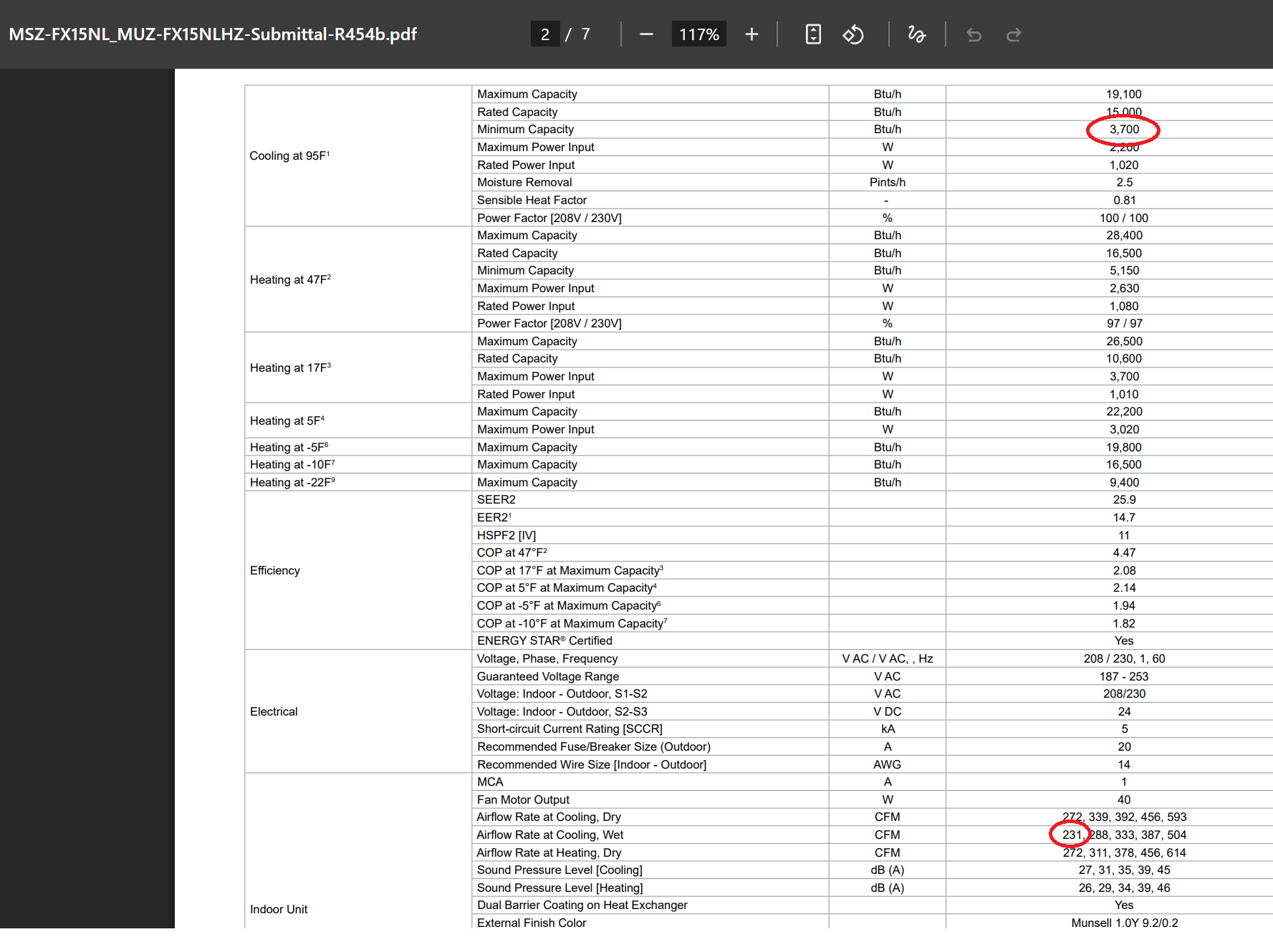
At max the unit is 330CFM/ton, at min it is 770CFM/ton.
No way for the unit to do much de-humidificaiton at the low end with that much air.
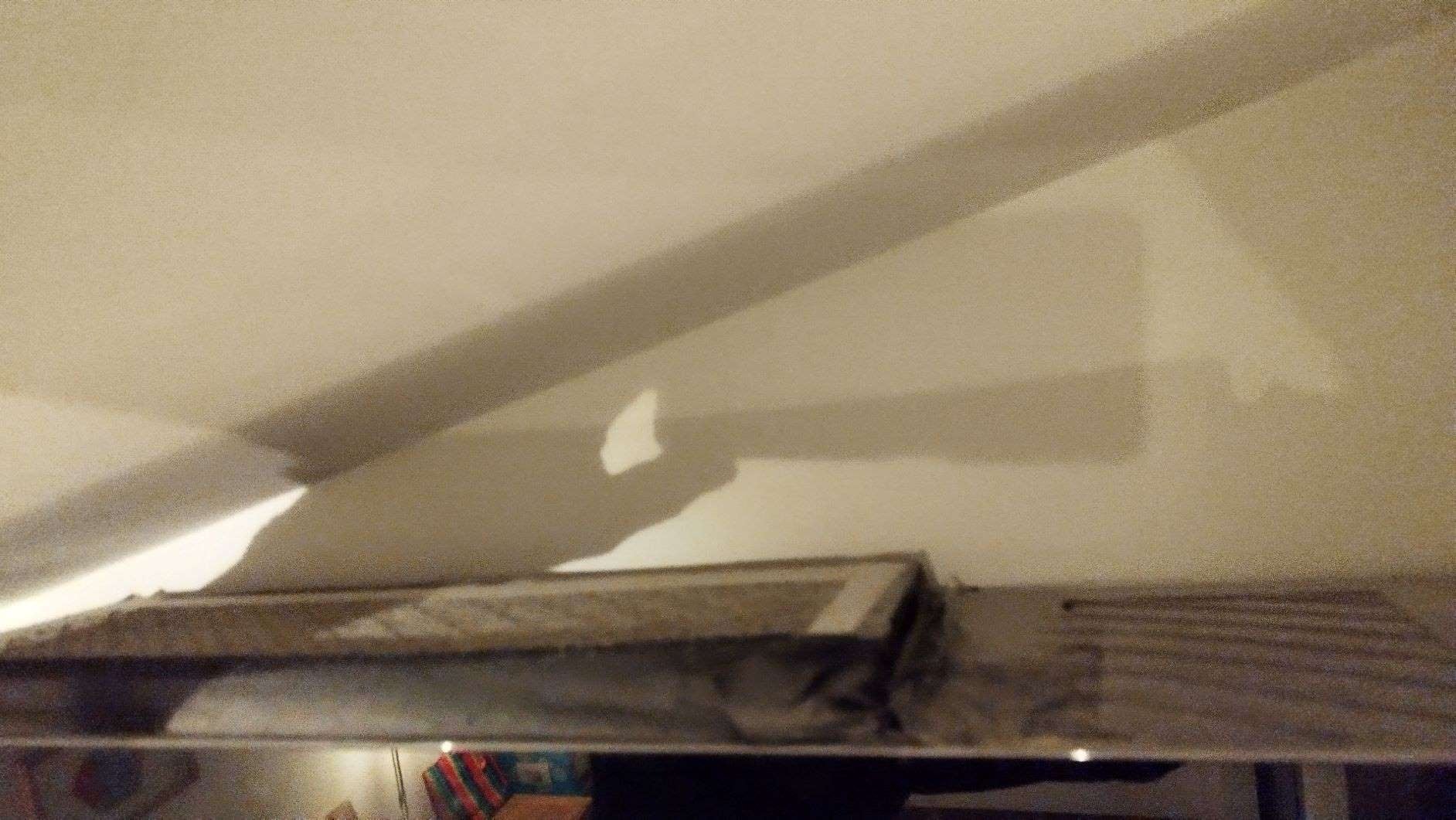
The answer is you need to reduce the airflow rate. The way I have done this is by blocking the intake. Adding a pleated intake filter does a decent job of this. As a bonus it keeps the coil much cleaner. This will reduce max cooling capacity, but that should not be an issue with an oversized unit.
 0
0 -
Thanks everyone for more advice. I put one of those humidity/temp sensors from one of the rooms on the inlet grate. They virtually read the same temperature and humidity after I let it normalize.
The indoor unit is on the inside of a gable end of a vaulted ceiling and it's not centered due to wall spacing. Top is 6-1/2" from the angles porion of the ceiling on one end and 23" on the other. Front the top of the unit to the peak of the cathedral is about 48".
I measured the inlet grate and may try that pleated filter idea, thanks for the suggestion.
0 -
Find a Mitsubishi "Diamond Dealer" to review the entire install. Ill bet they find several things not done properly from sizing to equipment location.
0 -
Thanks for your advice and explanation. I did get a MERV 8 filter and attached it to the top as you advised. Humidity is staying in the mid 50's when it's as low as 76 out so not ideal, but much better. Humidity does creep up overnight when the outside air temp drops, so I may see if turning it off for say 6 or 8 hours helps to prevent that. I have a Emporia Vue energy monitor on it so I'll see how turning of off vice leaving it on all night effects energy usage.
0




Categories
- All Categories
- 87.8K THE MAIN WALL
- 3.3K A-C, Heat Pumps & Refrigeration
- 60 Biomass
- 430 Carbon Monoxide Awareness
- 133 Chimneys & Flues
- 2.2K Domestic Hot Water
- 6K Gas Heating
- 124 Geothermal
- 170 Indoor-Air Quality
- 3.9K Oil Heating
- 79 Pipe Deterioration
- 1.1K Plumbing
- 6.7K Radiant Heating
- 397 Solar
- 16.1K Strictly Steam
- 3.5K Thermostats and Controls
- 56 Water Quality
- 51 Industry Classes
- 51 Job Opportunities
- 18 Recall Announcements